 Скачать презентацию Leyburn Community Primary School Curriculum Development What
9c2147c2769c82b0d82f6145e617c418.ppt
- Количество слайдов: 18



Leyburn Community Primary School Curriculum Development
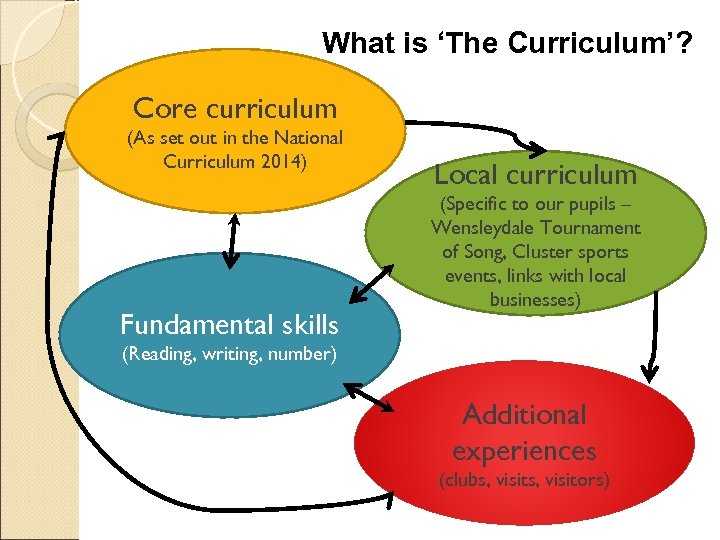
What is ‘The Curriculum’? Core curriculum (As set out in the National Curriculum 2014) Fundamental skills Local curriculum (Specific to our pupils – Wensleydale Tournament of Song, Cluster sports events, links with local businesses) (Reading, writing, number) Additional experiences (clubs, visitors)
Curriculum 2014 and beyond! At Leyburn Community Primary School, we aim to provide a positive learning environment which supports all pupils and values their individuality. We aim to enable our children to become successful learners, confident individuals and responsible young people. With this in mind, we have designed a curriculum to engage, motivate and inspire a love of life-long learning. It is based on the requirements of the National Curriculum but is also mindful of the additional experiences and skills that we can provide through school visits and visitors and extra-curricular clubs. Thematic units of work span across all year groups from Lower Foundation to Year 6 and combine learning in a cross-curricular approach. This allows skills and knowledge to be applied over a variety of subjects including history, geography, science and the arts whilst ensuring a focus on the fundamental standards of English and maths.
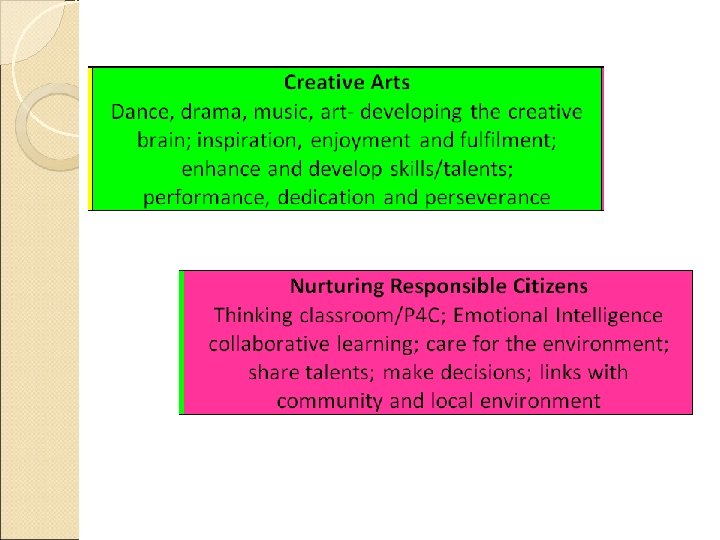
Developing skills of learning Through our delivery of the whole curriculum, we aim to: Ø provide pupils with the necessary knowledge and academic skills to be able to access opportunities throughout their school career and beyond, Ø provide opportunities to develop the social skills of respect and empathy, Ø encourage our pupils to explore their own learning behaviours to be curious, hard-working, resilient, dedicated, proud, and independent, able to use initiative to accomplish tasks in their own ways, Ø offer situations to develop pupil leadership across all phases of the school. ØEnable pupils to be responsible citizens; aware of and active within the local and wider community.
Key Changes In 2013 the government announced plans to overhaul the national curriculum. For most children, these changes took effect from September 2014, but children in Years 2 and 6 followed the previous programmes of study until September 2015 in English, maths and science.
Rationale for change The main aim is to raise standards, particularly as the UK is slipping down international student assessment league tables. Inspired by what is taught in the world’s most successful school systems, including Hong Kong, Singapore and Finland, as well as in the best UK schools. More challenging although the content is actually slimmer than the previous curriculum, focusing on essential core subject knowledge and skills such as essay writing and computer programming. It follows on from similar curriculum revamps in Scotland Wales, which were implemented in 2010 and 2008 respectively and have a similar focus on excellence and core skills.
Main changes - English Stronger emphasis on vocabulary development, grammar, punctuation and spelling (for example, the use of commas and apostrophes will be taught in KS 1) Handwriting – not previously assessed (much!) – is expected to be fluent, legible and speedy Spoken English has a greater emphasis, with children to be taught debating and presenting skills
Main changes - maths Five-year-olds will be expected to learn to count up to 100 (compared to 20 previously) and learn number bonds to 20 (previously up to 10) Simple fractions (1/4 and 1/2) will be taught from KS 1, and by the end of primary school, children should be able to convert decimal fractions to simple fractions (e. g. 0. 375 = 3/8) By the age of nine (Y 4), children will be expected to know times tables up to 12 x 12 (previously 10 x 10 by the end of Y 6) Calculators will not be used at all in primary schools, to encourage mental arithmetic
Other changes Science: ◦ Strong focus on scientific knowledge and language, rather than understanding the nature and methods of science in abstract terms ◦ Evolution will be taught in primary schools for the first time ◦ Non-core subjects like caring for animals will be replaced by topics like the human circulatory system Design & Technology: ◦ Afforded greater importance under the new curriculum, ◦ more sophisticated use of design equipment such as electronics and robotics ◦ In KS 2, children will learn about how key events and individuals in design and technology have shaped the world
ICT: ◦ ‘Computing’ ◦ a greater focus on programming rather than on operating programs ◦ from age five, children will learn to write and test simple programs and to organise, store and retrieve data, ◦ from seven, they will be taught to understand computer networks, including the internet ◦ Internet safety – previously only taught from 11 -16 – will be taught in primary schools Languages: ◦ Currently not statutory, a modern foreign language will be mandatory in KS 2 ◦ Children will be expected to master basic grammar and accurate pronunciation and to converse, present, read and write in the language
Tests and assessment Year 2 and Year 6 tests will continue in reading, writing (TA) and maths. Changes include mental arithmetic in Year 6 and SPa. G in Y 2. Phonics screening in Y 1 Other year groups will have school assessment tests and tracked to ensure progress.
How does this look in practice? Focus on fundamental skills: G/R, Big Maths Rigorous but maintain breadth and balance, creativity and balance ‘Keeping the cohort together’ ‘Mastery’ Raised expectations for the fundamental areas so included in all aspects where possible. Variable timetabling Ongoing assessments
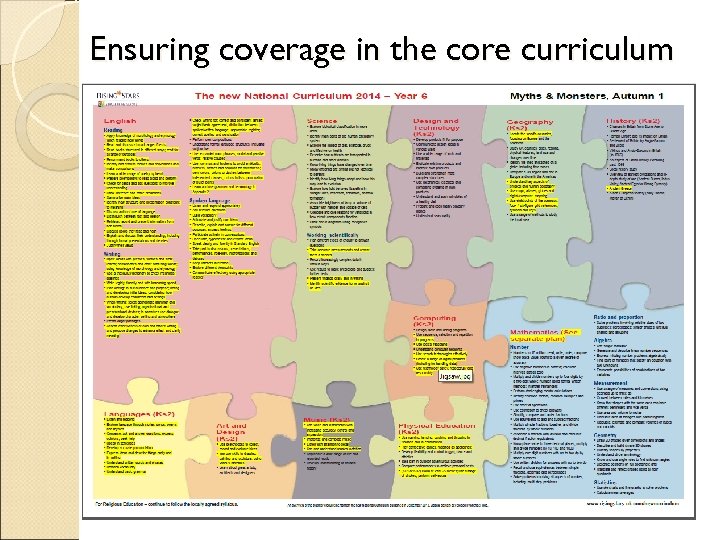
Ensuring coverage in the core curriculum
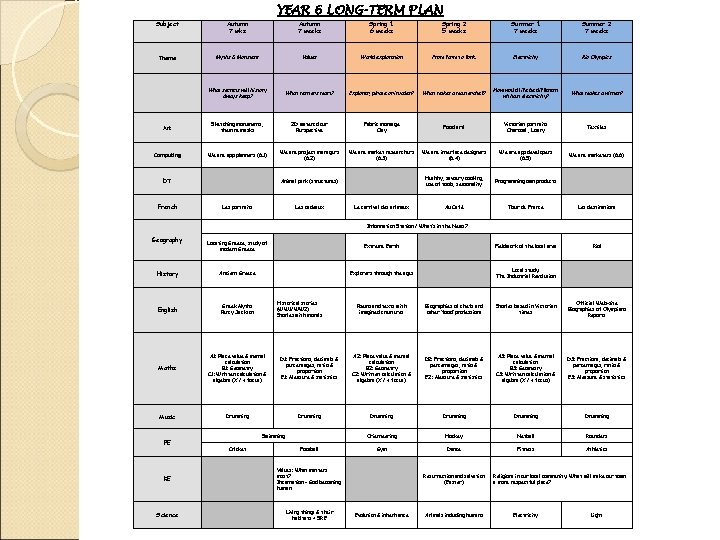
YEAR 6 LONG-TERM PLAN Subject Autumn 7 wks Autumn 7 weeks Spring 1 6 weeks Spring 2 5 weeks Summer 1 7 weeks Summer 2 7 weeks Theme Myths & Monsters Values World exploration From farm to fork. Electricity Rio Olympics What secrets will history always keep? What matters most? Explorer, pirate or invader? What makes a masterchef? How would life be different without electricity? What makes a winner? Art Sketching monuments, theatre masks 2 D watercolour Perspective Fabric montage Clay Food art! Victorian portraits Charcoal , Lowry Textiles Computing We are app planners (6. 1) We are project managers (6. 2) We are market researchers (6. 3) We are interface designers (6. 4) We are app developers (6. 5) We are marketers (6. 6) Healthy, savoury cooking, use of tools, seasonality Programming own products Au Café Tour de France Les destinations Rio! DT French Animal park (structures) Les portraits Les cadeaux Le carnival des animaux Information Station / What’s in the News? Geography Locating Greece, study of modern Greece Extreme Earth Fieldwork of the local area History Ancient Greece Explorers through the ages Local study: The Industrial Revolution English Greek Myths Percy Jackson Maths A 1: Place value & mental calculation B 1: Geometry C 1: Written calculation & algebra (X / ÷ focus) Music Drumming PE Historical stories (WW 1/WW 2) Stories with morals Poems and texts with imagined creatures Biographies of chefs and other ‘food’ professions Stories based in Victorian times Official Web-site Biographies of Olympians Reports D 1: Fractions, decimals & percentages, ratio & proportion E 1: Measure & statistics A 2: Place value & mental calculation B 2: Geometry C 2: Written calculation & algebra (X / ÷ focus) D 2: Fractions, decimals & percentages, ratio & proportion E 2: Measure & statistics A 3: Place value & mental calculation B 3: Geometry C 3: Written calculation & algebra (X / ÷ focus) D 3: Fractions, decimals & percentages, ratio & proportion E 3: Measure & statistics Drumming Drumming Orienteering Hockey Netball Rounders Gym Dance Fitness Athletics Swimming Cricket Football RE Values: What matters most? Incarnation – God becoming human Science Living things & their habitats + SRE Resurrection and salvation (Easter) Evolution & inheritance Animals including humans Religions in our local community. What will make our town a more respectful place? Electricity Light
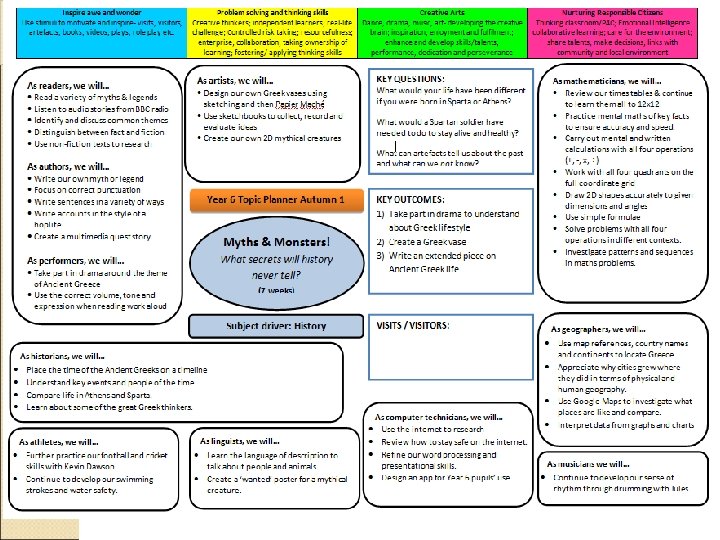
Our school website
Скачать презентацию Leyburn Community Primary School Curriculum Development What
9c2147c2769c82b0d82f6145e617c418.ppt