


 Скачать презентацию LEXICAL TRANSFORMATIONS 1 2 3 4 5 Concretization
Lecture 8 Translation.pptx
- Количество слайдов: 13
 LEXICAL TRANSFORMATIONS 1. 2. 3. 4. 5. Concretization Generalization Antonymic translation Metonymic translation Paraphrasing
 Concretization • a most frequent device in translation from English into Russian. • There is a large group of English words of wide semantic volume. They belong to different parts of speech: nouns, adjectives, verbs, • e. g. thing; point, stuff, stunt, affair; nice, fine, bad; to say, to go, to get, to come, to involve. • As the meaning of such words is relatively vague they can be used in different contexts, and their valency is extremely broad. • A context, at least a micro context, is necessary to determine their meaning.
 Concretization • He came in sight of the lodge, a long, low, frowning thing of red brick (A. Wilson). - Он увидел домик привратника, длинное, низкое, хмурое здание из красного кирпича. • At the by-election victory went to the Labour candidate (M. S. 1973). - На дополнительных выборах победу одержал лейборист. • The rain came in torrents (I. Murdoch). Полил сильный дождь.
 Concretization • So far 65 people have died in floods in Dacca Province, East Pakistan (Morning Star, 1973) По имеющимся сведениям, 65 человек утонуло во время наводнения в провинции Дакка, Восточный Пакистан. • Abstract nouns are often concretized in translation if there is no correlated abstract word in Russian: • The Soviet Union's record in medical care достижения Советского Союза в области здравоохранения.
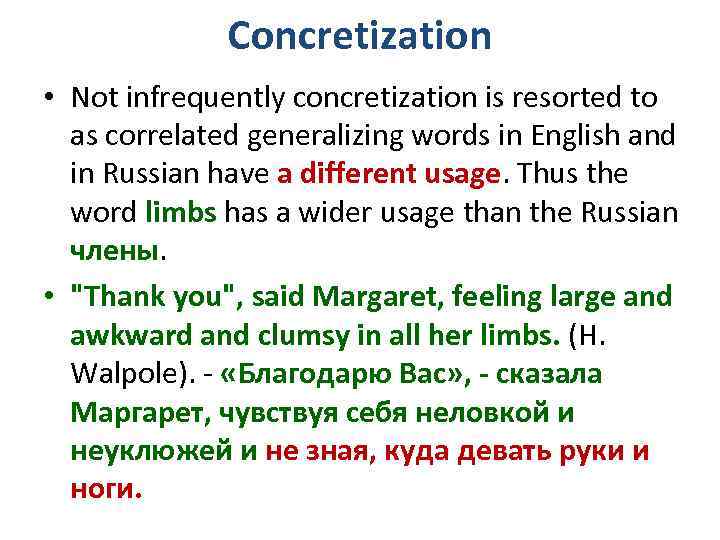 Concretization • Not infrequently concretization is resorted to as correlated generalizing words in English and in Russian have a different usage. Thus the word limbs has a wider usage than the Russian члены. • "Thank you", said Margaret, feeling large and awkward and clumsy in all her limbs. (H. Walpole). - «Благодарю Вас» , - сказала Маргарет, чувствуя себя неловкой и неуклюжей и не зная, куда девать руки и ноги.
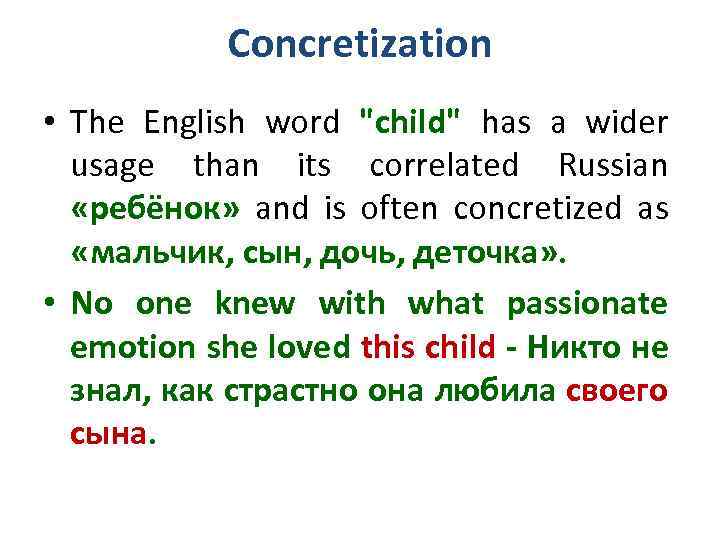 Concretization • The English word "child" has a wider usage than its correlated Russian «ребёнок» and is often concretized as «мальчик, сын, дочь, деточка» . • No one knew with what passionate emotion she loved this child - Никто не знал, как страстно она любила своего сына.
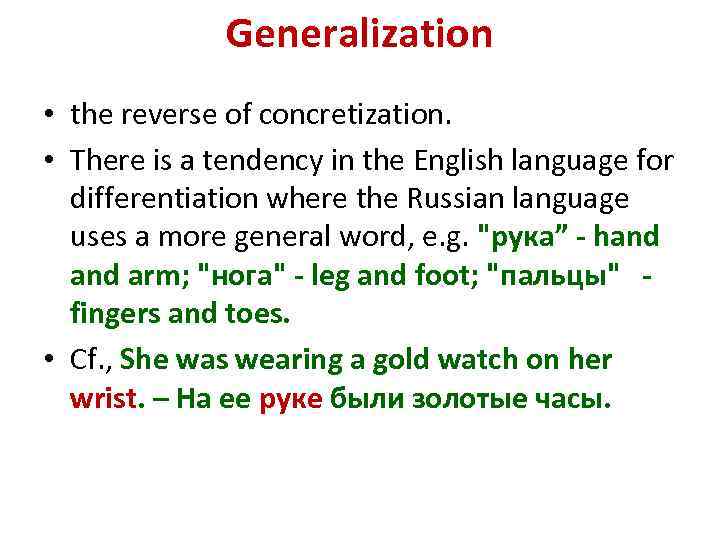 Generalization • the reverse of concretization. • There is a tendency in the English language for differentiation where the Russian language uses a more general word, e. g. "рука” - hand arm; "нога" - leg and foot; "пальцы" fingers and toes. • Cf. , She was wearing a gold watch on her wrist. – На ее руке были золотые часы.
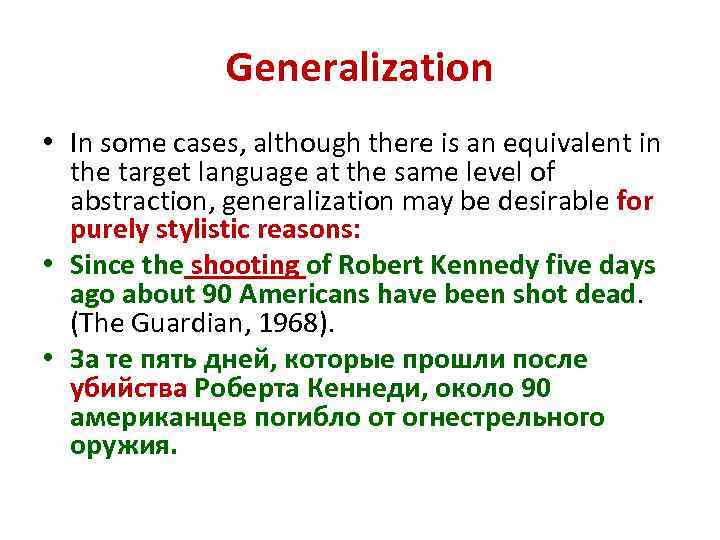 Generalization • In some cases, although there is an equivalent in the target language at the same level of abstraction, generalization may be desirable for purely stylistic reasons: • Since the shooting of Robert Kennedy five days ago about 90 Americans have been shot dead. (The Guardian, 1968). • За те пять дней, которые прошли после убийства Роберта Кеннеди, около 90 американцев погибло от огнестрельного оружия.
 Generalization • Generalization is sometimes used in rendering non-equivalents, • e. g. summary court - дисциплинарный суд; • a summary court is not only a disciplinary court but the least formal one, consisting of one officer, etc.
 Antonymic Translation • Antonymic translation is a kind of grammatical and lexical transformation which substitutes an affirmative construction for a negative or vice versa with some accompanying lexical change, usually substituting the antonym for the original word.
 Antonymic Translation • Keep the child out of the sun - He держите ребёнка на солнце. : • "My precious wife", said I, "we must be serious sometimes". (Ch. Dickens), «Моя драгоценная жёнушка» , - сказал я, - «Нельзя же вечно смеяться и шутить» . • My aunt and I, when we were left alone, talked far into the night, how the emigrants never wrote home otherwise than cheerfully and hopefully. (Ibid. ) • Оставшись вдвоём, мы с тётушкой до глубокой ночи говорили о том, что уехавшие всегда писали весёлые письма, полные надежд.
 Metonymic Translation • Metonymic translation is a lexical transformation based on the substitution of contiguous concepts. • On Capitol Hill residents have been assaulted on their porches - in their garages or while waiting for a bus, sometimes within full view of other citizens too frightened to move. • В районе Капитолия на жителей нападали у входа в дом, в их гаражах или на остановке автобуса, иногда на глазах у других граждан, слишком напуганных, чтобы хоть пальцем пошевелить.
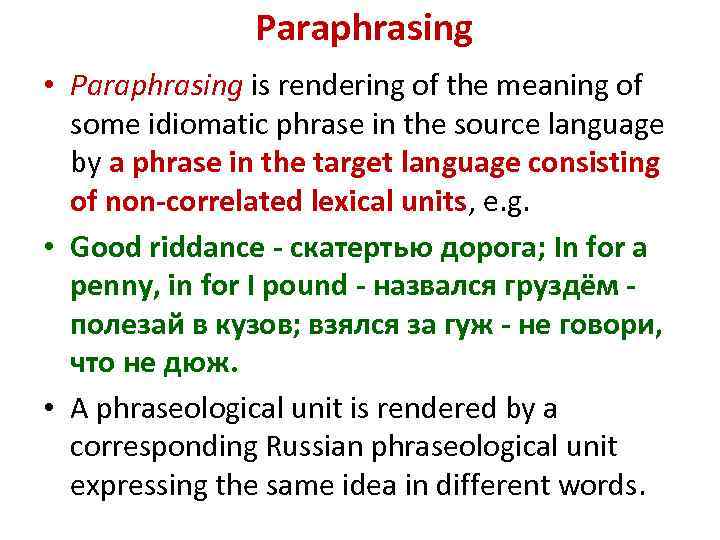 Paraphrasing • Paraphrasing is rendering of the meaning of some idiomatic phrase in the source language by a phrase in the target language consisting of non-correlated lexical units, e. g. • Good riddance - скатертью дорога; In for a penny, in for I pound - назвался груздём полезай в кузов; взялся за гуж - не говори, что не дюж. • A phraseological unit is rendered by a corresponding Russian phraseological unit expressing the same idea in different words.