

LEXICAL MEANING AS A LINGUISTIC CATEGORY POINTS FOR







 Скачать презентацию LEXICAL MEANING AS A LINGUISTIC CATEGORY POINTS FOR
36316-lexical_meaning_as_a_linguistic_category.ppt
- Количество слайдов: 17
LEXICAL MEANING AS A LINGUISTIC CATEGORY
POINTS FOR DISCUSSION What is meaning? Semantic structure of the word. Polysemy. Types of lexical meaning. The process of development and change of meaning. Homonymy.
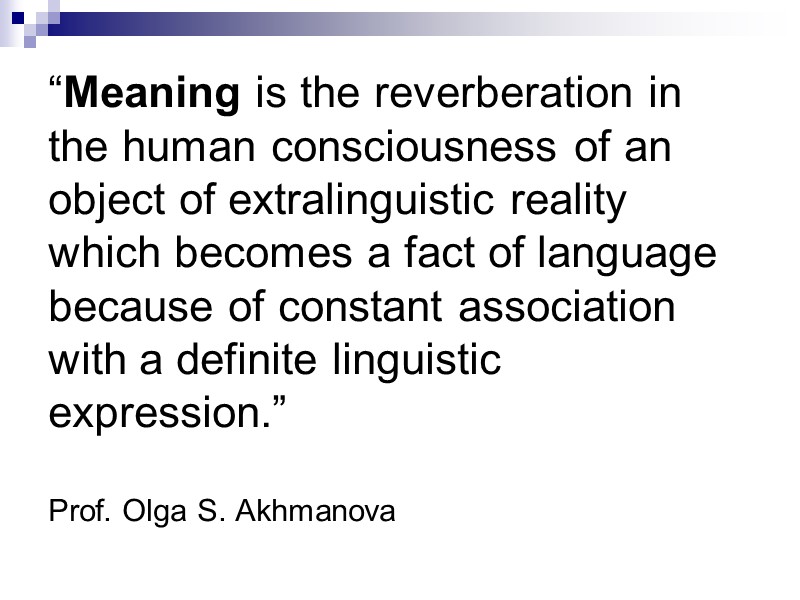
“Meaning is the reverberation in the human consciousness of an object of extralinguistic reality which becomes a fact of language because of constant association with a definite linguistic expression.” Prof. Olga S. Akhmanova
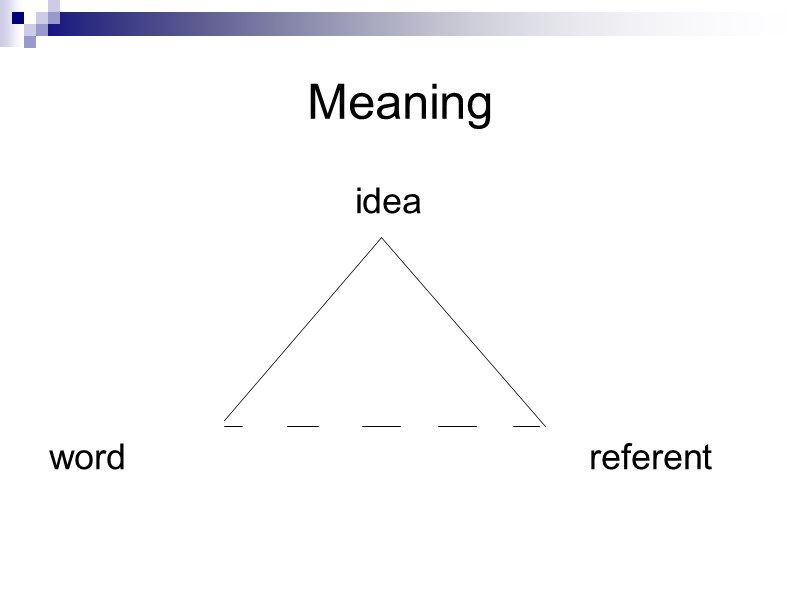
Meaning idea word referent
Polysemy – the existence within one word of several connected meanings as the result of development and changes of its original meaning.
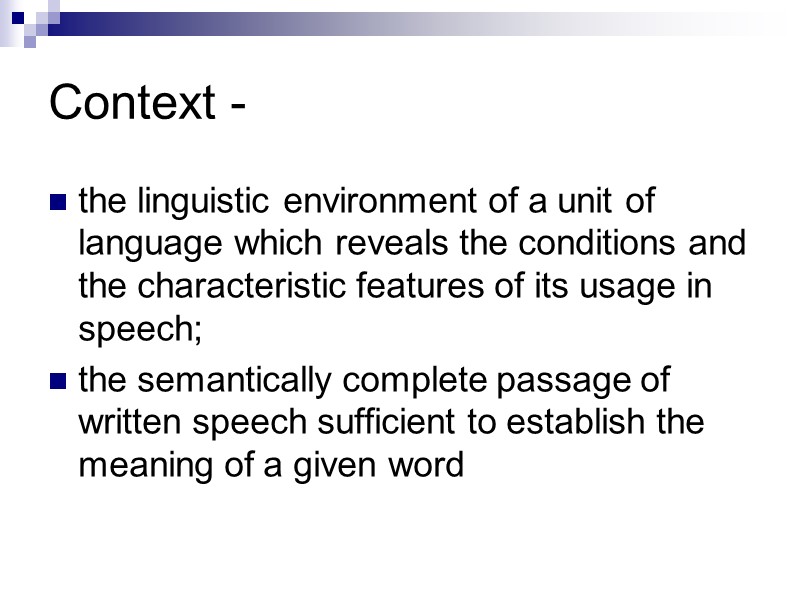
Context - the linguistic environment of a unit of language which reveals the conditions and the characteristic features of its usage in speech; the semantically complete passage of written speech sufficient to establish the meaning of a given word
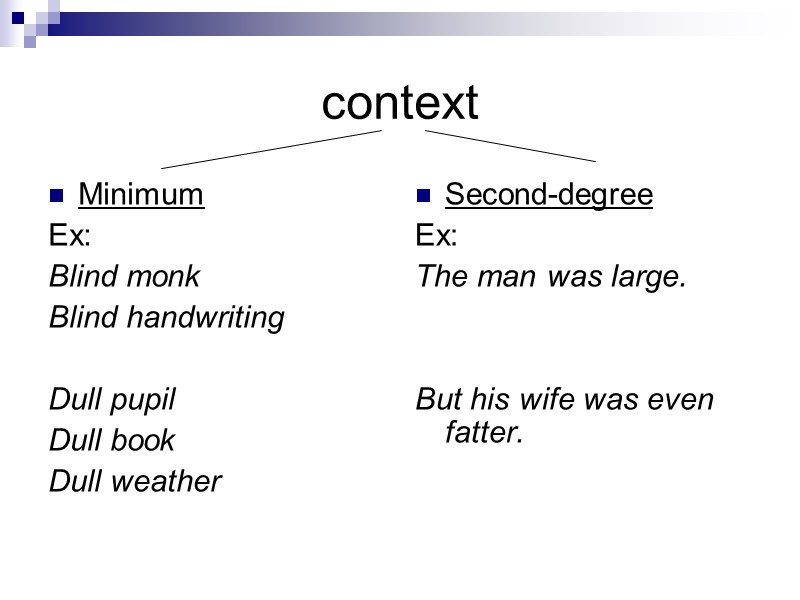
context Minimum Ex: Blind monk Blind handwriting Dull pupil Dull book Dull weather Second-degree Ex: The man was large. But his wife was even fatter.
Semantic structure with the main (direct) meaning holding it together Bar, n I any kind of barrier II profession III counter of a lawyer for drinks
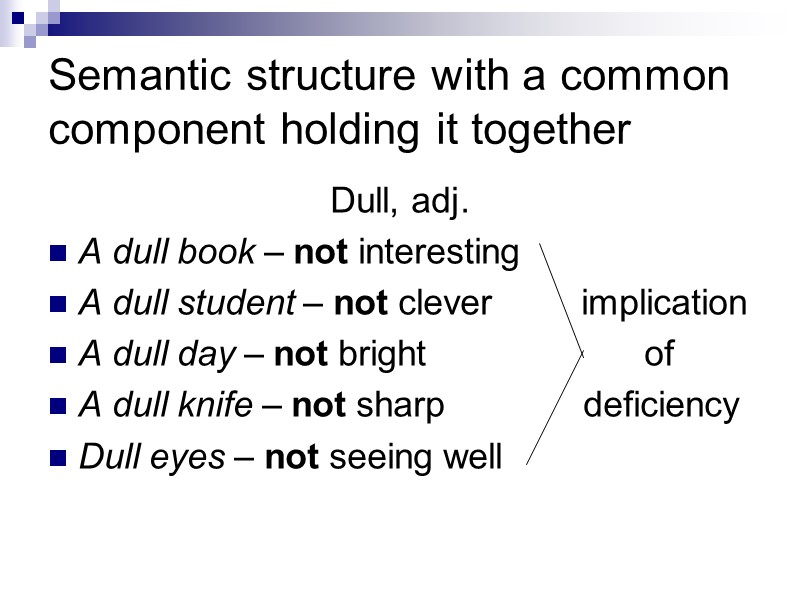
Semantic structure with a common component holding it together Dull, adj. A dull book – not interesting A dull student – not clever implication A dull day – not bright of A dull knife – not sharp deficiency Dull eyes – not seeing well
Diachronic and synchronic approaches towards meaning quick, adj. Diachronic: Etymological flexible Archaic alive (Ex: the quick and the dead) Synchronic: Main fast Secondary …
TYPES OF LEXICAL MEANING Nominative Nominative-derivative Linguistically (colligationally and collocationally) bound Phraseologically bound
The processes of development and change of meaning Transference based on similarity (linguistic metaphor) Transference based on contiguity (linguistic metonymy) Generalization and specialization of meaning “Degeneration” and “elevation” of meaning
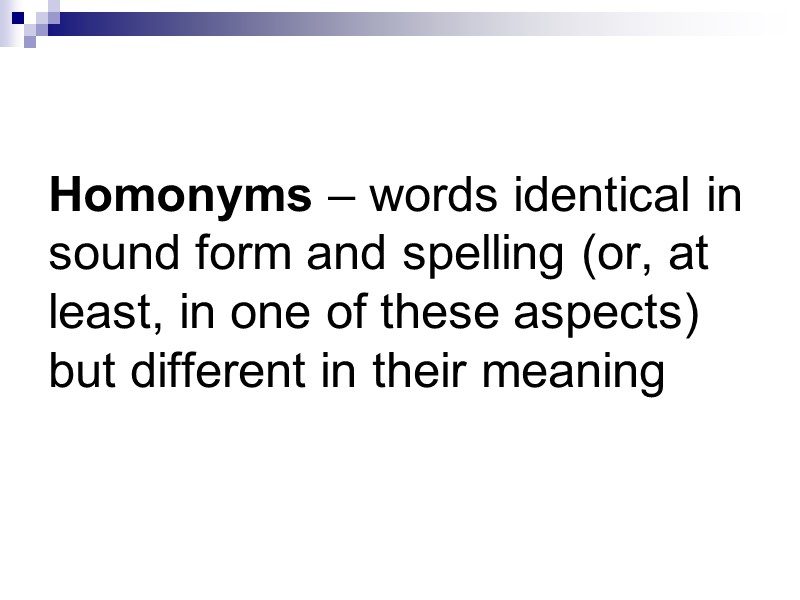
Homonyms – words identical in sound form and spelling (or, at least, in one of these aspects) but different in their meaning
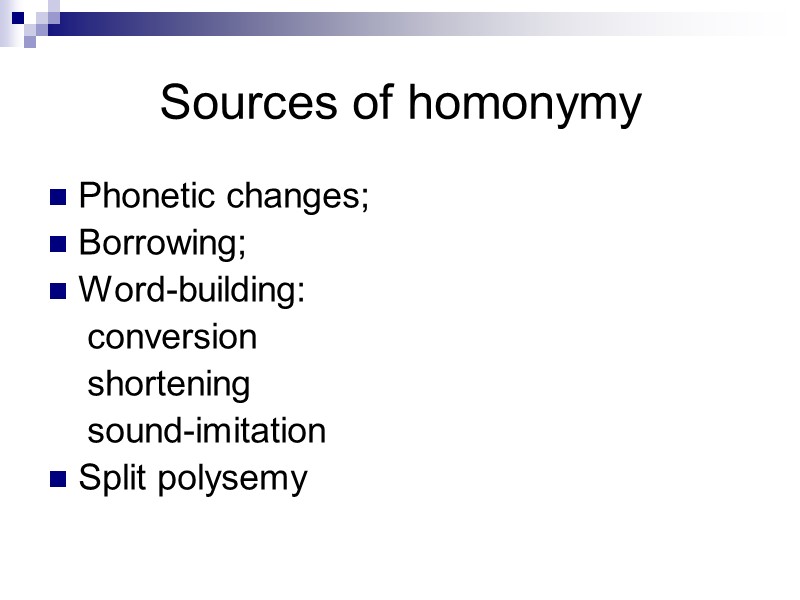
Sources of homonymy Phonetic changes; Borrowing; Word-building: conversion shortening sound-imitation Split polysemy
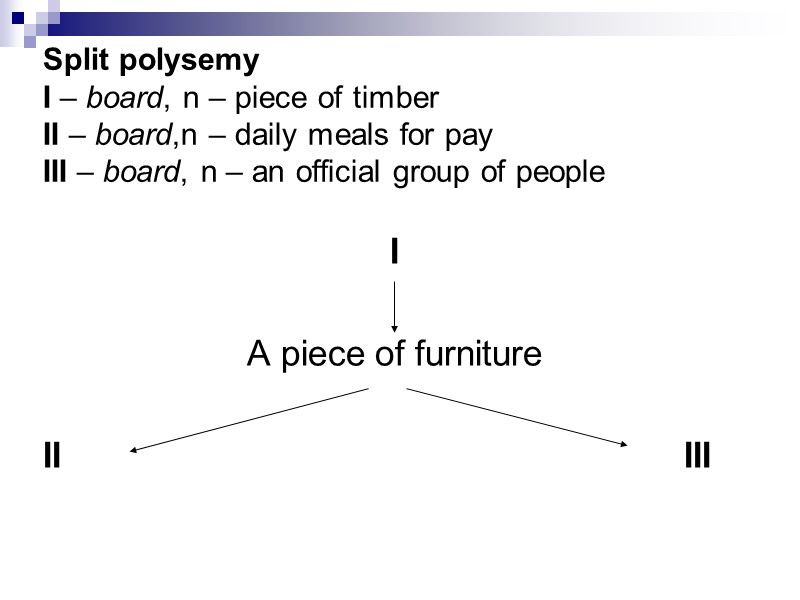
Split polysemy I – board, n – piece of timber II – board,n – daily meals for pay III – board, n – an official group of people I A piece of furniture II III
Split polysemy I – board, n – piece of timber II – board,n – daily meals for pay III – board, n – an official group of people I II III
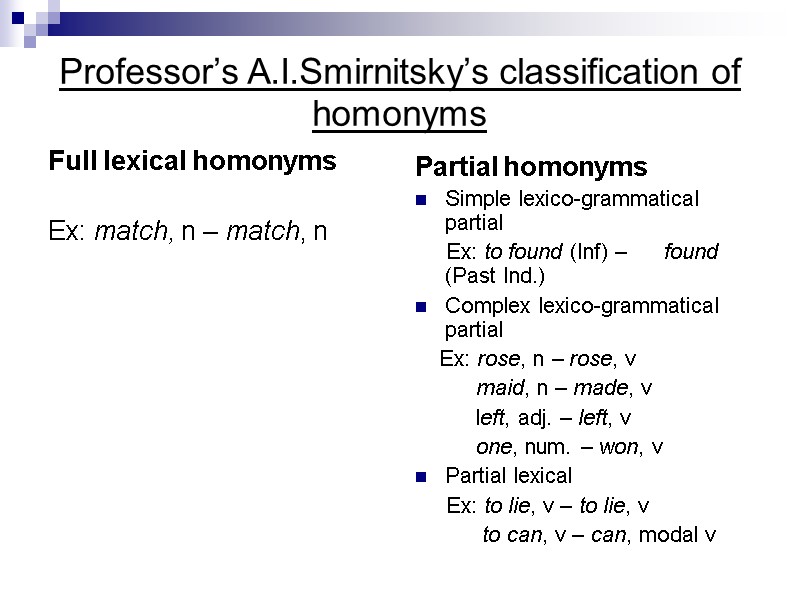
Professor’s A.I.Smirnitsky’s classification of homonyms Full lexical homonyms Ex: match, n – match, n Partial homonyms Simple lexico-grammatical partial Ex: to found (Inf) – found (Past Ind.) Complex lexico-grammatical partial Ex: rose, n – rose, v maid, n – made, v left, adj. – left, v one, num. – won, v Partial lexical Ex: to lie, v – to lie, v to can, v – can, modal v