 Скачать презентацию Leveraging Web Analytics and Search Engine Optimization SEO
9053a0cb5daafcf19f667faceeeee0a5.ppt
- Количество слайдов: 26



Leveraging Web Analytics and Search Engine Optimization (SEO) Project Workshop Brian Alpert July 14, 2010
Agenda • What is the project? • Where do we want to go? • Starting the Conversation 2
What is the project? 3
The Project and SI’s Strategic Plan • Assess and recommend improvements relating to two of the Strategic Plan’s six priorities – Measure Outcomes (web analytics) – Broaden Access (search engine optimization - SEO) • Examine a cross-section of the Institution’s internally hosted, public-facing websites • Interview web practitioners for those and other SI sites • Summarize SI and industry best practices 4
SI Web Analytics Challenges • Data collection & reporting silo’d • Data may not inform website improvements – i. e. , it is “non-actionable” • Quantity of data unmanageable • Strategy to leverage both Web. Trends and Google Analytics not fully articulated – Resources to program analytics code are limited • Pan-institutional benchmarking – Varied formats prevent apples-to-apples comparisons 5
Project Results: Web Analytics • Foster understanding of what’s being done; gaps • Educate web practitioners on using “actionable” data to drive improvements, experiments • Understand what are the common “most desired behaviors” across multiple SI sites • Explore opportunities for benchmarking and paninstitutional commonalities • Create prototype for a pan-institutional dashboard – Measurements relevant to most (or all) Units – This won’t be enough – individualized metrics will still be critical 6
SI SEO Challenges • • Level of SEO knowledge / awareness Degree of SEO implementation Standards for SEO tagging and content SEO benchmarking across SI and competition • SEO analytics 7
Project Results: SEO • Immediate goal: clearer understanding within SI – – SEO factors Best practices Current gaps Set the stage for creating more “search-friendly” sites • Next step: improved “findability” of SI websites – – Broadened access to SI web content Reaching new audiences Enable them to find “hidden gems” Higher user satisfaction 8
Where do we want to go? 9
Avinash Kaushik • Google’s “Analytics Evangelist” – Author, Web Analytics 1. 0 / Web Analytics 2. 0 – Blog, “Occam’s Razor” http: //www. kaushik. net/avinash/ • A holistic approach to analytics – – Identify business (i. e. , Unit) objectives Improve the site to support them Understand implement site user segmentation Design metrics which focus less on what is occurring; more on why 10
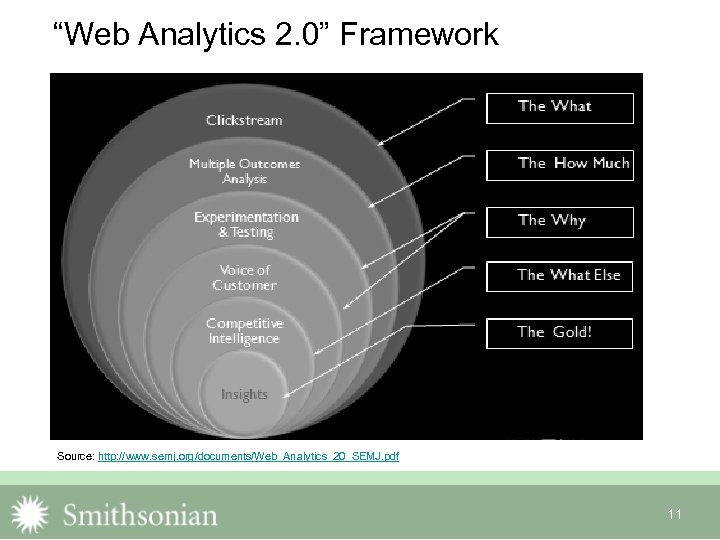
“Web Analytics 2. 0” Framework Source: http: //www. semj. org/documents/Web_Analytics_20_SEMJ. pdf 11
Web Analytics 2. 0 Framework (cont’d) • The What – Clickstream Analysis – Web. Trends, Google Analytics – Foundational data – Website User Segmentation • The How Much – Analyzing Outcomes – Most Desired Behaviors (a. k. a. conversions) • • Buy something Join a group or membership View a video Download something Sign-up for email newsletter Register for an event Submit contact form 12
Web Analytics 2. 0 Framework (cont’d) • The Why (1) – Experimentation and Testing – A/B and/or multivariate testing – Google Website Optimizer • The Why (2) – Voice of the Customer – – Qualitative data Satisfaction, loyalty, willingness to recommend Fore. See Results Focus Groups • The What Else – Competitive Intelligence – Peer Sites – Sites doing better on search engines – Compete. com, Hitwise • Use these together to get to… The Gold – Insights 13
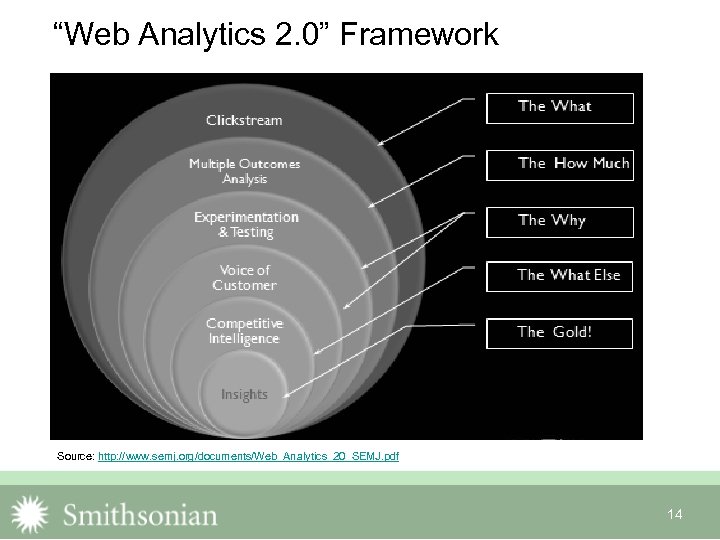
“Web Analytics 2. 0” Framework Source: http: //www. semj. org/documents/Web_Analytics_20_SEMJ. pdf 14
User Segmentation • Website users can be segmented by types of website behavior – E. g. , people who spend >X min. on the site – People who come from a specific place (Search engine, *. edu, Wikipedia, Google images, etc. ) – People who look at specific site sections or content types • Website “user segments" are different than audience segments (students, scientists, teachers, vacation planners, etc. ) 15
Avinash Kaushik on User Segmentation • “Segmentation is the primary (only? ) way of identifying actionable insights. ” • “Segmenting your data is key to your success. ” • “All data in aggregate is “crap. ”” 16
User Segmentation Video • From Occam’s Razor blog post – Videos: Actionable Web Analytics Tips – http: //www. kaushik. net/avinash/2009/01/actionableweb-analytics-tips. html • Or… search Google for “actionable web analytics tips” 17
Starting the Conversation 18
Starting the Conversation • Web practitioner survey • ‘Food for Thought’ handout discusses • Actionable data • “Most desired behaviors” a. k. a. conversions • Discussion • The current state of web analytics and SEO at SI • Your needs and challenges • Feedback re the proposed approach • Questions? 19
Thanks! Brian Alpert. B@si. edu 202 -633 -3955 20
Backup 21
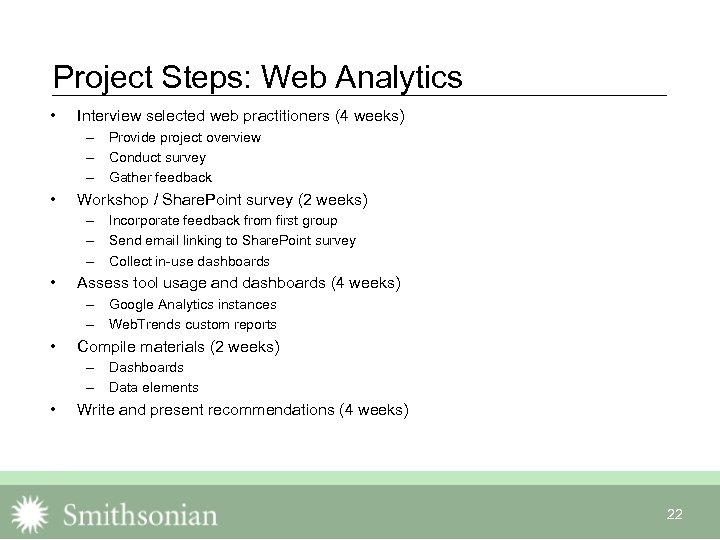
Project Steps: Web Analytics • Interview selected web practitioners (4 weeks) – Provide project overview – Conduct survey – Gather feedback • Workshop / Share. Point survey (2 weeks) – Incorporate feedback from first group – Send email linking to Share. Point survey – Collect in-use dashboards • Assess tool usage and dashboards (4 weeks) – Google Analytics instances – Web. Trends custom reports • Compile materials (2 weeks) – Dashboards – Data elements • Write and present recommendations (4 weeks) 22
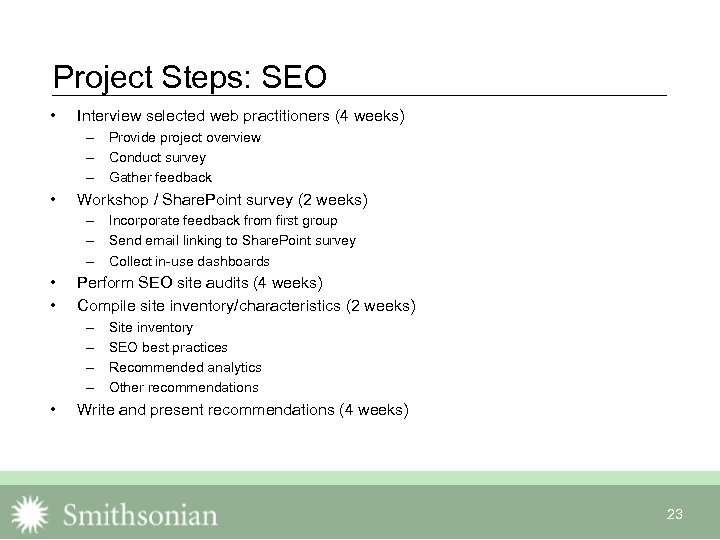
Project Steps: SEO • Interview selected web practitioners (4 weeks) – Provide project overview – Conduct survey – Gather feedback • Workshop / Share. Point survey (2 weeks) – Incorporate feedback from first group – Send email linking to Share. Point survey – Collect in-use dashboards • • Perform SEO site audits (4 weeks) Compile site inventory/characteristics (2 weeks) – – • Site inventory SEO best practices Recommended analytics Other recommendations Write and present recommendations (4 weeks) 23
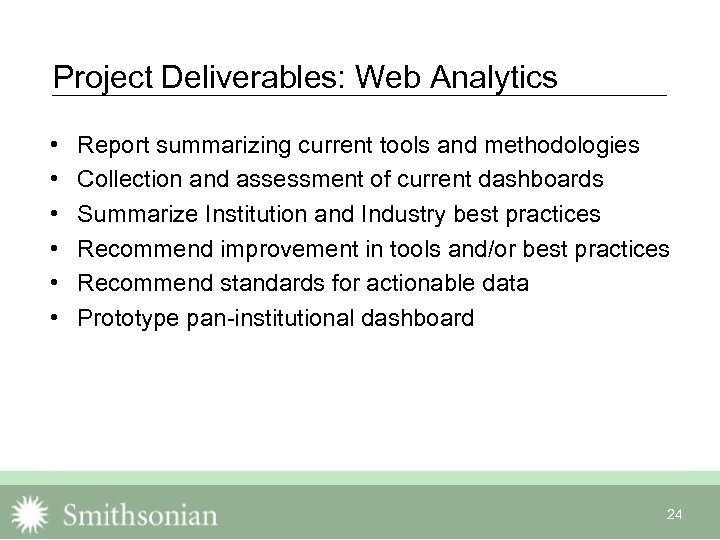
Project Deliverables: Web Analytics • • • Report summarizing current tools and methodologies Collection and assessment of current dashboards Summarize Institution and Industry best practices Recommend improvement in tools and/or best practices Recommend standards for actionable data Prototype pan-institutional dashboard 24
Project Deliverables: SEO • Report summarizing SEO characteristics assessed • Inventory of websites analyzed and how they conform to these characteristics • Recommend improvements in website SEO findability • Recommend improvements in tools and/or best practices • Recommend SEO-related dashboard measurements • Summary of current industry and Institution best practices 25
Project Schedule • Information gathering June 1 – July 23 – Interview web practitioners – Workshop(s) – Survey • Assess tools, dashboard, sites July 26 – Aug 20 • Compile materials Aug 23 – Sep 3 • Write and present recommendations Sep 6 – Sep 30 26
Скачать презентацию Leveraging Web Analytics and Search Engine Optimization SEO
9053a0cb5daafcf19f667faceeeee0a5.ppt