


 Скачать презентацию Leveraging Selangor s Land Use Planning through the Optimization
87875e4fa51197db404bf76a620fd39e.ppt
- Количество слайдов: 23
 Leveraging Selangor’s Land Use Planning through the Optimization of its Web Enabled Spatial Information System - SISMAPS Geospatial World Forum, Rotterdam, 13 -16 May 2013
 Introduction Selangor, the fastest growing state in Malaysia § § § Rapid Urbanisation in major cities and its peripheries Kuala Lumpur conurbation: Incl. Kuala Lumpur (capital city) and several cities around it Urbanising pressures on semi-urban or rural areas close to the cities In effect, diverse and complex issues surrounding the state’s planning and development procedures Selangor Town and Country Planning Department as the authority responsible to plan, monitor and coordinate land use planning Need for an effective and efficient tool for management of information concerning planning and development
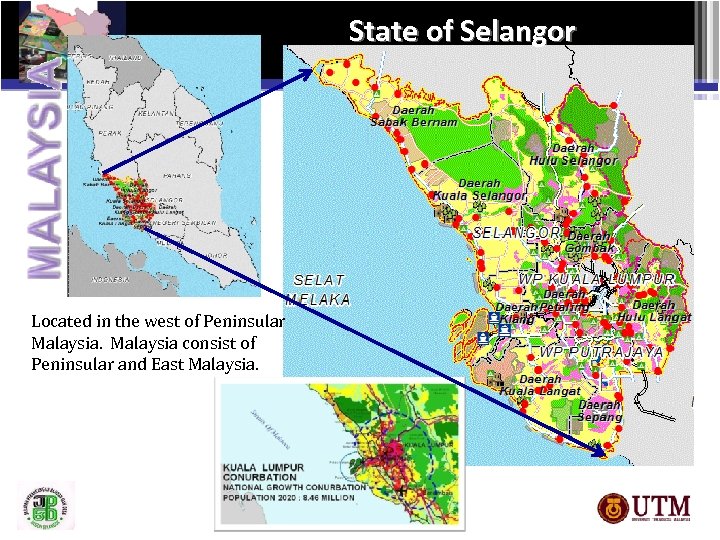 State of Selangor Located in the west of Peninsular Malaysia consist of Peninsular and East Malaysia.
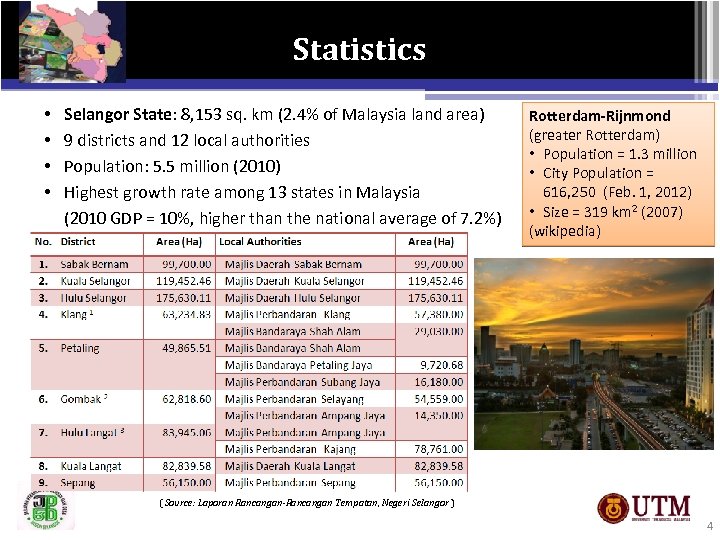 Statistics • • Selangor State: 8, 153 sq. km (2. 4% of Malaysia land area) 9 districts and 12 local authorities Population: 5. 5 million (2010) Highest growth rate among 13 states in Malaysia (2010 GDP = 10%, higher than the national average of 7. 2%) Rotterdam-Rijnmond (greater Rotterdam) • Population = 1. 3 million • City Population = 616, 250 (Feb. 1, 2012) • Size = 319 km 2 (2007) (wikipedia) ( Source: Laporan Rancangan-Rancangan Tempatan, Negeri Selangor ) 4
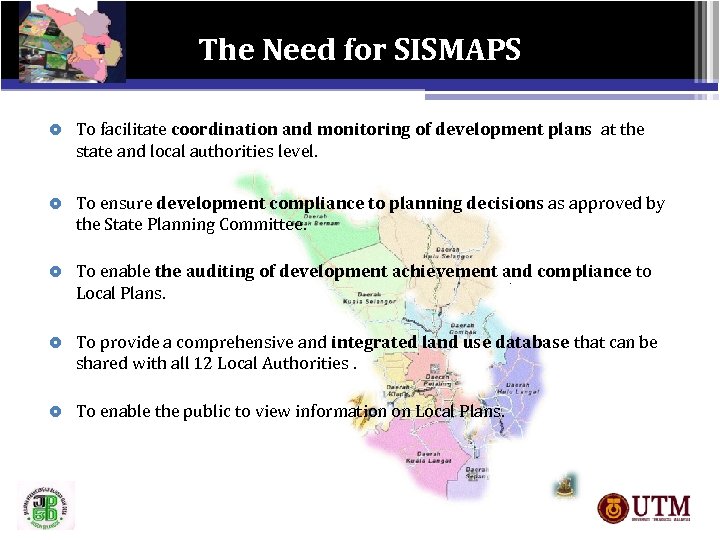 The Need for SISMAPS To facilitate coordination and monitoring of development plans at the state and local authorities level. To ensure development compliance to planning decisions as approved by the State Planning Committee. To enable the auditing of development achievement and compliance to Local Plans. To provide a comprehensive and integrated land use database that can be shared with all 12 Local Authorities. To enable the public to view information on Local Plans.
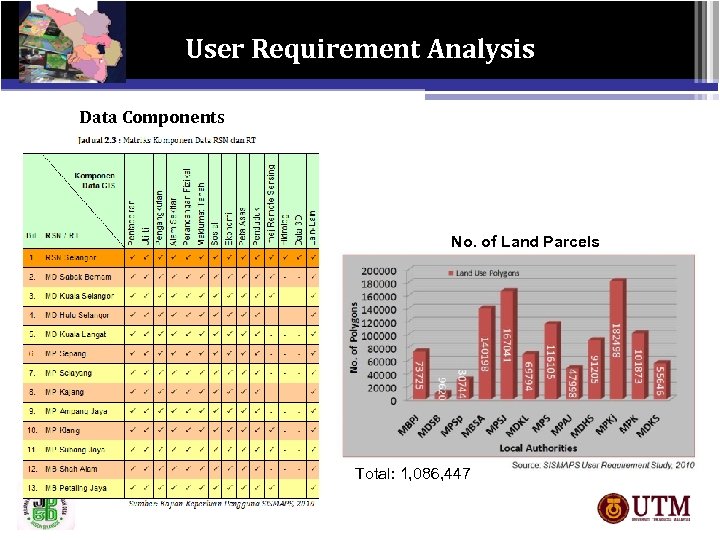 User Requirement Analysis Data Components No. of Land Parcels Total: 1, 086, 447
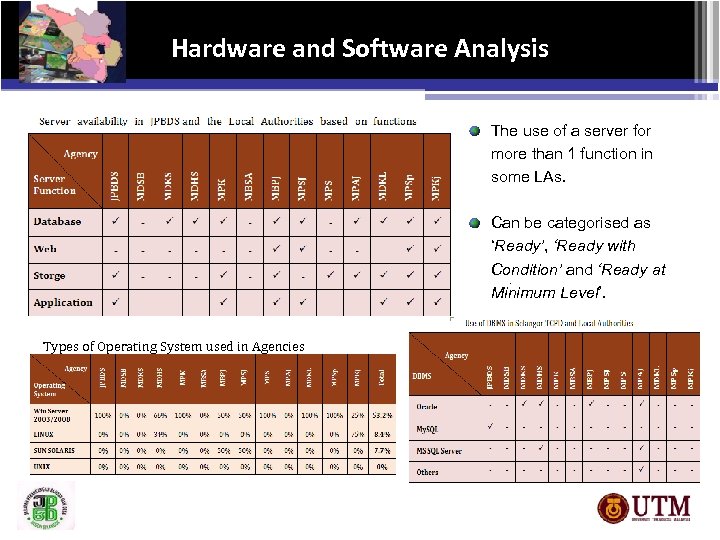 Hardware and Software Analysis The use of a server for more than 1 function in some LAs. Can be categorised as ‘Ready’, ‘Ready with Condition’ and ‘Ready at Minimum Level’. Types of Operating System used in Agencies
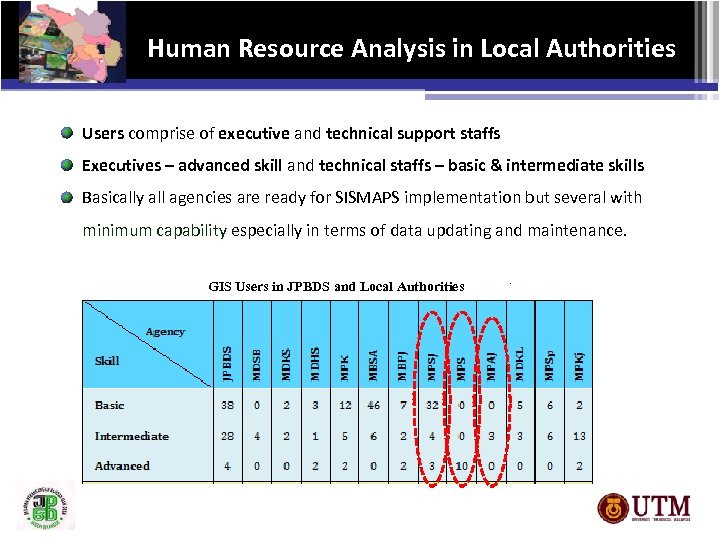 Human Resource Analysis in Local Authorities Users comprise of executive and technical support staffs Executives – advanced skill and technical staffs – basic & intermediate skills Basically all agencies are ready for SISMAPS implementation but several with minimum capability especially in terms of data updating and maintenance. GIS Users in JPBDS and Local Authorities
 Problems Identified Different GIS platform across Local Authorities and technical department requires integration Unstandardized data structure Poor data quality in some LAs Infrastructure capability (Hardware and network) Human resource
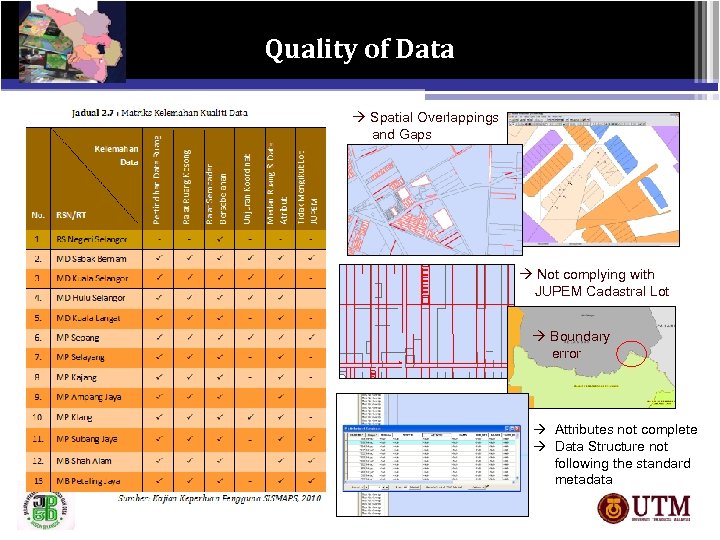 Quality of Data Spatial Overlappings and Gaps Not complying with JUPEM Cadastral Lot Boundary error Attributes not complete Data Structure not following the standard metadata
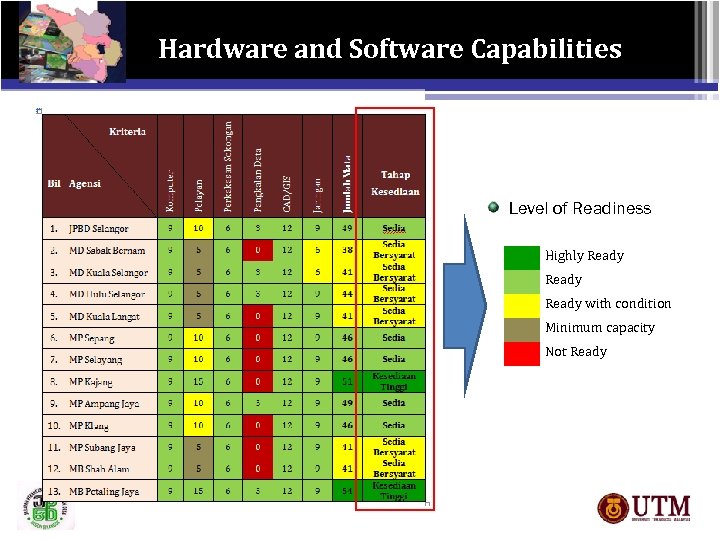 Hardware and Software Capabilities Level of Readiness Highly Ready with condition Minimum capacity Not Ready
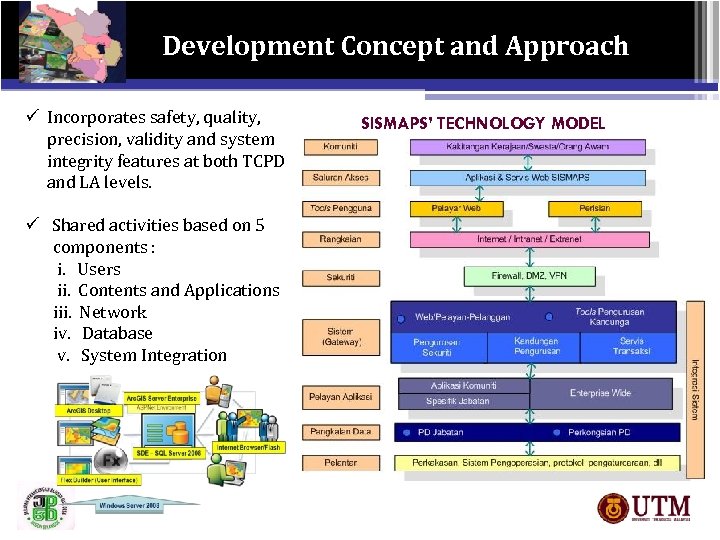 Development Concept and Approach ü Incorporates safety, quality, precision, validity and system integrity features at both TCPD and LA levels. ü Shared activities based on 5 components : i. Users ii. Contents and Applications iii. Network iv. Database v. System Integration SISMAPS’ TECHNOLOGY MODEL
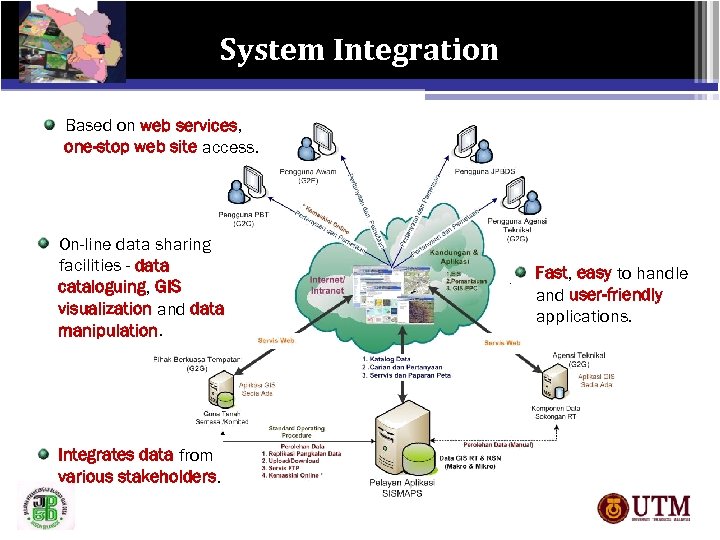 System Integration Based on web services, one-stop web site access. On-line data sharing facilities - data cataloguing, GIS visualization and data manipulation. Integrates data from various stakeholders. Fast, easy to handle and user-friendly applications.
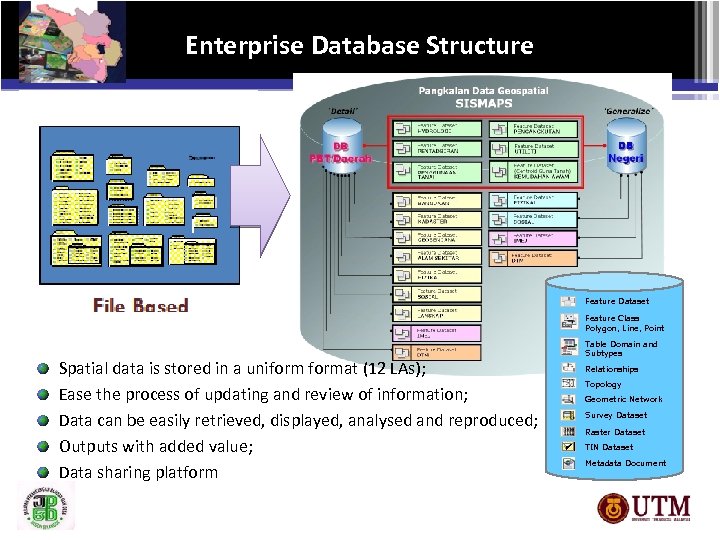 Enterprise Database Structure Feature Dataset Feature Class Polygon, Line, Point Spatial data is stored in a uniformat (12 LAs); Ease the process of updating and review of information; Data can be easily retrieved, displayed, analysed and reproduced; Outputs with added value; Data sharing platform Table Domain and Subtypes Relationships Topology Geometric Network Survey Dataset Raster Dataset TIN Dataset Metadata Document
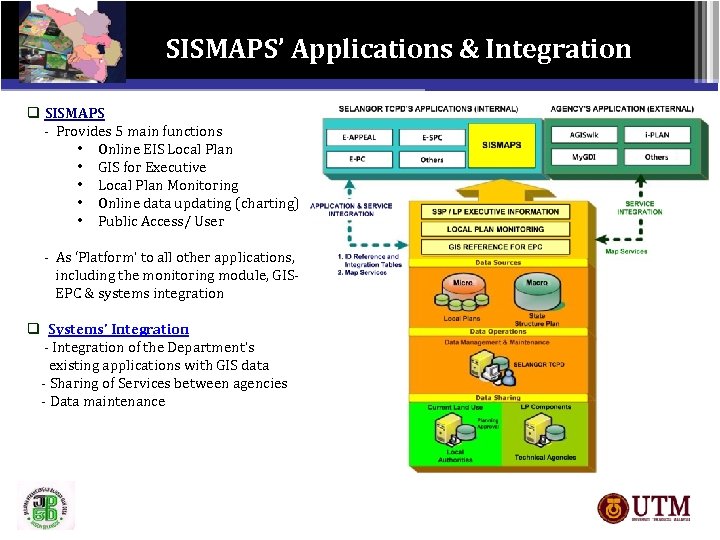 SISMAPS’ Applications & Integration q SISMAPS - Provides 5 main functions • Online EIS Local Plan • GIS for Executive • Local Plan Monitoring • Online data updating (charting) • Public Access/ User - As ‘Platform’ to all other applications, including the monitoring module, GISEPC & systems integration q Systems’ Integration - Integration of the Department’s existing applications with GIS data - Sharing of Services between agencies - Data maintenance
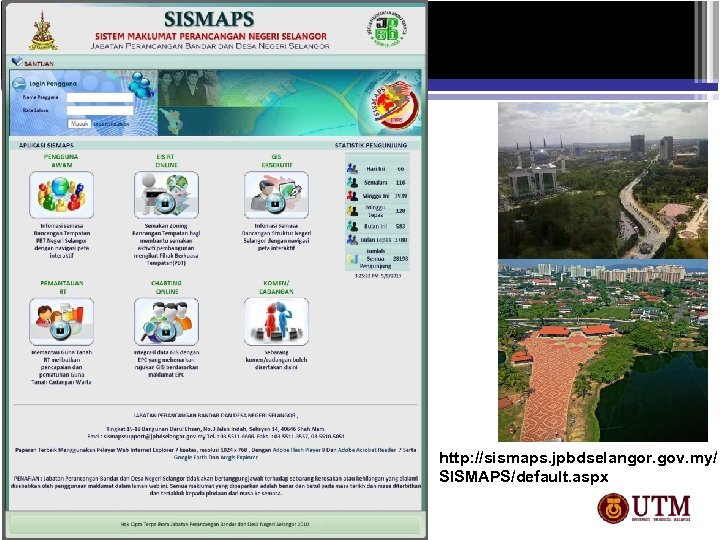 http: //sismaps. jpbdselangor. gov. my/ SISMAPS/default. aspx
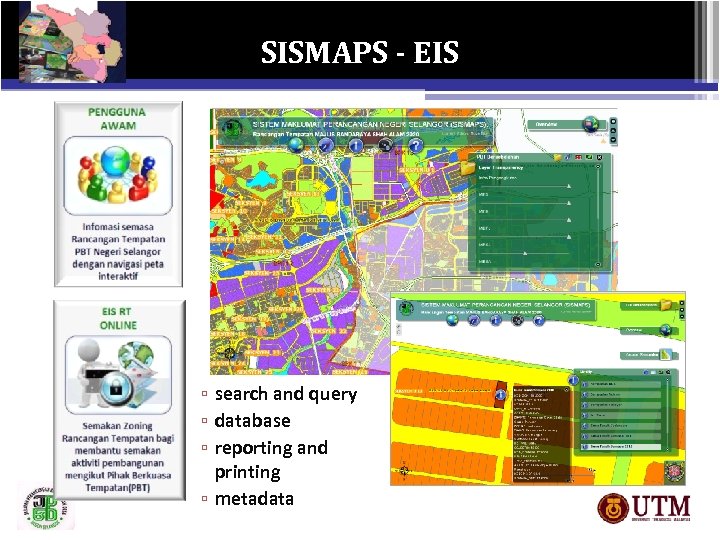 SISMAPS - EIS ▫ search and query ▫ database ▫ reporting and printing ▫ metadata
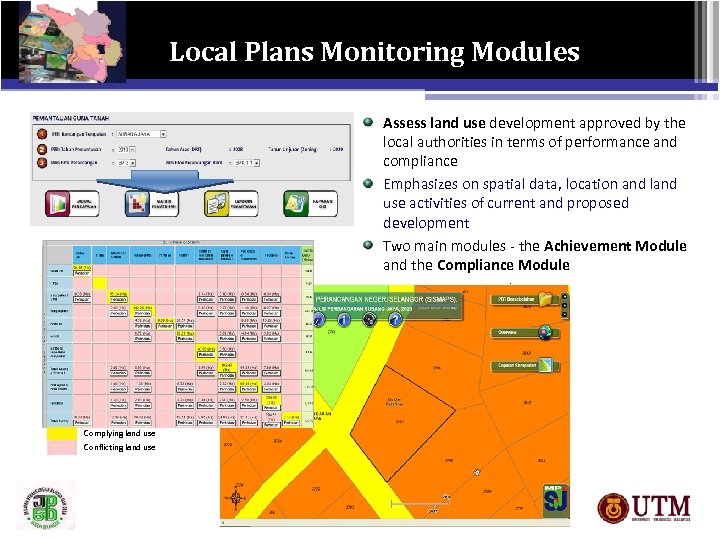 Local Plans Monitoring Modules Assess land use development approved by the local authorities in terms of performance and compliance Emphasizes on spatial data, location and land use activities of current and proposed development Two main modules - the Achievement Module and the Compliance Module Complying land use Conflicting land use
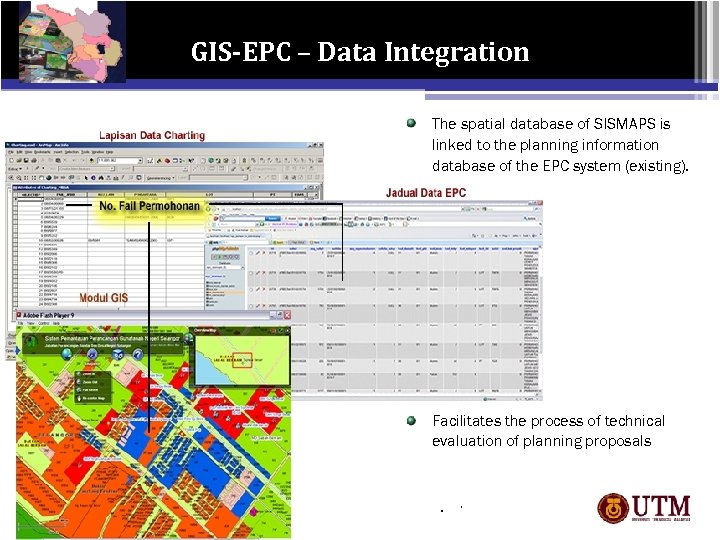 GIS-EPC – Data Integration The spatial database of SISMAPS is linked to the planning information database of the EPC system (existing). Facilitates the process of technical evaluation of planning proposals
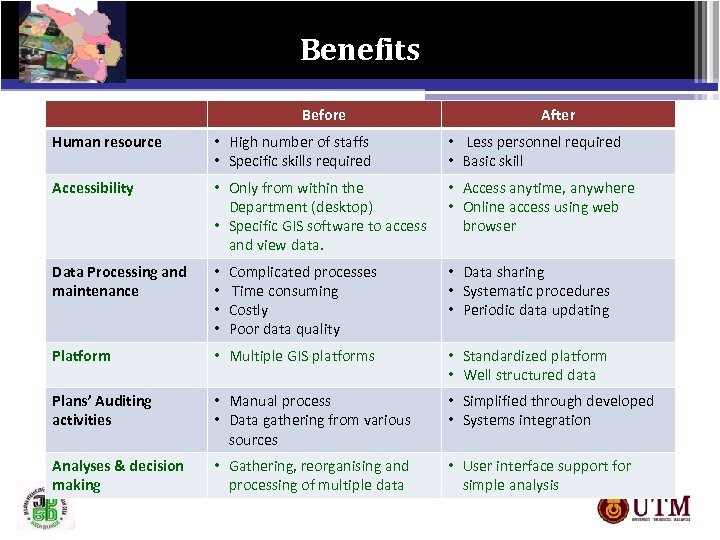 Benefits Before After Human resource • High number of staffs • Specific skills required • Less personnel required • Basic skill Accessibility • Only from within the Department (desktop) • Specific GIS software to access and view data. • Access anytime, anywhere • Online access using web browser Data Processing and maintenance • • Complicated processes Time consuming Costly Poor data quality • Data sharing • Systematic procedures • Periodic data updating Platform • Multiple GIS platforms • Standardized platform • Well structured data Plans’ Auditing activities • Manual process • Data gathering from various sources • Simplified through developed • Systems integration Analyses & decision making • Gathering, reorganising and processing of multiple data • User interface support for simple analysis
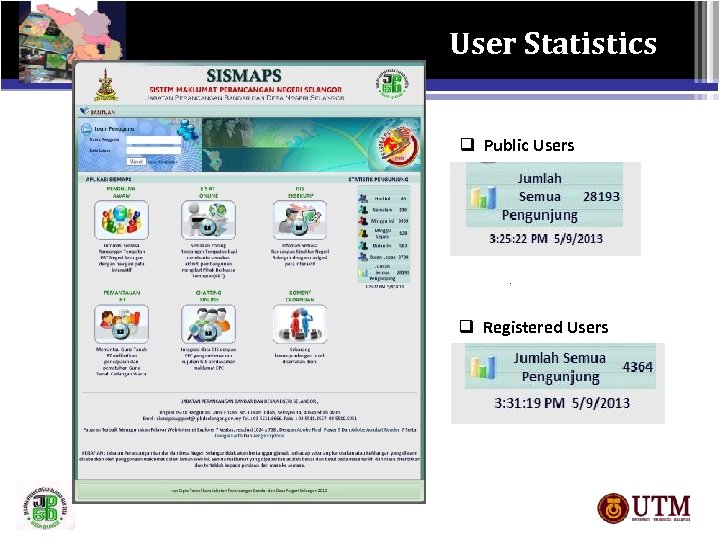 User Statistics q Public Users q Registered Users
 Conclusion A new tool as part of the Planning Support System Integration of functions involving GIS and data analysis in digital form. Land use data and information stored in standard and periodic form facilitates development monitoring, analysis and review. Provide a scientific analysis technique for assessing the status of LP implementation. Allow for state wide and inter border local authority to monitor development 22
 http: //sismaps. jpbdselangor. gov. my Thank you… b-anazri@utm. my Mohd. Zaki Ibrahim Aizuddin Safiaii Selangor Town and Country Planning Department Malaysia Ahmad Nazri Muhamad Ludin Yazid Abu Bakar Susilawati Sulaiman Department of Urban and Regional Planning Faculty of Built Environment Universiti Teknologi Malaysia