


 Скачать презентацию Leveraging Resources to Enhance Data Capacity and Utilization
db3d9e2ec3fa860ba9b7db2dc5ad2459.ppt
- Количество слайдов: 30
 Leveraging Resources to Enhance Data Capacity and Utilization in Nebraska Joint Public Health Data Center Ming Qu, MD. , MEd. , Ph. D Ge Lin, Ph. D Jianhua Qin, MS Jeff Armitage, BS Department of Health and Human Services College of Public Health, UNMC 2014 APHA Annual Meeting, Nov. 18, 2014 New Orleans, Louisiana
 Contents § Brief introduction of the Joint Public Health Data Center (JDC) § Briefly highlight major infrastructure building activities of the JDC § Report major projects including development of master data index and potential utilization
 About the JDC • The data center was established in 2011 • A component of the CDC Public Health Infrastructure grant 3
 Mission Statement § Build upon the strengths – Public health Agencies (Division of Public Health, DHHS) – Research institutions (Co. PH, UNMC) – Non-profit organizations (e. g. , NHA) The mission of the JDC is to improve public health in Nebraska by enhancing data quality and utilization – Enhance data standardization and integration – Provide analysis for public health decision making and research – Improve data dissemination
 Activities § § § Update public health data inventory Develop and implement query system Perform data Linkage Develop master data index Conduct demonstration studies Assist in internal trainings to improve EPI and statistics competencies § Provide technical assistance in data linkage and analyses
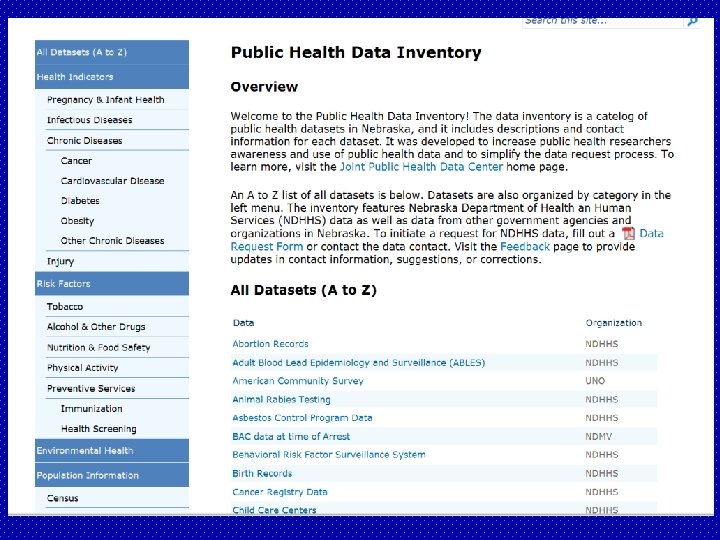
 Public Health Data Inventory § To maintain an up to date data inventory is critical for the enhancement of public health practice and research in Nebraska § The website of the data inventory allows data users to search for and utilize public health data in a more efficient manner 3/16/2018
 Public Health Data Inventory (Countinued) §The updated list of inventory was released on the center website in May 2013. §More than 100 datasets included in the data inventory §Website: http: //dhhs. ne. gov/publichealth/Data. Ce nter/Pages/Inventory. Home. aspx
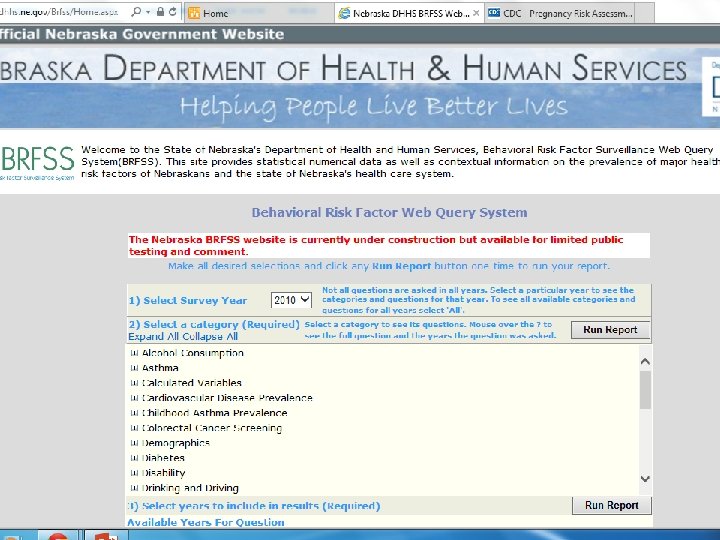
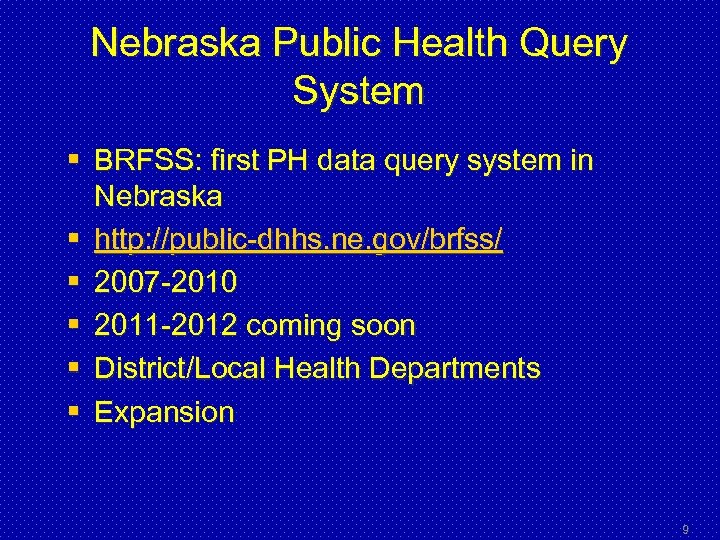 Nebraska Public Health Query System § BRFSS: first PH data query system in Nebraska § http: //public-dhhs. ne. gov/brfss/ § 2007 -2010 § 2011 -2012 coming soon § District/Local Health Departments § Expansion 9
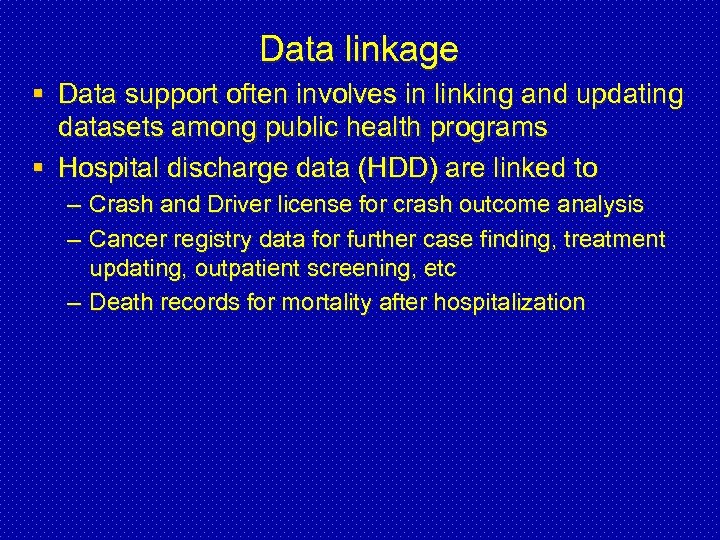 Data linkage § Data support often involves in linking and updating datasets among public health programs § Hospital discharge data (HDD) are linked to – Crash and Driver license for crash outcome analysis – Cancer registry data for further case finding, treatment updating, outpatient screening, etc – Death records for mortality after hospitalization
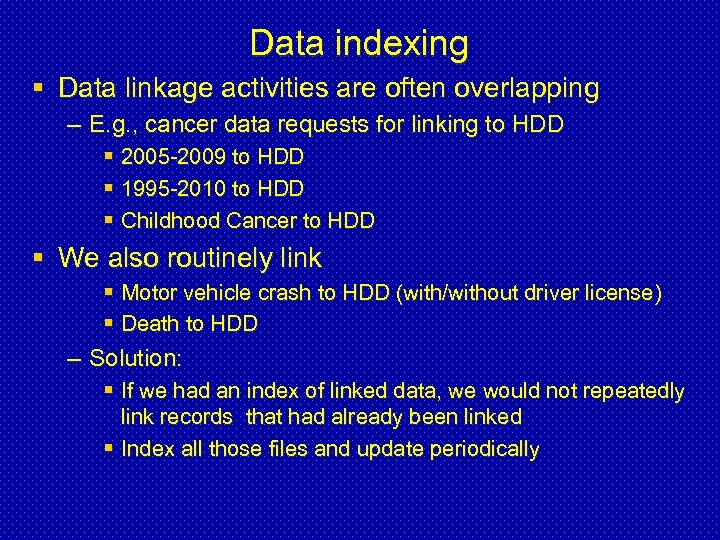 Data indexing § Data linkage activities are often overlapping – E. g. , cancer data requests for linking to HDD § § § 2005 -2009 to HDD 1995 -2010 to HDD Childhood Cancer to HDD § We also routinely link § § Motor vehicle crash to HDD (with/without driver license) Death to HDD – Solution: § If we had an index of linked data, we would not repeatedly link records that had already been linked § Index all those files and update periodically
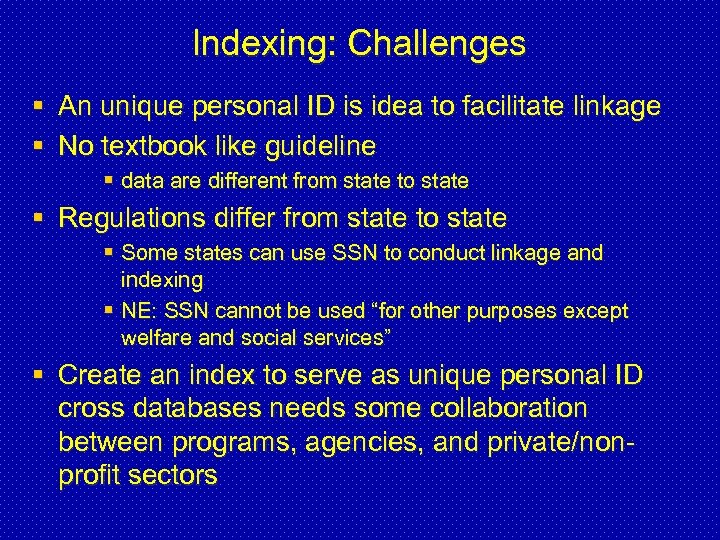 Indexing: Challenges § An unique personal ID is idea to facilitate linkage § No textbook like guideline § data are different from state to state § Regulations differ from state to state § Some states can use SSN to conduct linkage and indexing § NE: SSN cannot be used “for other purposes except welfare and social services” § Create an index to serve as unique personal ID cross databases needs some collaboration between programs, agencies, and private/nonprofit sectors
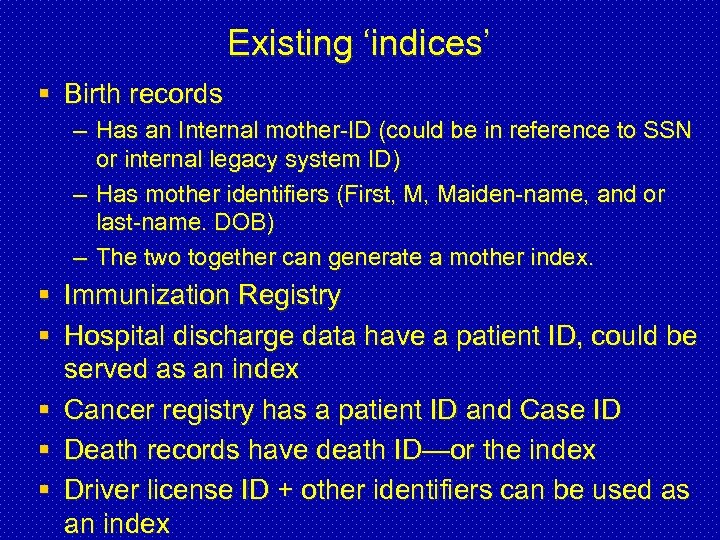 Existing ‘indices’ § Birth records – Has an Internal mother-ID (could be in reference to SSN or internal legacy system ID) – Has mother identifiers (First, M, Maiden-name, and or last-name. DOB) – The two together can generate a mother index. § Immunization Registry § Hospital discharge data have a patient ID, could be served as an index § Cancer registry has a patient ID and Case ID § Death records have death ID—or the index § Driver license ID + other identifiers can be used as an index
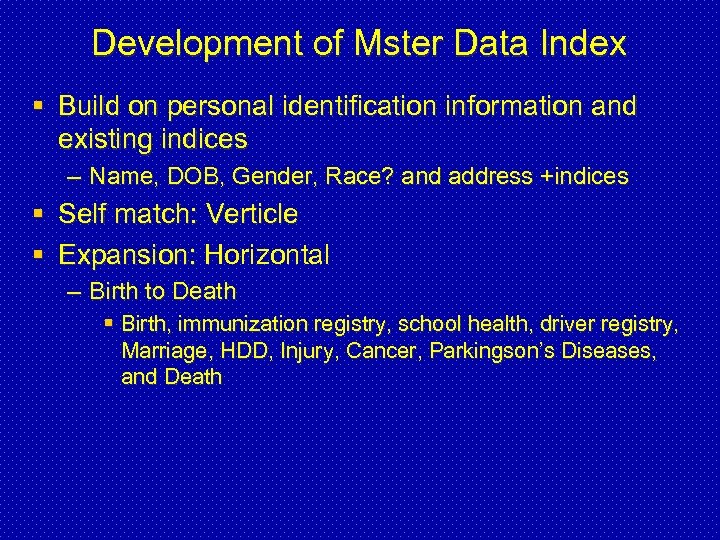 Development of Mster Data Index § Build on personal identification information and existing indices – Name, DOB, Gender, Race? and address +indices § § Self match: Verticle Expansion: Horizontal – Birth to Death § Birth, immunization registry, school health, driver registry, Marriage, HDD, Injury, Cancer, Parkingson’s Diseases, and Death
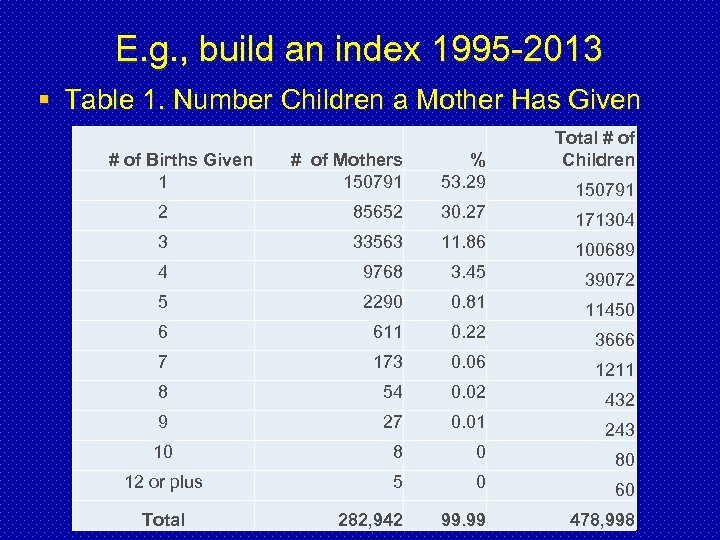 E. g. , build an index 1995 -2013 § Table 1. Number Children a Mother Has Given # of Births Given 1 Total # of Children # of Mothers 150791 % 53. 29 2 85652 30. 27 171304 3 33563 11. 86 100689 4 9768 3. 45 39072 5 2290 0. 81 11450 6 611 0. 22 3666 7 173 0. 06 1211 8 54 0. 02 432 9 27 0. 01 243 10 8 0 80 12 or plus 5 0 60 282, 942 99. 99 478, 998 Total 150791
 Expand Linkage : Horizontal § § § Internal datasets are linked to HDD is a base data set Cancer, Crash, Trauma, EMS, Death, PDs Create Index table including Generated MDI Perform Index Linkage to HDD one time for all Towards an internal registry systems indexing
 HDD Race Linkage Project § Backgrounds: – HDD data 2005 -2011 had 1. 45 million records – Less than 7% of HDD records have race information, a major barrier for racial disparity assessment. § Many datasets within the agency have race/ethnicity and linkage variables (names, address, etc) – – Cancer registry by patient race/ethnicity (240, 000 records) Birth records by mother/father race/ethnicity (500, 000 records) Death records by race/ethnicity (100, 000+ records) Trauma registry (70, 000+ records) § from hospitals (trauma centers) § race is required – Driver license has self-reported race ( 1. 47 million records)
 Race Index Project Results § Results: the linkage rates: Ø 89. 7% for Inpatient records (among 1. 5 million records) Ø 76. 0% for Out-patient records (among 17 million records) Ø Using area-based census tract data by race in 2010, we were able to code inpatient race variable to 100% § Both inpatient data and outpatient data (e. g. , Current Procedural Terminology codes) can then be linked back to all linkage databases (e. g. , cancer, birth, death, trauma etc)
 Master Address Index § Many datasets within the agency need to be geocoded – Birth records, Birth Defect Cancer registry, Trauma registry, Crash outcomes, HDD Death records § A lot of addresses are identical (e. g. , repeated hospitalization during a short period of time) § Standardized addresses only need to be coded one time § We coded more than 2 million addresses for above databases, and we do not want to repeat another 2 millions § A master address index can go hand in hand with the master data index
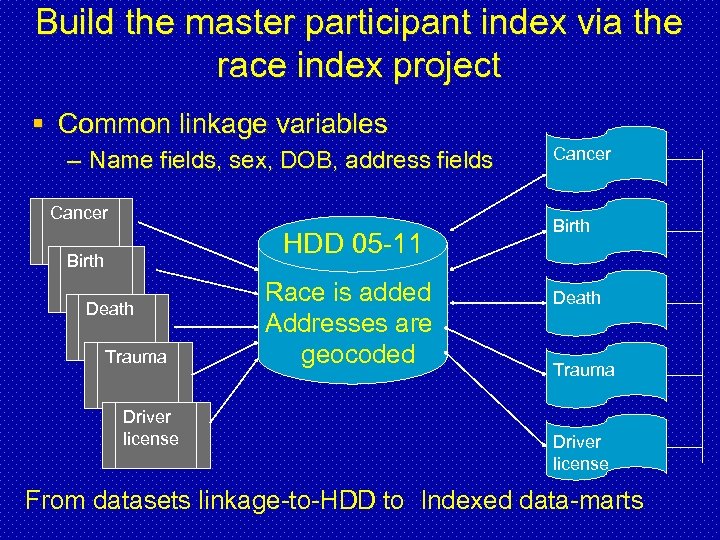 Build the master participant index via the race index project § Common linkage variables – Name fields, sex, DOB, address fields Cancer HDD 05 -11 Birth Death Trauma Driver license Race is added Addresses are geocoded Cancer Birth Death Trauma Driver license From datasets linkage-to-HDD to Indexed data-marts
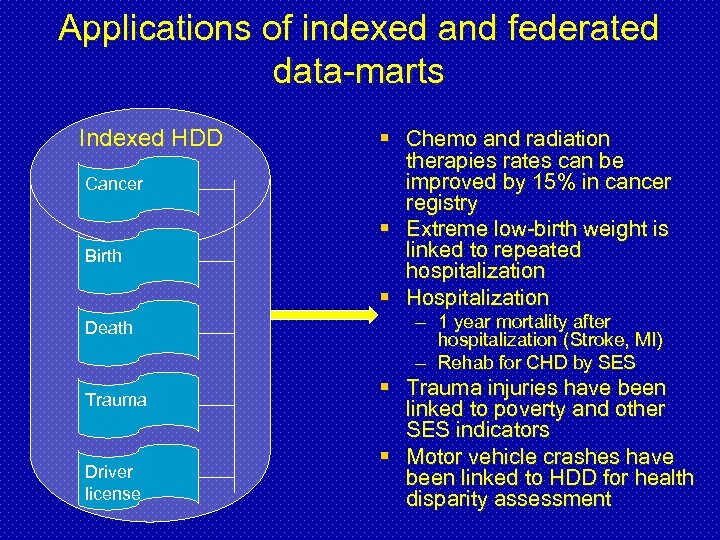 Applications of indexed and federated data-marts Indexed HDD Cancer Birth Death Trauma Driver license § Chemo and radiation therapies rates can be improved by 15% in cancer registry § Extreme low-birth weight is linked to repeated hospitalization § Hospitalization – 1 year mortality after hospitalization (Stroke, MI) – Rehab for CHD by SES § Trauma injuries have been linked to poverty and other SES indicators § Motor vehicle crashes have been linked to HDD for health disparity assessment
 Some demonstrative examples § In the following few slides, we demonstrate how linked data might provide new insight
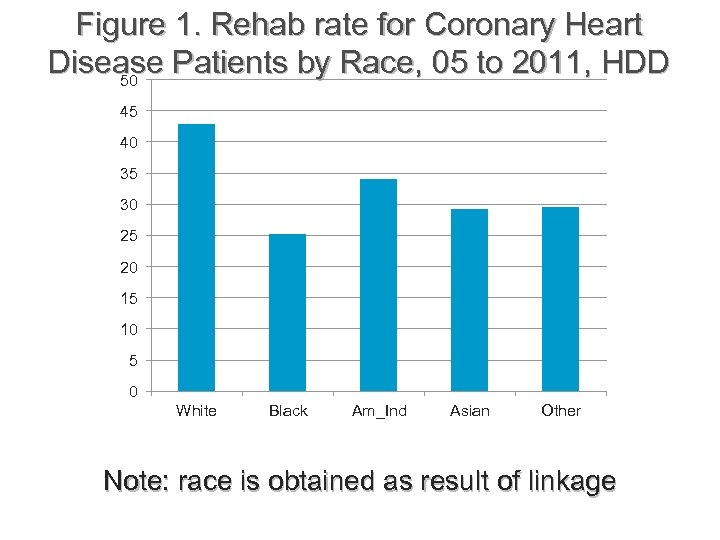 Figure 1. Rehab rate for Coronary Heart Disease Patients by Race, 05 to 2011, HDD 50 45 40 35 30 25 20 15 10 5 0 White Black Am_Ind Asian Other Note: race is obtained as result of linkage
 Figure 2. Lung cancer survival curves by stage and comorbidities (e. g. , COPD predicts short survival) Note that comorbidities are not available from NCR
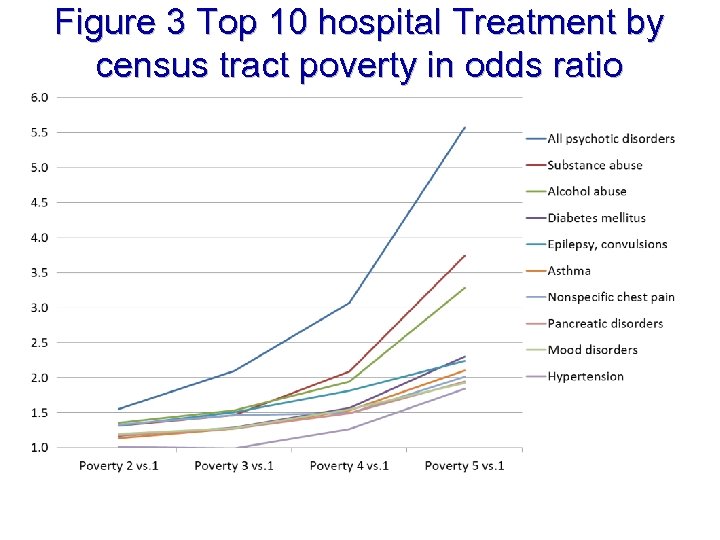 Figure 3 Top 10 hospital Treatment by census tract poverty in odds ratio
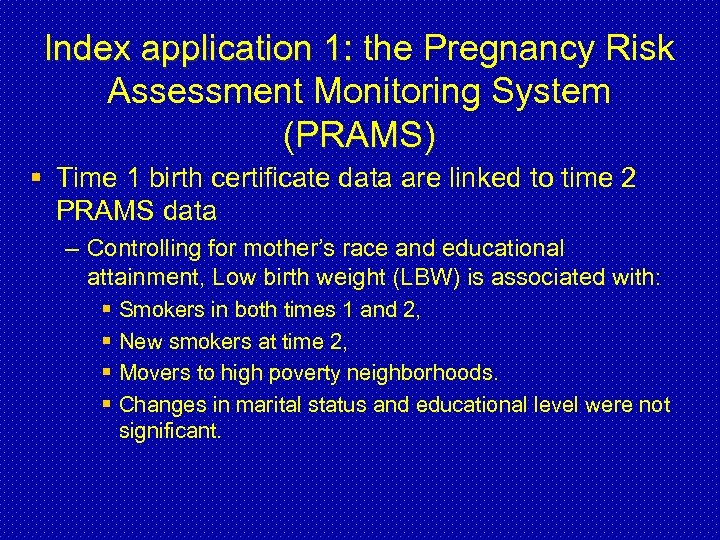 Index application 1: the Pregnancy Risk Assessment Monitoring System (PRAMS) § Time 1 birth certificate data are linked to time 2 PRAMS data – Controlling for mother’s race and educational attainment, Low birth weight (LBW) is associated with: § § Smokers in both times 1 and 2, New smokers at time 2, Movers to high poverty neighborhoods. Changes in marital status and educational level were not significant.
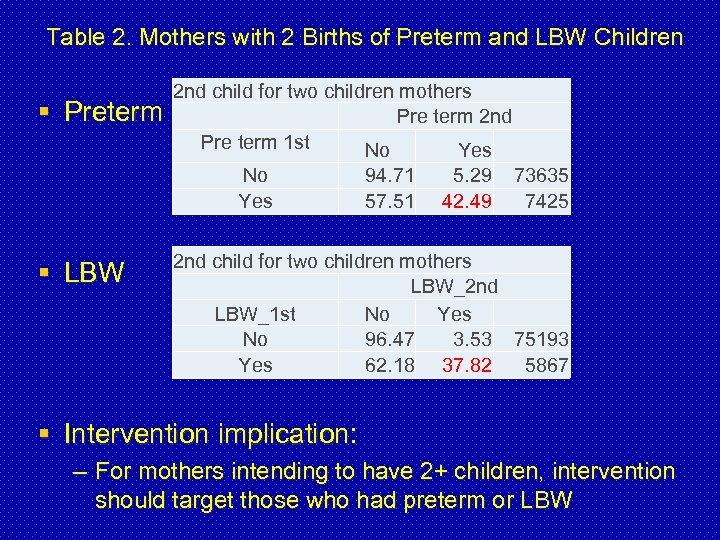 Table 2. Mothers with 2 Births of Preterm and LBW Children § Preterm 2 nd child for two children mothers Pre term 2 nd Pre term 1 st No Yes § LBW 94. 71 57. 51 5. 29 42. 49 73635 7425 2 nd child for two children mothers LBW_2 nd LBW_1 st No Yes No 96. 47 3. 53 75193 Yes 62. 18 37. 82 5867 § Intervention implication: – For mothers intending to have 2+ children, intervention should target those who had preterm or LBW
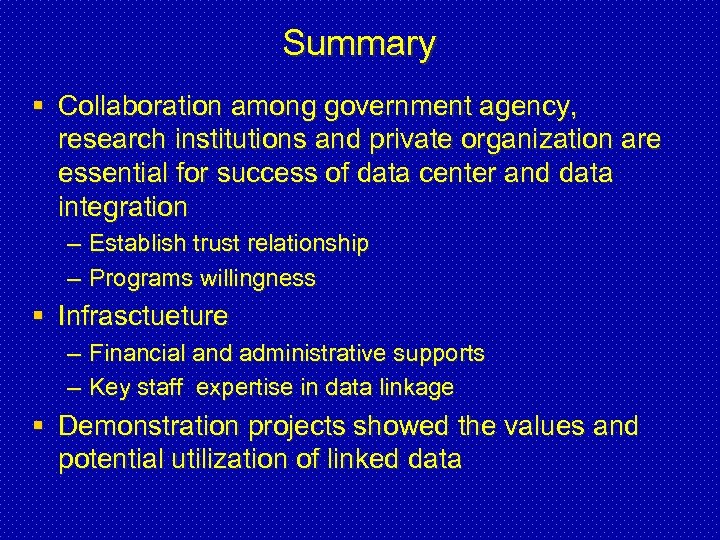 Summary § Collaboration among government agency, research institutions and private organization are essential for success of data center and data integration – Establish trust relationship – Programs willingness § Infrasctueture – Financial and administrative supports – Key staff expertise in data linkage § Demonstration projects showed the values and potential utilization of linked data
 Thanks § § § Ming Qu, Administrator Epidemiology and Health Informatics Nebraska Dept. of Health and Human Services (402)3103532 ming. qu@nebraska. gov