


 Скачать презентацию Levels of organisation Individual Consider a young dog
1d74a5f550ac88953392570ded46a43c.ppt
- Количество слайдов: 44
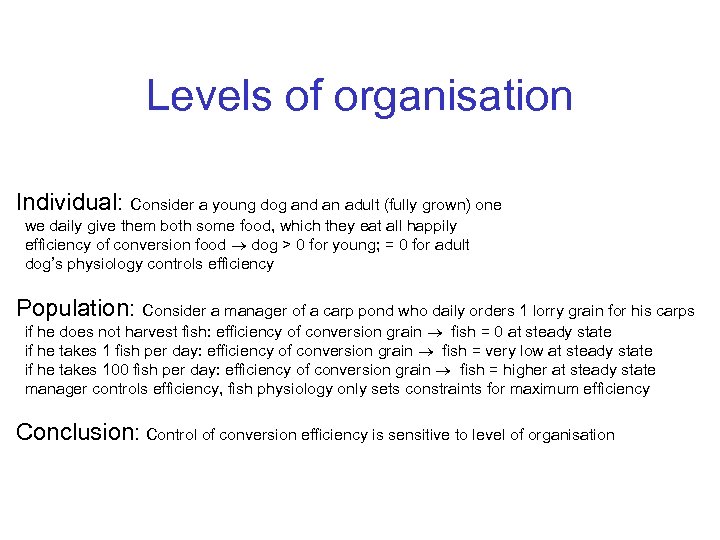 Levels of organisation Individual: Consider a young dog and an adult (fully grown) one we daily give them both some food, which they eat all happily efficiency of conversion food dog > 0 for young; = 0 for adult dog’s physiology controls efficiency Population: Consider a manager of a carp pond who daily orders 1 lorry grain for his carps if he does not harvest fish: efficiency of conversion grain fish = 0 at steady state if he takes 1 fish per day: efficiency of conversion grain fish = very low at steady state if he takes 100 fish per day: efficiency of conversion grain fish = higher at steady state manager controls efficiency, fish physiology only sets constraints for maximum efficiency Conclusion: Control of conversion efficiency is sensitive to level of organisation
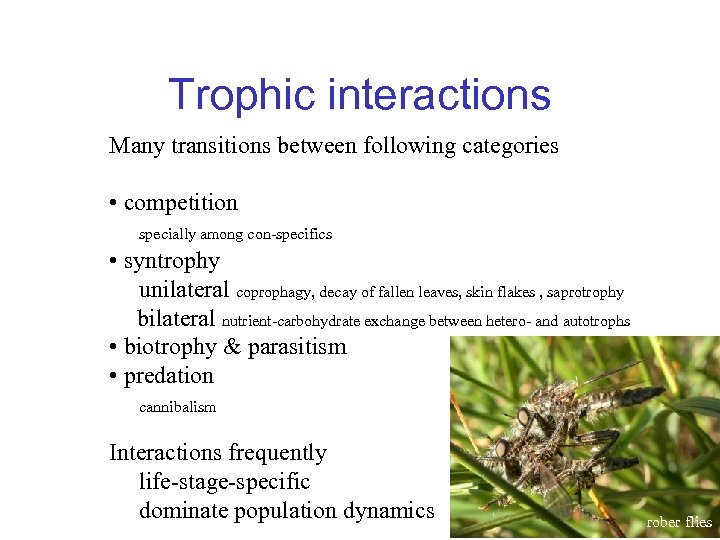 Trophic interactions Many transitions between following categories • competition specially among con-specifics • syntrophy unilateral coprophagy, decay of fallen leaves, skin flakes , saprotrophy bilateral nutrient-carbohydrate exchange between hetero- and autotrophs • biotrophy & parasitism • predation cannibalism Interactions frequently life-stage-specific dominate population dynamics rober flies
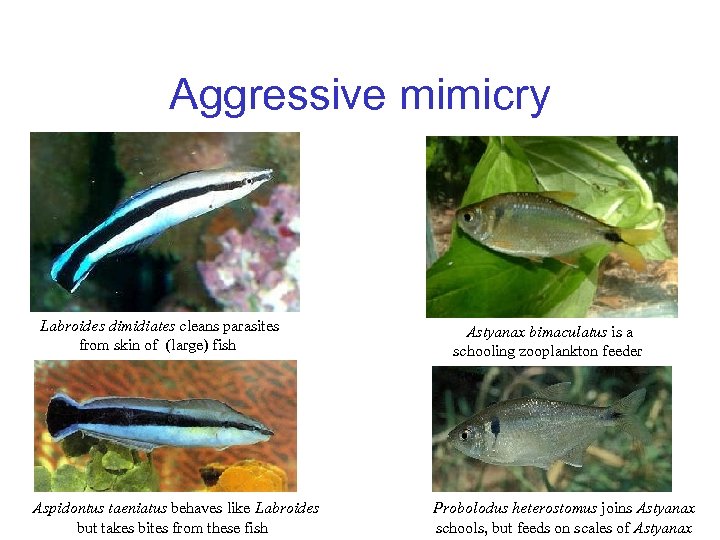 Aggressive mimicry Labroides dimidiates cleans parasites from skin of (large) fish Aspidontus taeniatus behaves like Labroides but takes bites from these fish Astyanax bimaculatus is a schooling zooplankton feeder Probolodus heterostomus joins Astyanax schools, but feeds on scales of Astyanax
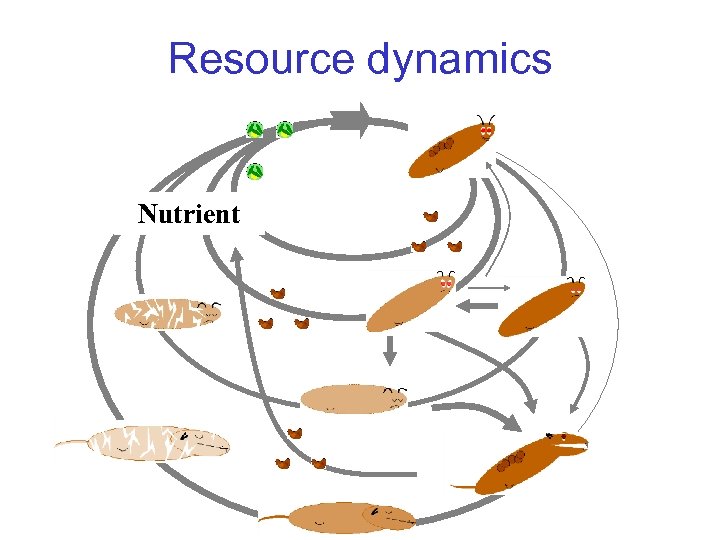
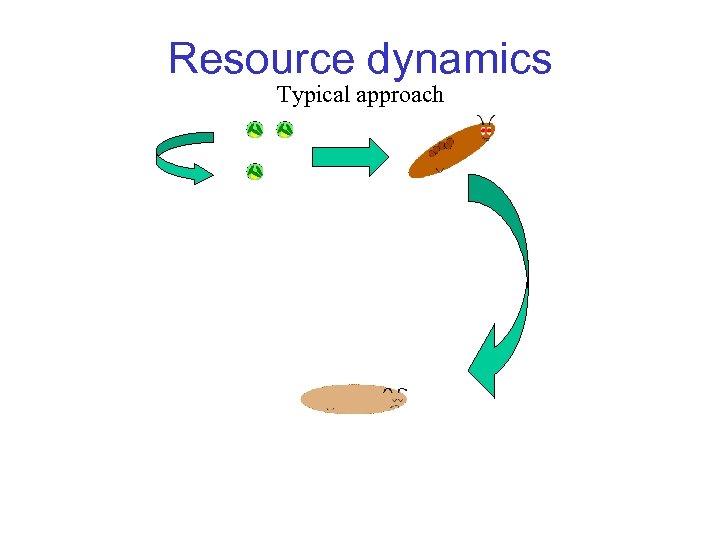 Resource dynamics Typical approach
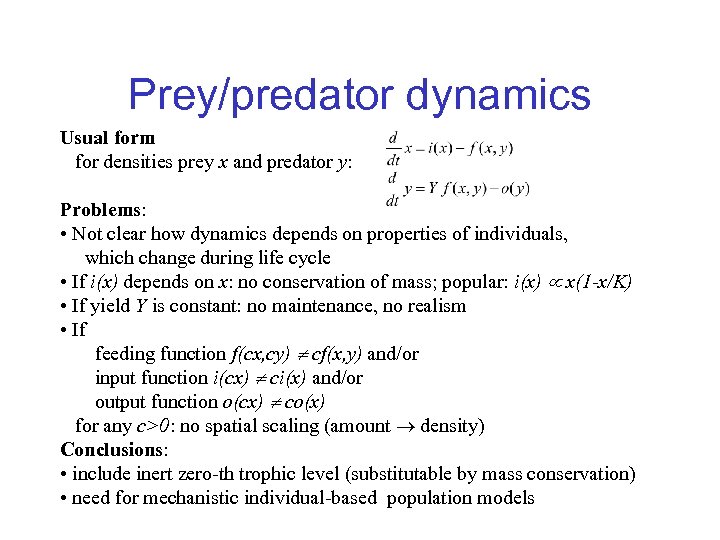 Prey/predator dynamics Usual form for densities prey x and predator y: Problems: • Not clear how dynamics depends on properties of individuals, which change during life cycle • If i(x) depends on x: no conservation of mass; popular: i(x) x(1 -x/K) • If yield Y is constant: no maintenance, no realism • If feeding function f(cx, cy) cf(x, y) and/or input function i(cx) ci(x) and/or output function o(cx) co(x) for any c>0: no spatial scaling (amount density) Conclusions: • include inert zero-th trophic level (substitutable by mass conservation) • need for mechanistic individual-based population models
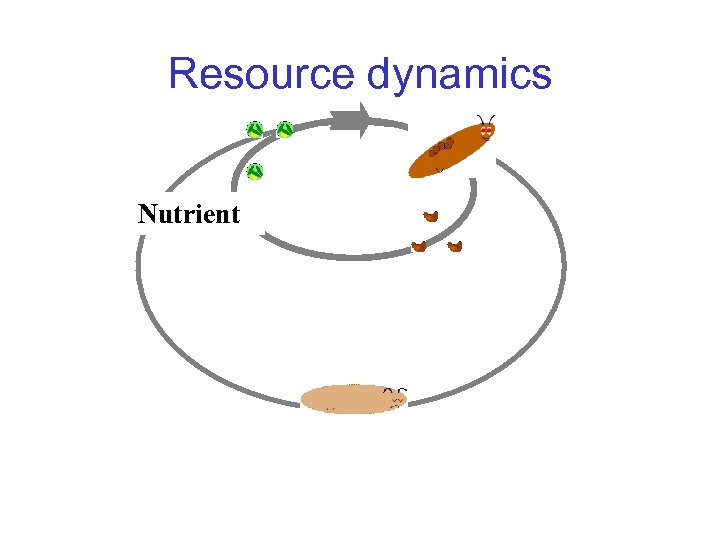 Resource dynamics Nutrient
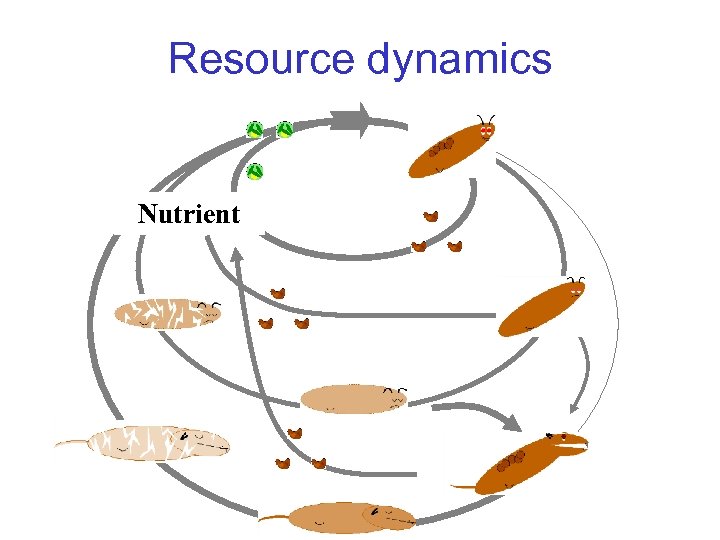 Resource dynamics Nutrient
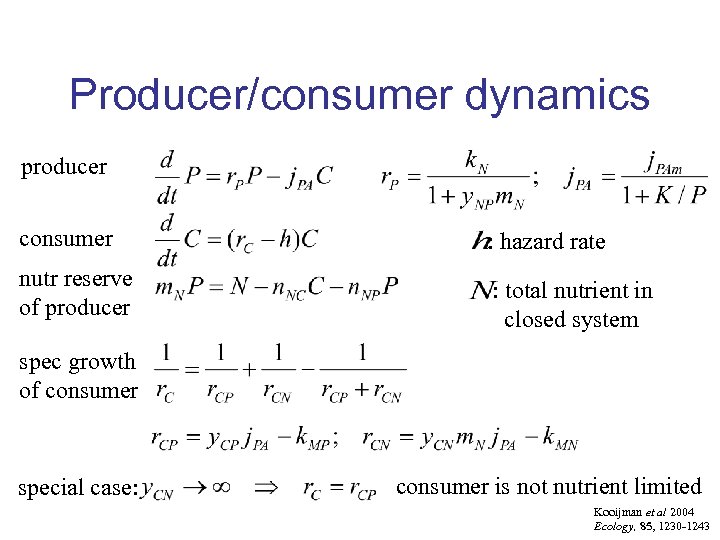 Producer/consumer dynamics producer consumer : hazard rate nutr reserve of producer : total nutrient in closed system spec growth of consumer special case: consumer is not nutrient limited Kooijman et al 2004 Ecology, 85, 1230 -1243
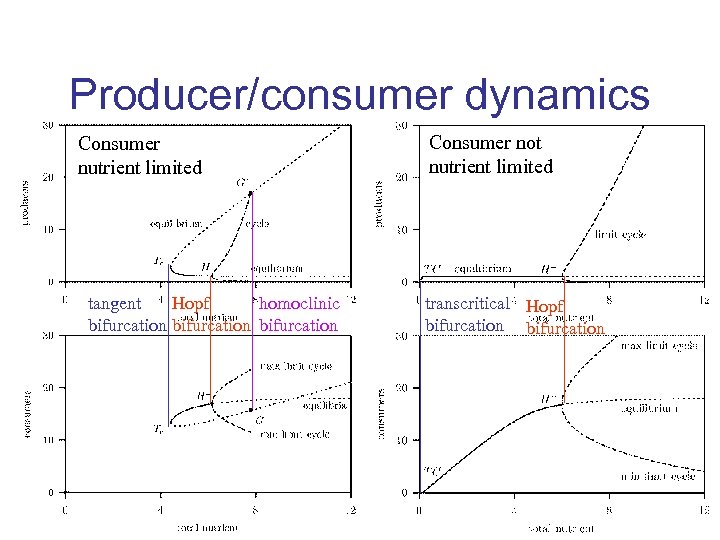 Producer/consumer dynamics Consumer nutrient limited tangent Hopf homoclinic bifurcation Consumer not nutrient limited transcritical Hopf bifurcation
 Effects of parasites On individuals: Many parasites • increase (chemical manipulation) • harvest (all) allocation to dev. /reprod. Results • larger body size higher food intake • reduced reproduction On populations: Many small parasites • • convert healthy (susceptible) individuals to affected ones on contact convert affected individuals into non-susceptible ones
 Resource dynamics Nutrient
 IBM ODE • isomorph populations require IBMs V 1 -morph populations can be modelled with ODEs all individuals have the same reserve density in homogeneous space state variables: total structure and typical reserve density • application of shape correction function M(V) = (V/Vd)a to isomorphs gives a smooth transition from IBM to ODE for a: 0 1/3 • if individuals propagate by division (2 Vb = Vd) V 1 -morphs approximate other morphs well at the population level the required doubling time dominates dynamics, not details of morph • if Vm >> Vb, morph details are important individual basis of population dynamics is more important for e. g. whales than for plankton
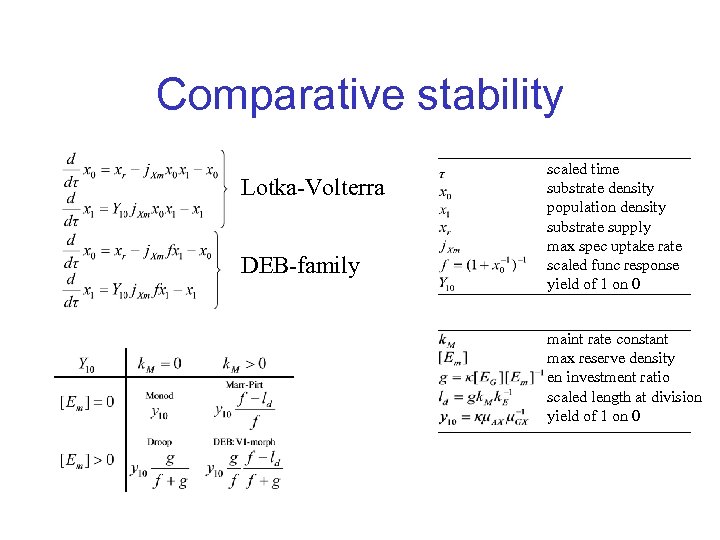 Comparative stability Lotka-Volterra DEB-family scaled time substrate density population density substrate supply max spec uptake rate scaled func response yield of 1 on 0 maint rate constant max reserve density en investment ratio scaled length at division yield of 1 on 0
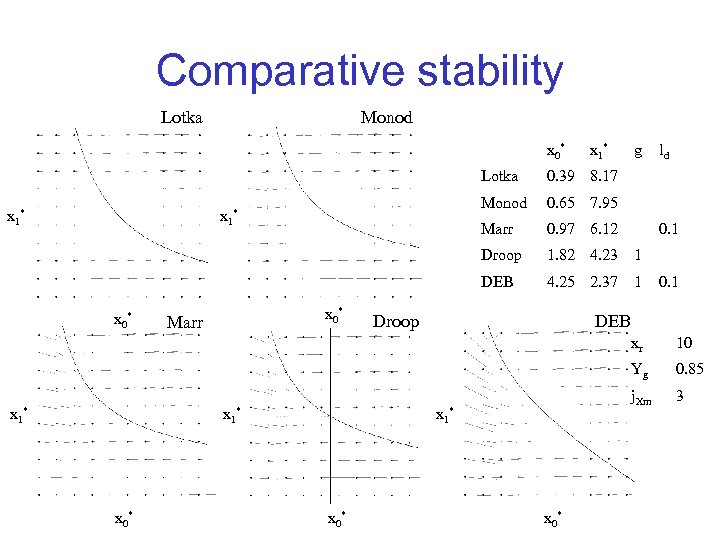 Comparative stability Lotka Monod x 0* x 1* g Lotka Monod x 0* Marr 0. 97 6. 12 1. 82 4. 23 1 DEB x 0* 0. 65 7. 95 Marr x 1* 0. 39 8. 17 Droop x 1* 4. 25 2. 37 1 ld Droop 0. 1 DEB xr Yg x 1* x 0* 0. 85 j. Xm x 1* 10 3
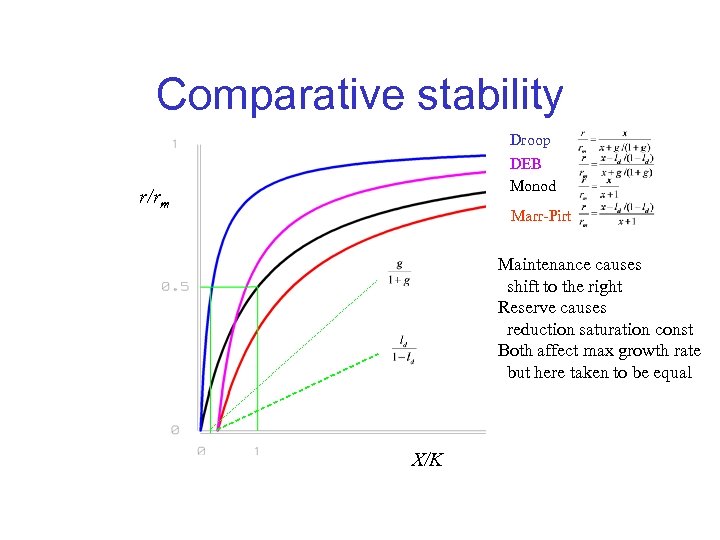 Comparative stability Droop DEB Monod r/rm Marr-Pirt Maintenance causes shift to the right Reserve causes reduction saturation const Both affect max growth rate but here taken to be equal X/K
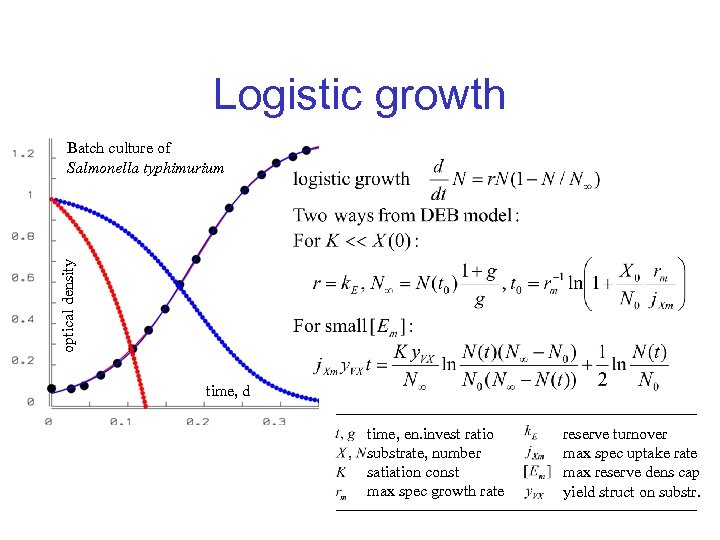 Logistic growth optical density Batch culture of Salmonella typhimurium time, d time, en. invest ratio substrate, number satiation const max spec growth rate reserve turnover max spec uptake rate max reserve dens cap yield struct on substr.
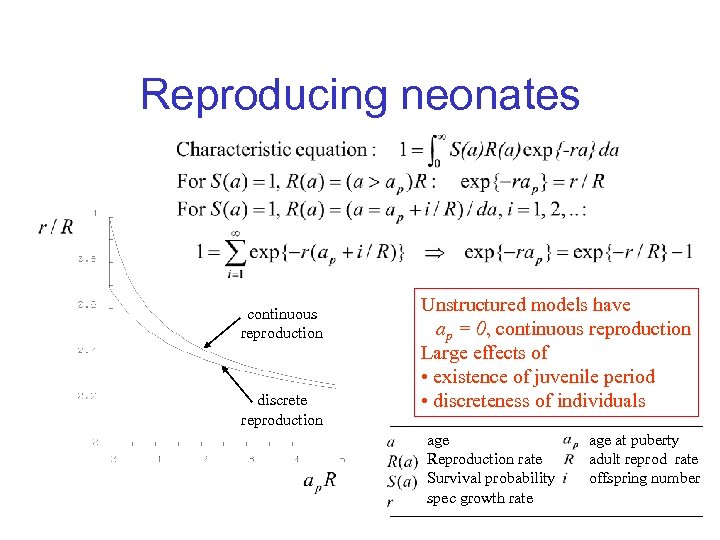 Reproducing neonates continuous reproduction discrete reproduction Unstructured models have ap = 0, continuous reproduction Large effects of • existence of juvenile period • discreteness of individuals age Reproduction rate Survival probability spec growth rate age at puberty adult reprod rate offspring number
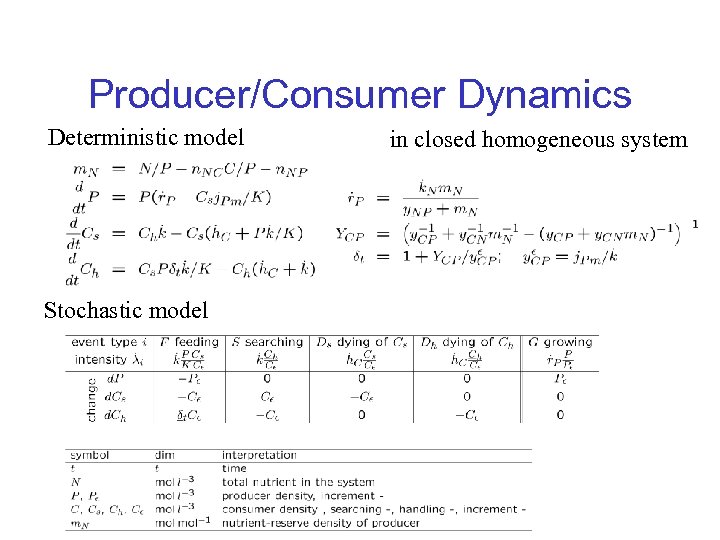 Producer/Consumer Dynamics Deterministic model Stochastic model in closed homogeneous system
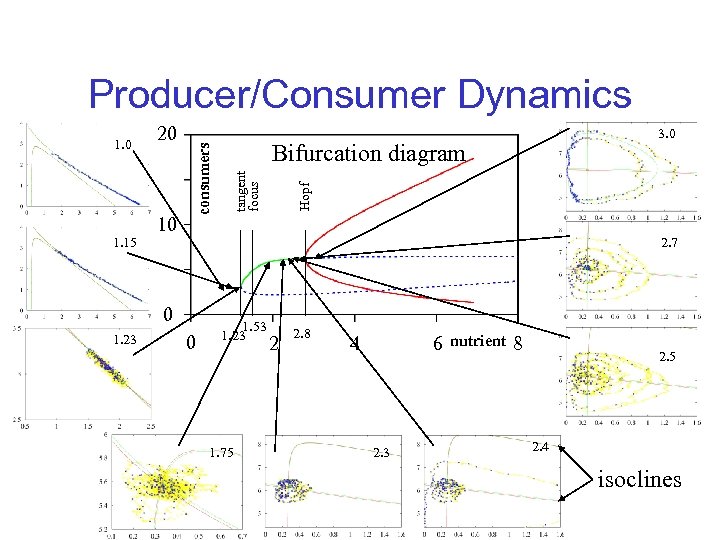 10 3. 0 Bifurcation diagram Hopf 20 tangent focus 1. 0 consumers Producer/Consumer Dynamics 1. 15 2. 7 0 1. 23 0 1. 53 1. 23 1. 75 2 2. 8 4 6 2. 3 nutrient 8 2. 5 2. 4 isoclines
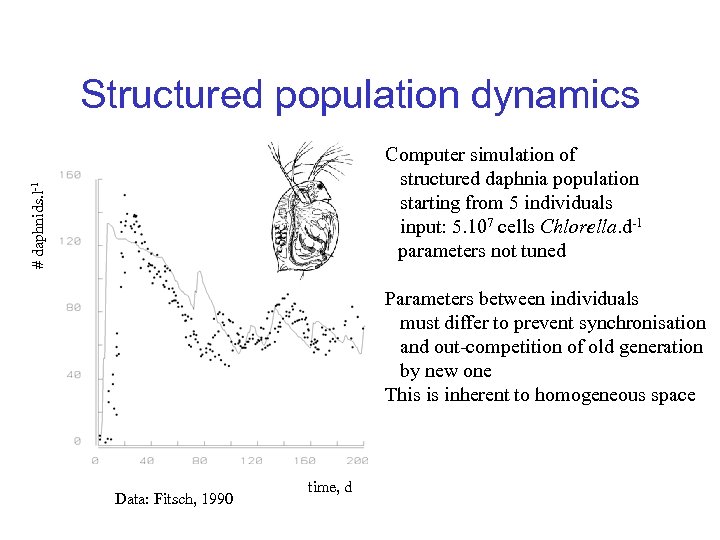 Structured population dynamics # daphnids. l-1 Computer simulation of structured daphnia population starting from 5 individuals input: 5. 107 cells Chlorella. d-1 parameters not tuned Parameters between individuals must differ to prevent synchronisation and out-competition of old generation by new one This is inherent to homogeneous space Data: Fitsch, 1990 time, d
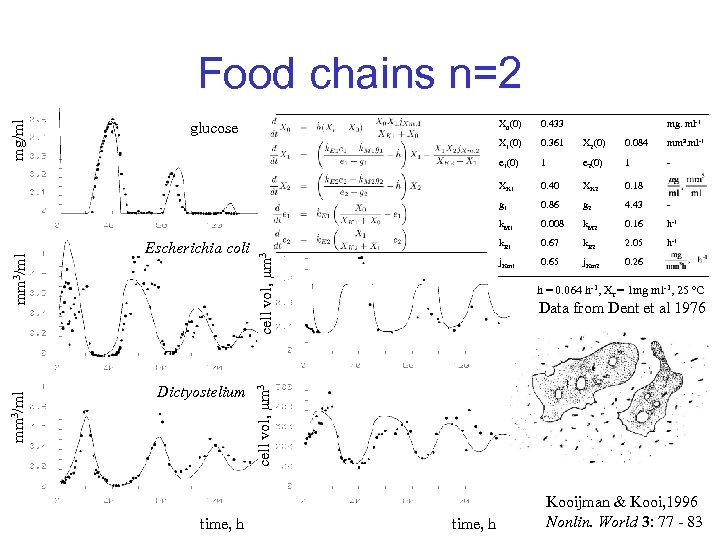 Food chains n=2 mm 3. ml-1 1 e 2(0) 1 - 0. 40 XK 2 0. 18 0. 86 g 2 4. 43 - 0. 008 k. M 2 0. 16 h-1 k. E 1 0. 67 k. E 2 2. 05 h-1 j. Xm 1 cell vol, m 3 mg. ml-1 0. 65 j. Xm 2 0. 26 h = 0. 064 h-1, Xr = 1 mg ml-1, 25 °C Data from Dent et al 1976 cell vol, m 3 mg/ml 0. 084 k. M 1 time, h X 2(0) e 1(0) Dictyostelium 0. 361 g 1 mm 3/ml X 1(0) Escherichia coli 0. 433 XK 1 mm 3/ml X 0(0) glucose time, h Kooijman & Kooi, 1996 Nonlin. World 3: 77 - 83
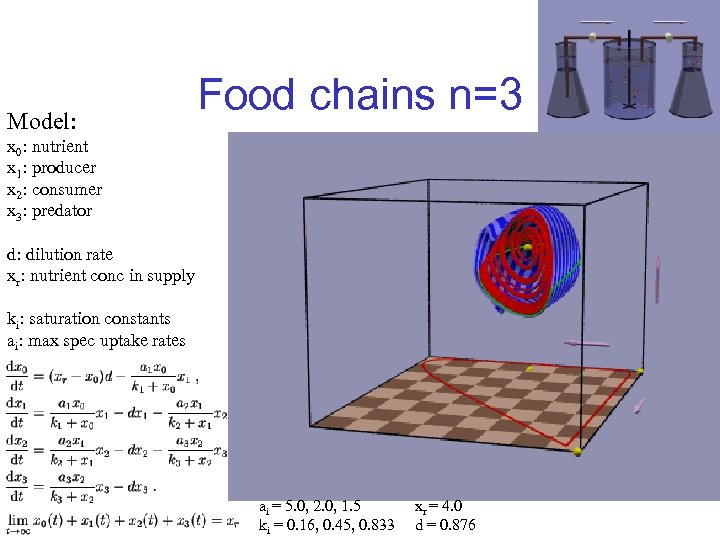 Model: Food chains n=3 x 0: nutrient x 1: producer x 2: consumer x 3: predator d: dilution rate xr: nutrient conc in supply ki: saturation constants ai: max spec uptake rates limit cycle (saddle) separatrix chaotic attractor unstable equilibria stable limit cycle Boer, M. P. 2000. The dynamics of tritrophic food chains. Ph. D thesis, Vrije Universiteit, Amsterdam ai = 5. 0, 2. 0, 1. 5 xr = 4. 0 ki = 0. 16, 0. 45, 0. 833 d = 0. 876
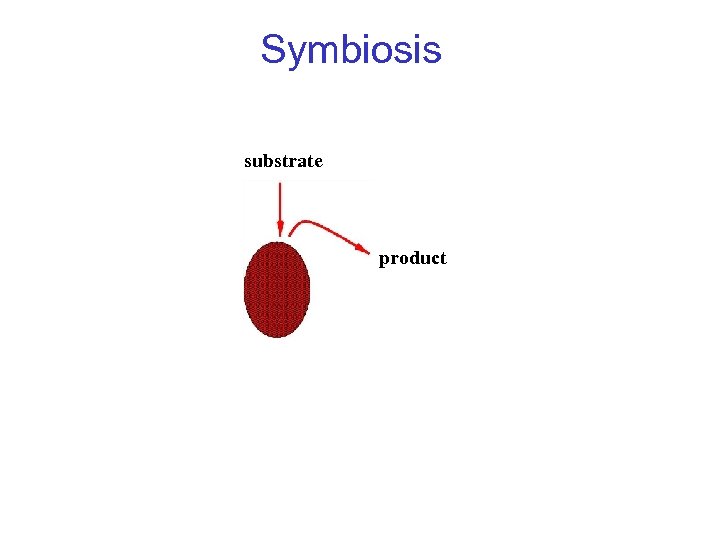 Symbiosis substrate product
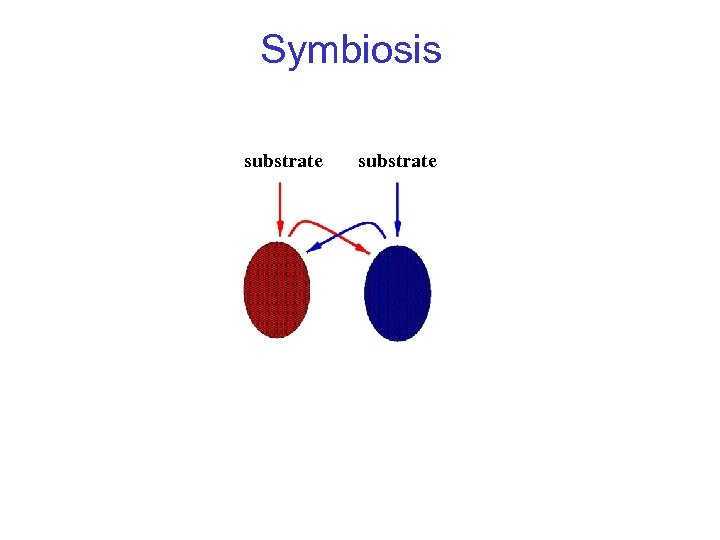 Symbiosis substrate
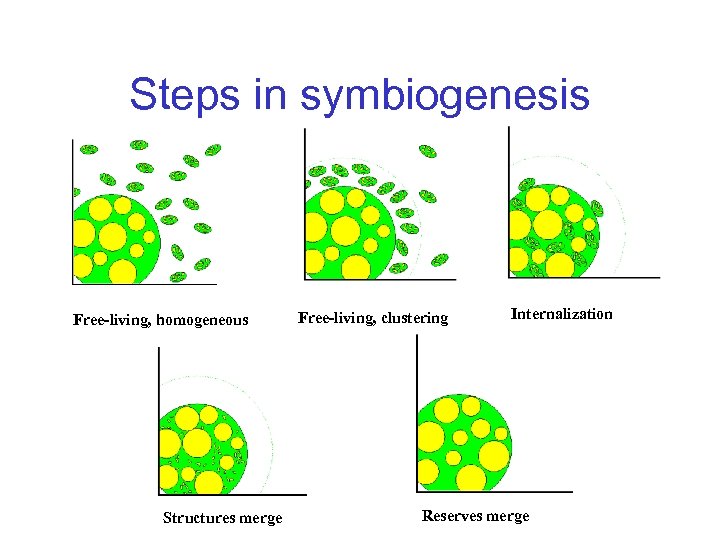 Steps in symbiogenesis Free-living, homogeneous Structures merge Free-living, clustering Internalization Reserves merge
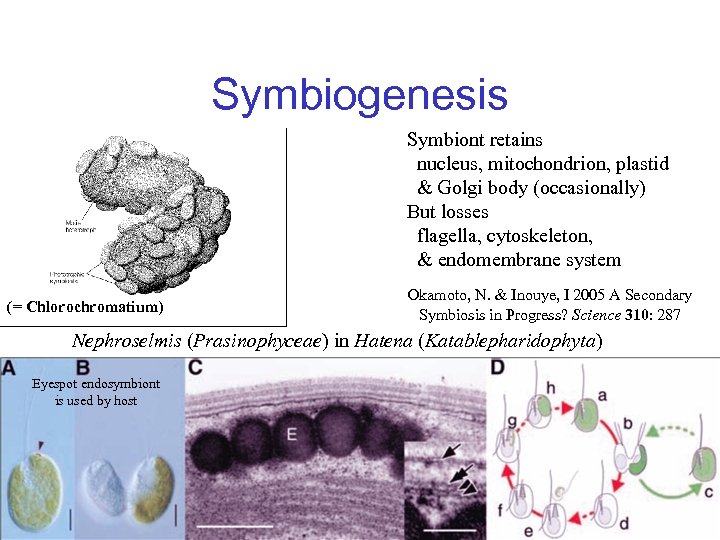 Symbiogenesis Symbiont retains nucleus, mitochondrion, plastid & Golgi body (occasionally) But losses flagella, cytoskeleton, & endomembrane system (= Chlorochromatium) Okamoto, N. & Inouye, I 2005 A Secondary Symbiosis in Progress? Science 310: 287 Nephroselmis (Prasinophyceae) in Hatena (Katablepharidophyta) Eyespot endosymbiont is used by host
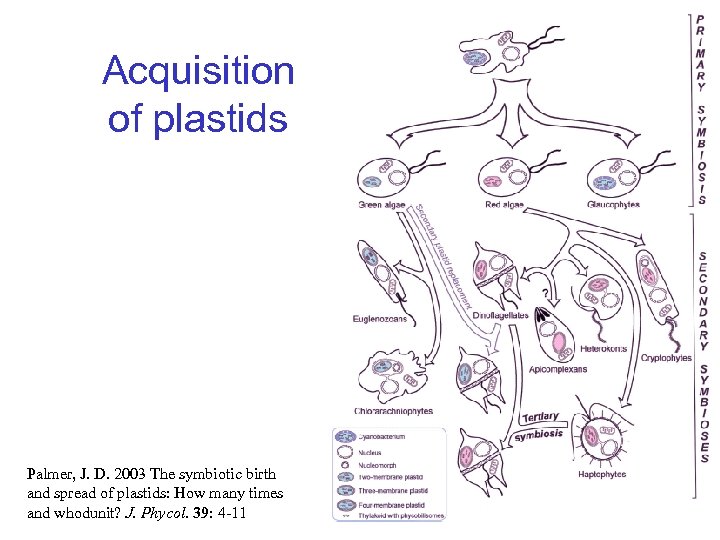 Acquisition of plastids Palmer, J. D. 2003 The symbiotic birth and spread of plastids: How many times and whodunit? J. Phycol. 39: 4 -11
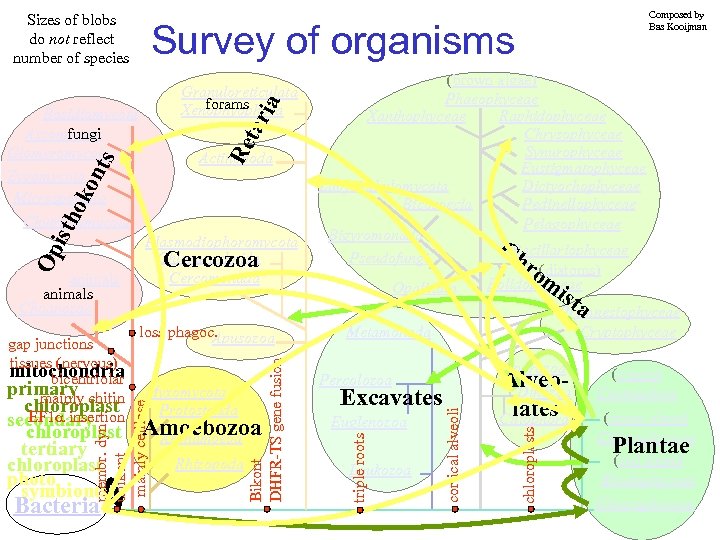 Sizes of blobs do not reflect number of species Survey of organisms chloroplast Amoebozoa Archamoeba tertiary chloroplast photo symbionts Bacteria Rhizopoda Excavates Euglenozoa Loukozoa Alveo. Dinozoa lates Ciliophora chloroplasts Myxomycota Protostelida Sporozoa Percolozoa cortical alveoli Re loss phagoc. Apusozoa membr. dyn unikont mainly celllose gap junctions tissues (nervous) mitochondria bicentriolar primary chitin mainly chloroplast EF 1 insertion secondary Plasmodiophoromycota Chlorarachnida Cercozoa Cercomonada Bikont DHFR-TS gene fusion Op isth ok on ts Actinopoda (brown algae) Phaeophyceae Xanthophyceae Raphidophyceae Chrysophyceae Synurophyceae Eustigmatophyceae Labyrinthulomycota Dictyochophyceae Bicosoecia Pedinellophyceae Pelagophyceae Bigyromonada CBacillariophyceae Pseudofungi hr (diatoms) om Bolidophyceae Opalinata ist a Prymnesiophyceae Metamonada Cryptophyceae triple roots tar ia Granuloreticulata forams Xenophyophora Basidiomycota Ascomycota fungi Glomeromycota Zygomycota Microsporidia Chytridiomycota animals Choanozoa Composed by Bas Kooijman (plants) Cormophyta (green algae) Chlorophyceae Plantae (red algae) Rhodophyceae Glaucophyceae
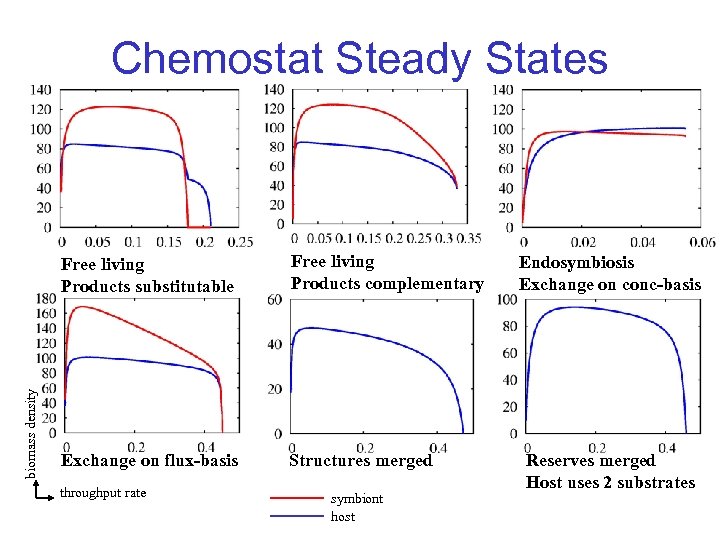 Chemostat Steady States biomass density Free living Products substitutable Free living Products complementary Exchange on flux-basis Structures merged throughput rate symbiont host Endosymbiosis Exchange on conc-basis Reserves merged Host uses 2 substrates
 Symbiogenesis • symbioses: fundamental organization of life based on syntrophy ranges from weak to strong interactions; basis of biodiversity • symbiogenesis: evolution of eukaryotes (mitochondria, plastids) • DEB model is closed under symbiogenesis: it is possible to model symbiogenesis of two initially independently living populations that follow the DEB rules by incremental changes of parameter values such that a single population emerges that again follows the DEB rules • essential property for models that apply to all organisms Kooijman, Auger, Poggiale, Kooi 2003 Quantitative steps in symbiogenesis and the evolution of homeostasis Biological Reviews (to appear)
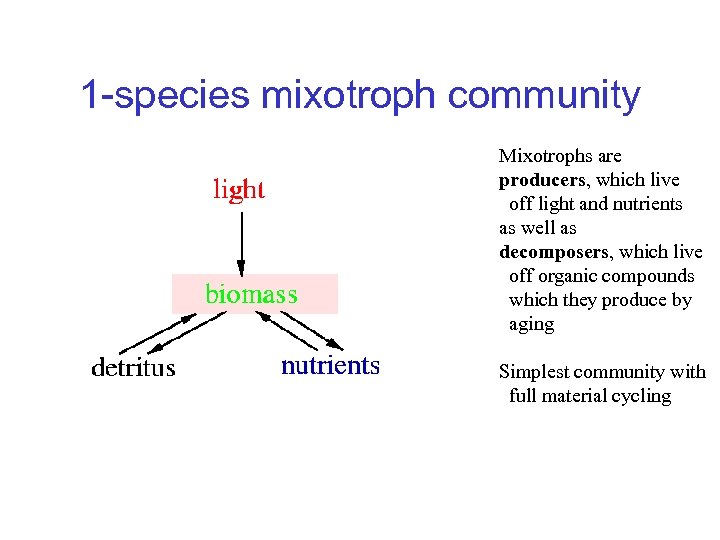 1 -species mixotroph community Mixotrophs are producers, which live off light and nutrients as well as decomposers, which live off organic compounds which they produce by aging Simplest community with full material cycling
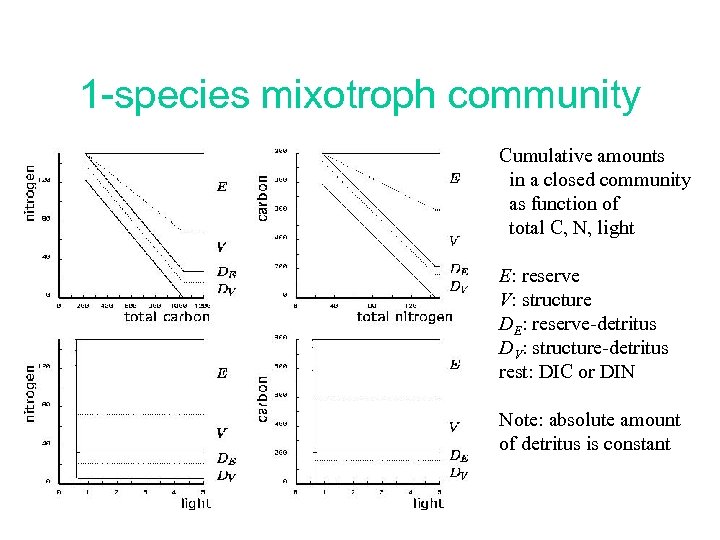 1 -species mixotroph community Cumulative amounts in a closed community as function of total C, N, light E: reserve V: structure DE: reserve-detritus DV: structure-detritus rest: DIC or DIN Note: absolute amount of detritus is constant
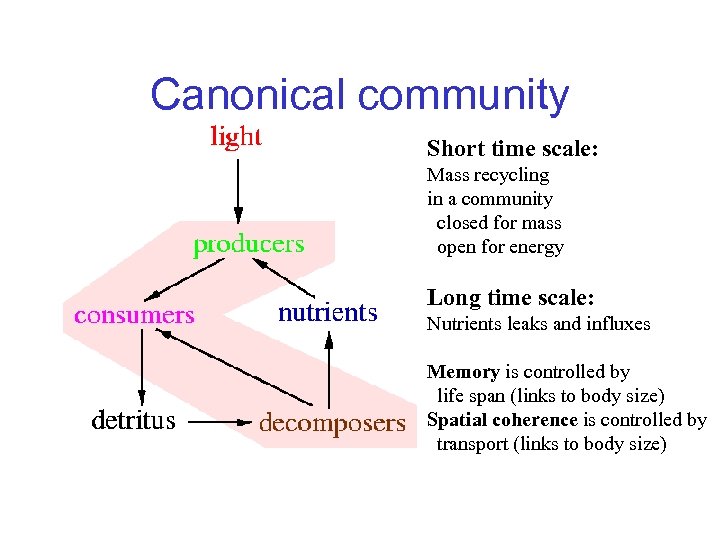 Canonical community Short time scale: Mass recycling in a community closed for mass open for energy Long time scale: Nutrients leaks and influxes Memory is controlled by life span (links to body size) Spatial coherence is controlled by transport (links to body size)
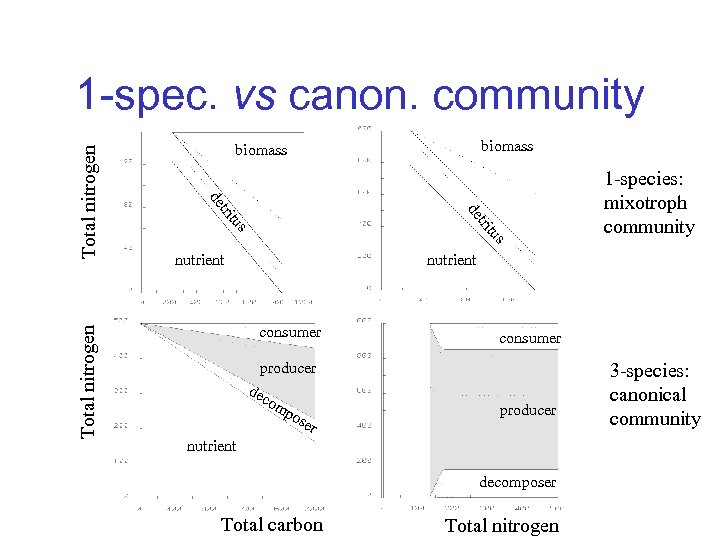 us t tri de t tri us Total nitrogen biomass de Total nitrogen 1 -spec. vs canon. community nutrient 1 -species: mixotroph community nutrient consumer producer dec om po ser producer nutrient decomposer Total carbon Total nitrogen 3 -species: canonical community
 Self organisation of ecosystems • homogeneous environment, closed for mass • start from mono-species community of mixotrophs • parameters constant for each individual • allow incremental deviations across generations link extensive parameters (body size segregation) • study speciation using adaptive dynamics • allow cannibalism/carnivory • study trophic food web/piramid: coupling of structure & function • study co-evolution of life, geochemical dynamics , climate Kooijman, Dijkstra, Kooi 2002 Light-induced mass turnover in a mono-species community of mixotrophs J. Theor. Biol. 214: 233 -254
 Climate affects marine plankton • temperature affects all physiological rates • nutrient supply via erosion from terrestrial systems water cycle ocean circulation (wind forcing, plate tectonics) wind-induced primary production • light availability (albedo) Climate change induces extinction and speciation in combination with biotic factors (competition)
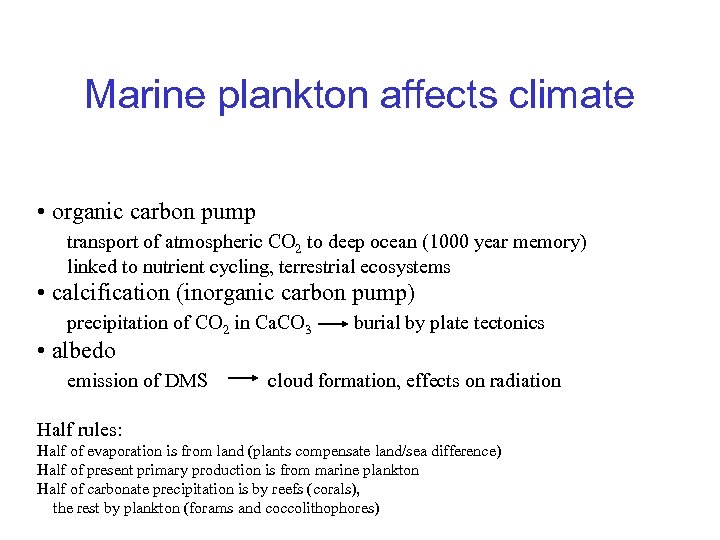 Marine plankton affects climate • organic carbon pump transport of atmospheric CO 2 to deep ocean (1000 year memory) linked to nutrient cycling, terrestrial ecosystems • calcification (inorganic carbon pump) precipitation of CO 2 in Ca. CO 3 burial by plate tectonics • albedo emission of DMS cloud formation, effects on radiation Half rules: Half of evaporation is from land (plants compensate land/sea difference) Half of present primary production is from marine plankton Half of carbonate precipitation is by reefs (corals), the rest by plankton (forams and coccolithophores)
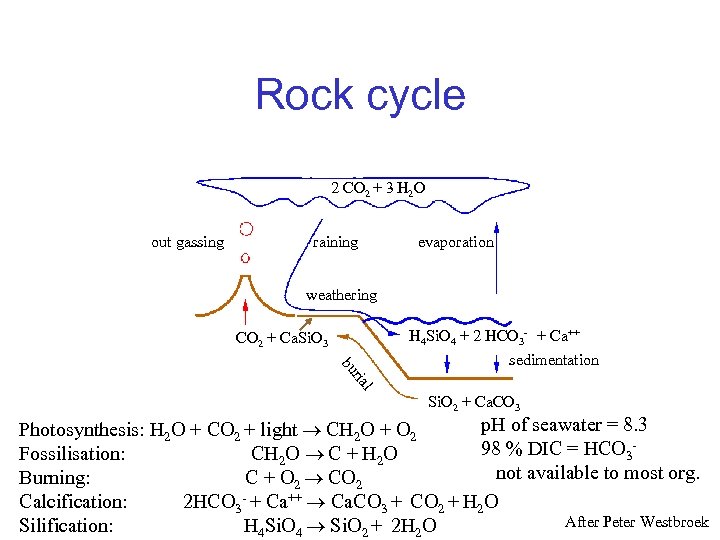 Rock cycle 2 CO 2 + 3 H 2 O out gassing raining evaporation weathering CO 2 + Ca. Si. O 3 ria bu H 4 Si. O 4 + 2 HCO 3 - + Ca++ sedimentation l Si. O 2 + Ca. CO 3 p. H of seawater = 8. 3 Photosynthesis: H 2 O + CO 2 + light CH 2 O + O 2 98 % DIC = HCO 3 Fossilisation: CH 2 O C + H 2 O not available to most org. Burning: C + O 2 CO 2 Calcification: 2 HCO 3 - + Ca++ Ca. CO 3 + CO 2 + H 2 O After Peter Westbroek Silification: H 4 Si. O 4 Si. O 2 + 2 H 2 O
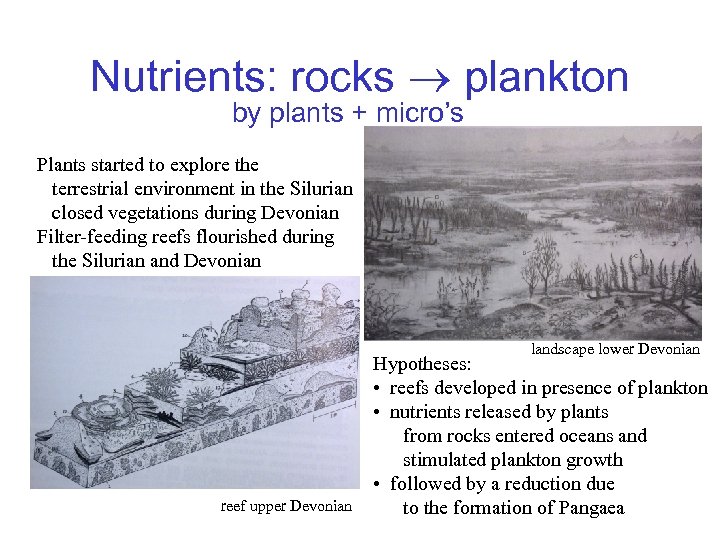 Nutrients: rocks plankton by plants + micro’s Plants started to explore the terrestrial environment in the Silurian closed vegetations during Devonian Filter-feeding reefs flourished during the Silurian and Devonian landscape lower Devonian reef upper Devonian Hypotheses: • reefs developed in presence of plankton • nutrients released by plants from rocks entered oceans and stimulated plankton growth • followed by a reduction due to the formation of Pangaea
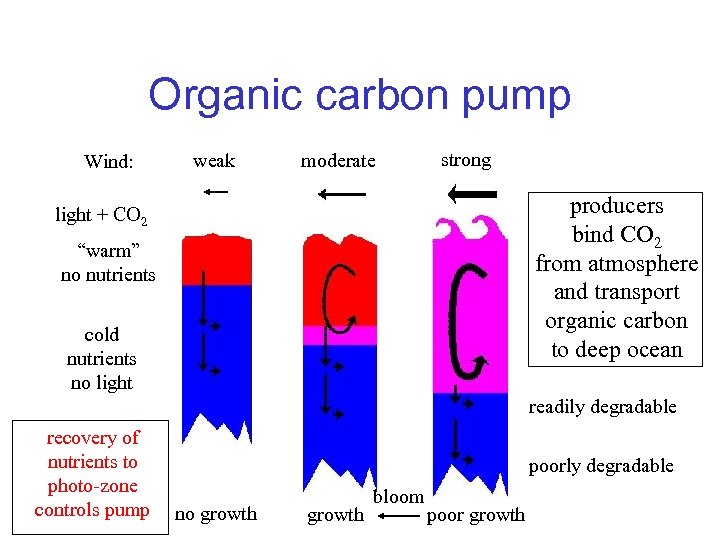 Organic carbon pump Wind: weak moderate strong producers bind CO 2 from atmosphere and transport organic carbon to deep ocean light + CO 2 “warm” no nutrients cold nutrients no light readily degradable recovery of nutrients to photo-zone controls pump poorly degradable no growth bloom poor growth
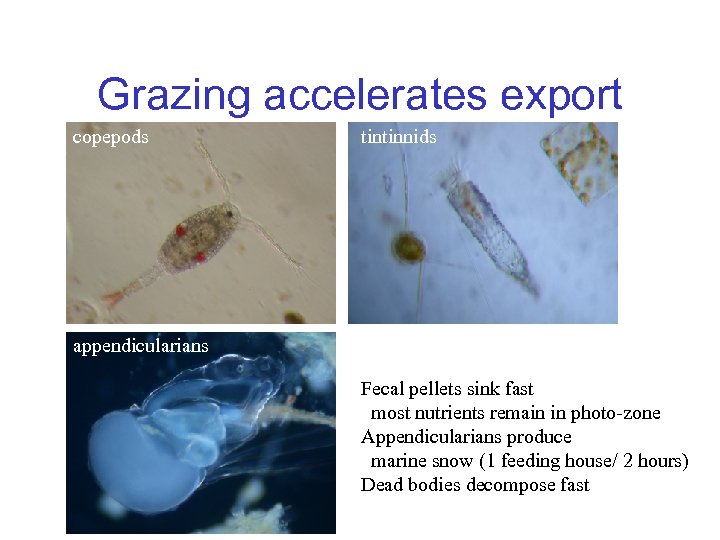 Grazing accelerates export copepods tintinnids appendicularians Fecal pellets sink fast most nutrients remain in photo-zone Appendicularians produce marine snow (1 feeding house/ 2 hours) Dead bodies decompose fast
 Some conclusions • • simultaneous nutrient limitations on producers’ growth is well captured by DEB theory based on SU’s surface area/volume interactions dominate (transport) kinetics on all space/time scales and are basic to DEB theory wind is in proximate control of primary production in oceans rate of organic carbon pump is controlled by nutrient recycling factors: sinking, decomposition, grazing need for clear time scale separation organic carbon pump is only of interest on time scale of ocean turnover calcification is important at longer time scales plants reduce erosion on short time scale, increase it on long time scale long term behaviour of ecosystems is controlled by leaks and inputs of nutrients, with important roles for continental drift and vulcanism climate-life interactions can only be understood in a holistic perspective coupling of biogeochemical cycles with climate (water, heat)
 Life climate interactions • H 2 O greenhouse gas # 1 plants pump H 2 O soil atmosphere; depends on latitude: heat equator poles; albedo increase water capacity by rock soil; erosion on small time scale; erosion on long time scale • CO 2 greenhouse gas # 2 corals, coccolithophorans, charophytes control Ca 2+ + 2 HCO 3 - Ca. CO 3 + CO 2 + H 2 O plankton pump CO 2 atmosphere deep ocean plants + plankton: fossilisation: CH 2 O C + H 2 O in anaerobic environments: coasts humans: C + O 2 CO 2 • CH 4 greenhouse gas # 3 methanogens presently produce 85 %; enhanced by humans via wood cutting & termites CH 4 + 2 O 2 CO 2 + H 2 O in stratosphere, where H 2 O intercepts radiation humans: CH 4 + O 2 CO 2 + H 2 O; pump CH 4 soil/sediment atmosphere • O 2 transformation driver cyanobacteria, plants, “algae”photosynthesis: CO 2 + H 2 O + light CH 2 O + O 2 Ozon UV shield: O 2 O 3 • C, H, O, N, . . cycles are coupled, partly by life Kooijman 2003 On the coevolution of life and climate. In: Miller et al Scientists on Gaia 2000 MIT Press, to appear
 DEB tele course 2013 http: //www. bio. vu. nl/thb/deb/ Free of financial costs; Some 108 or 216 h effort investment Program for 2013: Feb/Mar general theory (5 w) April symposium at NIOZ-Texel (NL) (8 d +3 d) Target audience: Ph. D students We encourage participation in groups who organize local meetings weekly Cambridge Univ Press 2009 Software package DEBtool for Octave/ Matlab freely downloadable Slides of this presentation are downloadable from http: //www. bio. vu. nl/thb/users/bas/lectures/ Audience: thank you for your attention