


 Скачать презентацию Level of population education and its economic consequences
6b88fc2758ff5b0bcdf912605398583d.ppt
- Количество слайдов: 20
 Level of population education and its economic consequences Ladislav Kulčár M. Bel University Banská Bystrica Faculty of Economics Institute of Managerial Systems Branch Poprad, Slovakia 1
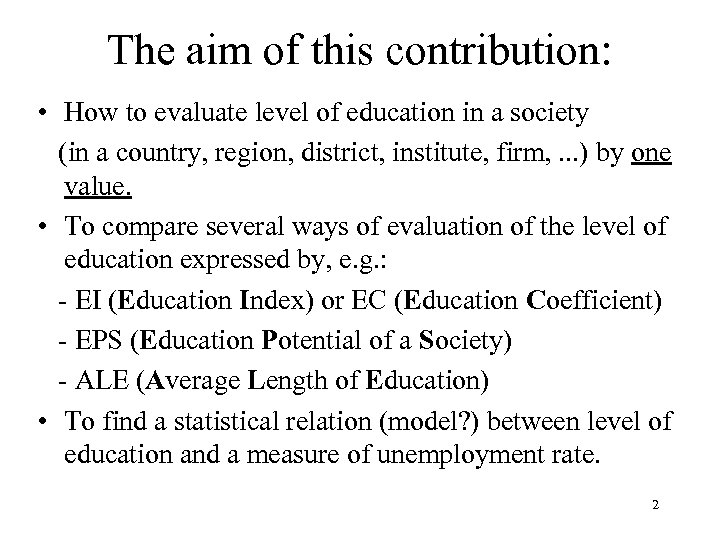 The aim of this contribution: • How to evaluate level of education in a society (in a country, region, district, institute, firm, . . . ) by one value. • To compare several ways of evaluation of the level of education expressed by, e. g. : - EI (Education Index) or EC (Education Coefficient) - EPS (Education Potential of a Society) - ALE (Average Length of Education) • To find a statistical relation (model? ) between level of education and a measure of unemployment rate. 2
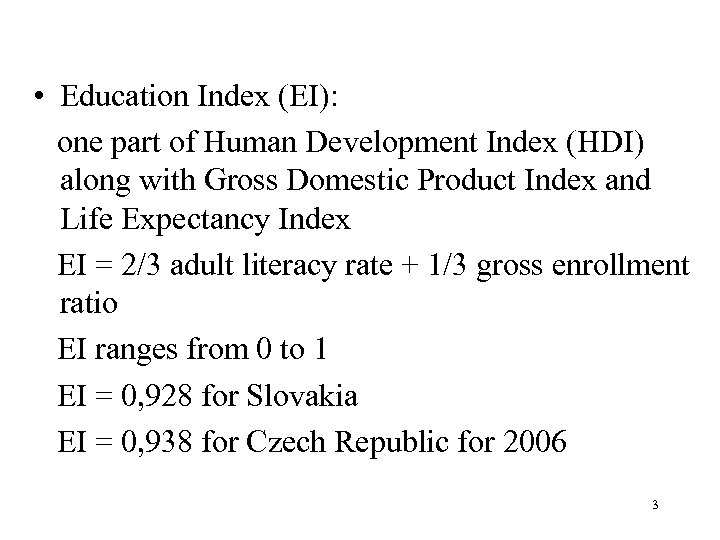 • Education Index (EI): one part of Human Development Index (HDI) along with Gross Domestic Product Index and Life Expectancy Index EI = 2/3 adult literacy rate + 1/3 gross enrollment ratio EI ranges from 0 to 1 EI = 0, 928 for Slovakia EI = 0, 938 for Czech Republic for 2006 3
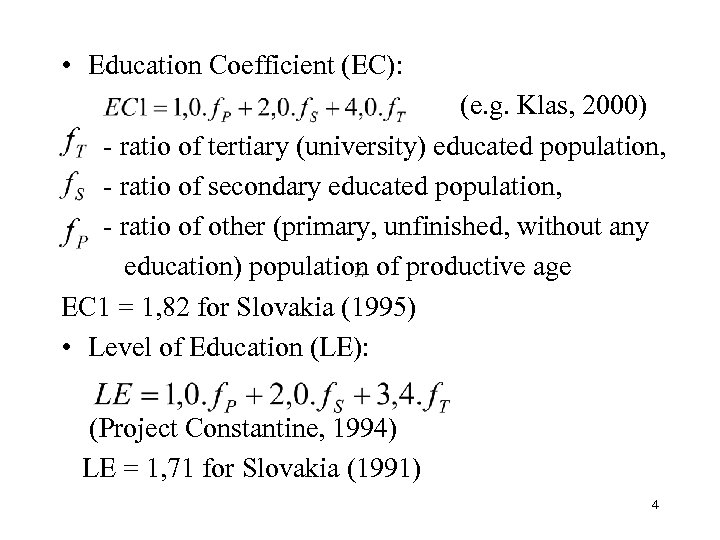 • Education Coefficient (EC): (e. g. Klas, 2000) - ratio of tertiary (university) educated population, - ratio of secondary educated population, - ratio of other (primary, unfinished, without any education) population of productive age EC 1 = 1, 82 for Slovakia (1995) • Level of Education (LE): (Project Constantine, 1994) LE = 1, 71 for Slovakia (1991) 4
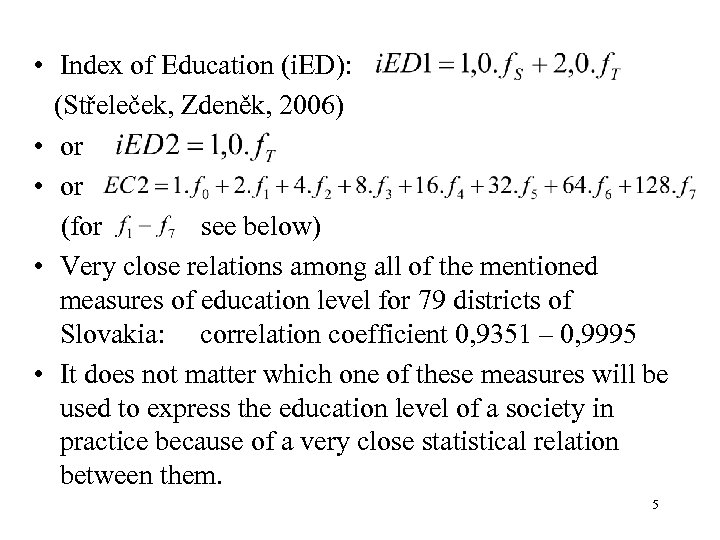 • Index of Education (i. ED): (Střeleček, Zdeněk, 2006) • or (for see below) • Very close relations among all of the mentioned measures of education level for 79 districts of Slovakia: correlation coefficient 0, 9351 – 0, 9995 • It does not matter which one of these measures will be used to express the education level of a society in practice because of a very close statistical relation between them. 5
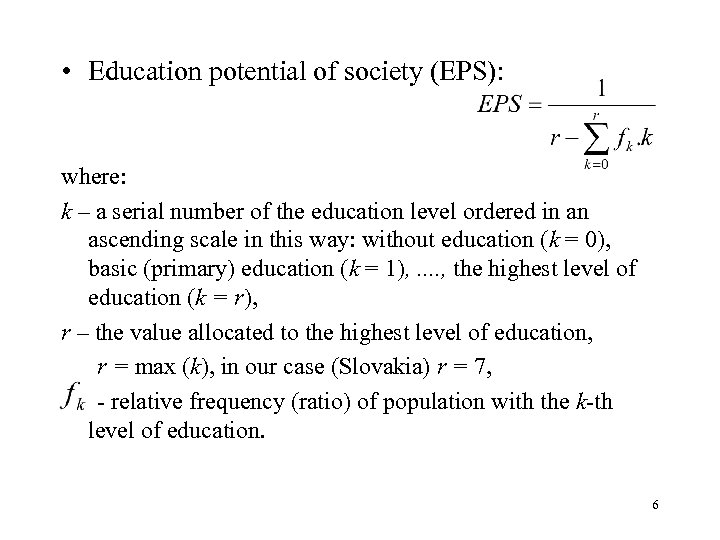 • Education potential of society (EPS): where: k – a serial number of the education level ordered in an ascending scale in this way: without education (k = 0), basic (primary) education (k = 1), . . , the highest level of education (k = r), r – the value allocated to the highest level of education, r = max (k), in our case (Slovakia) r = 7, - relative frequency (ratio) of population with the k-th level of education. 6
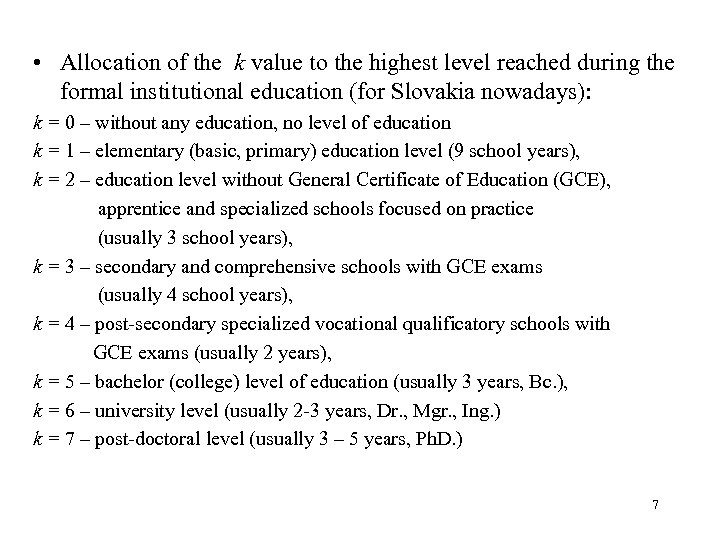 • Allocation of the k value to the highest level reached during the formal institutional education (for Slovakia nowadays): k = 0 – without any education, no level of education k = 1 – elementary (basic, primary) education level (9 school years), k = 2 – education level without General Certificate of Education (GCE), apprentice and specialized schools focused on practice (usually 3 school years), k = 3 – secondary and comprehensive schools with GCE exams (usually 4 school years), k = 4 – post-secondary specialized vocational qualificatory schools with GCE exams (usually 2 years), k = 5 – bachelor (college) level of education (usually 3 years, Bc. ), k = 6 – university level (usually 2 -3 years, Dr. , Mgr. , Ing. ) k = 7 – post-doctoral level (usually 3 – 5 years, Ph. D. ) 7
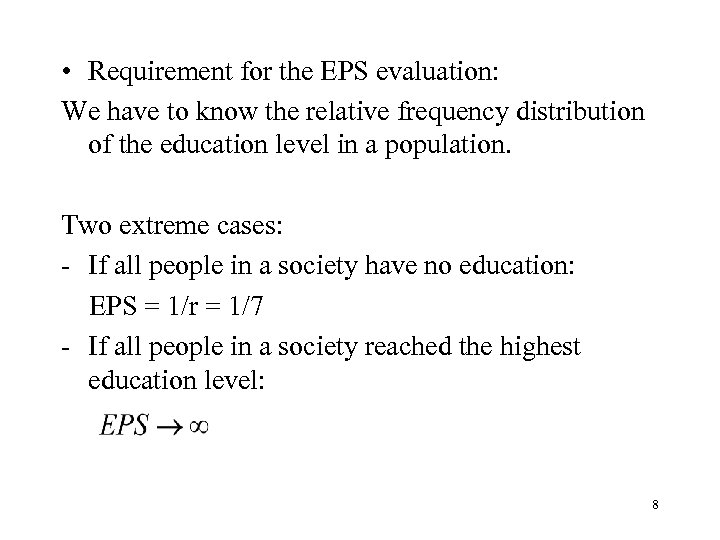 • Requirement for the EPS evaluation: We have to know the relative frequency distribution of the education level in a population. Two extreme cases: - If all people in a society have no education: EPS = 1/r = 1/7 - If all people in a society reached the highest education level: 8
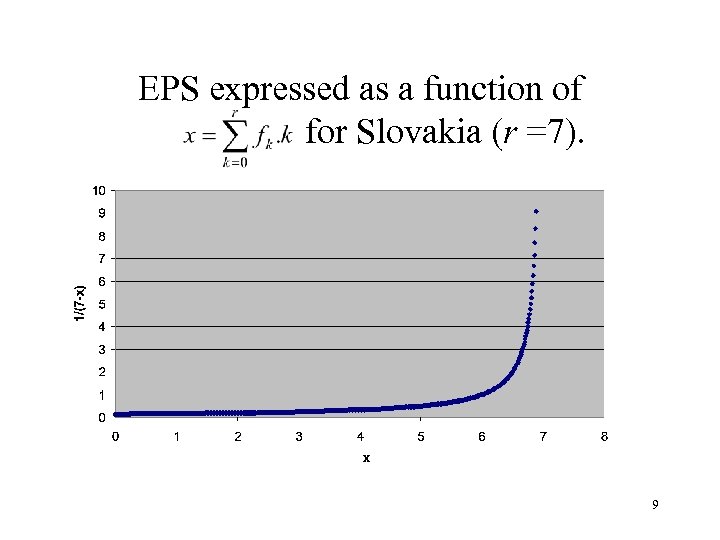 EPS expressed as a function of for Slovakia (r =7). 9
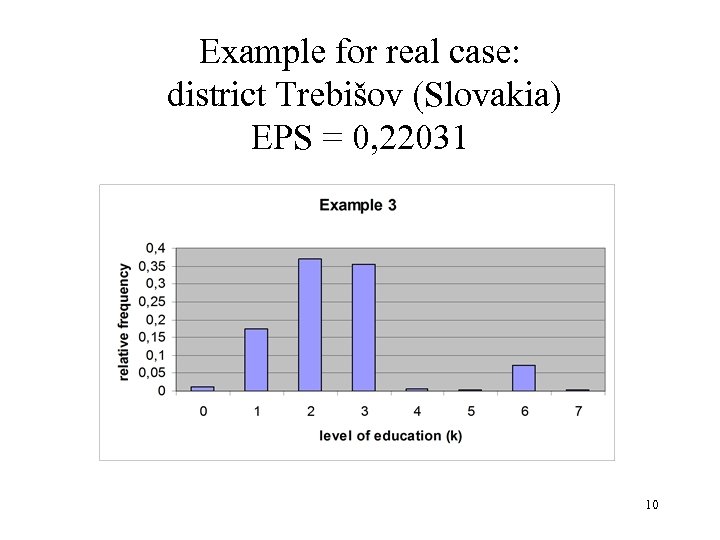 Example for real case: district Trebišov (Slovakia) EPS = 0, 22031 10
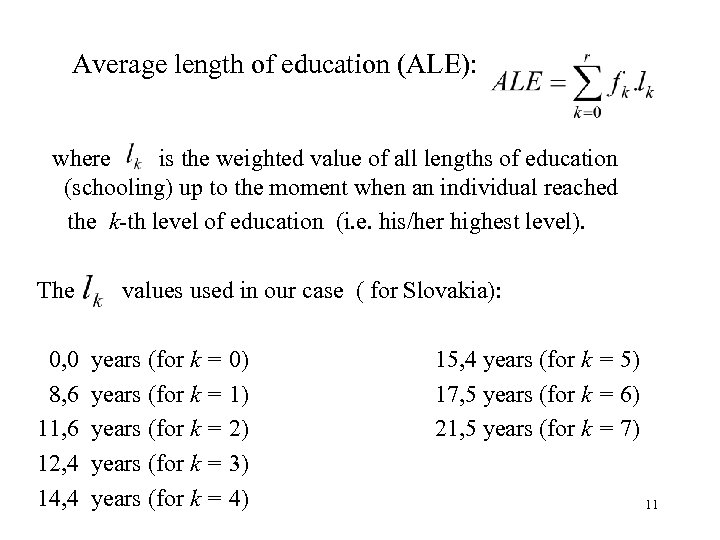 Average length of education (ALE): where is the weighted value of all lengths of education (schooling) up to the moment when an individual reached the k-th level of education (i. e. his/her highest level). The values used in our case ( for Slovakia): 0, 0 years (for k = 0) 15, 4 years (for k = 5) 8, 6 years (for k = 1) 17, 5 years (for k = 6) 11, 6 years (for k = 2) 21, 5 years (for k = 7) 12, 4 years (for k = 3) 14, 4 years (for k = 4) 11
 Education level and unemployment rate in Slovakia (2001) • Our aim: To find statistical model based on mutual relation between ALE and UE values for Slovakia • Problem: Unemployment rate is much more sensitive in time than level of education 12
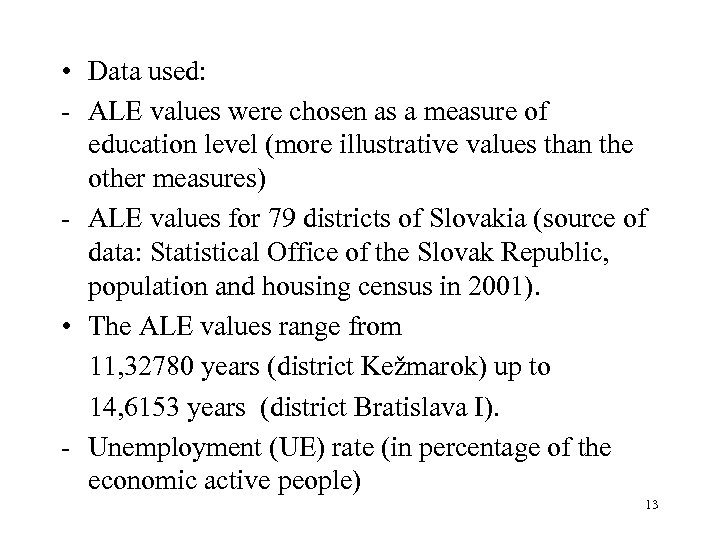 • Data used: - ALE values were chosen as a measure of education level (more illustrative values than the other measures) - ALE values for 79 districts of Slovakia (source of data: Statistical Office of the Slovak Republic, population and housing census in 2001). • The ALE values range from 11, 32780 years (district Kežmarok) up to 14, 6153 years (district Bratislava I). - Unemployment (UE) rate (in percentage of the economic active people) 13
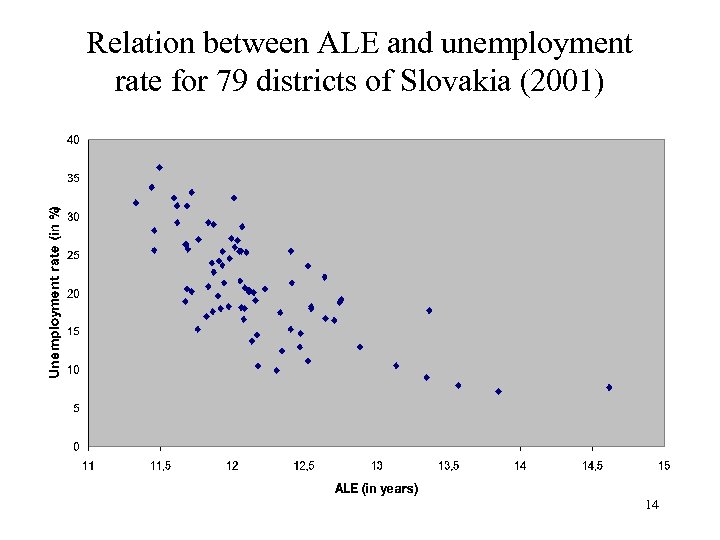 Relation between ALE and unemployment rate for 79 districts of Slovakia (2001) 14
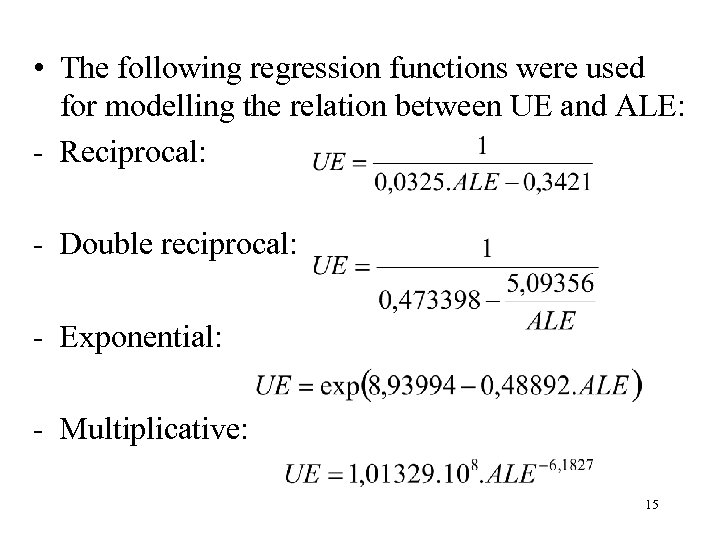 • The following regression functions were used for modelling the relation between UE and ALE: - Reciprocal: - Double reciprocal: - Exponential: - Multiplicative: 15
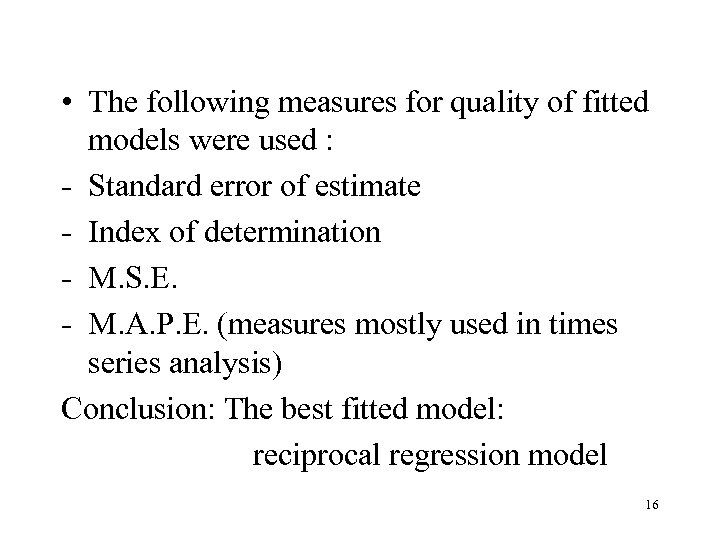 • The following measures for quality of fitted models were used : - Standard error of estimate - Index of determination - M. S. E. - M. A. P. E. (measures mostly used in times series analysis) Conclusion: The best fitted model: reciprocal regression model 16
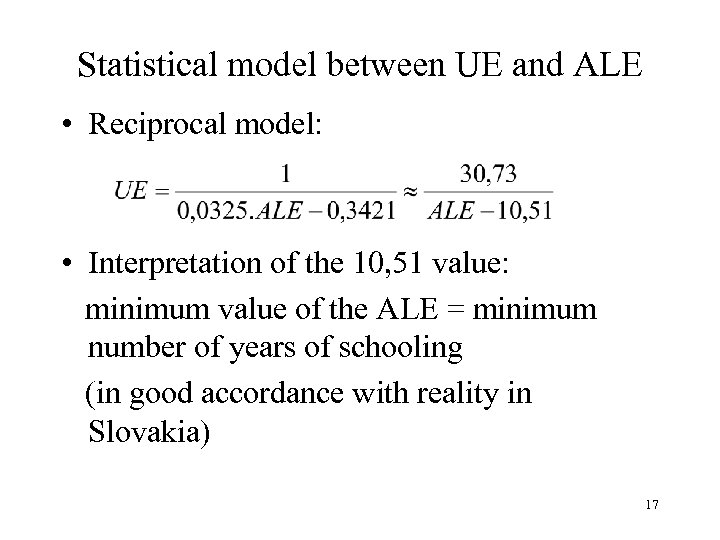 Statistical model between UE and ALE • Reciprocal model: • Interpretation of the 10, 51 value: minimum value of the ALE = minimum number of years of schooling (in good accordance with reality in Slovakia) 17
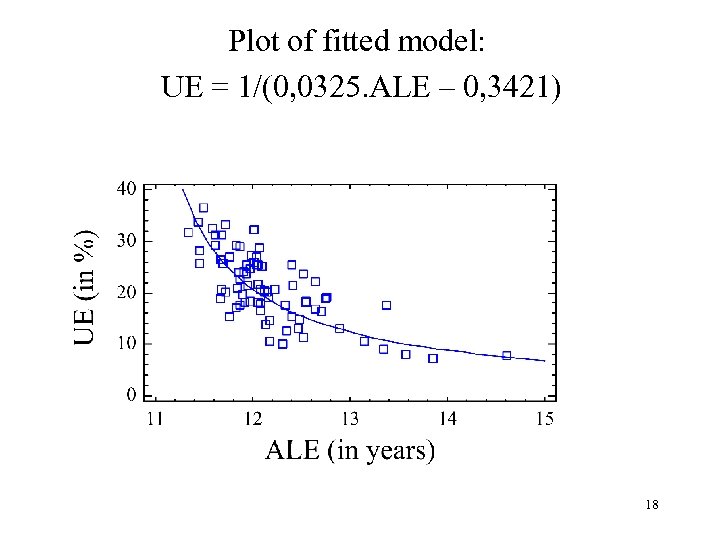 Plot of fitted model: UE = 1/(0, 0325. ALE – 0, 3421) 18
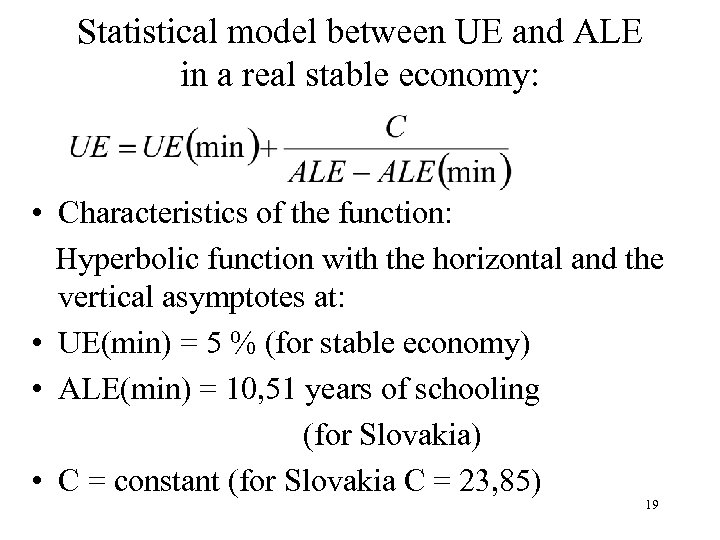 Statistical model between UE and ALE in a real stable economy: • Characteristics of the function: Hyperbolic function with the horizontal and the vertical asymptotes at: • UE(min) = 5 % (for stable economy) • ALE(min) = 10, 51 years of schooling (for Slovakia) • C = constant (for Slovakia C = 23, 85) 19
 Thank you for your attention 20