 Скачать презентацию Level 3 Certificate in Coaching Badminton Module 4
c9da98169c1fbe47f8900cf47c2b612c.ppt
- Количество слайдов: 37



Level 3 Certificate in Coaching Badminton Module 4, Day 1 Performance Factors 3: Technical training 1
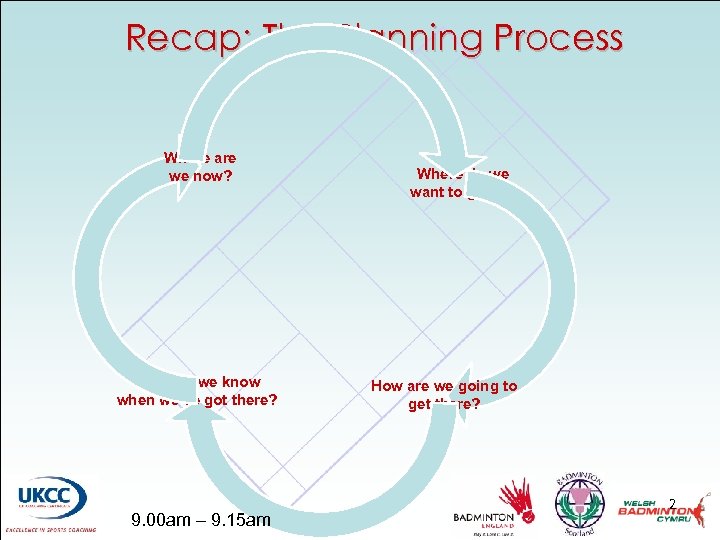
Recap: The Planning Process Where are we now? How will we know when we’ve got there? 9. 00 am – 9. 15 am Where do we want to get to? How are we going to get there? 2
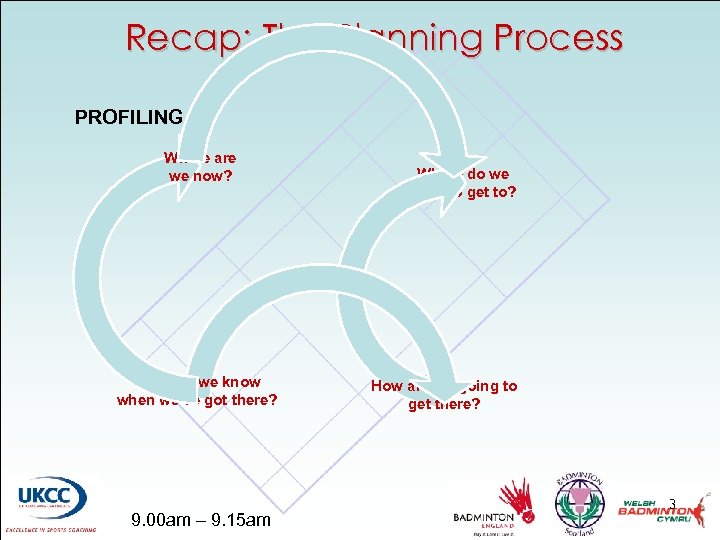
Recap: The Planning Process PROFILING Where are we now? How will we know when we’ve got there? 9. 00 am – 9. 15 am Where do we want to get to? How are we going to get there? 3
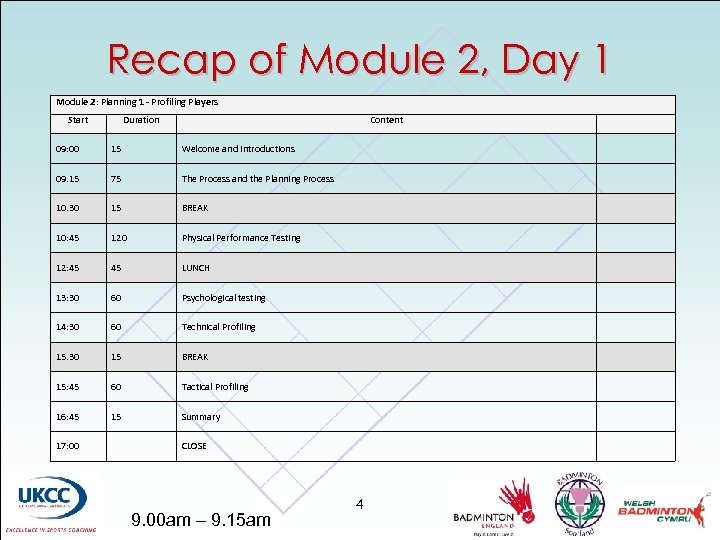
Recap of Module 2, Day 1 Module 2: Planning 1 - Profiling Players Start Duration Content 09: 00 15 Welcome and Introductions 09. 15 75 The Process and the Planning Process 10. 30 15 BREAK 10: 45 120 Physical Performance Testing 12: 45 45 LUNCH 13: 30 60 Psychological testing 14: 30 60 Technical Profiling 15. 30 15 BREAK 15: 45 60 Tactical Profiling 16: 45 15 Summary 17: 00 CLOSE 9. 00 am – 9. 15 am 4
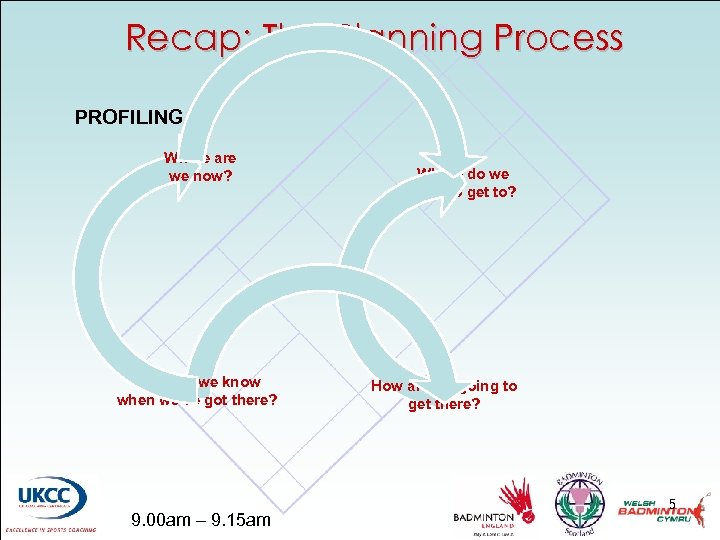
Recap: The Planning Process PROFILING Where are we now? How will we know when we’ve got there? 9. 00 am – 9. 15 am Where do we want to get to? How are we going to get there? 5
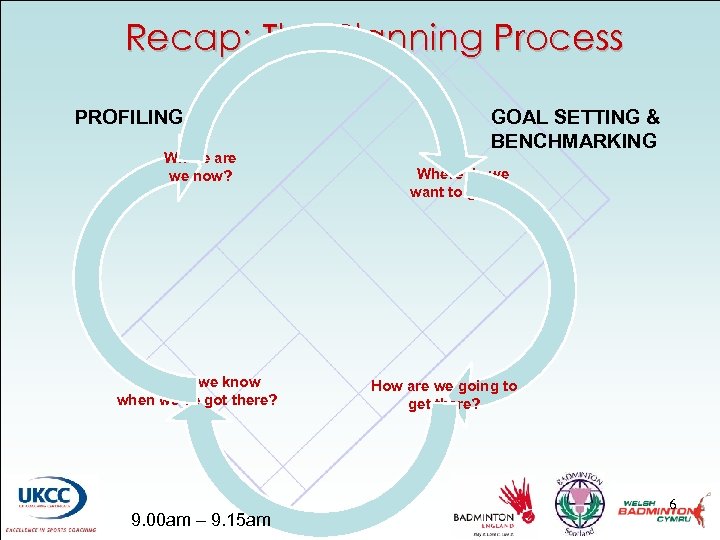
Recap: The Planning Process PROFILING Where are we now? How will we know when we’ve got there? 9. 00 am – 9. 15 am GOAL SETTING & BENCHMARKING Where do we want to get to? How are we going to get there? 6
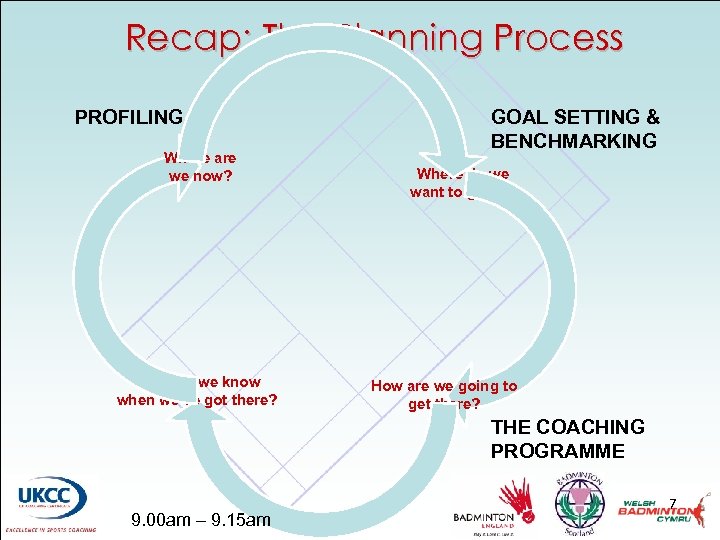
Recap: The Planning Process PROFILING Where are we now? How will we know when we’ve got there? GOAL SETTING & BENCHMARKING Where do we want to get to? How are we going to get there? THE COACHING PROGRAMME 9. 00 am – 9. 15 am 7
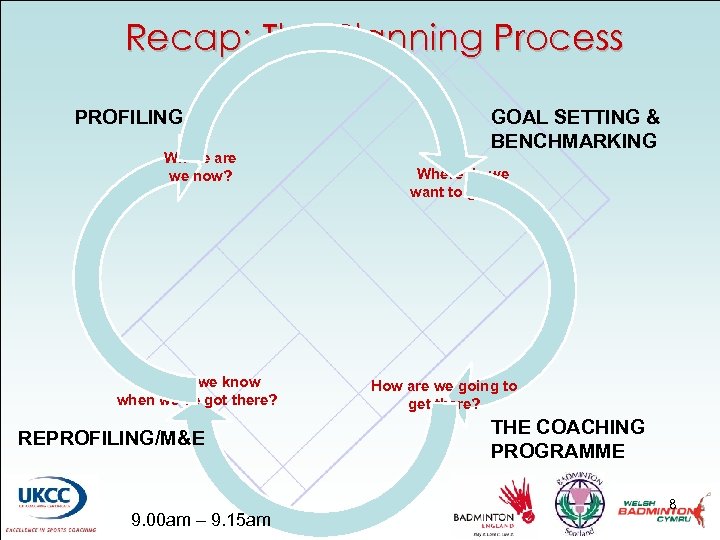
Recap: The Planning Process PROFILING Where are we now? How will we know when we’ve got there? REPROFILING/M&E 9. 00 am – 9. 15 am GOAL SETTING & BENCHMARKING Where do we want to get to? How are we going to get there? THE COACHING PROGRAMME 8
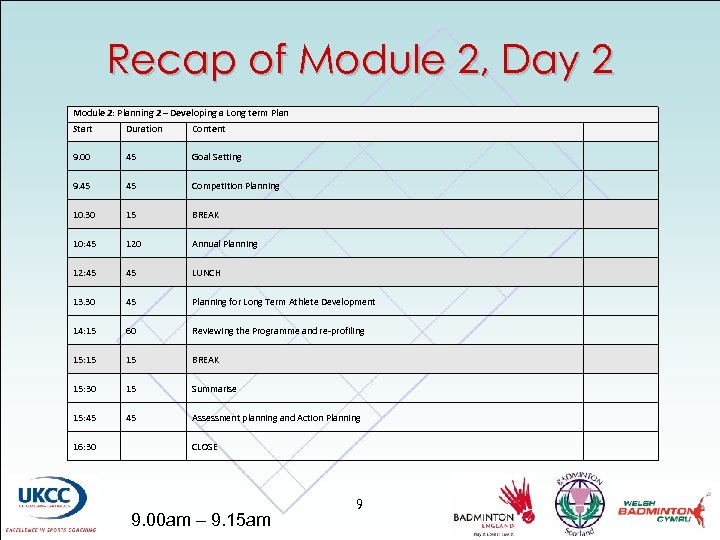
Recap of Module 2, Day 2 Module 2: Planning 2 – Developing a Long term Plan Start Duration Content 9. 00 45 Goal Setting 9. 45 45 Competition Planning 10. 30 15 BREAK 10: 45 120 Annual Planning 12: 45 45 LUNCH 13. 30 45 Planning for Long Term Athlete Development 14: 15 60 Reviewing the Programme and re-profiling 15: 15 15 BREAK 15: 30 15 Summarise 15: 45 45 Assessment planning and Action Planning 16: 30 CLOSE 9. 00 am – 9. 15 am 9
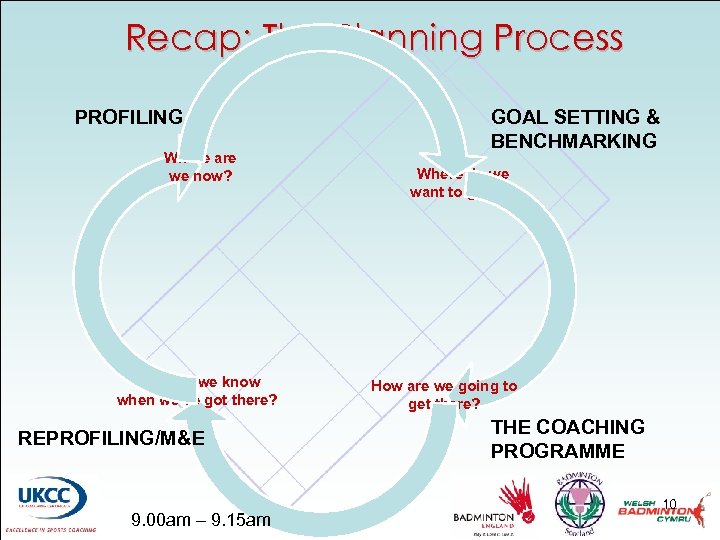
Recap: The Planning Process PROFILING Where are we now? How will we know when we’ve got there? REPROFILING/M&E 9. 00 am – 9. 15 am GOAL SETTING & BENCHMARKING Where do we want to get to? How are we going to get there? THE COACHING PROGRAMME 10
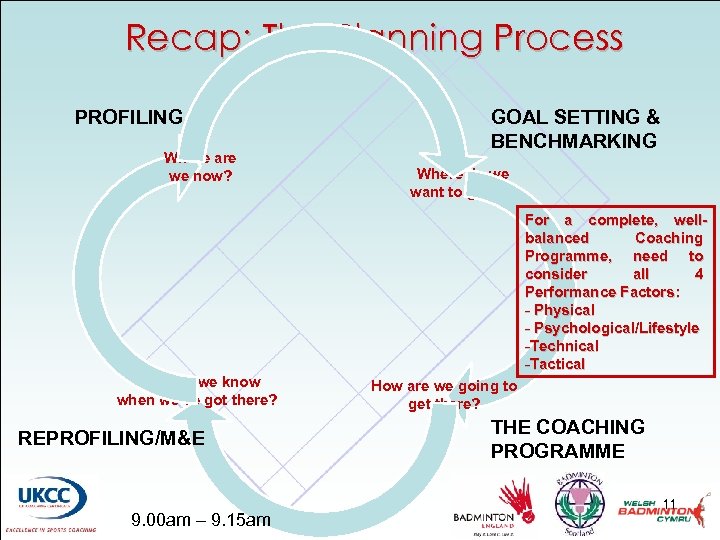
Recap: The Planning Process PROFILING Where are we now? GOAL SETTING & BENCHMARKING Where do we want to get to? For a complete, wellbalanced Coaching Programme, need to consider all 4 Performance Factors: - Physical - Psychological/Lifestyle -Technical -Tactical How will we know when we’ve got there? REPROFILING/M&E 9. 00 am – 9. 15 am How are we going to get there? THE COACHING PROGRAMME 11
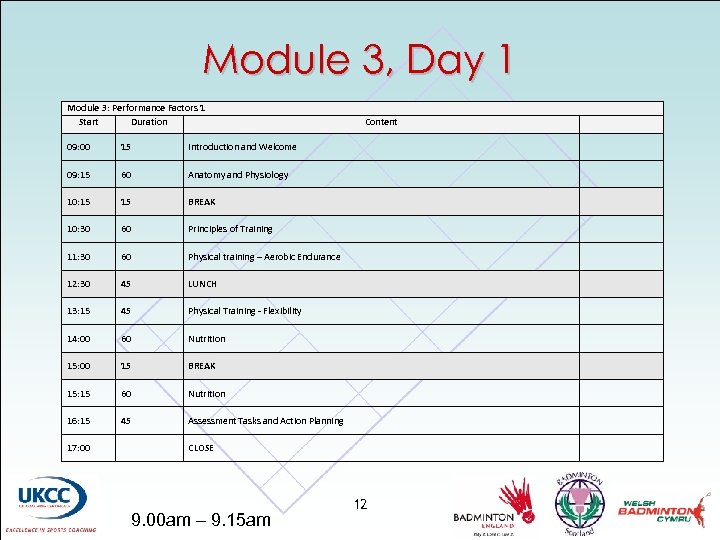
Module 3, Day 1 Module 3: Performance Factors 1 Start Duration 09: 00 15 Introduction and Welcome 09: 15 60 Anatomy and Physiology 10: 15 15 BREAK 10: 30 60 Principles of Training 11: 30 60 Physical training – Aerobic Endurance 12: 30 45 LUNCH 13: 15 45 Physical Training - Flexibility 14: 00 60 Nutrition 15: 00 15 BREAK 15: 15 60 Nutrition 16: 15 45 Content Assessment Tasks and Action Planning 17: 00 CLOSE 9. 00 am – 9. 15 am 12
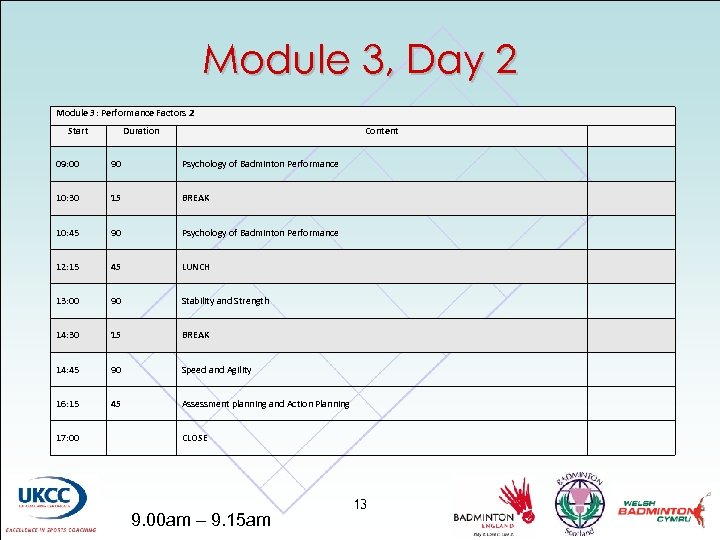
Module 3, Day 2 Module 3: Performance Factors 2 Start Duration Content 09: 00 90 Psychology of Badminton Performance 10: 30 15 BREAK 10: 45 90 Psychology of Badminton Performance 12: 15 45 LUNCH 13: 00 90 Stability and Strength 14: 30 15 BREAK 14: 45 90 Speed and Agility 16: 15 45 Assessment planning and Action Planning 17: 00 CLOSE 9. 00 am – 9. 15 am 13
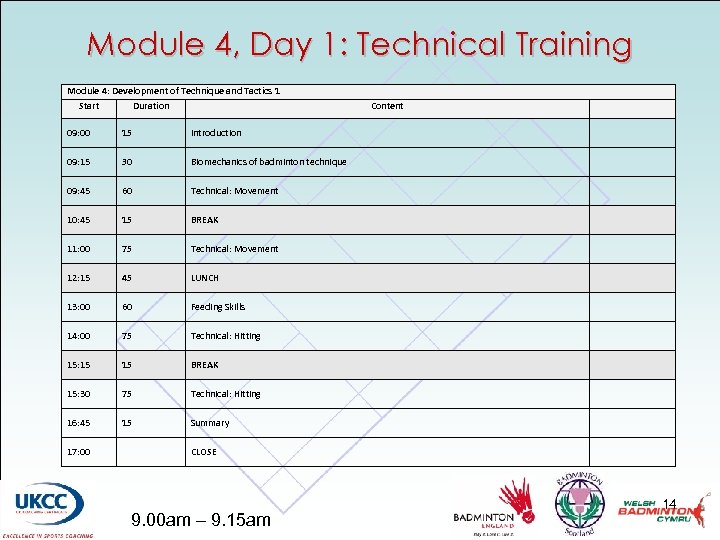
Module 4, Day 1: Technical Training Module 4: Development of Technique and Tactics 1 Start Duration Content 09: 00 15 Introduction 09: 15 30 Biomechanics of badminton technique 09: 45 60 Technical: Movement 10: 45 15 BREAK 11: 00 75 Technical: Movement 12: 15 45 LUNCH 13: 00 60 Feeding Skills 14: 00 75 Technical: Hitting 15: 15 15 BREAK 15: 30 75 Technical: Hitting 16: 45 15 Summary 17: 00 CLOSE 9. 00 am – 9. 15 am 14
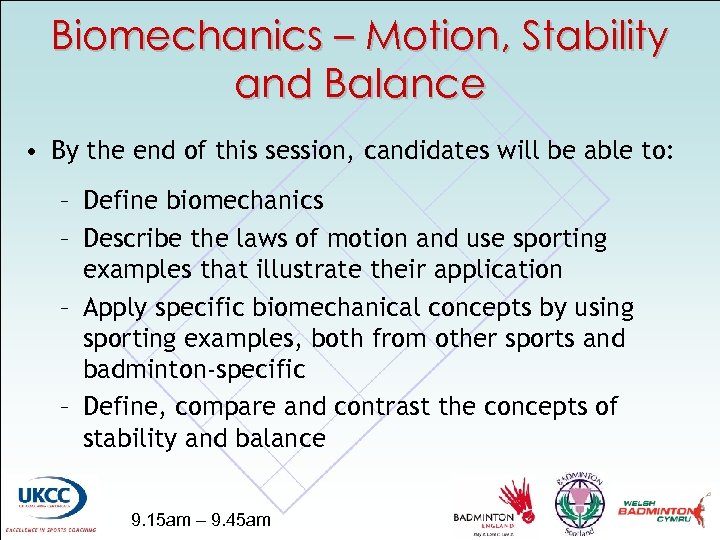
Biomechanics – Motion, Stability and Balance • By the end of this session, candidates will be able to: – Define biomechanics – Describe the laws of motion and use sporting examples that illustrate their application – Apply specific biomechanical concepts by using sporting examples, both from other sports and badminton-specific – Define, compare and contrast the concepts of stability and balance 9. 15 am – 9. 45 am
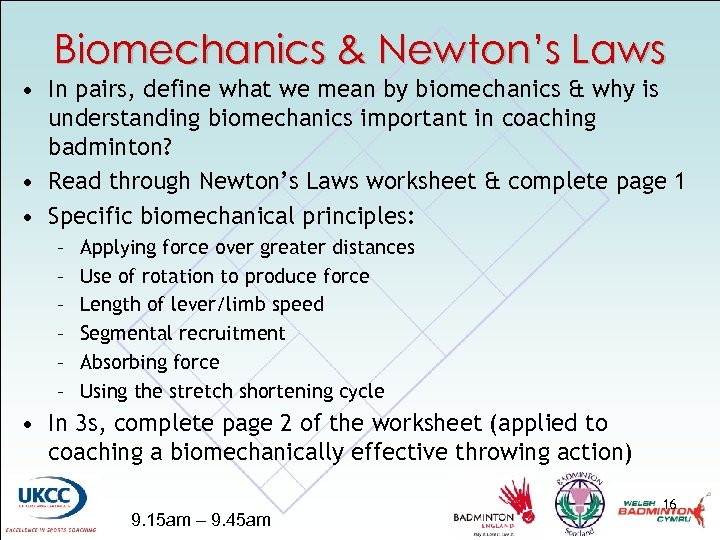
Biomechanics & Newton’s Laws • In pairs, define what we mean by biomechanics & why is understanding biomechanics important in coaching badminton? • Read through Newton’s Laws worksheet & complete page 1 • Specific biomechanical principles: – – – Applying force over greater distances Use of rotation to produce force Length of lever/limb speed Segmental recruitment Absorbing force Using the stretch shortening cycle • In 3 s, complete page 2 of the worksheet (applied to coaching a biomechanically effective throwing action) 9. 15 am – 9. 45 am 16
Biomechanics & Newton’s Laws • Stability is the ability to resist movement • In pairs, practical methods to improve stability, e. g. in defence • Also, how would you define balance (& static/dynamic)? 9. 15 am – 9. 45 am 17
Biomechanics & Newton’s Laws • Stability is the ability to resist movement • In pairs, practical methods to improve stability, e. g. in defence • Also, how would you define balance (& static/dynamic)? • Balance is the ability to control equilibrium – Static balance: Ability to maintain equilibrium – Dynamic balance: Ability to flow in and out of equilibrium • In pairs, consider following equations and illustrate with example(s): – Stability = ? Static balance – Stability = ? Dynamic balance 9. 15 am – 9. 45 am 18
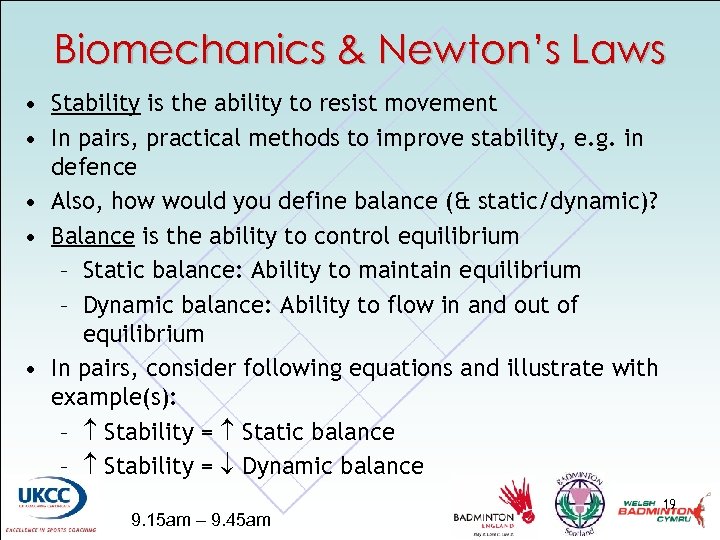
Biomechanics & Newton’s Laws • Stability is the ability to resist movement • In pairs, practical methods to improve stability, e. g. in defence • Also, how would you define balance (& static/dynamic)? • Balance is the ability to control equilibrium – Static balance: Ability to maintain equilibrium – Dynamic balance: Ability to flow in and out of equilibrium • In pairs, consider following equations and illustrate with example(s): – Stability = Static balance – Stability = Dynamic balance 9. 15 am – 9. 45 am 19
Technical Training – Movement • Recap of Module 2 – Stages of technical development (benchmarks) – 4 year – correct shapes & patterns when compared to recognised technical models, sustained under largely predictable environments – 8 years – economy, consistency and control in match-like conditions against their peers – 12 years – excellent control at extreme pace • Movement components at each stage of stroke cycle • In 3 s, complete Worksheet (Question 1) – what types of movements do you see? – what are the attributes of a quality mover? 9. 45 am – 9. 55 am 20
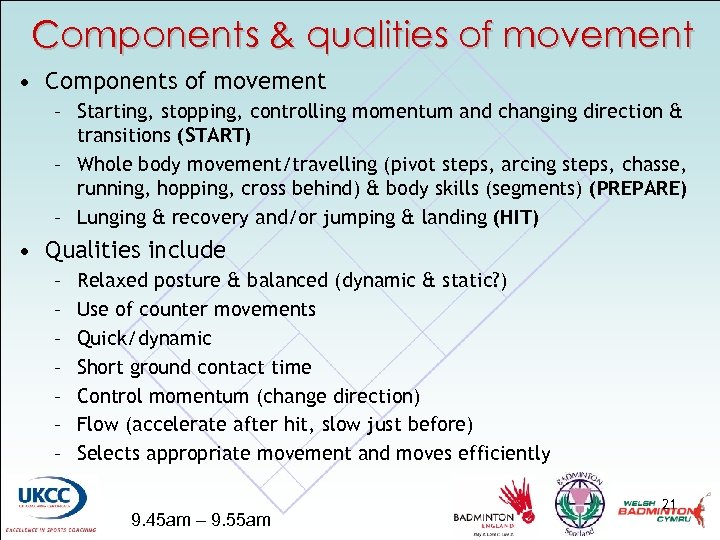
Components & qualities of movement • Components of movement – Starting, stopping, controlling momentum and changing direction & transitions (START) – Whole body movement/travelling (pivot steps, arcing steps, chasse, running, hopping, cross behind) & body skills (segments) (PREPARE) – Lunging & recovery and/or jumping & landing (HIT) • Qualities include – – – – Relaxed posture & balanced (dynamic & static? ) Use of counter movements Quick/dynamic Short ground contact time Control momentum (change direction) Flow (accelerate after hit, slow just before) Selects appropriate movement and moves efficiently 9. 45 am – 9. 55 am 21
Identifying typical movement patterns • In 3 groups, identify and demonstrate key movement patterns (full stroke cycle): – Group A: From bases to FC corners – Group B: From bases to RC corners – Group C: Long diagonals & long distances • Same groups, all consider: – Examples of Newton’s Laws applied to badminton movement – Differences between singles & doubles movement skills – Worksheet question 2 9. 55 am – 10. 30 am 22
Movement & biomechanics • Same groups, observe 5 demonstrations – Analyse badminton movements by applying underpinning biomechanical principles – Briefly discuss findings after each demo 10. 30 am – 10. 45 am 23
Movement & biomechanics • Same groups, observe 5 demonstrations – Analyse badminton movements by applying underpinning biomechanical principles – Briefly discuss findings after each demo • Should have observed the following: – 1. No split drop or slowing down before the opponent’s hit – 2. Diagonal jumps taking off the wrong foot and with a heavy landing on the racket leg (often falling out of court) – 3. Over-chasseing around the court – 4. Collapsing and misaligned lunge – 5. Step back on F/H overheads 10. 30 am – 10. 45 am 24
Devising effective technical practices • “An effective set of practices will progress in such a way that allow the player to experience success at all stages” • “An effective set of practices will put the players in a situation where they cannot help but succeed” • In 2 s/3 s, (a) discuss why this is effective coaching practice and (b) general guidelines for progressing practices 10. 45 am – 11. 15 am 25
Devising effective technical practices • STEP variables that can be used to progress practices (i. e. make easier or harder) are – – Space in which practice takes place Type of activity Equipment used People involved • For a given set of variables, practices should be progressed from – Simple to complex – Slow to quick – Closed to open 10. 45 am – 11. 15 am 26
Devising effective technical practices • In pairs, devise series of progressive practices to help a player overcome one of the movement challenges demonstrated in the previous section • “An effective set of practices will put the players in a situation where they cannot help but succeed” • Practices must start very simple and finish with a complex practice involving striking the shuttle (as a minimum) • BREAK – 11. 15 am – 11. 30 am • Candidates demonstrate and deliver technical practices – Discuss appropriateness of progressions – Do the practices provide credible opportunities for players to experience success at every stage? 10. 45 am – 12. 30 pm 27
Lunch 12. 30 pm – 1. 15 pm 28
Feeding skills • In 2 s/3 s: – How would you define “effective feeding”? – Contrast advantages and disadvantages of multi -feeding and continuous rallying – Discuss ways a feed can be varied to support progression 1. 15 pm – 2. 00 pm 29
Feeding skills • “Effective feeding” – the ability to deliver the shuttle consistently to the required area, so that players are given meaningful practice opportunities • Ways a feed may be varied – Power, trajectory, predictability, frequency • Demonstration of underarm and overarm multi-feed techniques • Multi-feed challenges in pairs: – Using an underarm multi-feed: Improve player’s ability to look for attacking opportunities in the FC after F/H smash – Using an overarm multi-feed: Improve player’s (a) F/H defence, (b) B/H defence and (c) ability to rapidly change grip in defence 1. 15 pm – 2. 00 pm 30
Technical Training – Hitting • Recap of Module 2 – Stages of technical development (benchmarks) – 4 year – correct shapes & patterns when compared to recognised technical models, sustained under largely predictable environments – 8 years – economy, consistency and control in match-like conditions against their peers – 12 years – excellent control at extreme pace • In 2 s/3 s, discuss – Grips on F/H side when racket is above and below hand when shuttle is (a) in front, (b) at side and (c) behind body – Grips on B/H side when racket is above and below hand when shuttle is (a) in front, (b) at side and (c) behind body – What is it that ultimately determines grip? 2. 00 pm – 2. 15 pm 31
Technical Training – Hitting • Basic principles that underpin hitting (see Worksheet): – 1. There are thousands of grips – 2. Either hit through the shuttle or across the shuttle (by adjusting the racket face) • In pairs, observe 5 demonstrations – Analyse badminton hitting by applying underpinning biomechanical principles and/or grip principles (note observations on Worksheet) – Briefly discuss findings after each demo • Observe and analyse by: – – – Breaking action down into smaller phases Observe several times from different angles Compare against recognised technical model Select specific technical element to work on Identify the relevant biomechanical principles 2. 15 pm – 2. 45 pm 32
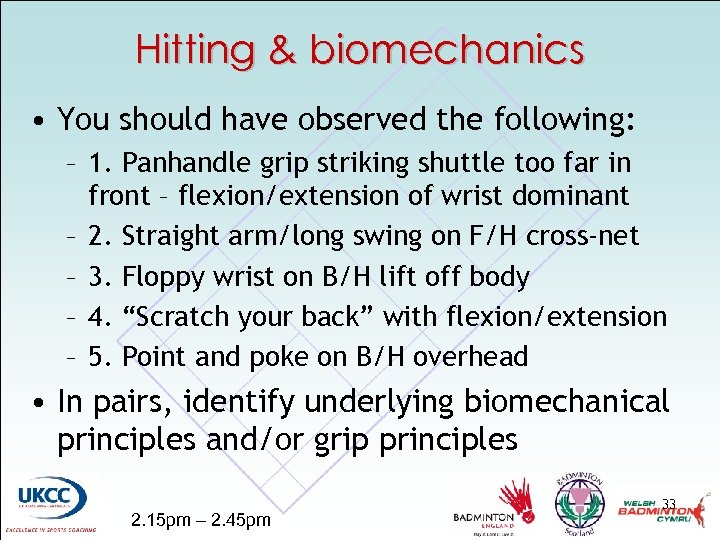
Hitting & biomechanics • You should have observed the following: – 1. Panhandle grip striking shuttle too far in front – flexion/extension of wrist dominant – 2. Straight arm/long swing on F/H cross-net – 3. Floppy wrist on B/H lift off body – 4. “Scratch your back” with flexion/extension – 5. Point and poke on B/H overhead • In pairs, identify underlying biomechanical principles and/or grip principles 2. 15 pm – 2. 45 pm 33
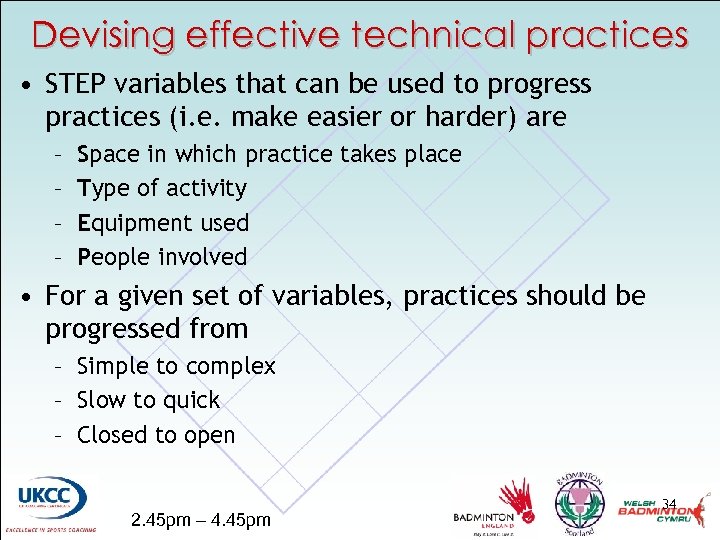
Devising effective technical practices • STEP variables that can be used to progress practices (i. e. make easier or harder) are – – Space in which practice takes place Type of activity Equipment used People involved • For a given set of variables, practices should be progressed from – Simple to complex – Slow to quick – Closed to open 2. 45 pm – 4. 45 pm 34
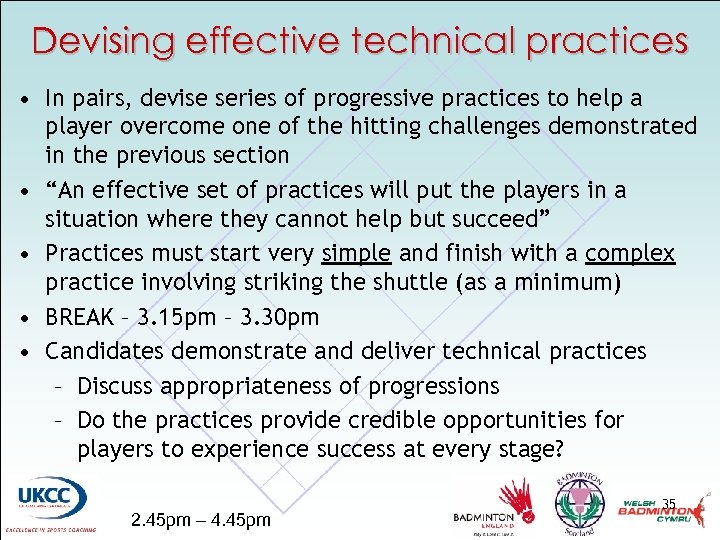
Devising effective technical practices • In pairs, devise series of progressive practices to help a player overcome one of the hitting challenges demonstrated in the previous section • “An effective set of practices will put the players in a situation where they cannot help but succeed” • Practices must start very simple and finish with a complex practice involving striking the shuttle (as a minimum) • BREAK – 3. 15 pm – 3. 30 pm • Candidates demonstrate and deliver technical practices – Discuss appropriateness of progressions – Do the practices provide credible opportunities for players to experience success at every stage? 2. 45 pm – 4. 45 pm 35
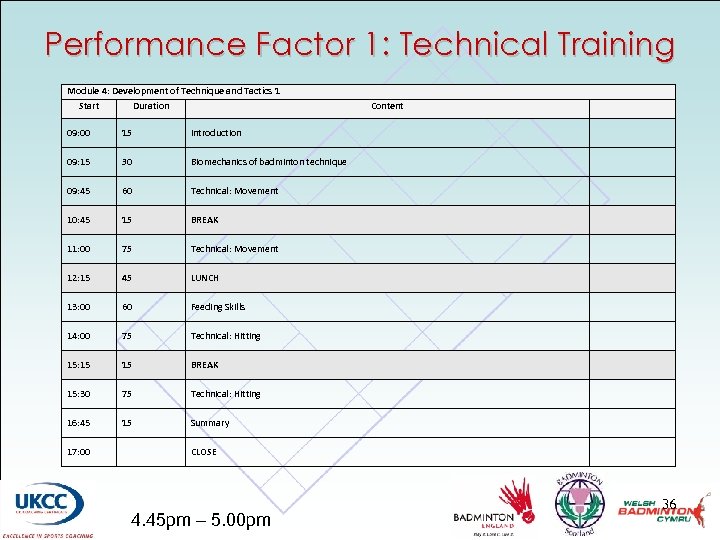
Performance Factor 1: Technical Training Module 4: Development of Technique and Tactics 1 Start Duration Content 09: 00 15 Introduction 09: 15 30 Biomechanics of badminton technique 09: 45 60 Technical: Movement 10: 45 15 BREAK 11: 00 75 Technical: Movement 12: 15 45 LUNCH 13: 00 60 Feeding Skills 14: 00 75 Technical: Hitting 15: 15 15 BREAK 15: 30 75 Technical: Hitting 16: 45 15 Summary 17: 00 CLOSE 4. 45 pm – 5. 00 pm 36
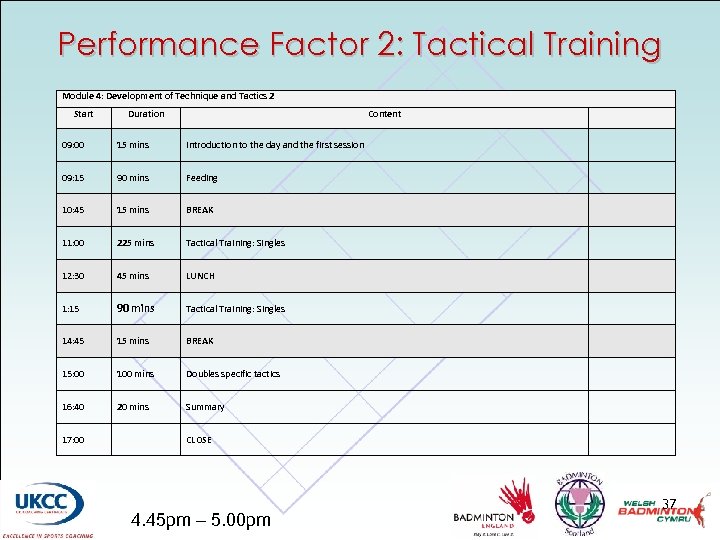
Performance Factor 2: Tactical Training Module 4: Development of Technique and Tactics 2 Start Duration Content 09: 00 15 mins Introduction to the day and the first session 09: 15 90 mins Feeding 10: 45 15 mins BREAK 11: 00 225 mins Tactical Training: Singles 12: 30 45 mins LUNCH 1: 15 90 mins Tactical Training: Singles 14: 45 15 mins BREAK 15: 00 100 mins Doubles specific tactics 16: 40 20 mins Summary 17: 00 CLOSE 4. 45 pm – 5. 00 pm 37
Скачать презентацию Level 3 Certificate in Coaching Badminton Module 4
c9da98169c1fbe47f8900cf47c2b612c.ppt