


 Скачать презентацию Lets Communicate March 2012 ECIS Athens Help Me
a5f26a5a44cd56d294d83f45d634d61d.ppt
- Количество слайдов: 29
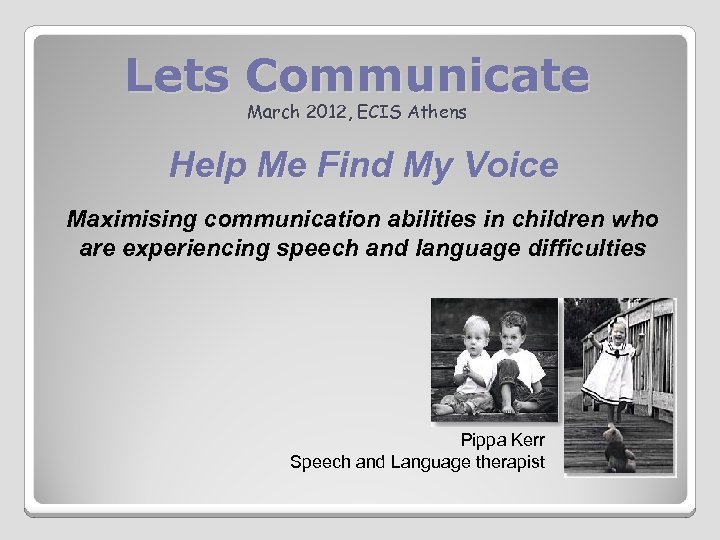 Lets Communicate March 2012, ECIS Athens Help Me Find My Voice Maximising communication abilities in children who are experiencing speech and language difficulties Pippa Kerr Speech and Language therapist
 Session plan • Breaking down communication Communication profiling Working with different communication challenges & Goal Setting Practical tips for supporting students who are slower to develop their communication skills
 I am always losing my glasses. Did you see me put them down?
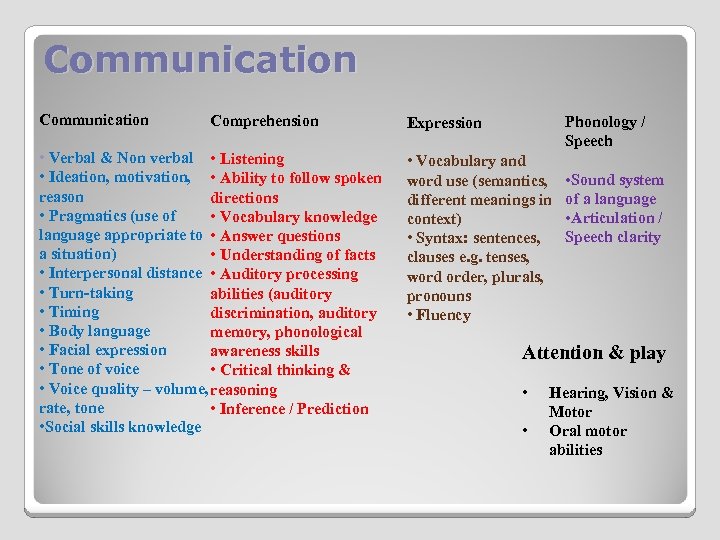 Communication Comprehension • Verbal & Non verbal • Listening • Ideation, motivation, • Ability to follow spoken reason directions • Pragmatics (use of • Vocabulary knowledge language appropriate to • Answer questions a situation) • Understanding of facts • Interpersonal distance • Auditory processing • Turn-taking abilities (auditory • Timing discrimination, auditory • Body language memory, phonological • Facial expression awareness skills • Tone of voice • Critical thinking & • Voice quality – volume, reasoning rate, tone • Inference / Prediction • Social skills knowledge Phonology / Speech Expression • Vocabulary and word use (semantics, different meanings in context) • Syntax: sentences, clauses e. g. tenses, word order, plurals, pronouns • Fluency • Sound system of a language • Articulation / Speech clarity Attention & play • • Hearing, Vision & Motor Oral motor abilities
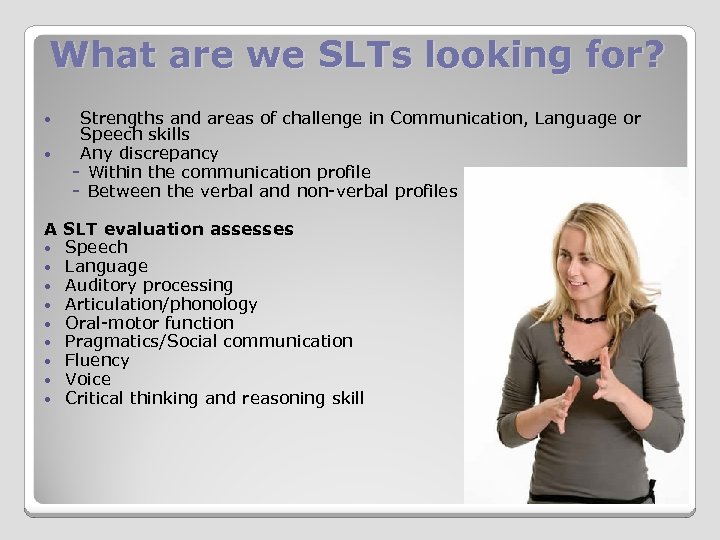 What are we SLTs looking for? Strengths and areas of challenge in Communication, Language or Speech skills Any discrepancy - Within the communication profile - Between the verbal and non-verbal profiles A SLT evaluation assesses Speech Language Auditory processing Articulation/phonology Oral-motor function Pragmatics/Social communication Fluency Voice Critical thinking and reasoning skill
 Session plan • Breaking down communication Communication profiling Working with different communication challenges & Goal Setting Practical tips for supporting students who are slower to develop their communication skills
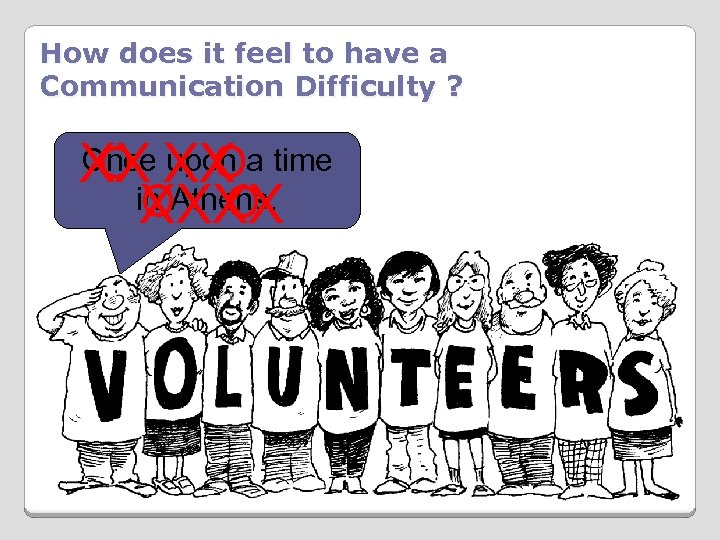 How does it feel to have a Communication Difficulty ? Once upon O O XX XX a time in Athens. O O XXXX
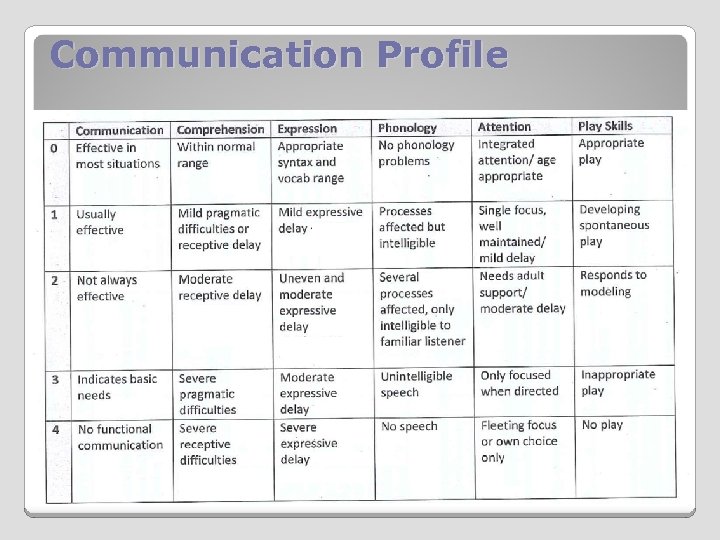 Communication Profile
 Communication Profiling Videos of child V Videos of child M Activity: Plot their profiles
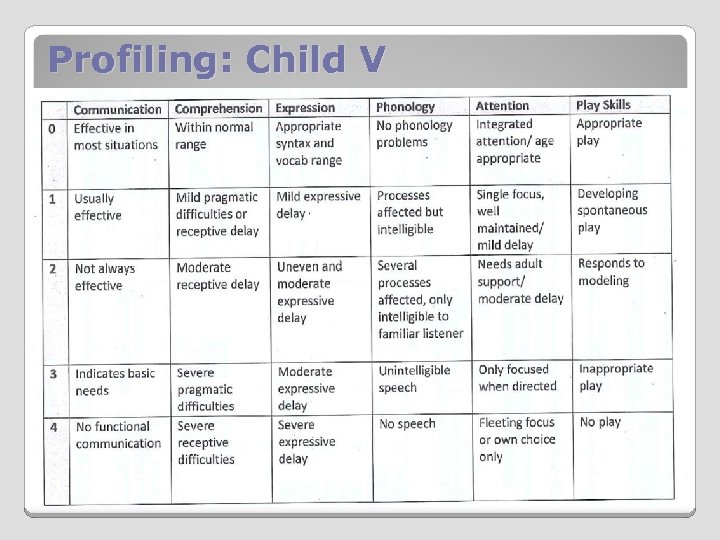 Profiling: Child V
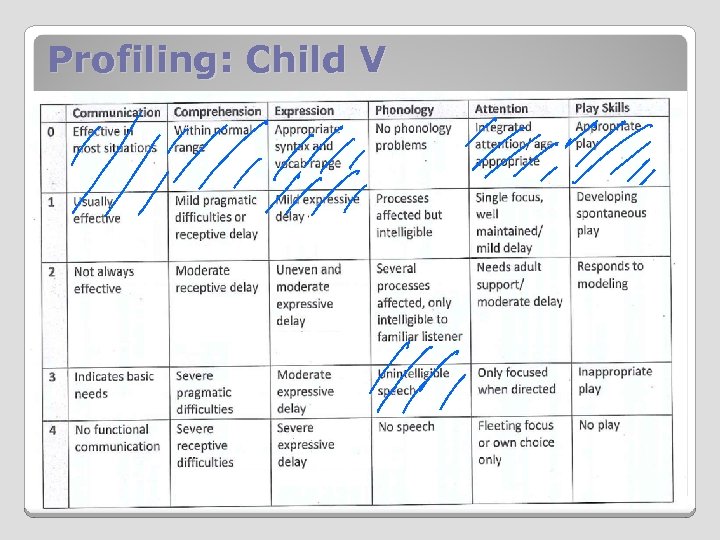 Profiling: Child V
 Communication profiles • Think of one of your own students who has a communication difficulty • Plot their communication profile • Think of a specific example of their communication challenge which helps explain your choices • Discuss with your partner the profile you have plotted
 Session plan • Breaking down communication Communication profiling Working with different communication challenges & Goal Setting Practical tips for supporting students who are slower to develop their communication skills
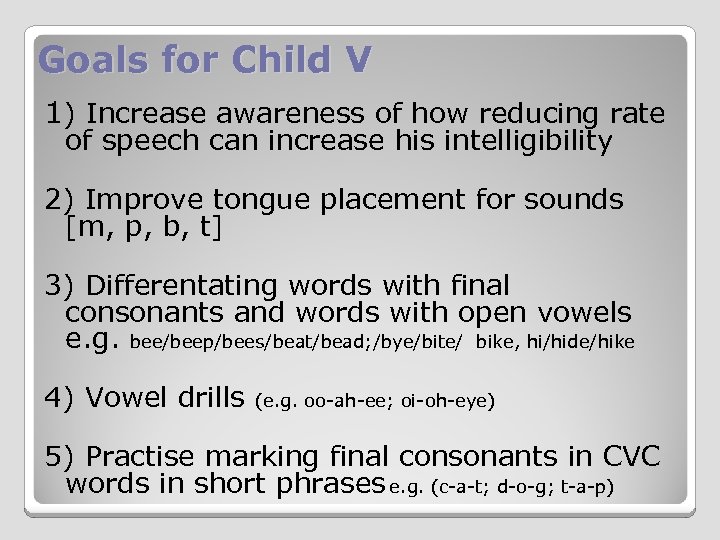 Goals for Child V 1) Increase awareness of how reducing rate of speech can increase his intelligibility 2) Improve tongue placement for sounds [m, p, b, t] 3) Differentating words with final consonants and words with open vowels e. g. bee/beep/bees/beat/bead; /bye/bite/ bike, hi/hide/hike 4) Vowel drills (e. g. oo-ah-ee; oi-oh-eye) 5) Practise marking final consonants in CVC words in short phrases e. g. (c-a-t; d-o-g; t-a-p)
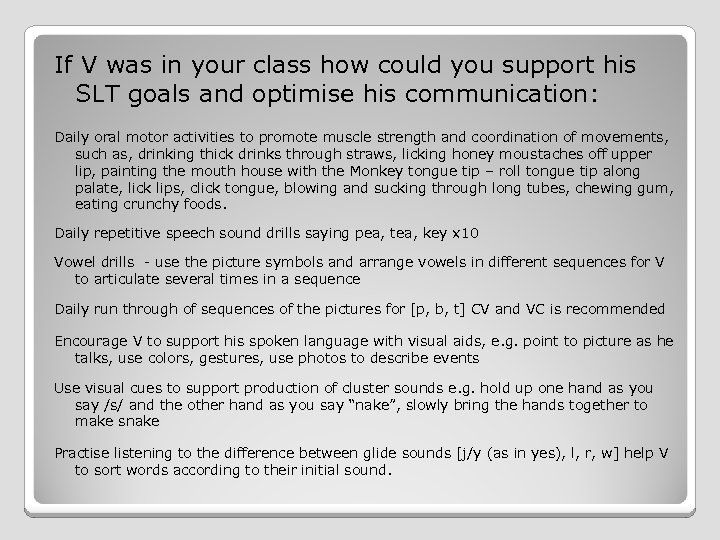 If V was in your class how could you support his SLT goals and optimise his communication: Daily oral motor activities to promote muscle strength and coordination of movements, such as, drinking thick drinks through straws, licking honey moustaches off upper lip, painting the mouth house with the Monkey tongue tip – roll tongue tip along palate, lick lips, click tongue, blowing and sucking through long tubes, chewing gum, eating crunchy foods. Daily repetitive speech sound drills saying pea, tea, key x 10 Vowel drills - use the picture symbols and arrange vowels in different sequences for V to articulate several times in a sequence Daily run through of sequences of the pictures for [p, b, t] CV and VC is recommended Encourage V to support his spoken language with visual aids, e. g. point to picture as he talks, use colors, gestures, use photos to describe events Use visual cues to support production of cluster sounds e. g. hold up one hand as you say /s/ and the other hand as you say “nake”, slowly bring the hands together to make snake Practise listening to the difference between glide sounds [j/y (as in yes), l, r, w] help V to sort words according to their initial sound.
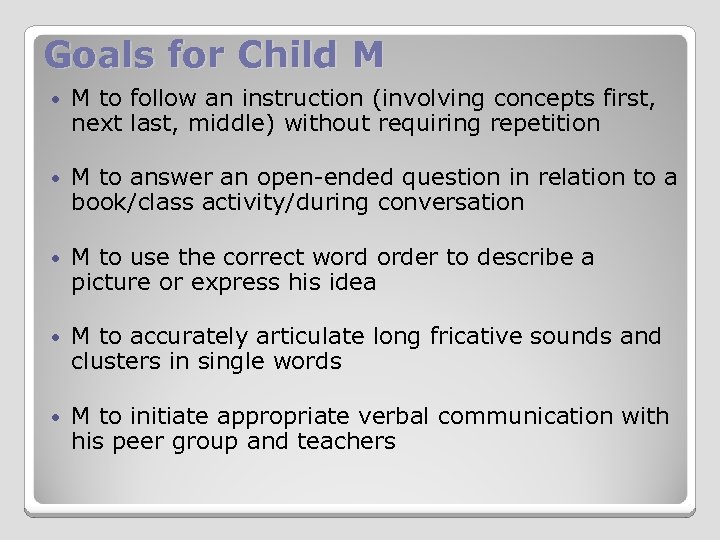 Goals for Child M M to follow an instruction (involving concepts first, next last, middle) without requiring repetition M to answer an open-ended question in relation to a book/class activity/during conversation M to use the correct word order to describe a picture or express his idea M to accurately articulate long fricative sounds and clusters in single words M to initiate appropriate verbal communication with his peer group and teachers
 Specific tasks in speech and language sessions: Practise use of Subject-Verb-Object sentences to describe a picture/event Practise verb tensing in set SLT activities Use accurate pronouns and prepositions in set tasks Speech sound work accurately articulate clusters
 If M was in your class how could you support his SLT goals and optimise his communication: Ensure M’s attention before giving him an instruction Check his comprehension Positive reinforcement/feedback on good language and desired behaviours Encourage M to give context by saying a single word/ drawing/gesturing before commencing his conversation
 Goals for your student (10 minute activity) Go back to the communication profile you have plotted Suggest the appropriate goal areas to work on Have a try at creating a 1 or 2 goals for your chosen student
 Session plan • Breaking down communication Communication profiling Working with different communication challenges & Goal Setting Practical tips for supporting students who are slower to develop their communication skills
 Practical tips for supporting individuals with communication difficulties Talk as clearly as possible Make sure person is looking at you Use a slower rate, clear articulation, simple grammar with shorter sentences Concentrate on ‘here and now’ 6 second rule – ask a question wait 6 seconds, reduce language but ask same questions Focus on the message not the delivery- actively listen to what the individualis trying to say not how they are saying it. Keep communication successful, use multi-channelled cues
 Supporting Social Communication • Eye level • Responsibility e. g. show me your good listening • Unacceptable & give example of preferred way • Highlight good models • Simple and clear language • Avoid negative questions • Open-ended questions, 6 second rule, reduce complexity • Participation • Positive instruction • State the obvious • Social stories – Carol Gray
 Supporting Social Communication • Inference and predication • Problem solving • Self-advocacy skills • Role-play different social situations & social rules • PRAISE appropriate behaviour • Give specific concrete examples of desired behaviour
 Supporting Attention and Listening • Preferred seating • Manipulate environment - sensory overload • Clear expectations • First say child’s name (and touch gently) • Ask child to repeat back instruction before carrying out • Offer regular visual clues • Consistent gestures/objects of reference • Fiddle toy • Physical activity/small breaks
 Supporting Understanding • Visual timetables • “Finish box” • Photos & social stories • Structure • Multi-sensory • Reinforce verbal with visual aids/gestures • Sequence instructions, repeat, emphasise key words • Check for understanding • Encourage child to recognise (and admit) they are not sure • Repair strategies • Model correct response, don’t tell child they are wrong
 Supporting Expressive Language • Teach vocabulary within topics • Vocabulary building (pre-teach & review) • Model accurate language structures • Repeat back utterance and add 1 word • Reduce questions offer a forced alternative (is it an apple or an orange? instead of what is it? • Open-ended questions • Reduce pressure by commenting and leaving a sentence to be finished e. g. I can see a……. . • KEEP QUIET! Allow space for expression (wait 6 seconds) • Observe Wait Listen (OWL)
 Supporting Speech Development • Promote awareness of sounds • Help child differentiate pronunciations – give positive feedback • Do not correct, instead give accurate model Phonological awareness / pre-reading skills • Identifying objects by initial/final sound • Identify/generate rhymes • Count syllables Oral motor skills • Increase awareness of articulators • Look in mirror • Promote muscle strength/range of movement • Swallowing – lisps, tongue position
 Lets Communicate March 2012, ECIS Athens Help Me Find My Voice Thank you Pippa Kerr Speech and Language therapist pippa@letscommunicate. eu
 Back UP