


 Скачать презентацию Lessons on Process and Standards in other science
149b72b84685510dc650cee14fd082eb.ppt
- Количество слайдов: 42
 Lessons on Process and Standards in other science communities IMAG Model Sharing Strategies Workshop NIH April 10 2007 Geoffrey Fox Computer Science, Informatics, Physics Pervasive Technology Laboratories Indiana University Bloomington IN 47401 http: //grids. ucs. indiana. edu/ptliupages/presentations/ gcf@indiana. edu http: //www. infomall. org 1
 What is a Model Electronically? This should have a label – a URI It should have a collection of data or metadata defining it It might have some way of building composite models by joining multiple smaller models together • Need to be able to define connections Maybe there also “mechanisms” to manipulate model or evolve it in time A computer program defines the data as values and the mechanisms as subroutines/methods • Programs can be Fortran, Python, C#, Prolog • Declarative or Imperative; Scripted or Compiled However in spite of software engineering, computer programs are very hard to share and re-use 2
 What are Questions? What are the models we are trying to define? What is Process to decide on needed standards and their Syntax Are we mainly concerned about data defining the model and/or the programs that build the model Where are overlaps between IMAG requirements and other computer science or science fields Is the barrier to sharing models “science” (i. e. it is not clear what the common interfaces are) or “systematization” (we agree on interface points but don’t have a common syntax) 3
 Some Examples There are many examples of relevant efforts to encourage sharing of models DMSO (Defense Modeling and Simulation Office) produced HLA (High Level Architecture) as a (pre-CORBA/Web Service) way of defining military models as discrete event simulations • Good but of date The Open Geospatial Consortium OGC http: //www. opengeospatial. org/ is a consortium of 339 organization setting excellent standards for Geographical Information Systems • We could develop a BIS Biological Information System? International Virtual Observatory Alliance IVOA http: //www. ivoa. net/ is 16 organizations (each of which is a collection like EVO the European Virtual Obsevatory) is defining sharing standards for astronomy data 4
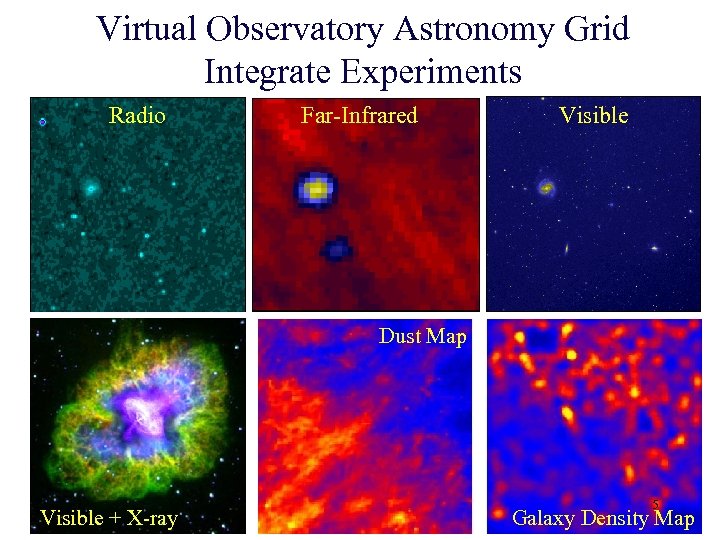 Virtual Observatory Astronomy Grid Integrate Experiments Radio Far-Infrared Visible Dust Map Visible + X-ray 5 Galaxy Density Map
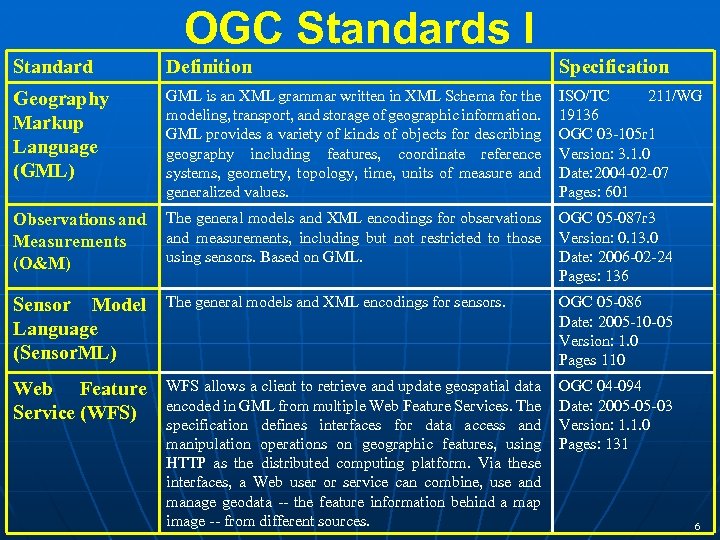 OGC Standards I Standard Definition Specification Geography Markup Language (GML) GML is an XML grammar written in XML Schema for the modeling, transport, and storage of geographic information. GML provides a variety of kinds of objects for describing geography including features, coordinate reference systems, geometry, topology, time, units of measure and generalized values. ISO/TC 211/WG 19136 OGC 03 -105 r 1 Version: 3. 1. 0 Date: 2004 -02 -07 Pages: 601 Observations and The general models and XML encodings for observations and measurements, including but not restricted to those Measurements using sensors. Based on GML. (O&M) OGC 05 -087 r 3 Version: 0. 13. 0 Date: 2006 -02 -24 Pages: 136 Sensor Model Language (Sensor. ML) The general models and XML encodings for sensors. OGC 05 -086 Date: 2005 -10 -05 Version: 1. 0 Pages 110 Web Feature Service (WFS) WFS allows a client to retrieve and update geospatial data encoded in GML from multiple Web Feature Services. The specification defines interfaces for data access and manipulation operations on geographic features, using HTTP as the distributed computing platform. Via these interfaces, a Web user or service can combine, use and manage geodata -- the feature information behind a map image -- from different sources. OGC 04 -094 Date: 2005 -05 -03 Version: 1. 1. 0 Pages: 131 6
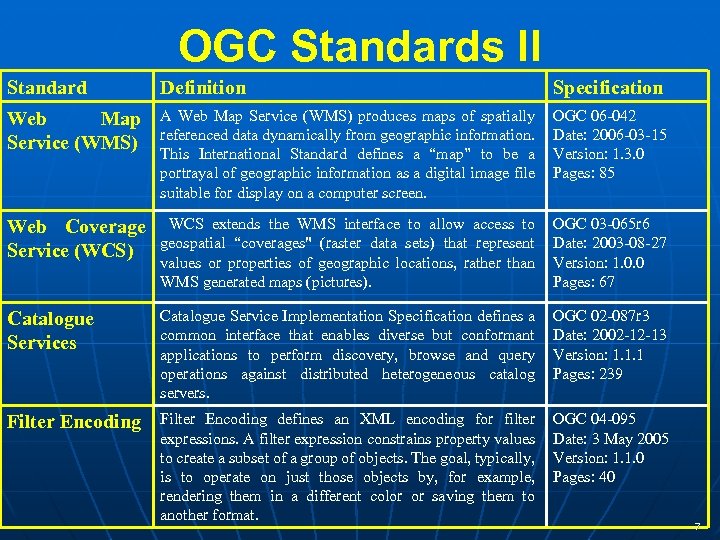 OGC Standards II Standard Definition Specification Web Map Service (WMS) A Web Map Service (WMS) produces maps of spatially referenced data dynamically from geographic information. This International Standard defines a “map” to be a portrayal of geographic information as a digital image file suitable for display on a computer screen. OGC 06 -042 Date: 2006 -03 -15 Version: 1. 3. 0 Pages: 85 Web Coverage Service (WCS) WCS extends the WMS interface to allow access to geospatial “coverages" (raster data sets) that represent values or properties of geographic locations, rather than WMS generated maps (pictures). OGC 03 -065 r 6 Date: 2003 -08 -27 Version: 1. 0. 0 Pages: 67 Catalogue Services Catalogue Service Implementation Specification defines a common interface that enables diverse but conformant applications to perform discovery, browse and query operations against distributed heterogeneous catalog servers. OGC 02 -087 r 3 Date: 2002 -12 -13 Version: 1. 1. 1 Pages: 239 Filter Encoding defines an XML encoding for filter expressions. A filter expression constrains property values to create a subset of a group of objects. The goal, typically, is to operate on just those objects by, for example, rendering them in a different color or saving them to another format. OGC 04 -095 Date: 3 May 2005 Version: 1. 1. 0 Pages: 40 Filter Encoding 7
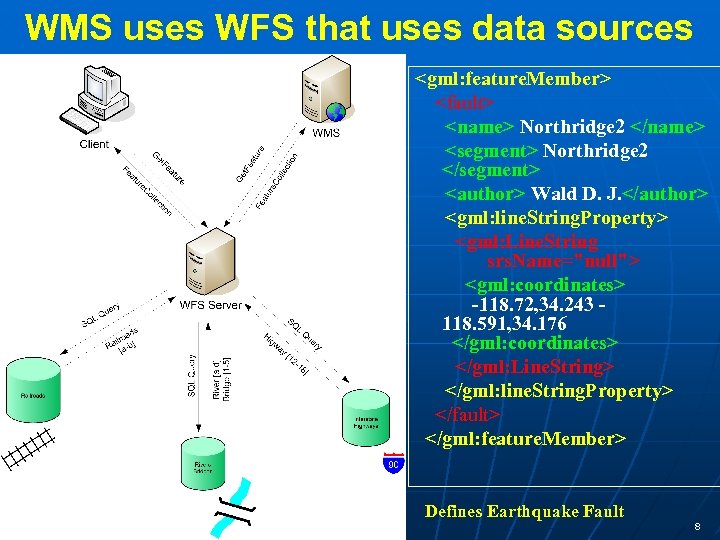 WMS uses WFS that uses data sources
 OGC Standards Typify a common competition – there is a similar effort by Technical Committee tasked by the International Standards Organization (ISO/TC 211). Are very complex – GML specification itself is over 600 pages Underlie the success of GIS and enabled through first through ESRI (Arc. Info) and Minnesota Map Server and now through Google Maps Are built in XML (as they should be) but for efficiency one • Transmits through binary XML • Stores in SQL databases not in XML databases Define some tings (catalog) which are unnecessary as provided by a broader community Observations and Measurements work for any time series and so are also broader but no competition! 9
 OGC Standards Structure Have a language GML that defines the field – this would be Cell. ML and SBML in the case of Biology and CML for Chem. Informatics Have a user interface (the Map) captured as a Web Map Service Have a “pixel data” service WCS the Web Coverage Service Have a “vector” (feature, property) data service WFS the Web Feature Service • Note any Earth Science simulation or data analysis can be thought of as accepting WFS compatible data and producing WFS or WCS compatible output 10
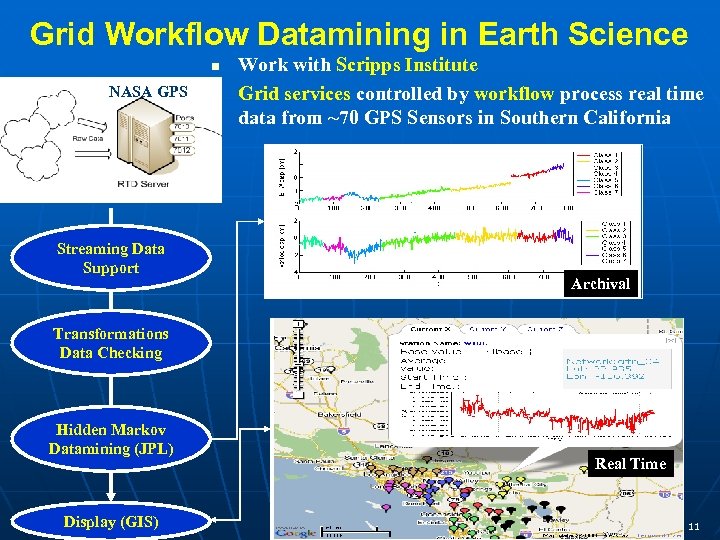 Grid Workflow Datamining in Earth Science NASA GPS Work with Scripps Institute Grid services controlled by workflow process real time data from ~70 GPS Sensors in Southern California Earthquake Streaming Data Support Archival Transformations Data Checking Hidden Markov Datamining (JPL) Display (GIS) Real Time 11
 Data Federation The IVOA activities is aimed largely at supporting interoperable data repositories that can feed into the image processing filtering needed to extract signals • There us not so much simulation Chem. Informatics has most data in NIH’s Pub. Chem but will need to federate additional repositories such as those produced by individual Chemistry groups and the raw data from NIH screening centers Every county (total 92) in Indiana has its own GIS and something equivalent to a WFS holding information not yet known to Google! (e. g. our house pinpoint address and assessment) • Need to federate all these to support state agencies So federation of distributed resources a major issue and WFS uses “capabilities” to support this 12
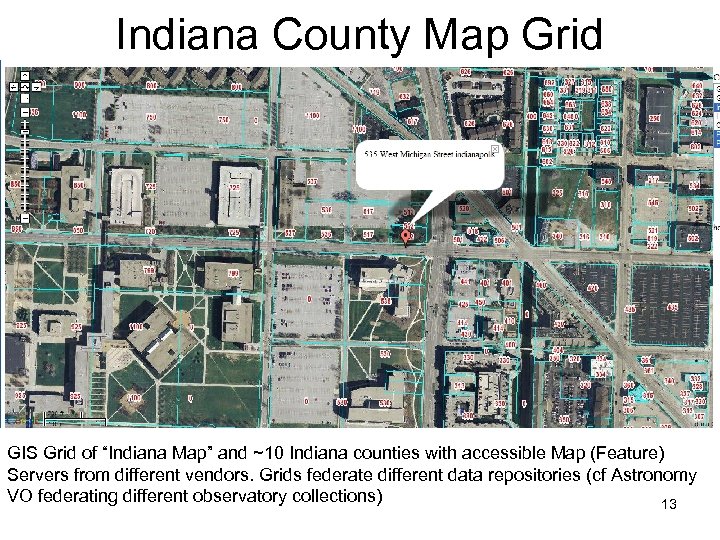 Indiana County Map Grid GIS Grid of “Indiana Map” and ~10 Indiana counties with accessible Map (Feature) Servers from different vendors. Grids federate different data repositories (cf Astronomy VO federating different observatory collections) 13
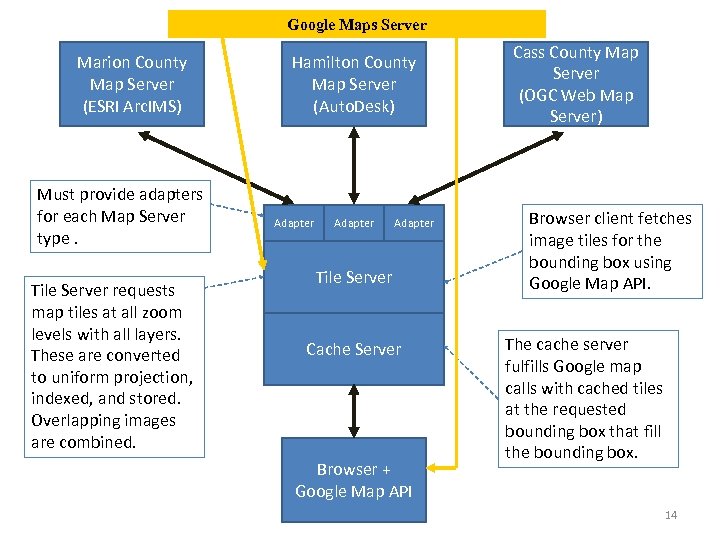 Google Maps Server Marion County Map Server (ESRI Arc. IMS) Must provide adapters for each Map Server type. Tile Server requests map tiles at all zoom levels with all layers. These are converted to uniform projection, indexed, and stored. Overlapping images are combined. Hamilton County Map Server (Auto. Desk) Adapter Tile Server Cache Server Browser + Google Map API Cass County Map Server (OGC Web Map Server) Browser client fetches image tiles for the bounding box using Google Map API. The cache server fulfills Google map calls with cached tiles at the requested bounding box that fill the bounding box. 14
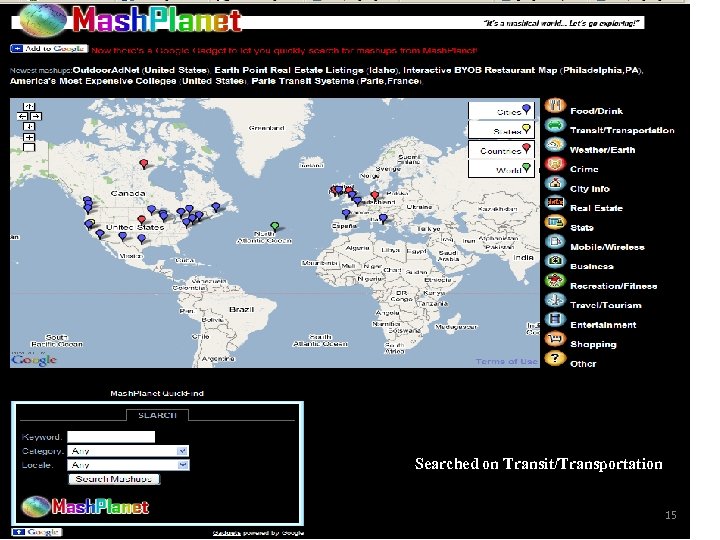 Searched on Transit/Transportation 15
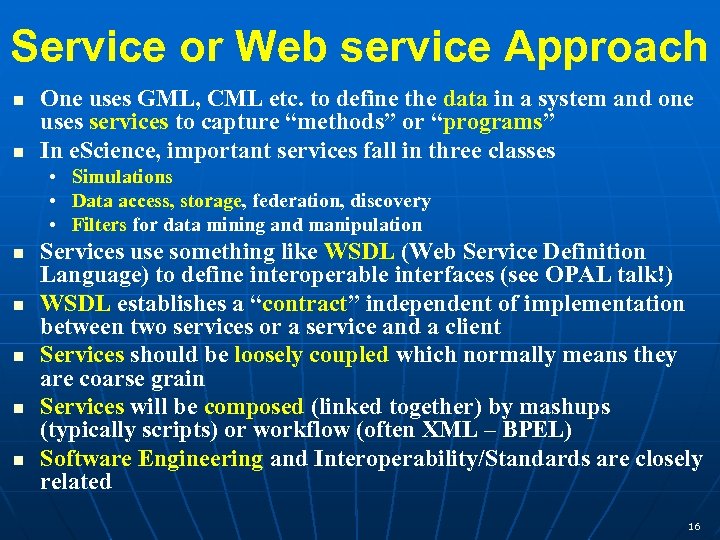 Service or Web service Approach One uses GML, CML etc. to define the data in a system and one uses services to capture “methods” or “programs” In e. Science, important services fall in three classes • Simulations • Data access, storage, federation, discovery • Filters for data mining and manipulation Services use something like WSDL (Web Service Definition Language) to define interoperable interfaces (see OPAL talk!) WSDL establishes a “contract” independent of implementation between two services or a service and a client Services should be loosely coupled which normally means they are coarse grain Services will be composed (linked together) by mashups (typically scripts) or workflow (often XML – BPEL) Software Engineering and Interoperability/Standards are closely related 16
 Philosophy of Web Service Grids Much of Distributed Computing was built by natural extensions of computing models developed for sequential machines This leads to the distributed object (DO) model represented by Java and CORBA • RPC (Remote Procedure Call) or RMI (Remote Method Invocation) for Java Key people think this is not a good idea as it scales badly and ties distributed entities together too tightly • Distributed Objects Replaced by Services Note CORBA was considered too complicated in both organization and proposed infrastructure • and Java was considered as “tightly coupled to Sun” • So there were other reasons to discard Thus replace distributed objects by services connected by “one-way” messages and not by request-response messages 17
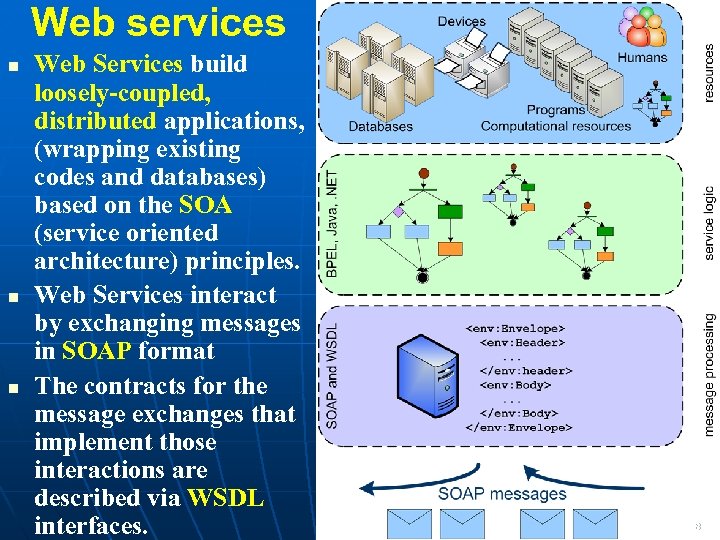 Web services Web Services build loosely-coupled, distributed applications, (wrapping existing codes and databases) based on the SOA (service oriented architecture) principles. Web Services interact by exchanging messages in SOAP format The contracts for the message exchanges that implement those interactions are described via WSDL interfaces. 18
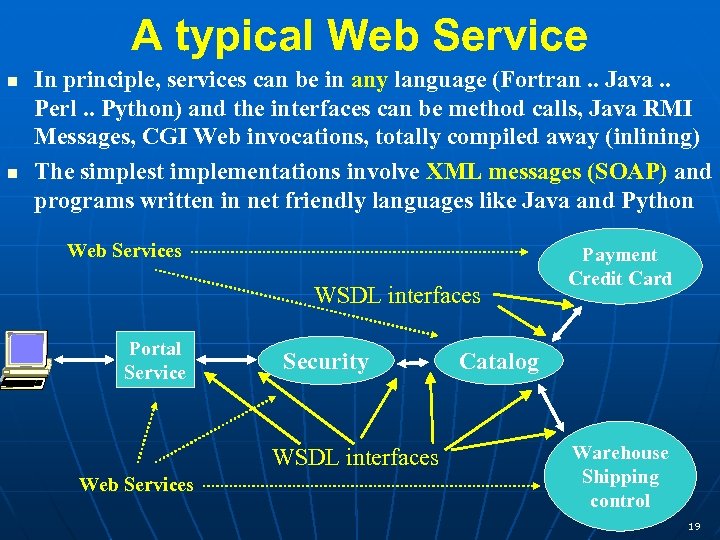 A typical Web Service In principle, services can be in any language (Fortran. . Java. . Perl. . Python) and the interfaces can be method calls, Java RMI Messages, CGI Web invocations, totally compiled away (inlining) The simplest implementations involve XML messages (SOAP) and programs written in net friendly languages like Java and Python Web Services WSDL interfaces Portal Service Security WSDL interfaces Web Services Payment Credit Card Catalog Warehouse Shipping control 19
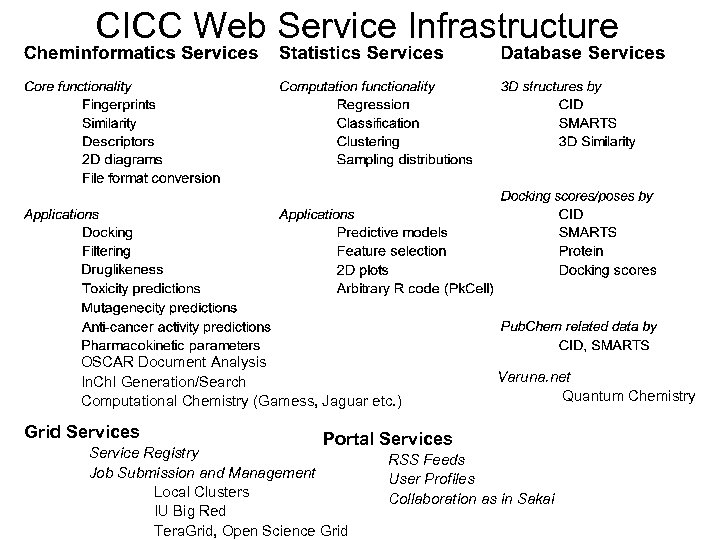 CICC Web Service Infrastructure OSCAR Document Analysis In. Ch. I Generation/Search Computational Chemistry (Gamess, Jaguar etc. ) Grid Services Varuna. net Quantum Chemistry Portal Services Service Registry Job Submission and Management Local Clusters IU Big Red Tera. Grid, Open Science Grid RSS Feeds User Profiles Collaboration as in Sakai
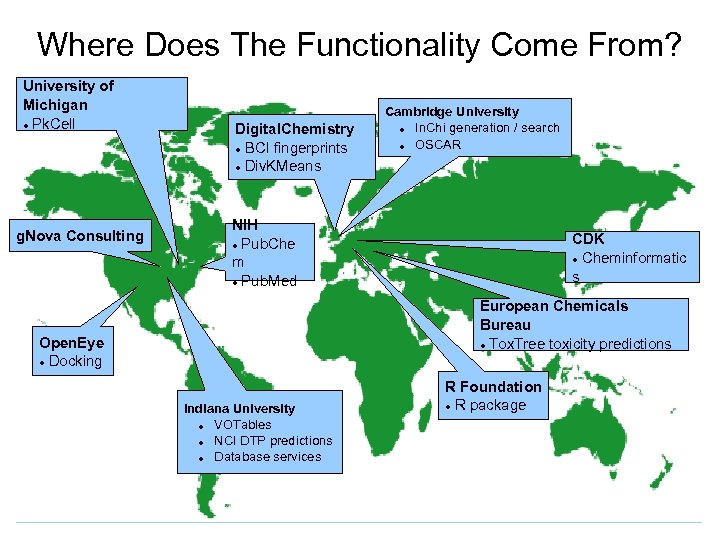 Where Does The Functionality Come From? University of Michigan Pk. Cell g. Nova Consulting Digital. Chemistry BCI fingerprints Div. KMeans Cambridge University In. Chi generation / search OSCAR NIH Pub. Che m Pub. Med CDK Cheminformatic s European Chemicals Bureau Tox. Tree toxicity predictions Open. Eye Docking Indiana University VOTables NCI DTP predictions Database services R Foundation R package
 Service Modeling Language (SML) Submitted to W 3 C by industry giants 21 March 2007 A model in SML is realized as a set of interrelated XML documents. The XML documents contain information about the parts of an IT service, as well as the constraints that each part must satisfy for the IT service to function properly. Constraints are captured in two ways: Schemas – these are constraints on the structure and content of the documents in a model. SML uses a profile of XML Schema 1. 0 as the schema language. SML also defines a set of extensions to XML Schema to support inter-document references. Rules – are Boolean expressions that constrain the structure and content of documents in a model. SML uses a profile of Schematron (goes between documents) and XPath 1. 0 for rules. 22
 Models in SML Models focus on capturing all invariant aspects of a service/system that must be maintained for the service/system to be functional. Models are units of communication and collaboration between designers, implementers, operators, and users; and can easily be shared, tracked, and revision controlled. This is important because complex services are often built and maintained by a variety of people playing different roles. Models drive modularity, re-use, and standardization. Most real-world complex services and systems are composed of sufficiently complex parts. Re-use and standardization of services/systems and their parts is a key factor in reducing overall production and operation cost and in increasing reliability. Models represent a powerful mechanism for validating changes before applying the changes to a service/system. Also, when changes happen in a running service/system, they can be validated against the intended state described in the model. The actual service/system and its model together enable a self-healing service/system – the ultimate objective. Models of a service/system must necessarily stay decoupled from the live service/system to create the control loop Models enable increased automation of management tasks. Automation facilities exposed by the majority of IT services/systems today could be driven by software – not people – for reliable initial realization of a service/system as well as for ongoing lifecycle management. 23
 Structured v Unstructured Metadata The schema’s that are defined by GML etc. are structured definitions The traditional semantic web approach is largely based on structured metadata (OWL) that one can analyze precisely UML was for example used by OGC in developing standards In the “real world”, unstructured annotation has been very successful as seen in Connotea, del. icio. us and Cite. ULike 24
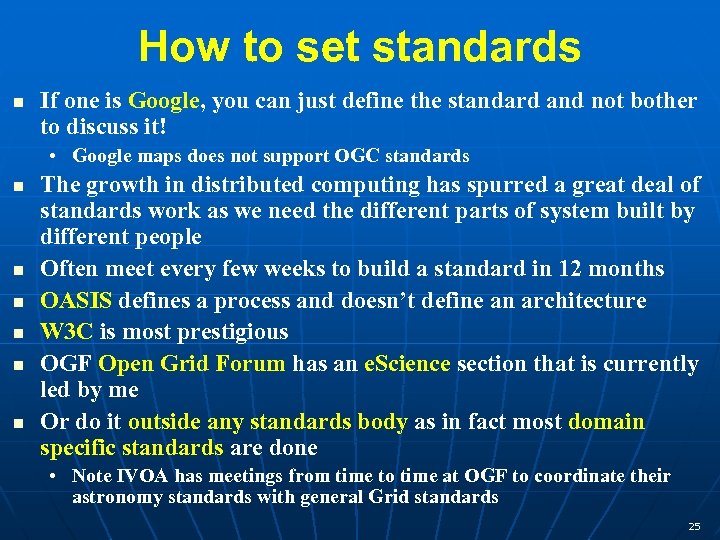 How to set standards If one is Google, you can just define the standard and not bother to discuss it! • Google maps does not support OGC standards The growth in distributed computing has spurred a great deal of standards work as we need the different parts of system built by different people Often meet every few weeks to build a standard in 12 months OASIS defines a process and doesn’t define an architecture W 3 C is most prestigious OGF Open Grid Forum has an e. Science section that is currently led by me Or do it outside any standards body as in fact most domain specific standards are done • Note IVOA has meetings from time to time at OGF to coordinate their astronomy standards with general Grid standards 25
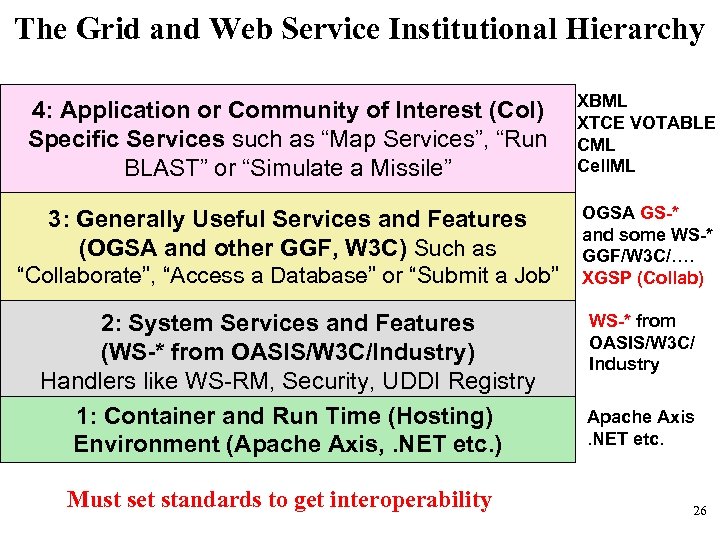 The Grid and Web Service Institutional Hierarchy 4: Application or Community of Interest (Co. I) Specific Services such as “Map Services”, “Run BLAST” or “Simulate a Missile” XBML XTCE VOTABLE CML Cell. ML 3: Generally Useful Services and Features (OGSA and other GGF, W 3 C) Such as “Collaborate”, “Access a Database” or “Submit a Job” OGSA GS-* and some WS-* GGF/W 3 C/…. XGSP (Collab) 2: System Services and Features (WS-* from OASIS/W 3 C/Industry) Handlers like WS-RM, Security, UDDI Registry 1: Container and Run Time (Hosting) Environment (Apache Axis, . NET etc. ) Must set standards to get interoperability WS-* from OASIS/W 3 C/ Industry Apache Axis. NET etc. 26
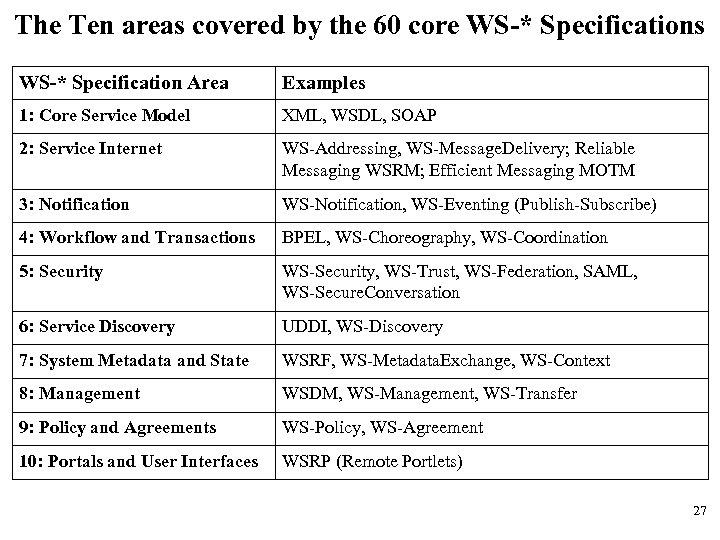 The Ten areas covered by the 60 core WS-* Specifications WS-* Specification Area Examples 1: Core Service Model XML, WSDL, SOAP 2: Service Internet WS-Addressing, WS-Message. Delivery; Reliable Messaging WSRM; Efficient Messaging MOTM 3: Notification WS-Notification, WS-Eventing (Publish-Subscribe) 4: Workflow and Transactions BPEL, WS-Choreography, WS-Coordination 5: Security WS-Security, WS-Trust, WS-Federation, SAML, WS-Secure. Conversation 6: Service Discovery UDDI, WS-Discovery 7: System Metadata and State WSRF, WS-Metadata. Exchange, WS-Context 8: Management WSDM, WS-Management, WS-Transfer 9: Policy and Agreements WS-Policy, WS-Agreement 10: Portals and User Interfaces WSRP (Remote Portlets) 27
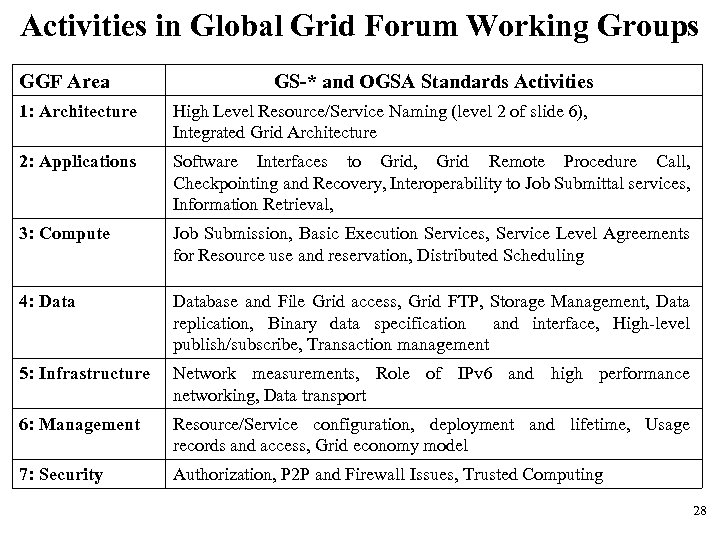 Activities in Global Grid Forum Working Groups GGF Area GS-* and OGSA Standards Activities 1: Architecture High Level Resource/Service Naming (level 2 of slide 6), Integrated Grid Architecture 2: Applications Software Interfaces to Grid, Grid Remote Procedure Call, Checkpointing and Recovery, Interoperability to Job Submittal services, Information Retrieval, 3: Compute Job Submission, Basic Execution Services, Service Level Agreements for Resource use and reservation, Distributed Scheduling 4: Database and File Grid access, Grid FTP, Storage Management, Data replication, Binary data specification and interface, High-level publish/subscribe, Transaction management 5: Infrastructure Network measurements, Role of IPv 6 and high performance networking, Data transport 6: Management Resource/Service configuration, deployment and lifetime, Usage records and access, Grid economy model 7: Security Authorization, P 2 P and Firewall Issues, Trusted Computing 28
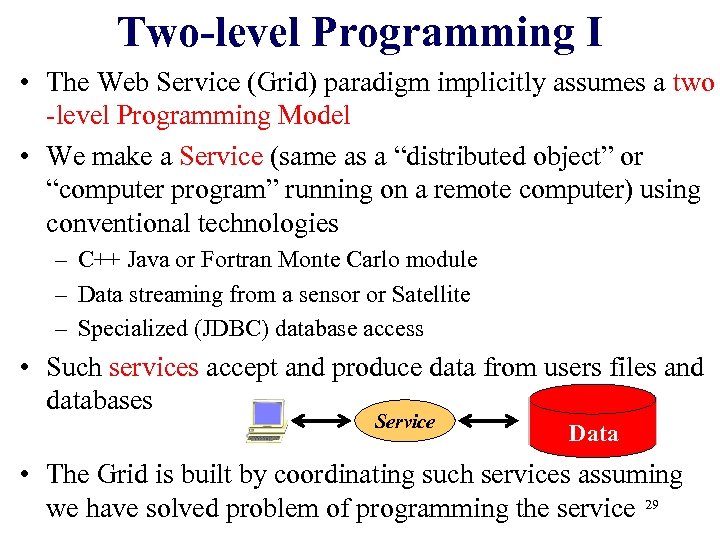 Two-level Programming I • The Web Service (Grid) paradigm implicitly assumes a two -level Programming Model • We make a Service (same as a “distributed object” or “computer program” running on a remote computer) using conventional technologies – C++ Java or Fortran Monte Carlo module – Data streaming from a sensor or Satellite – Specialized (JDBC) database access • Such services accept and produce data from users files and databases Service Data • The Grid is built by coordinating such services assuming we have solved problem of programming the service 29
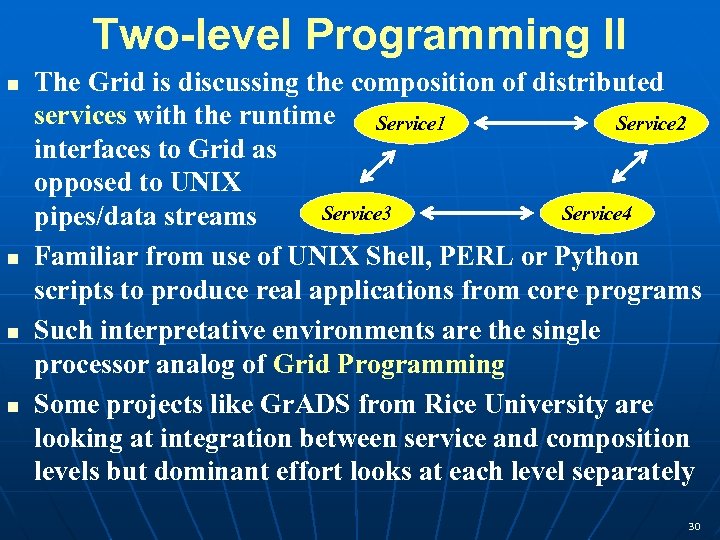 Two-level Programming II The Grid is discussing the composition of distributed services with the runtime Service 1 Service 2 interfaces to Grid as opposed to UNIX Service 3 Service 4 pipes/data streams Familiar from use of UNIX Shell, PERL or Python scripts to produce real applications from core programs Such interpretative environments are the single processor analog of Grid Programming Some projects like Gr. ADS from Rice University are looking at integration between service and composition levels but dominant effort looks at each level separately 30
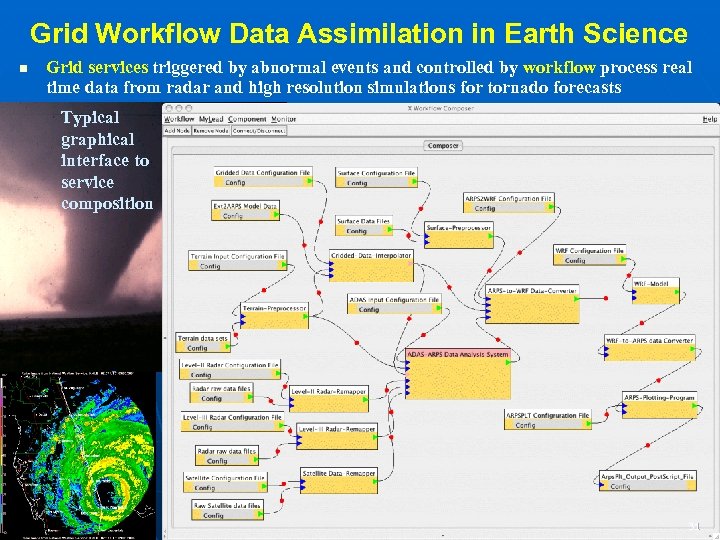 Grid Workflow Data Assimilation in Earth Science Grid services triggered by abnormal events and controlled by workflow process real time data from radar and high resolution simulations for tornado forecasts Typical graphical interface to service composition 31
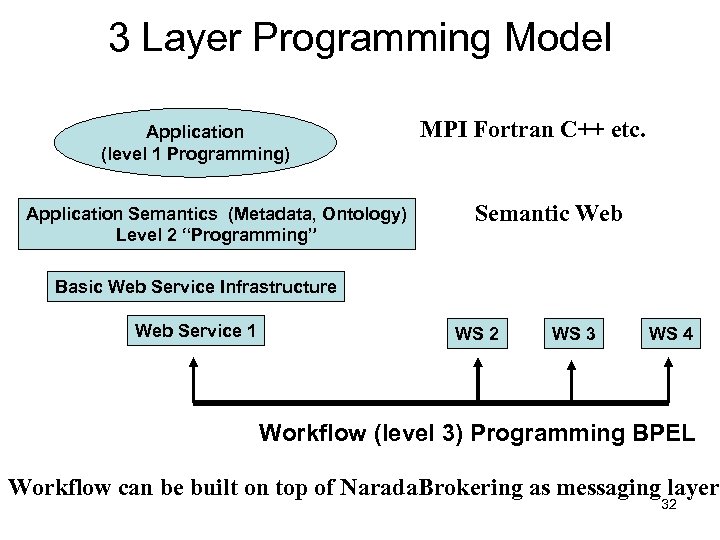 3 Layer Programming Model Application (level 1 Programming) Application Semantics (Metadata, Ontology) Level 2 “Programming” MPI Fortran C++ etc. Semantic Web Basic Web Service Infrastructure Web Service 1 WS 2 WS 3 WS 4 Workflow (level 3) Programming BPEL Workflow can be built on top of Narada. Brokering as messaging layer 32
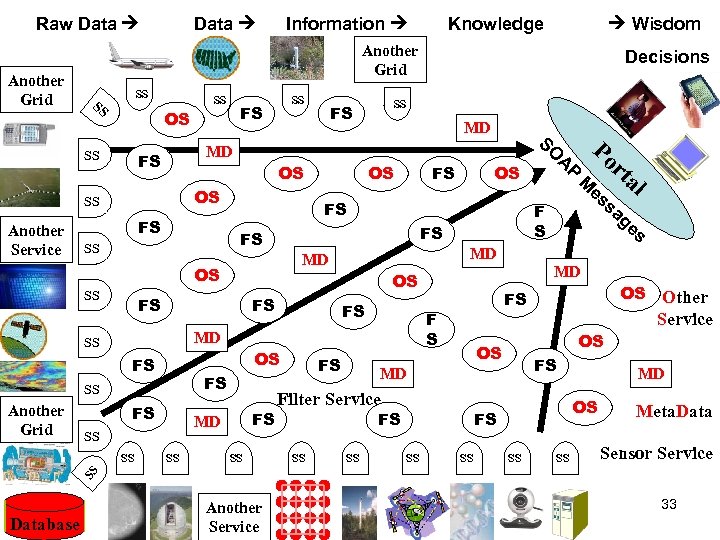 Raw Data Information Knowledge Wisdom Another Grid SS SS FS OS OS FS FS SS FS FS MD SS SS FS es sa al ge s MD F S FS FS SS MD OS FS SS Other Service OS OS MD SS OS FS Filter Service SS rt SS SS Meta. Data Sensor Service SS SS M MD MD SS P F S OS FS Po A OS FS MD FS SS SO FS OS Another Grid MD FS SS SS FS MD SS Another Service FS OS SS SS Another Grid Decisions Database Another Service 33
 Information Management/Processing SOAP messages transport information expressed in a semantically rich fashion between sources and services that enhance and transform information so that complete system provides • Semantic Web technologies like RDF and OWL help us have rich expressivity Data Information Knowledge transformation We build application specific information management/transformation systems ASIS for each application domain One special domain is the system itself where the metadata associated with services, sessions, Grids, messages, streams and workflow is itself managed and supported by an SIIS 34
 Generalizing a GIS Geographical Information Systems GIS have been hugely successful in all fields that study the earth and related worlds • They define Geography Syntax (GML) and ways to store, access, query, manipulate and display geographical features • In SOA, GIS corresponds to a domain specific XML language and a suite of services for different functions above However such a universal information model has not been developed in other areas even though there are many fields in which it appears possible • • • BIS Biological Information System MIS Military Information System IRIS Information Retrieval Information System PAIS Physics Analysis Information System SIIS Service Infrastructure Information System 35
 ASIS Application Specific Information System I a) Discovery capabilities that are best done using WS-* standards b) Domain specific metadata and data including search/store/access interface. (cf WFS). Lets call generalization ASFS (Application Specific Feature Service) • Language to express domain specific features (cf GML). Lets call this ASL (Application Specific language) • Tools to manipulate information expressed in language and key data of application (cf coordinate transformations). Lets call this ASTT (Application specific Tools and Transformations) • ASL must support Data sources such as sensors (cf OGC metadata and data sensor standards) and repositories. Sensors need (common across applications) support of streams of data • Queries need to support archived (find all relevant data in past) and streaming (find all data in future with given properties) • Note all AS Services behave like Sensors and all sensors are wrapped as services • Any domain will have “raw data” (binary) and that which has been filtered to ASL. Lets call ASBD (Application Specific Binary Data) 36
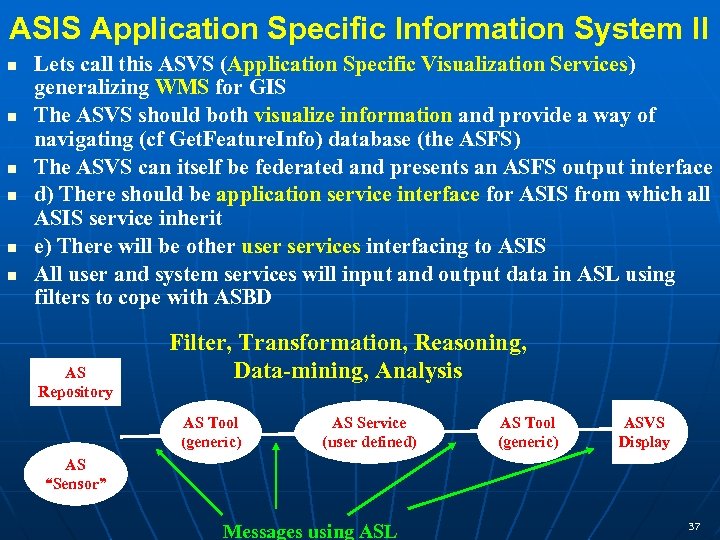 ASIS Application Specific Information System II Lets call this ASVS (Application Specific Visualization Services) generalizing WMS for GIS The ASVS should both visualize information and provide a way of navigating (cf Get. Feature. Info) database (the ASFS) The ASVS can itself be federated and presents an ASFS output interface d) There should be application service interface for ASIS from which all ASIS service inherit e) There will be other user services interfacing to ASIS All user and system services will input and output data in ASL using filters to cope with ASBD AS Repository Filter, Transformation, Reasoning, Data-mining, Analysis AS Tool (generic) AS Service (user defined) AS Tool (generic) ASVS Display AS “Sensor” Messages using ASL 37
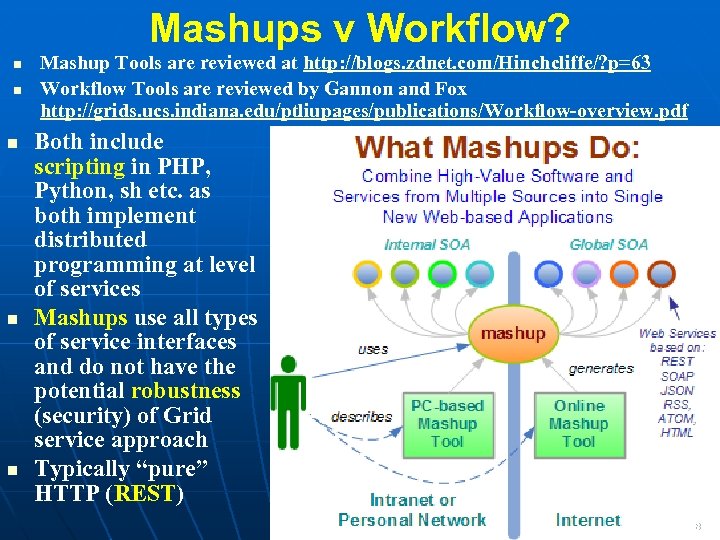 Mashups v Workflow? Mashup Tools are reviewed at http: //blogs. zdnet. com/Hinchcliffe/? p=63 Workflow Tools are reviewed by Gannon and Fox http: //grids. ucs. indiana. edu/ptliupages/publications/Workflow-overview. pdf Both include scripting in PHP, Python, sh etc. as both implement distributed programming at level of services Mashups use all types of service interfaces and do not have the potential robustness (security) of Grid service approach Typically “pure” HTTP (REST) 38
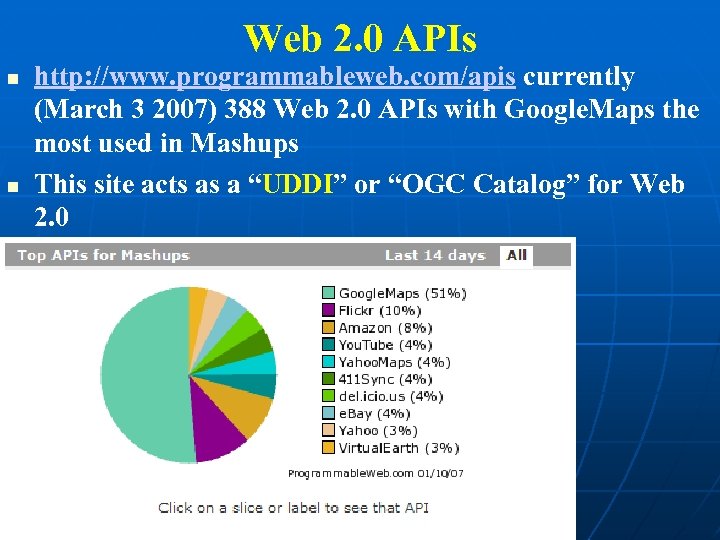 Web 2. 0 APIs http: //www. programmableweb. com/apis currently (March 3 2007) 388 Web 2. 0 APIs with Google. Maps the most used in Mashups This site acts as a “UDDI” or “OGC Catalog” for Web 2. 0
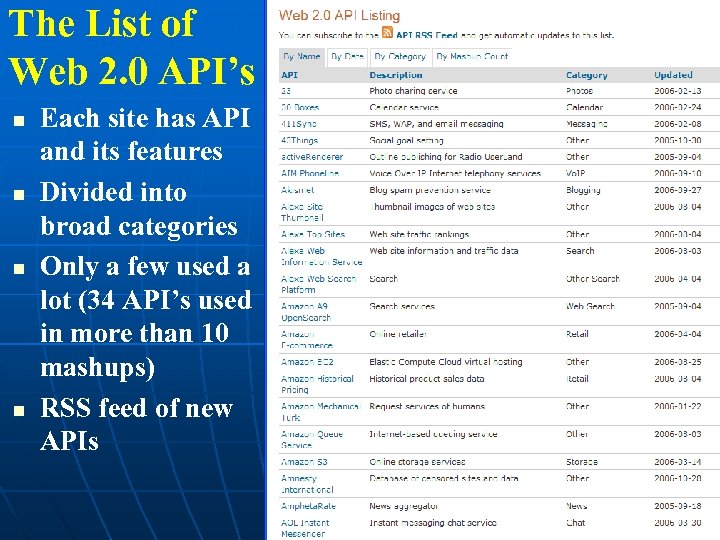 The List of Web 2. 0 API’s Each site has API and its features Divided into broad categories Only a few used a lot (34 API’s used in more than 10 mashups) RSS feed of new APIs
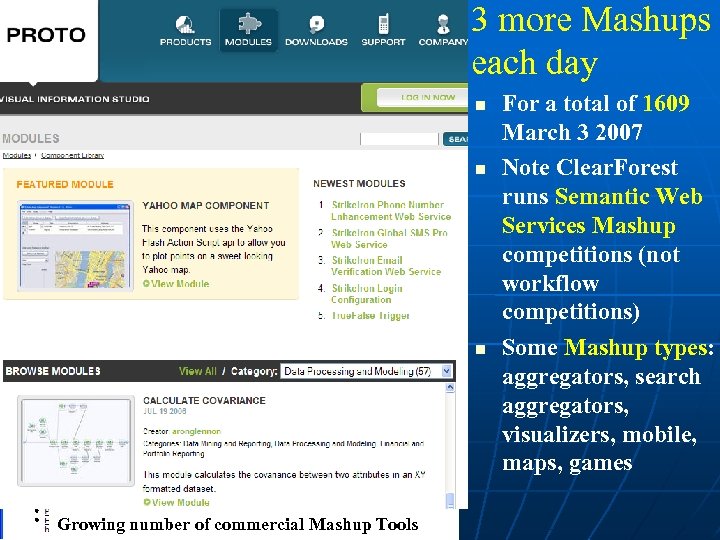 3 more Mashups each day Growing number of commercial Mashup Tools For a total of 1609 March 3 2007 Note Clear. Forest runs Semantic Web Services Mashup competitions (not workflow competitions) Some Mashup types: aggregators, search aggregators, visualizers, mobile, maps, games
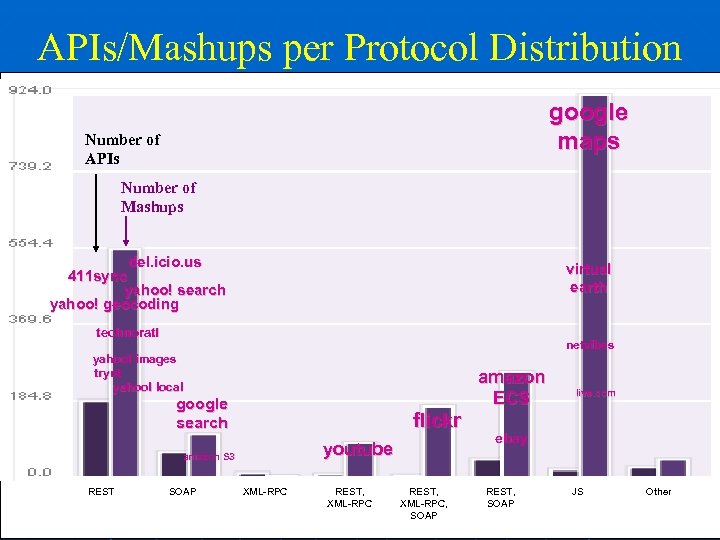 APIs/Mashups per Protocol Distribution google maps Number of APIs Number of Mashups del. icio. us virtual earth 411 sync yahoo! search yahoo! geocoding technorati netvibes yahoo! images trynt yahoo! local amazon ECS google search flickr youtube amazon S 3 REST SOAP XML-RPC REST, XML-RPC, SOAP live. com ebay REST, SOAP JS Other