 Скачать презентацию Lessons I have learnt about Outsourcing Sue Clarke
df16bf8cedeb290b67d21386e4c1ff21.ppt
- Количество слайдов: 25



Lessons I have learnt about Outsourcing Sue Clarke, 20/1/09
Contents Background to outsourcing RFP process overview Project setup Governance Plan • Phases • Approach • Timelines Key activities (Process and staffing) Ways of working and behaviours Project management concerns Lessons learnt Summary
Background Global climate IS always has to do more for less • Save costs – Headcount – Reduce cost of ownership (e. g. lease deals, buy off the shelf not bespoke development) – Re-use • Improve efficiency Trend is to move to a multiple supplier model to achieve these aims
Background There’s usually a mixed staff and contractor model Key intellectual property with contractors Expensive Move to service effect and fixed price Greater delivery flexibility with reduced costs Improved service levels Key intellectual property retained by permanent staff • But impact is reduced staff numbers
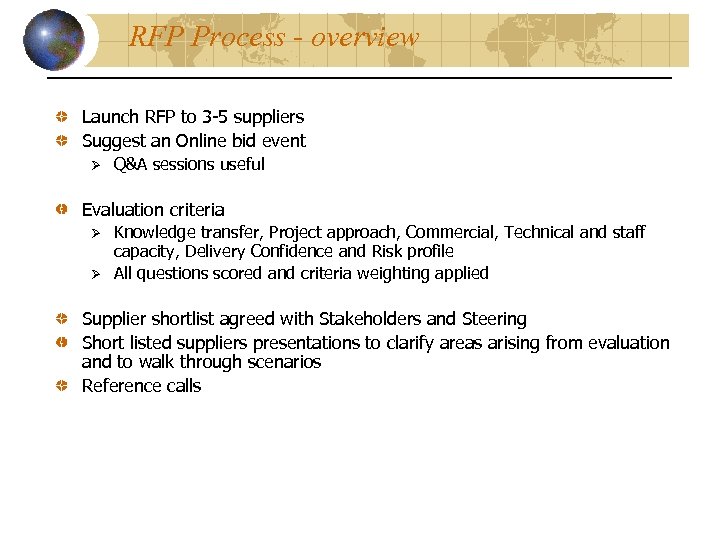
RFP Process - overview Launch RFP to 3 -5 suppliers Suggest an Online bid event Ø Q&A sessions useful Evaluation criteria Ø Ø Knowledge transfer, Project approach, Commercial, Technical and staff capacity, Delivery Confidence and Risk profile All questions scored and criteria weighting applied Supplier shortlist agreed with Stakeholders and Steering Short listed suppliers presentations to clarify areas arising from evaluation and to walk through scenarios Reference calls
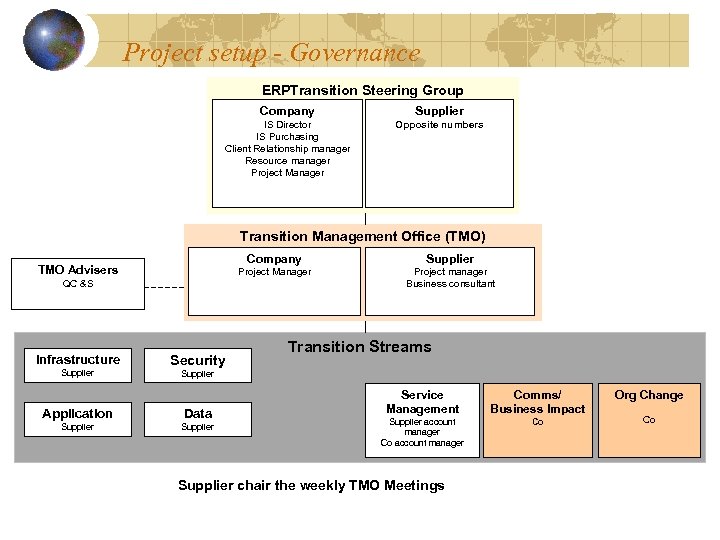
Project setup - Governance ERPTransition Steering Group Company Supplier IS Director IS Purchasing Client Relationship manager Resource manager Project Manager Opposite numbers Transition Management Office (TMO) Company QC &S Infrastructure Supplier Security Supplier Project Manager TMO Advisers Project manager Business consultant Transition Streams Supplier Application Data Supplier Service Management Comms/ Business Impact Supplier account manager Co Supplier chair the weekly TMO Meetings Org Change Co
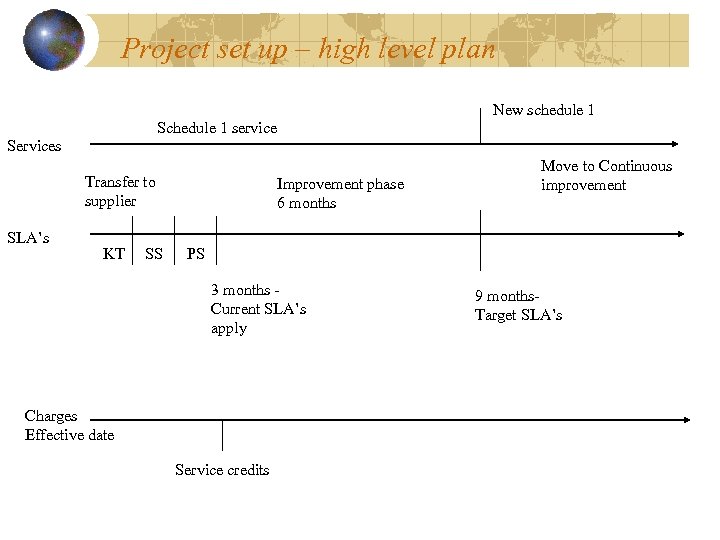
Project set up – high level plan New schedule 1 Schedule 1 service Services Transfer to supplier SLA’s KT SS Improvement phase 6 months Move to Continuous improvement PS 3 months Current SLA’s apply Charges Effective date Service credits 9 months. Target SLA’s
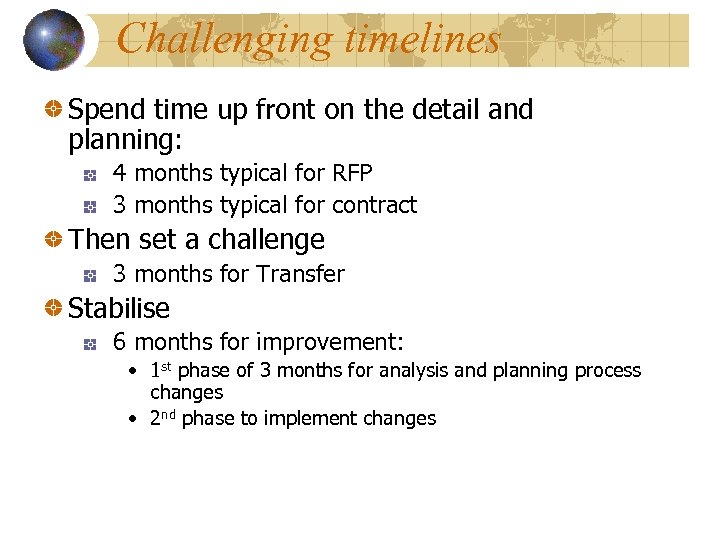
Challenging timelines Spend time up front on the detail and planning: 4 months typical for RFP 3 months typical for contract Then set a challenge 3 months for Transfer Stabilise 6 months for improvement: • 1 st phase of 3 months for analysis and planning process changes • 2 nd phase to implement changes
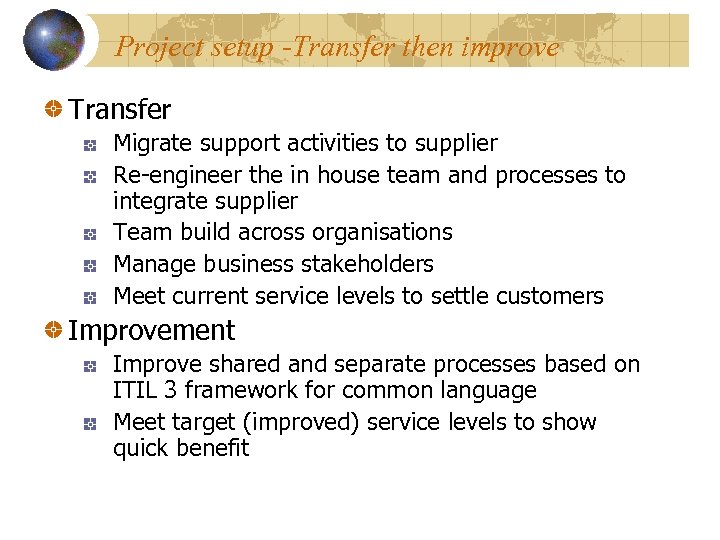
Project setup -Transfer then improve Transfer Migrate support activities to supplier Re-engineer the in house team and processes to integrate supplier Team build across organisations Manage business stakeholders Meet current service levels to settle customers Improvement Improve shared and separate processes based on ITIL 3 framework for common language Meet target (improved) service levels to show quick benefit
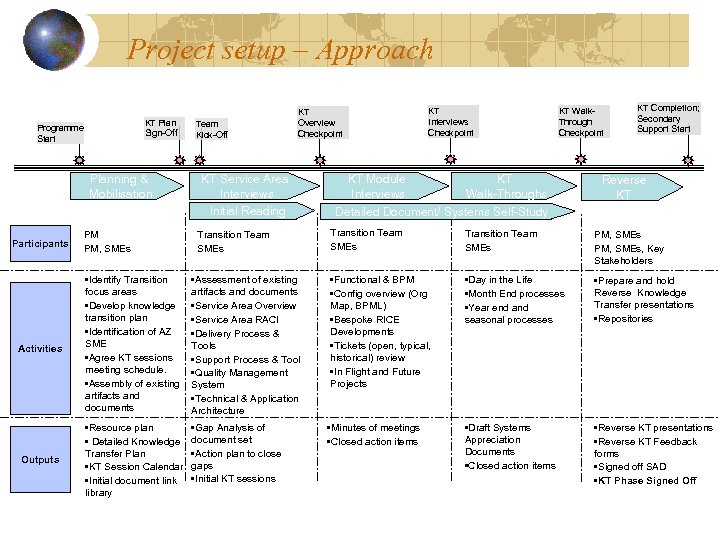
Project setup – Approach KT Plan Sign-Off Programme Start Planning & Mobilisation Participants Activities Outputs PM PM, SMEs Team Kick-Off KT Interviews Checkpoint KT Overview Checkpoint KT Service Area Interviews Initial Reading Transition Team SMEs KT Module Interviews KT Walk. Through Checkpoint KT Walk-Throughs KT Completion; Secondary Support Start Reverse KT Detailed Document/ Systems Self-Study Transition Team SMEs PM, SMEs, Key Stakeholders • Identify Transition focus areas • Develop knowledge transition plan • Identification of AZ SME • Agree KT sessions meeting schedule. • Assembly of existing artifacts and documents • Assessment of existing artifacts and documents • Service Area Overview • Service Area RACI • Delivery Process & Tools • Support Process & Tool • Quality Management System • Technical & Application Architecture • Functional & BPM • Config overview (Org Map, BPML) • Bespoke RICE Developments • Tickets (open, typical, historical) review • In Flight and Future Projects • Day in the Life • Month End processes • Year end and seasonal processes • Prepare and hold Reverse Knowledge Transfer presentations • Repositories • Resource plan • Detailed Knowledge Transfer Plan • KT Session Calendar • Initial document link library • Gap Analysis of document set • Action plan to close gaps • Initial KT sessions • Minutes of meetings • Closed action items • Draft Systems Appreciation Documents • Closed action items • Reverse KT presentations • Reverse KT Feedback forms • Signed off SAD • KT Phase Signed Off
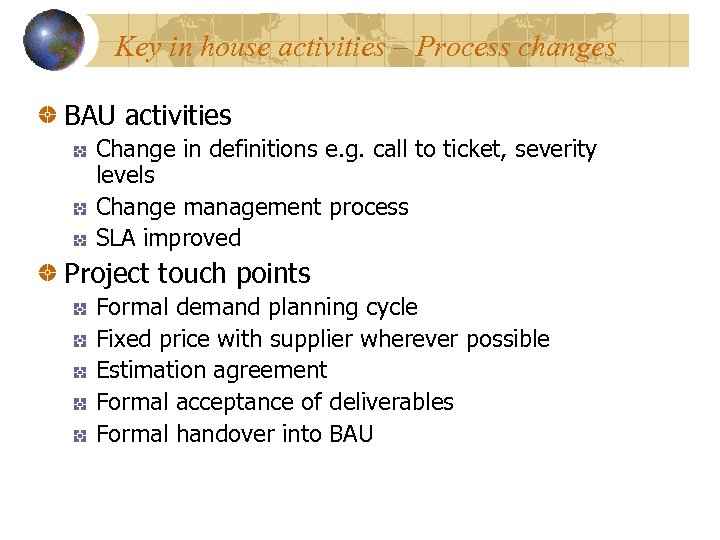
Key in house activities – Process changes BAU activities Change in definitions e. g. call to ticket, severity levels Change management process SLA improved Project touch points Formal demand planning cycle Fixed price with supplier wherever possible Estimation agreement Formal acceptance of deliverables Formal handover into BAU
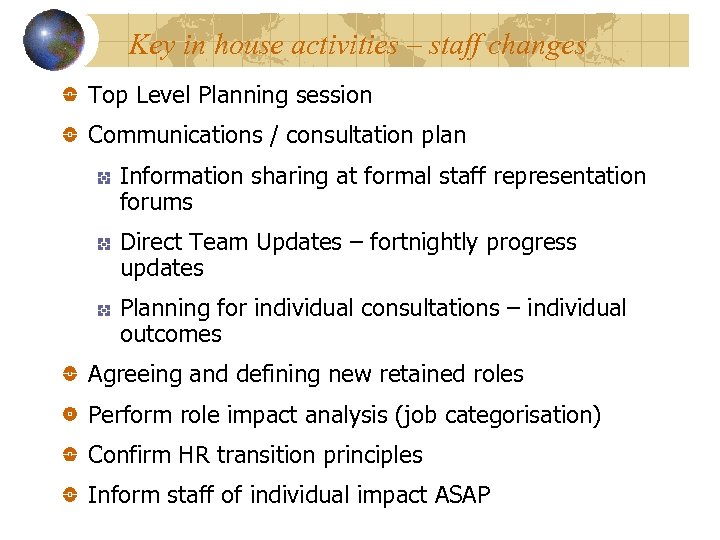
Key in house activities – staff changes Top Level Planning session Communications / consultation plan Information sharing at formal staff representation forums Direct Team Updates – fortnightly progress updates Planning for individual consultations – individual outcomes Agreeing and defining new retained roles Perform role impact analysis (job categorisation) Confirm HR transition principles Inform staff of individual impact ASAP
Ways of Working & Behaviours Joint responsibility from everybody to deliver success Establish shared language and thinking (ITIL) Contractual incentives and penalties Creative rewards for all involved in house staff Collaborative approach required team effort, across the whole group. Activities to proactively build cross-organisational team e. g. evening events, monthly newsletter, weekly team meetings Cultural awareness cuts both ways Encourage initiative “Please contribute if you think anything has been missed or could be done better”. Focused, effective and timely all participants must be striving to complete all sessions, covering all scope, within the allotted time and schedule; focus on the agreed agenda. if any issues come up that can’t be resolved quickly, park them and schedule a separate discussion for that specific topic; all preparation to completed in advance of meetings; Minute and record all sessions
Project Management concerns Logistics of getting the supplier in Having to wait for the contract! Quality control and validation Induction, security and sign-ons Seating……… VC facilities Scheduling How to track changes but stay on plan e. g. no shows India working day and holiday mismatches Time away from the day job Staff workload and priority of other activities Managing interest from other areas
Project Management concerns Supplier processes bring added rigour and therefore benefit: Do we have all the documentation needed? Do we still have the knowledge in-house for old systems? For some may need to agree a “reverse KT” Admit to issues with current processes • Workshops needed to redesign • Could be corporately embarrassing but identify additional quick win improvements Puts retained staff on their mettle • Downside can be defensiveness/aggression
Project Management concerns Pace/impetus Getting the supplier team in on the back of the announcement (v. time to finalise contract) Being fair to staff who would deliver this, perhaps at expense of their own role • Educate them on where they were on the change curve • Multiple communication and feedback channels Customer expectations of “no impact” but change usually has a dip in performance before the improvement
Project Management concerns Manage inputs to the critical path People! Be one step ahead of supplier on finding information sources; protects contractual relationship Manage risks Ring fence system support Quality controls Stakeholder management Tracking (as payments on milestones) Review and approve process to agree deliverables Document standards and measures and agree % thresholds
Lessons learnt - RFP Contract draft & templates issued with the RFP More work on definitions upfront More focus on reading the RFP content for accuracy prior to issue. Preparation, preparation!
Lessons learnt Schedules Block at least one full week from all the key parties to the negotiation - some members will be on call during each day as required. Get your specialist resources cleared of everything else and book them longer than you think you will need them Make sure the team understands how the schedules are put together. Book internal group meetings as separate dates, not block bookings. The meeting diary becomes impossible to work with and does not reflect well with external suppliers. Structure and time bounding for daily negotiations and expected outcomes communicated to internal and external supplier in reasonable time frame and review at the close of each day for completeness. Its going to take longer than you think
Lessons learnt Negotiations - Agree as early as possible what negotiations/discussions are pre/post contract signature. set the pace, agenda, tone Keep control of the documents – don’t let the supplier write them Get their lawyers and decision makers round the table Agree roles beforehand – good cop, bad cop Keep flexible Focus on and maintain relationship management inside negotiations Have someone available during the negotiations to record discussion, agreement, actions, and deadlines.
Lessons learnt Stakeholder engagement Clear accountability for decisions agreed Consistent communications at key decision points for buy-in Keep finance in the loop so they understand the changes to the business case Billing decisions up for negotiation Logistics Main area with full connectivity for everyone and secure breakout areas for both parties
Lessons learnt HR Be clear about the principles which lie behind the process of identifying 'retained' and 'transferring' staff and ensure that the objective analysis supports those principles Move quickly on from data collection and analysis to pragmatic checking through line managers Maintain line management and engagement throughout Don’t mention dates! Very much dependent upon individual reactions and cases.
Lessons learnt Project management Expect and plan for less efficient working during the negotiation period Get the supplier programme team to spend time on site before contract award Mobilisation For on shore staff, get supplier to move work permits along well prior to contract award Get supplier project team staffing agreed up front.
Summary Outsourcing can be seen as a negative My experience has been good and its nothing to be worried about These outsourcing companies do IS as a day job and are very good at it Customers and staff wary but seeing “offshore” as people matters. Its important to establish a good overall team and not work in silos; everyone has a contribution to success Don’t get defensive about current shortfalls: accepting the help brings benefits The contract is only there when things go BADLY wrong – the aim is not to need it

Thank You
Скачать презентацию Lessons I have learnt about Outsourcing Sue Clarke
df16bf8cedeb290b67d21386e4c1ff21.ppt