


 Скачать презентацию Lessons from the Emilia Romagna earthquake to enhance
7951b93d284427352626f284e2532d19.ppt
- Количество слайдов: 61
 Lessons from the Emilia. Romagna earthquake to enhance resilience of local communities. Health impact Giuliano Carrozzi, Lara Bolognesi, Letizia Sampaolo, Roberto Roveta, Carlo Alberto Goldoni “Epidemiological preparedness and response to environmental disasters” ISEE 2016 – Ancillary meeting 31 st August
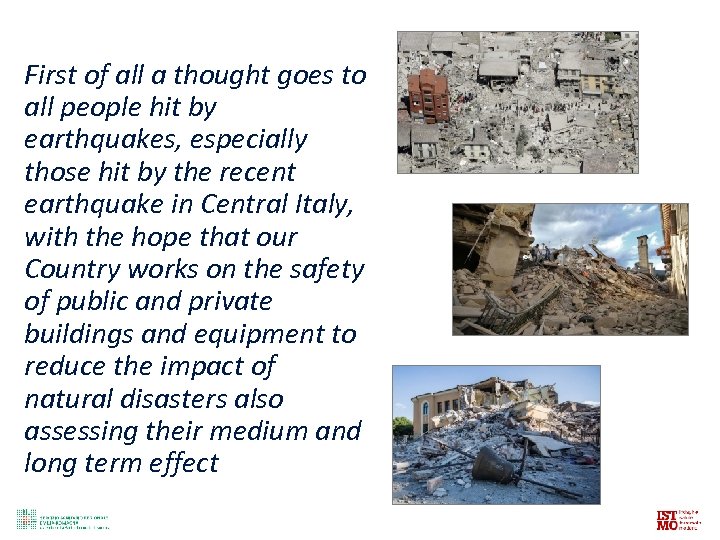 First of all a thought goes to all people hit by earthquakes, especially those hit by the recent earthquake in Central Italy, with the hope that our Country works on the safety of public and private buildings and equipment to reduce the impact of natural disasters also assessing their medium and long term effect
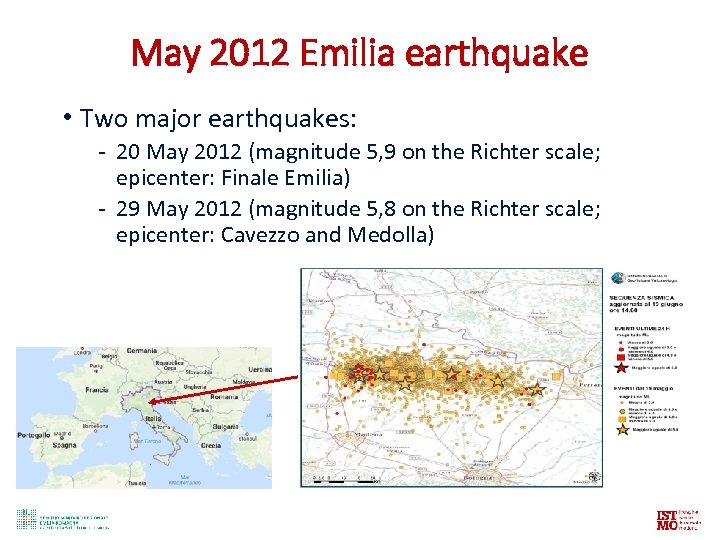 May 2012 Emilia earthquake • Two major earthquakes: - 20 May 2012 (magnitude 5, 9 on the Richter scale; epicenter: Finale Emilia) - 29 May 2012 (magnitude 5, 8 on the Richter scale; epicenter: Cavezzo and Medolla)
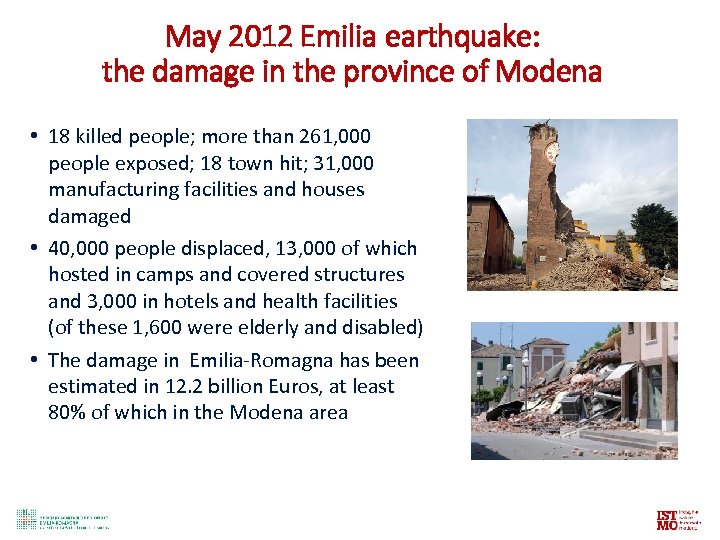 May 2012 Emilia earthquake: the damage in the province of Modena • 18 killed people; more than 261, 000 people exposed; 18 town hit; 31, 000 manufacturing facilities and houses damaged • 40, 000 people displaced, 13, 000 of which hosted in camps and covered structures and 3, 000 in hotels and health facilities (of these 1, 600 were elderly and disabled) • The damage in Emilia-Romagna has been estimated in 12. 2 billion Euros, at least 80% of which in the Modena area
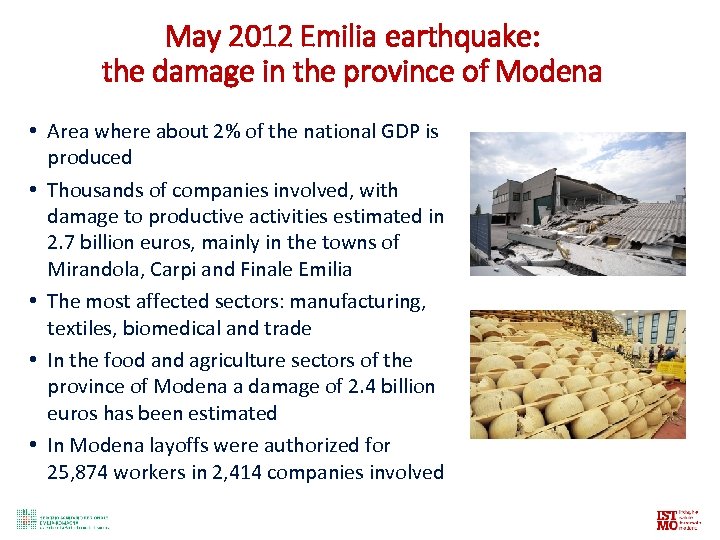 May 2012 Emilia earthquake: the damage in the province of Modena • Area where about 2% of the national GDP is produced • Thousands of companies involved, with damage to productive activities estimated in 2. 7 billion euros, mainly in the towns of Mirandola, Carpi and Finale Emilia • The most affected sectors: manufacturing, textiles, biomedical and trade • In the food and agriculture sectors of the province of Modena a damage of 2. 4 billion euros has been estimated • In Modena layoffs were authorized for 25, 874 workers in 2, 414 companies involved
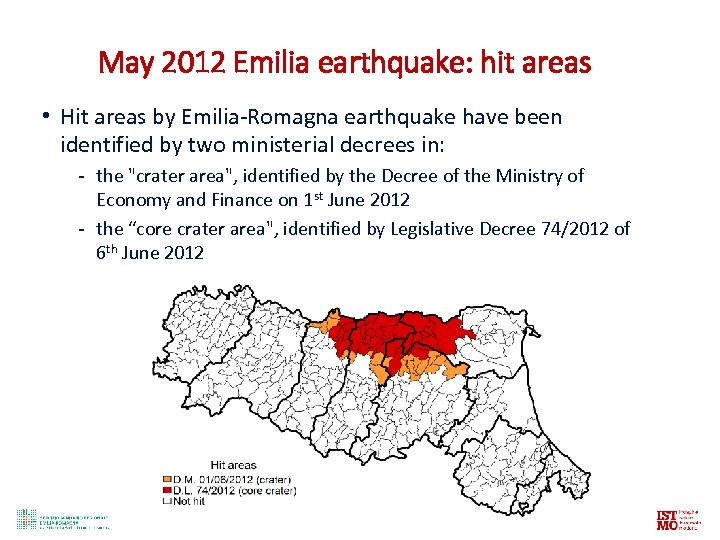 May 2012 Emilia earthquake: hit areas • Hit areas by Emilia-Romagna earthquake have been identified by two ministerial decrees in: - the "crater area", identified by the Decree of the Ministry of Economy and Finance on 1 st June 2012 - the “core crater area", identified by Legislative Decree 74/2012 of 6 th June 2012
 ISTMO survey (Health impact of Modena earthquake) • The research project of Local Health Authority of Modena was approved and funded by the Research and Innovation Board with co-financing of the “Fondazione Cassa di Risparmio” of Carpi and the “Fondazione Cassa di Risparmio” of Mirandola (two bank foundations) • ISTMO resumed the protocol and the questionnaire of the Italian Behavioral Risk Factor Surveillance System (PASSI) and survey Co. Me. Te. S conducted to evaluate the long-term health impact on the population of L’Aquila earthquake that occurred on April 6 th 2009
 Aims of ISTMO survey • Monitor the medium and long term outcome of the earthquake on health, lifestyle and the use of some preventive health activities in hit populations (screenings, vaccinations, etc. ) • The aims and means of the survey were the result of the collaboration among the members of the Scientific Committee, composed of the Directors of the District hit, General Practitioners, the psychologists and experts of National Institute of Public Health, the PASSI National Coordinating Board and the Co. Me. Te. S Group
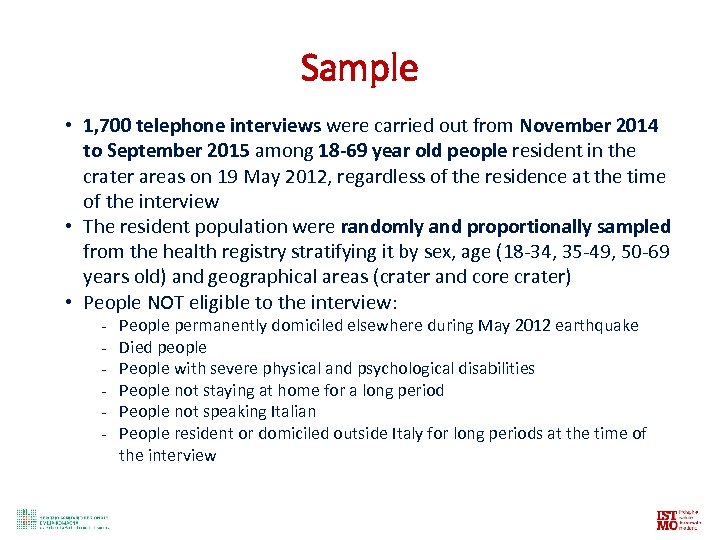 Sample • 1, 700 telephone interviews were carried out from November 2014 to September 2015 among 18 -69 year old people resident in the crater areas on 19 May 2012, regardless of the residence at the time of the interview • The resident population were randomly and proportionally sampled from the health registry stratifying it by sex, age (18 -34, 35 -49, 50 -69 years old) and geographical areas (crater and core crater) • People NOT eligible to the interview: - People permanently domiciled elsewhere during May 2012 earthquake Died people People with severe physical and psychological disabilities People not staying at home for a long period People not speaking Italian People resident or domiciled outside Italy for long periods at the time of the interview
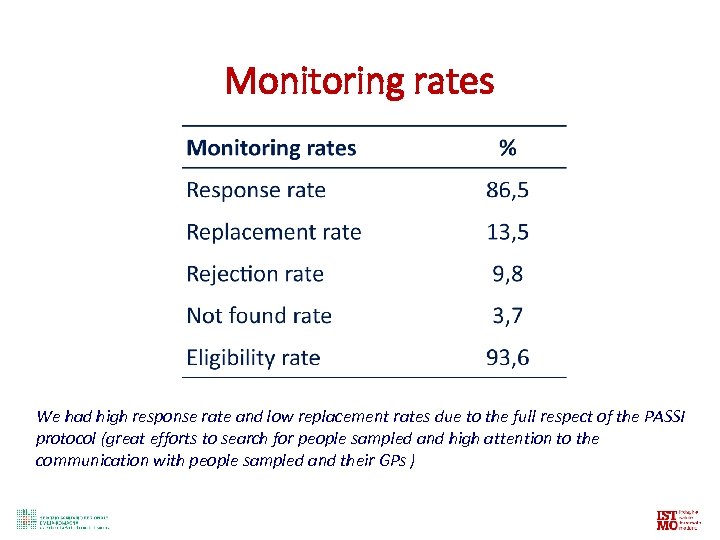 Monitoring rates We had high response rate and low replacement rates due to the full respect of the PASSI protocol (great efforts to search for people sampled and high attention to the communication with people sampled and their GPs )
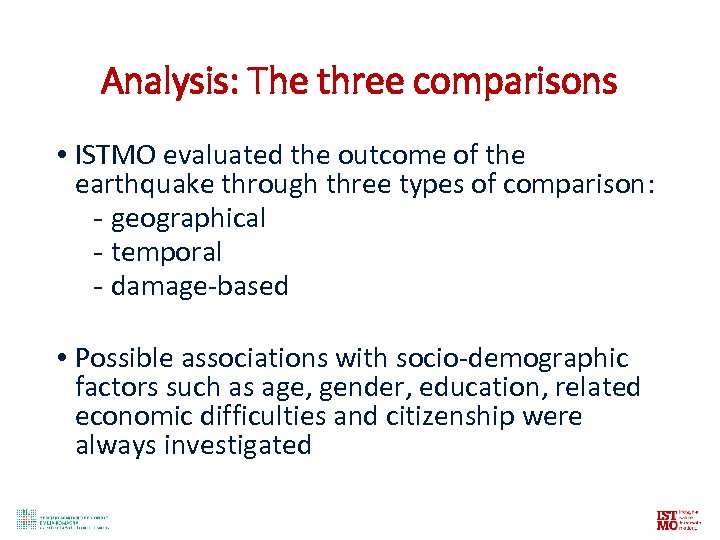 Analysis: The three comparisons • ISTMO evaluated the outcome of the earthquake through three types of comparison: - geographical - temporal - damage-based • Possible associations with socio-demographic factors such as age, gender, education, related economic difficulties and citizenship were always investigated
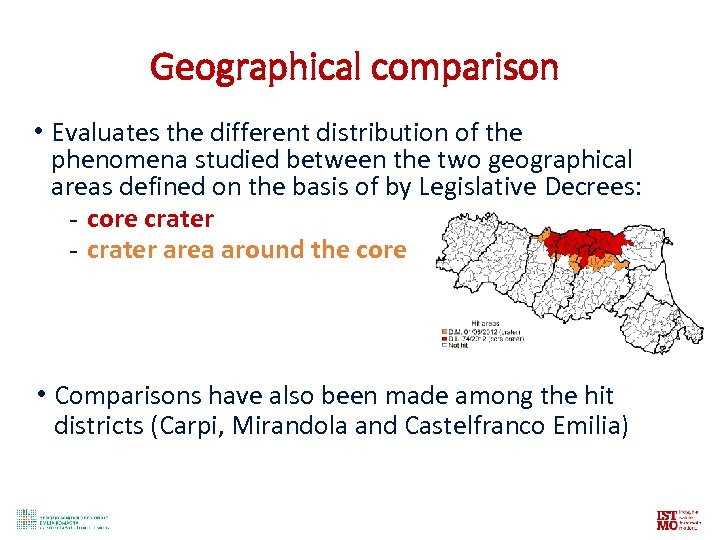 Geographical comparison • Evaluates the different distribution of the phenomena studied between the two geographical areas defined on the basis of by Legislative Decrees: - core crater - crater area around the core • Comparisons have also been made among the hit districts (Carpi, Mirandola and Castelfranco Emilia)
 Temporal comparision • Evaluates the different distribution of the phenomena studied before and after the earthquake using PASSI data (2008 -2015) in the hit and not hit areas at provincial and regional levels: - First: from January 2008 to May 19, 2012 - After: from June 2012 to December 2015 • These comparisons, although potentially very informative, should be interpreted with great caution because the trends of health status and lifestyle, in addition to the effects of the earthquake, are potentially also affected by other factors, such as the economic crisis, the change of social desirability bias and the different methods used (eg. thirdparty interviewers in ISTMO survey)
 Damage-based comparison • Investigates the different distribution of the phenomena studied for different levels of reported damage or troubles of different nature (health, economic and housing) • Due to the low number of some groups, composite variables of damage or troubles have also been used
 Composite variables of damage or troubles • People reporting “Injuries, losses or broken affective bonds” (dichotomous variable): identifies the people who reported the death of family or household members, loved ones, personal injuries, injuries among family and household members or broken affective bonds within the family, friendship or social spheres • “Material damage or troubles”: variable subdivided into three categories which combines the economic damage and the damage or troubles at work: - serious damage: people who reported severe economic damage to their property or have lost their jobs because of the earthquake - troubles: people who reported no serious economic damage to their property or who have had troubles at work because of the earthquake - no damage: people who have had no economic damage to their property or no business troubles because of the earthquake • “Persistent housing troubles” (dichotomous variable): identifies the people who were still living out of their homes or had permanently changed the municipality of residence or domicile at the time of the interview
 Anticipating the conclusions. . . psychological health • No evident changes in overall positively perceived health status (from 69% to 70%) but people who have reported damage or troubles because of the earthquake show a worse state of health, especially in the psychological sphere • One out of two people still reported an intrusive thought, that recalls the events even when they do not want to, or the memories of the events are triggered by other situations • State anxiety and depressive symptoms are more frequent among people who reported damage or troubles because of the earthquake. However, depressive symptoms reported decreased after the earthquake (from 10, 3% to 7, 2%)
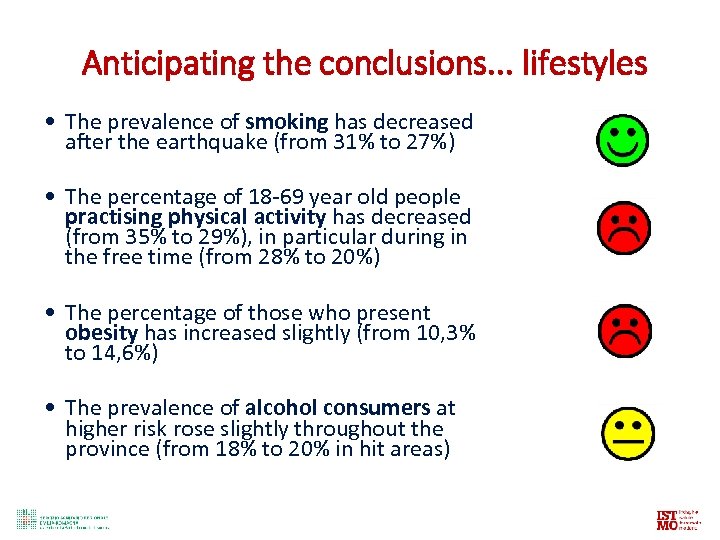 Anticipating the conclusions. . . lifestyles • The prevalence of smoking has decreased after the earthquake (from 31% to 27%) • The percentage of 18 -69 year old people practising physical activity has decreased (from 35% to 29%), in particular during in the free time (from 28% to 20%) • The percentage of those who present obesity has increased slightly (from 10, 3% to 14, 6%) • The prevalence of alcohol consumers at higher risk rose slightly throughout the province (from 18% to 20% in hit areas)
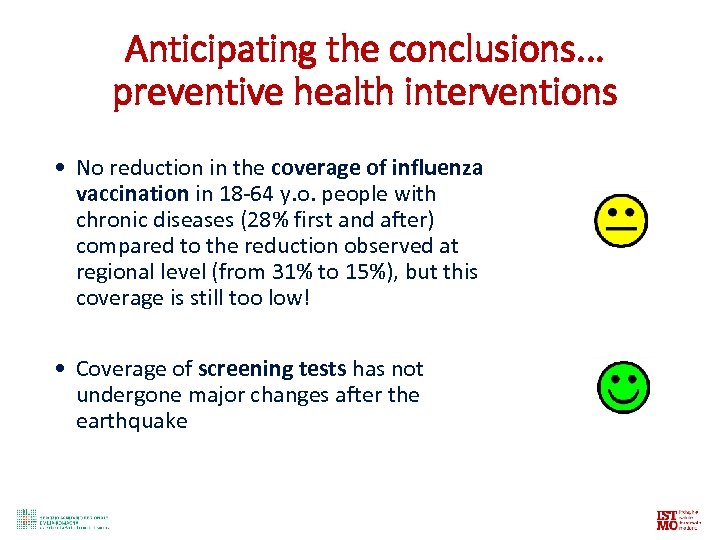 Anticipating the conclusions. . . preventive health interventions • No reduction in the coverage of influenza vaccination in 18 -64 y. o. people with chronic diseases (28% first and after) compared to the reduction observed at regional level (from 31% to 15%), but this coverage is still too low! • Coverage of screening tests has not undergone major changes after the earthquake
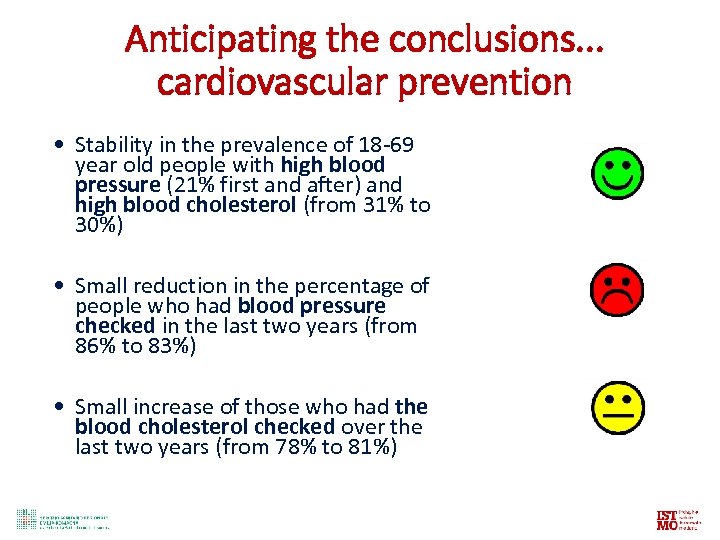 Anticipating the conclusions. . . cardiovascular prevention • Stability in the prevalence of 18 -69 year old people with high blood pressure (21% first and after) and high blood cholesterol (from 31% to 30%) • Small reduction in the percentage of people who had blood pressure checked in the last two years (from 86% to 83%) • Small increase of those who had the blood cholesterol checked over the last two years (from 78% to 81%)
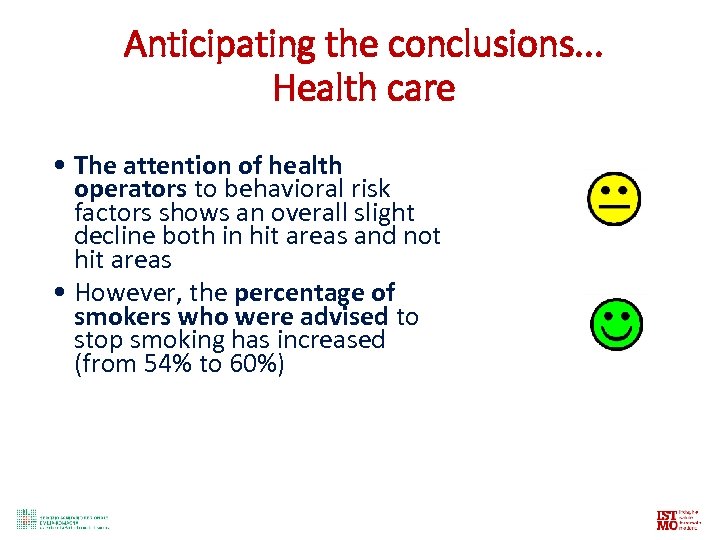 Anticipating the conclusions. . . Health care • The attention of health operators to behavioral risk factors shows an overall slight decline both in hit areas and not hit areas • However, the percentage of smokers who were advised to stop smoking has increased (from 54% to 60%)
 Anticipating the conclusions. . . road safety • Small increase in the use of the front seat belts after the earthquake (from 88% to 91%) • Decrease in the percentage of people who reported driving under influence of alcohol last month (from 6, 1% to 4, 2%)
 Anticipating the conclusions… home and work safety • the perception of the risk of being injured at home and in workplace decreased: respectively from 7, 3% to 4, 5% and from 26% to 18% • Increase in the percentage of people who have received information on how to prevent accidents at work and occupational diseases (from 59% to 62%)
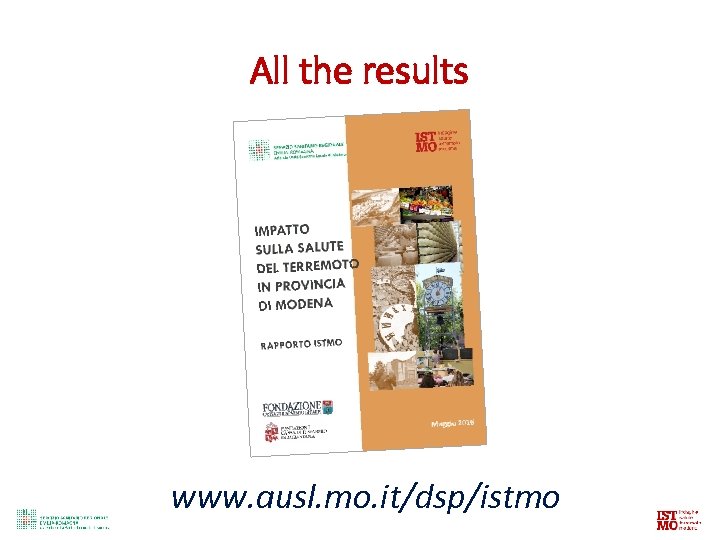 All the results www. ausl. mo. it/dsp/istmo
 Psychological health in hit area
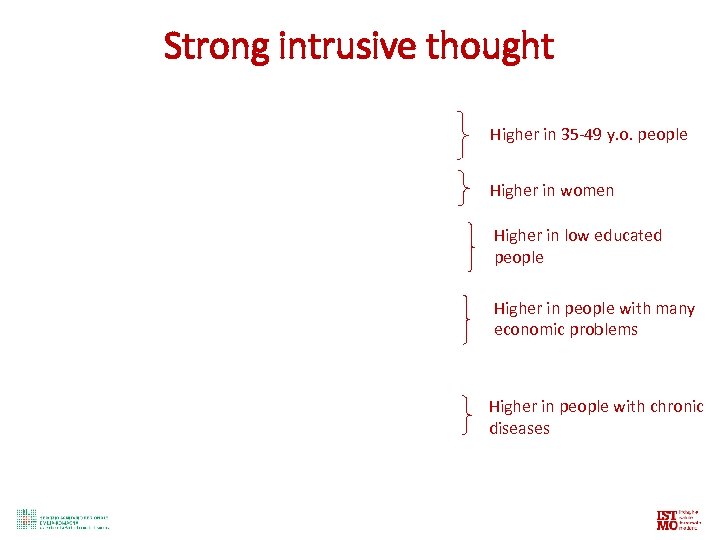
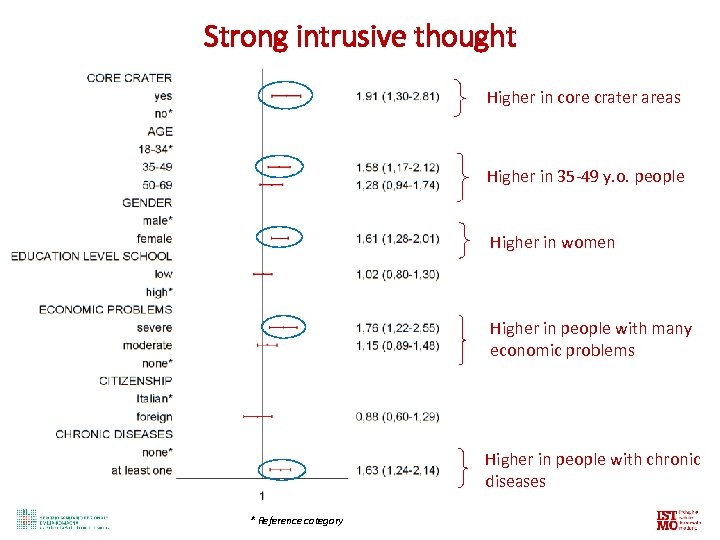
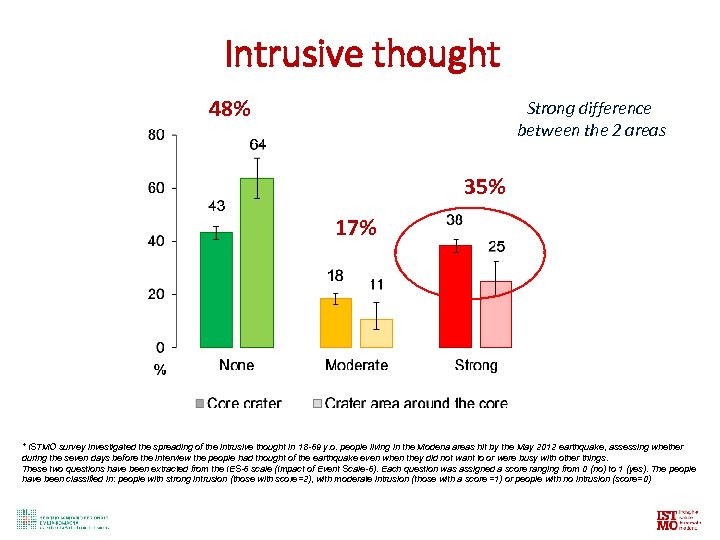 Intrusive thought 48% Strong difference between the 2 areas 35% 17% * ISTMO survey investigated the spreading of the intrusive thought in 18 -69 y. o. people living in the Modena areas hit by the May 2012 earthquake, assessing whether during the seven days before the interview the people had thought of the earthquake even when they did not want to or were busy with other things. These two questions have been extracted from the IES-6 scale (Impact of Event Scale-6). Each question was assigned a score ranging from 0 (no) to 1 (yes). The people have been classified in: people with strong intrusion (those with score=2), with moderate intrusion (those with a score =1) or people with no intrusion (score=0)
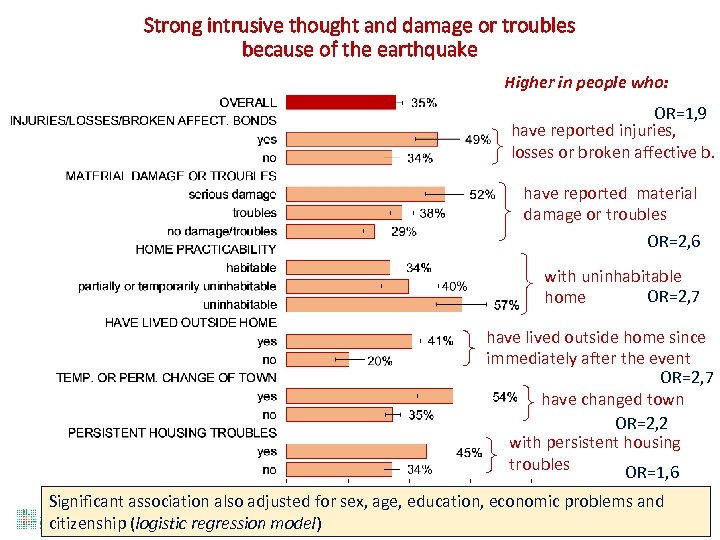 Strong intrusive thought and damage or troubles because of the earthquake Higher in people who: OR=1, 9 have reported injuries, losses or broken affective b. have reported material damage or troubles OR=2, 6 with uninhabitable OR=2, 7 home have lived outside home since immediately after the event OR=2, 7 have changed town OR=2, 2 with persistent housing troubles OR=1, 6 Significant association also adjusted for sex, age, education, economic problems and citizenship (logistic regression model)
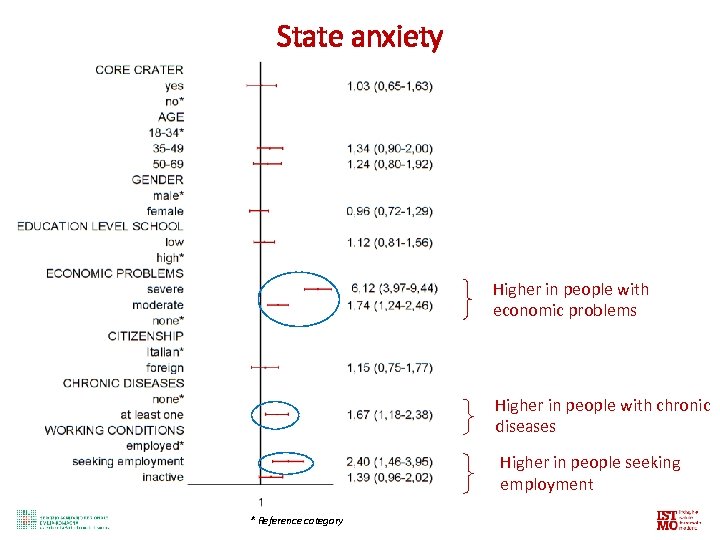
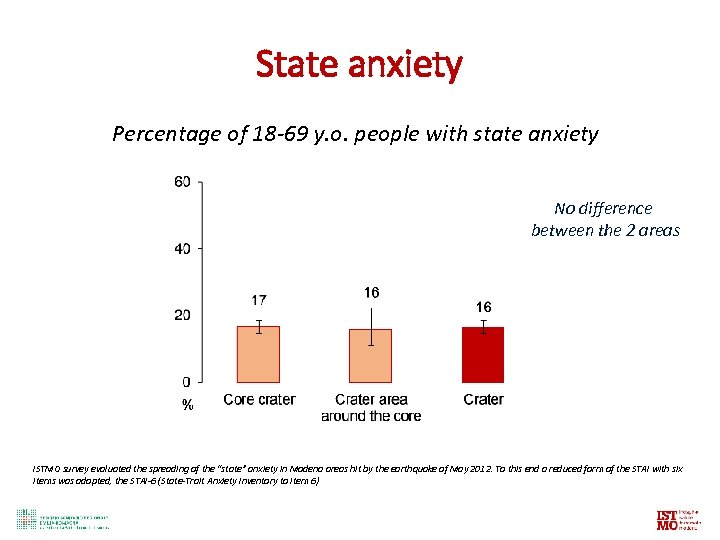 State anxiety Percentage of 18 -69 y. o. people with state anxiety No difference between the 2 areas ISTMO survey evaluated the spreading of the “state” anxiety in Modena areas hit by the earthquake of May 2012. To this end a reduced form of the STAI with six items was adopted, the STAI-6 (State-Trait Anxiety Inventory to item 6)
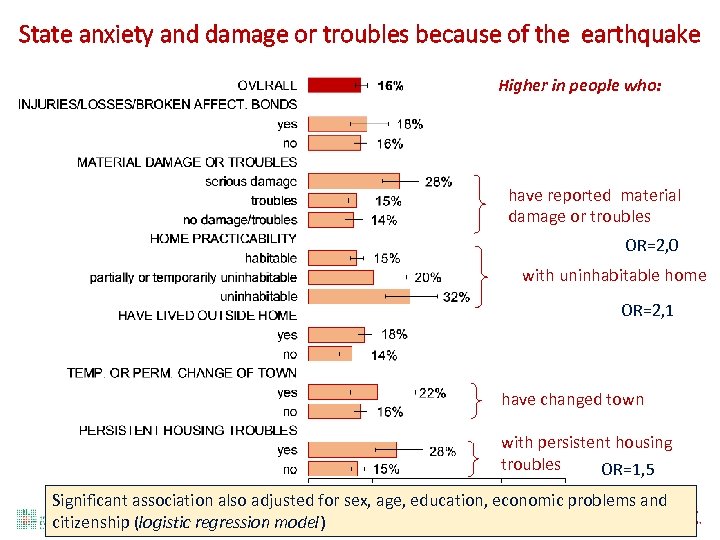 State anxiety and damage or troubles because of the earthquake Higher in people who: have reported material damage or troubles OR=2, 0 with uninhabitable home OR=2, 1 have changed town with persistent housing troubles OR=1, 5 Significant association also adjusted for sex, age, education, economic problems and citizenship (logistic regression model)
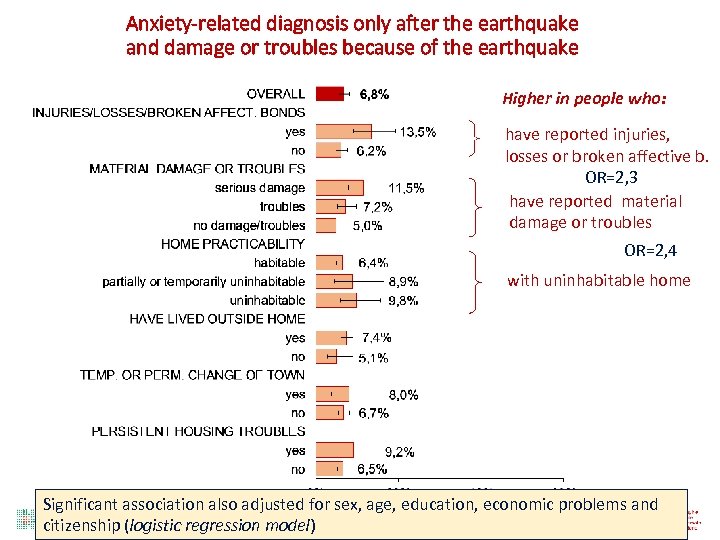 Anxiety-related diagnosis only after the earthquake and damage or troubles because of the earthquake Higher in people who: have reported injuries, losses or broken affective b. OR=2, 3 have reported material damage or troubles OR=2, 4 with uninhabitable home Significant association also adjusted for sex, age, education, economic problems and citizenship (logistic regression model)
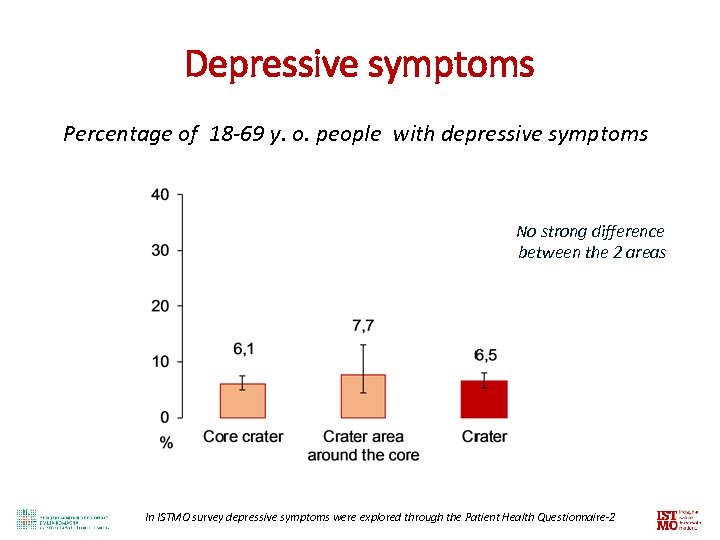 Depressive symptoms Percentage of 18 -69 y. o. people with depressive symptoms No strong difference between the 2 areas In ISTMO survey depressive symptoms were explored through the Patient Health Questionnaire-2
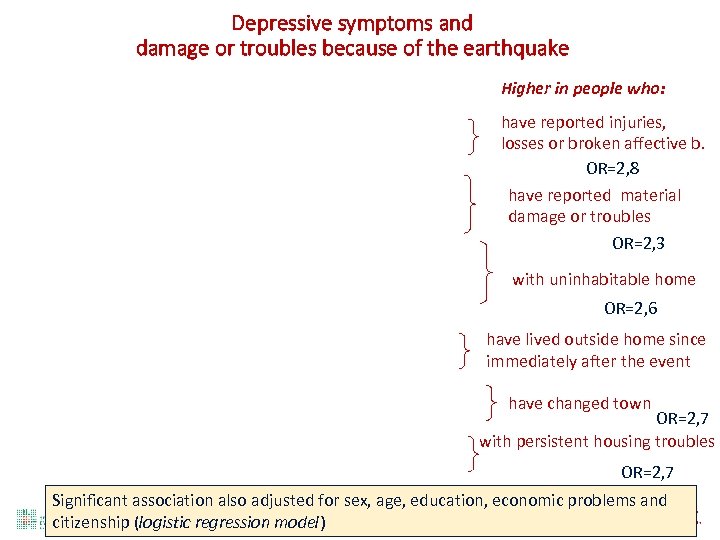 Depressive symptoms and damage or troubles because of the earthquake Higher in people who: have reported injuries, losses or broken affective b. OR=2, 8 have reported material damage or troubles OR=2, 3 with uninhabitable home OR=2, 6 have lived outside home since immediately after the event have changed town OR=2, 7 with persistent housing troubles OR=2, 7 Significant association also adjusted for sex, age, education, economic problems and citizenship (logistic regression model)
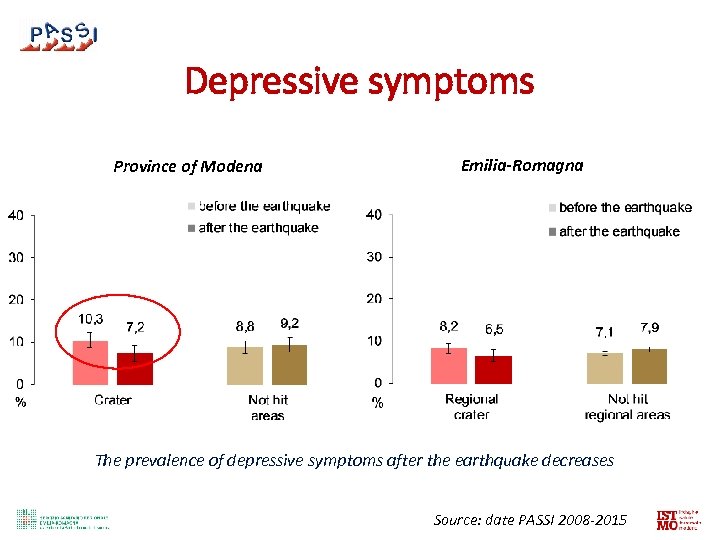 Depressive symptoms Province of Modena Emilia-Romagna The prevalence of depressive symptoms after the earthquake decreases Source: date PASSI 2008 -2015
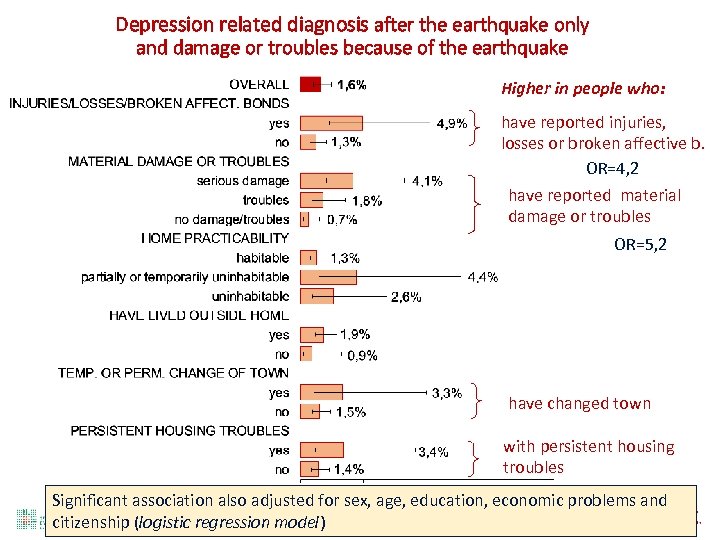 Depression related diagnosis after the earthquake only and damage or troubles because of the earthquake Higher in people who: have reported injuries, losses or broken affective b. OR=4, 2 have reported material damage or troubles OR=5, 2 have changed town with persistent housing troubles Significant association also adjusted for sex, age, education, economic problems and citizenship (logistic regression model)
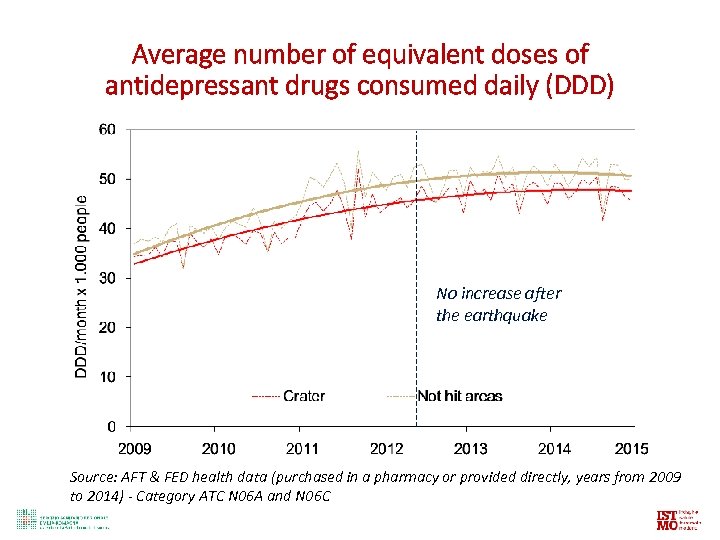 Average number of equivalent doses of antidepressant drugs consumed daily (DDD) No increase after the earthquake Source: AFT & FED health data (purchased in a pharmacy or provided directly, years from 2009 to 2014) - Category ATC N 06 A and N 06 C
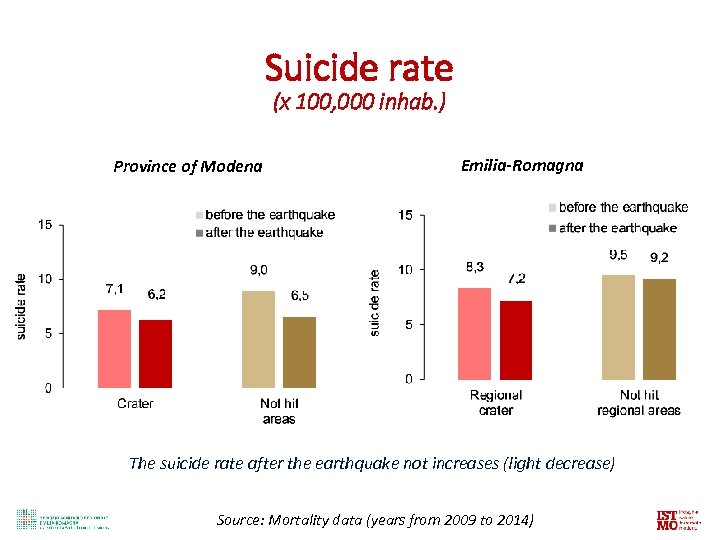 Suicide rate (x 100, 000 inhab. ) Province of Modena Emilia-Romagna The suicide rate after the earthquake not increases (light decrease) Source: Mortality data (years from 2009 to 2014)
 Health status in hit area
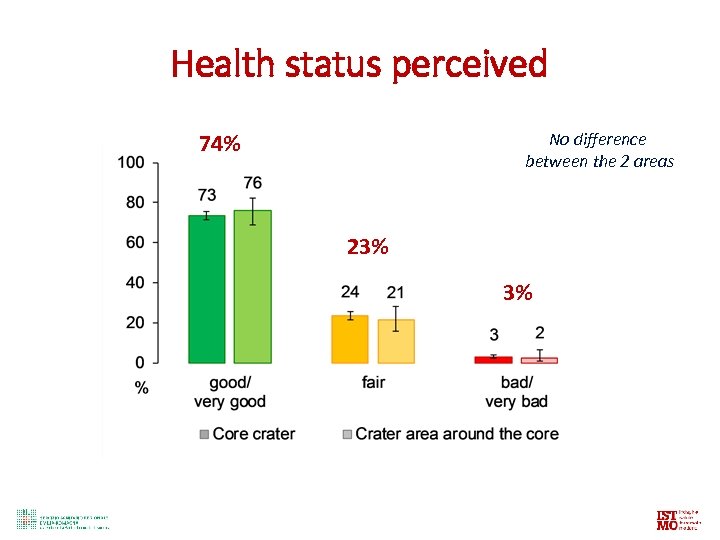 Health status perceived 74% No difference between the 2 areas 23% 3%
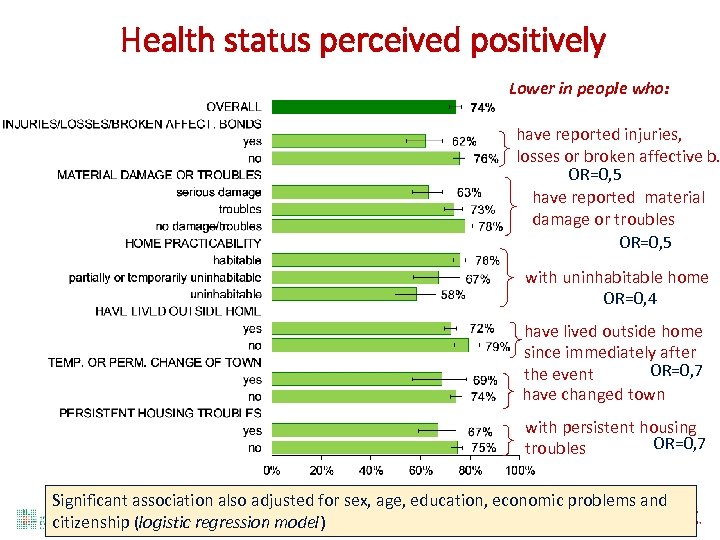 Health status perceived positively Lower in people who: have reported injuries, losses or broken affective b. OR=0, 5 have reported material damage or troubles OR=0, 5 with uninhabitable home OR=0, 4 have lived outside home since immediately after OR=0, 7 the event have changed town with persistent housing OR=0, 7 troubles Significant association also adjusted for sex, age, education, economic problems and citizenship (logistic regression model)
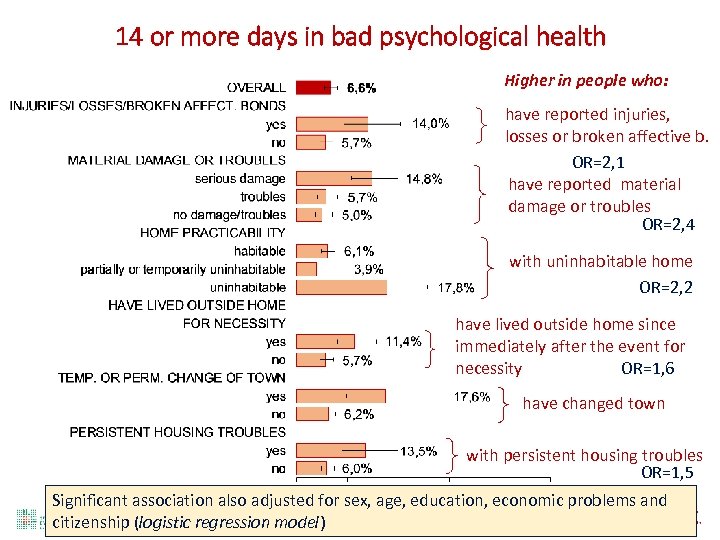 14 or more days in bad psychological health Higher in people who: have reported injuries, losses or broken affective b. OR=2, 1 have reported material damage or troubles OR=2, 4 with uninhabitable home OR=2, 2 have lived outside home since immediately after the event for necessity OR=1, 6 have changed town with persistent housing troubles OR=1, 5 Significant association also adjusted for sex, age, education, economic problems and citizenship (logistic regression model)
 Lifestyle in the hit area
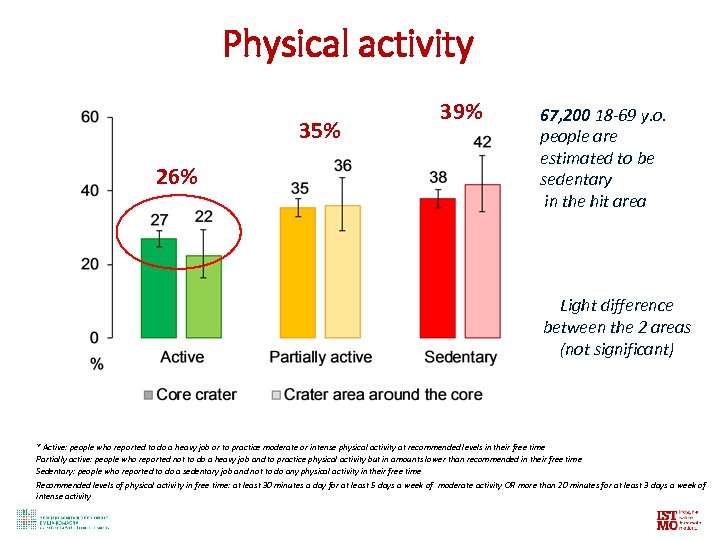 Physical activity 35% 26% 39% 67, 200 18 -69 y. o. people are estimated to be sedentary in the hit area Light difference between the 2 areas (not significant) * Active: people who reported to do a heavy job or to practice moderate or intense physical activity at recommended levels in their free time Partially active: people who reported not to do a heavy job and to practice physical activity but in amounts lower than recommended in their free time Sedentary: people who reported to do a sedentary job and not to do any physical activity in their free time Recommended levels of physical activity in free time: at least 30 minutes a day for at least 5 days a week of moderate activity OR more than 20 minutes for at least 3 days a week of intense activity
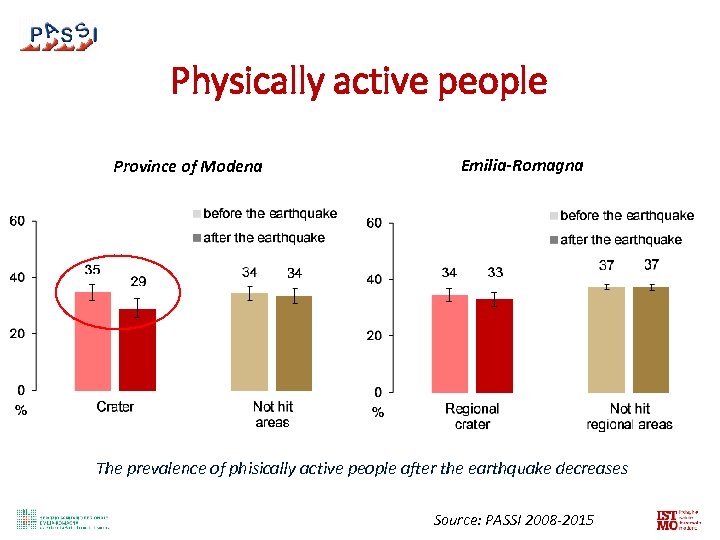 Physically active people Province of Modena Emilia-Romagna The prevalence of phisically active people after the earthquake decreases Source: PASSI 2008 -2015
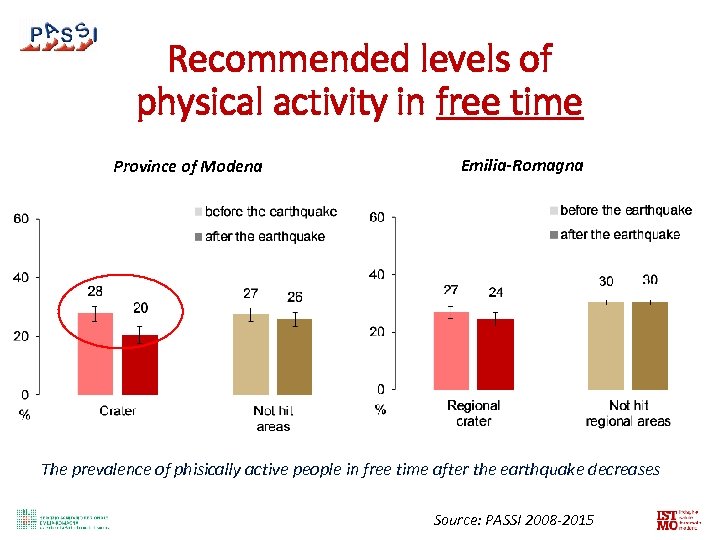 Recommended levels of physical activity in free time Province of Modena Emilia-Romagna The prevalence of phisically active people in free time after the earthquake decreases Source: PASSI 2008 -2015
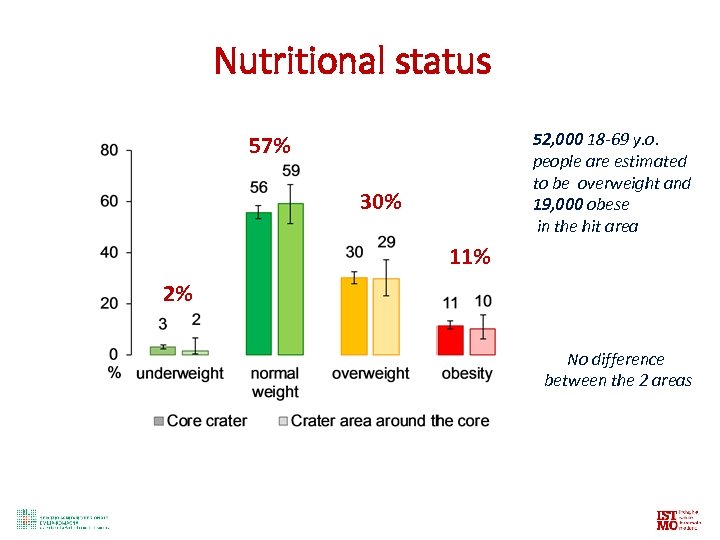 Nutritional status 52, 000 18 -69 y. o. people are estimated to be overweight and 19, 000 obese in the hit area 57% 30% 11% 2% No difference between the 2 areas
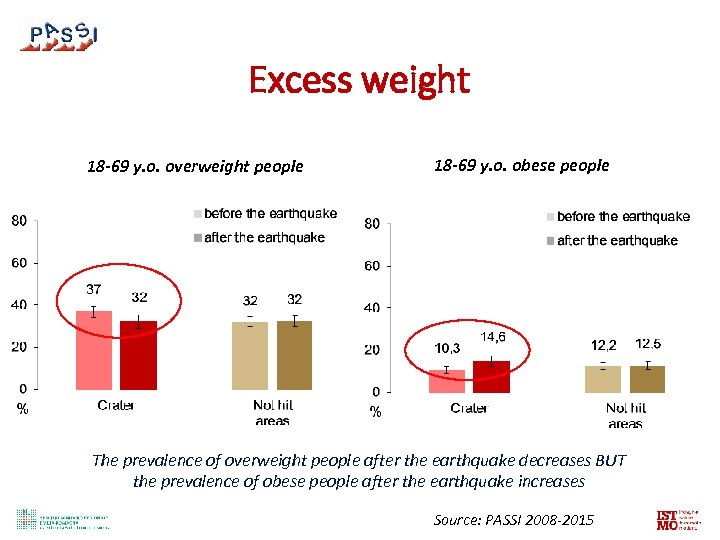 Excess weight 18 -69 y. o. overweight people 18 -69 y. o. obese people The prevalence of overweight people after the earthquake decreases BUT the prevalence of obese people after the earthquake increases Source: PASSI 2008 -2015
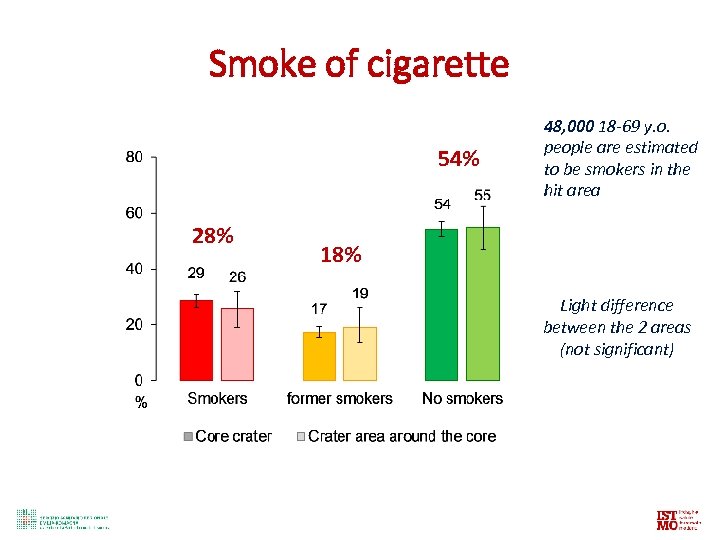 Smoke of cigarette 54% 28% 48, 000 18 -69 y. o. people are estimated to be smokers in the hit area 18% Light difference between the 2 areas (not significant)
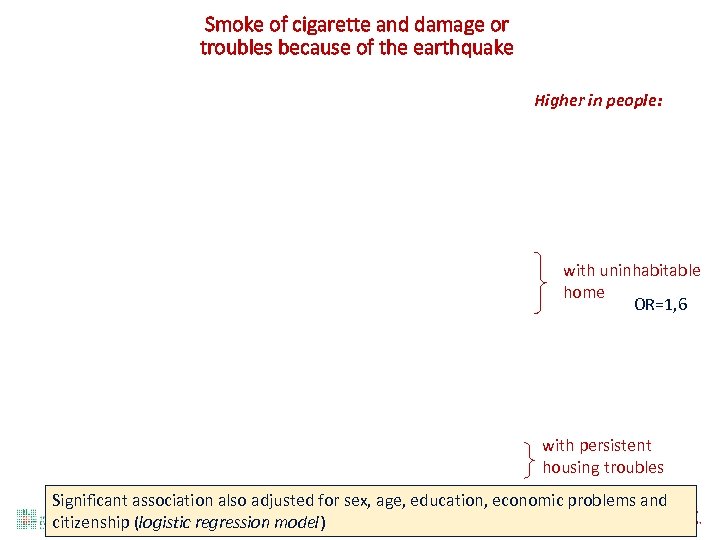 Smoke of cigarette and damage or troubles because of the earthquake Higher in people: with uninhabitable home OR=1, 6 with persistent housing troubles Significant association also adjusted for sex, age, education, economic problems and citizenship (logistic regression model)
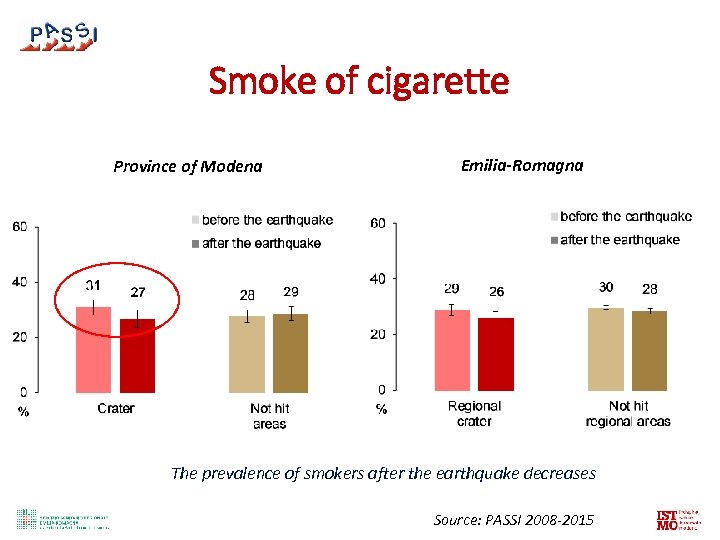 Smoke of cigarette Province of Modena Emilia-Romagna The prevalence of smokers after the earthquake decreases Source: PASSI 2008 -2015
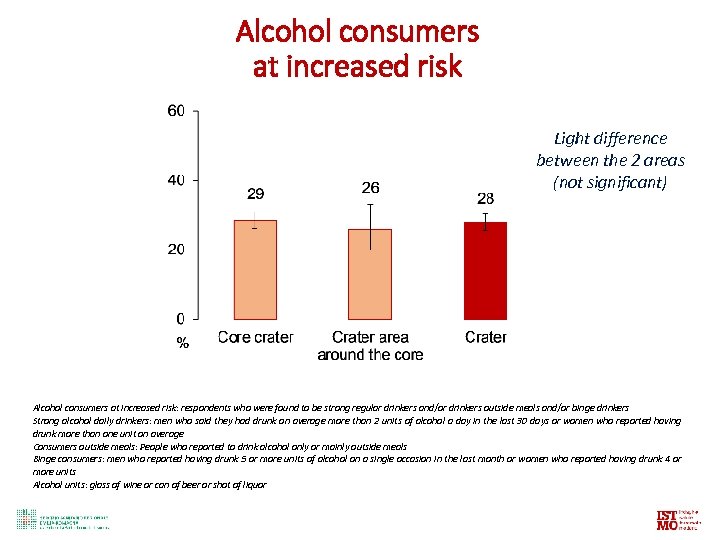 Alcohol consumers at increased risk Light difference between the 2 areas (not significant) Alcohol consumers at increased risk: respondents who were found to be strong regular drinkers and/or drinkers outside meals and/or binge drinkers Strong alcohol daily drinkers: men who said they had drunk on average more than 2 units of alcohol a day in the last 30 days or women who reported having drunk more than one unit on average Consumers outside meals: People who reported to drink alcohol only or mainly outside meals Binge consumers: men who reported having drunk 5 or more units of alcohol on a single occasion in the last month or women who reported having drunk 4 or more units Alcohol units: glass of wine or can of beer or shot of liquor
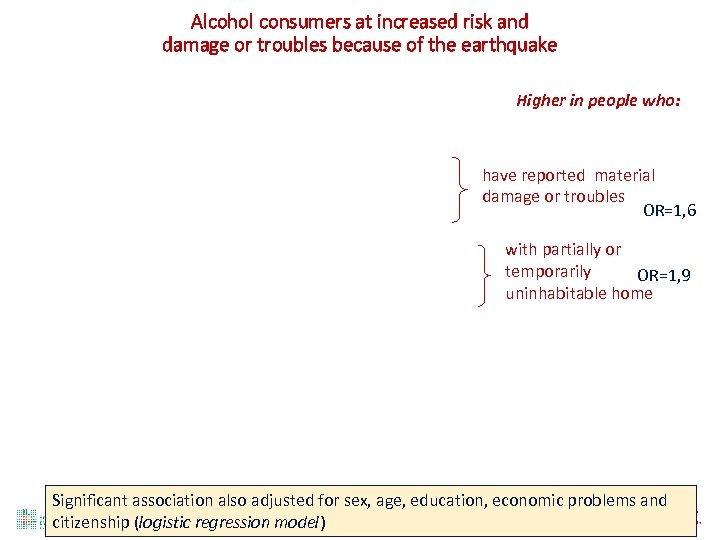 Alcohol consumers at increased risk and damage or troubles because of the earthquake Higher in people who: have reported material damage or troubles OR=1, 6 with partially or temporarily OR=1, 9 uninhabitable home Significant association also adjusted for sex, age, education, economic problems and citizenship (logistic regression model)
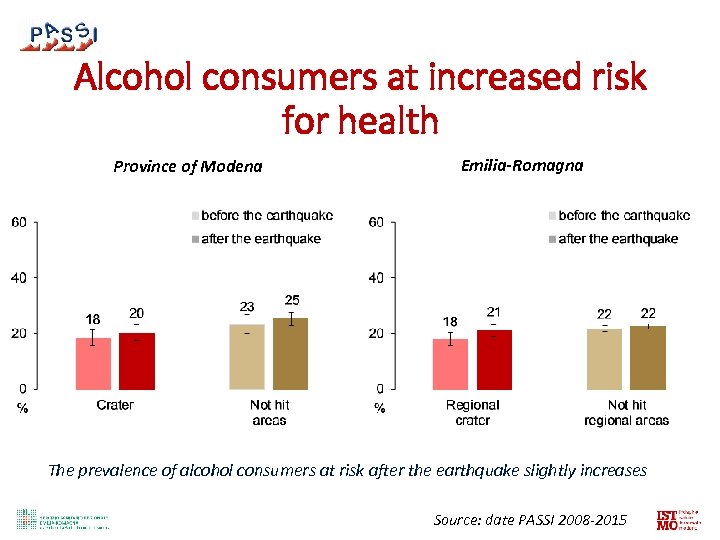 Alcohol consumers at increased risk for health Province of Modena Emilia-Romagna The prevalence of alcohol consumers at risk after the earthquake slightly increases Source: date PASSI 2008 -2015
 Thanks for your attention ISTMO survey was carried out thanks to the funding of the Research and Innovation Board of the Local Health Authority of Modena which received a contribution from the “Fondazione Cassa di Risparmio” of Carpi and the “Fondazione Cassa di Risparmio” of Mirandola
 Working team of Local Health Authority of Modena: Carlo Alberto Goldoni - Local Health Authority of Modena Giuliano Carrozzi - Local Health Authority of Modena Lara Bolognesi - Local Health Authority of Modena Letizia Sampaolo - University Ca’ Foscari of Venice and Local Health Authority of Modena Roberto Roveta - Local Health Authority of Modena Scientific Committee Elisa Bergonzini - Local Health Authority of Modena Nunzio Borelli - General practitioners, Medolla Davide Botturi - Region Emilia-Romagna Nicola Caranci - Region Emilia-Romagna Paolo D’Argenio - PASSI National Coordinating Maria Luisa De Luca - Local Health Authority of Modena Davide Ferrari - Local Health Authority of Modena Adriana Giannini - Region Emilia-Romagna Antonella Gigantesco - National Institute of Public Health Massimo Marcon - Local Health Authority of Modena Nora Marzi - Local Health Authority of Modena Maria Masocco - National Institute of Public Health Mario Meschieri - Local Health Authority of Modena Valentina Minardi - National Institute of Public Health Daniela Rebecchi - Local Health Authority of Modena Massimo Oddone Trinito - PASSI National Coordinating Claudio Vagnini - Local Health Authority of Modena
 Strong intrusive thought Higher in 35 -49 y. o. people Higher in women Higher in low educated people Higher in people with many economic problems Higher in people with chronic diseases
 Strong intrusive thought Higher in core crater areas Higher in 35 -49 y. o. people Higher in women Higher in people with many economic problems Higher in people with chronic diseases * Reference category
 State anxiety Higher in people with economic problems Higher in people with chronic diseases Higher in people seeking employment * Reference category
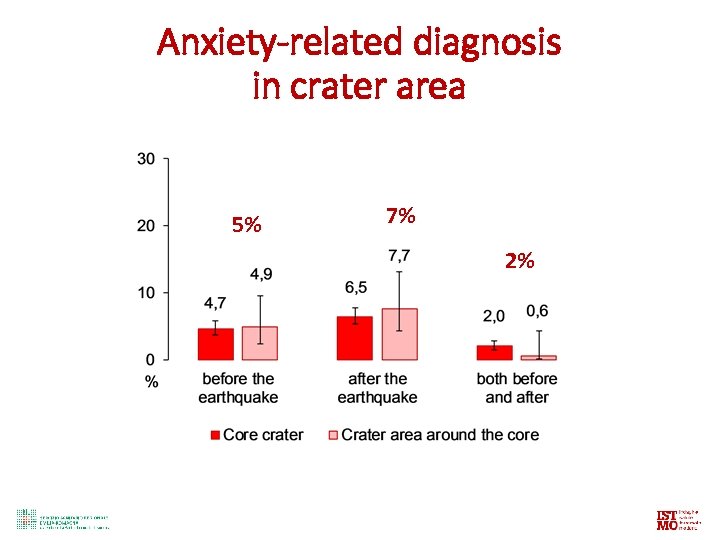 Anxiety-related diagnosis in crater area 5% 7% 2%
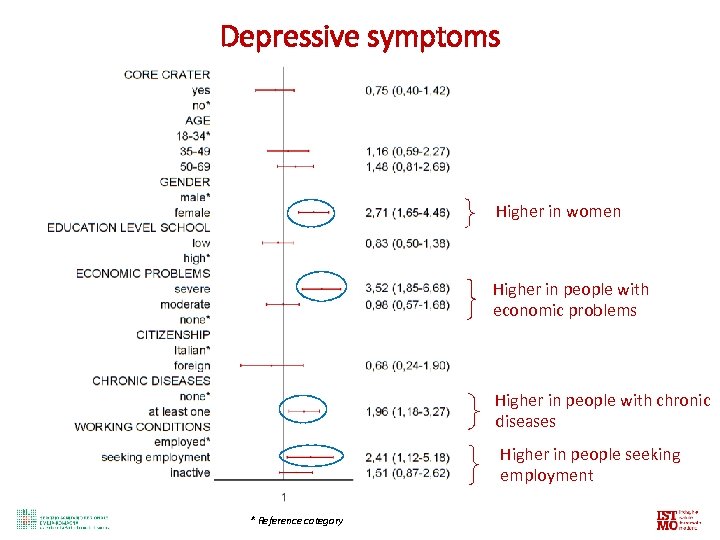 Depressive symptoms Higher in women Higher in people with economic problems Higher in people with chronic diseases Higher in people seeking employment * Reference category
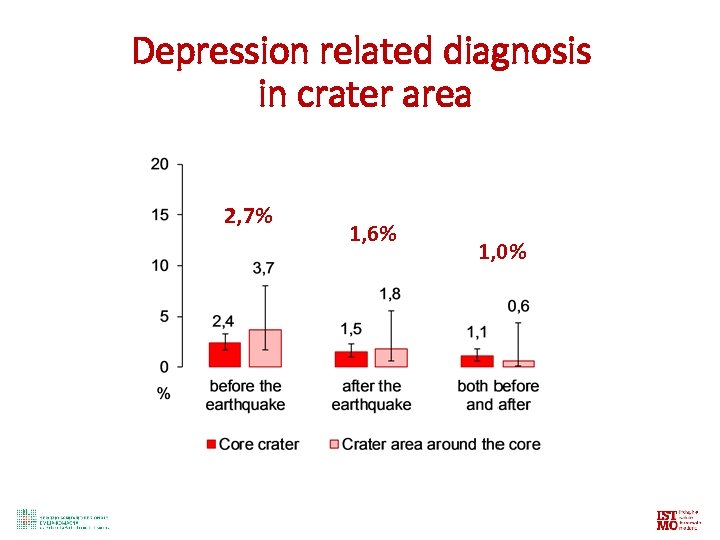 Depression related diagnosis in crater area 2, 7% 1, 6% 1, 0%
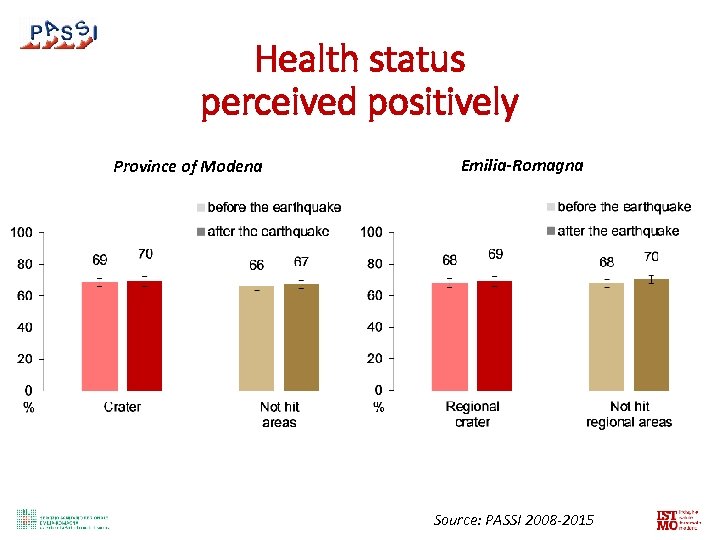 Health status perceived positively Province of Modena Emilia-Romagna Source: PASSI 2008 -2015
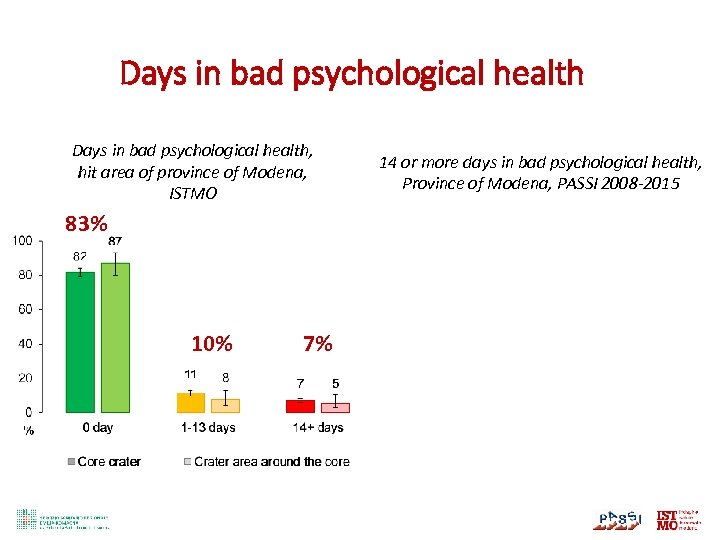 Days in bad psychological health, hit area of province of Modena, ISTMO 83% 10% 7% 14 or more days in bad psychological health, Province of Modena, PASSI 2008 -2015