


 Скачать презентацию Lessons for Argentina from the Health Information Technology
5dc3cabe74fcadc0cacba64d705129e4.ppt
- Количество слайдов: 26
 Lessons for Argentina from the Health Information Technology Experience of the United States Presentation to the 37 o Congreso Argentino de Pediatria Joseph H Schneider, MD Chief Health Information Officer Indiana University Health AAP Council of Clinical Information Technology and Child Health Informatics Center October 1, 2015 3/15/2018 1
 Hola y Gracias 2
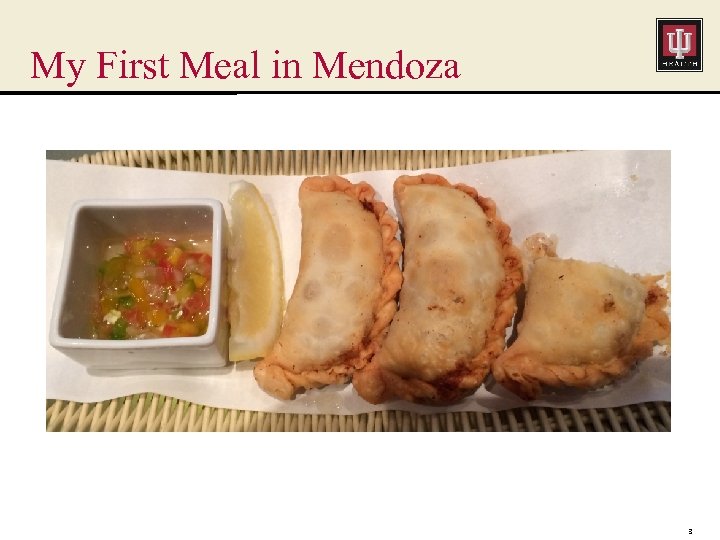 My First Meal in Mendoza 3
 Our Objectives – To communicate: • How the United States’ path towards electronic medical records (EMRs) and health information technology (HIT) evolved • Selected benefits and risks of electronic medical records • Lessons for Argentina as you look to making pediatric care electronic • Opportunities for cross-collaboration in development of EMRs and HIT “por un futuro mejor: niños y adolescentes saludables en tiempos de cambio“ 3/15/2018 4
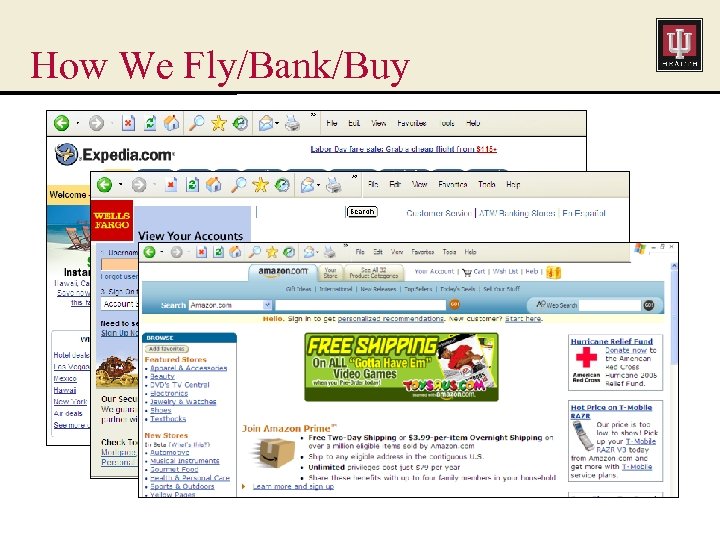 How We Fly/Bank/Buy
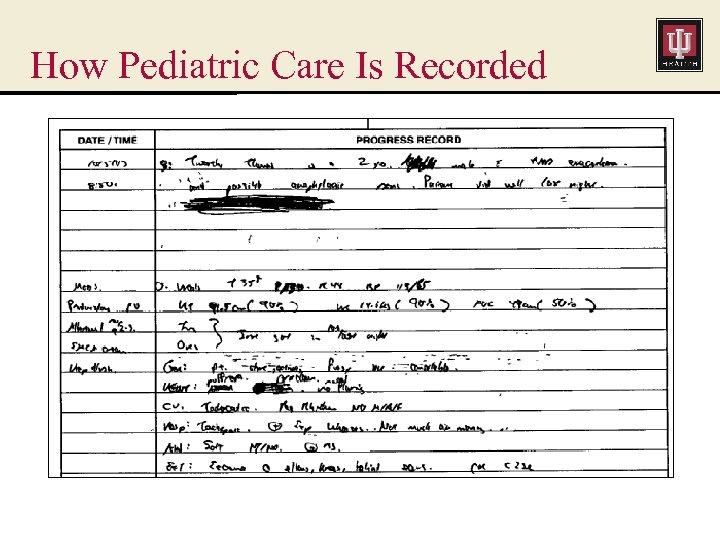 How Pediatric Care Is Recorded
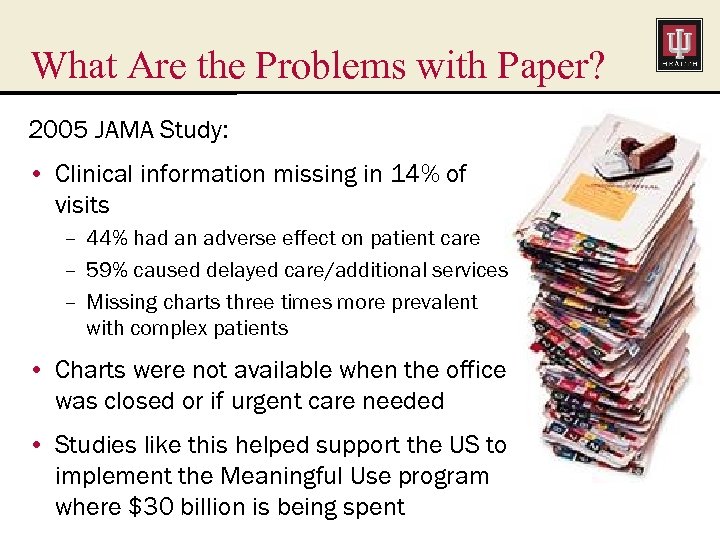 What Are the Problems with Paper? 2005 JAMA Study: • Clinical information missing in 14% of visits – 44% had an adverse effect on patient care – 59% caused delayed care/additional services – Missing charts three times more prevalent with complex patients • Charts were not available when the office was closed or if urgent care needed • Studies like this helped support the US to implement the Meaningful Use program where $30 billion is being spent
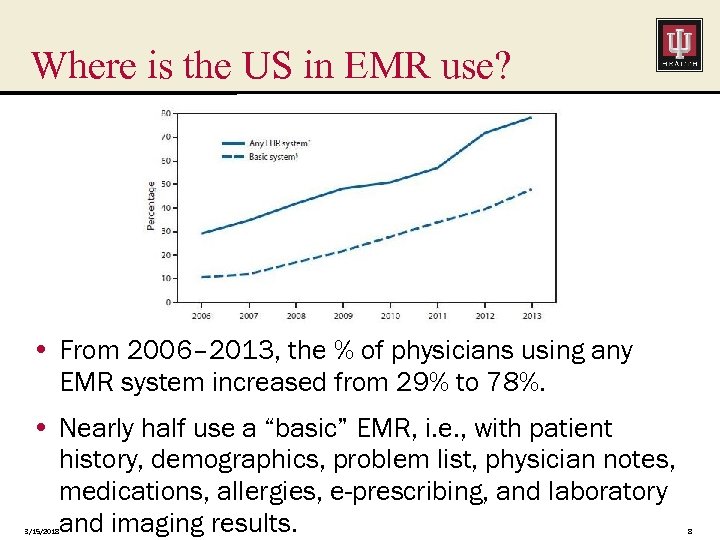 Where is the US in EMR use? • From 2006– 2013, the % of physicians using any EMR system increased from 29% to 78%. • Nearly half use a “basic” EMR, i. e. , with patient history, demographics, problem list, physician notes, medications, allergies, e-prescribing, and laboratory and imaging results. 3/15/2018 8
 Where is the US with EMR use? • In a 2012 study, pediatrician EMR usage was at 79% with 31 % using a “basic” EMR. • But only 14% used advanced EMR tools such as weight -based dosing/tracking immunizations • One-to-two pediatrician practices were less likely to have an EMR • Younger physicians were more likely to have an EMR. 3/15/2018 9
 Where is the US in EMR use? AAP and other Pediatric Activity • 2002: Council on Clinical Information Technology (COCIT) • 2003: #1 Board resolution for a pediatric friendly EMR • 2004: First electronic transfer of pediatric patient information using AAP-supported Continuity of Care Record • 2005 Partnership for Policy Implementation formed to improve “computability” of AAP guidelines • 2009: Child Health Informatics Center (CHIC) formed to help lead AAP’s HIT efforts • 2013: Model Child Electronic Health Record Format 3/15/2018 10
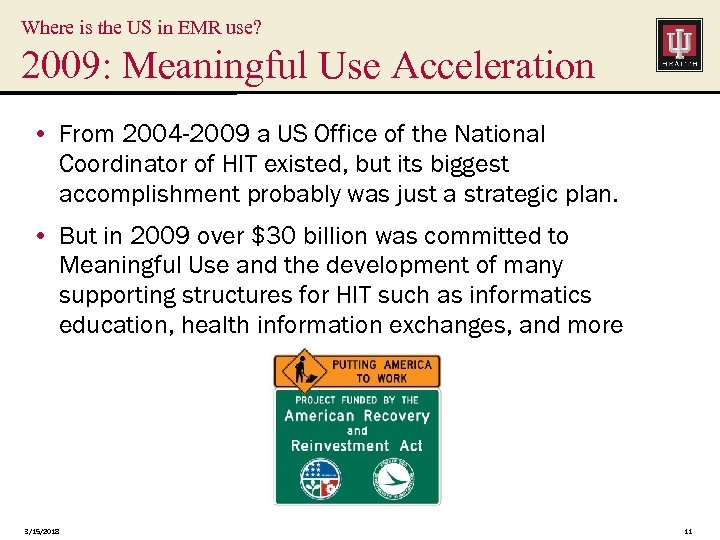 Where is the US in EMR use? 2009: Meaningful Use Acceleration • From 2004 -2009 a US Office of the National Coordinator of HIT existed, but its biggest accomplishment probably was just a strategic plan. • But in 2009 over $30 billion was committed to Meaningful Use and the development of many supporting structures for HIT such as informatics education, health information exchanges, and more 3/15/2018 11
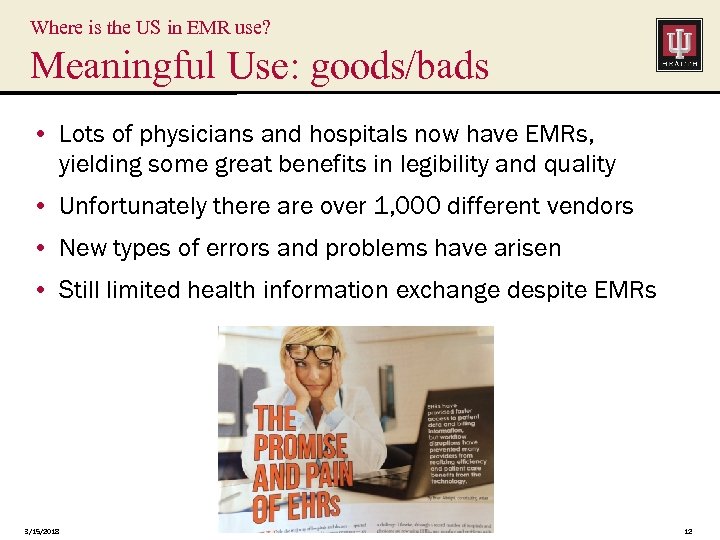 Where is the US in EMR use? Meaningful Use: goods/bads • Lots of physicians and hospitals now have EMRs, yielding some great benefits in legibility and quality • Unfortunately there are over 1, 000 different vendors • New types of errors and problems have arisen • Still limited health information exchange despite EMRs 3/15/2018 12
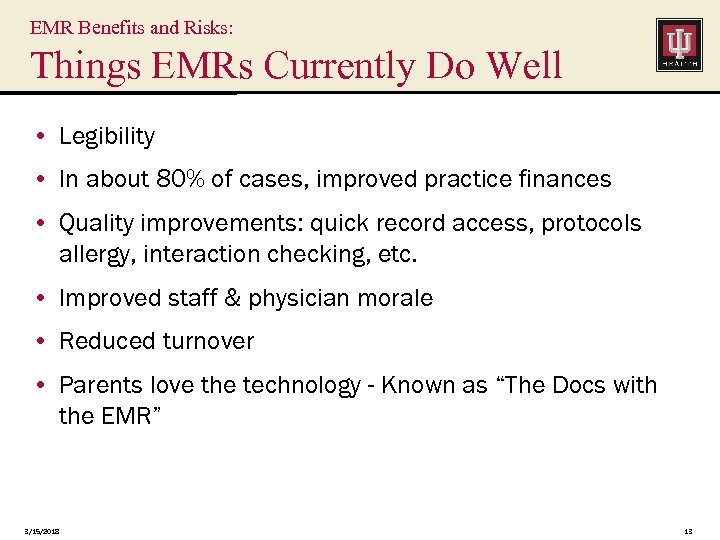 EMR Benefits and Risks: Things EMRs Currently Do Well • Legibility • In about 80% of cases, improved practice finances • Quality improvements: quick record access, protocols allergy, interaction checking, etc. • Improved staff & physician morale • Reduced turnover • Parents love the technology - Known as “The Docs with the EMR” 3/15/2018 13
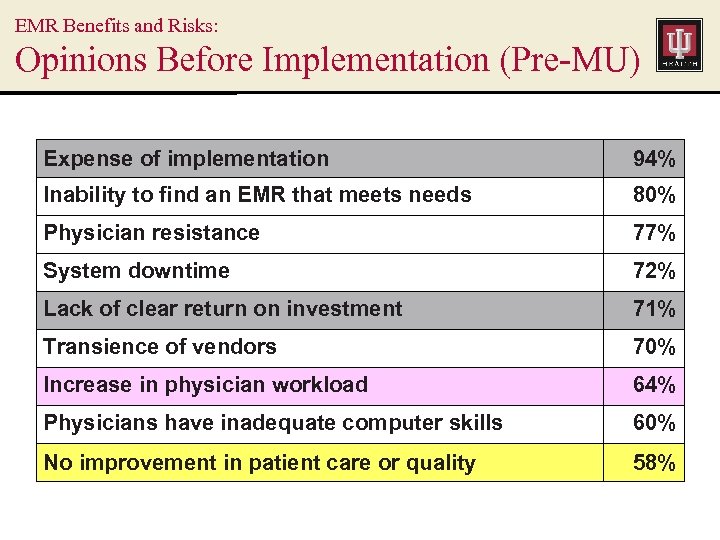 EMR Benefits and Risks: Opinions Before Implementation (Pre-MU) Expense of implementation 94% Inability to find an EMR that meets needs 80% Physician resistance 77% System downtime 72% Lack of clear return on investment 71% Transience of vendors 70% Increase in physician workload 64% Physicians have inadequate computer skills 60% No improvement in patient care or quality 58%
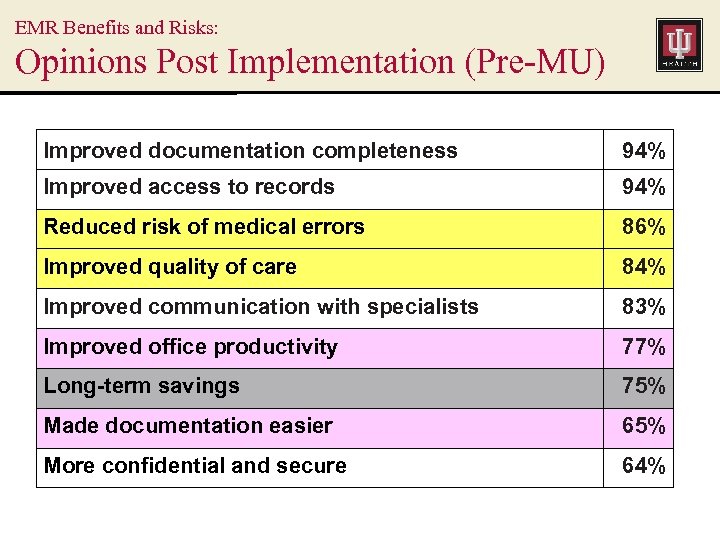 EMR Benefits and Risks: Opinions Post Implementation (Pre-MU) Improved documentation completeness 94% Improved access to records 94% Reduced risk of medical errors 86% Improved quality of care 84% Improved communication with specialists 83% Improved office productivity 77% Long-term savings 75% Made documentation easier 65% More confidential and secure 64%
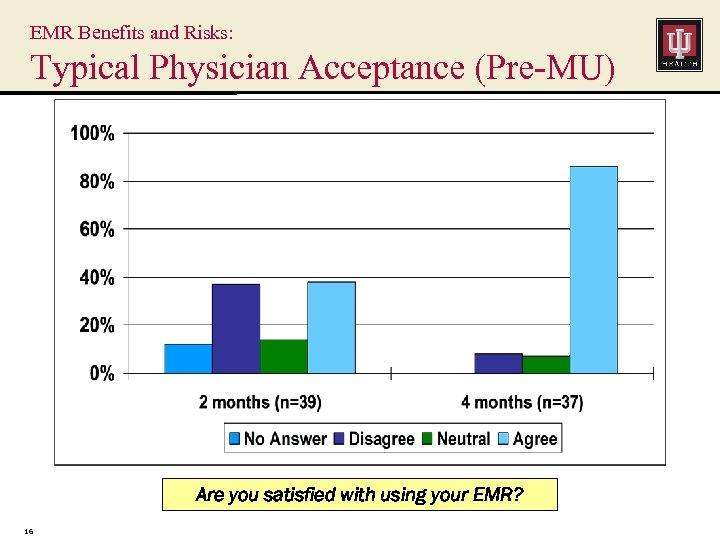 EMR Benefits and Risks: Typical Physician Acceptance (Pre-MU) Are you satisfied with using your EMR? 16
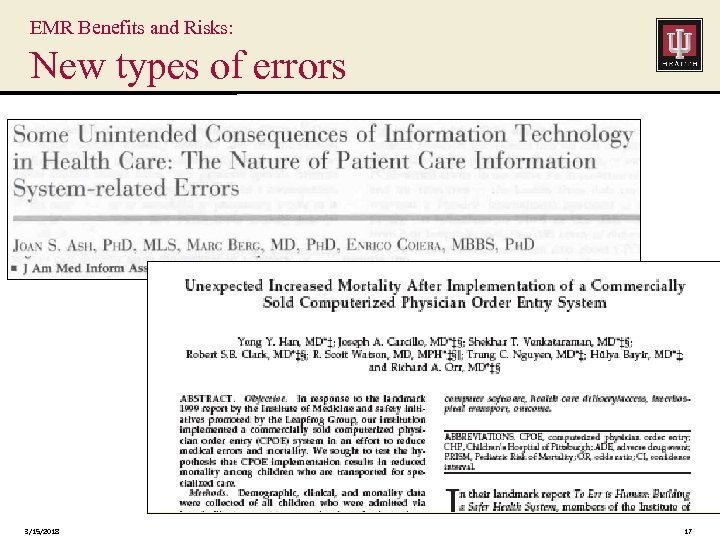 EMR Benefits and Risks: New types of errors 3/15/2018 17
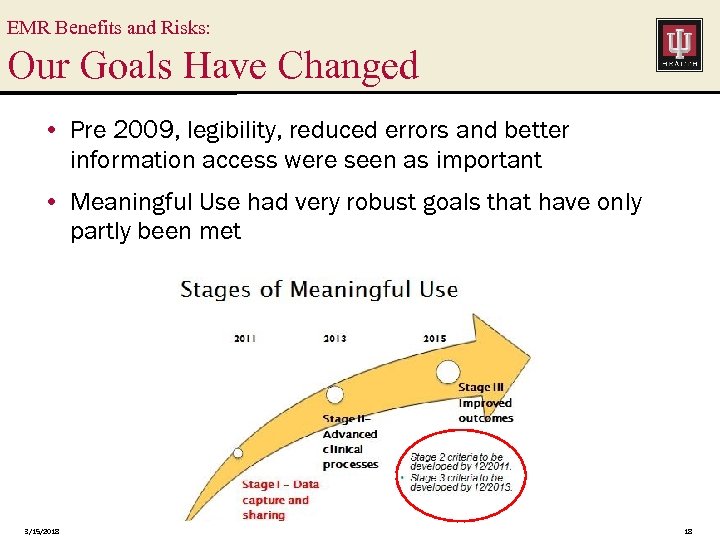 EMR Benefits and Risks: Our Goals Have Changed • Pre 2009, legibility, reduced errors and better information access were seen as important • Meaningful Use had very robust goals that have only partly been met 3/15/2018 18
 So - What Have We Learned? • EMRs and other technology have strengths/weaknesses; like everything else, we need to address these • Reducing costs and impact to small practices & hospitals through cloud computing can help with satisfaction/safety • Processes must be redesigned. Standardizing our work nationally and internationally is key for STEEEP care, efficient research and proper new physician training • Physician involvement in system development and implementation is absolutely vital • Relying on political programs for a strategy is dangerous • Patient involvement and data access is a key to success; in fact, a single record for each patient is the ideal 3/15/2018 19
 Recommendations - Can Argentina Avoid the US Mistakes? • Each child should have their own unique standardsbased secure record for their data – EMRs would contribute to the patient’s record after each visit and draw from it for each visit (EMRs can compete on data presentation and the algorithms they provide) – Consider starting a patient registry for birth information (linked with Plan Nacer? ) and add allergies, medications, immunizations and problems. Then add more with time to generate a longitudinal views of patients from data – Patients should have access to the record and be able to comment on it by using cell phones or computers • With support, could SAP develop this (inter)/national registry/patient record system to make it trusted? • This avoids the data exchange problem that the US has 20
 Recommendations - Can Argentina Avoid the US Mistakes? • Consider a “SAP approved” stamp for vendors that meet key requirements (such as contributing to a common patient record) – This avoids the government setting requirements, which is a big problem in the US • Consider that SAP (with the AAP? ) could develop cloud Clinical Decision Support that EMRs could access (e. g. , growth charts that would be populated automatically) • Consider having SAP require that vendors use a single secure communication method to replace regular email, that is tied to all EMRs so that patient interactions can be better tracked 21
 Recommendations - Can Argentina Avoid the US Mistakes? • Consider asking each patient to be a research subject so that the database can be use to develop predictive information for patients/populations • Consider supporting cloud EMRs as they are likely to be the least costly, but there are dangers with limited internet access – Less risk for downtime? – Updates processed immediately rather than waiting for an IT person to do them • Consider modifying learner education so that this system is supported by new physicians 22
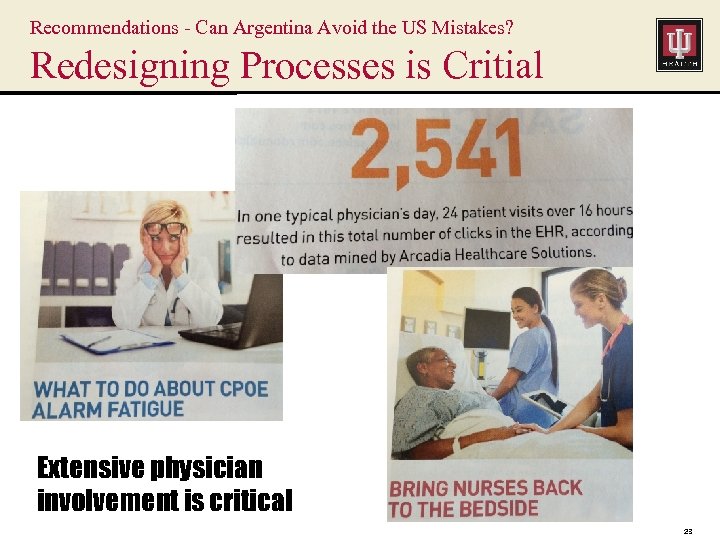 Recommendations - Can Argentina Avoid the US Mistakes? Redesigning Processes is Critial Extensive physician involvement is critical 23
 Standards: Can we work together towards “un futuro mejor…? • Can we work together on international pediatric standards for: – A single repository for children, separated by language – Patient input to EMRs and HIT – Protocols/order sets – Research (should we think of every patient as a research subject? ) – Quality processes and outcomes measures (e. g. , newborn screening and follow-up) – EMR presentation of new data types, e. g. , genetics 3/15/2018 24
 Argentine Pediatricans: Is it Time To Take the EMR Plunge? Yes, especially if • you are under 55 • you care about REALLY improving quality of care in Argentina • you want to help develop SAP/Argentina as a leader in technology
 Adios, Gracias y Preguntas Joseph H Schneider, MD drjoes 1 tx@gmail. com Indiana University Health Indianapolis, Indiana American Academy of Pediatrics Council on Clinical Information Technology (COCIT) Child Health Informatics Center (CHIC) Elk Grove Village, Illinois