


 Скачать презентацию Lesson Overview 1 1 What Is Science
ba6eef86761a44b3a1be378d1820b011.ppt
- Количество слайдов: 15
 Lesson Overview 1. 1 What Is Science?
 THINK ABOUT IT – Where did plants and animals come from? How did I come to be? – Humans have tried to answer these questions in different ways. Some ways of explaining the world have stayed the same over time. Science, however, is always changing.
 What Science Is and Is Not – What are the goals of science? – One goal of science is to provide natural explanations for events in the natural world. – Science also aims to use those explanations to understand patterns in nature and to make useful predictions about natural events. – What are some examples of patterns that scientists use to make predictions?
 What Science Is and Is Not – Biology is not just a collection of neverchanging facts or unchanging beliefs about the world. – Some scientific “facts” will change soon—if they haven’t changed already – and scientific ideas are open to testing, discussion, and revision. – What is an example of a scientific “fact” that has changed over time?
 Science as a Way of Knowing – Science is an organized way of gathering and analyzing evidence about the natural world. – Science deals only with the natural world. – Scientists collect and organize information in an orderly way, looking for patterns and connections among events. – Scientists propose explanations that are based on evidence, not belief. Then they test those explanations with more evidence.
 Science, Change, and Uncertainty – Despite all of our scientific knowledge, much of nature remains a mystery. – Almost every major scientific discovery raises more questions than it answers. This constant change shows that science continues to advance. – Learning about science means understanding what we know and what we don’t know. – Science rarely “proves” anything in absolute terms – Scientists aim for the best understanding of the natural world that current methods can reveal.
 Scientific Methodology: The Heart of Science – What procedures are at the core of scientific methodology? – Scientific methodology involves: – Making observations and asking questions – Making inferences and forming hypotheses – Conducting controlled experiments – Collecting and analyzing data, and – Drawing conclusions
 The Scientific Method • Scientists use The Scientific Method to find answers to their questions • Scientific investigations begin with observation, the act of noticing and describing events or processes in a careful, orderly way. • Consider this hypothetical scenario: • You are walking home from school when you notice 2 plants of the same species in front of your house that are 2 different sizes. • What observation is being made here?
 The Scientific Method • You remember that your mom made you plant these plants last summer so you know they were originally the same size. (an observation) • After posing questions, scientists use further observations to make inferences, or logical interpretations based on what is already known. • You continue to observe the plants over the next few weeks. The smaller plants seems to be in the shade for most of the day, while the larger plant is almost always in the sunlight. What inference can be made about the difference in the plants’ growth based on your observations?
 The Scientific Method • Inference can lead to a hypothesis, or a scientific explanation for a set of observations that can be tested in ways that support or reject it. • Our hypothesis would be: This species of plant grows better in sunlight than shade. • Can we test this? If so, how?
 The Scientific Method • Whenever possible, a hypothesis should be tested by an experiment in which only one variable is changed. All other variables should be kept unchanged, or controlled. This type of experiment is called a controlled experiment. • How could we test our hypothesis? • Would it be easier to move the shaded plant to sunlight, or cover the sunny plant in shade? • What else affects plant growth?
 Controlling Variables • It is important to control variables because if several variables are changed in the experiment, researchers can’t tell which variable is responsible for the results • The variable that is deliberately changed is called the independent variable (also called the manipulated variable) • The variable that is observed and that changes in response to the independent variable is called the dependent variable (also called the responding variable)
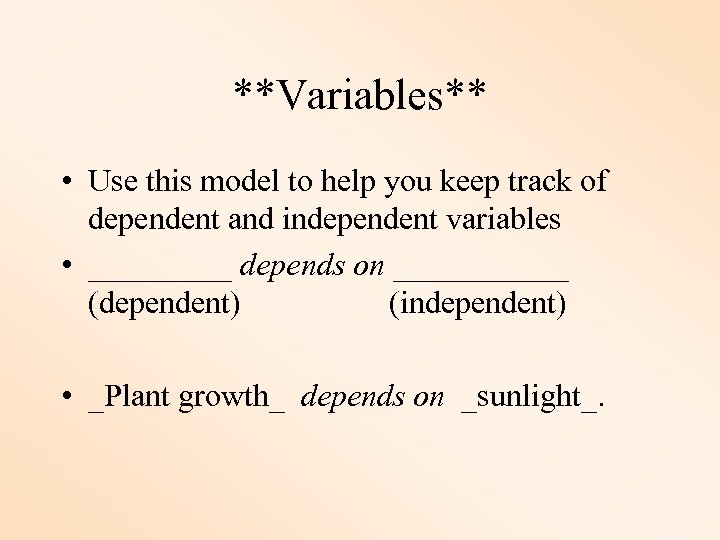 **Variables** • Use this model to help you keep track of dependent and independent variables • _____ depends on ______ (dependent) (independent) • _Plant growth_ depends on _sunlight_.
 Control and Experimental Groups • Typically, an experiment is divided into control and experimental groups. • A control group is exposed to the same conditions as the experimental group except for one independent variable. • Scientists set up several sets of control and experimental groups to try to reproduce or replicate their observations.
 Control and Experimental Groups • Which plant was our “control” and which plant was our “experimental”? • Control group = • Experimental group =