 Скачать презентацию Lesson 6 Book 3 Twelve Angry Men Part
8a27da3f3e75cc796fe724018863efcb.ppt
- Количество слайдов: 178



Lesson 6 Book 3 Twelve Angry Men (Part Two) Reginald Rose W B T L E
Lesson 6 Book 3 Contents Part One: Warm-up Part Two: Background Information Part Three: Text Appreciation Part Four: Language Study Part Five: Extension W W B B T T L L E E
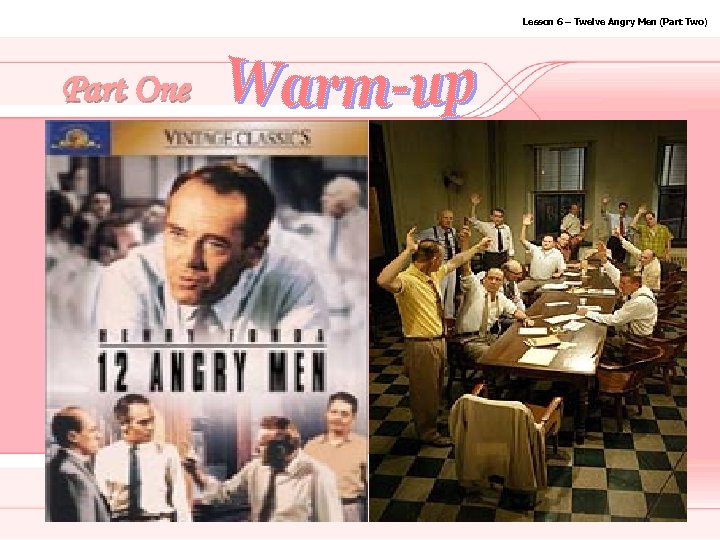
Lesson 6 – Twelve Angry Men (Part Two) Part One W B T L E ENTER
Lesson 6 – Twelve Angry Men (Part Two) Warm-up I. On justice II. Song for Courage III. Poem: Courage W B T L E
Lesson 6 – Twelve Angry Men (Part Two) I. On justice The whole history of the world is summed up in the fact that, when nations are strong, they are not always just, and when they wish be to just, they are longer no strong. —Winston Churchill 世界的整个历史可以归结为这个事实: 一个国家强大时就 不太公正, 而当他们希望求得公正时, 就不再强大。 —丘吉尔 W B T L E To be continued on the next page.
Lesson 6 – Twelve Angry Men (Part Two) I. On justice I have always found that mercy bears richer fruits than strict justice. —Abraham Lincoln Courage is of no value unless accompanied by justice; yet if all men became just, there would be no need for courage. —Agesilaus the Second W B T L E To be continued on the next page.
Lesson 6 – Twelve Angry Men (Part Two) I. On justice It is in justice that the ordering of society is centered. —Aristotle Justice is the constant and perpetual will to allot to every man his due. —Domitus Ulpian If it were not for injustice, men would not know justice. —Heraclitus W B T L E To be continued on the next page.
Lesson 6 – Twelve Angry Men (Part Two) I. On justice Justice consists not in being neutral between right and wrong, but in finding out the right and upholding it, wherever found, against the wrong. —Theodore Roosevelt Justice delayed, is justice denied. —William Galdstone W B T L E The end of On justice.
Lesson 6 – Twelve Angry Men (Part Two) II. Song for Courage (extracted) Tom Gardner There are those who follow those who take the darker side It’s courage that will pull you out if you would just decide and you can be the leader and then those who follow you can help the lives of others and then they will do it too Lalalala… W B T L E To be continued on the next page.
Lesson 6 – Twelve Angry Men (Part Two) II. Song for Courage If you’re going to speak up then SAY SOMETHING If you’re going to stand up then STAND FOR SOMETHING If you want to march on then DO SOMETHING With the courage in your heart (You’ll find the) courage in your heart W B T L E The end of singing.
Lesson 6 – Twelve Angry Men (Part Two) II. Song for Courage If you’re going to smile then SMILE ON SOMEONE If you’re going to reach out then TOUCH SOMETHING If you want to feel good then HELP SOMEONE Find the courage in your heart (You’ll find the) courage in your heart W B T L E The end of singing.
Lesson 6 – Twelve Angry Men (Part Two) III. Poem: Courage Anne Sexton It is in the small things we see it. The child's first step, as awesome as an earthquake. The first time you rode a bike, wallowing up the sidewalk. The first spanking when your heart went on a journey all alone. When they called you crybaby or poor or fatty or crazy and made you into an alien, you drank their acid and concealed it. W B T L E To be continued on the next page.
Lesson 6 – Twelve Angry Men (Part Two) III. Poem: Courage Later, if you faced the death of bombs and bullets you did not do it with a banner, you did it with only a hat to comver your heart. You did not fondle the weakness inside you though it was there. Your courage was a small coal that you kept swallowing. If your buddy saved you and died himself in so doing, then his courage was not courage, it was love; love as simple as shaving soap. W B T L E To be continued on the next page.
Lesson 6 – Twelve Angry Men (Part Two) III. Poem: Courage Later, if you have endured a great despair, then you did it alone, getting a transfusion from the fire, picking the scabs off your heart, then wringing it out like a sock. Next, my kinsman, you powdered your sorrow, you gave it a back rub and then you covered it with a blanket and after it had slept a while it woke to the wings of the roses and was transformed. W B T L E To be continued on the next page.
Lesson 6 – Twelve Angry Men (Part Two) III. Poem: Courage Later, when you face old age and its natural conclusion your courage will still be shown in the little ways, each spring will be a sword you'll sharpen, those you love will live in a fever of love, and you'll bargain with the calendar and at the last moment when death opens the back door you'll put on your carpet slippers and stride out. W B T L E The end of the poem.
Lesson 6 – Twelve Angry Men (Part Two) Part One This is the end of Part One. Please click HOME to visit other parts. W B T L E
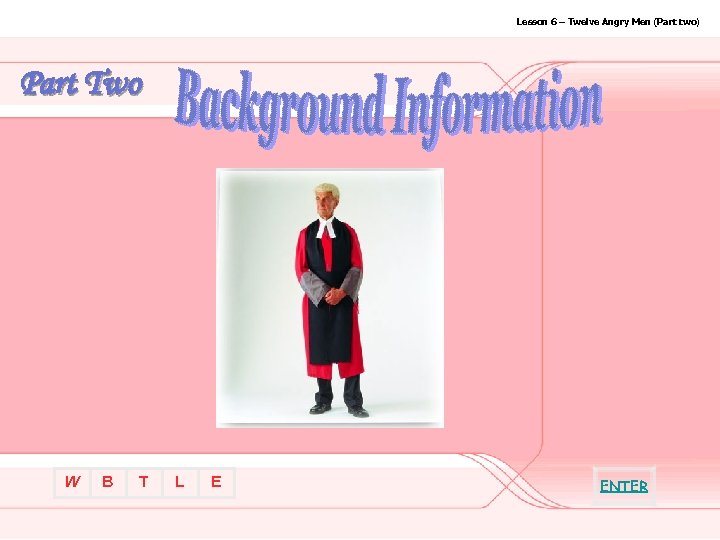
Lesson 6 – Twelve Angry Men (Part two) Part Two W B T L E ENTER
Lesson 6 – Twelve Angry Men (Part two) Background information I. Judges II. Barristers III. Court working dresses in England Wales W B T L E
Lesson 6 – Twelve Angry Men (Part two) I. Judges A judge or justice is an appointed or elected official who presides over a court. The powers, functions, and training of judges varies widely from jurisdiction to jurisdiction. In USA, judges are not trained separately from lawyers and are generally appointed or elected from among practicing attorneys. A professional person authorized to practice law; conducts lawsuits or gives legal advice W B T L E To be continued on the next page.
Lesson 6 – Twelve Angry Men (Part two) I. Judges Being a judge is usually a prestigious position in society, and as a result a variety of solemn traditions have become associated with the occupation. In most nations of the world judges wear long robes, usually black or red, and sit on an elevated platform during trials. The standard judges uniform originated with the Roman toga. In some countries, notably Britain, judges also wear long wigs and use special gavels to instill order in the courtroom. In the People’s Republic of China, judges wore regular street clothes until 1984, when they began to wear military style uniforms, which were intended to demonstrate authority. These uniforms were replaced in 2000 by black robes similar to those in the rest of the world. W B T L E To be continued on the next page. Symbols of office
Lesson 6 – Twelve Angry Men (Part two) I. Judges In most English speaking countries (particularly the USA) a judge is addressed as "Your Honor" when presiding over the judge's court, as a sign of respect for the office. United States, and the judges of the supreme courts of several U. S. states and other countries are called “justices”. In the United Kingdom, a comparable rank is held by the House of Lords; its judges are not called judges, but Law Lords, and sit in the House of Lords as peers. W B T L E The end of Judges. Nomenclature
Lesson 6 – Twelve Angry Men (Part two) II. Barristers In many common law jurisdictions, a barrister or advocate is a type of lawyer, particularly one entitled to appear before the superior courts of that jurisdiction. The legal profession in England Wales is divided between solicitors and barristers. Both are trained in law but serve different functions in the practice of law. Solicitors are regulated by the Law Society, barristers by the General Council of the Bar and the individual Inns of Court. W B T L E To be continued on the next page.
Lesson 6 – Twelve Angry Men (Part two) II. Barristers' work dress is very traditional in that they are required to wear a horsehair wig when they appear as advocates in court, with a black gown and a dark suit and a white shirt with strips of white cotton called 'bands' hanging before a wing collar. This makes them very easy to distinguish, although individuals can be disguised anonymous, whereas the garments emphasize the dramatic nature of their calling. The question of barristers' and judges' clothing is currently the subject of review, and there is some pressure to adopt a more "modern" style of dress, with European-style gowns worn over lounge suits. W B T L E To be continued on the next page. Symbols
Lesson 6 – Twelve Angry Men (Part two) II. Barristers Most barristers are probably properly equated with US trial lawyers in that they do not deal with the public (or lay clients) directly, but through the intermediary of a solicitor. W B T L E To be continued on the next page.
Lesson 6 – Twelve Angry Men (Part two) II. Barristers are also found in Northern Ireland, Hong Kong (where the Chinese language name 大 律 师 is also used), and Australia (in the states without a fused profession, namely New South Wales, South Australia, Queensland Victoria). In Canada the professions of barrister and solicitor are fused and many lawyers refer to themselves with both names. Unlike its common law brethren, the United States does not draw a distinction between barristers and solicitors; all lawyers who pass the bar exam may argue in court. W B T L E The end of Barristers.
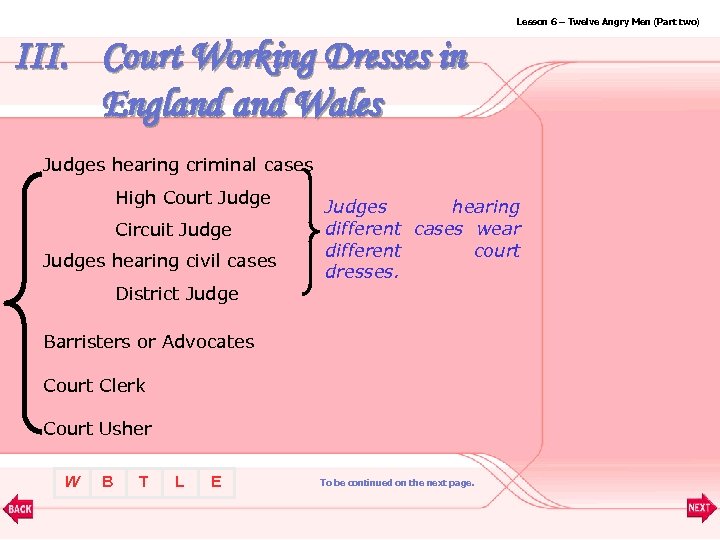
Lesson 6 – Twelve Angry Men (Part two) III. Court Working Dresses in England Wales Judges hearing criminal cases High Court Judge Circuit Judges hearing civil cases District Judges hearing different cases wear different court dresses. Barristers or Advocates Court Clerk Court Usher W B T L E To be continued on the next page.
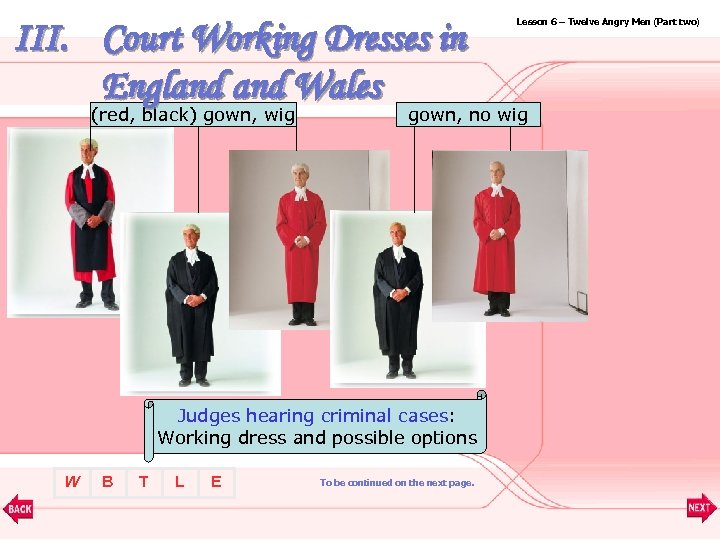
III. Court Working Dresses in England Wales (red, black) gown, wig gown, no wig Judges hearing criminal cases: Working dress and possible options W B T L E Lesson 6 – Twelve Angry Men (Part two) To be continued on the next page.
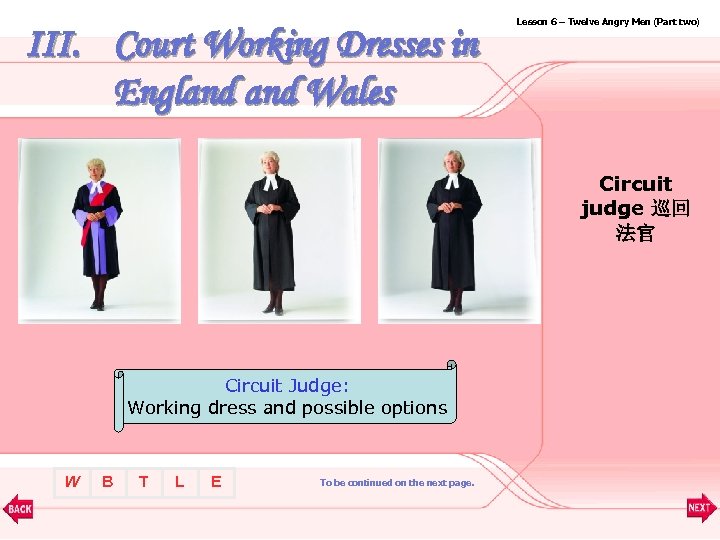
III. Court Working Dresses in England Wales Lesson 6 – Twelve Angry Men (Part two) Circuit judge 巡回 法官 Circuit Judge: Working dress and possible options W B T L E To be continued on the next page.
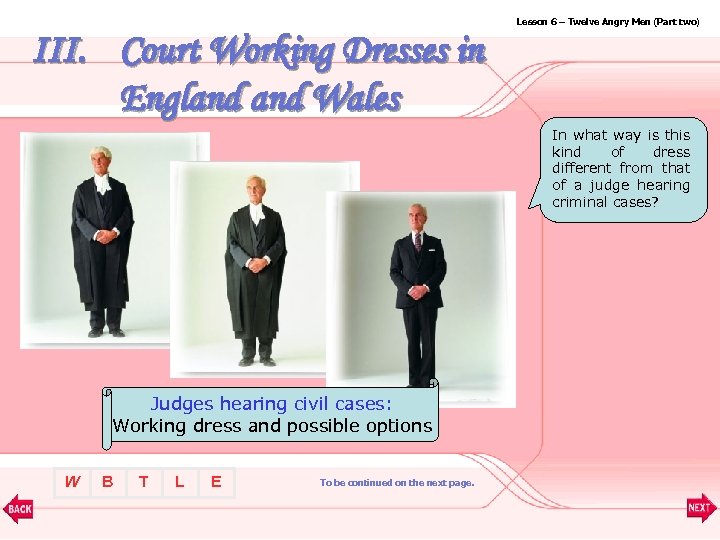
Lesson 6 – Twelve Angry Men (Part two) III. Court Working Dresses in England Wales In what way is this kind of dress different from that of a judge hearing criminal cases? Judges hearing civil cases: Working dress and possible options W B T L E To be continued on the next page.
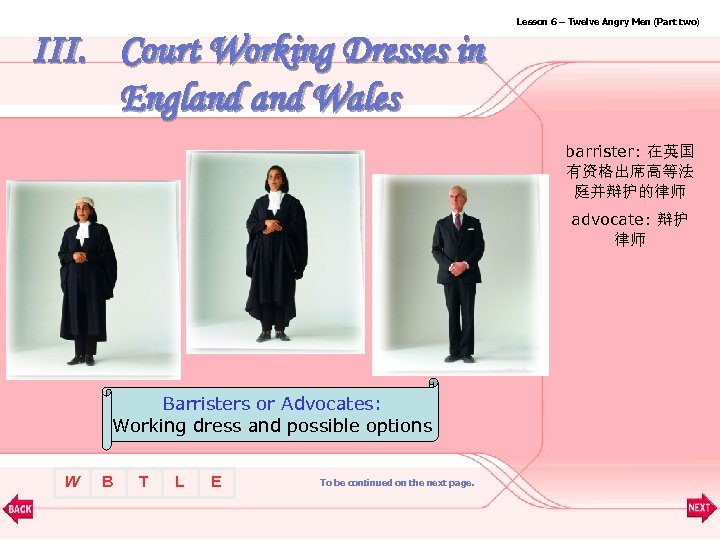
Lesson 6 – Twelve Angry Men (Part two) III. Court Working Dresses in England Wales barrister: 在英国 有资格出席高等法 庭并辩护的律师 advocate: 辩护 律师 Barristers or Advocates: Working dress and possible options W B T L E To be continued on the next page.
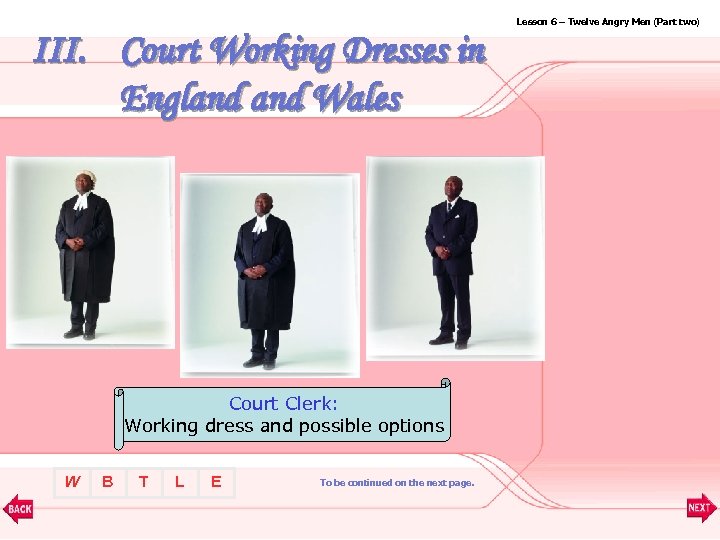
Lesson 6 – Twelve Angry Men (Part two) III. Court Working Dresses in England Wales Court Clerk: Working dress and possible options W B T L E To be continued on the next page.
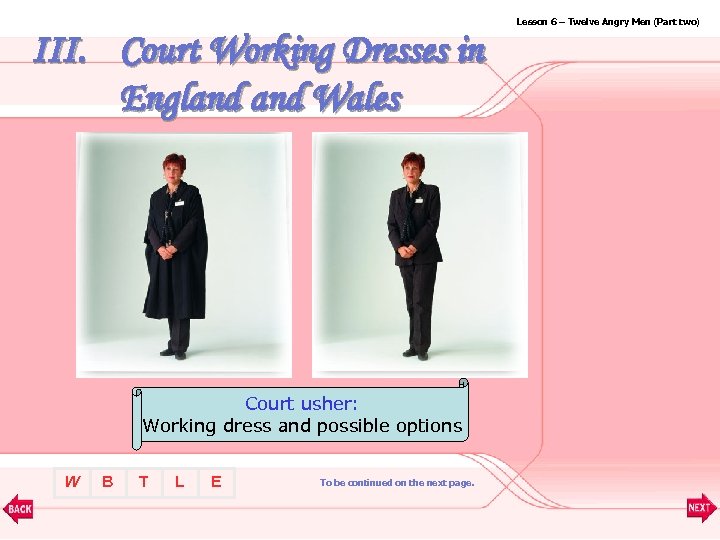
Lesson 6 – Twelve Angry Men (Part two) III. Court Working Dresses in England Wales Court usher: Working dress and possible options W B T L E To be continued on the next page.
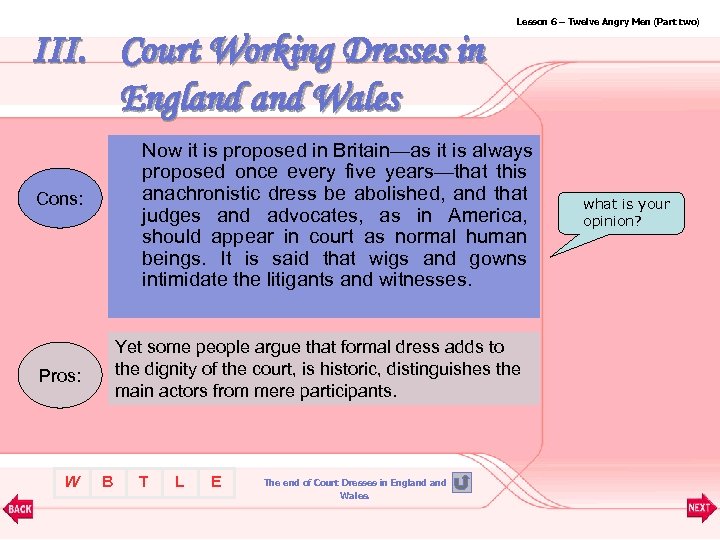
Lesson 6 – Twelve Angry Men (Part two) III. Court Working Dresses in England Wales Now it is proposed in Britain—as it is always proposed once every five years—that this anachronistic dress be abolished, and that judges and advocates, as in America, should appear in court as normal human beings. It is said that wigs and gowns intimidate the litigants and witnesses. Cons: Yet some people argue that formal dress adds to the dignity of the court, is historic, distinguishes the main actors from mere participants. Pros: W B T L E The end of Court Dresses in England Wales. what is your opinion?
Lesson 6 – Twelve Angry Men (Part two) Part Two This is the end of Part Two. Please click HOME to visit other parts. W B T L E
Lesson 6 – Twelve Angry Men (Part Two) Part Three W B T L E ENTER
Lesson 6 – Twelve Angry Men (Part Two) Text Appreciation I. General Introduction II. Text analysis I. Questions II. Further Discussion III. Writing devices: Pun IV. W B T Sentence paraphrase L E
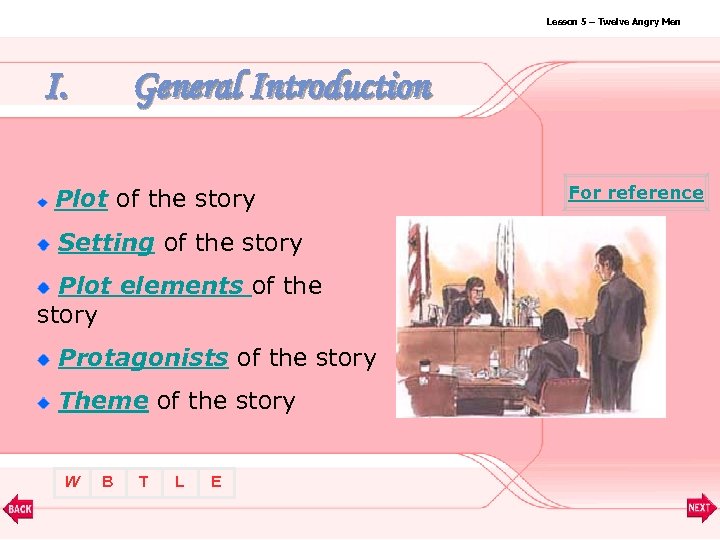
Lesson 5 – Twelve Angry Men I. General Introduction Plot of the story Setting of the story Plot elements of the story Protagonists of the story Theme of the story W B T L E For reference
Lesson 6 – Twelve Angry Men (Part Two) I. General Introduction Plot: A young delinquent awaits sentencing for the manslaughter of his aggressive father. One juror feels there is a reasonable doubt— to the frustration of his eleven colleagues— thus preventing a quick verdict. During the heated deliberations, the hidden preconceptions and prejudices of the jurors are revealed. Plot elements: conflict, crisis/turning moment, climax, etc. W B T L E The end of General Introduction.
Lesson 6 – Twelve Angry Men (Part Two) I. General Introduction u Setting: jury room u Protagonists : 12 jurors Theme of the story: "Twelve Angry Men" is about one individual's ability to stand up for what he believes, even when others ridicule him. It is also a powerful study not just of the criminal justice system, but also of the diversity of human experience, the nature of peer pressure, and the difficulty of ever fully knowing the truth. u W B T L E The end of General Introduction.
Lesson 6 – Twelve Angry Men (Part Two) II. Text Analysis No. 7: Bright! He’s a common ignorant slob. He don’t even speak good English. Question: What tone was No. 10 using when he attacked the accused? What can we know about No. 10? He was sneering at the accused in an ironic tone, however he himself made a grammar mistake, thus revealing himself an incompetent language speaker. W B T L E To be continued on the next page. In Para. 5
Lesson 6 – Twelve Angry Men (Part Two) II. Text Analysis No. 12: … It wasn’t very nice to have it sticking out of some people’s chests. No. 7: Especially relatives’. Question: Do you think No. 7 was a humorous person? How do you like his joke here? NO. 12 and No. 7 are joking about this murder. But in fact this is disgusting and distasteful to joke about a murder. W B T L E To be continued on the next page. Attention to the wording.
Lesson 6 – Twelve Angry Men (Part Two) II. Text Analysis No. 11: Ah, this then would depend on your definition of panic. He would have to be calm enough to see to it that there were no fingerprints left on the knife. Now, where did the panic start and where did it end? Question: Figure out No. 11’s logic of reasoning. No. 4 thought that the boy could run out in a panic after having killed his father, after he calmed down, he realized that he left his knife at the scene. But No. 11 didn’t think it held water because if the boy had run out in a panic, he couldn’t be so calm to be sure that there were no fingerprints left on the knife. So No. 11 asked where the panic started and where it ended. W B T L E To be continued on the next page. In Para. 15
Lesson 6 – Twelve Angry Men (Part Two) II. Text Analysis No. 8: Maybe the boy did kill his father, did run out in a panic, …. Maybe all those things happened. But maybe they didn’t. I think there’s enough doubt that we can wonder if he was there at all during the time the killing took place. Question: What is the reasonable doubt here? It is possible that the boy was not at the scene when the killing took place. (or: It is possible that he didn’t come back home only to get his knife, risking being caught. ) W B T L E To be continued on the next page. In Para. 17
Lesson 6 – Twelve Angry Men (Part Two) II. Text Analysis No. 7: (To No. 8) Ran, walked. What’s the difference? Anyway he got there! Question: What character did No. 7 reveal here, in your opinion? He didn’t care much about the details, but in most cases, details can tell the detectives a lot about what could have happened. In fact, No. 7 had got a theatre ticket burning in his pocket, he was in a hurry to get out of here, therefore he just wanted to rush up thus tended to leave out many important things. That just shows us how little he took another person’s life. W B T L E To be continued on the next page. In Para. 23
Lesson 6 – Twelve Angry Men (Part Two) II. Text Analysis No. 3: He was an old man. Half the time, he was confused. How could he be positive about anything? (He tries to cover his blunder. …) Question: What blunder did No. 3 make? No. 3 said that half the time, the old man was confused and couldn’t be sure about anything, so how could he be so sure that it was 20 seconds? W B T L E To be continued on the next page. In Para. 31
Lesson 6 – Twelve Angry Men (Part Two) II. Text Analysis No. 3: Assumed! Brother, I’ve seen all kinds of dishonesty in my day, but this little display takes the cake. What’s the matter with you guys? You all know he’s guilty. He’s got to burn and you let him slip through our fingers! Question: What did No. 3 assume himself to be? Do you think a conscientious juror should talk like that? No. 3 was not the executioner, but he talked as if so. He was not supposed to base his judgment simply on what he thought to be. Facts and reason matter most. A conscientious juror should try to be impartial rather than biased. W B T L E To be continued on the next page. In Para. 43 (Also refer to Para. 47)
Lesson 6 – Twelve Angry Men (Part Two) II. Text Analysis No. 3: Phew, I’ll kill him! No. 8: You don’t really mean you’d kill me, do you? Question: Why did No. 8 deliberately make No. 3 mad? How do you feel about the language power? No. 3 couldn’t mean it when he said that “I’ll kill you!”, likewise, it is possible that the accused boy also didn’t mean it when he said the same thing. It is a clever way to retort. No. 8 just used the same logic of reasoning to fight against No. 3’s logic –if the boy said it, he meant it. W B T L E To be continued on the next page. In Para. 49, 50
Lesson 6 – Twelve Angry Men (Part Two) II. Text Analysis No. 10: Don’t give me that! I’m sick and tired of facts. You can think any way you like. Question: In what way was No. 10’s view of facts different from that of No. 9? Compare and contrast these two jurors. No. 9: a gentle old man, took his duty as a juror seriously. Decent , upright. “The facts of the case are supposed to determine the case. ” No. 10: prejudiced against poor people and people with little schooling. “I’m sick and tired of facts. ” W B T L E To be continued on the next page. In Para. 55
Lesson 6 – Twelve Angry Men (Part Two) II. Text Analysis No. 7: … How do you like this guy? He comes here running for his life. And now, before he can take a deep breath, he’s telling us how to run the show. The arrogance of this guy. Question: How do you think of No. 7? No. 7 himself was arrogant. He despised No. 11’s identity as an immigrant, and was impatient with any reasoning and talking which could prolong this discussion, thus ruin his chance of going to theatre. W B T L E To be continued on the next page. In Para. 62
Lesson 6 – Twelve Angry Men (Part Two) II. Text Analysis No. 9: I think the point is made. No. 10: Big point! Question: What point was made? What did No. 10 mean by saying “big point”? Did he mean it or not? (Refer to Para. 113 for clearer understanding. ) No. 9 thinks that the demonstration has proved No. 8’s point that the boy couldn’t have remembered the details when questioned by the detectives, under great emotional stress. No. 10 was talking ironically. He didn’t mean it at all. W B T L E To be continued on the next page. In Para. 86, 87
Lesson 6 – Twelve Angry Men (Part Two) II. Text Analysis No. 3: (pointing to the knife. ) Give me that. I’m going to give you a demonstration. Somebody get up. (… He holds the knife up and then stabs downward towards No. 8’s chest. He stops just before the blade reaches his chest… ) Question: How do you comment on what No. 3 did to No. 8? Under what circumstances would one say “somebody get up”? W B T L E To be continued on the next page. In Para. 92
Lesson 6 – Twelve Angry Men (Part Two) II. Text Analysis No. 3 took this opportunity to take revenge on No. 8. No. 3 took this argument very personally. Thus we know that he was narrow-minded. On the other hand, he was biased because No. 3 had serious problems with his own son who beat the father up, and he believed the accused boy was just like his own son. It sounds more like an order, which is not a polite way to speak to other jurors. W B T L E To be continued on the next page.
Lesson 6 – Twelve Angry Men (Part Two) II. Text Analysis No. 10: … You know how these people lie. It’s born in them… They don’t know what the truth is. And let me tell you. They don’t even need any real big reason to kill someone, either. No sir! That’s the way they are. By nature. Violent!… The kid’s liar. I know it… Question: Was No. 10 talking about the facts or opinions? What kind of person was No. 10? No. 10 was not talking about facts, he was talking about opinions, to be exact, strongly held prejudices. W B T L E To be continued on the next page. In Para. 113
Lesson 6 – Twelve Angry Men (Part Two) II. Text Analysis No. 4: I’m trying to settle something. Do you mind? No. 4: If it’s any of your business, I was rubbing it because it bothered me a little. No. 4: Very annoying. Question: How did No. 4’s attitude change from politeness to irony? Pay attention to his tone. He was getting impatient with No. 9, thus we can observe a shade of irony in his tone: “if it’s any of your business”, “very annoying” “Very annoying” , a pun, is used ironically to contain two layers of meaning: one, No. 4 found the two deep impressions beside his nose annoying; the other, he thought No. 9’s persistent interruption was annoying. W B T L E To be continued on the next page. In Para. 122, 124, 128
Lesson 6 – Twelve Angry Men (Part Two) II. Text Analysis No. 3: …Well, say something! You lousy bunch of bleeding hearts. You’re not going to intimidate me. I’m entitled to my opinion… Question: Compare No. 3 and No. 8’s performances in the courtroom. In what way did they impress you? No. 3 couldn’t get rid of his prejudices against the accused boy, but he based his judgment not on logical reasoning but on emotional associations. No. 8 successfully brought all other jurors around by persistent efforts, logical reasoning, support and respect he won from other jurors. He was cool, logical and rational. W B T L E The end of Questions. in Para. 164
Lesson 6 – Twelve Angry Men (Part Two) II. Text Analysis Further discussion about the story Why do you think the author gives “Twelve Angry Men” as the title of the play? Why are these people so angry? Do you agree that strong emotions can often affect our judgment? Do you find it strange that the truth is sometimes in the hands of one person? Why is it so easy for people to go along with the crowd? What lesson should we draw from this? W B T L E To be continued on the next page.
Lesson 6 – Twelve Angry Men (Part Two) II. Text Analysis Further discussion about the story How does No. 5 begin to doubt that the downward stab could have been made by the boy? Do you think he has made a good point? What supportive arguments does he get from No. 7? In order to convince the others No. 3 also gives a demonstration. But does his demonstration have the same effect on others? What does No. 10 say that disgusts almost everybody and discredits whatever else he has to say? What does No. 4 consider “the unshakable testimony”? How is this “unshakable” testimony finally shaken? W W B B T T L L E E To be continued on the next page.
Lesson 6 – Twelve Angry Men (Part Two) II. Text Analysis Further discussion about the story What is the question raised by No. 11? How do those still voting guilty try to explain why the boy risked being caught and came back 3 hours after he had killed his father? Do you agree with him? No. 7 says that the old man ran to the door. Is that a faithful description of what happened? Why does No. 5 make such a fuss about the use of the word “ran” then? What does No. 8 want the diagram of the apartment for? Can you draw that diagram to show everything is supposed to have happened according to the testimonies? Do you think No. 8’s little demonstration proves their doubt reasonable? W B T L E The end of Text Analysis.
Lesson 6 – Twelve Angry Men (Part Two) III. Writing Devices pun More examples A pun is defined as "the humorous use of a word, or of words which are formed or sounded alike but have different meanings, in such a way as to play on two or more of the possible applications; a play on words. " W B T L E To be continued on the next page.
Lesson 6 – Twelve Angry Men (Part Two) III. Writing Devices Figure out which part of the sentence is a pun. Pun Seven days without food makes one weak. Income Tax: Capital punishment. W B T L E To be continued on the next page.
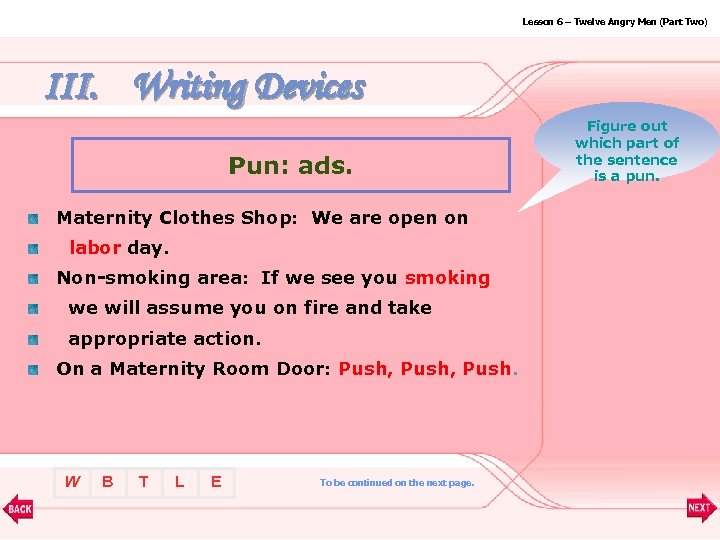
Lesson 6 – Twelve Angry Men (Part Two) III. Writing Devices Pun: ads. Maternity Clothes Shop: We are open on labor day. Non-smoking area: If we see you smoking we will assume you on fire and take appropriate action. On a Maternity Room Door: Push, Push. W B T L E To be continued on the next page. Figure out which part of the sentence is a pun.
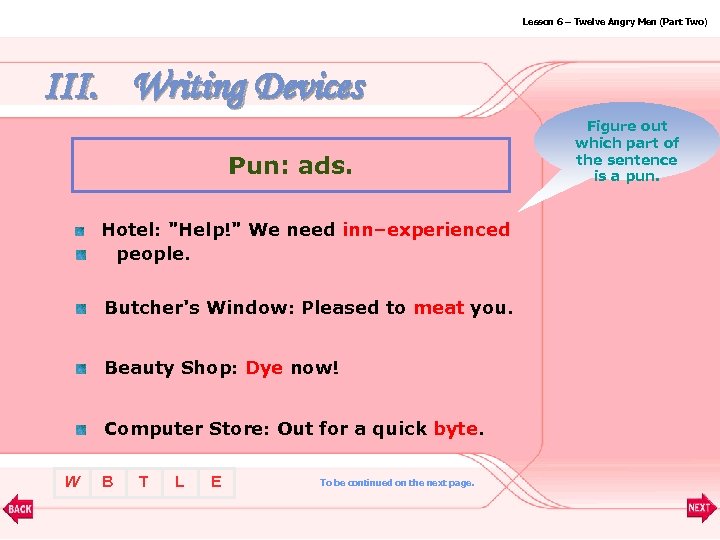
Lesson 6 – Twelve Angry Men (Part Two) III. Writing Devices Pun: ads. Hotel: "Help!" We need inn–experienced people. Butcher's Window: Pleased to meat you. Beauty Shop: Dye now! Computer Store: Out for a quick byte. W B T L E To be continued on the next page. Figure out which part of the sentence is a pun.
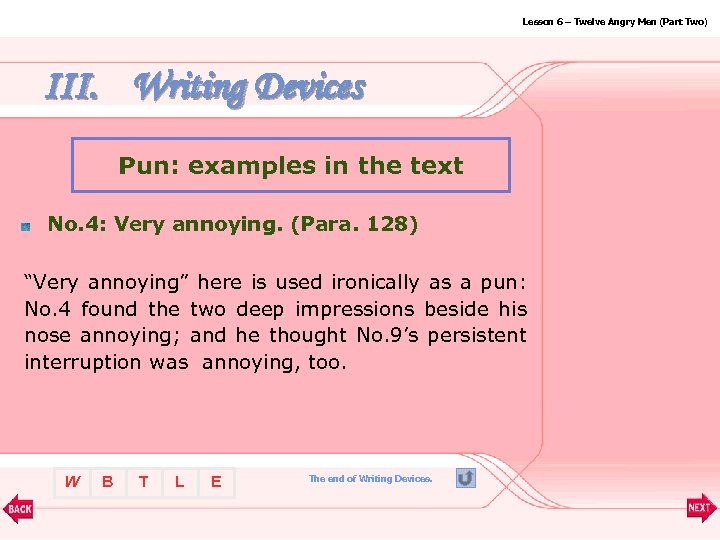
Lesson 6 – Twelve Angry Men (Part Two) III. Writing Devices Pun: examples in the text No. 4: Very annoying. (Para. 128) “Very annoying” here is used ironically as a pun: No. 4 found the two deep impressions beside his nose annoying; and he thought No. 9’s persistent interruption was annoying, too. W B T L E The end of Writing Devices.
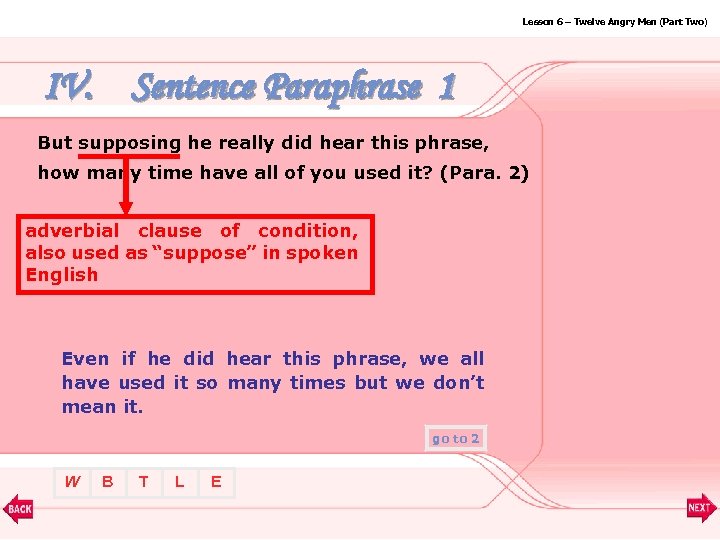
Lesson 6 – Twelve Angry Men (Part Two) IV. Sentence Paraphrase 1 But supposing he really did hear this phrase, how many time have all of you used it? (Para. 2) adverbial clause of condition, also used as “suppose” in spoken English Even if he did hear this phrase, we all have used it so many times but we don’t mean it. go to 2 W B T L E
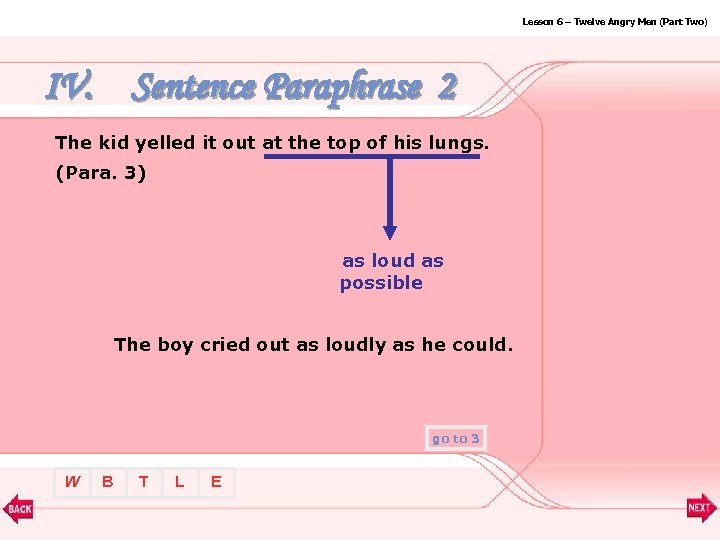
Lesson 6 – Twelve Angry Men (Part Two) IV. Sentence Paraphrase 2 The kid yelled it out at the top of his lungs. (Para. 3) as loud as possible The boy cried out as loudly as he could. go to 3 W B T L E
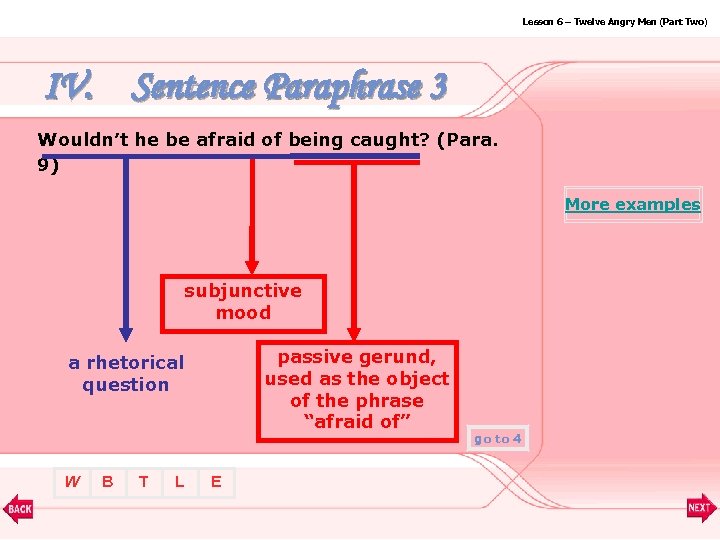
Lesson 6 – Twelve Angry Men (Part Two) IV. Sentence Paraphrase 3 Wouldn’t he be afraid of being caught? (Para. 9) More examples subjunctive mood passive gerund, used as the object of the phrase “afraid of” a rhetorical question W B T L E go to 4
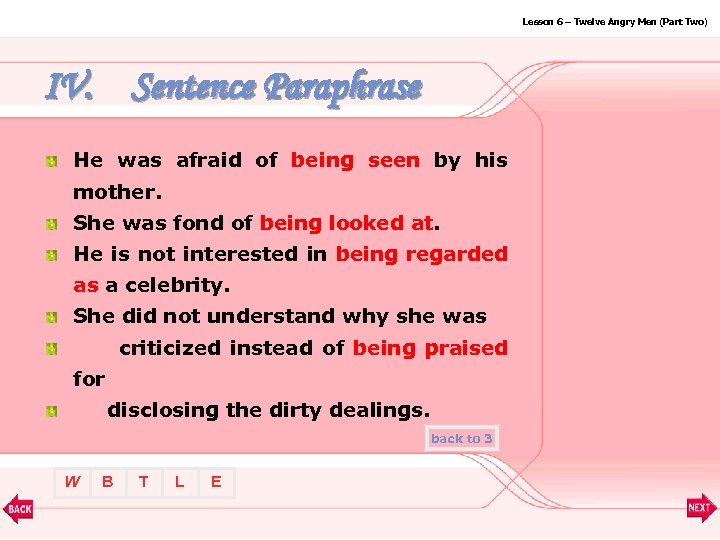
Lesson 6 – Twelve Angry Men (Part Two) IV. Sentence Paraphrase He was afraid of being seen by his mother. She was fond of being looked at. He is not interested in being regarded as a celebrity. She did not understand why she was criticized instead of being praised for disclosing the dirty dealings. back to 3 W B T L E
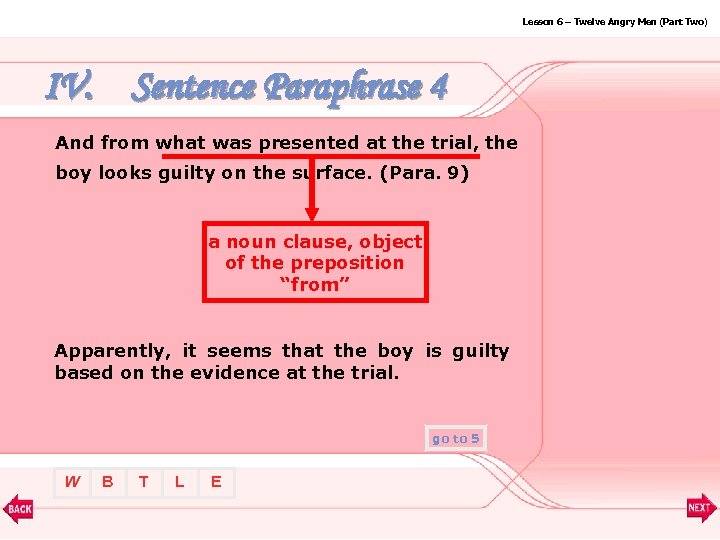
Lesson 6 – Twelve Angry Men (Part Two) IV. Sentence Paraphrase 4 And from what was presented at the trial, the boy looks guilty on the surface. (Para. 9) a noun clause, object of the preposition “from” Apparently, it seems that the boy is guilty based on the evidence at the trial. go to 5 W B T L E
Lesson 6 – Twelve Angry Men (Part Two) IV. Sentence Paraphrase 5 … why did he leave it there in the first place? (Para. 13) … why did the boy leave the knife at the scene at the very beginning? go to 6 W B T L E
Lesson 6 – Twelve Angry Men (Part Two) IV. Sentence Paraphrase 6 We can assume that the boy ran out in a state of panic after having just killed his father. (Para. 14) More formal than “in panic”. Likewise, “in the course of history” is a more formal version of “in history”. Gerund, used as the object of the preposition “after” We can suppose that the boy killed his father first, then ran out, overwhelmed with terror. go to 7 W B T L E
Lesson 6 – Twelve Angry Men (Part Two) IV. Sentence Paraphrase 7 Well, if I were the boy and had stabbed my father, I would take a chance and go back for the knife. (16) Subjunctive mood: No. 12 tried to put himself in the boy’s shoes and figure out what was really on his mind. go to 8 W B T L E
Lesson 6 – Twelve Angry Men (Part Two) IV. Sentence Paraphrase 8 I think there’s enough doubt that we can wonder if he was there at all during the time the killing took place. (Para. 17) There is enough evidence so that we can doubt that the boy was there at the scene. go to 9 W B T L E
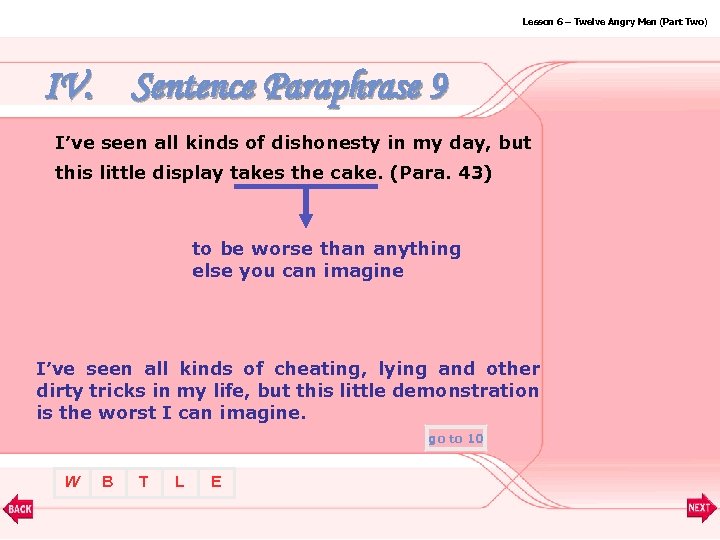
Lesson 6 – Twelve Angry Men (Part Two) IV. Sentence Paraphrase 9 I’ve seen all kinds of dishonesty in my day, but this little display takes the cake. (Para. 43) to be worse than anything else you can imagine I’ve seen all kinds of cheating, lying and other dirty tricks in my life, but this little demonstration is the worst I can imagine. go to 10 W B T L E
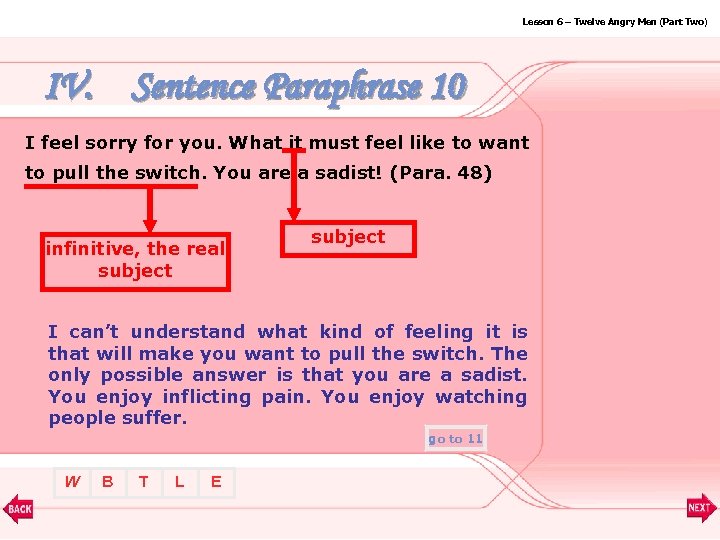
Lesson 6 – Twelve Angry Men (Part Two) IV. Sentence Paraphrase 10 I feel sorry for you. What it must feel like to want to pull the switch. You are a sadist! (Para. 48) infinitive, the real subject I can’t understand what kind of feeling it is that will make you want to pull the switch. The only possible answer is that you are a sadist. You enjoy inflicting pain. You enjoy watching people suffer. go to 11 W B T L E
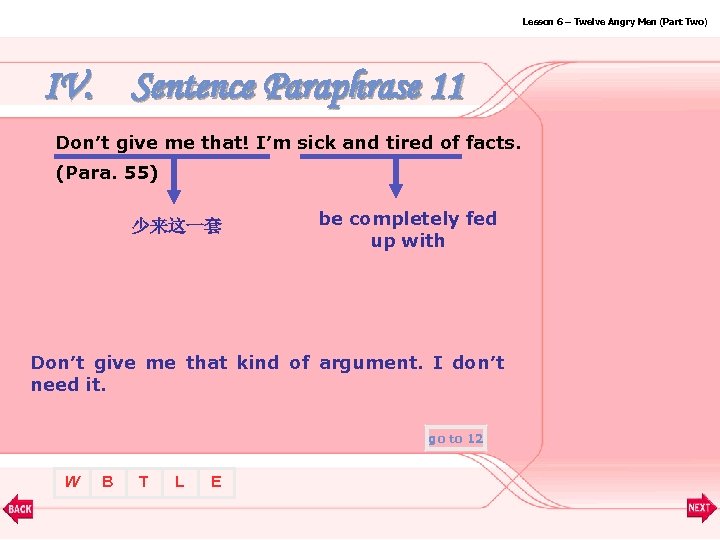
Lesson 6 – Twelve Angry Men (Part Two) IV. Sentence Paraphrase 11 Don’t give me that! I’m sick and tired of facts. (Para. 55) 少来这一套 be completely fed up with Don’t give me that kind of argument. I don’t need it. go to 12 W B T L E
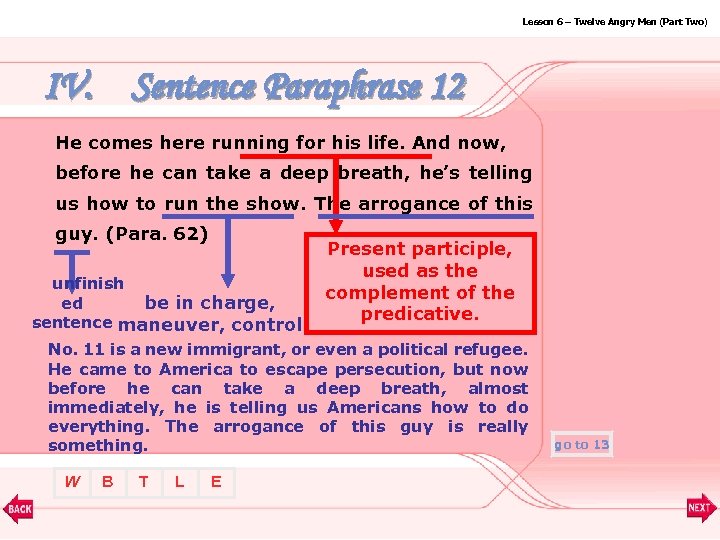
Lesson 6 – Twelve Angry Men (Part Two) IV. Sentence Paraphrase 12 He comes here running for his life. And now, before he can take a deep breath, he’s telling us how to run the show. The arrogance of this guy. (Para. 62) unfinish ed be in charge, sentence maneuver, control Present participle, used as the complement of the predicative. No. 11 is a new immigrant, or even a political refugee. He came to America to escape persecution, but now before he can take a deep breath, almost immediately, he is telling us Americans how to do everything. The arrogance of this guy is really something. W B T L E go to 13
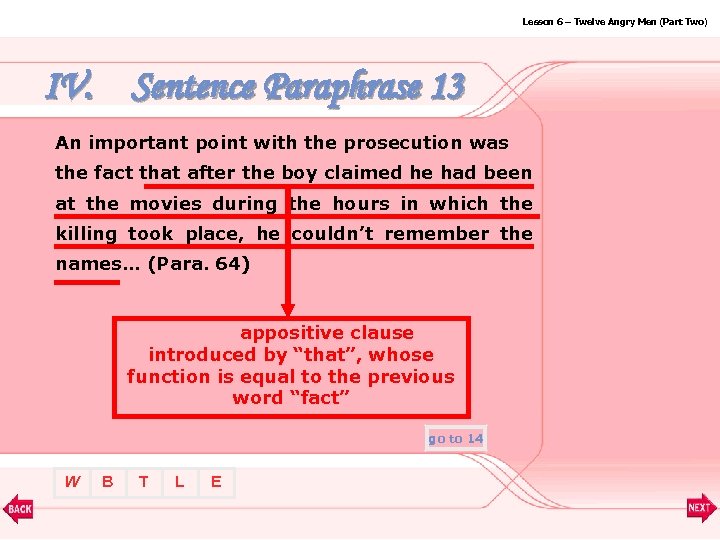
Lesson 6 – Twelve Angry Men (Part Two) IV. Sentence Paraphrase 13 An important point with the prosecution was the fact that after the boy claimed he had been at the movies during the hours in which the killing took place, he couldn’t remember the names… (Para. 64) appositive clause introduced by “that”, whose function is equal to the previous word “fact” go to 14 W B T L E
Lesson 6 – Twelve Angry Men (Part Two) IV. Sentence Paraphrase 14 I’m getting sick and tired of this yakking, yakking. So I guess I’ll have to break the tie. (Para. 99) end a relationship with a organization who voted for guilty These wordy, boring discussion is unbearable. Now I decided I’ll break away from my former union. go to 15 W B T L E
Lesson 6 – Twelve Angry Men (Part Two) IV. Sentence Paraphrase 15 Whenever you run into it, it always obscures the truth. (Para. 115) to start to experience a difficult or unpleasant situation When you run into prejudice, it will make it difficult to pursue the truth. go to 16 W B T L E
Lesson 6 – Twelve Angry Men (Part Two) IV. Sentence Paraphrase 16 Could these marks be made by anything other than eyeglasses? (Para. 137) except, apart from Is it possible that these marks could also be made by something else besides eyeglasses? W B T L E The end of Sentence Paraphrase.
Lesson 6 – Twelve Angry Men (Part Two) Part Three This is the end of Part Three. Please click HOME to visit other parts. W B T L E
Lesson 6 – Twelve Angry Men (Part Two) Part Four W B T L E ENTER
Lesson 6 – Twelve Angry Men (Part Two) Language Study I. Word Study II. Phrases and Expressions III. Word Building IV. Grammar W B T L E
Lesson 6 – Twelve Angry Men (Part Two) I. Word Study Word list: 1. acquittal 10. obscure 2. avenge 11. recreate 3. bear 12. stamp 4. blunder 13. stick 5. commonplace 14. testify 6. injustice 15. trot 7. intimidate 16. underhand 8. lunge 9. object W B T L E
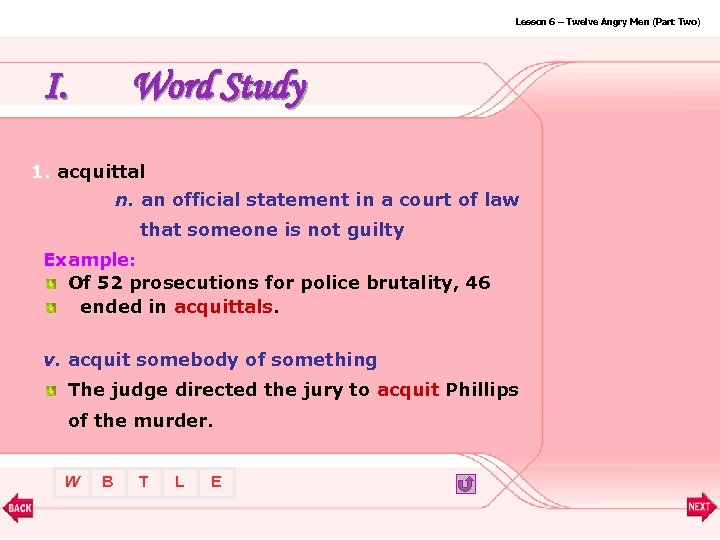
Lesson 6 – Twelve Angry Men (Part Two) I. Word Study 1. acquittal n. an official statement in a court of law that someone is not guilty Example: Of 52 prosecutions for police brutality, 46 ended in acquittals. v. acquit somebody of something The judge directed the jury to acquit Phillips of the murder. W B T L E
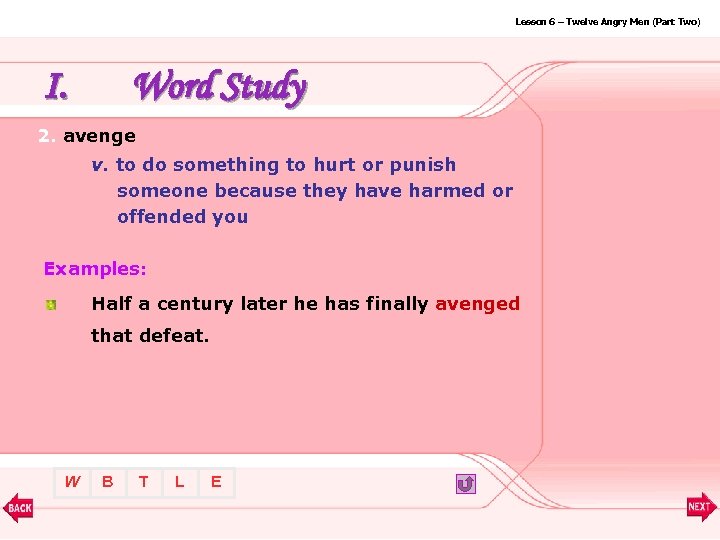
Lesson 6 – Twelve Angry Men (Part Two) I. Word Study 2. avenge v. to do something to hurt or punish someone because they have harmed or offended you Examples: Half a century later he has finally avenged that defeat. W B T L E
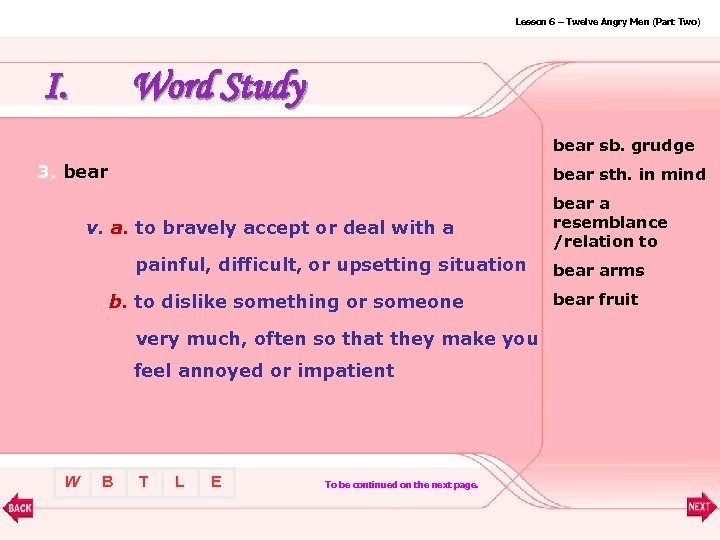
Lesson 6 – Twelve Angry Men (Part Two) I. Word Study bear sb. grudge 3. bear sth. in mind v. a. to bravely accept or deal with a painful, difficult, or upsetting situation b. to dislike something or someone very much, often so that they make you feel annoyed or impatient W B T L E To be continued on the next page. bear a resemblance /relation to bear arms bear fruit
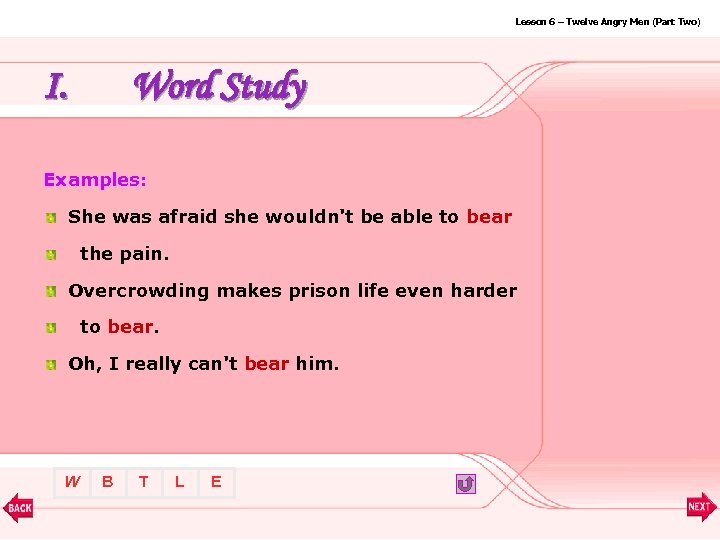
Lesson 6 – Twelve Angry Men (Part Two) I. Word Study Examples: She was afraid she wouldn't be able to bear the pain. Overcrowding makes prison life even harder to bear. Oh, I really can't bear him. W B T L E
Lesson 6 – Twelve Angry Men (Part Two) I. Word Study 4. blunder n. a careless or stupid mistake commit a blunder, make a blunder Examples: Major management blunders have led the company into bankruptcy. The parents face a nightmare week-long wait before blood tests show if there has been a hospital blunder. W B T L E
Lesson 6 – Twelve Angry Men (Part Two) I. Word Study 5. commonplace a. happening or existing in many places, and therefore not special or unusual Examples: Car thefts are commonplace in this part of town. Expensive foreign cars are commonplace in this Chicago suburb. W B T L E
Lesson 6 – Twelve Angry Men (Part Two) I. Word Study 6. injustice Word formations n. a situation in which people are treated very unfairly and not given their rights Examples: The group, called the Wilmington 10, were active in protests against racial injustices in the schools in the early 1970 s. These injustices are intolerable, especially when the victims are children. W B T L E a. unjust
Lesson 6 – Twelve Angry Men (Part Two) I. Word Study 7. intimidate v. to frighten or threaten someone into making them do what you want Examples: They tried to intimidate the young people into voting for them. Attempts to intimidate her failed. W B T L E Synonyms threat
Lesson 6 – Twelve Angry Men (Part Two) I. Word Study 8. lunge v. to make a sudden strong movement towards someone or something, especially to attack them Examples: The goats lunged at each other with their horns. John lunged forward and grabbed him by the throat. W B T L E Word formation n. lunge
Lesson 6 – Twelve Angry Men (Part Two) I. Word Study 9. object v. to feel or say that you oppose or disapprove of something Examples: Robson strongly objected to the terms of the contract. I objected to having to rewrite the article. Cf. : n. object W B T L E Word formation n. objection
Lesson 6 – Twelve Angry Men (Part Two) I. Word Study 10. obscure v. a. to make something difficult to know or understand b. to prevent something from being seen or heard clearly Examples: Recent successes have obscured the fact that the company is still in trouble. The view was obscured by mist. W B T L E To be continued on the next page.
Lesson 6 – Twelve Angry Men (Part Two) I. Word Study a. not well known and usually not very important b. difficult to understand Examples: an obscure poet 无名的,不知名的 The details of his life remain obscure. 含糊的, 不清楚的 He’s using an obscure old law to try to stop the new road being built. 晦涩难懂的 W B T L E Word formation n. obscurity
Lesson 6 – Twelve Angry Men (Part Two) I. Word Study 11. recreate v. to make something from the past exist again in a new form or be experienced again W B T L E To be continued on the next page.
Lesson 6 – Twelve Angry Men (Part Two) I. Word Study Examples: Evan often chimes in, so we work together to recreate the story. And we can share best practices so that every educator and employer does not have to recreate effective strategies from scratch. Arjelo's novel vividly recreates 15 th-century Spain. W B T L E
Lesson 6 – Twelve Angry Men (Part Two) I. Word Study 12. stamp v. a. to put your foot down onto the ground loudly and with a lot of force b. to put a pattern, sign, or letters on something using a special tool c. to have an important or permanent effect on someone or something W B T L E To be continued on the next page.
Lesson 6 – Twelve Angry Men (Part Two) I. Word Study Examples: “I will not!” Bert yelled and stamped his foot. The woman at the desk stamped my passport. The experience remained stamped on her memory for many years. W B T L E
Lesson 6 – Twelve Angry Men (Part Two) I. Word Study 13. stick v. a. to attach something to something else using a substance, or to become attached to a surface b. if a pointed object sticks into something, or if you stick it there, it is pushed into it c. if you stick a part of your body somewhere, you put it in a position where other people can see it W B T L E To be continued on the next page
Lesson 6 – Twelve Angry Men (Part Two) I. Word Study Examples: Someone had stuck posters all over the walls. pins stuck in a notice board Clara stuck her head around the door to see who was there. W B T L E
Lesson 6 – Twelve Angry Men (Part Two) I. Word Study 14. testify v. a. to make a formal statement of what is true, especially in a court of law b. to show clearly that something is the case W B T L E To be continued on the next page.
Lesson 6 – Twelve Angry Men (Part Two) I. Word Study Examples: More Examples Mr. Molto has agreed to testify at the trial. Later, the witness who had testified against Muawad withdrew his allegation. The empty shops in the high street testify to the depth of the recession. The company's experience testifies to the difficulties of opening a business in a foreign country. W B T L E To be continued on the next page.
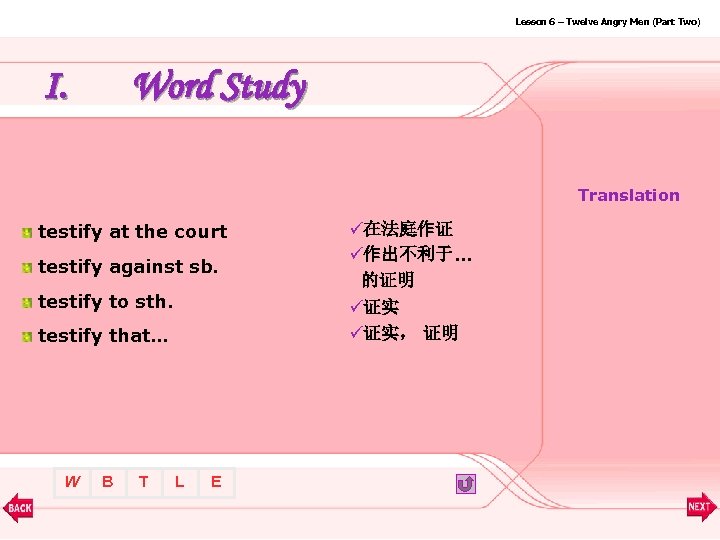
Lesson 6 – Twelve Angry Men (Part Two) I. Word Study Translation testify at the court testify against sb. testify to sth. testify that… W B T L E ü在法庭作证 ü作出不利于… 的证明 ü证实, 证明
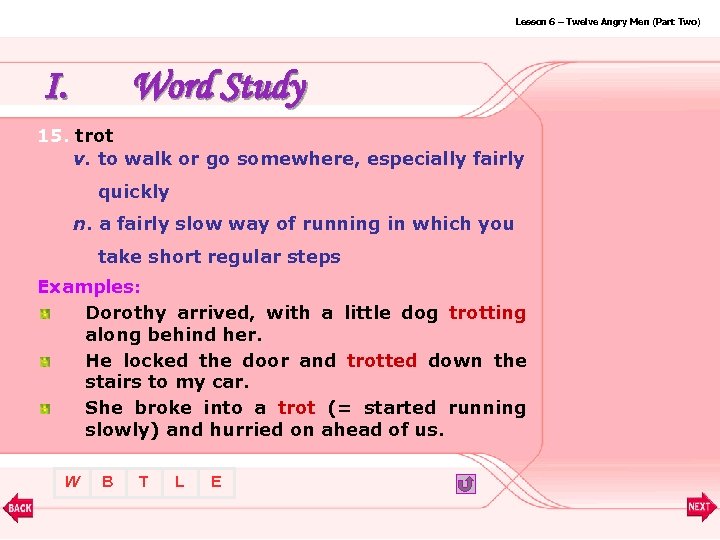
Lesson 6 – Twelve Angry Men (Part Two) I. Word Study 15. trot v. to walk or go somewhere, especially fairly quickly n. a fairly slow way of running in which you take short regular steps Examples: Dorothy arrived, with a little dog trotting along behind her. He locked the door and trotted down the stairs to my car. She broke into a trot (= started running slowly) and hurried on ahead of us. W B T L E
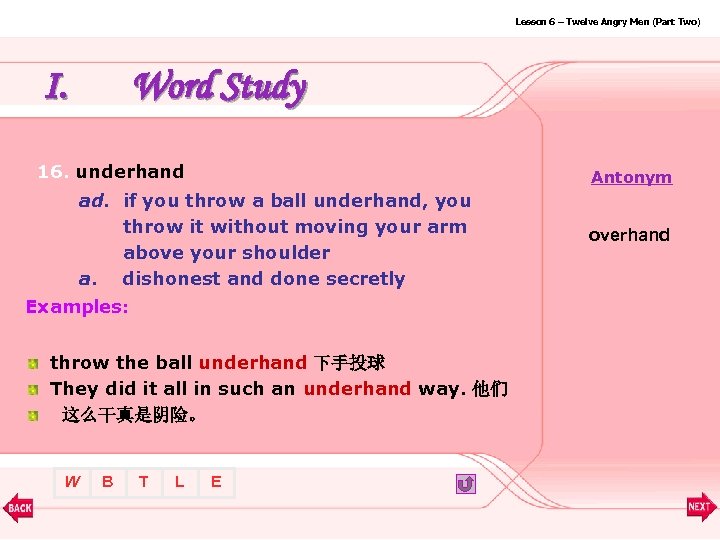
Lesson 6 – Twelve Angry Men (Part Two) I. Word Study 16. underhand Antonym ad. if you throw a ball underhand, you throw it without moving your arm above your shoulder a. dishonest and done secretly Examples: throw the ball underhand 下手投球 They did it all in such an underhand way. 他们 这么干真是阴险。 W B T L E overhand
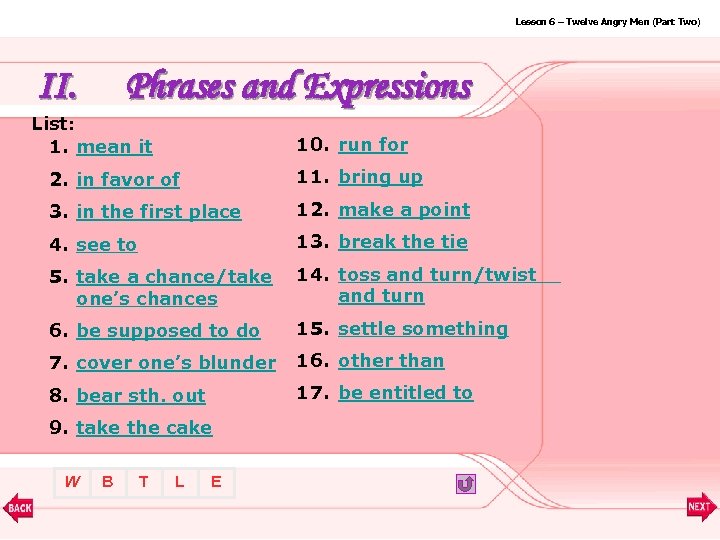
Lesson 6 – Twelve Angry Men (Part Two) II. Phrases and Expressions List: 1. mean it 10. run for 2. in favor of 11. bring up 3. in the first place 12. make a point 4. see to 13. break the tie 5. take a chance/take 14. toss and turn/twist and turn one’s chances 6. be supposed to do 15. settle something 7. cover one’s blunder 16. other than 8. bear sth. out 17. be entitled to 9. take the cake W B T L E
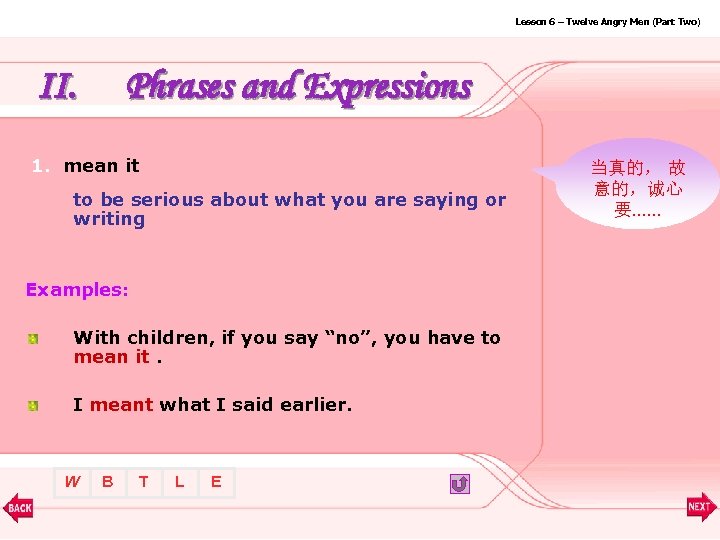
Lesson 6 – Twelve Angry Men (Part Two) II. Phrases and Expressions 1. mean it to be serious about what you are saying or writing Examples: With children, if you say “no”, you have to mean it. I meant what I said earlier. W B T L E 当真的, 故 意的,诚心 要……
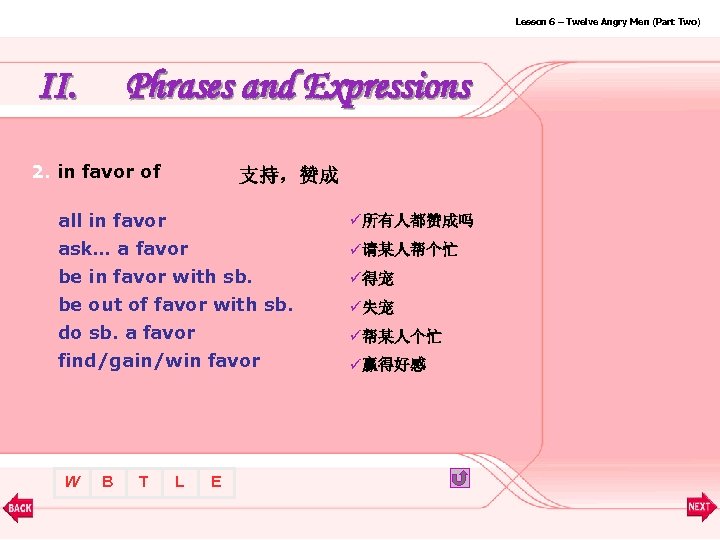
Lesson 6 – Twelve Angry Men (Part Two) II. Phrases and Expressions 2. in favor of 支持,赞成 all in favor ü所有人都赞成吗 ask… a favor ü请某人帮个忙 be in favor with sb. ü得宠 be out of favor with sb. ü失宠 do sb. a favor ü帮某人个忙 find/gain/win favor ü赢得好感 W B T L E
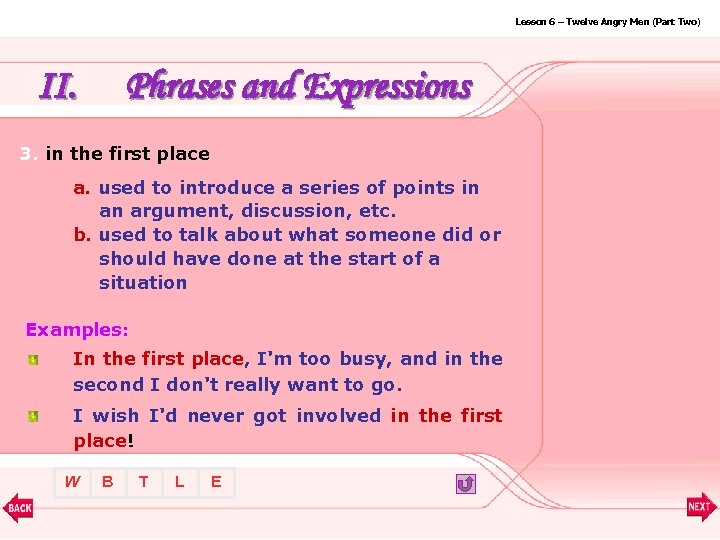
Lesson 6 – Twelve Angry Men (Part Two) II. Phrases and Expressions 3. in the first place a. used to introduce a series of points in an argument, discussion, etc. b. used to talk about what someone did or should have done at the start of a situation Examples: In the first place, I'm too busy, and in the second I don't really want to go. I wish I'd never got involved in the first place! W B T L E
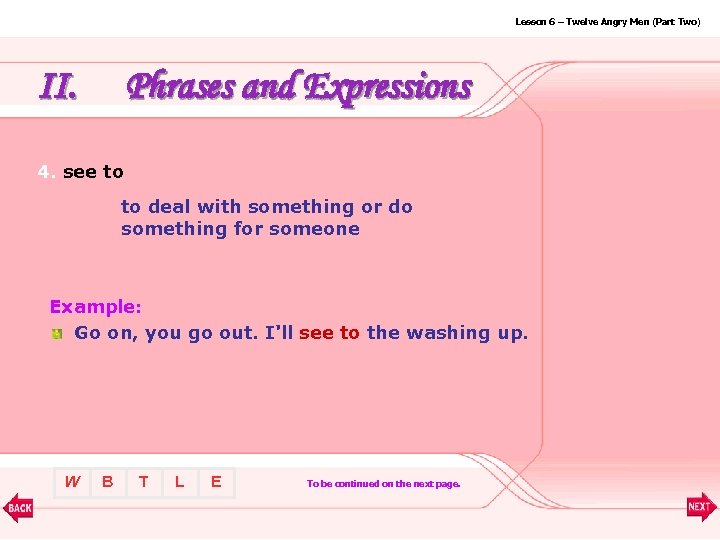
Lesson 6 – Twelve Angry Men (Part Two) II. Phrases and Expressions 4. see to to deal with something or do something for someone Example: Go on, you go out. I'll see to the washing up. W B T L E To be continued on the next page.
Lesson 6 – Twelve Angry Men (Part Two) II. Phrases and Expressions Cf. I'd better see about dinner. They've gone to the airport to see their son off. She saw out her last years at Sudeley Castle. I could never lie to her because I know she'd see through me straight away. I've got enough money to see me through six months of unemployment. W B T L E
Lesson 6 – Twelve Angry Men (Part Two) II. Phrases and Expressions 5. take a chance to do something that involves risks Examples: The rope might break, but that's a chance we'll have to take. After losing $20, 000 on my last business venture, I'm not taking any chances this time. Cf. take the chance/grab the chance/jump at the chance You should take the chance to travel while you're still young. W B T L E To be continued on the next page.
Lesson 6 – Twelve Angry Men (Part Two) II. Phrases and Expressions chance n. Examples: What are the team's chances of success? She has a good chance of a successful recovery. There is little chance of her being found alive. The day will be cloudy with a slight chance of rain later tonight. He gave the show a fifty-fifty chance of survival. W B T L E To be continued on the next page.
Lesson 6 – Twelve Angry Men (Part Two) II. Phrases and Expressions It was a million to one chance , but it had happened. The operation is performed under local anaesthetic, which lessens the chances of infection. How can we improve our chances of career development? Chances are they'll be out when we call. W B T L E
Lesson 6 – Twelve Angry Men (Part Two) II. Phrases and Expressions 6. be supposed to a. used to say what someone should or should not do, especially because of rules or what someone in authority has said b. used to say what was or is expected or intended to happen, especially when it did not happen c. used to say that something is believed to be true by many people, although it might not be true or you might disagree W B T L E To be continued on the next page. More examples
Lesson 6 – Twelve Angry Men (Part Two) I. Word Study We're supposed to check out of the hotel by 11 o'clock. What time are you supposed to be there? The meeting was supposed to take place on Tuesday, but we've had to postpone it. The new laws are supposed to prevent crime. “Dirty Harry” is supposed to be one of Eastwood's best films. Mrs. Carver is supposed to have a lot of money. W B T L E
Lesson 6 – Twelve Angry Men (Part Two) II. Phrases and Expressions 7. cover one’s blunder 掩饰错误 Cf. commit a blunder 犯错误 make a blunder 犯错误 W B T L E
Lesson 6 – Twelve Angry Men (Part Two) II. Phrases and Expressions 8. bear sth. out that “bear” phrases if facts or information bear out a claim, story, opinion, etc. , they help to prove it is true Example: Evidence bears out the idea that students learn best in small groups. W B T L E To be continued on the next page.
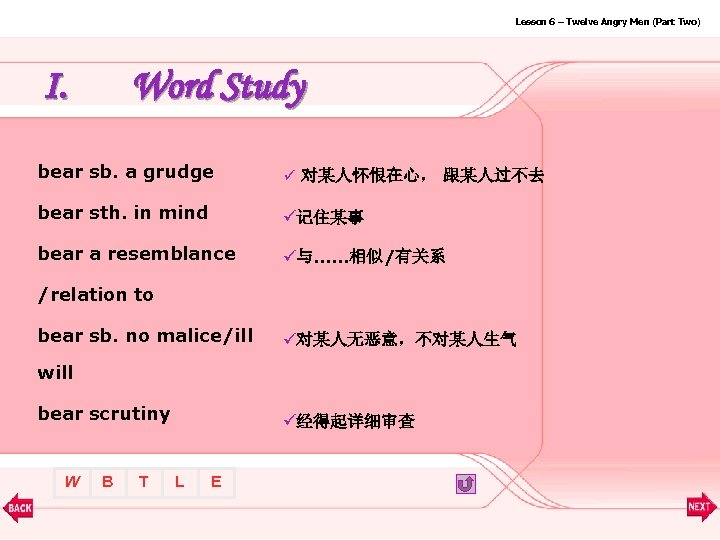
Lesson 6 – Twelve Angry Men (Part Two) I. Word Study bear sb. a grudge ü 对某人怀恨在心, 跟某人过不去 bear sth. in mind ü记住某事 bear a resemblance ü与……相似/有关系 /relation to bear sb. no malice/ill ü对某人无恶意,不对某人生气 will bear scrutiny W B T ü经得起详细审查 L E
Lesson 6 – Twelve Angry Men (Part Two) II. Phrases and Expressions 9. take the cake to be worse than anything else you can imagine Example: I've heard some pretty dumb ideas, but that takes the cake! W B T L E To be continued on the next page. Related phrases
Lesson 6 – Twelve Angry Men (Part Two) II. Phrases and Expressions a piece of cake 小菜一碟 have your cake and eat it 捞到全部的好处 a slice of cake 一点好处 Examples: “How do you do that? ” “It's a piece of cake! Watch!” They don't imagine they can have their cake and eat it too. Both companies expect to get a big slice of the cake. W B T L E
Lesson 6 – Twelve Angry Men (Part Two) II. Phrases and Expressions 10. run for to try to be elected in an election Examples: Salinas is running for a second term as President. an attempt to encourage more women to run for office run for his life: run in order to avoid being killed 逃命 W B T L E
Lesson 6 – Twelve Angry Men (Part Two) II. Phrases and Expressions 11. bring up a. to mention a subject or start to talk about it b. to look after and influence a child until he or she is grown up Examples: Why did you have to bring up the subject of money? (Synonym: raise) He was brought up by his grandparents. (Synonym: raise) W B T L E
Lesson 6 – Twelve Angry Men (Part Two) II. Phrases and Expressions 12. make a point 证明论点正确, 得一分 Cf. : make a point of: to do something deliberately, even when it involves making a special effort Example: • He made a point of spending Saturdays with his children. W B T L E
Lesson 6 – Twelve Angry Men (Part Two) II. Phrases and Expressions 13. break the tie to swing the balance when two or more people or teams get the same number of points, votes Example: If three or more teams tie, the overall record of the tied teams against each other shall break the tie. W B T L E 打破平局
Lesson 6 – Twelve Angry Men (Part Two) II. Phrases and Expressions 14. toss and turn / twist and turn Examples: The river twists and turns through the green fields. 弯弯曲曲 She had slept badly, tossing and turning before falling into a fitful doze. 辗转反侧 W B T L E
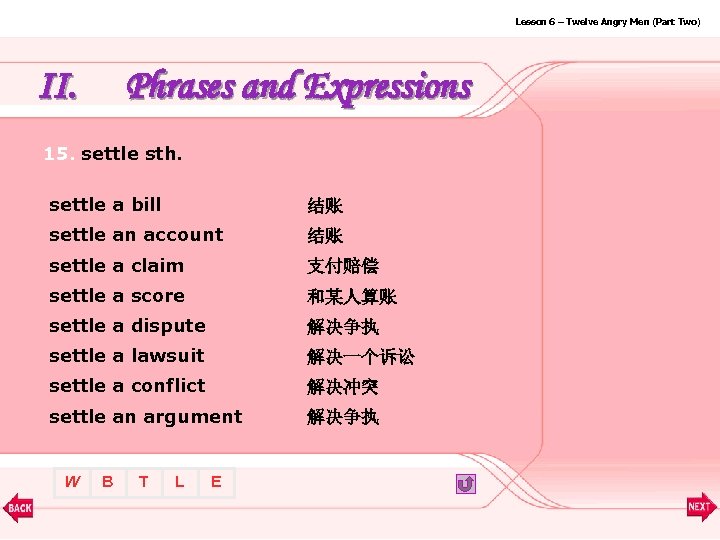
Lesson 6 – Twelve Angry Men (Part Two) II. Phrases and Expressions 15. settle sth. settle a bill 结账 settle an account 结账 settle a claim 支付赔偿 settle a score 和某人算账 settle a dispute 解决争执 settle a lawsuit 解决一个诉讼 settle a conflict 解决冲突 settle an argument 解决争执 W B T L E
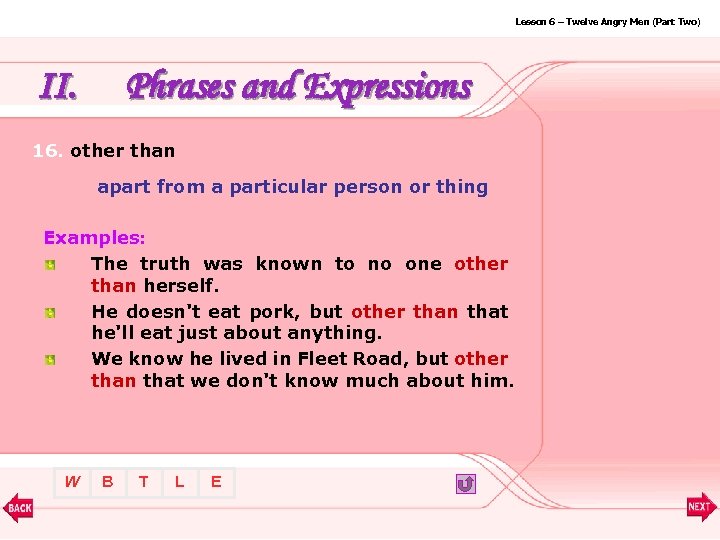
Lesson 6 – Twelve Angry Men (Part Two) II. Phrases and Expressions 16. other than apart from a particular person or thing Examples: The truth was known to no one other than herself. He doesn't eat pork, but other than that he'll eat just about anything. We know he lived in Fleet Road, but other than that we don't know much about him. W B T L E
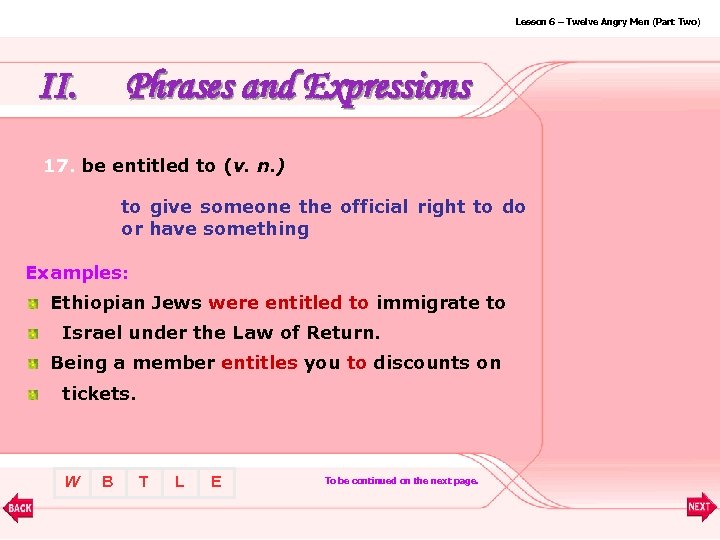
Lesson 6 – Twelve Angry Men (Part Two) II. Phrases and Expressions 17. be entitled to (v. n. ) to give someone the official right to do or have something Examples: Ethiopian Jews were entitled to immigrate to Israel under the Law of Return. Being a member entitles you to discounts on tickets. W B T L E To be continued on the next page.
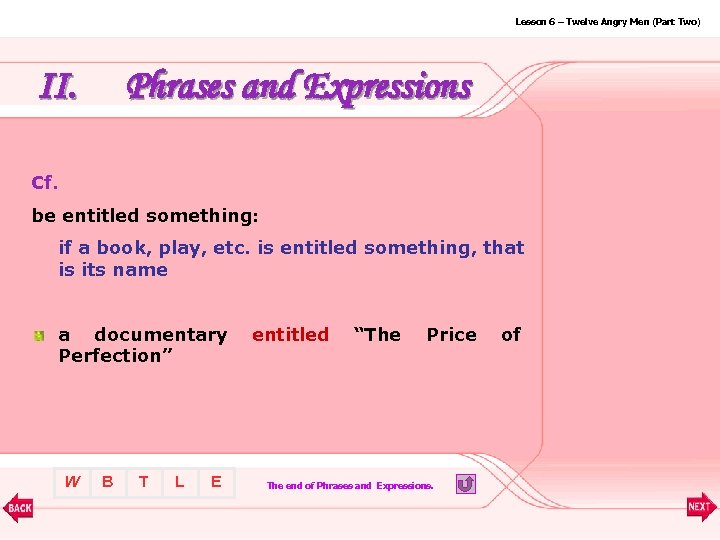
Lesson 6 – Twelve Angry Men (Part Two) II. Phrases and Expressions Cf. be entitled something: if a book, play, etc. is entitled something, that is its name a documentary Perfection” W B T L E entitled “The Price The end of Phrases and Expressions. of
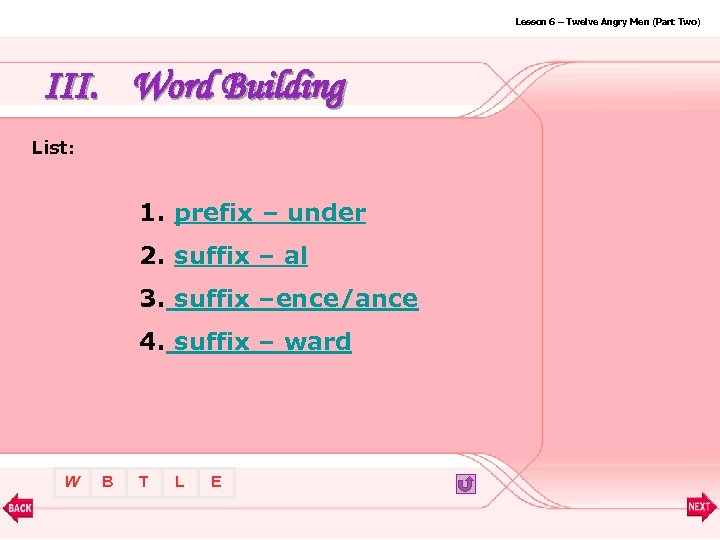
Lesson 6 – Twelve Angry Men (Part Two) III. Word Building List: 1. prefix – under 2. suffix – al 3. suffix –ence/ance 4. suffix – ward W B T L E
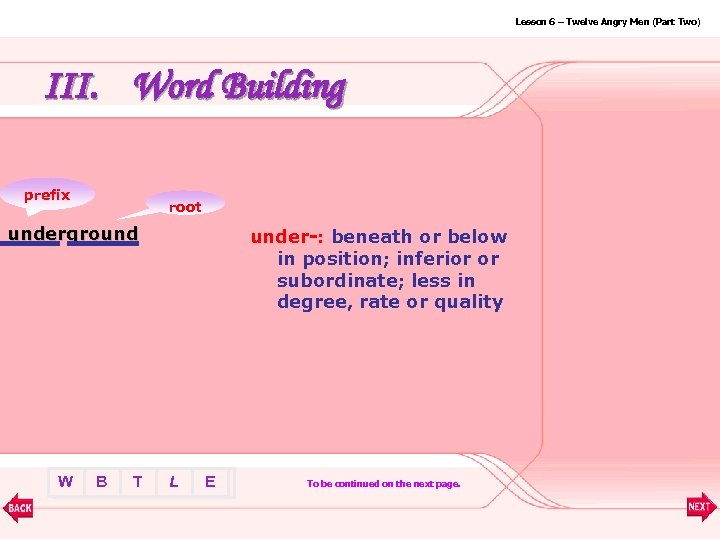
Lesson 6 – Twelve Angry Men (Part Two) III. Word Building prefix root underground W W B B T T under-: beneath or below in position; inferior or subordinate; less in degree, rate or quality L L E E To be continued on the next page.
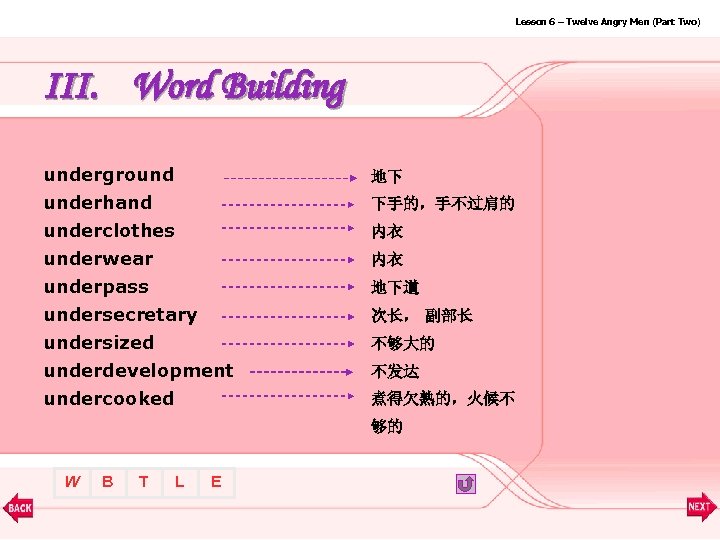
Lesson 6 – Twelve Angry Men (Part Two) III. Word Building underground 地下 underhand 下手的,手不过肩的 underclothes 内衣 underwear 内衣 underpass 地下道 undersecretary 次长, 副部长 undersized 不够大的 underdevelopment 不发达 undercooked 煮得欠熟的,火候不 够的 W B T L E
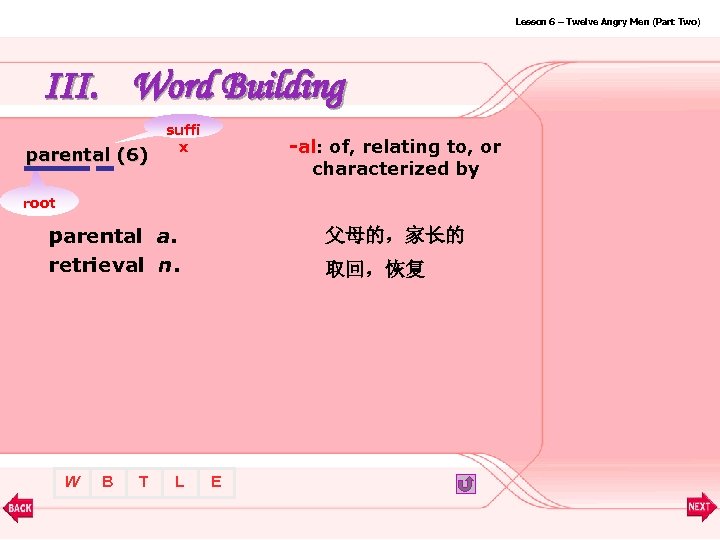
Lesson 6 – Twelve Angry Men (Part Two) III. Word Building parental (6) suffi x -al: of, relating to, or characterized by root parental a. retrieval n. W B T L 父母的,家长的 取回,恢复 E
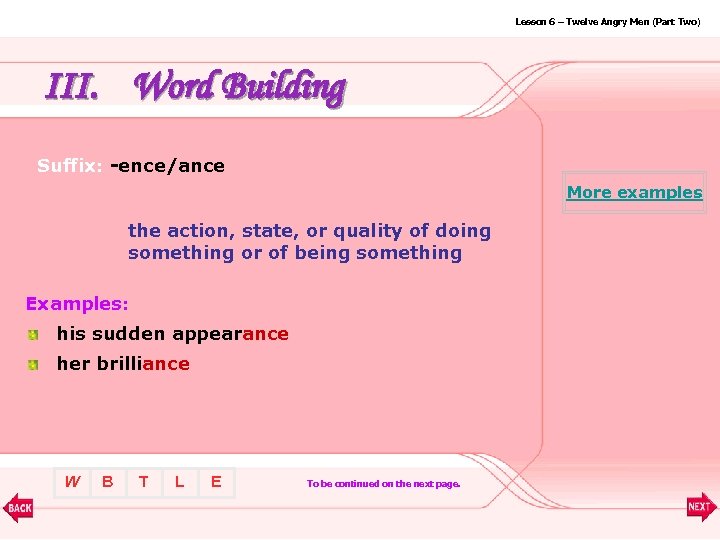
Lesson 6 – Twelve Angry Men (Part Two) III. Word Building Suffix: -ence/ance More examples the action, state, or quality of doing something or of being something Examples: his sudden appearance her brilliance W B T L E To be continued on the next page.
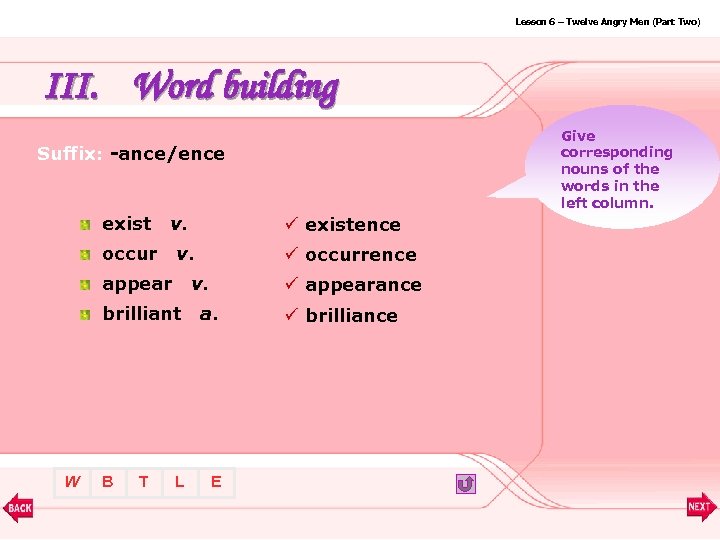
Lesson 6 – Twelve Angry Men (Part Two) III. Word building Give corresponding nouns of the words in the left column. Suffix: -ance/ence exist v. occur v. ü occurrence appear v. ü appearance brilliant a. W ü existence ü brilliance B T L E
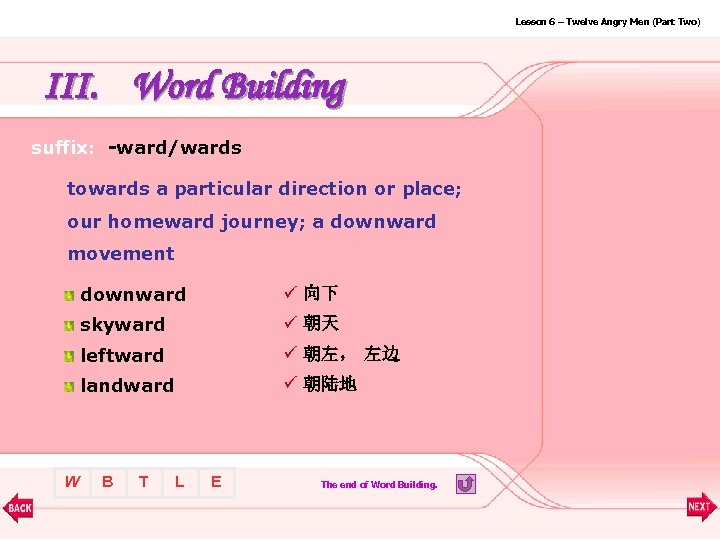
Lesson 6 – Twelve Angry Men (Part Two) III. Word Building suffix: -ward/wards towards a particular direction or place; our homeward journey; a downward movement downward ü 向下 skyward ü 朝天 leftward ü 朝左, 左边 landward ü 朝陆地 W B T L E The end of Word Building.
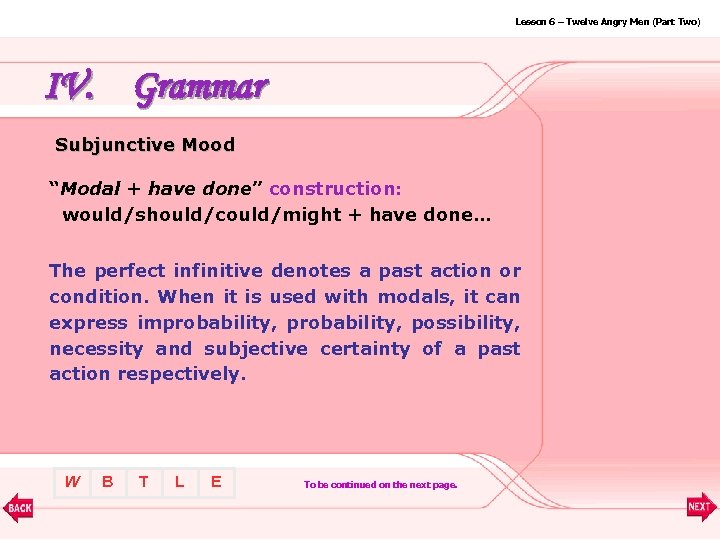
Lesson 6 – Twelve Angry Men (Part Two) IV. Grammar Subjunctive Mood “Modal + have done” construction: would/should/could/might + have done… The perfect infinitive denotes a past action or condition. When it is used with modals, it can express improbability, possibility, necessity and subjective certainty of a past action respectively. W B T L E To be continued on the next page.
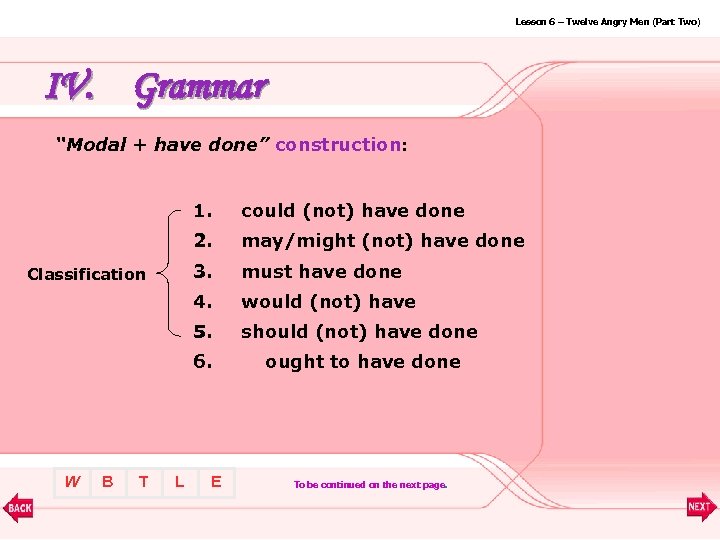
Lesson 6 – Twelve Angry Men (Part Two) IV. Grammar “Modal + have done” construction: 1. 2. L should (not) have done 6. T would (not) have 5. B must have done 4. W may/might (not) have done 3. Classification could (not) have done ought to have done E To be continued on the next page.
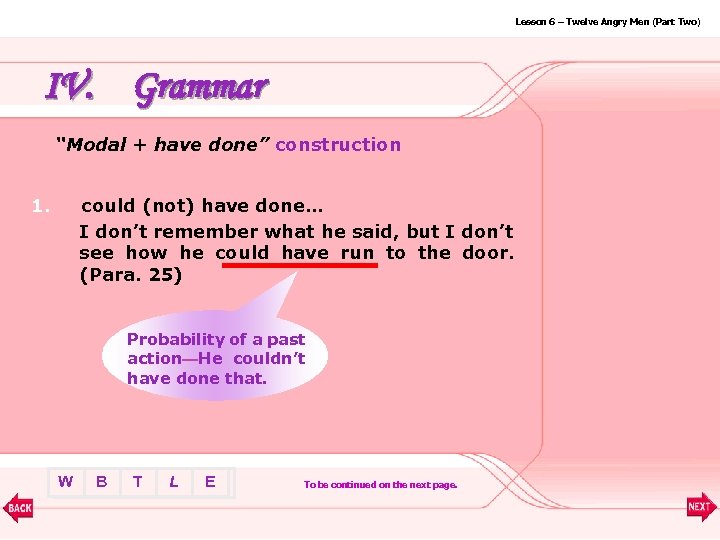
Lesson 6 – Twelve Angry Men (Part Two) IV. Grammar “Modal + have done” construction 1. could (not) have done… I don’t remember what he said, but I don’t see how he could have run to the door. (Para. 25) Probability of a past action—He couldn’t have done that. W W B B T T L L E E To be continued on the next page.
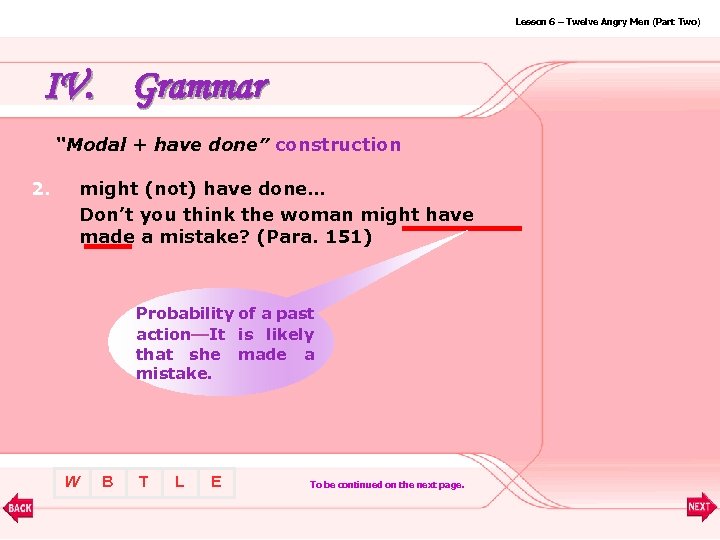
Lesson 6 – Twelve Angry Men (Part Two) IV. Grammar “Modal + have done” construction 2. might (not) have done… Don’t you think the woman might have made a mistake? (Para. 151) Probability of a past action—It is likely that she made a mistake. W B T L E To be continued on the next page.
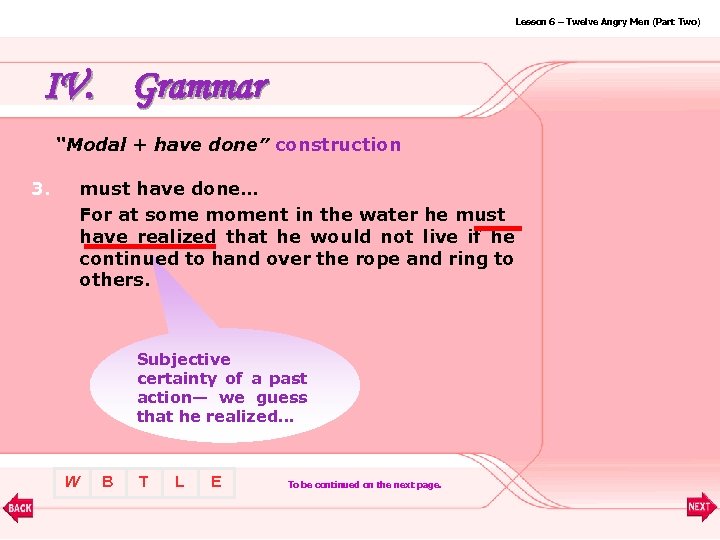
Lesson 6 – Twelve Angry Men (Part Two) IV. Grammar “Modal + have done” construction 3. must have done… For at some moment in the water he must have realized that he would not live if he continued to hand over the rope and ring to others. Subjective certainty of a past action— we guess that he realized… W B T L E To be continued on the next page.
Lesson 6 – Twelve Angry Men (Part Two) IV. Grammar “Modal + have done” construction 4. would (not) have done… I just can’t see two slaps in the face would have provoked him into committing murder. (Para. 46) Probability of a past action—he wouldn’t be provoked into committing the crime. W B T L E To be continued on the next page.
Lesson 6 – Twelve Angry Men (Part Two) IV. Grammar “Modal + have done” construction 5. should (not) have done… “I think you ought to have told me, Alan, ” said Hughie in a bad temper, “and not have let me make such a fool of myself. ” Obligation for a past action—but in fact Alan didn’t tell me. W B T L E The end of Grammar.
Lesson 6 – Twelve Angry Men (Part Two) Part Four This is the end of Part Four. Please click HOME to visit other parts. W B T L E
Lesson 6 – Twelve Angry Men (Part Two) Part Five W B T L E ENTER
Lesson 6 – Twelve Angry Men (Part Two) Extension I. Oral work II. Quiz III. Writing IV. Listening lab W B T L E
Lesson 6 – Twelve Angry Men (Part Two) Oral Work I. List: 1. Group discussion 2. Appreciation of quotes: Prejudice and justice 3. Debating W B T L E
Lesson 6 – Twelve Angry Men (Part Two) Oral Work I. Group Discussion Why do you think Juror No. 8 could stand up against all the opposition and finally won this argument? Do you think we are all prone to prejudices just like the jurors? Why? What is the difference between the American judicial system and the Chinese one? Does reasonable doubt also play a part in the Chinese judicial system? W B T L E The end of Group Discussion. Brainstor m in groups.
Lesson 6 – Twelve Angry Men (Part Two) Oral Work I. Appreciation of Quotes Common sense is the collection of prejudices acquired by age eighteen. –Albert Einstein The greatest friend of Truth is time, her greatest enemy is Prejudice, and her constant companion Humility. –Charles Caleb Colton Everyone is a prisoner of his own experiences. No one can eliminate prejudices–just recognize them. –Edward R. Murrow W B T L E To be continued on the next page.
Lesson 6 – Twelve Angry Men (Part Two) Oral Work I. Appreciation of Quotes If we were to wake up some morning and find that everyone was the same race, creed and color, we would find some other cause for prejudice by noon. –George Aiken There are, in every age, new errors to be rectified and new prejudices to be opposed. –Samuel Johnson W B T L E To be continued on the next page.
Lesson 6 – Twelve Angry Men (Part Two) Oral Work I. Appreciation of Quotes I am free of all prejudice. I hate everyone equally. –W. C. Fields A great many people think they are thinking when they are merely rearranging their prejudices. –William James Never try to reason the prejudice out of a man. It was not reasoned into him, and cannot be reasoned out. –Sydney Smith W B T L E The end of Appreciation of Quotes.
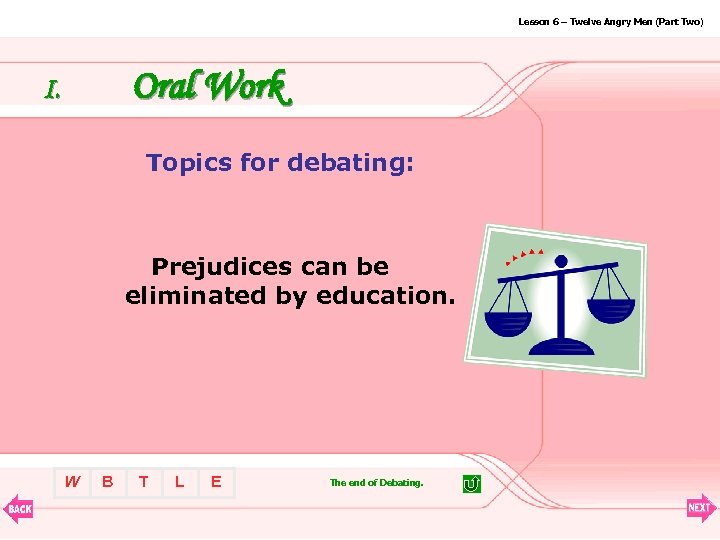
Lesson 6 – Twelve Angry Men (Part Two) Oral Work I. Topics for debating: Prejudices can be eliminated by education. W B T L E The end of Debating.
Lesson 6 – Twelve Angry Men (Part Two) Quiz II. List: 1. Quiz 1 2. Quiz 2 3. Quiz 3 W B T L E
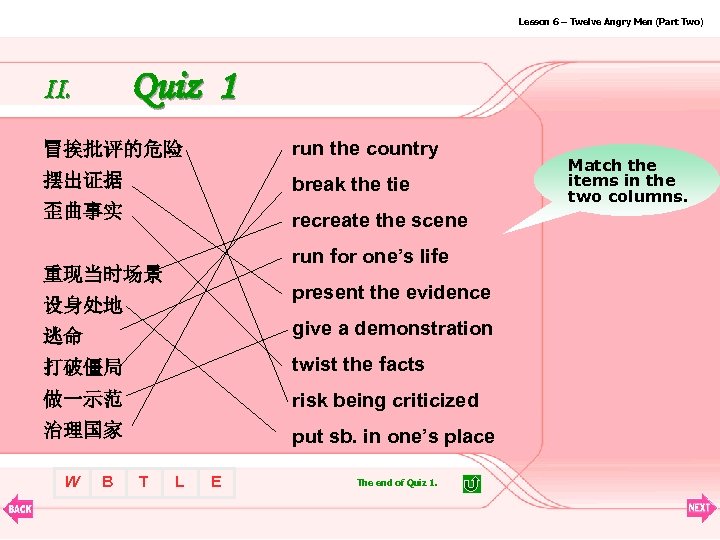
Lesson 6 – Twelve Angry Men (Part Two) Quiz 1 II. 冒挨批评的危险 run the country 摆出证据 break the tie 歪曲事实 recreate the scene run for one’s life 重现当时场景 present the evidence 设身处地 逃命 give a demonstration 打破僵局 twist the facts 做一示范 risk being criticized 治理国家 put sb. in one’s place W B T L E The end of Quiz 1. Match the items in the two columns.
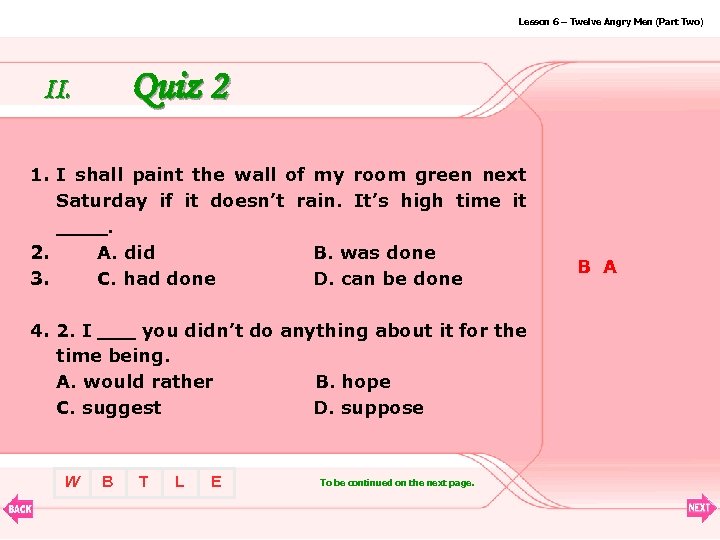
Lesson 6 – Twelve Angry Men (Part Two) Quiz 2 II. 1. I shall paint the wall of my room green next Saturday if it doesn’t rain. It’s high time it ____. 2. A. did B. was done 3. C. had done D. can be done 4. 2. I ___ you didn’t do anything about it for the time being. A. would rather B. hope C. suggest D. suppose W B T L E To be continued on the next page. B A
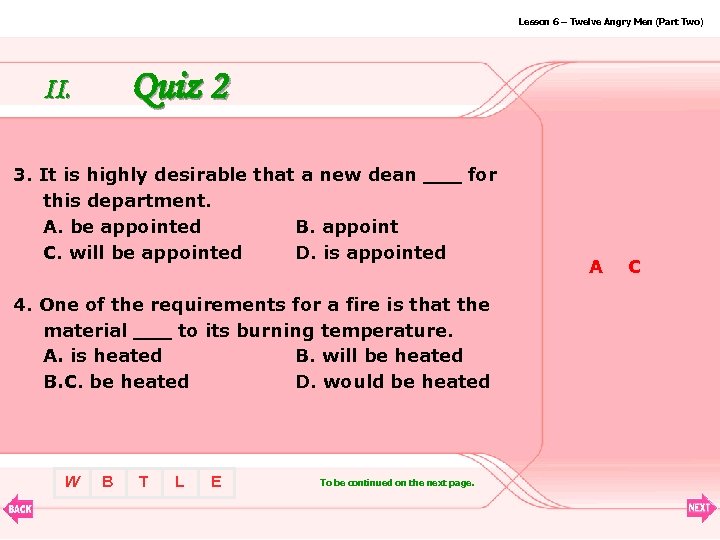
Lesson 6 – Twelve Angry Men (Part Two) Quiz 2 II. 3. It is highly desirable that a new dean ___ for this department. A. be appointed B. appoint C. will be appointed D. is appointed 4. One of the requirements for a fire is that the material ___ to its burning temperature. A. is heated B. will be heated B. C. be heated D. would be heated W B T L E To be continued on the next page. A C
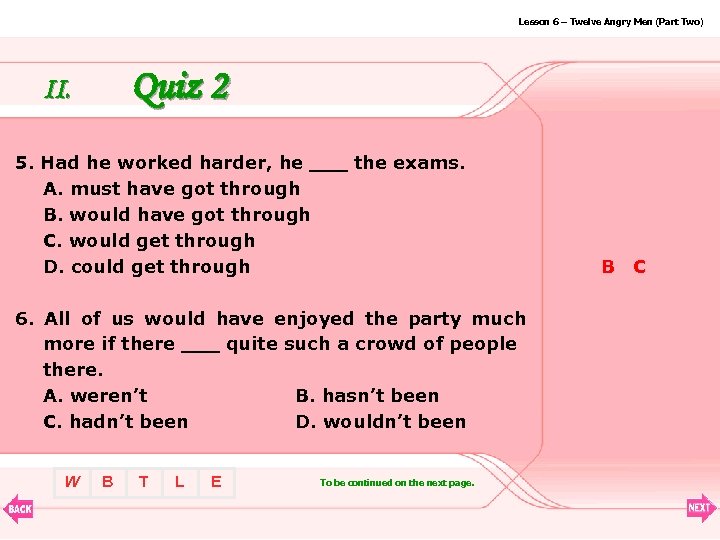
Lesson 6 – Twelve Angry Men (Part Two) Quiz 2 II. 5. Had he worked harder, he ___ the exams. A. must have got through B. would have got through C. would get through D. could get through 6. All of us would have enjoyed the party much more if there ___ quite such a crowd of people there. A. weren’t B. hasn’t been C. hadn’t been D. wouldn’t been W B T L E To be continued on the next page. B C
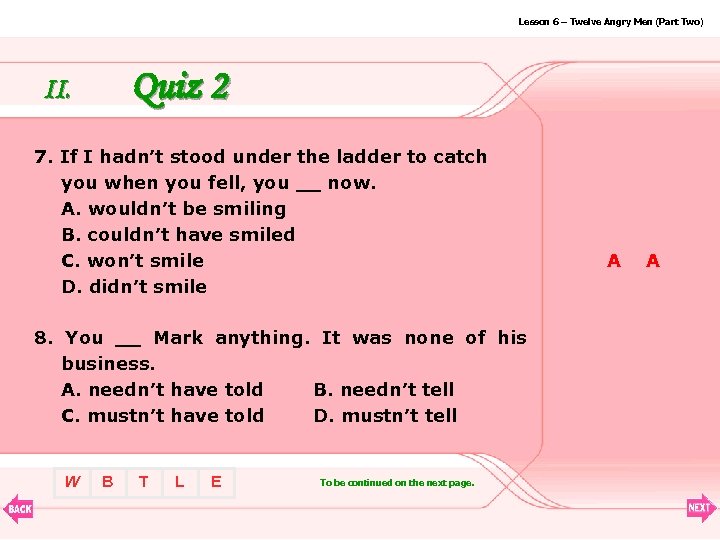
Lesson 6 – Twelve Angry Men (Part Two) Quiz 2 II. 7. If I hadn’t stood under the ladder to catch you when you fell, you __ now. A. wouldn’t be smiling B. couldn’t have smiled C. won’t smile D. didn’t smile 8. You __ Mark anything. It was none of his business. A. needn’t have told B. needn’t tell C. mustn’t have told D. mustn’t tell W B T L E To be continued on the next page. A A
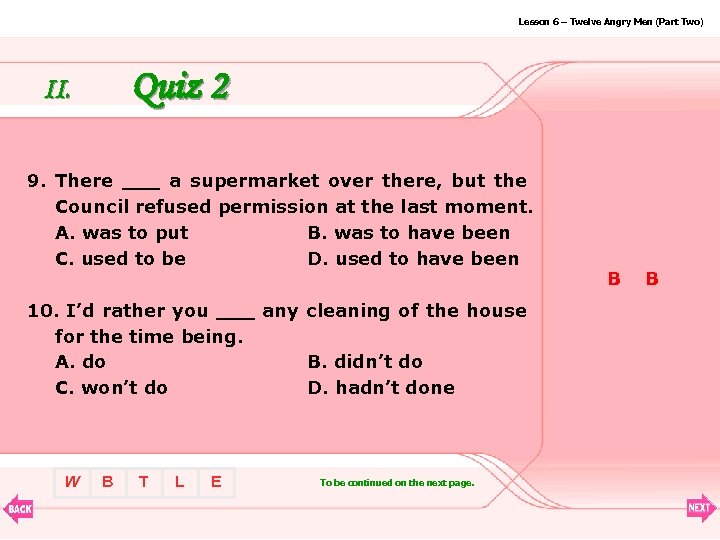
Lesson 6 – Twelve Angry Men (Part Two) Quiz 2 II. 9. There ___ a supermarket over there, but the Council refused permission at the last moment. A. was to put B. was to have been C. used to be D. used to have been 10. I’d rather you ___ any cleaning of the house for the time being. A. do B. didn’t do C. won’t do D. hadn’t done W B T L E To be continued on the next page. B B
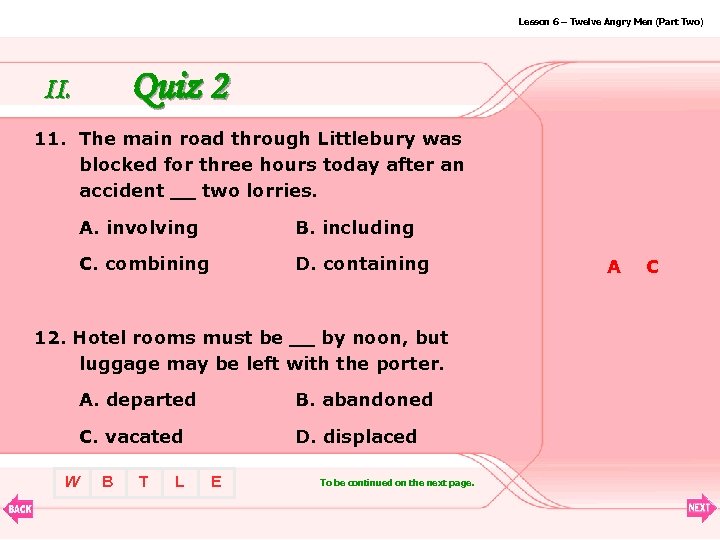
Lesson 6 – Twelve Angry Men (Part Two) Quiz 2 II. 11. The main road through Littlebury was blocked for three hours today after an accident __ two lorries. A. involving B. including C. combining D. containing 12. Hotel rooms must be __ by noon, but luggage may be left with the porter. A. departed B. abandoned C. vacated D. displaced W B T L E To be continued on the next page. A C
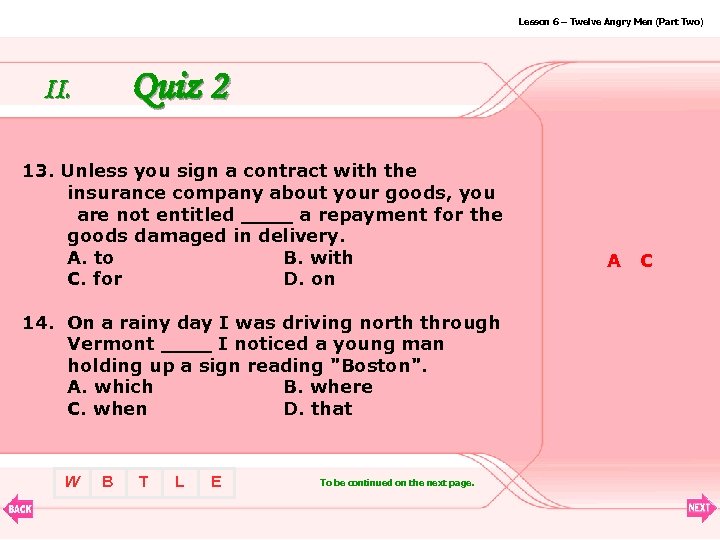
Lesson 6 – Twelve Angry Men (Part Two) Quiz 2 II. 13. Unless you sign a contract with the insurance company about your goods, you are not entitled ____ a repayment for the goods damaged in delivery. A. to B. with C. for D. on 14. On a rainy day I was driving north through Vermont ____ I noticed a young man holding up a sign reading "Boston". A. which B. where C. when D. that W B T L E To be continued on the next page. A C
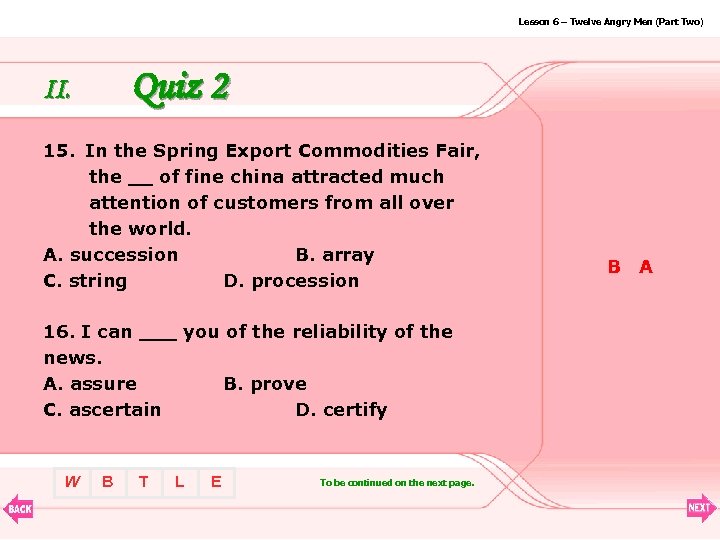
Lesson 6 – Twelve Angry Men (Part Two) Quiz 2 II. 15. In the Spring Export Commodities Fair, the __ of fine china attracted much attention of customers from all over the world. A. succession B. array C. string D. procession 16. I can ___ you of the reliability of the news. A. assure B. prove C. ascertain D. certify W B T L E To be continued on the next page. B A
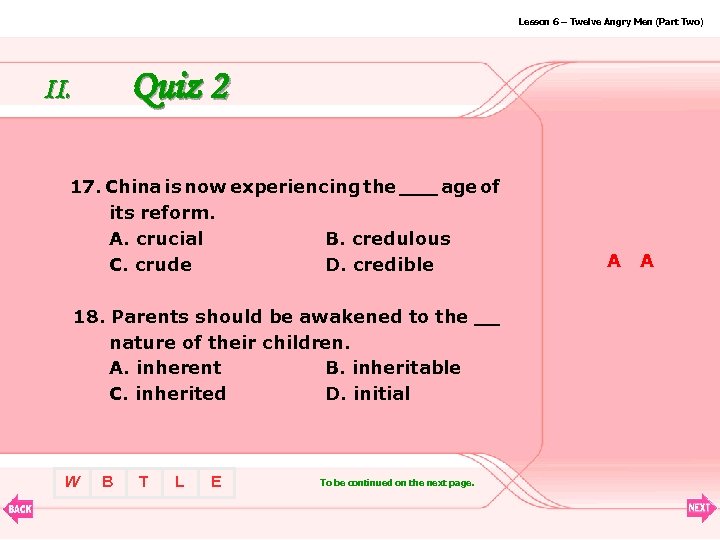
Lesson 6 – Twelve Angry Men (Part Two) Quiz 2 II. 17. China is now experiencing the ___ age of its reform. A. crucial B. credulous C. crude D. credible 18. Parents should be awakened to the __ nature of their children. A. inherent B. inheritable C. inherited D. initial W B T L E To be continued on the next page. A A
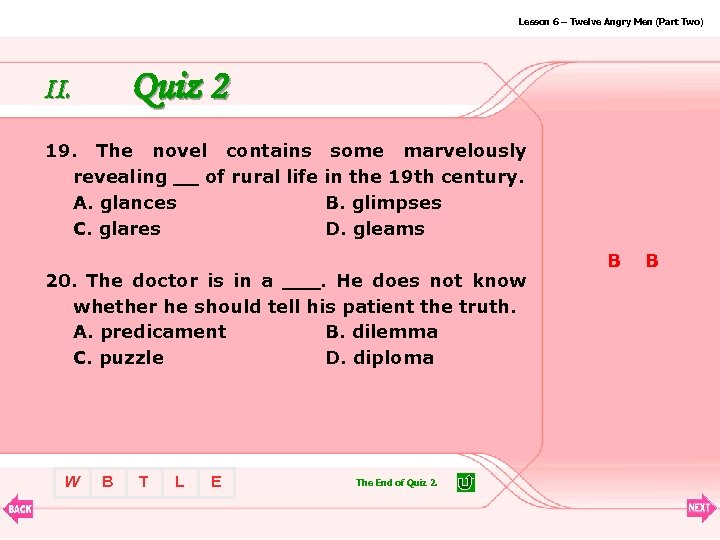
Lesson 6 – Twelve Angry Men (Part Two) Quiz 2 II. 19. The novel contains some marvelously revealing __ of rural life in the 19 th century. A. glances B. glimpses C. glares D. gleams 20. The doctor is in a ___. He does not know whether he should tell his patient the truth. A. predicament B. dilemma C. puzzle D. diploma W B T L E The End of Quiz 2. B B
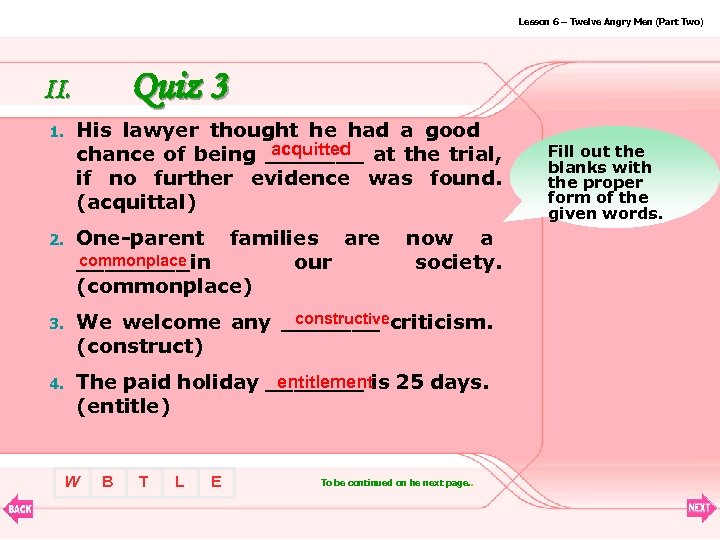
Lesson 6 – Twelve Angry Men (Part Two) Quiz 3 II. 1. His lawyer thought he had a good acquitted chance of being _______ at the trial, if no further evidence was found. (acquittal) 2. One-parent families are now a commonplace ____in our society. (commonplace) 3. constructive We welcome any _______ criticism. (construct) 4. entitlement The paid holiday _______ is 25 days. (entitle) W B T L E To be continued on he next page. . Fill out the blanks with the proper form of the given words.
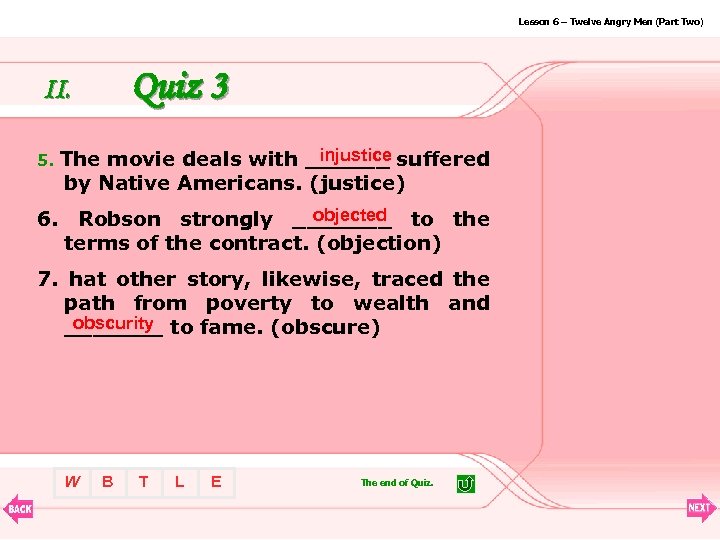
Lesson 6 – Twelve Angry Men (Part Two) Quiz 3 II. injustice 5. The movie deals with ______ suffered by Native Americans. (justice) objected 6. Robson strongly _______ to the terms of the contract. (objection) 7. hat other story, likewise, traced the path from poverty to wealth and obscurity _______ to fame. (obscure) W B T L E The end of Quiz.
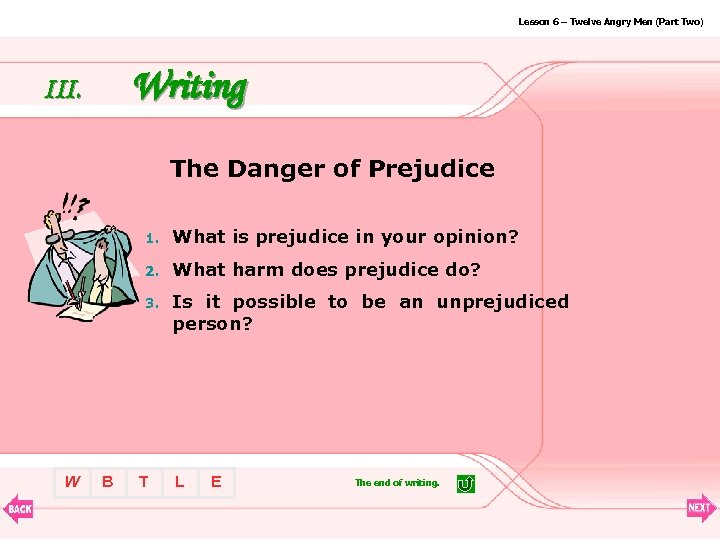
Lesson 6 – Twelve Angry Men (Part Two) Writing III. The Danger of Prejudice 1. 2. B What harm does prejudice do? 3. W What is prejudice in your opinion? Is it possible to be an unprejudiced person? T L E The end of writing.
Lesson 6 – Twelve Angry Men (Part Two) Listening Lab IV. No. 1: 8 EBay Sellers Admit to Phony Bids —China Radio International Fill out the blanks while you are listening. keys inflate W W B B T T L L E E To be continued on the next page.
Lesson 6 – Twelve Angry Men (Part Two) Listening Lab IV. Spokesman Darren Dopp said the cases stemmed from specific ____, but the office has not conducted a broad investigation of the online auction industry and doesn't know how widespread the practice of ___ is. One buyer, Brad Clarke, 48, of Peachtree City, Ga. , already has received a check for $___ after overpaying for a 1999 Jeep Cherokee sport utility vehicle he bought on e. Bay from a New York seller in 2002. W W B B T T L L E E To be continued on the next page. keys complaints, phony bidding, 3, 089
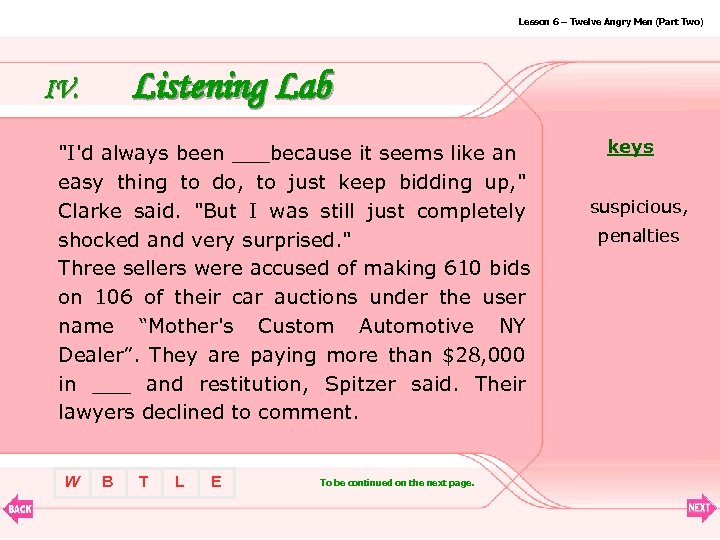
Lesson 6 – Twelve Angry Men (Part Two) Listening Lab IV. "I'd always been ___because it seems like an easy thing to do, to just keep bidding up, " Clarke said. "But I was still just completely shocked and very surprised. " Three sellers were accused of making 610 bids on 106 of their car auctions under the user name “Mother's Custom Automotive NY Dealer”. They are paying more than $28, 000 in ___ and restitution, Spitzer said. Their lawyers declined to comment. W B T L E To be continued on the next page. keys suspicious, penalties
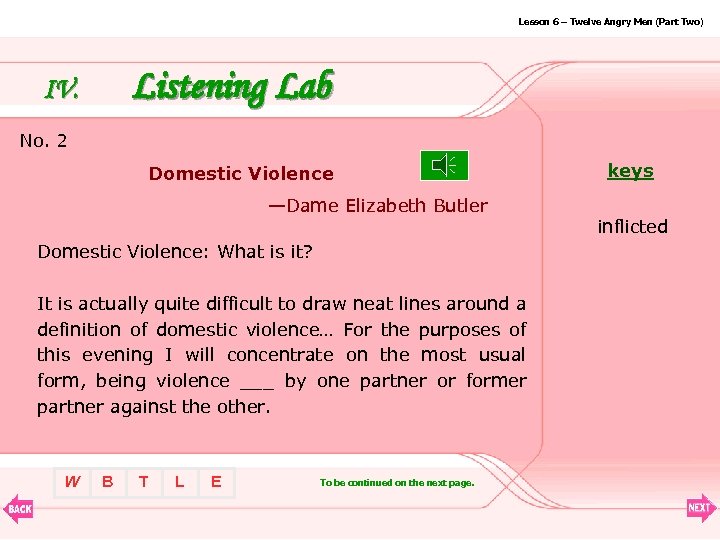
Lesson 6 – Twelve Angry Men (Part Two) Listening Lab IV. No. 2 Domestic Violence —Dame Elizabeth Butler Domestic Violence: What is it? It is actually quite difficult to draw neat lines around a definition of domestic violence… For the purposes of this evening I will concentrate on the most usual form, being violence ___ by one partner or former partner against the other. W B T L E To be continued on the next page. keys inflicted
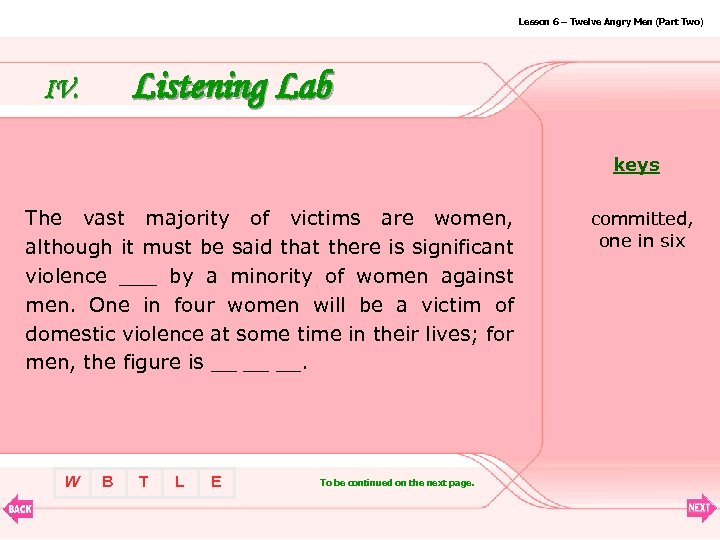
Lesson 6 – Twelve Angry Men (Part Two) Listening Lab IV. keys The vast majority of victims are women, although it must be said that there is significant violence ___ by a minority of women against men. One in four women will be a victim of domestic violence at some time in their lives; for men, the figure is __ __ __. W B T L E To be continued on the next page. committed, one in six
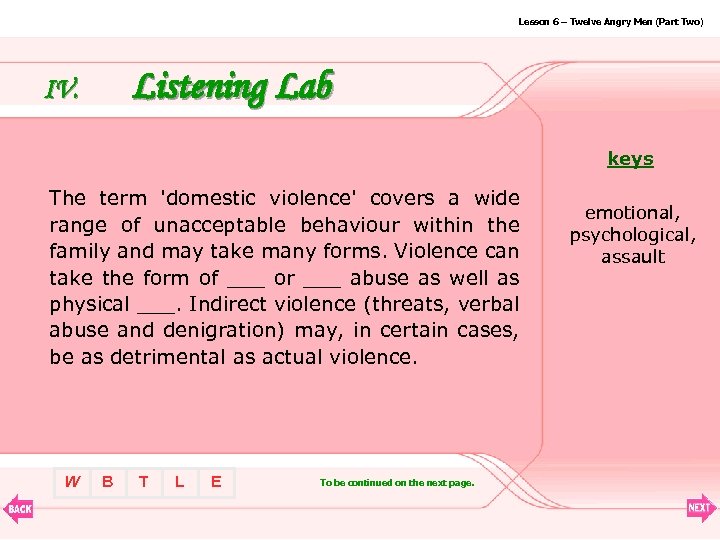
Lesson 6 – Twelve Angry Men (Part Two) Listening Lab IV. keys The term 'domestic violence' covers a wide range of unacceptable behaviour within the family and may take many forms. Violence can take the form of ___ or ___ abuse as well as physical ___. Indirect violence (threats, verbal abuse and denigration) may, in certain cases, be as detrimental as actual violence. W B T L E To be continued on the next page. emotional, psychological, assault
Lesson 6 – Twelve Angry Men (Part Two) Listening Lab IV. keys Those who commit violence on a partner or other member of the family may come from any stratum of society. They may be your next -door neighbours. We cannot ___ this sort of violence away by conveniently labelling it as belonging only to socially ___ sectors of society. Perpetrators of this kind of violence may be from such sectors, but often are not. W B T L E The end of Listening lab. sweep, deprived
Lesson 6 – Twelve Angry Men (Part Two) Part Five This is the end of Lesson Four. W B T L E
Скачать презентацию Lesson 6 Book 3 Twelve Angry Men Part
8a27da3f3e75cc796fe724018863efcb.ppt