


 Скачать презентацию Lesson 16 Dialogue 2 Grammar Directional Complements
c07e9fa3b2868bcc9f14762afd6b863f.ppt
- Количество слайдов: 31
 Lesson 16 Dialogue 2 Grammar
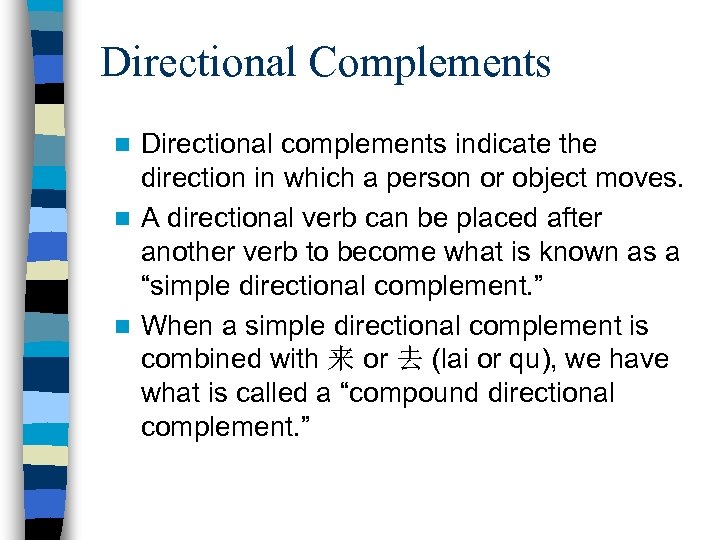 Directional Complements Directional complements indicate the direction in which a person or object moves. n A directional verb can be placed after another verb to become what is known as a “simple directional complement. ” n When a simple directional complement is combined with 来 or 去 (lai or qu), we have what is called a “compound directional complement. ” n
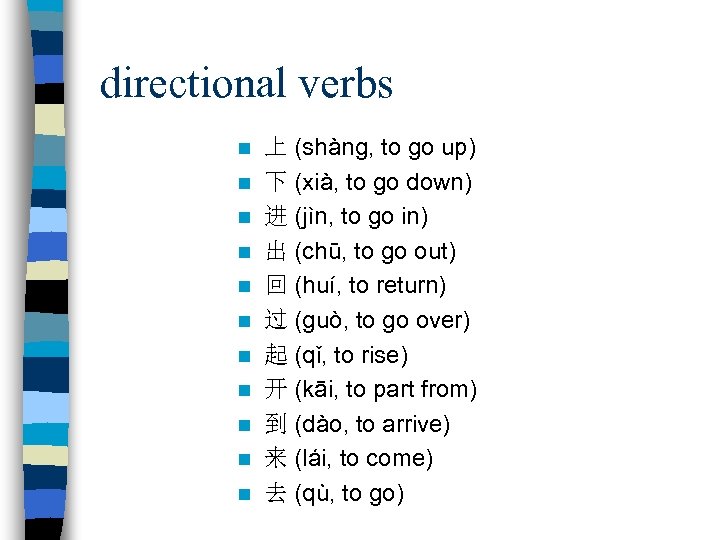 directional verbs n n n 上 (shàng, to go up) 下 (xià, to go down) 进 (jìn, to go in) 出 (chū, to go out) 回 (huí, to return) 过 (guò, to go over) 起 (qǐ, to rise) 开 (kāi, to part from) 到 (dào, to arrive) 来 (lái, to come) 去 (qù, to go)
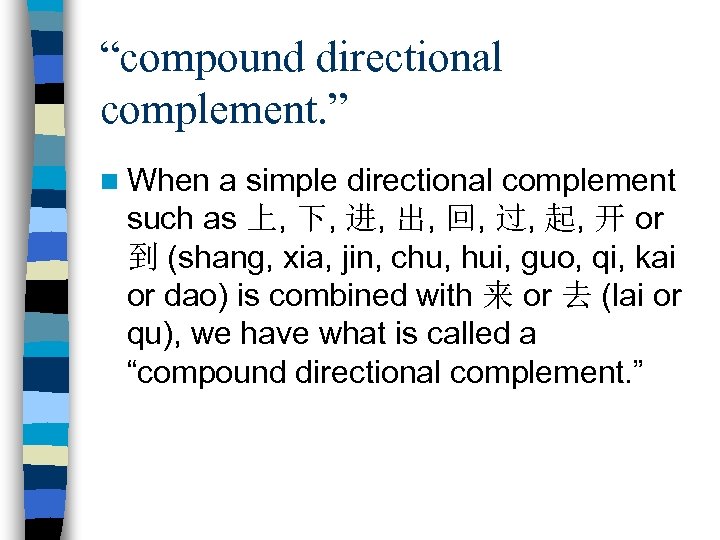 “compound directional complement. ” n When a simple directional complement such as 上, 下, 进, 出, 回, 过, 起, 开 or 到 (shang, xia, jin, chu, hui, guo, qi, kai or dao) is combined with 来 or 去 (lai or qu), we have what is called a “compound directional complement. ”
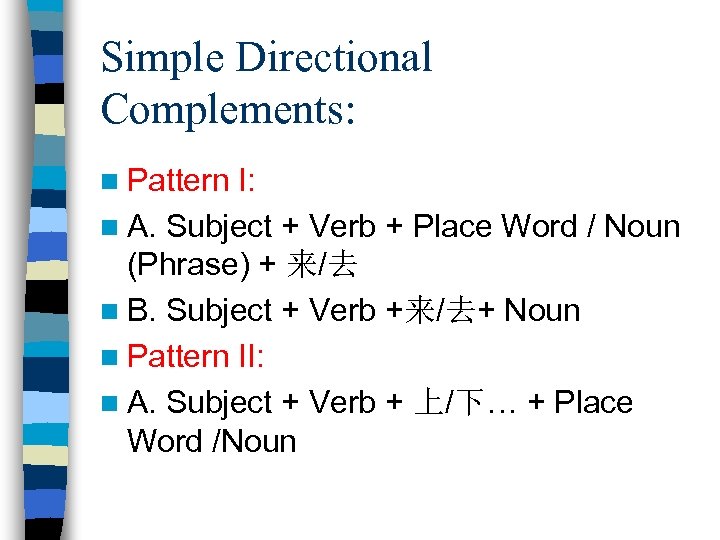 Simple Directional Complements: n Pattern I: n A. Subject + Verb + Place Word / Noun (Phrase) + 来/去 n B. Subject + Verb +来/去+ Noun n Pattern II: n A. Subject + Verb + 上/下… + Place Word /Noun
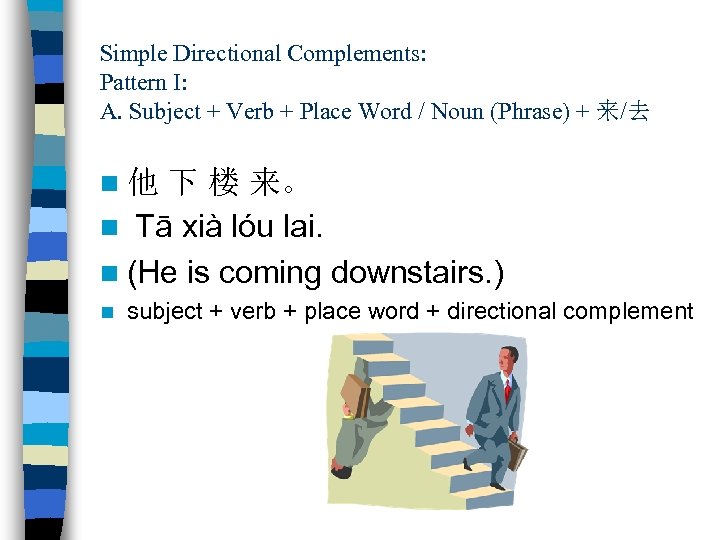 Simple Directional Complements: Pattern I: A. Subject + Verb + Place Word / Noun (Phrase) + 来/去 n他 下 楼 来。 n Tā xià lóu lai. n (He is coming downstairs. ) n subject + verb + place word + directional complement
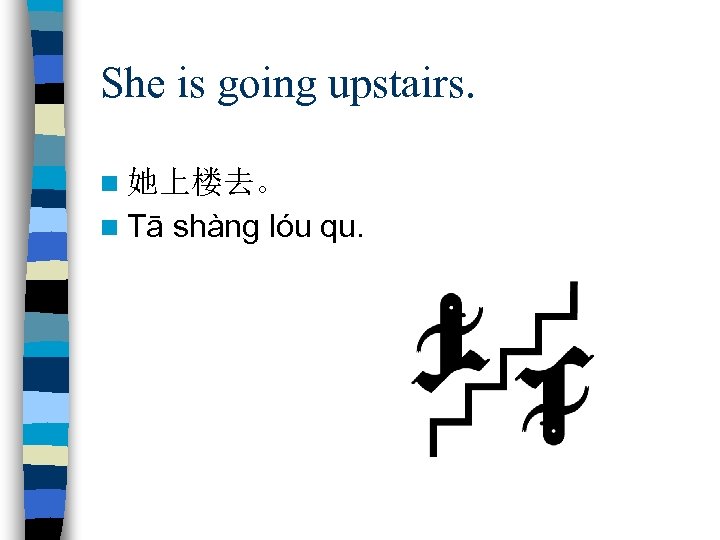 She is going upstairs. n 她上楼去。 n Tā shàng lóu qu.
 n When a verb is followed by a location word, that verb can only be a directional verb such as 上 (shàng), 下 (xià), 进 (jìn), 出 (chū), 回 (huí), 过 (guò), or 到 (dào), as shown in (1) and (2).
 n请 你 买 一些水果 来。 n Qǐng nǐ mǎi yì xiē shuǐguǒ lai. n (Please buy some fruit [and bring it] here. ) n subject + verb + noun phrase + directional complement
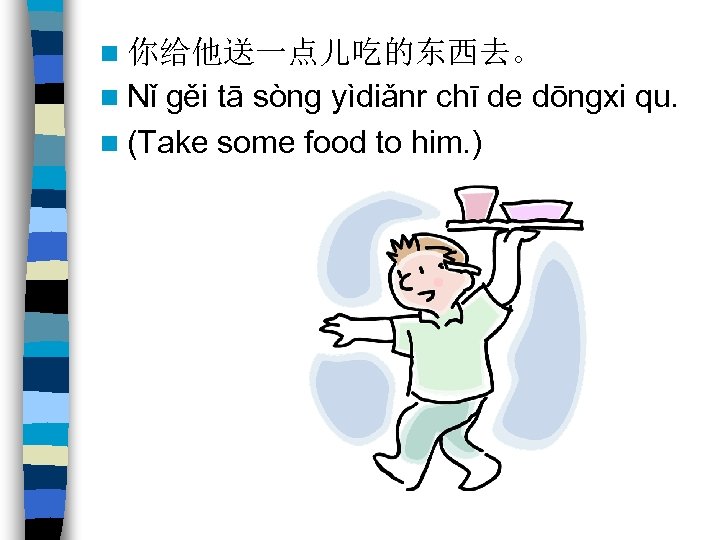 n 你给他送一点儿吃的东西去。 n Nǐ gěi tā sòng yìdiǎnr chī de dōngxi qu. n (Take some food to him. )
 n When the object of the verb is a location word, the sentence can only appear in Pattern A, as in (1) and (2). n When the object is a regular noun and the action is not completed, the sentence often appears in Pattern A as well, as in (3) and (4).
 Simple Directional Complements: Pattern I: B. Subject + Verb +来/去+ Noun n 他买来了一些水果。 n Tā mǎi lai le yì xiē shuǐguǒ. n (He bought some fruit and brought it here. )
 Simple Directional Complements: Pattern II: A. Subject + Verb + 上/下… + Place Word /Noun n 他走上楼。 n Tā zǒu shang lóu. n (He walked upstairs. ) n [The sentence doesn’t indicate whether the speaker is upstairs or downstairs. ]
 n 老师走进教室。 n Lǎoshī zǒu jin jiàoshì. n (The teacher walked into the classroom. ) n [The sentence doesn’t indicate whether the speaker is in the classroom or not. ]
 n 他拿出一张纸。 n Tā ná chu yì zhāng zhǐ. n (He took out a piece of paper. )
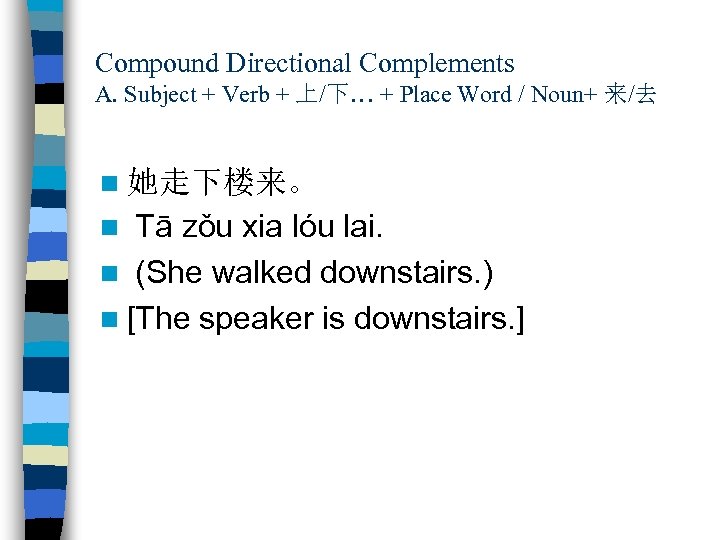 Compound Directional Complements A. Subject + Verb + 上/下… + Place Word / Noun+ 来/去 n 她走下楼来。 Tā zǒu xia lóu lai. n (She walked downstairs. ) n [The speaker is downstairs. ] n
 n 老师走进教室去/来。 n Lǎoshī zǒu jin jiàoshì qu/lai. n (The teacher walked into the classroom. ) n With 去, the speaker is not in the classroom; n with 来, the speaker is in the classroom.
 n 弟弟跳上床来/去。 n Dìdi tiào shang chuáng lai/qu. n (My little brother jumped onto the bed. ) With 来, the speaker is on the bed; n with 去, the speaker is not on the bed.
 n 我的同学走进书店来/去。 n Wǒ de tóngxué zǒu jin shūdiàn lai/qu. n (My classmate walked into the bookstore. ) n With 来, the speaker was in the bookstore; n with 去, the speaker was not in the bookstore.
 n 请你买回一些梨来。 n Qǐng nǐ mǎi hui yì xiē lí lai. n (Please buy some pears and bring them back here. )
 n 他拿出一张纸来。 n Tā ná chu yì zhāng zhǐ lai. n (He took out a piece of paper. )
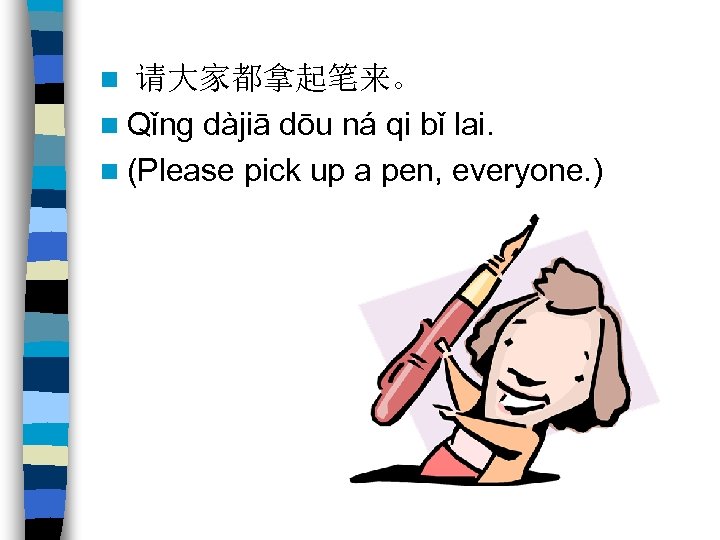 请大家都拿起笔来。 n Qǐng dàjiā dōu ná qi bǐ lai. n (Please pick up a pen, everyone. ) n
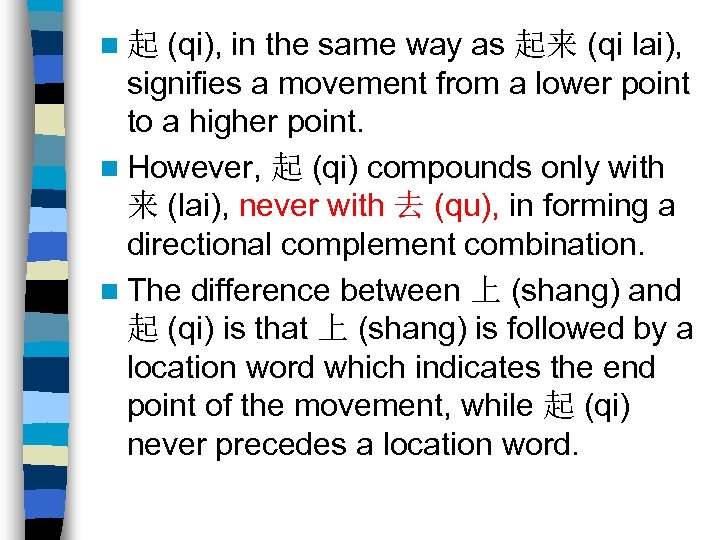 (qi), in the same way as 起来 (qi lai), signifies a movement from a lower point to a higher point. n However, 起 (qi) compounds only with 来 (lai), never with 去 (qu), in forming a directional complement combination. n The difference between 上 (shang) and 起 (qi) is that 上 (shang) is followed by a location word which indicates the end point of the movement, while 起 (qi) never precedes a location word. n起
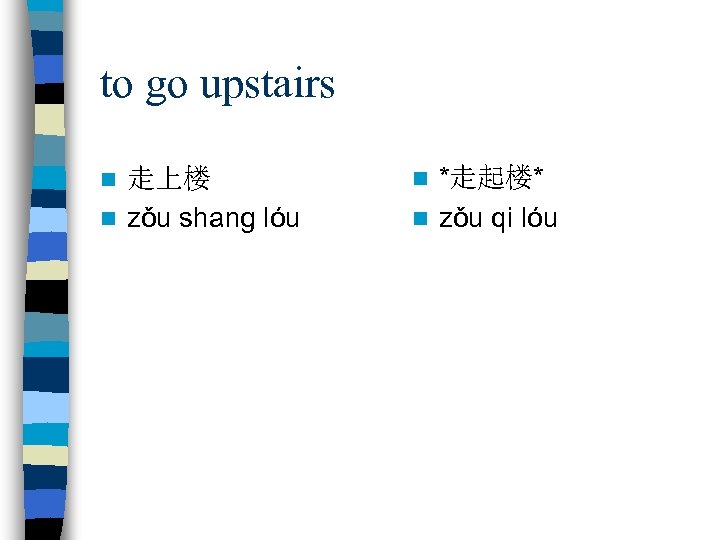 to go upstairs 走上楼 n zǒu shang lóu n *走起楼* n zǒu qi lóu n
 Compound Directional Complements B. Subject + Verb + 上/下… + 来/去 + Noun n 他买回来了一些水果。 n Tā mǎi hui lai le yì xiē shuǐguǒ. n (He bought some fruit and brought it back here. )
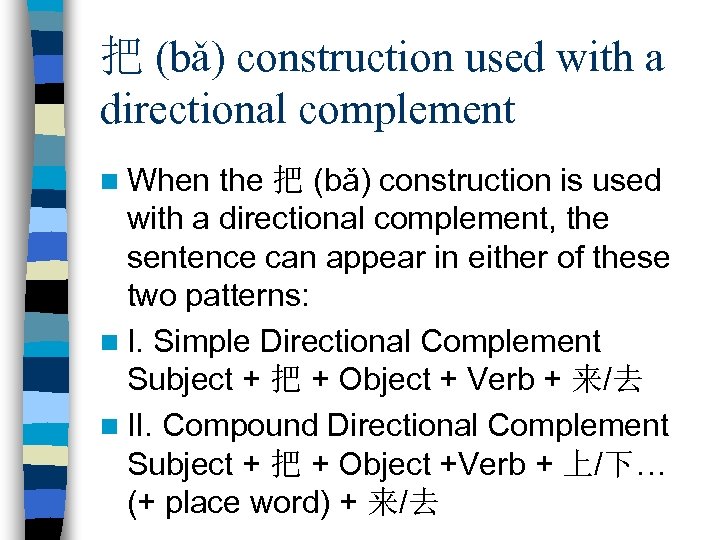 把 (bǎ) construction used with a directional complement n When the 把 (bǎ) construction is used with a directional complement, the sentence can appear in either of these two patterns: n I. Simple Directional Complement Subject + 把 + Object + Verb + 来/去 n II. Compound Directional Complement Subject + 把 + Object +Verb + 上/下… (+ place word) + 来/去
 I. Simple Directional Complement Subject + 把 + Object + Verb + 来/去 n 请把你的床搬来。 n Qǐng bǎ nǐ de chuáng bān lai. n Please move your bed here.
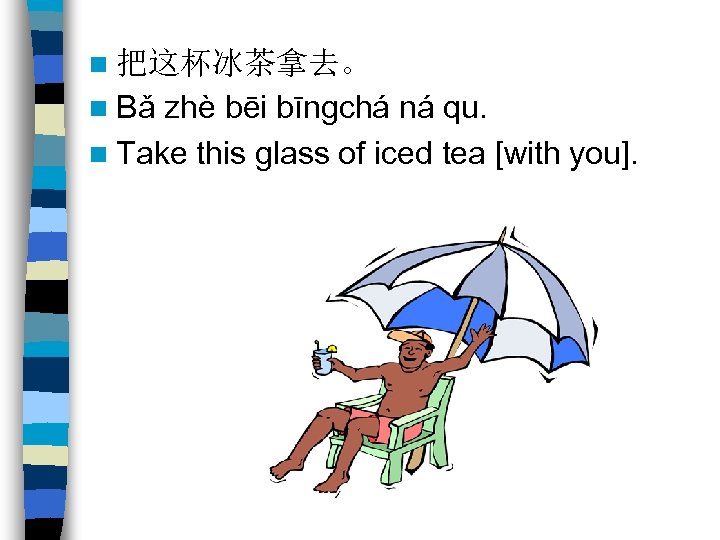 n 把这杯冰茶拿去。 n Bǎ zhè bēi bīngchá ná qu. n Take this glass of iced tea [with you].
 II. Compound Directional Complement Subject + 把 + Object +Verb + 上/下… (+ place word) + 来/去 n 我把书拿起来了。 n Wǒ bǎ shū ná qi lai le. n I picked up the book.
 n 快把车开回家去。 n Kuài bǎ chē kāi hui jiā qu. n Drive the car back home right away.
 谢谢 再见 UM Flint 钟研