


 Скачать презентацию LESSON 15 SEROLOGY IMMUNITY REACTIONS AGGLUTINATION PRECIPITATION
15 SEROLOGY.pptx
- Количество слайдов: 27
 LESSON № 15 SEROLOGY IMMUNITY REACTIONS AGGLUTINATION, PRECIPITATION AND IMMUNOFLUORESCENCE REACTIONS
 WHAT IS SEROLOGY? Serology is the scientific study of serum. In practice, the term usually refers to the diagnostic identification of antibodies in the serum. Such antibodies are typically formed in response to an infection (against a given microorganism), against other foreign proteins (in response, for example, to a mismatched blood transfusion), or to one's own proteins (in instances of autoimmune disease).
 WHAT IS BLOOD SERUM? Blood serum is a liquid part of the blood without formed elements and fibrinogen. Serum includes all proteins not used in blood clotting (coagulation) and all the electrolytes, antibodies, antigens, hormones, and any exogenous substances (drugs and microorganisms). To obtain serum, the blood is left at room temperature for 15 minutes, then, with a thin glass rod (or Pasteur pipette), gently, without destroying the cells, the clot is separated from the walls of the tube and centrifuged for 10 -15 minutes at 3000 rpm. Immediately after centrifugation, the serum is separated from the clot.
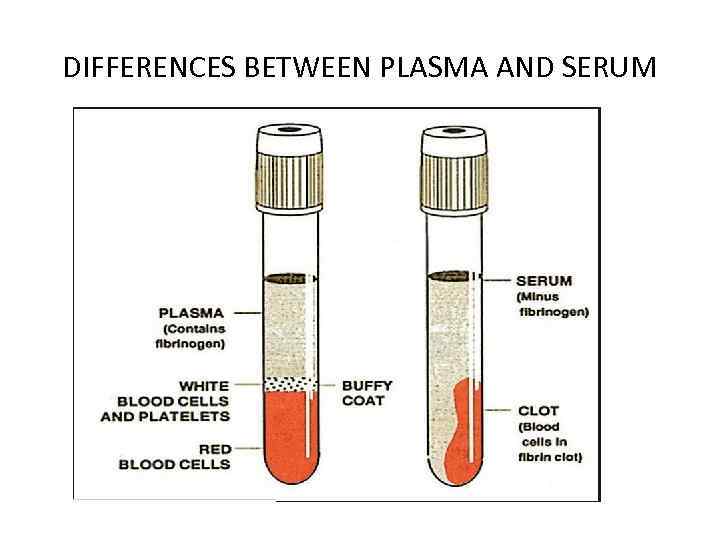 DIFFERENCES BETWEEN PLASMA AND SERUM
 SEROLOGIC STUDIES Ø Serologic studies are methods of studying certain antibodies or antigens in the blood serum of patients based on the reactions of immunity. With their help, antigens of microbes or tissues are also identified for the purpose of their identification. Ø The detection of antibodies to the infectious agent or the corresponding antigen in the serum of the patient allows to establish the cause of the disease. Ø Serological studies are also used to determine blood group antigens, tissue antigens and the level of humoral immunity.
 SEROLOGICAL IDENTIFICATION OF MICROORGANISMS When the microbe is isolated from the patient, identification of the pathogen is carried out by studying its antigenic properties with the help of immune diagnostic sera, i. e. blood sera of hyperimmunized animals containing specific antibodies. This is the socalled serological identification of microorganisms.
 IMMUNITY REACTIONS ü Immunity reaction is an interaction between antibody and antigen. ü Antibody synthesis is caused by presence of antigen. ü Many tests based on the interactions of antibodies and antigens have been developed to determine the presence of antibodies or antigens in a patient. ü These tests require both specificity and sensitivity of the antibodies. Sensitivity is the ability to recognize and bind to the antigen, specificity is the characteristic of binding only to one antigen and no others.
 IMMUNITY REACTIONS Antibody-antigen interaction occurs in two phases: 1. Specific: binding between antigen’s dominant group and antibody’s binding site. Result: formation of complexes insoluble in isotonic solutions. 2. Non-specific: precipitation of formed complexes.
 IMMUNITY REACTIONS
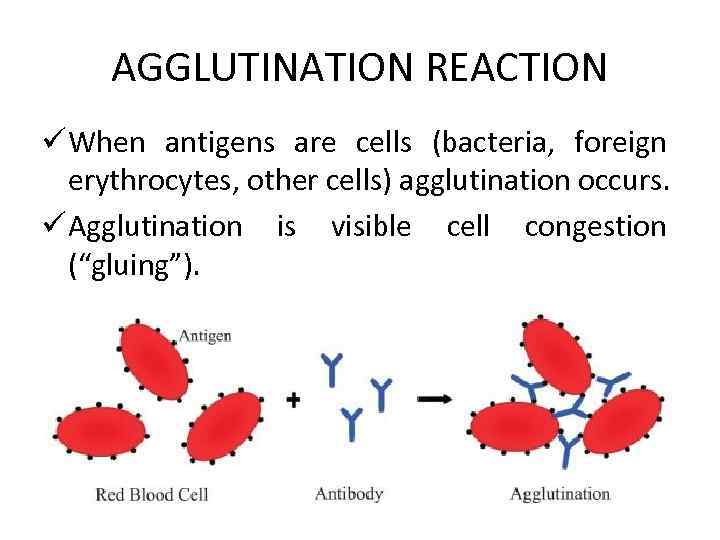 AGGLUTINATION REACTION ü When antigens are cells (bacteria, foreign erythrocytes, other cells) agglutination occurs. ü Agglutination is visible cell congestion (“gluing”).
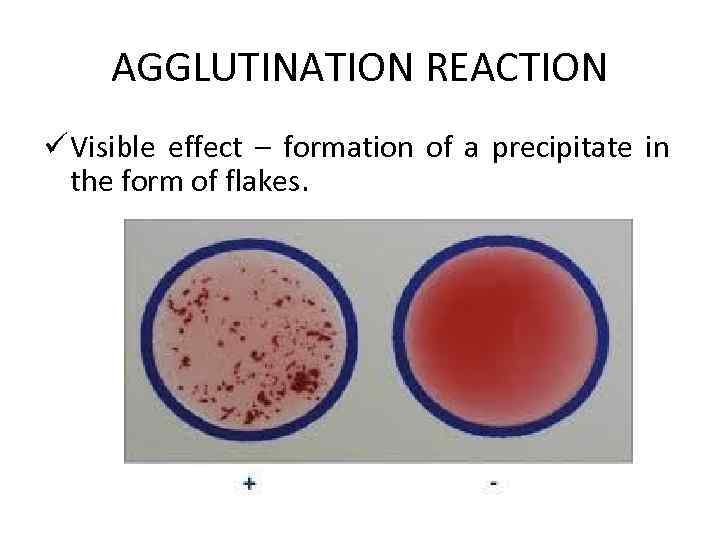 AGGLUTINATION REACTION ü Visible effect – formation of a precipitate in the form of flakes.
 AGGLUTINATION REACTION ü Agglutinins are antibodies that have ability to form macroconglomerates with antigen cells. ü Agglutinating serum contains agglutinins. ü Agglutinating serum is obtained by immunizing rabbits (intravenously, subcutaneously or intraperitoneally) with a suspension of killed bacteria, starting at a dose of 200 millions, then 500 millions, 1 billion, 2 billions, microbial bodies in 1 ml, at intervals of 5 days. 7 -8 days after the last immunization, blood is taken and the antibody titer is determined. The titer of the agglutinating serum is the maximum serum dilution at which agglutination occurs with the corresponding microorganism.
 AGGLUTINATION REACTION ü An approximate reaction of agglutination on the glass. To a drop of agglutinating serum (1: 20 dilution), a suspension of bacteria isolated from the diseased animal is added. A flocculent deposit forms. ü A full agglutination reaction with the pathogen isolated from the diseased animal. A suspension of bacteria isolated from the patient is added to the dilutions of the agglutinating serum. 1) Agglutination with O-diagnosticum (bacteria killed by heating, retained O-antigen) occurs in the form of fine-grained agglutination. 2) Agglutination with H-diagnosticum (bacteria, killed with formalin, retained flagellate H-antigen) - largeclawed and proceeds faster.
 TASK 1 AGGLUTINATION REACTION ON GLASS 1. Degrease the glass. 2. Make 1 drop of isotonic solution and 2 drops of serum to the degreased glass. 3. Add a microbial culture to the drop of the isotonic solution with a bacterial loop and mix. 4. In one of the drops of serum with a bacterial loop, add the microbial culture and mix.
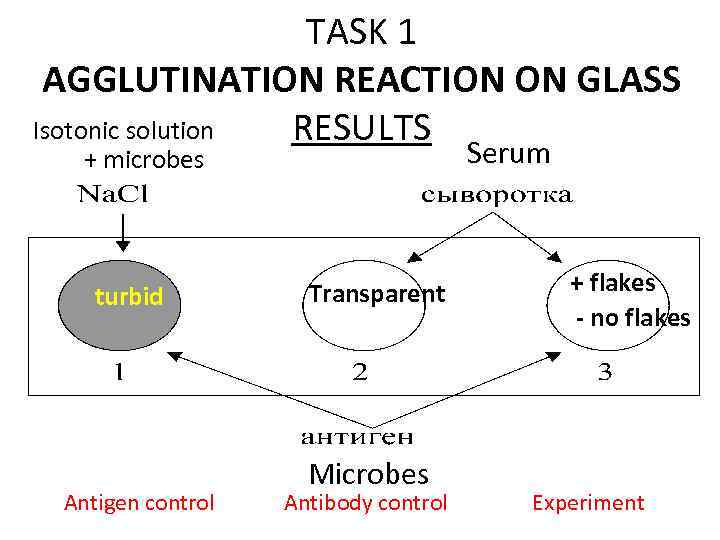 TASK 1 AGGLUTINATION REACTION ON GLASS Isotonic solution RESULTS Serum + microbes turbid Antigen control Transparent Microbes Antibody control + flakes - no flakes Experiment
 AGGLUTINATION REACTION ü Is specific ü Is widely used for antigen detection in patient’s sera (serodiagnosis) which are formed during the course of the disease, to a pathogen circulating in the body with the help of known microbes (diagnosticum) ü May be used for antigen structure determination ü The isogemoagglutination reaction is used to determine the blood group of a person
 PRECIPITATION REACTION üAn antibody reacts with an antigen to form precipitate. üAntigens are highly dispersed (proteins, polysaccharides). üVisible effect – opacity due to coarsening of particles in electrolyte solution (0. 9 % Na. Cl). üHighly specific and sensitive. üIs used for detection of pathogen antigens (even in very small amount): anthrax, plague, tularemia.
 PRECIPITATION REACTION üPrecipitins are antibodies which form precipitate with highly dispersed antigens. üPrecipitation serum contains precipitins. üImmune precipitating sera are obtained by immunizing the animals with an appropriate antigen. For example, serum precipitating a human protein is obtained by immunizing a rabbit with a human protein. The titer of the precipitating serum is the largest dilution of the antigen with which it produces a reaction. Serum is usually used undiluted or in a 1: 5 dilution.
 TASK 2 RING PRECIPITATION TEST An antibody reacts with an antigen to form precipitate. Precipitation serum with antibodies is introduced into a small diameter test tube, and the antigen is then carefully added to form a distinct upper layer. A ring of precipitate forms at the point of contact in the presence of antigen-antibody reaction. The rates at which the visible ring forms depends on the concentration of the antigen.
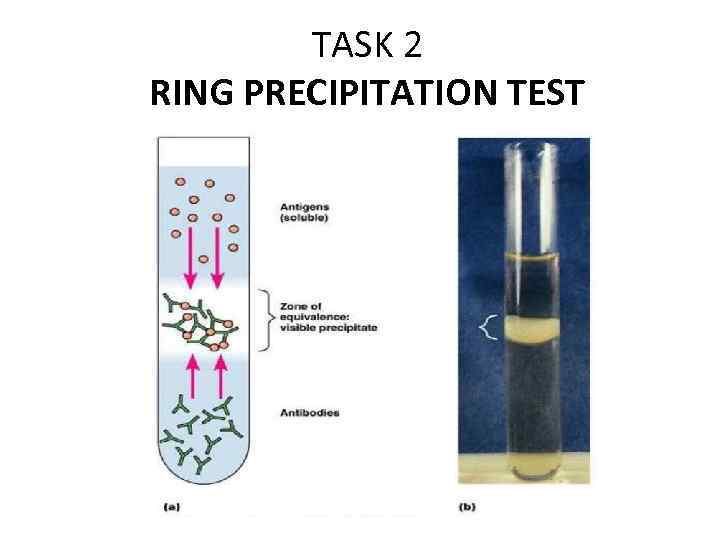 TASK 2 RING PRECIPITATION TEST
 IMMUNOFLUORESCENCE Immunofluorescence analysis, or the reaction of immunofluorescence, is based on the interaction of antigens with antibodies, but the reagent is then labeled with a dye that glows in the ultraviolet. Luminous antigen-antibody complexes are clearly visible under fluorescence microscopy. It is a rapid and accurate diagnostic method for the detection of antigens of microbes or the detection of antibodies.
 IMMUNOFLUORESCENCE Obtaining if immune sera: 1. Animal immunization with proper antigen. 2. Release of immunoglobulins. 3. Binding of immunoglobulins with luminous dyes (fluorochromes).
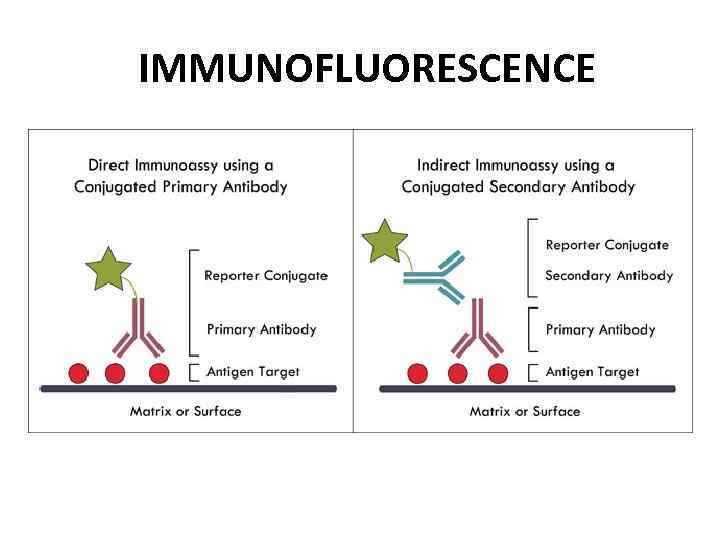
 IMMUNOFLUORESCENCE The analysis is carried out in three ways. Direct immunofluorescence reaction The assay is designed to determine antigens. To the test material, luminescent sera containing labeled antibodies are added. The resulting immune complexes are detected using a fluorescence microscope. Indirect immunofluorescence reaction The assay is performed to identify antibodies to a specific antigen. The reagent is an unlabeled antigen that binds to the antibodies contained in the test material. Then a reagent with labeled anti-antibodies, i. e. , anti-immunoglobulins, is added.
 IMMUNOFLUORESCENCE
 IMMUNOFLUORESCENCE Competitive reaction of immunofluorescence The assay is assigned to identify antigens. The reagent is antibodies to which the test material is added with antigens and an additional reagent (standard labeled antigens). Labeled antigens react with antibodies in the first place, competing, thus, with unlabeled antigens. The formed immune complexes glow with microscopy, and by their quantity it is possible to determine the antigen content in the material under study.
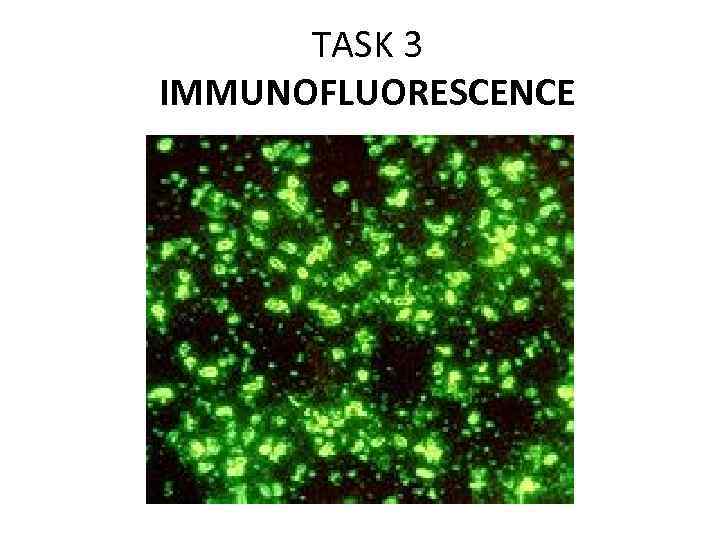 TASK 3 IMMUNOFLUORESCENCE
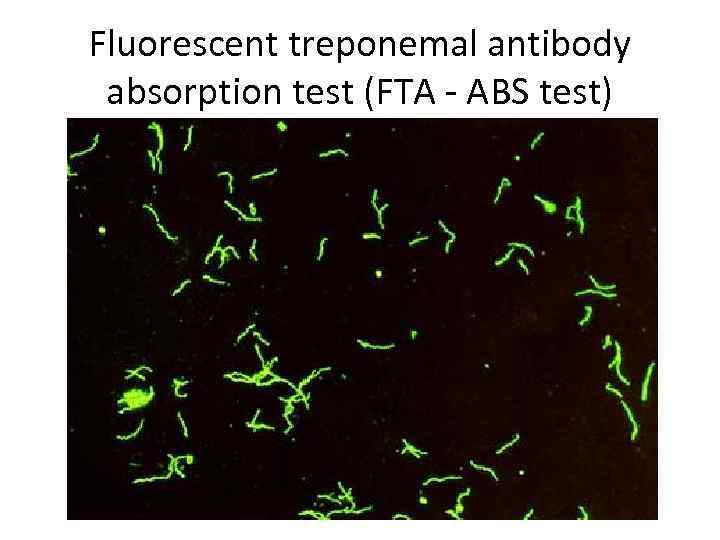 Fluorescent treponemal antibody absorption test (FTA - ABS test)