 Скачать презентацию Lesson 1 Why Save Basics of Financial Investing
efe1ea385c5bdb9f54e54422168523eb.ppt
- Количество слайдов: 34



Lesson 1: Why Save? Basics of Financial Investing
Why Save? o Today we will discuss: n What it is to save. n Why people save. n How interest is calculated on money saved
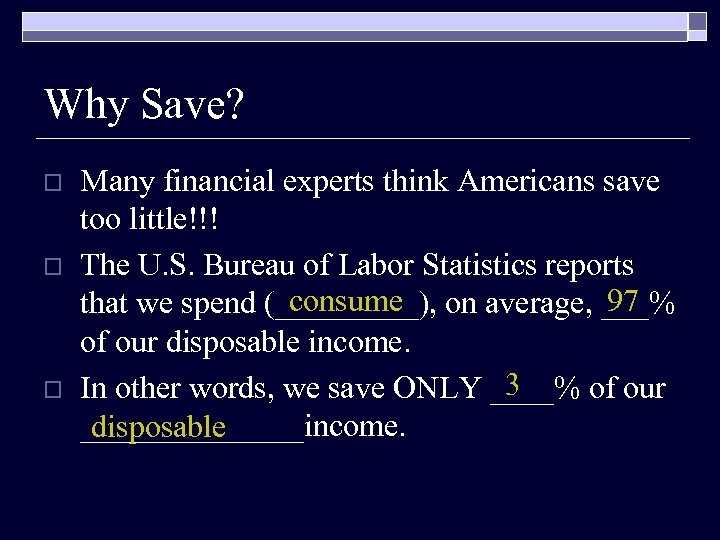
Why Save? o o o Many financial experts think Americans save too little!!! The U. S. Bureau of Labor Statistics reports consume 97 that we spend (_____), on average, ___% of our disposable income. 3 In other words, we save ONLY ____% of our _______income. disposable
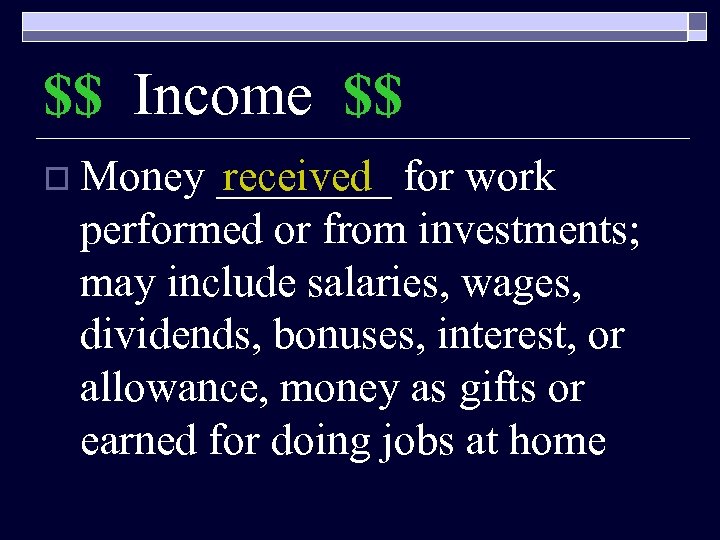
$$ Income $$ o Money ____ for work received performed or from investments; may include salaries, wages, dividends, bonuses, interest, or allowance, money as gifts or earned for doing jobs at home
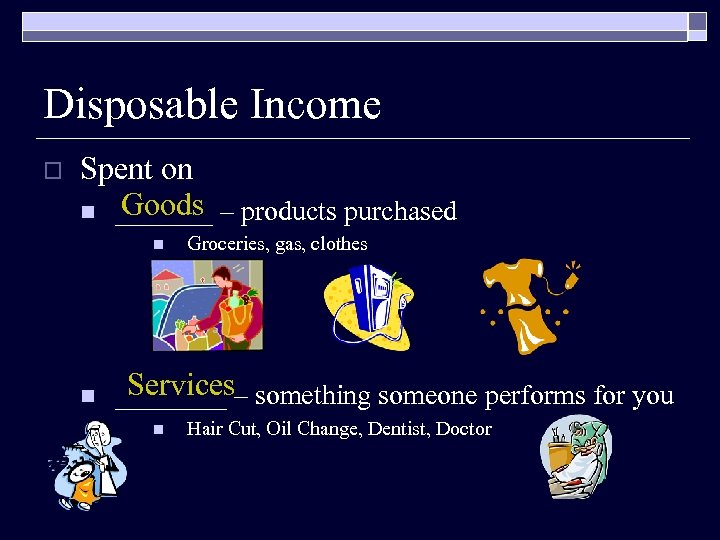
Disposable Income o Spent on Goods n _______ – products purchased n n Groceries, gas, clothes Services ____ – something someone performs for you n Hair Cut, Oil Change, Dentist, Doctor
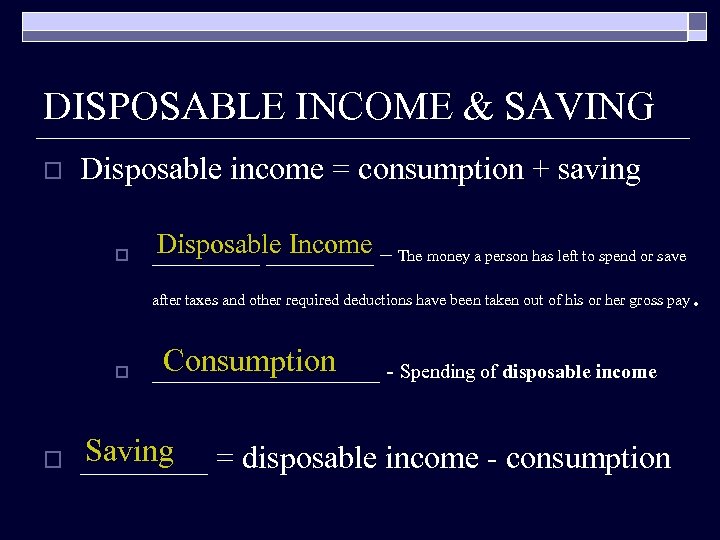
DISPOSABLE INCOME & SAVING o Disposable income = consumption + saving o Disposable Income _________ – The money a person has left to spend or save after taxes and other required deductions have been taken out of his or her gross pay o o Consumption __________ - Spending of disposable income Saving ____ = disposable income - consumption .
Activity 1 A Conversation Among Friends o Divide into groups n n o Choose a reporter to take notes Choose a leader to keep the group on task Read Activity 1 and discuss the two questions AY OURSELF IRST P__ Y___ F__!
PYF o P_____ Y______ F_______ ay ourself irst n n A person saves before spending money on goods & services Take 10% of your income & “save” it
Reasons People Save o o o o Satisfaction of purchasing a special gift For a large purchase Emergencies that might arise Money might be matched College Education ? ?
Saving o o All savings decisions relate to some future use of money goals Thinking about saving = thinking about ______
Simple vs. Compound o o We’re going to look at how the type of investments you choose can affect how your savings will grow. Starting at a very elementary level we’ll compare Simple interest to Compound interest.
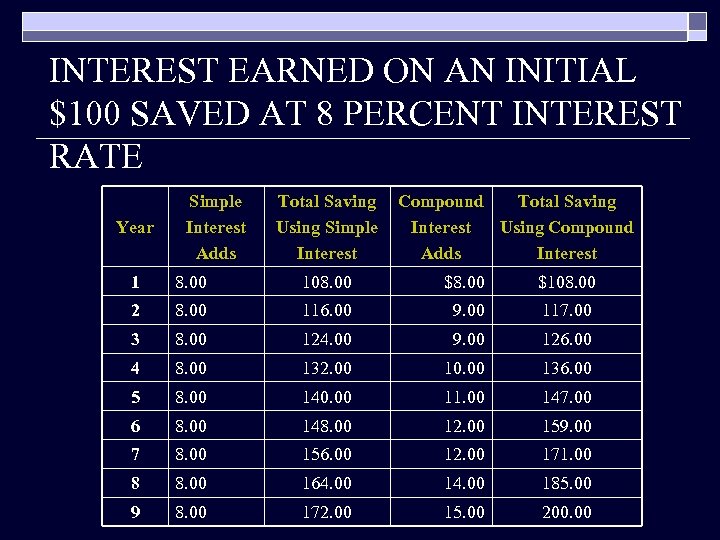
INTEREST EARNED ON AN INITIAL $100 SAVED AT 8 PERCENT INTEREST RATE Year Simple Interest Adds Total Saving Using Simple Interest Compound Total Saving Interest Using Compound Adds Interest 1 8. 00 108. 00 $108. 00 2 8. 00 116. 00 9. 00 117. 00 3 8. 00 124. 00 9. 00 126. 00 4 8. 00 132. 00 10. 00 136. 00 5 8. 00 140. 00 11. 00 147. 00 6 8. 00 148. 00 12. 00 159. 00 7 8. 00 156. 00 12. 00 171. 00 8 8. 00 164. 00 185. 00 9 8. 00 172. 00 15. 00 200. 00
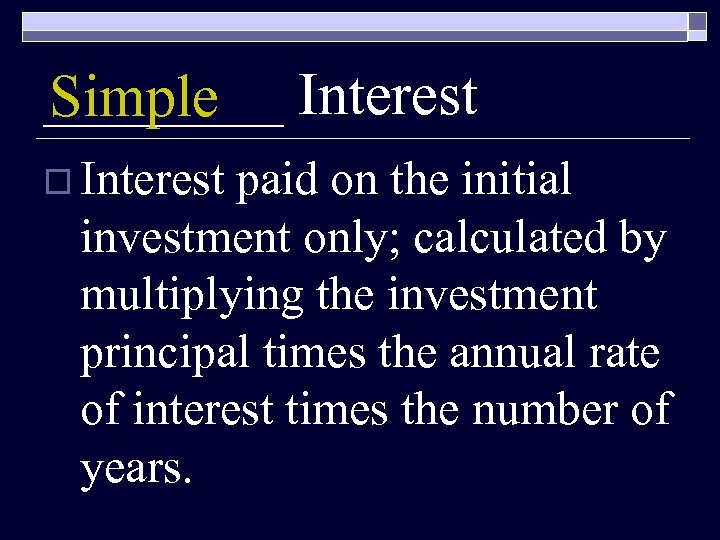
____ Interest Simple o Interest paid on the initial investment only; calculated by multiplying the investment principal times the annual rate of interest times the number of years.
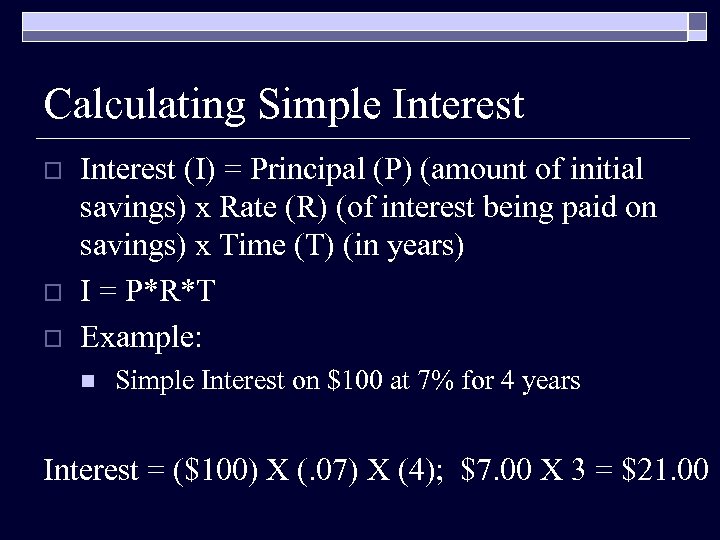
Calculating Simple Interest o o o Interest (I) = Principal (P) (amount of initial savings) x Rate (R) (of interest being paid on savings) x Time (T) (in years) I = P*R*T Example: n Simple Interest on $100 at 7% for 4 years Interest = ($100) X (. 07) X (4); $7. 00 X 3 = $21. 00
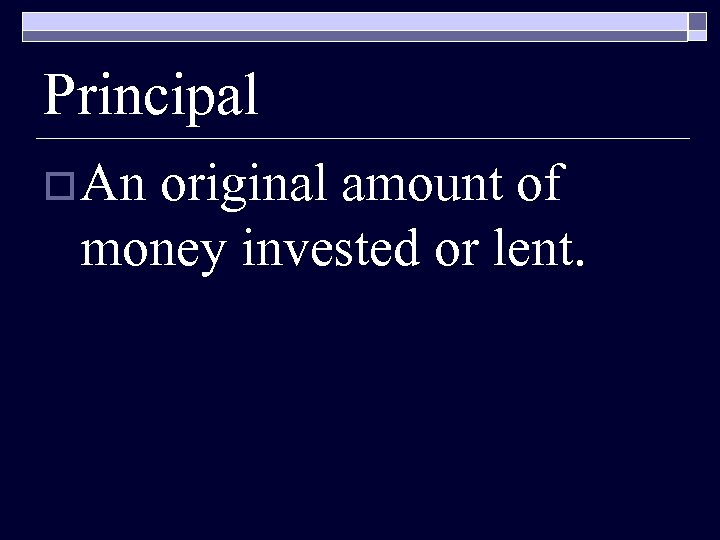
Principal o An original amount of money invested or lent.
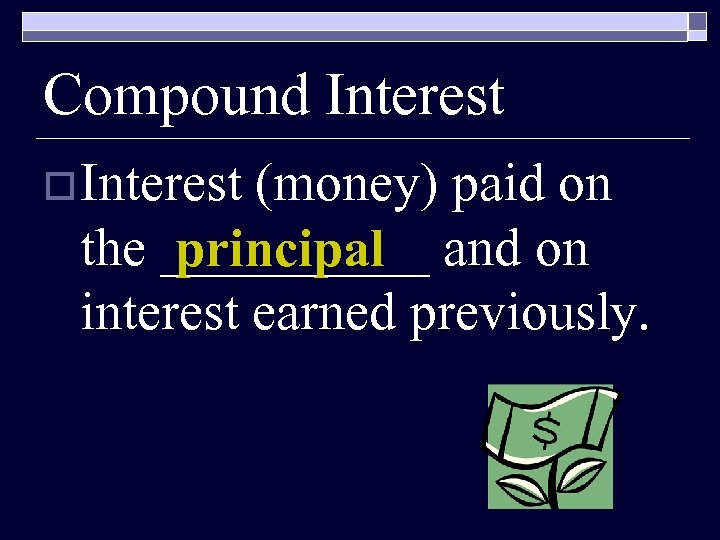
Compound Interest o Interest (money) paid on the _____ and on principal interest earned previously.
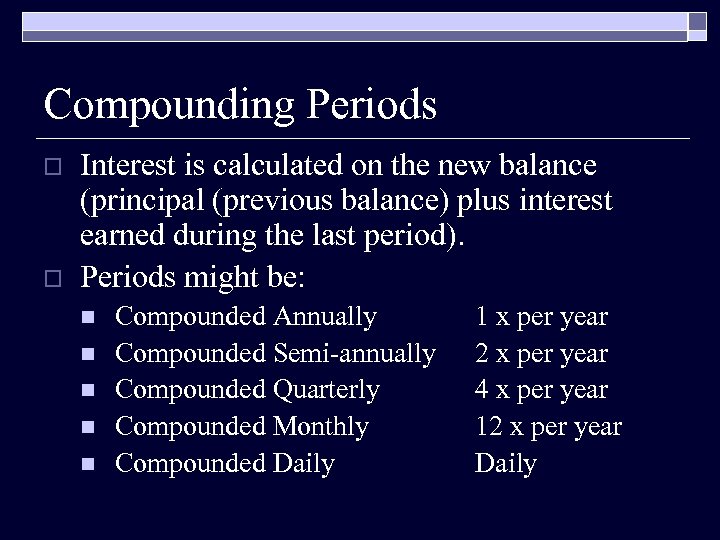
Compounding Periods o o Interest is calculated on the new balance (principal (previous balance) plus interest earned during the last period). Periods might be: n n n Compounded Annually Compounded Semi-annually Compounded Quarterly Compounded Monthly Compounded Daily 1 x per year 2 x per year 4 x per year 12 x per year Daily
Rule of 72 o. A mathematical rule used to approximate the number of years it will take for an investment to double in value when interest is compounded.
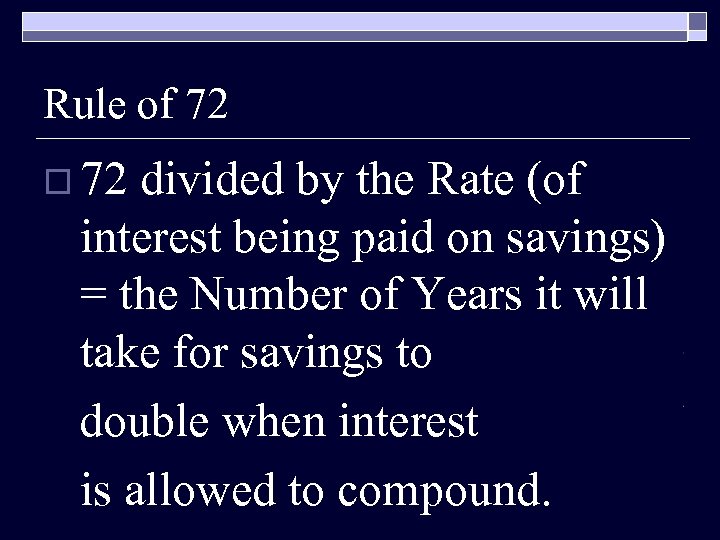
Rule of 72 o 72 divided by the Rate (of interest being paid on savings) = the Number of Years it will take for savings to double when interest is allowed to compound.
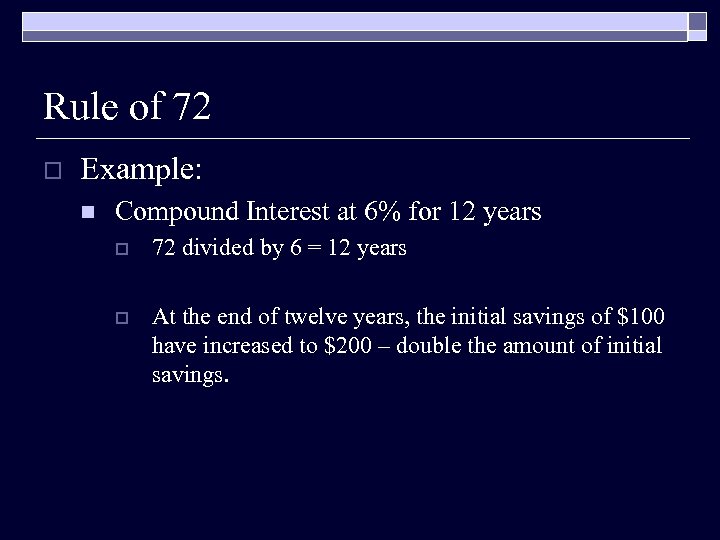
Rule of 72 o Example: n Compound Interest at 6% for 12 years o 72 divided by 6 = 12 years o At the end of twelve years, the initial savings of $100 have increased to $200 – double the amount of initial savings.
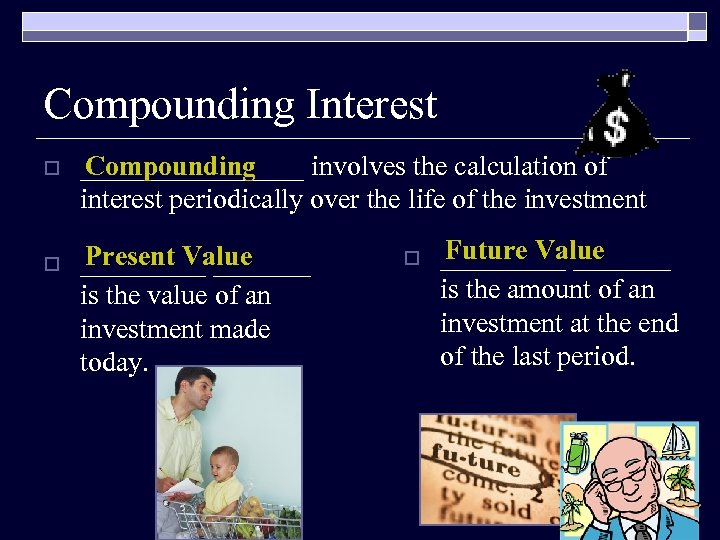
Compounding Interest o o ________ involves the calculation of Compounding interest periodically over the life of the investment Present Value _______ is the value of an investment made today. o Future Value _______ is the amount of an investment at the end of the last period.
What does “Time Value” of money refer to? o o o _______ refers to how the value Time Value of money changes over time. A dollar today is more valuable than a dollar ten years from now. You could invest the dollar you have today to make it grow to be worth more than a dollar in 10 years.
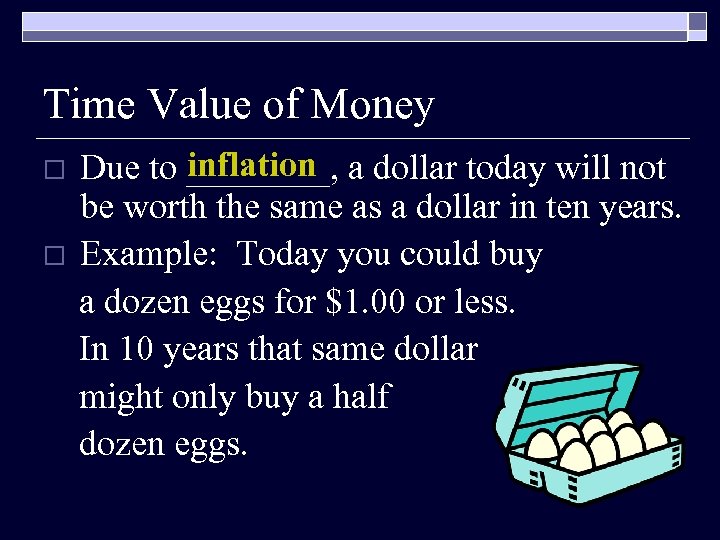
Time Value of Money o o inflation Due to ____, a dollar today will not be worth the same as a dollar in ten years. Example: Today you could buy a dozen eggs for $1. 00 or less. In 10 years that same dollar might only buy a half dozen eggs.
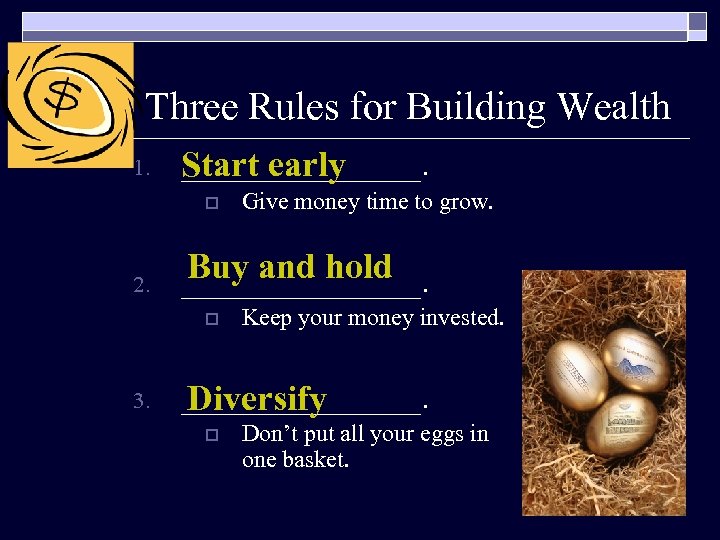
Three Rules for Building Wealth 1. ________. Start early o 2. Buy and hold ________. o 3. Give money time to grow. Keep your money invested. ________. Diversify o Don’t put all your eggs in one basket.
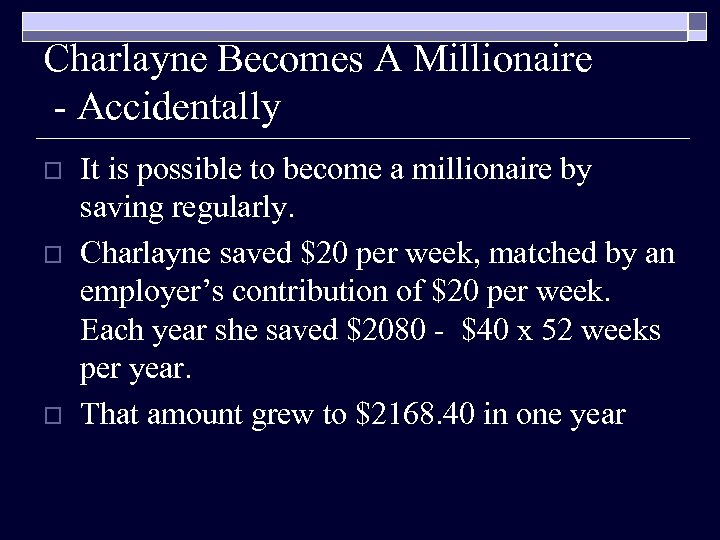
Charlayne Becomes A Millionaire - Accidentally o o o It is possible to become a millionaire by saving regularly. Charlayne saved $20 per week, matched by an employer’s contribution of $20 per week. Each year she saved $2080 - $40 x 52 weeks per year. That amount grew to $2168. 40 in one year
Charlayne’s Million o Each year Charlayne continued to contribute $20 per week and her employer matched the $20. She added $2080 to her savings and her investment grew like such: Refer to Charlayne’s Million Excel Spreadsheet file “Charlayne’s Million. xls”
The Magic of Compounding o o o When you save, you earn interest. When you take the interest out and spend it, it stops growing. But if you leave the interest in your account so it can grow, you start to earn interest on the interest you earned previously. Interest on interest is money you didn’t work for. It is money your money makes for you! Over time, interest on interest can increase your total savings greatly!!!!!
Marcus’s Mistake o o Marcus had the same job and pay as Charlayne, but didn’t start investing until 10 years after Charlayne. Because of Marcus’s later start, he would only be able to save a little over $400, 000.
Buy and Hold o In order to leave money in savings or investments, you have to do these things: n n n less Spend _______ than you receive. Become connected to _________. financial institutions Manage your ____ responsibly. credit
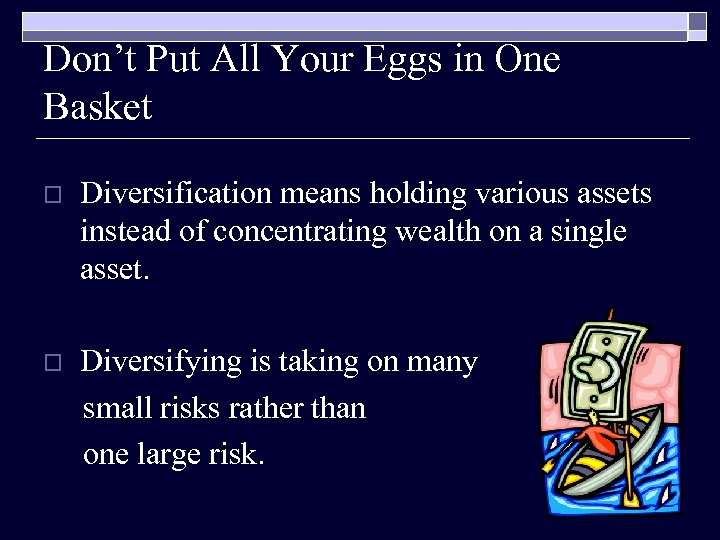
Don’t Put All Your Eggs in One Basket o Diversification means holding various assets instead of concentrating wealth on a single asset. o Diversifying is taking on many small risks rather than one large risk.
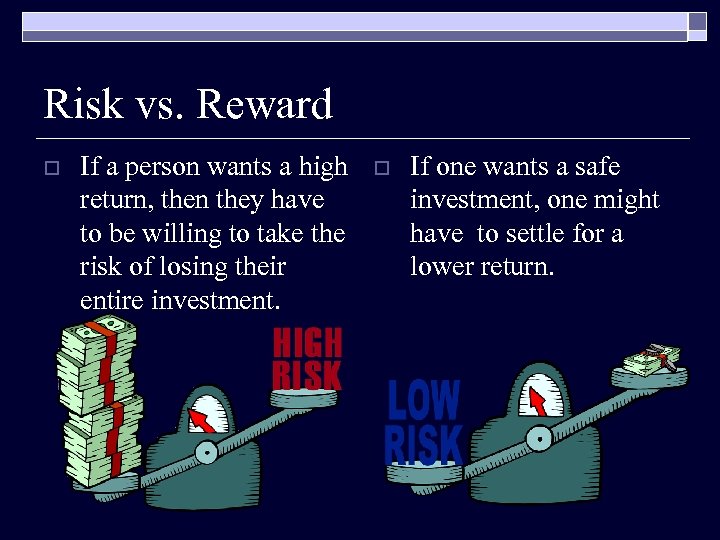
Risk vs. Reward o If a person wants a high return, then they have to be willing to take the risk of losing their entire investment. o If one wants a safe investment, one might have to settle for a lower return.
Forms of Saving and Investing Some Benefits & Costs o o Savings accounts: provide a small but steady return Certificate of deposit: very safe, but instant access carries a penalty Bonds: lending money to a corporation or government, with a promise of higher returns than those offered by bank savings accounts and CDS Real estate: the risks and benefits of being landlord.
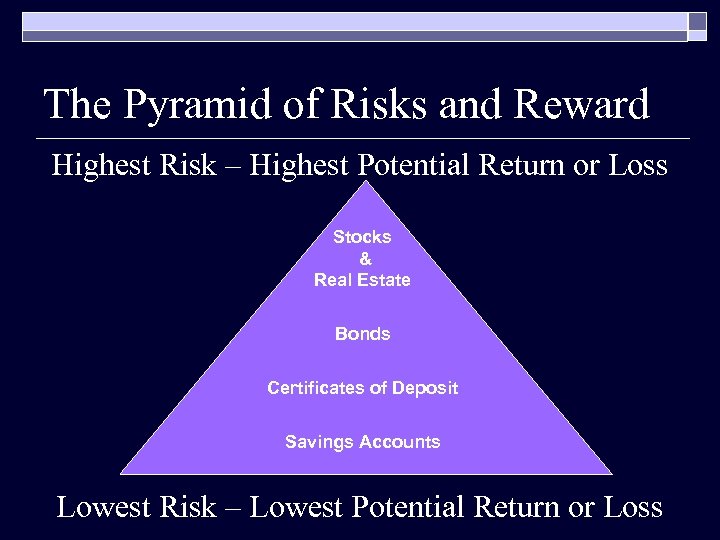
The Pyramid of Risks and Reward Highest Risk – Highest Potential Return or Loss Stocks & Real Estate Bonds Certificates of Deposit Savings Accounts Lowest Risk – Lowest Potential Return or Loss
Resources o Power. Point created using information from n n n o Lesson 1 Why Save? and Lesson 12 Building Wealth over the Long Term from “Learning, Earning and Investing – High School, ” 5 th Edition, © 2006, National Council on Economic Education Lesson 14 The Mathematics of Savings from “Mathematics & Economics: Connections for Life” – Grades 9 -12, © 2001, National Council on Economic Education Chapter 12 Compound Interest and Present Value from “Practical Business Math Procedures”, Eighth Edition, Slater, © 2001, Mc. Graw. Hill Slides designed by Lisa Fox, Hitchcock County High School Business Teacher, Trenton, NE
Скачать презентацию Lesson 1 Why Save Basics of Financial Investing
efe1ea385c5bdb9f54e54422168523eb.ppt