


 Скачать презентацию Leonard C S Professor NRU-HSE Chair Department of
Russian Regions.pptx
- Количество слайдов: 51
 Leonard C. S. Professor NRU-HSE, Chair Department of Regional Studies, Faculty of State and Municipal Administration 29 June 2013 carol. scott. leonard@gmail. com Regional Governance and Growth in Russia
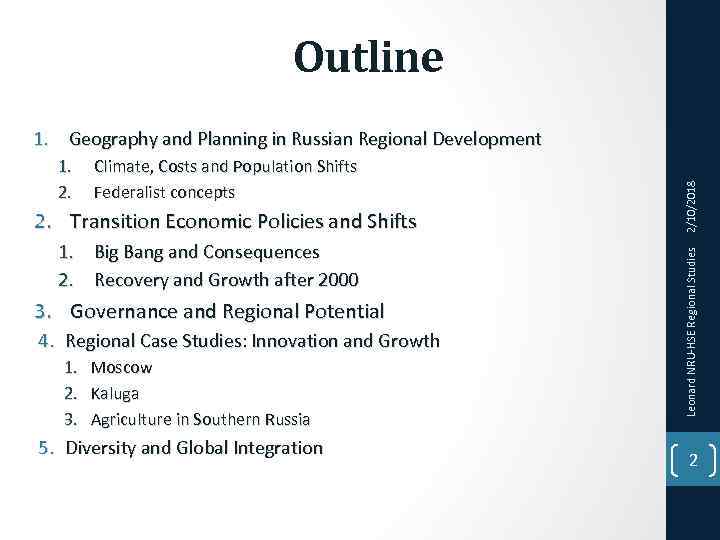 Outline Climate, Costs and Population Shifts Federalist concepts 2. Transition Economic Policies and Shifts 1. Big Bang and Consequences 2. Recovery and Growth after 2000 3. Governance and Regional Potential 4. Regional Case Studies: Innovation and Growth 1. 2. 3. Moscow Kaluga Agriculture in Southern Russia 5. Diversity and Global Integration Leonard NRU-HSE Regional Studies 1. 2. 2/10/2018 1. Geography and Planning in Russian Regional Development 2
 2/10/2018 REGIONAL GOVERNANCE Leonard NRU-HSE Regional Studies Geography and Planning 3
 Some governance dynamics from geography Leonard NRU-HSE Regional Studies • Regional shifts under the market economy • Resource locations and investment • Regions, innovation and planning 2/10/2018 • Cities in transition 4
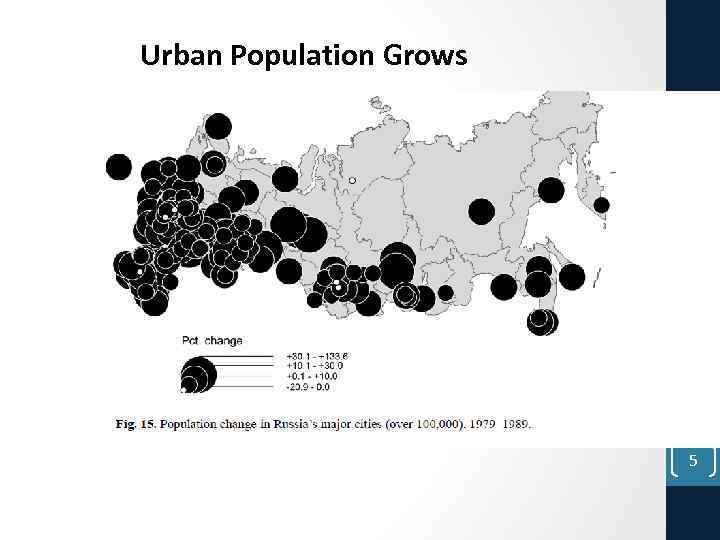 Leonard NRU-HSE Regional Studies 2/10/2018 Urban Population Grows 5
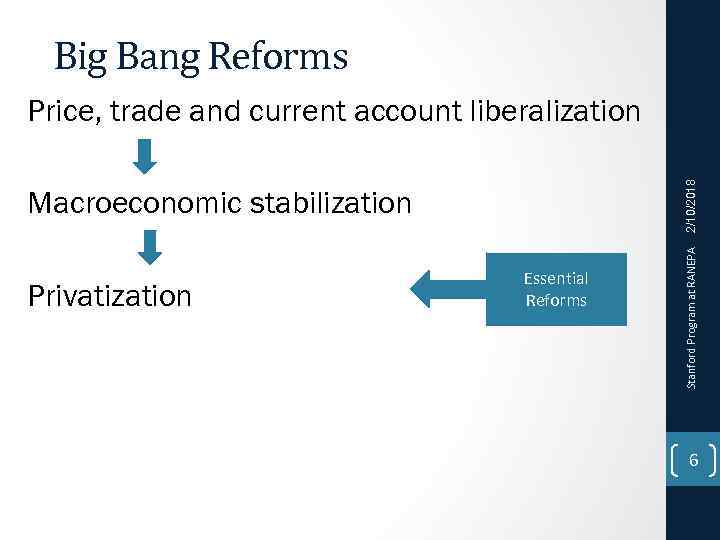 Big Bang Reforms Macroeconomic stabilization Privatization Essential Reforms Stanford Program at RANEPA 2/10/2018 Price, trade and current account liberalization 6
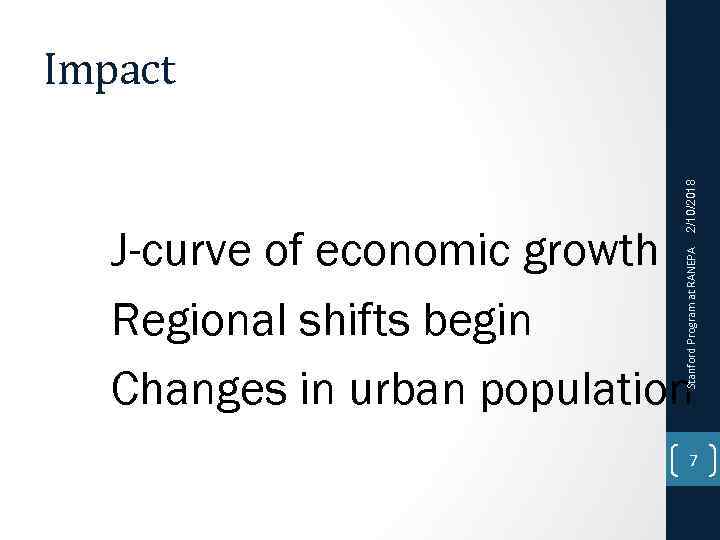 2/10/2018 Impact Stanford Program at RANEPA J-curve of economic growth Regional shifts begin Changes in urban population 7
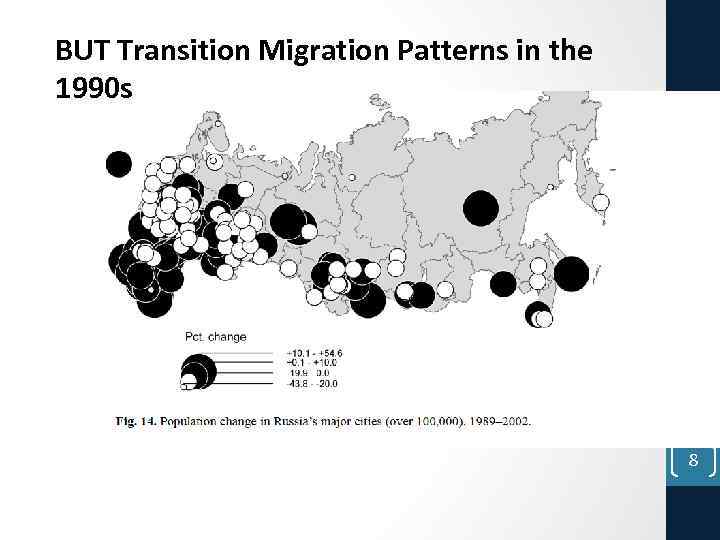 Leonard NRU-HSE Regional Studies 2/10/2018 BUT Transition Migration Patterns in the 1990 s 8
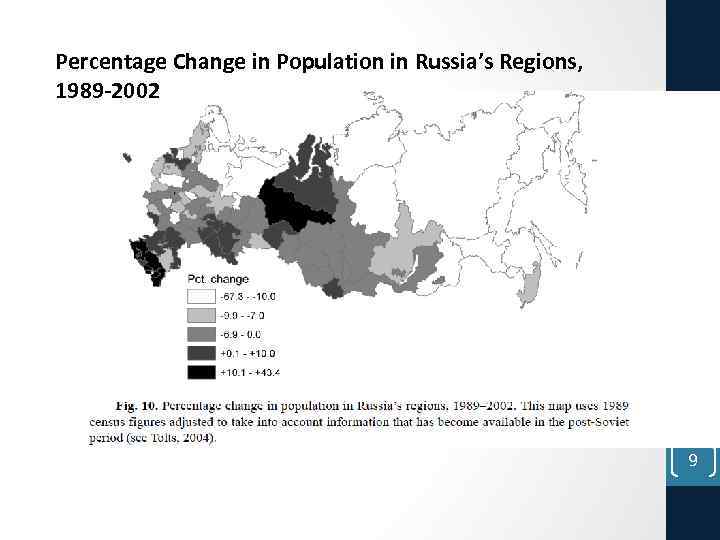 Leonard NRU-HSE Regional Studies 2/10/2018 Percentage Change in Population in Russia’s Regions, 1989 -2002 9
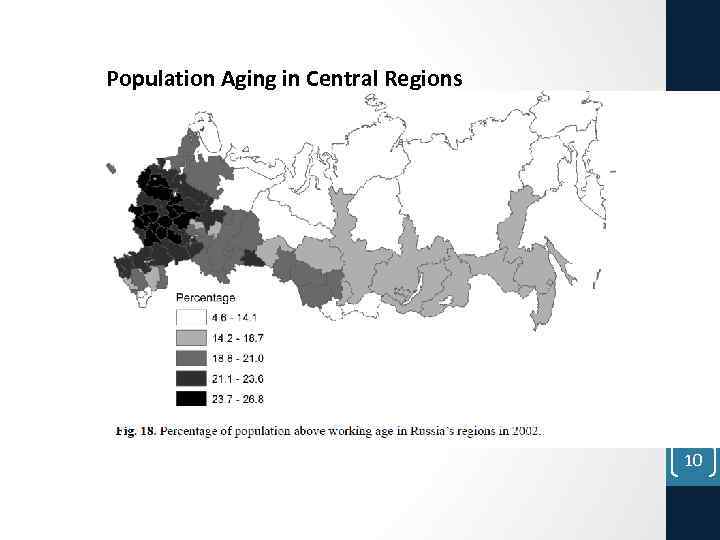 Leonard NRU-HSE Regional Studies 2/10/2018 Population Aging in Central Regions 10
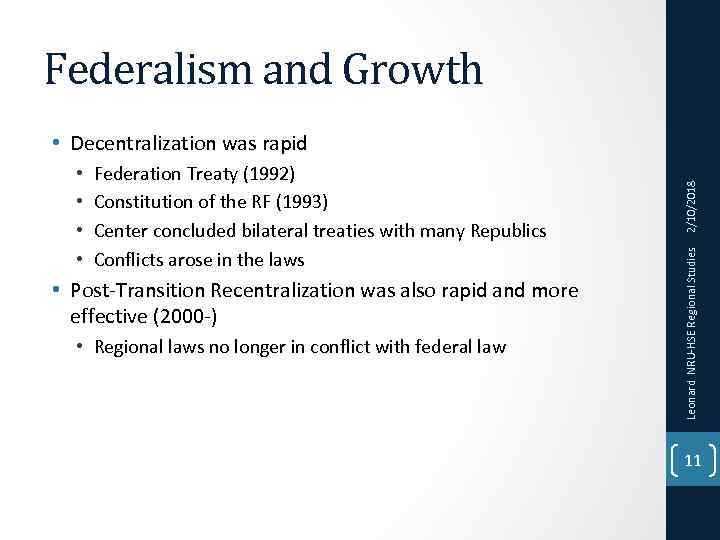 Federalism and Growth Federation Treaty (1992) Constitution of the RF (1993) Center concluded bilateral treaties with many Republics Conflicts arose in the laws • Post-Transition Recentralization was also rapid and more effective (2000 -) • Regional laws no longer in conflict with federal law Leonard NRU-HSE Regional Studies • • 2/10/2018 • Decentralization was rapid 11
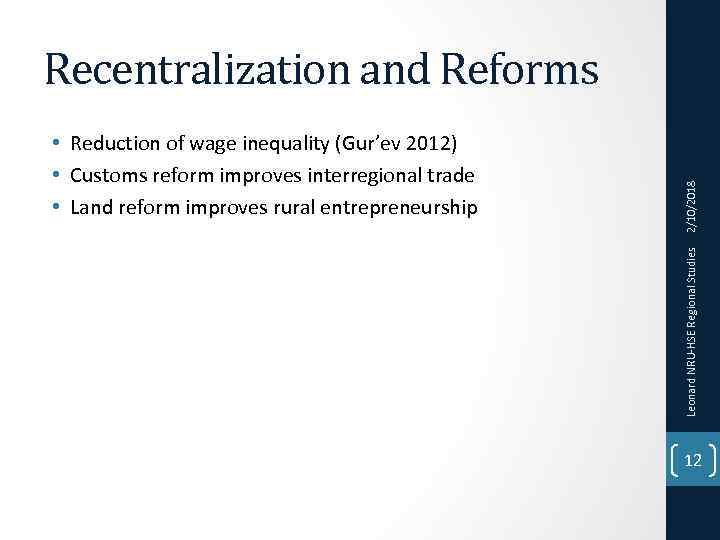 Leonard NRU-HSE Regional Studies • Reduction of wage inequality (Gur’ev 2012) • Customs reform improves interregional trade • Land reform improves rural entrepreneurship 2/10/2018 Recentralization and Reforms 12
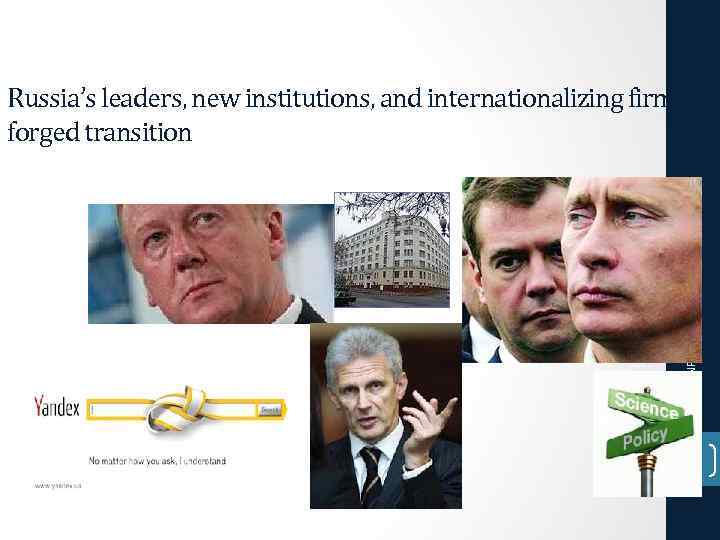 Leonard NRU-HSE Regional Studies 2/10/2018 Russia’s leaders, new institutions, and internationalizing firms forged transition 13
 2/10/2018 UNLEASHING REGIONAL POTENTIAL Leonard NRU-HSE Regional Studies Governance and Growth 14
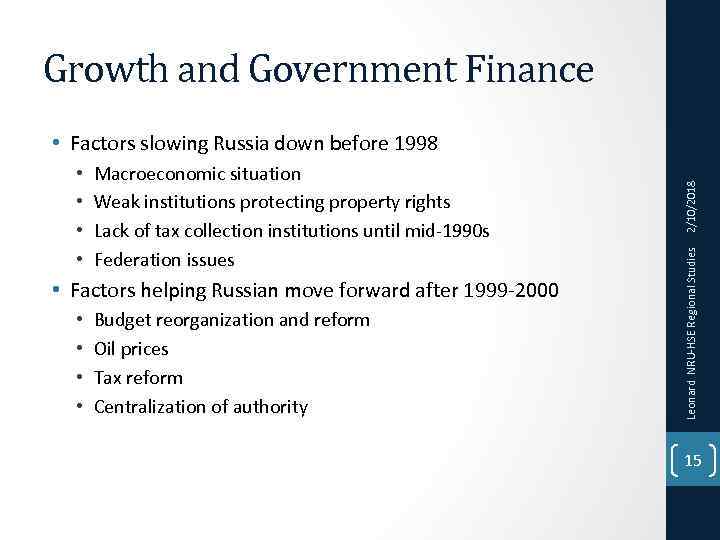 Growth and Government Finance Macroeconomic situation Weak institutions protecting property rights Lack of tax collection institutions until mid-1990 s Federation issues • Factors helping Russian move forward after 1999 -2000 • • Budget reorganization and reform Oil prices Tax reform Centralization of authority Leonard NRU-HSE Regional Studies • • 2/10/2018 • Factors slowing Russia down before 1998 15
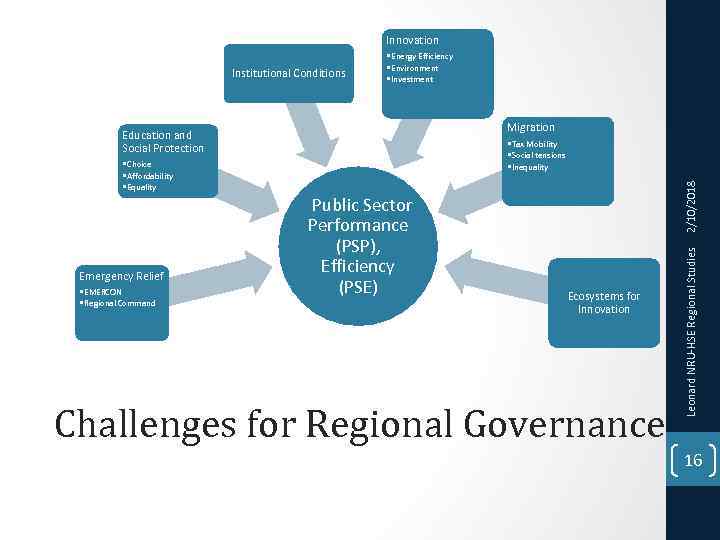 Innovation Institutional Conditions • Energy Efficiency • Environment • Investment Migration Education and Social Protection Emergency Relief • EMERCON • Regional Command Public Sector Performance (PSP), Efficiency (PSE) Ecosystems for Innovation Challenges for Regional Governance Leonard NRU-HSE Regional Studies • Choice • Affordability • Equality 2/10/2018 • Tax Mobility • Social tensions • Inequality 16
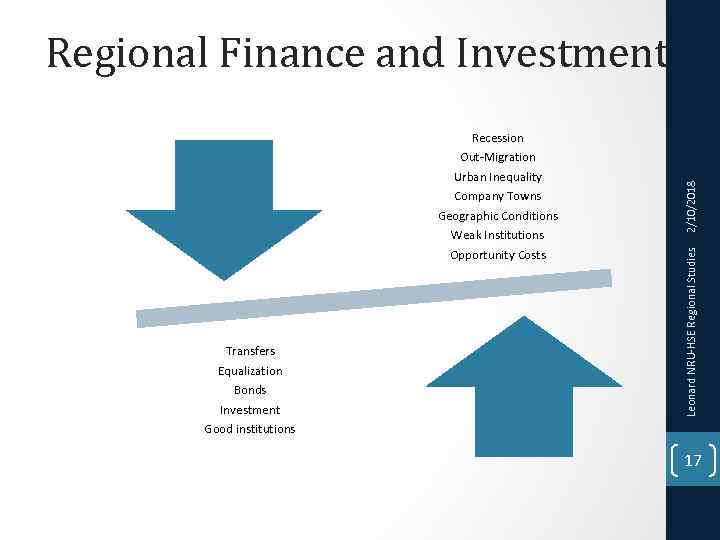 Company Towns Geographic Conditions Weak Institutions Opportunity Costs Transfers Equalization Bonds Investment Good institutions Leonard NRU-HSE Regional Studies Recession Out-Migration Urban Inequality 2/10/2018 Regional Finance and Investment 17
 2/10/2018 REGIONAL CASE STUDIES Leonard NRU-HSE Regional Studies Governance Innovation and Growth 18
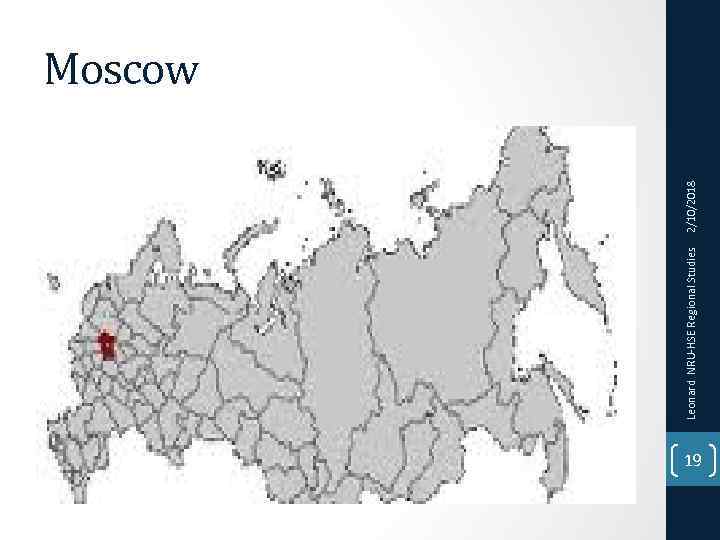 Leonard NRU-HSE Regional Studies 2/10/2018 Moscow 19
 Economic concentration shows Moscow has increased its level of dominance in economic terms Paris is comparable: National political power Functions of economic organization and coordination Cultural resources They serve as example and yardstick for the rest of the country Leonard NRU-HSE Regional Studies In the 1990 s, world wide attention focused on global cities 2/10/2018 Dominance of Moscow 20 A model of civilization with a way of life specific to the capital
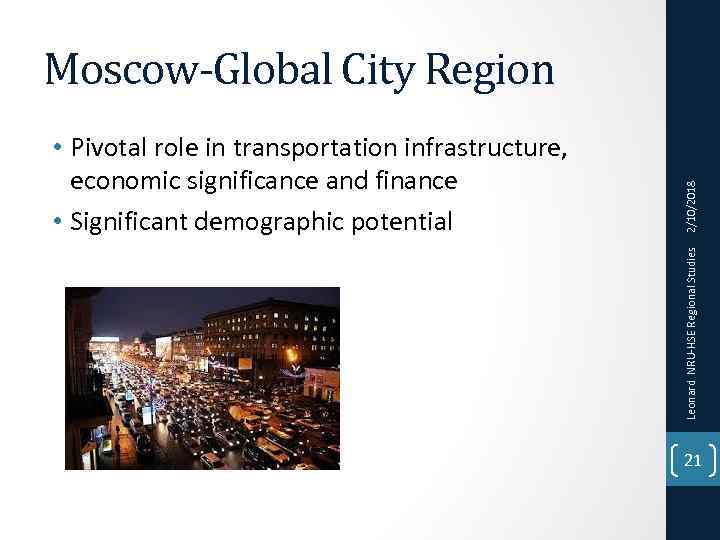 Leonard NRU-HSE Regional Studies • Pivotal role in transportation infrastructure, economic significance and finance • Significant demographic potential 2/10/2018 Moscow-Global City Region 21
 An Informational City (Castells 1993) Leonard NRU-HSE Regional Studies a) has national and international organizations, which can make farreaching political, diplomatic, legal, economic, and other decisions; b) direct contacts among different organizations; c) communication with other decision-making cities; and d) has information essential for business development and a producerservice sector (financial, consulting, banking, real estate, accounting, advertising services). 2/10/2018 Four key features of an Informational City: 22
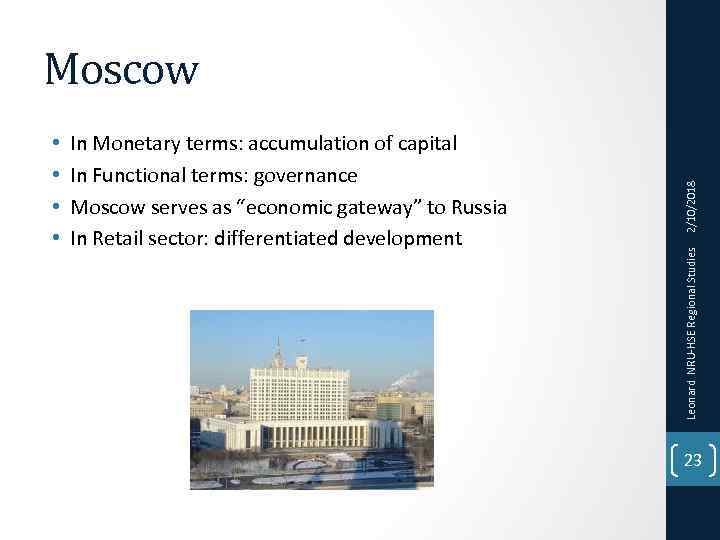 In Monetary terms: accumulation of capital In Functional terms: governance Moscow serves as “economic gateway” to Russia In Retail sector: differentiated development Leonard NRU-HSE Regional Studies • • 2/10/2018 Moscow 23
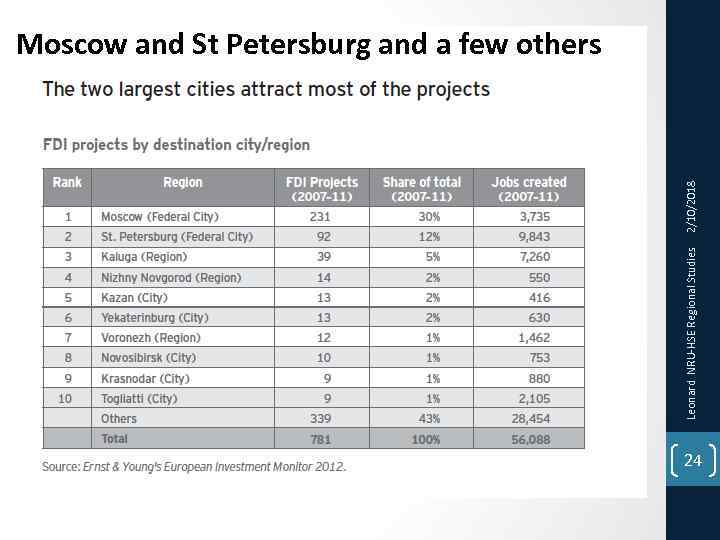 Leonard NRU-HSE Regional Studies 2/10/2018 Moscow and St Petersburg and a few others 24
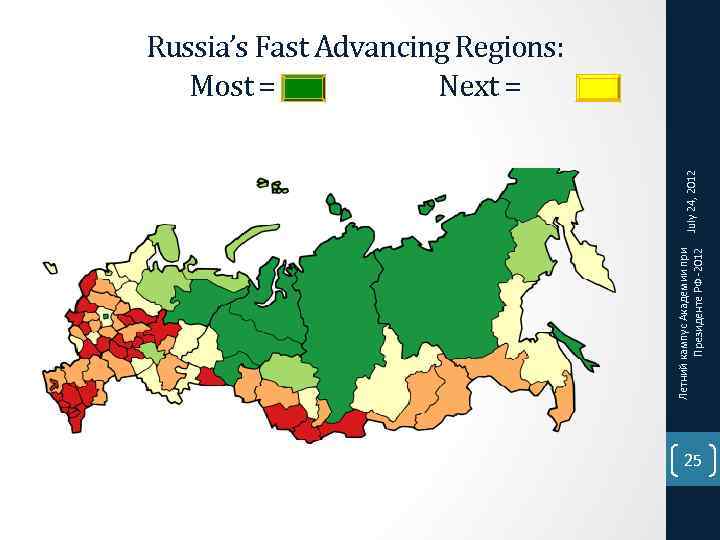 Летний кампус Академии при Президенте РФ -2012 July 24, 2012 Russia’s Fast Advancing Regions: Most = Next = 25
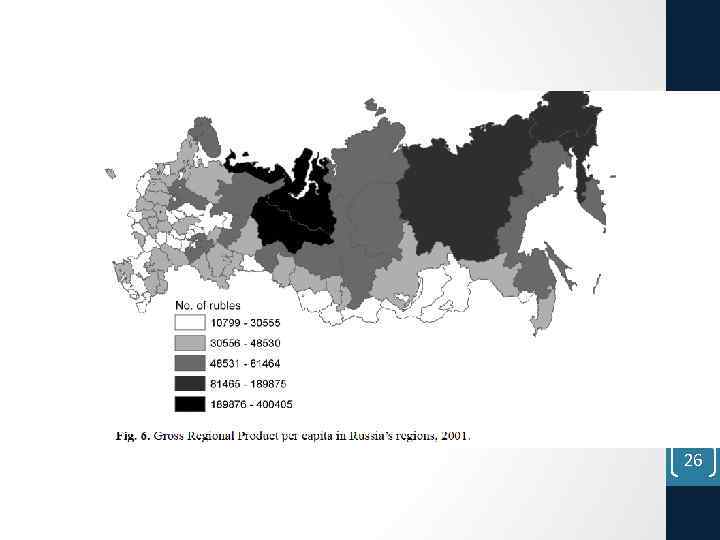 26 Leonard NRU-HSE Regional Studies 2/10/2018
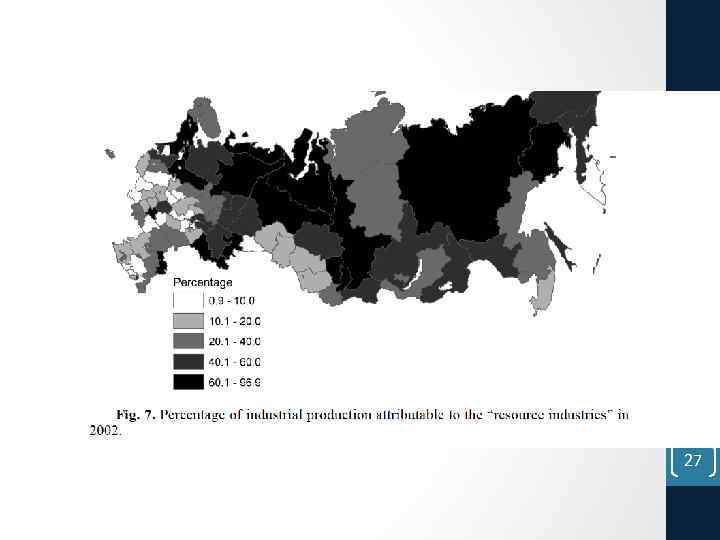 27 Leonard NRU-HSE Regional Studies 2/10/2018
 Летний кампус Академии при Президенте РФ -2012 • Many now among the “leaders” • Moscow, Ekaterinburg, Tomsk…. July 24, 2012 Regions without mineral resources 28
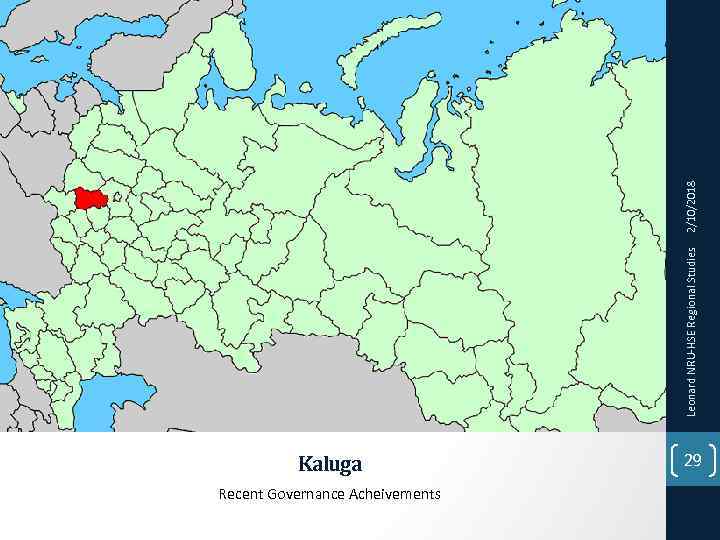 Kaluga Recent Governance Acheivements 29 Leonard NRU-HSE Regional Studies 2/10/2018
 Летний кампус Академии при Президенте РФ -2012 • Pro-Investment Strategy • Begins 2006 • Results staggering July 24, 2012 Federal and Subnational Effort 30
 Starting point: 1998 • • • Regional economy Military-oriented (one/half employees in 1980 s) Machine-building Production of transportation and related equipment (mainly for railroads), Few natural resources (some ag, timber, logging) Wood-working and paper industries July 24, 2012 • Along Moscow–Kiev motorway, backbone of the spatial economic organization Proximitiy to Moscow (170 km) Летний кампус Академии при Президенте РФ -2012 • • Location: 31
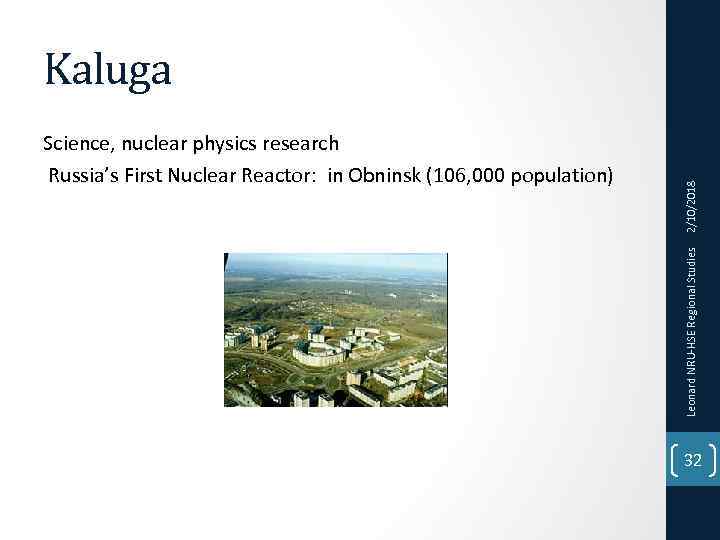 Leonard NRU-HSE Regional Studies Science, nuclear physics research Russia’s First Nuclear Reactor: in Obninsk (106, 000 population) 2/10/2018 Kaluga 32
 After 2006, it began to grow far faster than Russian average Летний кампус Академии при Президенте РФ -2012 In 1990 s, output shrank by almost 60% July 24, 2012 Decline, then growth 33
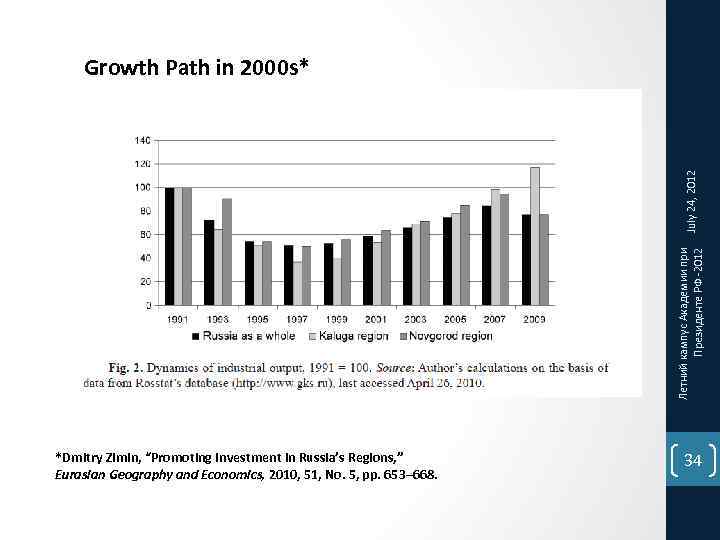 Летний кампус Академии при Президенте РФ -2012 July 24, 2012 Growth Path in 2000 s* *Dmitry Zimin, “Promoting Investment in Russia’s Regions, ” Eurasian Geography and Economics, 2010, 51, No. 5, pp. 653– 668. 34
 Летний кампус Академии при Президенте РФ -2012 • Kaluga became an “Investment Promotion Machine” as in some Central European States • Foreign involvement (which does not always produce wealth, as in financial gap, no spillovers) • Consensus among political and economic elites at national/regional/local level • No single project • Requires stable, predictable and honest government • Greenfield investments July 24, 2012 What happened? 35
 Kaluga Projects (2005 -8) with Federal Support Investment financed by borrowing (new corporation) The Russian Detroit Летний кампус Академии при Президенте РФ -2012 Public funds invested in transportation infrastructure (Federal investment in Moscow-Kiev motorway connecting Kaluga/Obninsk with Moscow July 24, 2012 Public funds invested in industrial parks (techno-parks) 36
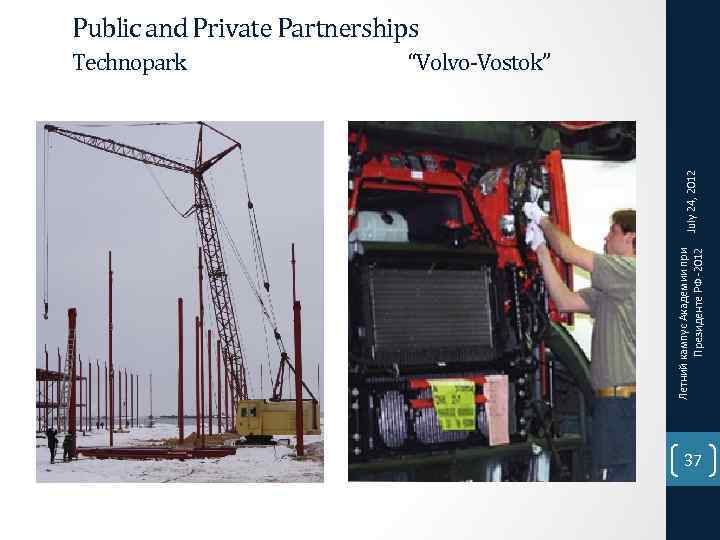 July 24, 2012 Technopark Летний кампус Академии при Президенте РФ -2012 Public and Private Partnerships “Volvo-Vostok” 37
 Government created four industrial zones (linking Kaluga, Obninsk with businesses) Public funds reconstructed them, then carefully sold to private investors • Created One-stop shop for investors (Kaluga Regional Development Agency) Helped investors with permissions (environmental, safety), services, meetings with public officials Летний кампус Академии при Президенте РФ -2012 • July 24, 2012 Industrial Zones 38
 Летний кампус Академии при Президенте РФ -2012 • Volkswagen, PSA joint venture, Samsung Electronics and Volvo Trucks • A stream of others followed • Only Greenfield projects: property rights still insufficiently protected July 24, 2012 Started with 4 major investors 39
 Летний кампус Академии при Президенте РФ -2012 • Real estate investors (housing construction boom) • Residence and Entertainment Parks • Entry of investors from many countries South Korea, Russia, French, Swedish • Foreign retail chains July 24, 2012 Spillovers 40
 Летний кампус Академии при Президенте РФ -2012 • Regional Industrial Output Grew by 63% from 2006 -2008 Particular in automotive industry • Foreign investment skyrocketed • Retail sector grew • Public sector funded a new Development Corporation to look for more funds July 24, 2012 Results 41
 Летний кампус Академии при Президенте РФ -2012 • Federal level industrial policy: High duties on imported cars Allows foreign automotive investors to bring in parts duty free Local production required for 30% of total cost July 24, 2012 Partnerships 42
 Летний кампус Академии при Президенте РФ -2012 • Transportation infrastructure allows close communication • As Moscow grows more expensive, Kaluga is attractive alternative for investors July 24, 2012 Exploiting proximity to Moscow 43
 Летний кампус Академии при Президенте РФ -2012 • Corruption continues • There are high costs—construction • Financial crisis struck Kaluga Debt rises (result of borrowing) Budget income fell by 4% (nominal) • However, federal transfers rose by 14% July 24, 2012 Problems 44
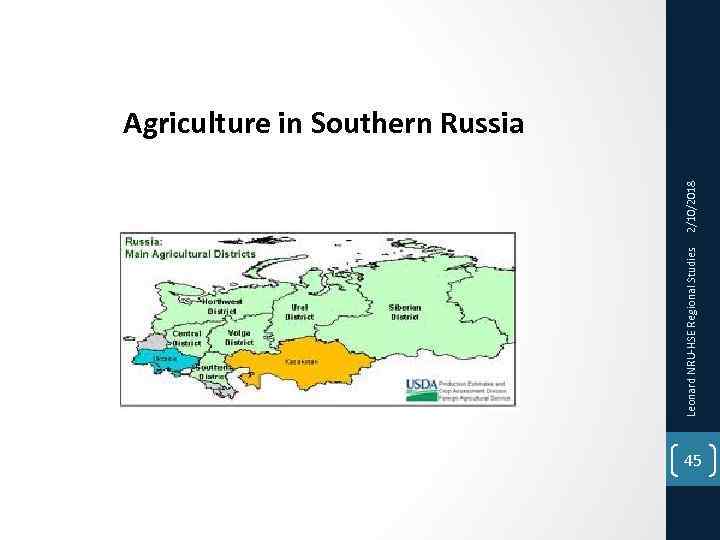 Leonard NRU-HSE Regional Studies 2/10/2018 Agriculture in Southern Russia 45
 Leonard NRU-HSE Regional Studies Cereals and meat value chains doing well Entry into WTO was preceded by years of support Although support is not substantial Problems with property rights in arable continue to slow primary production With land tenure as a bottleneck, farming continues to be dominated by large farms; small independents, although highly productive, are constrained 2/10/2018 Investment in Food Processing 46
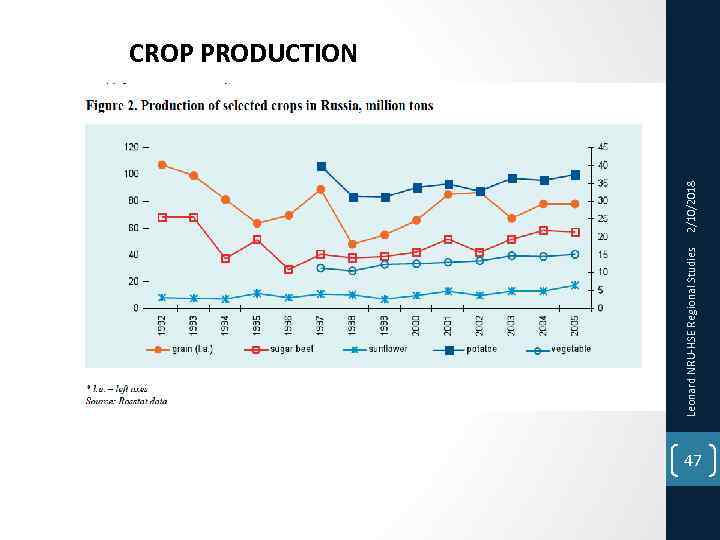 Leonard NRU-HSE Regional Studies 2/10/2018 CROP PRODUCTION 47
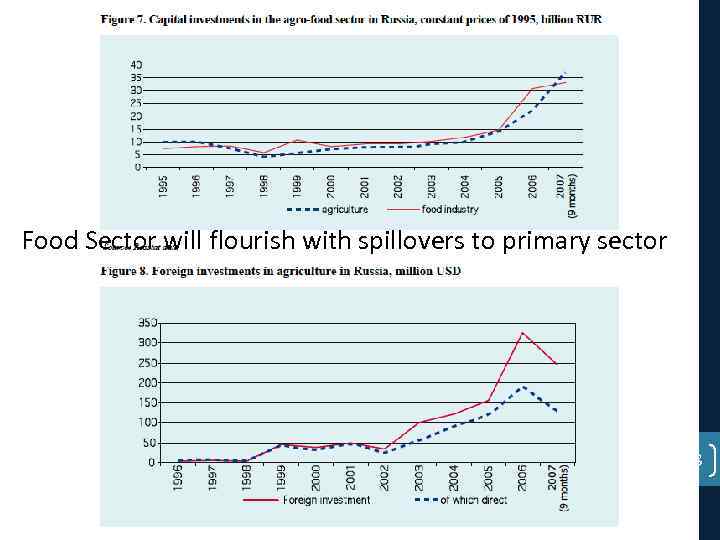 2/10/2018 Leonard NRU-HSE Regional Studies Food Sector will flourish with spillovers to primary sector 48
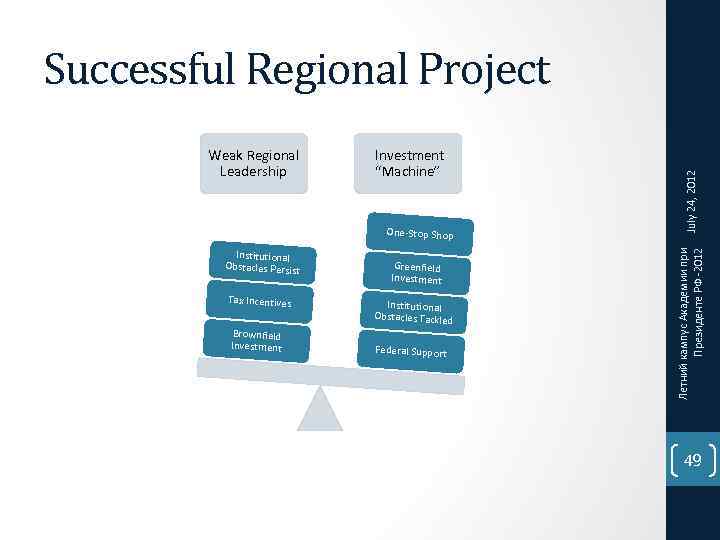 Investment “Machine” One-Stop Shop Institutional Obstacles Persist Tax Incentives Brownfield Investment Greenfield Investment Institutional Obstacles Tackled Federal Support Летний кампус Академии при Президенте РФ -2012 Weak Regional Leadership July 24, 2012 Successful Regional Project 49
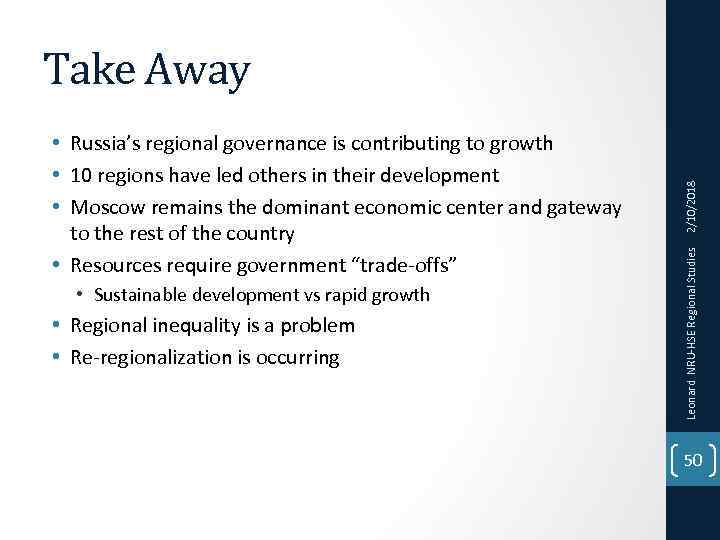 • Sustainable development vs rapid growth • Regional inequality is a problem • Re-regionalization is occurring Leonard NRU-HSE Regional Studies • Russia’s regional governance is contributing to growth • 10 regions have led others in their development • Moscow remains the dominant economic center and gateway to the rest of the country • Resources require government “trade-offs” 2/10/2018 Take Away 50
 Летний кампус Академии при Президенте РФ -2012 The End July 24, 2012