


 Скачать презентацию Leo Aoi Hosoya Research Institute for Humanity and
451bdaf4cb744d22a9809d640f525f97.ppt
- Количество слайдов: 33
 Leo Aoi Hosoya Research Institute for Humanity and Nature
 What is the ‘routine-scape’? - The basic concept What did agriculture bring to Japan? - Storage facilities and routine-scape in social transformation What Yayoi did (rice) agriculture bring to China? - Research perspective for reconstruction of diversity and transformation of routine-scapes of early rice farmers
 WHAT IS THE ‘ROUTINE-SCAPE’? -THE BASIC CONCEPT
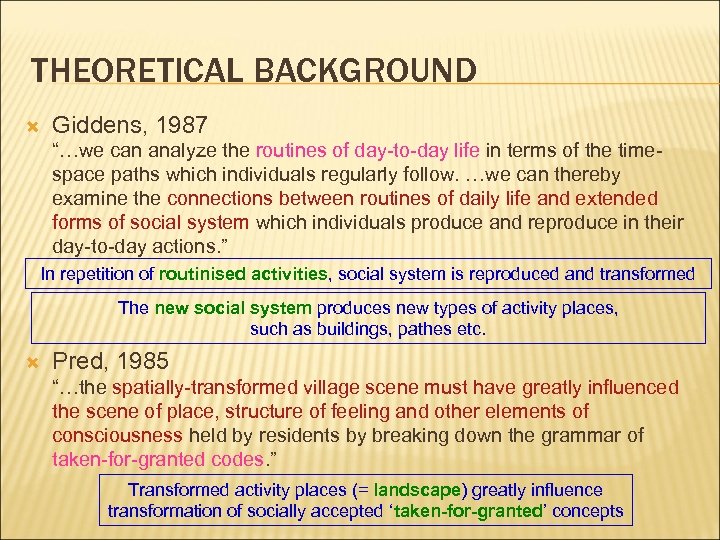 THEORETICAL BACKGROUND Giddens, 1987 “…we can analyze the routines of day-to-day life in terms of the timespace paths which individuals regularly follow. …we can thereby examine the connections between routines of daily life and extended forms of social system which individuals produce and reproduce in their day-to-day actions. ” In repetition of routinised activities, social system is reproduced and transformed The new social system produces new types of activity places, such as buildings, pathes etc. Pred, 1985 “…the spatially-transformed village scene must have greatly influenced the scene of place, structure of feeling and other elements of consciousness held by residents by breaking down the grammar of taken-for-granted codes. ” Transformed activity places (= landscape) greatly influence transformation of socially accepted ‘taken-for-granted’ concepts
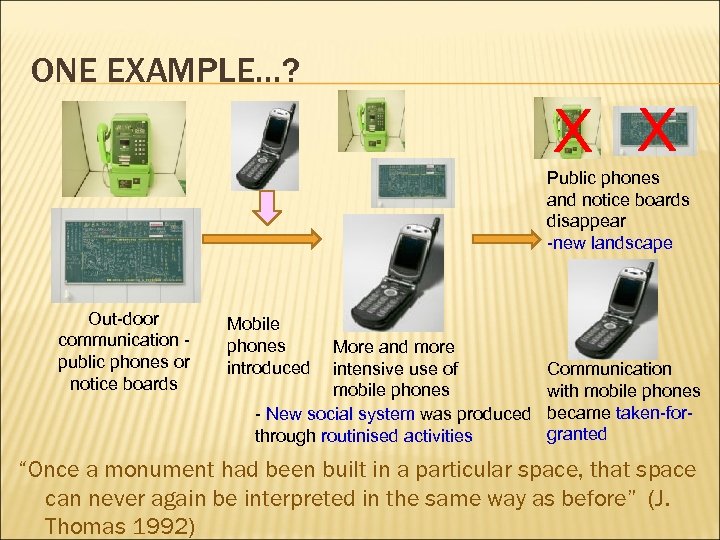 ONE EXAMPLE…? X X Public phones and notice boards disappear -new landscape Out-door communication public phones or notice boards Mobile phones introduced More and more intensive use of mobile phones - New social system was produced through routinised activities Communication with mobile phones became taken-forgranted “Once a monument had been built in a particular space, that space can never again be interpreted in the same way as before” (J. Thomas 1992)
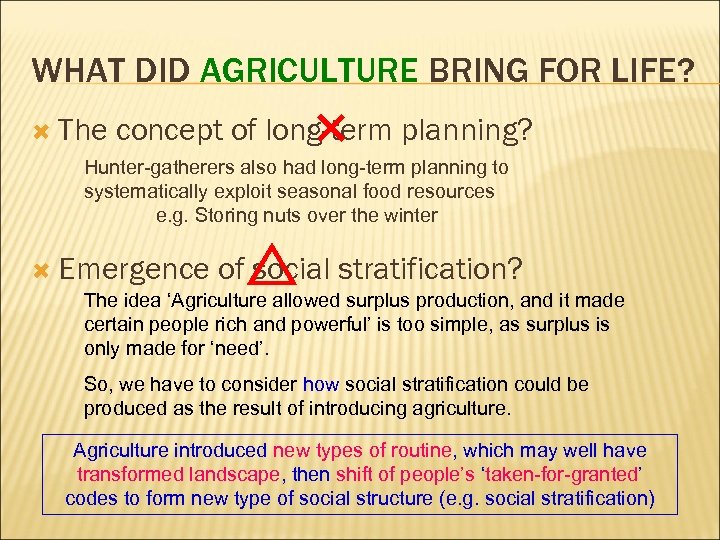 WHAT DID AGRICULTURE BRING FOR LIFE? The × concept of long-term planning? Hunter-gatherers also had long-term planning to systematically exploit seasonal food resources e. g. Storing nuts over the winter Emergence △ of social stratification? The idea ‘Agriculture allowed surplus production, and it made certain people rich and powerful’ is too simple, as surplus is only made for ‘need’. So, we have to consider how social stratification could be produced as the result of introducing agriculture. Agriculture introduced new types of routine, which may well have transformed landscape, then shift of people’s ‘taken-for-granted’ codes to form new type of social structure (e. g. social stratification)
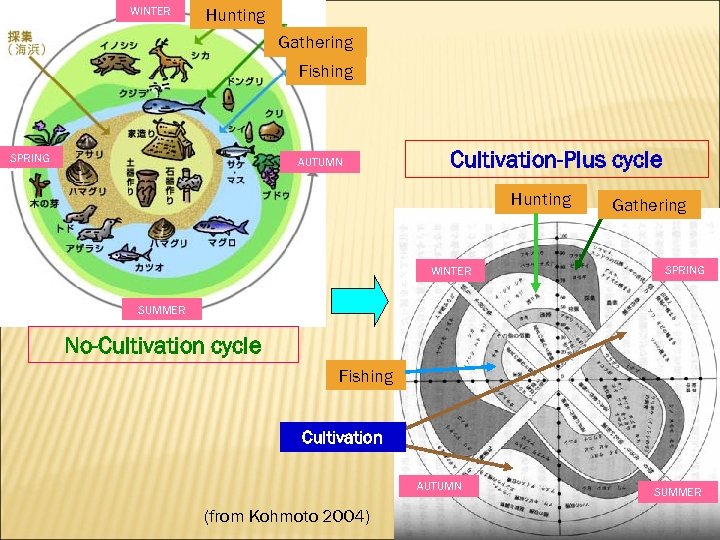 WINTER Hunting Gathering Fishing SPRING AUTUMN Cultivation-Plus cycle Hunting WINTER Gathering SPRING SUMMER No-Cultivation cycle Fishing Cultivation AUTUMN (from Kohmoto 2004) SUMMER
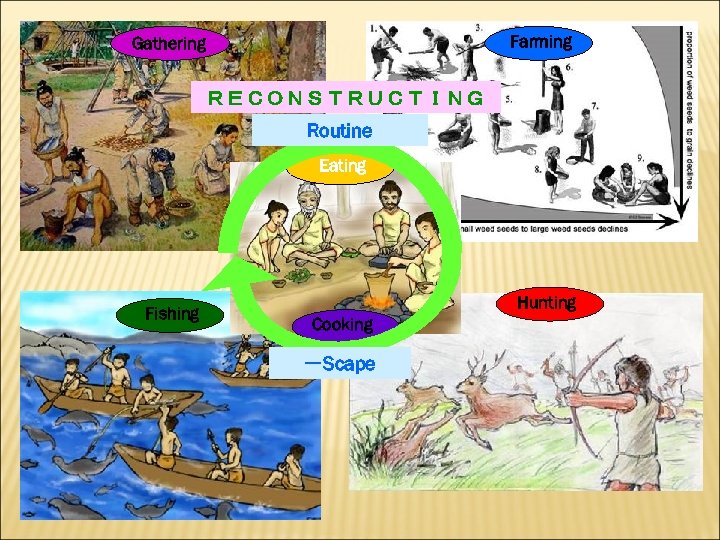 Farming Gathering RECONSTRUCTING Routine Eating Fishing Hunting Cooking -Scape
 WHAT DID AGRICULTURE BRING TO JAPAN? - STORAGE FACILITIES AND ROUTINE-SCAPE IN YAYOI SOCIAL TRANSFORMATION
![Origin and diffusion of rice agriculture [Origin] Yangtze area approx. 10, 000 b. p.](https://present5.com/presentation/451bdaf4cb744d22a9809d640f525f97/image-10.jpg "Origin and diffusion of rice agriculture [Origin] Yangtze area approx. 10, 000 b. p.") Origin and diffusion of rice agriculture [Origin] Yangtze area approx. 10, 000 b. p. CHINA KOREA JAPAN Jomon (Huntergatherers) culture 13, 0002, 500 b. p. Yayoi (Rice farming) culture 3, 000 -1, 700 b. p. [Diffusion to Japan] Northern Kyushu approx 3, 000 b. p.
Origin and diffusion of rice agriculture [Origin] Yangtze area approx. 10, 000 b. p. CHINA KOREA JAPAN Jomon (Huntergatherers) culture 13, 0002, 500 b. p. Yayoi (Rice farming) culture 3, 000 -1, 700 b. p. [Diffusion to Japan] Northern Kyushu approx 3, 000 b. p.
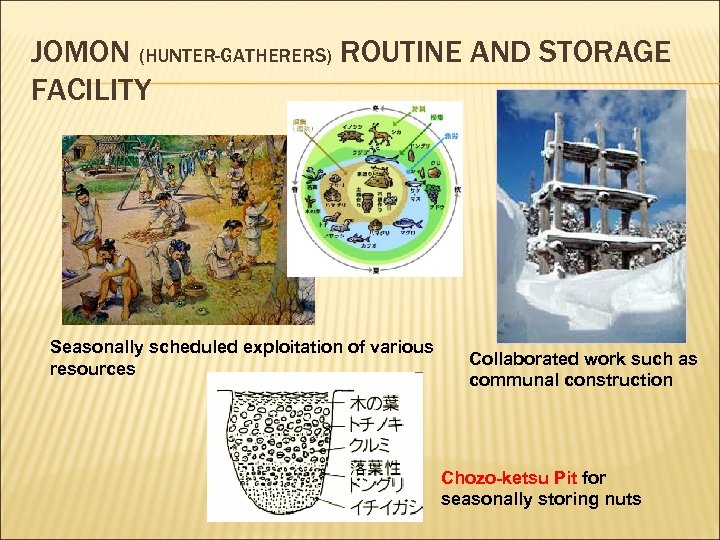 JOMON (HUNTER-GATHERERS) ROUTINE AND STORAGE FACILITY Seasonally scheduled exploitation of various resources Collaborated work such as communal construction Chozo-ketsu Pit for seasonally storing nuts
![YAYOI (EARLY FARMERS) PHASE I-II [CHOZO-KETSU PITS AS THE MAJOR STORAGE FACILITY] Probably controlled](https://present5.com/presentation/451bdaf4cb744d22a9809d640f525f97/image-12.jpg "YAYOI (EARLY FARMERS) PHASE I-II [CHOZO-KETSU PITS AS THE MAJOR STORAGE FACILITY] Probably controlled") YAYOI (EARLY FARMERS) PHASE I-II [CHOZO-KETSU PITS AS THE MAJOR STORAGE FACILITY] Probably controlled by each household More than 1000 Chozo-ketsu pits with an enclosure on the plateau Separate from the settlement Assembled but divided by ditches Ayaragi-go site, Chugoku (Yayoi Phase I)
YAYOI (EARLY FARMERS) PHASE I-II [CHOZO-KETSU PITS AS THE MAJOR STORAGE FACILITY] Probably controlled by each household More than 1000 Chozo-ketsu pits with an enclosure on the plateau Separate from the settlement Assembled but divided by ditches Ayaragi-go site, Chugoku (Yayoi Phase I)
![YAYOI PHASE II (CENTRE) ~PHASE V (PERIPHERY) [RAISED-FLOOR GRANARY AS MAJOR STORAGE FACILITY] Raised-floor](https://present5.com/presentation/451bdaf4cb744d22a9809d640f525f97/image-13.jpg "YAYOI PHASE II (CENTRE) ~PHASE V (PERIPHERY) [RAISED-FLOOR GRANARY AS MAJOR STORAGE FACILITY] Raised-floor") YAYOI PHASE II (CENTRE) ~PHASE V (PERIPHERY) [RAISED-FLOOR GRANARY AS MAJOR STORAGE FACILITY] Raised-floor granary (Reconstruction) Made within the settlement Attached to each house compound Pit House Probably controlled by each household Toro site, Chubu (Yayoi Phase V) (Reconstruction) Rice monoculture => storage dependent living style => larger storage facility, closer access to it
YAYOI PHASE II (CENTRE) ~PHASE V (PERIPHERY) [RAISED-FLOOR GRANARY AS MAJOR STORAGE FACILITY] Raised-floor granary (Reconstruction) Made within the settlement Attached to each house compound Pit House Probably controlled by each household Toro site, Chubu (Yayoi Phase V) (Reconstruction) Rice monoculture => storage dependent living style => larger storage facility, closer access to it
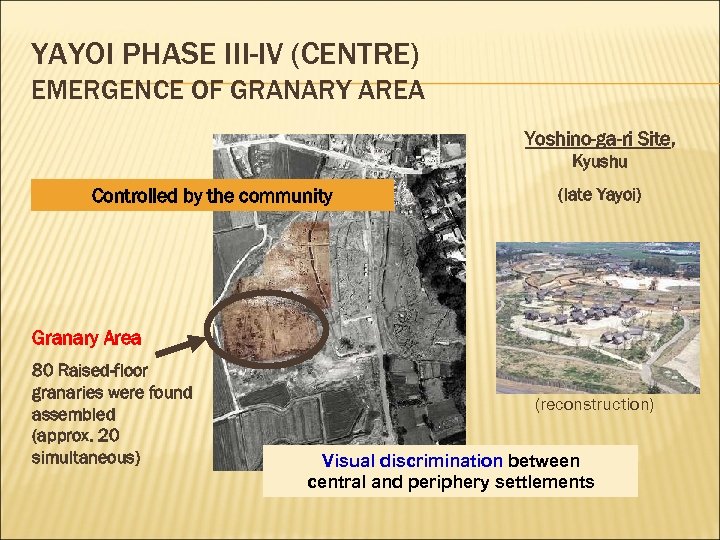 YAYOI PHASE III-IV (CENTRE) EMERGENCE OF GRANARY AREA Yoshino-ga-ri Site, Kyushu Controlled by the community (late Yayoi) Granary Area 80 Raised-floor granaries were found assembled (approx. 20 simultaneous) (reconstruction) Visual discrimination between central and periphery settlements
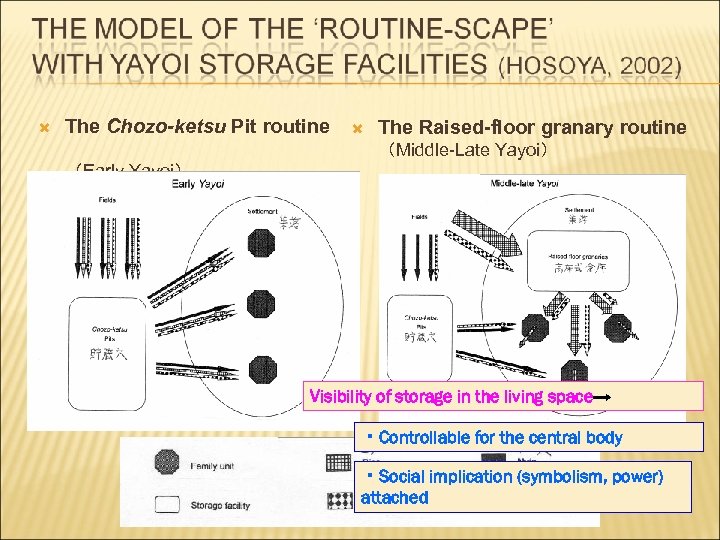 The Chozo-ketsu Pit routine (Early Yayoi) The Raised-floor granary routine (Middle-Late Yayoi) Visibility of storage in the living space→ ・Controllable for the central body ・Social implication (symbolism, power) attached
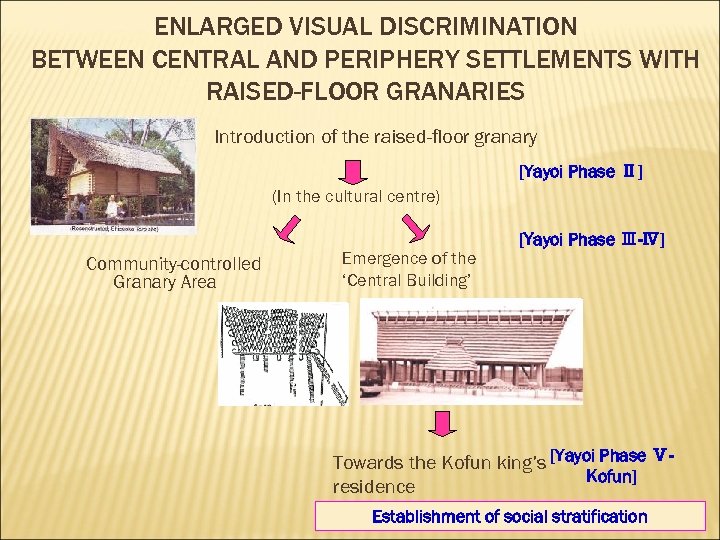 ENLARGED VISUAL DISCRIMINATION BETWEEN CENTRAL AND PERIPHERY SETTLEMENTS WITH RAISED-FLOOR GRANARIES Introduction of the raised-floor granary [Yayoi Phase Ⅱ] (In the cultural centre) Community-controlled Granary Area Emergence of the ‘Central Building’ [Yayoi Phase Ⅲ-Ⅳ] Towards the Kofun king’s [Yayoi Phase ⅤKofun] residence Establishment of social stratification
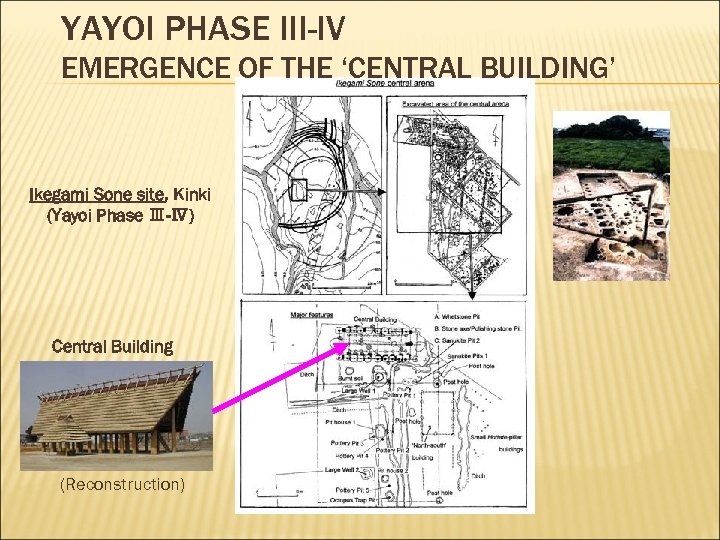 YAYOI PHASE III-IV EMERGENCE OF THE ‘CENTRAL BUILDING’ Ikegami Sone site, Kinki (Yayoi Phase Ⅲ-Ⅳ) Central Building (Reconstruction)
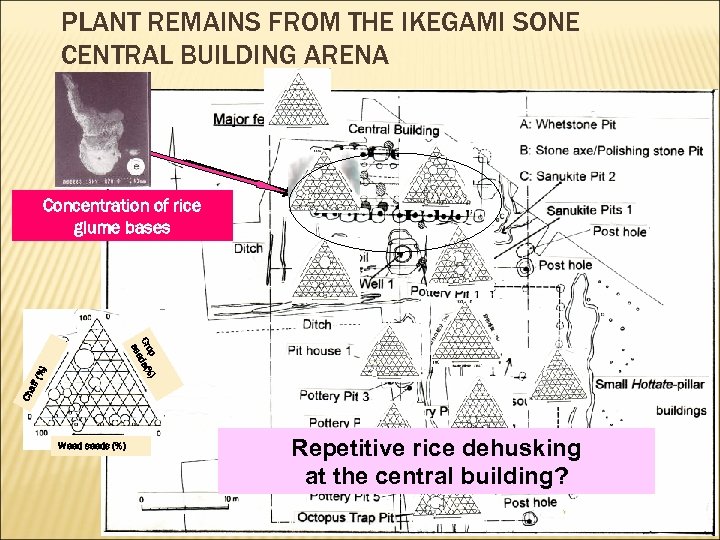 PLANT REMAINS FROM THE IKEGAMI SONE CENTRAL BUILDING ARENA Concentration of rice glume bases Ch aff ( %) ) p Cro ds(% e se Weed seeds (%) Repetitive rice dehusking at the central building?
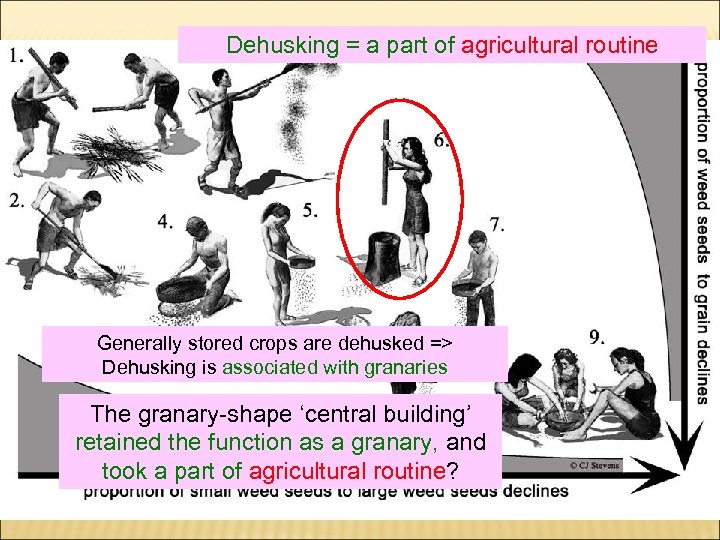 Dehusking = a part of agricultural routine Generally stored crops are dehusked => Dehusking is associated with granaries The granary-shape ‘central building’ retained the function as a granary, and took a part of agricultural routine?
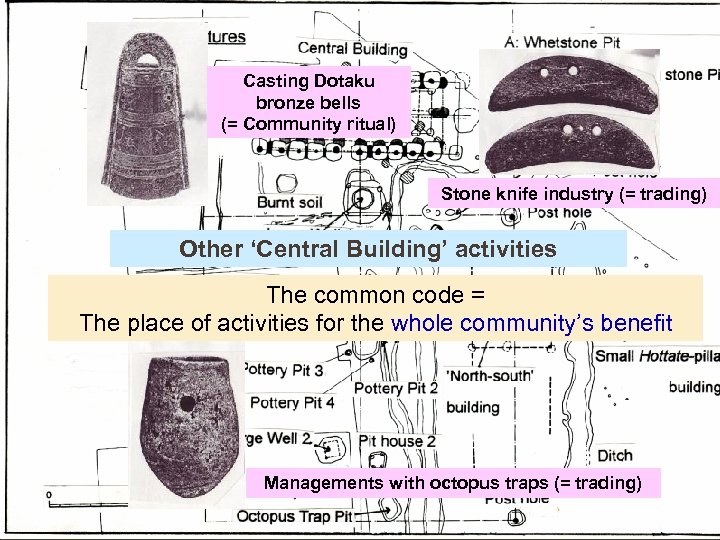 Casting Dotaku bronze bells (= Community ritual) Stone knife industry (= trading) Other ‘Central Building’ activities The common code = The place of activities for the whole community’s benefit Managements with octopus traps (= trading)
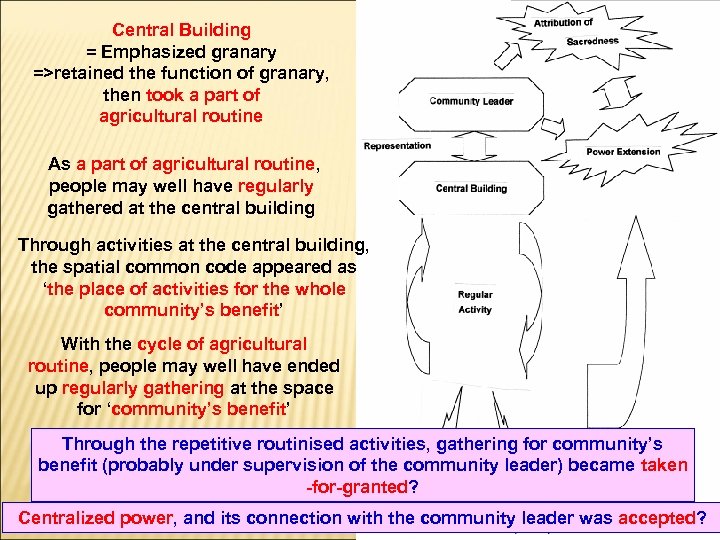 Central Building = Emphasized granary =>retained the function of granary, then took a part of agricultural routine As a part of agricultural routine, people may well have regularly gathered at the central building Through activities at the central building, the spatial common code appeared as ‘the place of activities for the whole community’s benefit’ With the cycle of agricultural routine, people may well have ended up regularly gathering at the space for ‘community’s benefit’ Through the repetitive routinised activities, gathering for community’s benefit (probably under supervision of the community leader) became taken -for-granted? Centralized power, and its connection with the community leader was accepted?
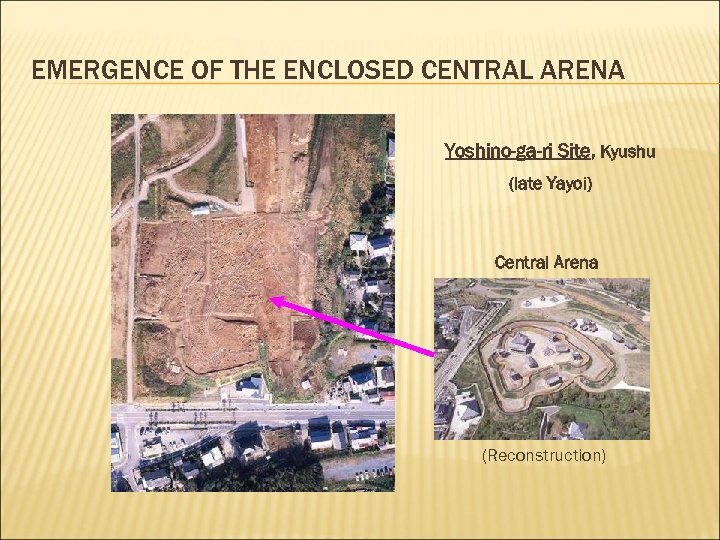 EMERGENCE OF THE ENCLOSED CENTRAL ARENA Yoshino-ga-ri Site, Kyushu (late Yayoi) Central Arena (Reconstruction)
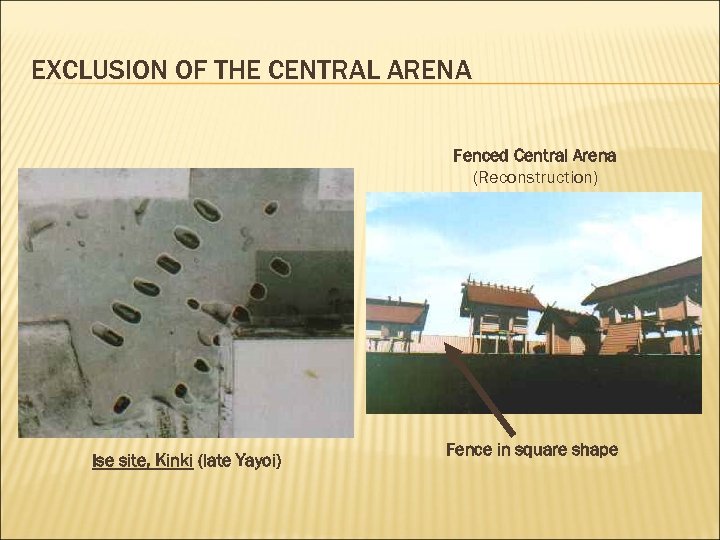 EXCLUSION OF THE CENTRAL ARENA Fenced Central Arena (Reconstruction) Ise site, Kinki (late Yayoi) Fence in square shape
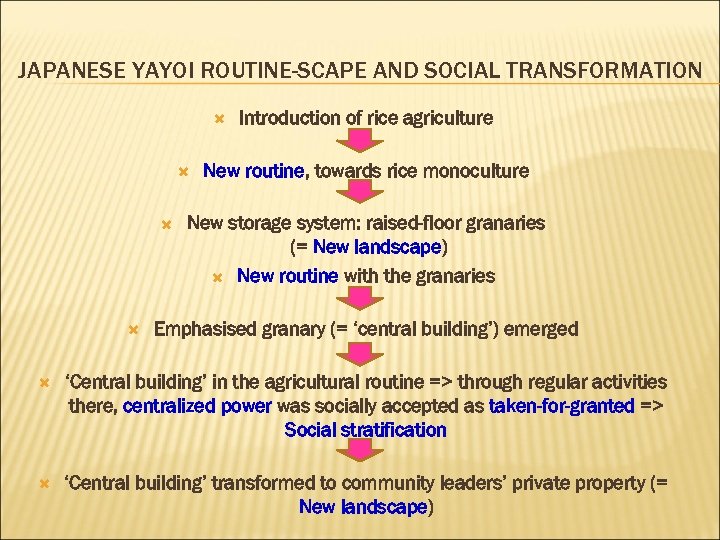 JAPANESE YAYOI ROUTINE-SCAPE AND SOCIAL TRANSFORMATION Introduction of rice agriculture New routine, towards rice monoculture New storage system: raised-floor granaries (= New landscape) New routine with the granaries Emphasised granary (= ‘central building’) emerged ‘Central building’ in the agricultural routine => through regular activities there, centralized power was socially accepted as taken-for-granted => Social stratification ‘Central building’ transformed to community leaders’ private property (= New landscape)
 WHAT DID (RICE) AGRICULTURE BRING TO CHINA? - RESEARCH PERSPECTIVE FOR RECONSTRUCTION OF DIVERSITY AND TRANSFORMATION OF ROUTINE-SCAPE OF EARLY RICE FARMERS
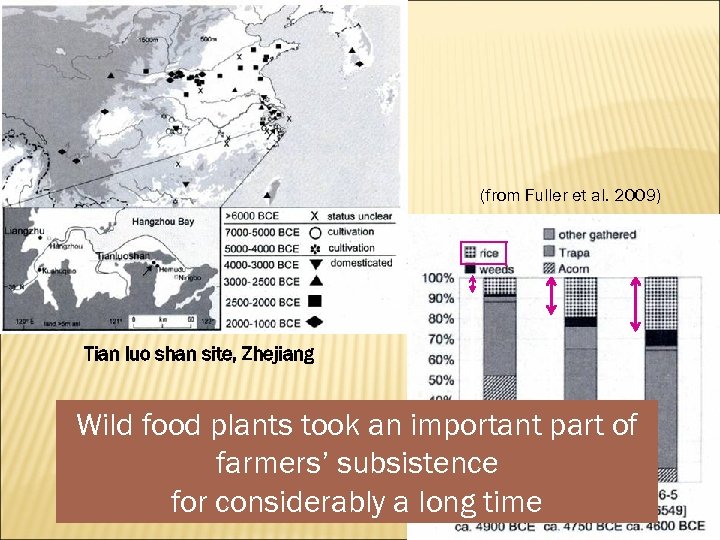 (from Fuller et al. 2009) Tian luo shan site, Zhejiang Wild food plants took an important part of farmers’ subsistence for considerably a long time
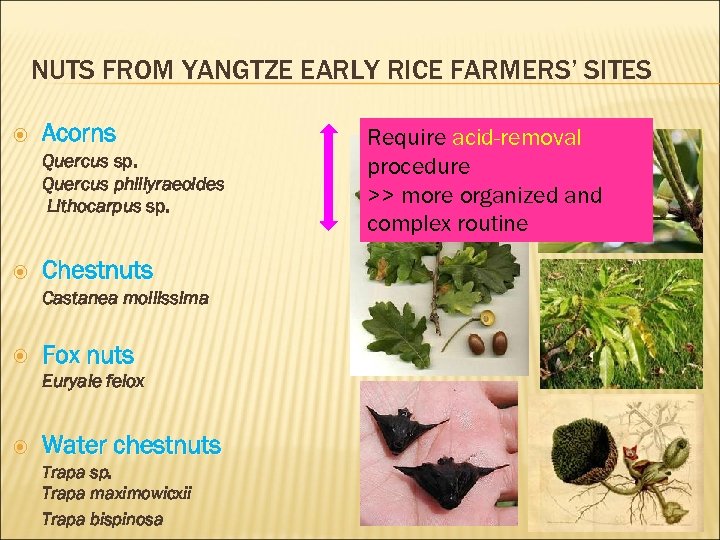 NUTS FROM YANGTZE EARLY RICE FARMERS’ SITES Acorns Quercus sp. Quercus phillyraeoides Lithocarpus sp. Chestnuts Castanea mollissima Fox nuts Euryale felox Water chestnuts Trapa sp. Trapa maximowicxii Trapa bispinosa Require acid-removal procedure >> more organized and complex routine
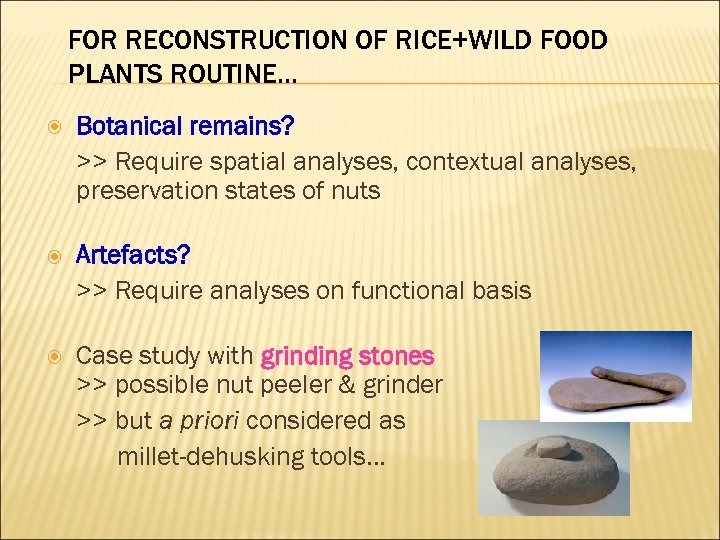 FOR RECONSTRUCTION OF RICE+WILD FOOD PLANTS ROUTINE… Botanical remains? >> Require spatial analyses, contextual analyses, preservation states of nuts Artefacts? >> Require analyses on functional basis Case study with grinding stones >> possible nut peeler & grinder >> but a priori considered as millet-dehusking tools…
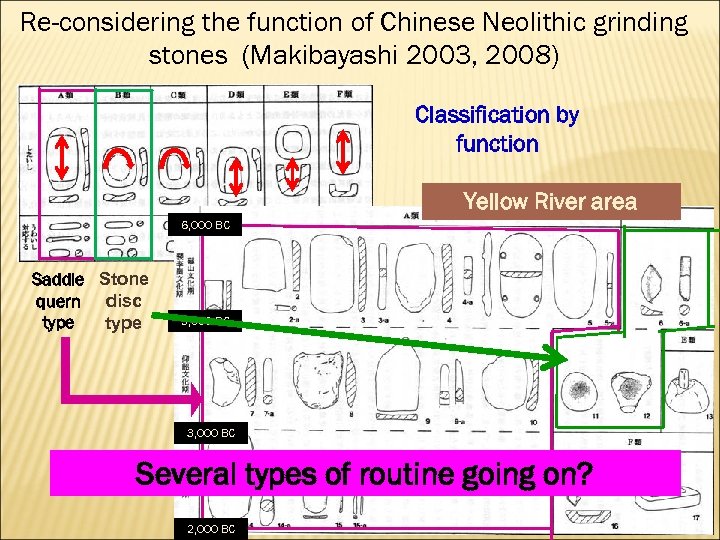 Re-considering the function of Chinese Neolithic grinding stones (Makibayashi 2003, 2008) Classification by function Yellow River area 6, 000 BC Saddle Stone quern disc type 5, 000 BC 3, 000 BC Several types of routine going on? 2, 000 BC
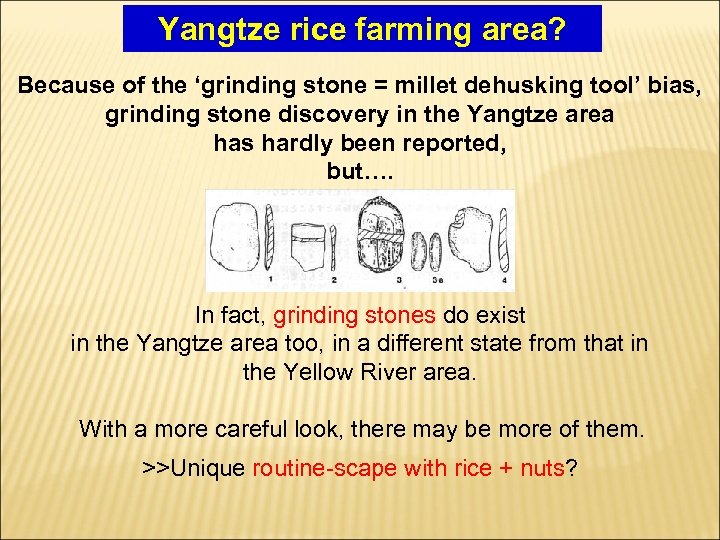 Yangtze rice farming area? Because of the ‘grinding stone = millet dehusking tool’ bias, grinding stone discovery in the Yangtze area has hardly been reported, but…. In fact, grinding stones do exist in the Yangtze area too, in a different state from that in the Yellow River area. With a more careful look, there may be more of them. >>Unique routine-scape with rice + nuts?
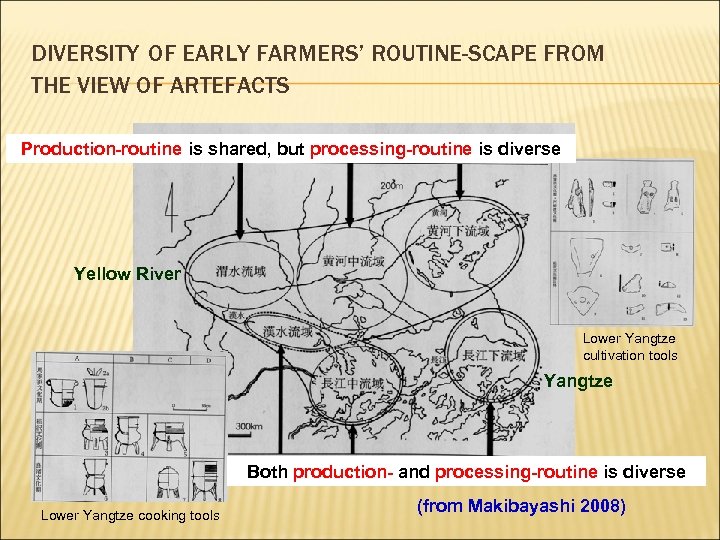 DIVERSITY OF EARLY FARMERS’ ROUTINE-SCAPE FROM THE VIEW OF ARTEFACTS Production-routine is shared, but processing-routine is diverse Yellow River Lower Yangtze cultivation tools Yangtze Both production- and processing-routine is diverse Lower Yangtze cooking tools (from Makibayashi 2008)
 ‘Routine-scape’ is an effective viewpoint for reconstructing dynamic interaction between landscape and social structure in continuous transformation, through reconstructing routinised activities, which are archaeologically approachable. In Japanese Yayoi early farmers’ case, introduction of rice agriculture led formation of rice monoculture society, accompanied with the new type of storage facility: raised-floor granaries. With it, ‘routine-scape’ greatly shifted, which ended up creating the space for centralized power accepted by people as taken-for-granted, through routinised activities there. In Chinese early rice farmers’ case, as the original places of rice cultivation, there are potentialities for reconstruction of diverse characteristics of regional farming communities and their social transformation towards established faming society, through the scope of ‘routine-scape’.
 Thank you !! Sorry I’m not here!! I appreciate any comments /questions to: Leo_Aoi@chikyu. ac. jp