 Скачать презентацию LEO Access Sub group Bo Bejmuk Chairman Review
6c6bd9774f61c207001180843f4a2b74.ppt
- Количество слайдов: 34



LEO Access Sub group Bo Bejmuk Chairman Review of US Human Space Flight Plans Committee 1
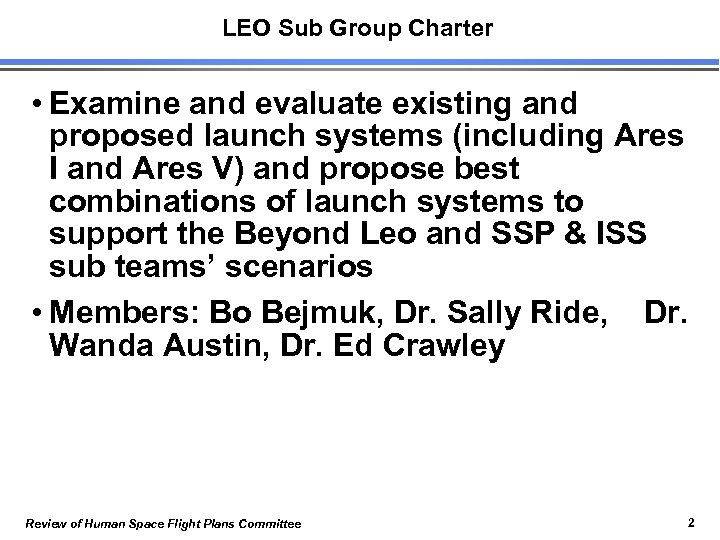
LEO Sub Group Charter • Examine and evaluate existing and proposed launch systems (including Ares I and Ares V) and propose best combinations of launch systems to support the Beyond Leo and SSP & ISS sub teams’ scenarios • Members: Bo Bejmuk, Dr. Sally Ride, Dr. Wanda Austin, Dr. Ed Crawley Review of Human Space Flight Plans Committee 2
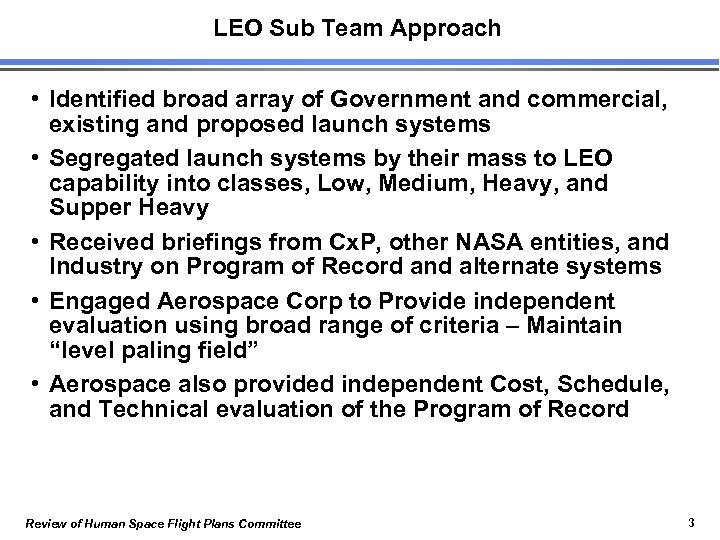
LEO Sub Team Approach • Identified broad array of Government and commercial, existing and proposed launch systems • Segregated launch systems by their mass to LEO capability into classes, Low, Medium, Heavy, and Supper Heavy • Received briefings from Cx. P, other NASA entities, and Industry on Program of Record and alternate systems • Engaged Aerospace Corp to Provide independent evaluation using broad range of criteria – Maintain “level paling field” • Aerospace also provided independent Cost, Schedule, and Technical evaluation of the Program of Record Review of Human Space Flight Plans Committee 3
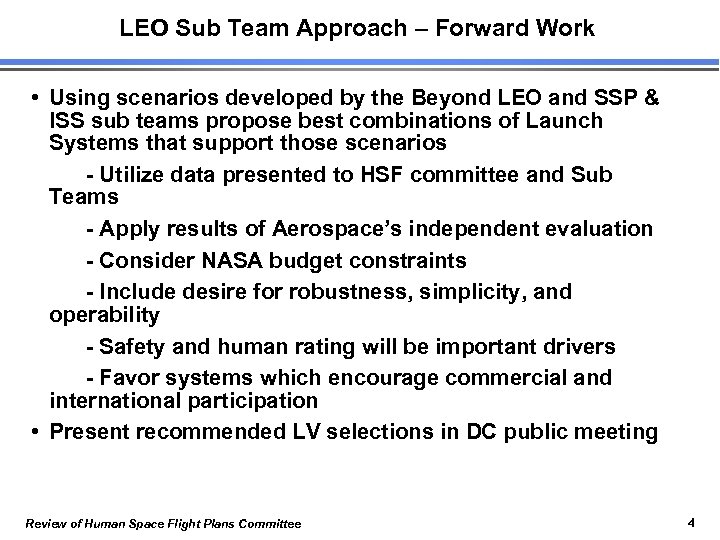
LEO Sub Team Approach – Forward Work • Using scenarios developed by the Beyond LEO and SSP & ISS sub teams propose best combinations of Launch Systems that support those scenarios - Utilize data presented to HSF committee and Sub Teams - Apply results of Aerospace’s independent evaluation - Consider NASA budget constraints - Include desire for robustness, simplicity, and operability - Safety and human rating will be important drivers - Favor systems which encourage commercial and international participation • Present recommended LV selections in DC public meeting Review of Human Space Flight Plans Committee 4
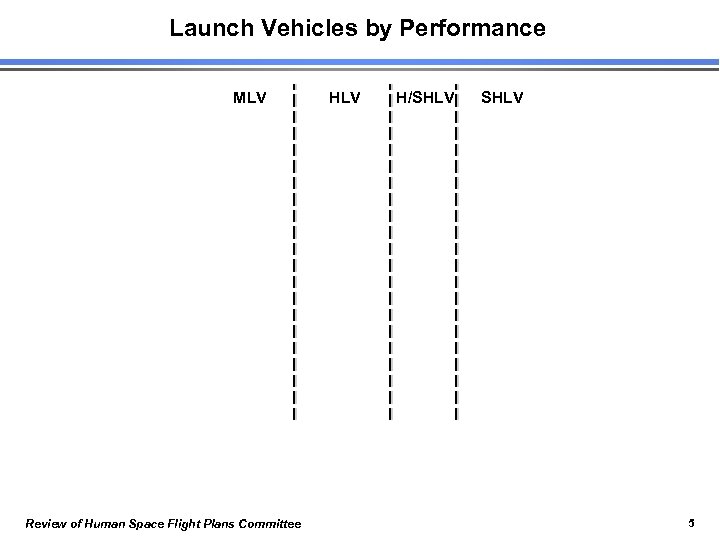
Launch Vehicles by Performance MLV Review of Human Space Flight Plans Committee HLV H/SHLV 5
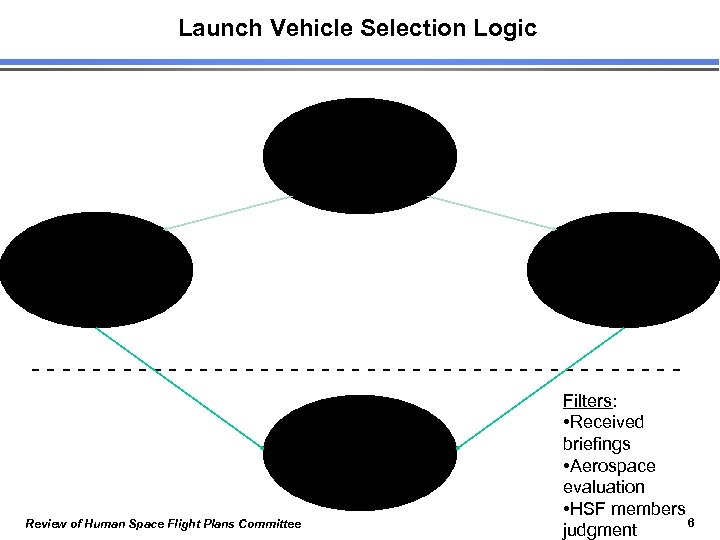
Launch Vehicle Selection Logic GOALS Beyond LEO Scenarios SSP & ISS Scenarios ---------------------Recommendation of Launch Systems Review of Human Space Flight Plans Committee Filters: • Received briefings • Aerospace evaluation • HSF members 6 judgment
Aerospace Presentation • Launch systems independent evaluation • Cost, Schedule, and Technical evaluation of POR Review of Human Space Flight Plans Committee 7
The Aerospace Corporation’s Support to The Review of U. S. Human Space Flight Plans Review Committee July 29, 2009 Gary Pulliam Vice President Civil and Commercial Operations 8 © The Aerospace Corporation 2009 APPROVED FOR PUBLIC RELEASE
Today’s Presentation • Launch vehicle assessment • Constellation program assessment APPROVED FOR PUBLIC RELEASE 9
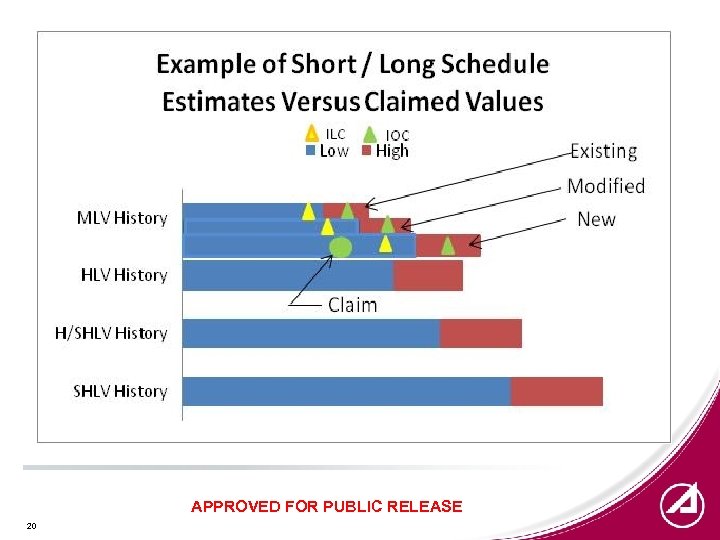
Assessment Comparison • Constellation – – • An existing government program of record Detailed data exists Risks and challenges more widely known Conformance to budget profiles known Alternate Launch Concepts – Various levels of maturity – History indicates commercial launch vehicle development takes longer to IOC – Sidemount and Direct are design studies only – Limited detailed data exists – Challenges exist with integrating other program elements – COTS is complementary to exploration – Conformance to budget profiles not known APPROVED FOR PUBLIC RELEASE 10
Launch Vehicle Assessment • Comparative assessment of – – – • Ares I/Ares V Human rated EELV Direct Side Mount Falcon 9 Taurus II The Aerospace Corporation’s approach – Developed an assessment methodology – Shared methodology with each program – Welcomed information APPROVED FOR PUBLIC RELEASE 11
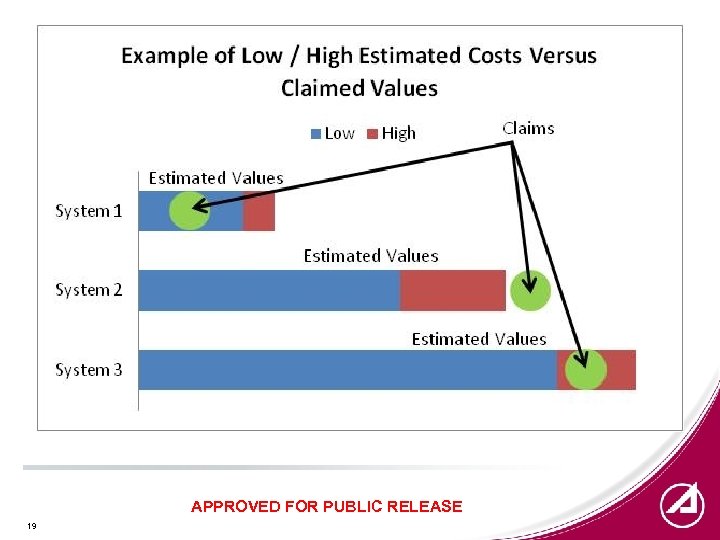
Evaluation Approach • • Systems are designed for different missions Systems have varying levels of claims We evaluated system claims for cost, schedule, performance and safety / human rating as well as 8 other diverse metrics We also evaluated systems against 4 mission classes – – Crew to ISS Cargo to ISS Crew to Earth Orbit Lunar Rendezvous and Beyond Cargo to Earth Orbit Lunar Rendezvous and Beyond APPROVED FOR PUBLIC RELEASE 12
Launch Vehicle Performance MLV H/SHLV ISS EOLR 13 APPROVED FOR PUBLIC RELEASE SHLV
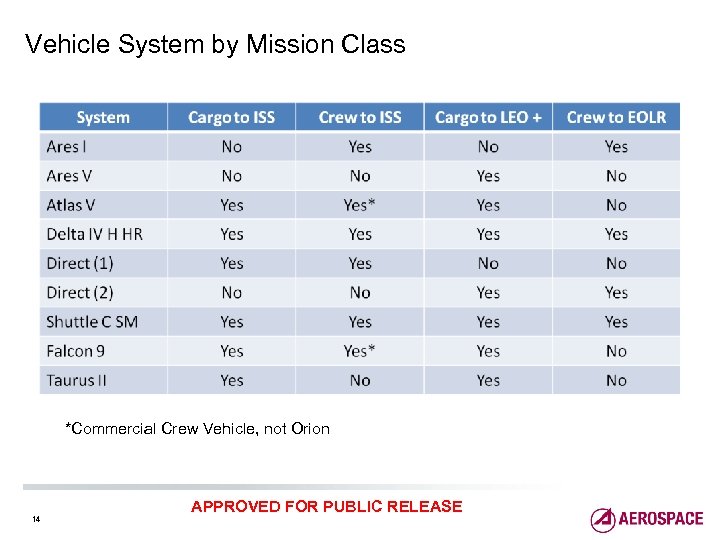
Vehicle System by Mission Class *Commercial Crew Vehicle, not Orion 14 APPROVED FOR PUBLIC RELEASE
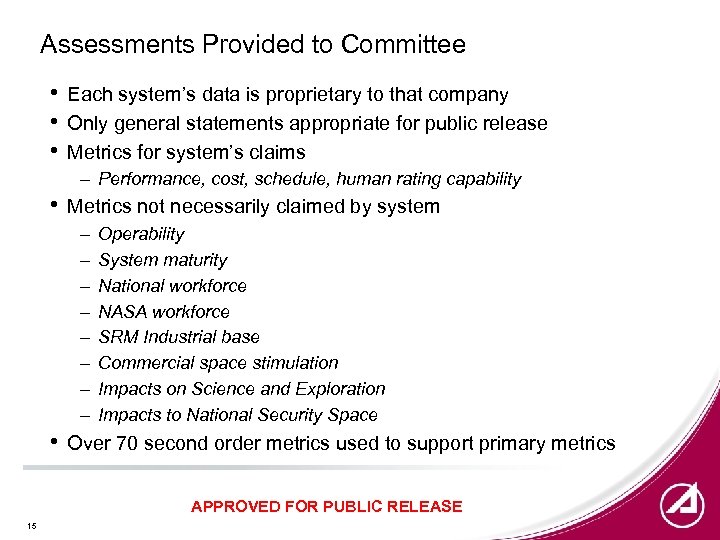
Assessments Provided to Committee • • • Each system’s data is proprietary to that company Only general statements appropriate for public release Metrics for system’s claims – Performance, cost, schedule, human rating capability • Metrics not necessarily claimed by system – – – – • Operability System maturity National workforce NASA workforce SRM Industrial base Commercial space stimulation Impacts on Science and Exploration Impacts to National Security Space Over 70 second order metrics used to support primary metrics APPROVED FOR PUBLIC RELEASE 15
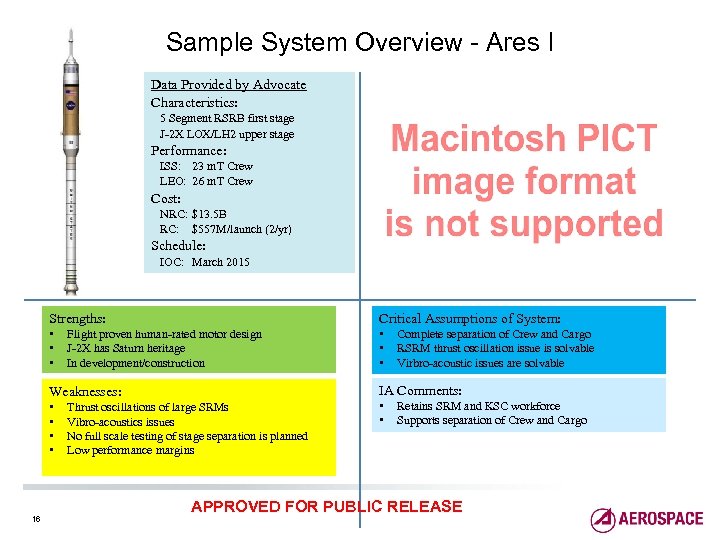
Sample System Overview - Ares I Data Provided by Advocate Characteristics: 5 Segment RSRB first stage J-2 X LOX/LH 2 upper stage Performance: ISS: 23 m. T Crew LEO: 26 m. T Crew Cost: NRC: $13. 5 B RC: $557 M/launch (2/yr) Schedule: IOC: March 2015 Strengths: Critical Assumptions of System: • • • Flight proven human-rated motor design J-2 X has Saturn heritage In development/construction IA Comments: Weaknesses: • • 16 Complete separation of Crew and Cargo RSRM thrust oscillation issue is solvable Virbro-acoustic issues are solvable Thrust oscillations of large SRMs Vibro-acoustics issues No full scale testing of stage separation is planned Low performance margins • • Retains SRM and KSC workforce Supports separation of Crew and Cargo APPROVED FOR PUBLIC RELEASE
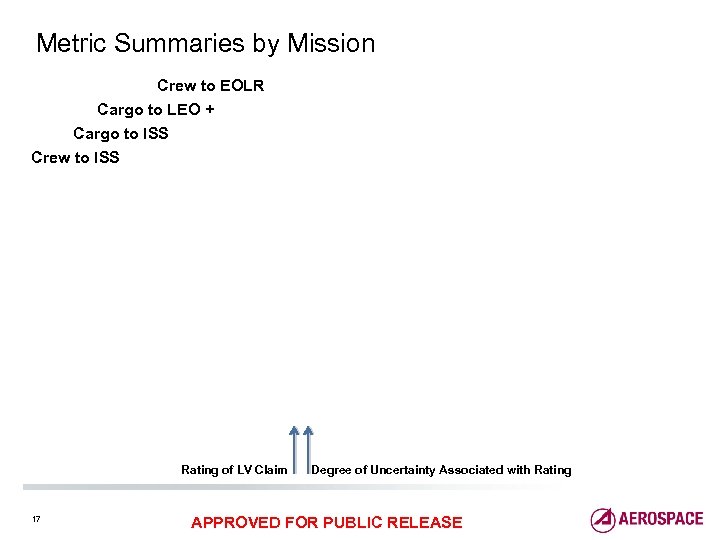
Metric Summaries by Mission Crew to EOLR Cargo to LEO + Cargo to ISS Crew to ISS Rating of LV Claim 17 Degree of Uncertainty Associated with Rating APPROVED FOR PUBLIC RELEASE
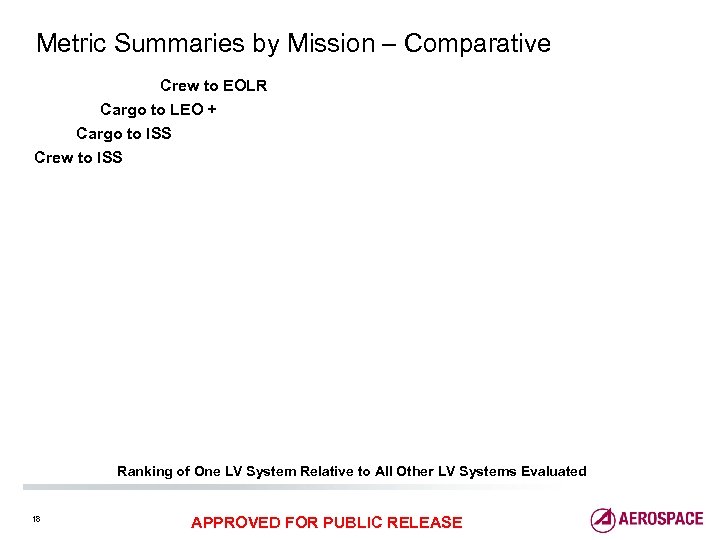
Metric Summaries by Mission – Comparative Crew to EOLR Cargo to LEO + Cargo to ISS Crew to ISS Ranking of One LV System Relative to All Other LV Systems Evaluated 18 APPROVED FOR PUBLIC RELEASE
APPROVED FOR PUBLIC RELEASE 19
APPROVED FOR PUBLIC RELEASE 20
Alternate Launch Vehicle Assessment Summary • COTS is an important complement to exploration • Vehicles in HLV/SHLV category provide minimum capability for 2 launch solution • Not all systems satisfy all missions • Options exist for all mission classes • Assessment certainty is greater for systems farthest along • Several systems omit critical elements from their claims • Information intended to guide committee deliberations • Detailed, program review level assessment required prior to decisions APPROVED FOR PUBLIC RELEASE 21
Constellation Program Independent Assessment • • • Timeline was very compressed No detailed design review No traditional independent cost or schedule estimates Cx Program provided PMR’ 09 baseline cost data (IOC milestones), and Integrated Risk Management Analysis (IRMA) risk data Baseline Constellation (Cx) Program Independent Assessment (IA) – – Effects of Budget Reduction Effects of Technical Cost Risk Assessment Effects of ISS Extension to 2020 Orion IOC “Quick-look” Schedule Assessment APPROVED FOR PUBLIC RELEASE 22
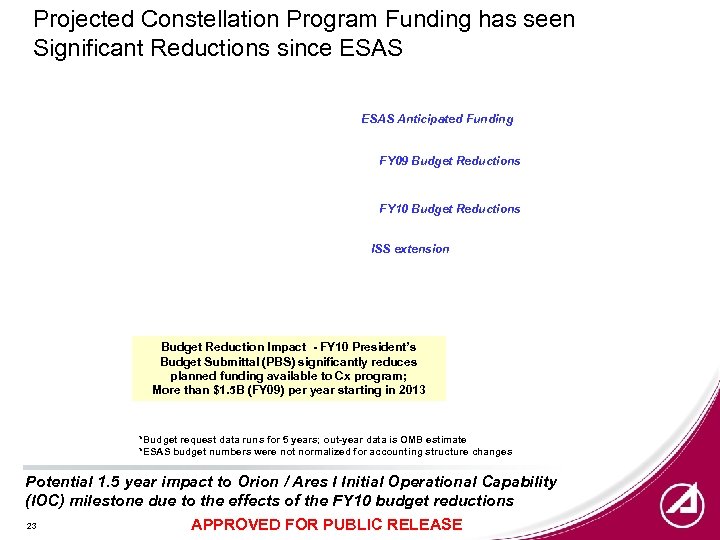
Projected Constellation Program Funding has seen Significant Reductions since ESAS Anticipated Funding FY 09 Budget Reductions FY 10 Budget Reductions ISS extension Budget Reduction Impact - FY 10 President’s Budget Submittal (PBS) significantly reduces planned funding available to Cx program; More than $1. 5 B (FY 09) per year starting in 2013 *Budget request data runs for 5 years; out-year data is OMB estimate *ESAS budget numbers were not normalized for accounting structure changes Potential 1. 5 year impact to Orion / Ares I Initial Operational Capability (IOC) milestone due to the effects of the FY 10 budget reductions 23 APPROVED FOR PUBLIC RELEASE
Technical Cost Risk Assessment • • Risks assessed were primarily from NASA We evaluated consequences on baseline – safety, performance, cost and schedule – Reviewed hundreds of risks – Reviewed mitigation plans, fallback plans and quantified risk amount (when provided in IRMA by Constellation Program) – Develop ranking for top risks Final element risk ranking was used to modify each cost-risk S-Curve based on historical cost growth Cx Program level affordability analysis performed to account for project interdependencies Potential delay of up to 2 years to Cx Program (Orion/Ares I ) IOC Includes all Projects under Cx APPROVED FOR PUBLIC RELEASE 24
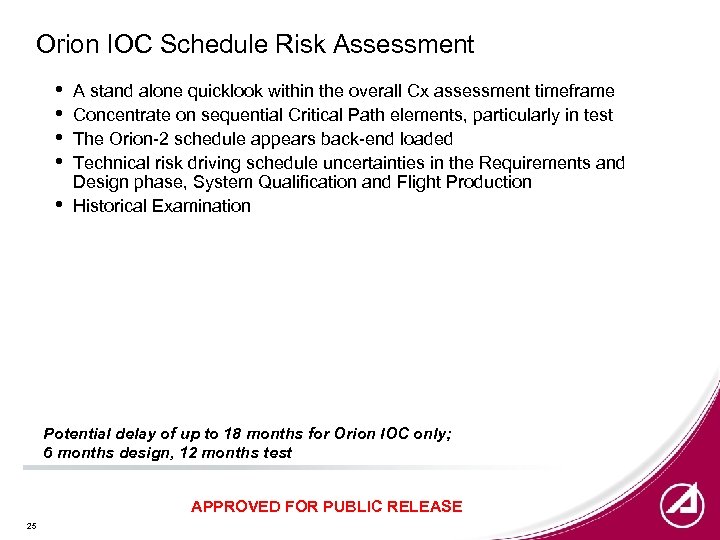
Orion IOC Schedule Risk Assessment • • • A stand alone quicklook within the overall Cx assessment timeframe Concentrate on sequential Critical Path elements, particularly in test The Orion-2 schedule appears back-end loaded Technical risk driving schedule uncertainties in the Requirements and Design phase, System Qualification and Flight Production Historical Examination Potential delay of up to 18 months for Orion IOC only; 6 months design, 12 months test APPROVED FOR PUBLIC RELEASE 25
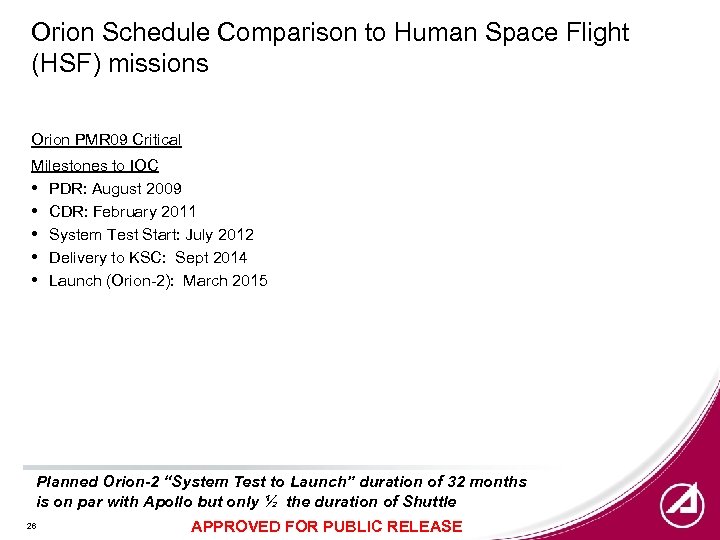
Orion Schedule Comparison to Human Space Flight (HSF) missions Orion PMR 09 Critical Milestones to IOC • PDR: August 2009 • CDR: February 2011 • System Test Start: July 2012 • Delivery to KSC: Sept 2014 • Launch (Orion-2): March 2015 Planned Orion-2 “System Test to Launch” duration of 32 months is on par with Apollo but only ½ the duration of Shuttle 26 APPROVED FOR PUBLIC RELEASE
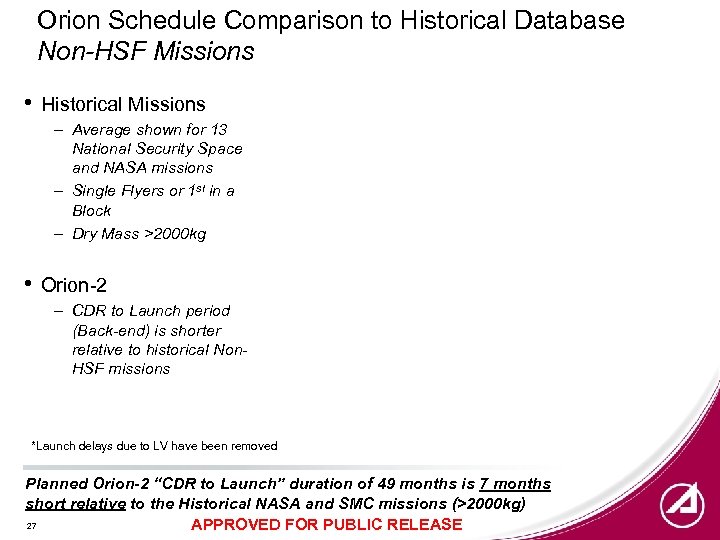
Orion Schedule Comparison to Historical Database Non-HSF Missions • Historical Missions – Average shown for 13 National Security Space and NASA missions – Single Flyers or 1 st in a Block – Dry Mass >2000 kg • Orion-2 – CDR to Launch period (Back-end) is shorter relative to historical Non. HSF missions *Launch delays due to LV have been removed Planned Orion-2 “CDR to Launch” duration of 49 months is 7 months short relative to the Historical NASA and SMC missions (>2000 kg) 27 APPROVED FOR PUBLIC RELEASE
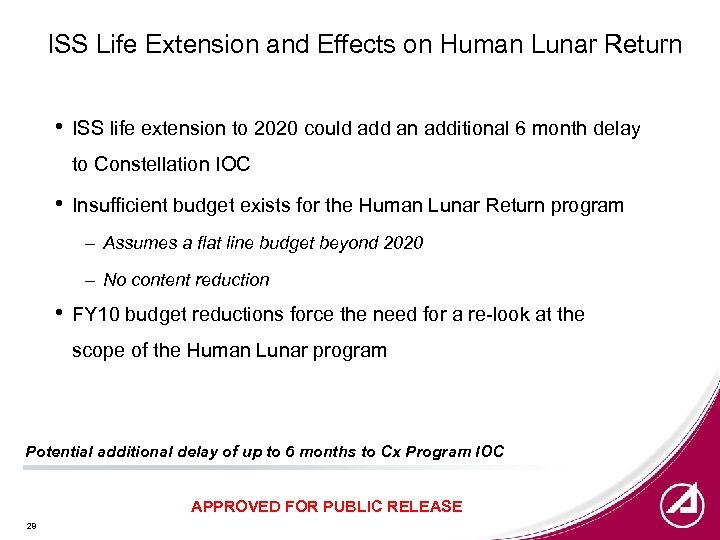
ISS Life Extension and Effects on Human Lunar Return • ISS life extension to 2020 could add an additional 6 month delay to Constellation IOC • Insufficient budget exists for the Human Lunar Return program – Assumes a flat line budget beyond 2020 – No content reduction • FY 10 budget reductions force the need for a re-look at the scope of the Human Lunar program Potential additional delay of up to 6 months to Cx Program IOC APPROVED FOR PUBLIC RELEASE 28
Impact to the IOC at 65% Confidence Level Multiple Effects Exacerbate the Gap 22 APPROVED FOR PUBLIC RELEASE
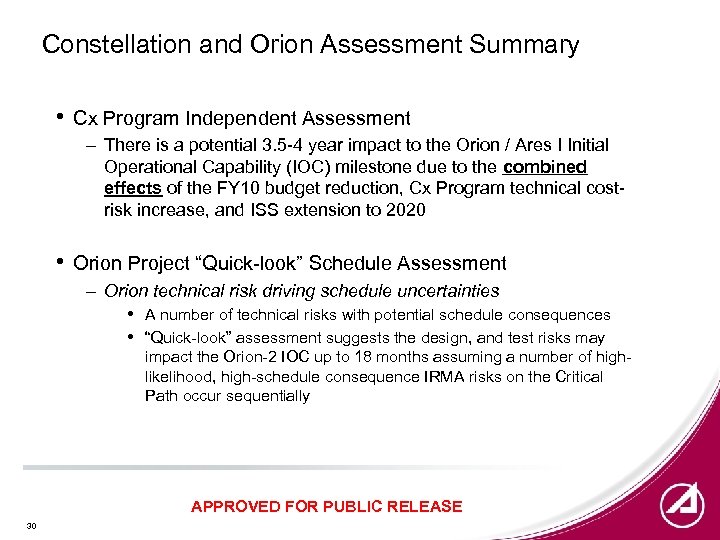
Constellation and Orion Assessment Summary • Cx Program Independent Assessment – There is a potential 3. 5 -4 year impact to the Orion / Ares I Initial Operational Capability (IOC) milestone due to the combined effects of the FY 10 budget reduction, Cx Program technical costrisk increase, and ISS extension to 2020 • Orion Project “Quick-look” Schedule Assessment – Orion technical risk driving schedule uncertainties • • A number of technical risks with potential schedule consequences “Quick-look” assessment suggests the design, and test risks may impact the Orion-2 IOC up to 18 months assuming a number of highlikelihood, high-schedule consequence IRMA risks on the Critical Path occur sequentially APPROVED FOR PUBLIC RELEASE 30
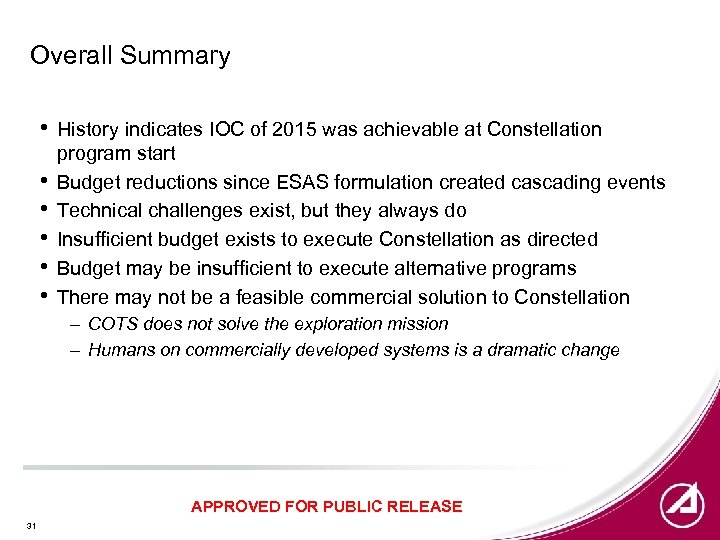
Overall Summary • • • History indicates IOC of 2015 was achievable at Constellation program start Budget reductions since ESAS formulation created cascading events Technical challenges exist, but they always do Insufficient budget exists to execute Constellation as directed Budget may be insufficient to execute alternative programs There may not be a feasible commercial solution to Constellation – COTS does not solve the exploration mission – Humans on commercially developed systems is a dramatic change APPROVED FOR PUBLIC RELEASE 31
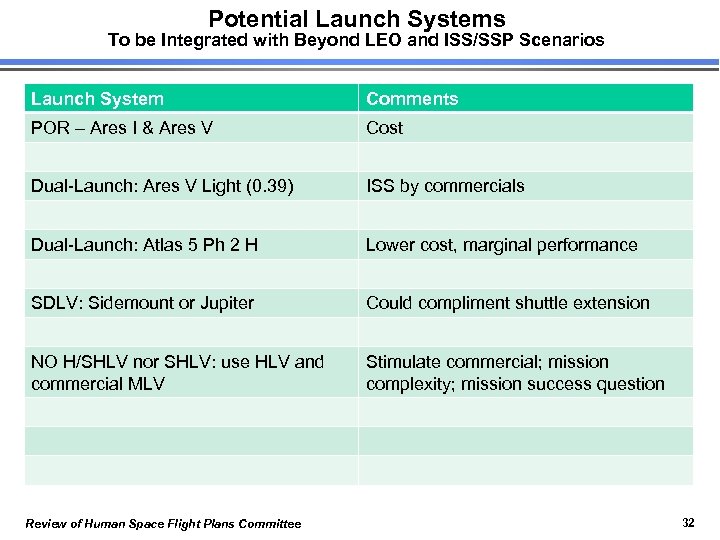
Potential Launch Systems To be Integrated with Beyond LEO and ISS/SSP Scenarios Launch System Comments POR – Ares I & Ares V Cost Dual-Launch: Ares V Light (0. 39) ISS by commercials Dual-Launch: Atlas 5 Ph 2 H Lower cost, marginal performance SDLV: Sidemount or Jupiter Could compliment shuttle extension NO H/SHLV nor SHLV: use HLV and commercial MLV Stimulate commercial; mission complexity; mission success question Review of Human Space Flight Plans Committee 32
Preliminary Findings • Insufficient funding for POR to achieve ISS and Lunar IOC with reasonable gap and present Constellation content • In spite of its technical and budgetary problems, Constellation has matured and could be successful given adequate funding • NASA needs to address detrimental effect of “fixed cost” on execution of major programs • If NASA mission and its implementation is changed, resulting changes to the POR launch system will have significant impact to cost and scedule Review of Human Space Flight Plans Committee 33
LEO Sub Team Summary • Government and commercial LV identified • Informational briefings received • Aerospace independent evaluation conducted • Beyond LEO and SSP & ISS teams scenarios will drive LV selection • Filters for selection identified • Proposed LV match to Scenarios will be deliberated in DC public meeting Review of Human Space Flight Plans Committee 34
Скачать презентацию LEO Access Sub group Bo Bejmuk Chairman Review
6c6bd9774f61c207001180843f4a2b74.ppt