


 Скачать презентацию лексикографические системы wordnet framenet http wordnet princeton
7d66361691e77e883e6e763389bf6d45.ppt
- Количество слайдов: 33
 лексикографические системы: wordnet framenet
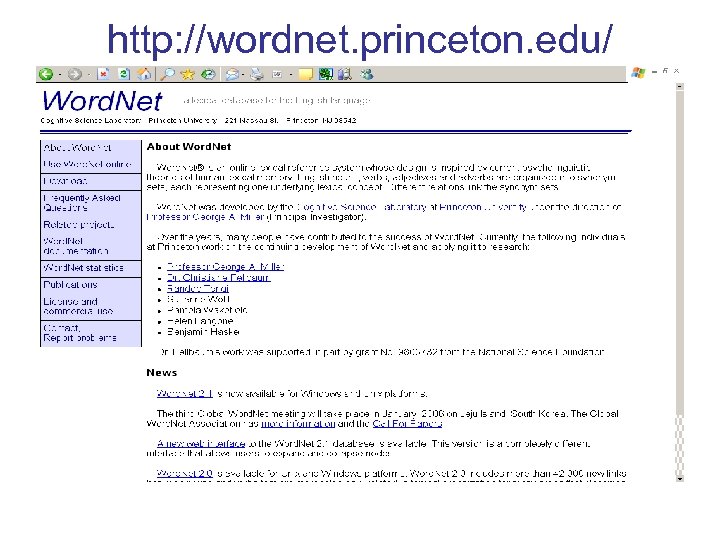 http: //wordnet. princeton. edu/
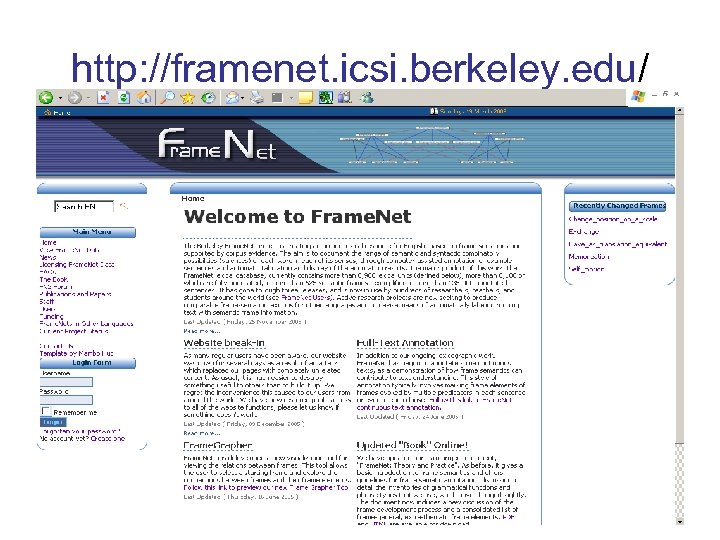 http: //framenet. icsi. berkeley. edu/
 ЧТО ТАКОЕ FRAMENET Лексикографический онлайновый ресурс, в основе которого лежат идеи «фреймовой семантики» (frame semantics) и корпусной лингвистики. Цель: документировать все семантические и синтаксические валентности каждого значения каждого слова.
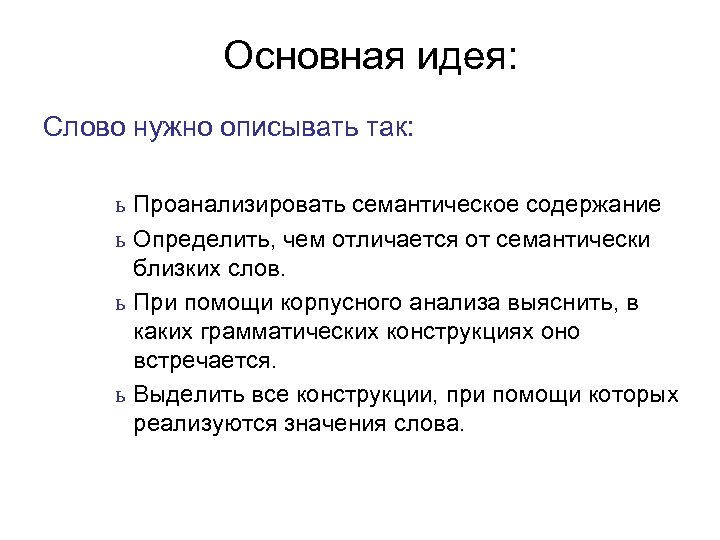 Основная идея: Слово нужно описывать так: ь Проанализировать семантическое содержание ь Определить, чем отличается от семантически близких слов. ь При помощи корпусного анализа выяснить, в каких грамматических конструкциях оно встречается. ь Выделить все конструкции, при помощи которых реализуются значения слова.
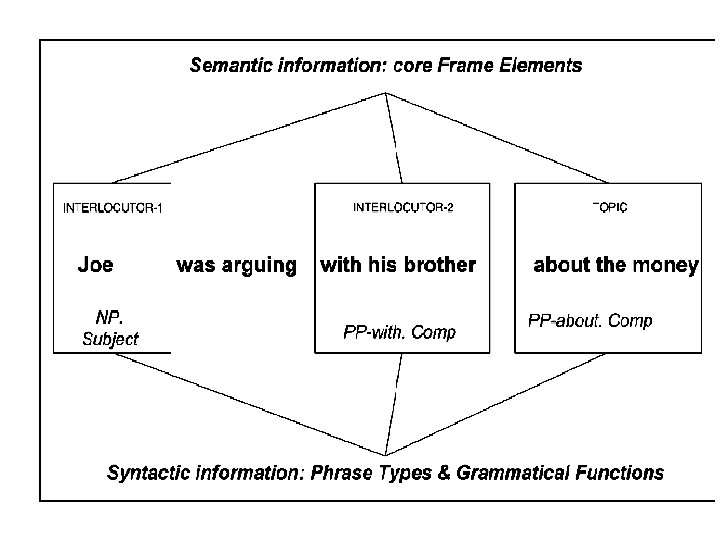
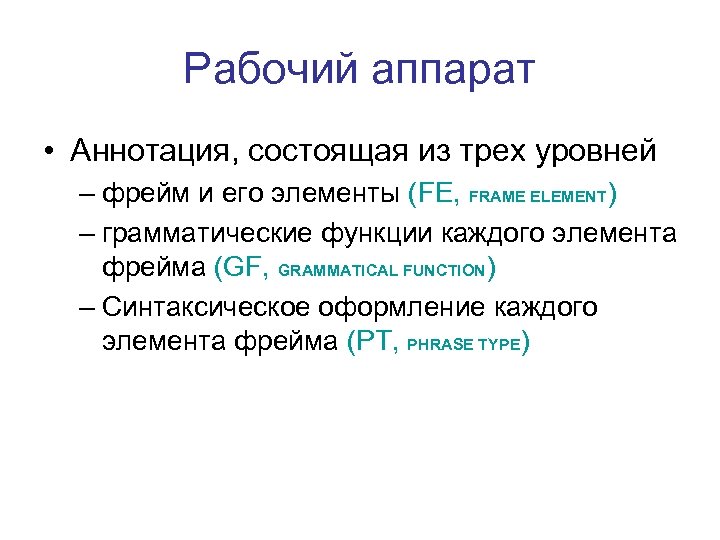 Рабочий аппарат • Аннотация, состоящая из трех уровней – фрейм и его элементы (FE, FRAME ELEMENT) – грамматические функции каждого элемента фрейма (GF, GRAMMATICAL FUNCTION) – Синтаксическое оформление каждого элемента фрейма (PT, PHRASE TYPE)
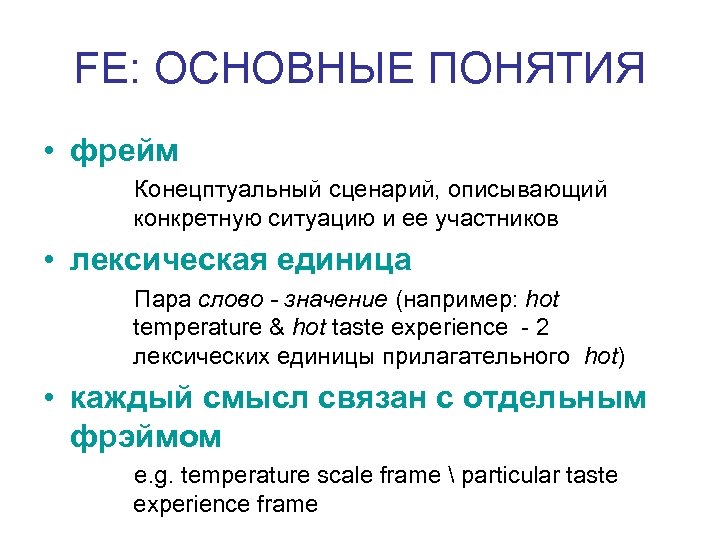 FE: ОСНОВНЫЕ ПОНЯТИЯ • фрейм Конецптуальный сценарий, описывающий конкретную ситуацию и ее участников • лексическая единица Пара слово - значение (например: hot temperature & hot taste experience - 2 лексических единицы прилагательного hot) • каждый смысл связан с отдельным фрэймом e. g. temperature scale frame particular taste experience frame
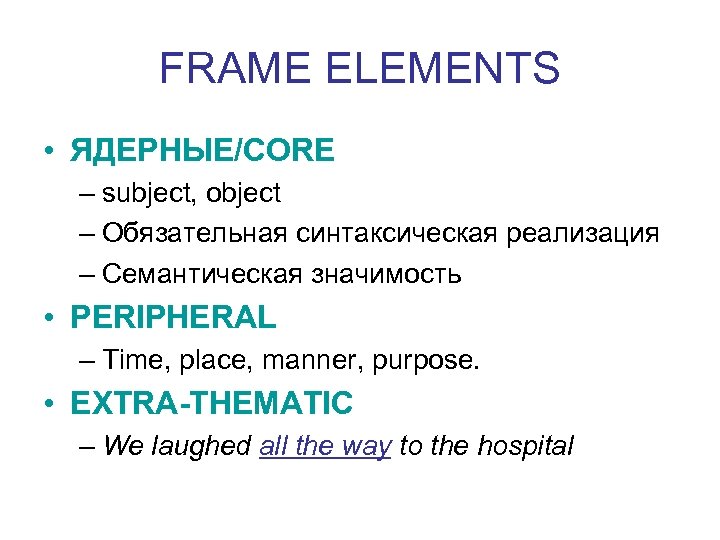 FRAME ELEMENTS • ЯДЕРНЫЕ/CORE – subject, object – Обязательная синтаксическая реализация – Семантическая значимость • PERIPHERAL – Time, place, manner, purpose. • EXTRA-THEMATIC – We laughed all the way to the hospital
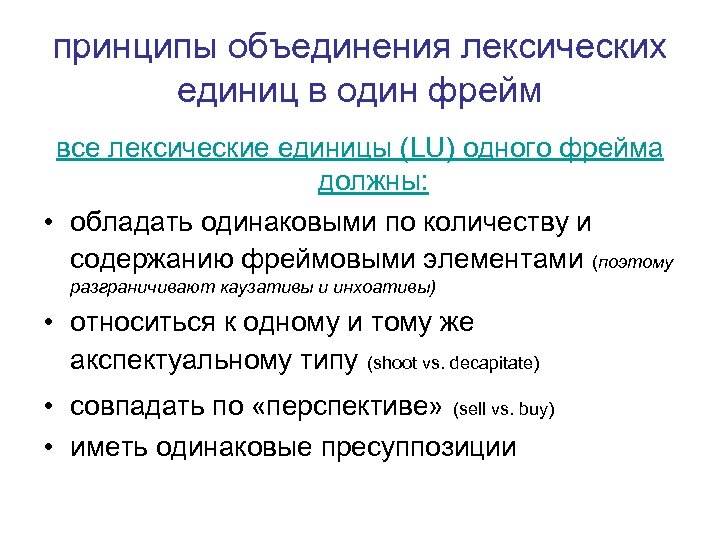 принципы объединения лексических единиц в один фрейм все лексические единицы (LU) одного фрейма должны: • обладать одинаковыми по количеству и содержанию фреймовыми элементами (поэтому разграничивают каузативы и инхоативы) • относиться к одному и тому же акспектуальному типу (shoot vs. decapitate) • совпадать по «перспективе» (sell vs. buy) • иметь одинаковые пресуппозиции
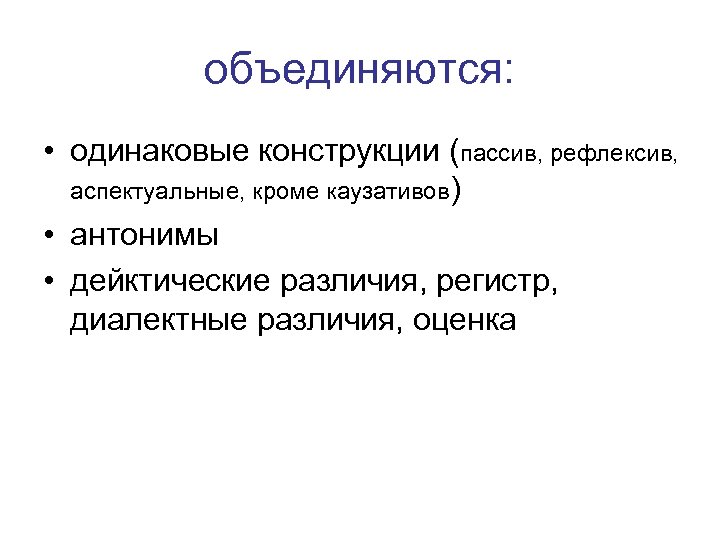 объединяются: • одинаковые конструкции (пассив, рефлексив, аспектуальные, кроме каузативов) • антонимы • дейктические различия, регистр, диалектные различия, оценка
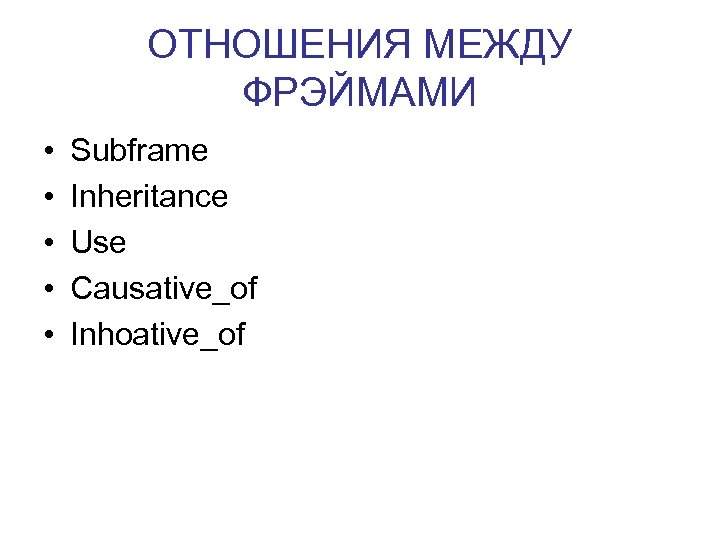 ОТНОШЕНИЯ МЕЖДУ ФРЭЙМАМИ • • • Subframe Inheritance Use Causative_of Inhoative_of
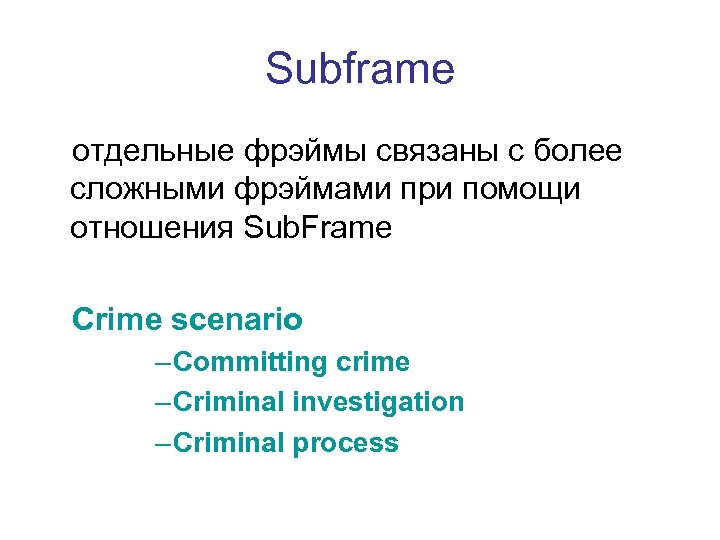 Subframe отдельные фрэймы связаны с более сложными фрэймами при помощи отношения Sub. Frame Crime scenario – Committing crime – Criminal investigation – Criminal process
 Inheritance При отношении наследства все элементы фрейма-наследника совпадают или же более конкретны по сравнению с элементами фрейма-родителя.
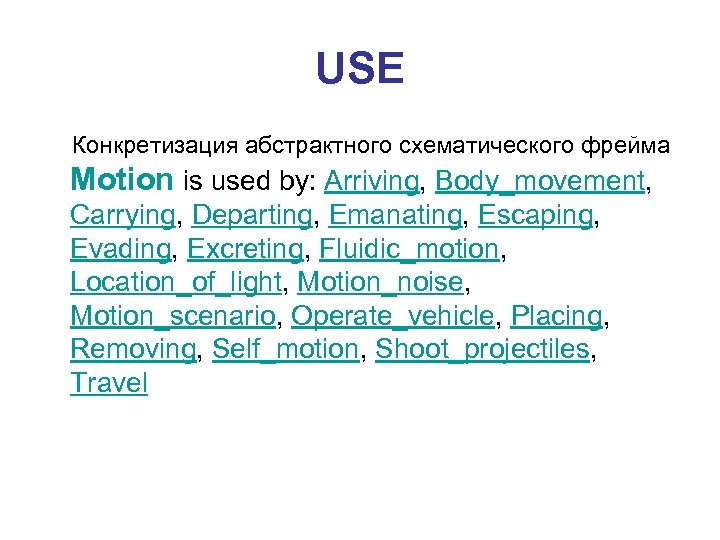 USE Конкретизация абстрактного схематического фрейма Motion is used by: Arriving, Body_movement, Carrying, Departing, Emanating, Escaping, Evading, Excreting, Fluidic_motion, Location_of_light, Motion_noise, Motion_scenario, Operate_vehicle, Placing, Removing, Self_motion, Shoot_projectiles, Travel
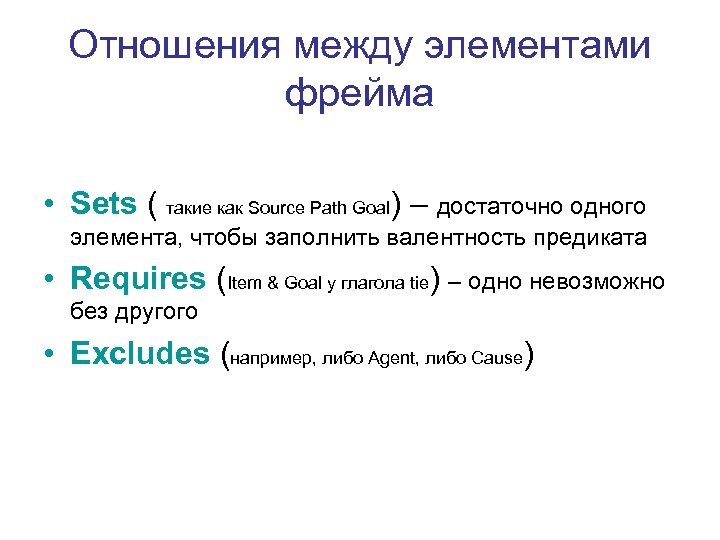 Отношения между элементами фрейма • Sets ( такие как Source Path Goal) – достаточно одного элемента, чтобы заполнить валентность предиката • Requires (Item & Goal у глагола tie) – одно невозможно без другого • Excludes (например, либо Agent, либо Cause)
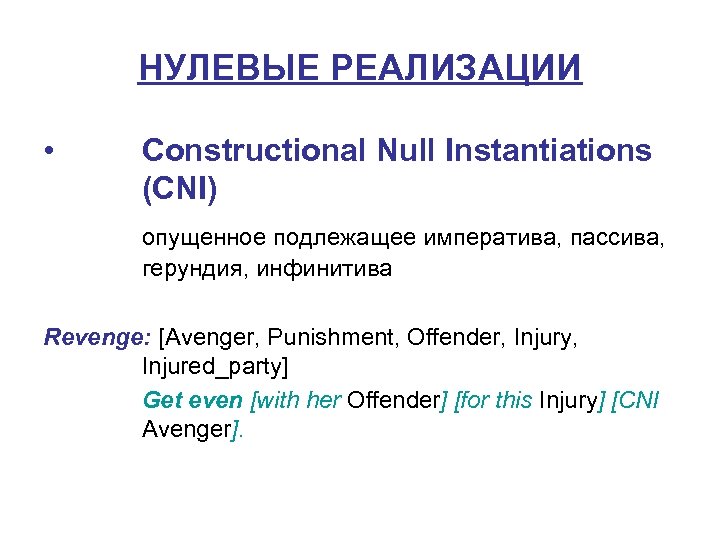 НУЛЕВЫЕ РЕАЛИЗАЦИИ • Constructional Null Instantiations (CNI) опущенное подлежащее императива, пассива, герундия, инфинитива Revenge: [Avenger, Punishment, Offender, Injury, Injured_party] Get even [with her Offender] [for this Injury] [CNI Avenger].
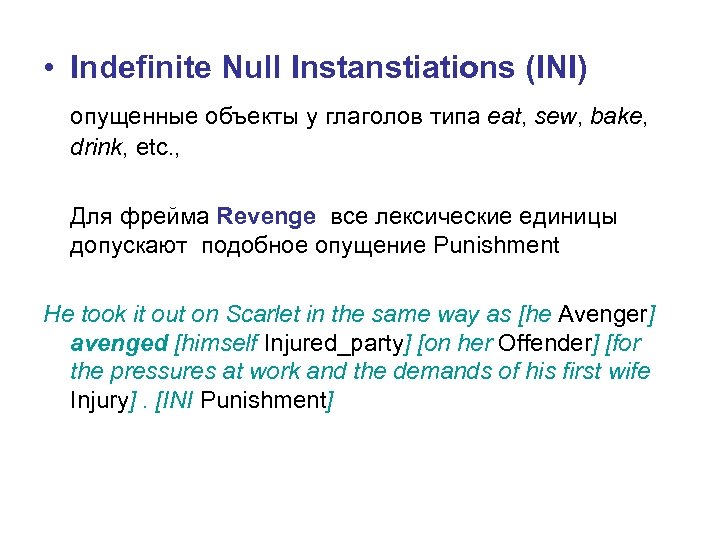 • Indefinite Null Instanstiations (INI) опущенные объекты у глаголов типа eat, sew, bake, drink, etc. , Для фрейма Revenge все лексические единицы допускают подобное опущение Punishment He took it out on Scarlet in the same way as [he Avenger] avenged [himself Injured_party] [on her Offender] [for the pressures at work and the demands of his first wife Injury]. [INI Punishment]
![• Definite Null Instanstiations нечто, что понятно из контекста. [The monkey Avenger] avenged](https://present5.com/presentation/7d66361691e77e883e6e763389bf6d45/image-19.jpg "• Definite Null Instanstiations нечто, что понятно из контекста. [The monkey Avenger] avenged") • Definite Null Instanstiations нечто, что понятно из контекста. [The monkey Avenger] avenged [himself Injured_party] [by growing to the size of a giant and setting fire to the city Punishment]. [Offender DNI].
• Definite Null Instanstiations нечто, что понятно из контекста. [The monkey Avenger] avenged [himself Injured_party] [by growing to the size of a giant and setting fire to the city Punishment]. [Offender DNI].
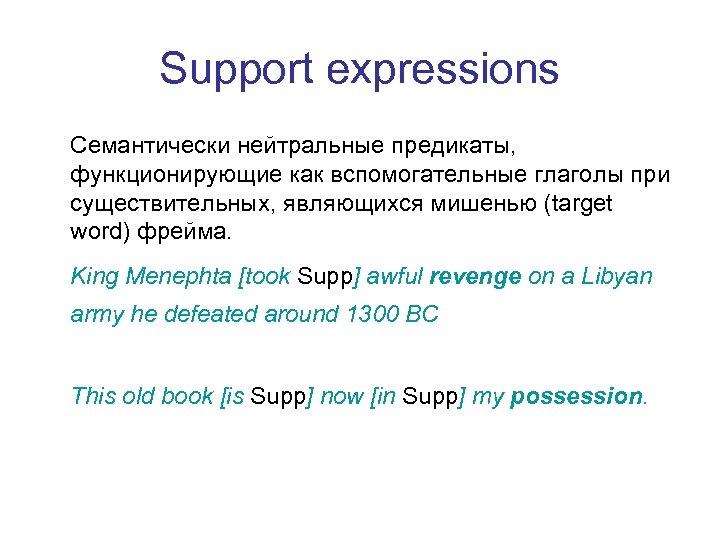 Support expressions Семантически нейтральные предикаты, функционирующие как вспомогательные глаголы при существительных, являющихся мишенью (target word) фрейма. King Menephta [took Supp] awful revenge on a Libyan army he defeated around 1300 BC This old book [is Supp] now [in Supp] my possession.
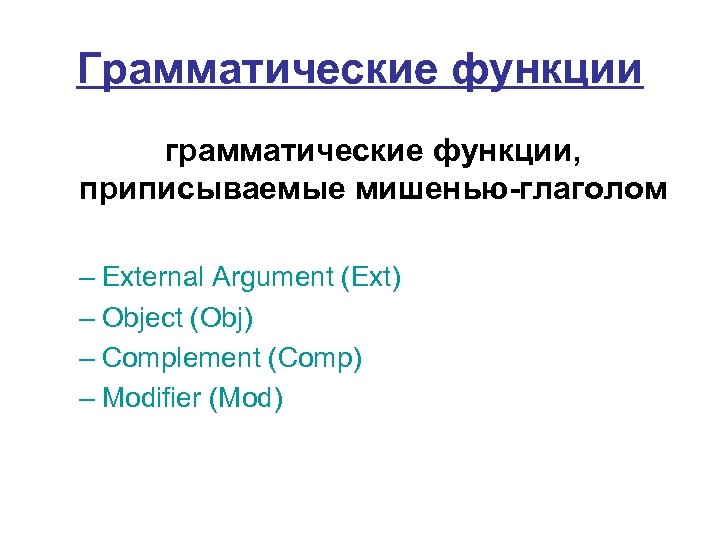 Грамматические функции грамматические функции, приписываемые мишенью-глаголом – External Argument (Ext) – Object (Obj) – Complement (Comp) – Modifier (Mod)
![Внешний аргумент (Ext) • подлежащее финитного глагола [The physician] performed the surgery; • подлежащее](https://present5.com/presentation/7d66361691e77e883e6e763389bf6d45/image-22.jpg "Внешний аргумент (Ext) • подлежащее финитного глагола [The physician] performed the surgery; • подлежащее") Внешний аргумент (Ext) • подлежащее финитного глагола [The physician] performed the surgery; • подлежащее или прямое дополнение контролера мишени: [The physician] decided to perform the surgery; • или его поссесивный модификатор: [The physician's] decision to perform the surgery. .
Внешний аргумент (Ext) • подлежащее финитного глагола [The physician] performed the surgery; • подлежащее или прямое дополнение контролера мишени: [The physician] decided to perform the surgery; • или его поссесивный модификатор: [The physician's] decision to perform the surgery. .
![Грамматические функции, приписываемые мишенью-прилагательным External Argument (Ext) [The chair] is red. – Head noun](https://present5.com/presentation/7d66361691e77e883e6e763389bf6d45/image-23.jpg "Грамматические функции, приписываемые мишенью-прилагательным External Argument (Ext) [The chair] is red. – Head noun") Грамматические функции, приписываемые мишенью-прилагательным External Argument (Ext) [The chair] is red. – Head noun modified by attributive adjective (Head) – Complement (Comp) Lee is certain [of his innocence ]. – Modifier (Mod)
Грамматические функции, приписываемые мишенью-прилагательным External Argument (Ext) [The chair] is red. – Head noun modified by attributive adjective (Head) – Complement (Comp) Lee is certain [of his innocence ]. – Modifier (Mod)
![Грамматические функции, приписываемые мишенью-предлогом • External Argument (Ext) [the day] before yesterday • Object](https://present5.com/presentation/7d66361691e77e883e6e763389bf6d45/image-24.jpg "Грамматические функции, приписываемые мишенью-предлогом • External Argument (Ext) [the day] before yesterday • Object") Грамматические функции, приписываемые мишенью-предлогом • External Argument (Ext) [the day] before yesterday • Object (Obj) We had a glass of wine before [the meal].
Грамматические функции, приписываемые мишенью-предлогом • External Argument (Ext) [the day] before yesterday • Object (Obj) We had a glass of wine before [the meal].
![Грамматические функции, приписываемые мишенью-существительным • External Argument (Ext) [He Ext] made a statement to](https://present5.com/presentation/7d66361691e77e883e6e763389bf6d45/image-25.jpg "Грамматические функции, приписываемые мишенью-существительным • External Argument (Ext) [He Ext] made a statement to") Грамматические функции, приписываемые мишенью-существительным • External Argument (Ext) [He Ext] made a statement to the press. • Complement (Comp) the fact [that cats have fur] a letter [to the President] your attempt [to scare me] • Genitive determiner (Gen) [your work's Gen] influence on the field • Modifier (Mod) [sleeping] cat • Appositive (Appos)
Грамматические функции, приписываемые мишенью-существительным • External Argument (Ext) [He Ext] made a statement to the press. • Complement (Comp) the fact [that cats have fur] a letter [to the President] your attempt [to scare me] • Genitive determiner (Gen) [your work's Gen] influence on the field • Modifier (Mod) [sleeping] cat • Appositive (Appos)
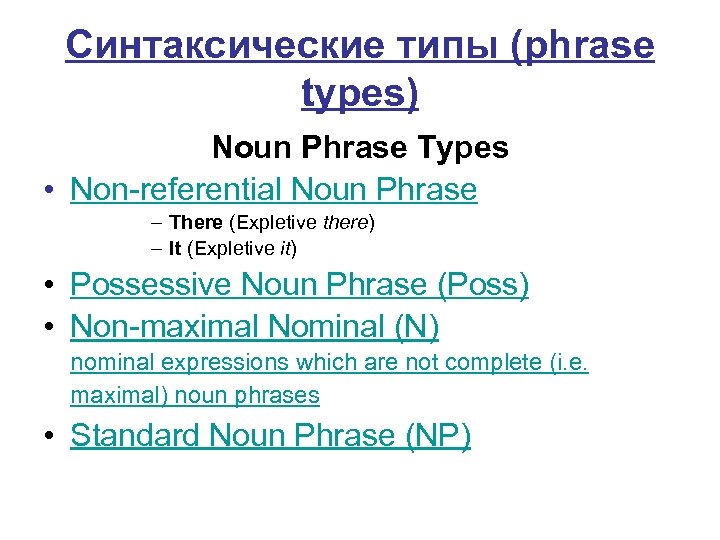 Синтаксические типы (phrase types) Noun Phrase Types • Non-referential Noun Phrase – There (Expletive there) – It (Expletive it) • Possessive Noun Phrase (Poss) • Non-maximal Nominal (N) nominal expressions which are not complete (i. e. maximal) noun phrases • Standard Noun Phrase (NP)
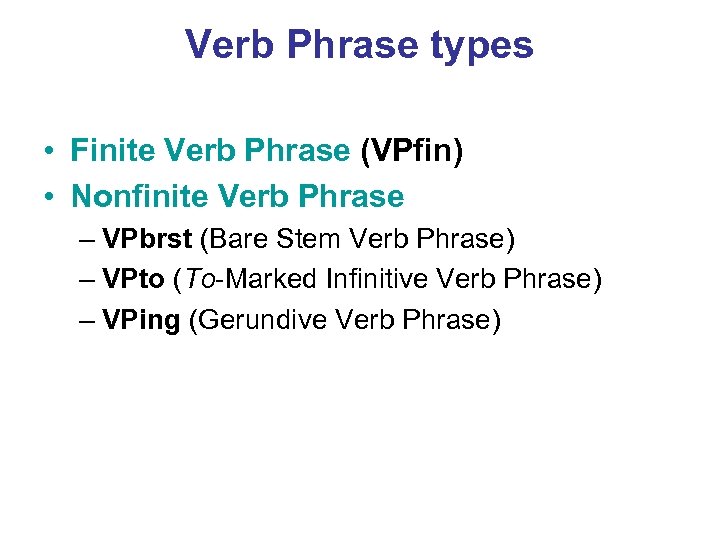 Verb Phrase types • Finite Verb Phrase (VPfin) • Nonfinite Verb Phrase – VPbrst (Bare Stem Verb Phrase) – VPto (To-Marked Infinitive Verb Phrase) – VPing (Gerundive Verb Phrase)
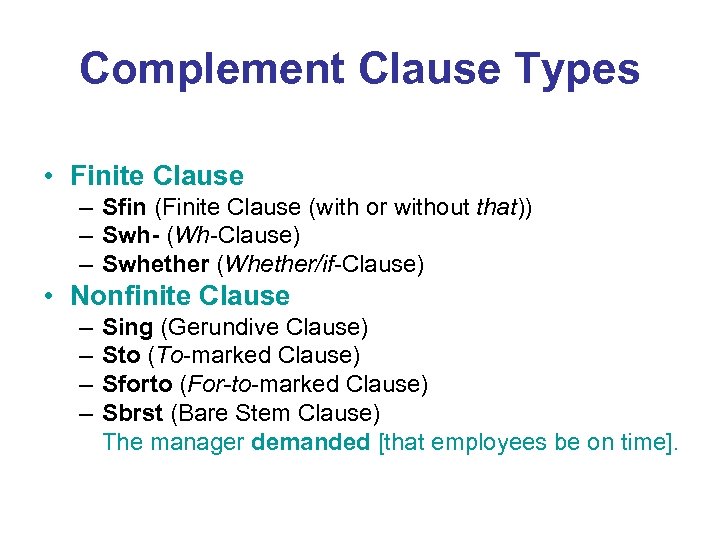 Complement Clause Types • Finite Clause – Sfin (Finite Clause (with or without that)) – Swh- (Wh-Clause) – Swhether (Whether/if-Clause) • Nonfinite Clause – – Sing (Gerundive Clause) Sto (To-marked Clause) Sforto (For-to-marked Clause) Sbrst (Bare Stem Clause) The manager demanded [that employees be on time].
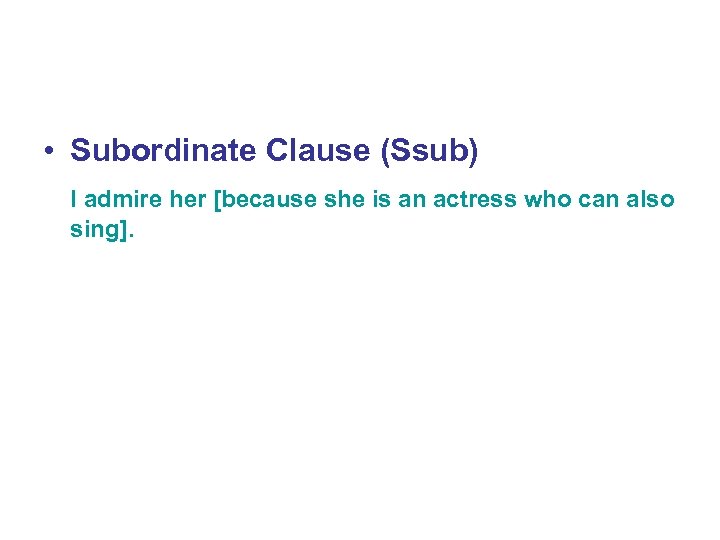 • Subordinate Clause (Ssub) I admire her [because she is an actress who can also sing].
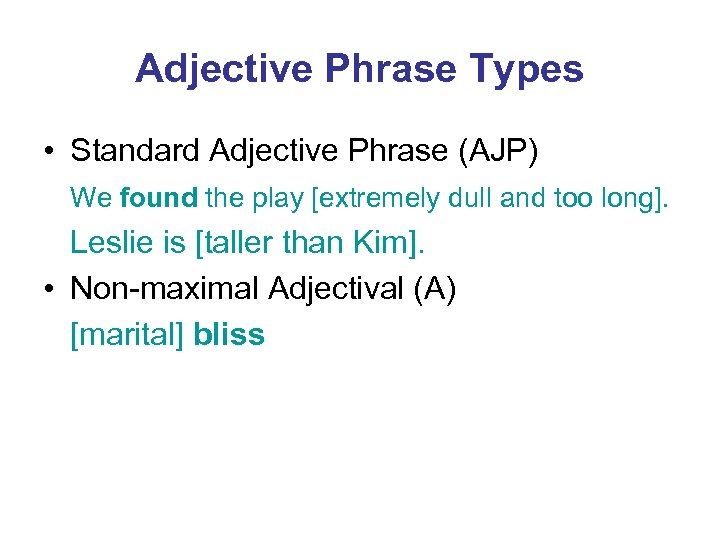 Adjective Phrase Types • Standard Adjective Phrase (AJP) We found the play [extremely dull and too long]. Leslie is [taller than Kim]. • Non-maximal Adjectival (A) [marital] bliss
![Phrase Type Labels for Adverb Phrases (AVP) The President answered the question [affirmatively]. Наречие](https://present5.com/presentation/7d66361691e77e883e6e763389bf6d45/image-31.jpg "Phrase Type Labels for Adverb Phrases (AVP) The President answered the question [affirmatively]. Наречие") Phrase Type Labels for Adverb Phrases (AVP) The President answered the question [affirmatively]. Наречие affirmatively выражает фреймовый элемент Message президент сказал «да» Поэтому ему приписывается синтаксический тип AVP, грамматическая функция Mod(ifier) и фрэймовый элемент Message.
Phrase Type Labels for Adverb Phrases (AVP) The President answered the question [affirmatively]. Наречие affirmatively выражает фреймовый элемент Message президент сказал «да» Поэтому ему приписывается синтаксический тип AVP, грамматическая функция Mod(ifier) и фрэймовый элемент Message.
![• Phrase Type Labels for Quantifiers (QUANT) Bob poured [two QUANT] cups of](https://present5.com/presentation/7d66361691e77e883e6e763389bf6d45/image-32.jpg "• Phrase Type Labels for Quantifiers (QUANT) Bob poured [two QUANT] cups of") • Phrase Type Labels for Quantifiers (QUANT) Bob poured [two QUANT] cups of coffee. Bob poured [thirty seven QUANT] cups of coffee at the brunch. Bob drank [a QUANT] glass of wine. • Phrase Type Labels for Quotes (QUO) Некоторые глаголы речи управляют цитатами: ["Get out of here!"] she cried. ["But, I, er, uh. . . "] he stammered.
• Phrase Type Labels for Quantifiers (QUANT) Bob poured [two QUANT] cups of coffee. Bob poured [thirty seven QUANT] cups of coffee at the brunch. Bob drank [a QUANT] glass of wine. • Phrase Type Labels for Quotes (QUO) Некоторые глаголы речи управляют цитатами: ["Get out of here!"] she cried. ["But, I, er, uh. . . "] he stammered.
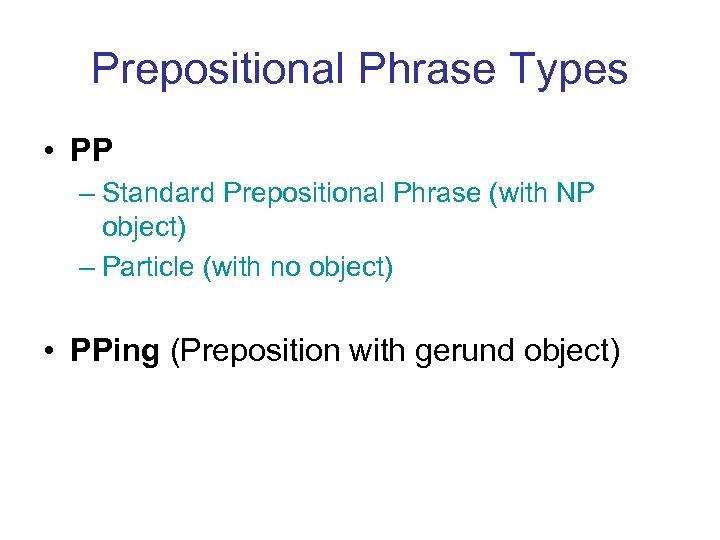 Prepositional Phrase Types • PP – Standard Prepositional Phrase (with NP object) – Particle (with no object) • PPing (Preposition with gerund object)