 Скачать презентацию Legislative Branch Ch 5 6 7 GPS
4576e3157972540d2e3db989eee2588b.ppt
- Количество слайдов: 63



Legislative Branch Ch 5, 6, 7
GPS SSCG 9 The student will explain the differences between the House of Representatives and the Senate, with emphasis on terms of office, powers, organization, leadership, and representation in each house.
GPS SSCG 10 The student will describe the legislative process including the roles played by committees and leadership. 1. 2. Explain the steps in the legislative process. Explain the function of various leadership positions within the legislature.
GPS l SSCG 11 The student will describe the influence of lobbyists (business, labor, professional organizations) and special interest groups in the legislative process. 1. 2. 3. Explain the function of lobbyists. Describe the laws and rules that govern lobbyists. Explain the function of special interest groups.
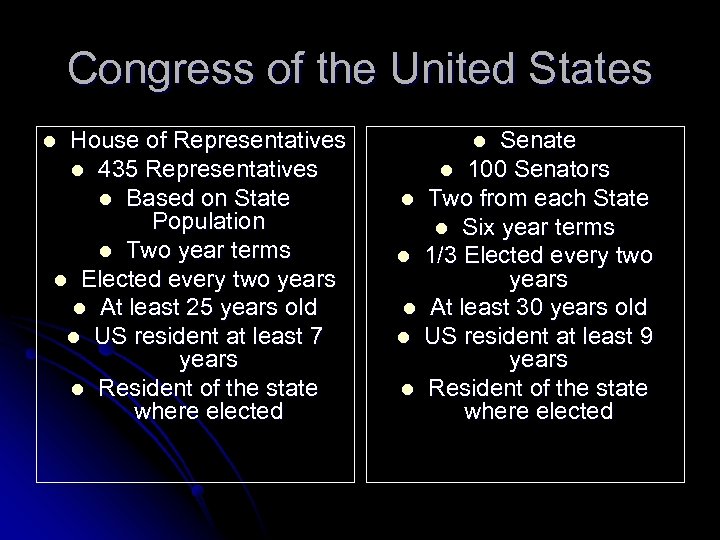
Congress of the United States House of Representatives l 435 Representatives l Based on State Population l Two year terms l Elected every two years l At least 25 years old l US resident at least 7 years l Resident of the state where elected l Senate l 100 Senators l Two from each State l Six year terms l 1/3 Elected every two years l At least 30 years old l US resident at least 9 years l Resident of the state where elected l
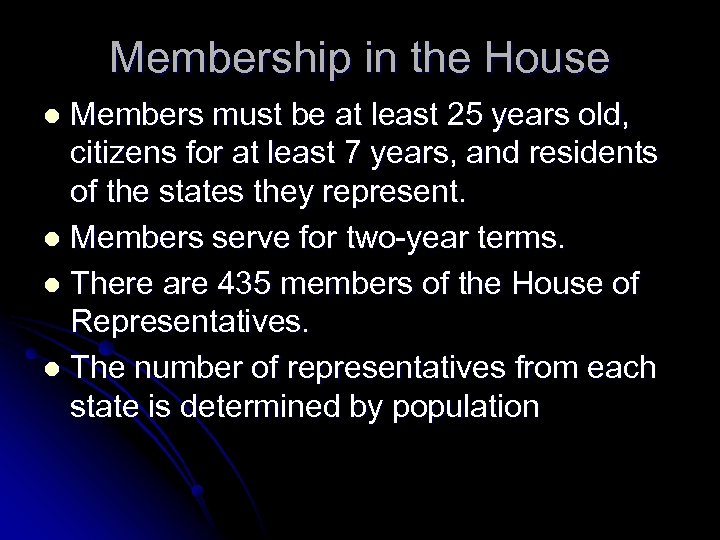
Membership in the House Members must be at least 25 years old, citizens for at least 7 years, and residents of the states they represent. l Members serve for two-year terms. l There are 435 members of the House of Representatives. l The number of representatives from each state is determined by population l
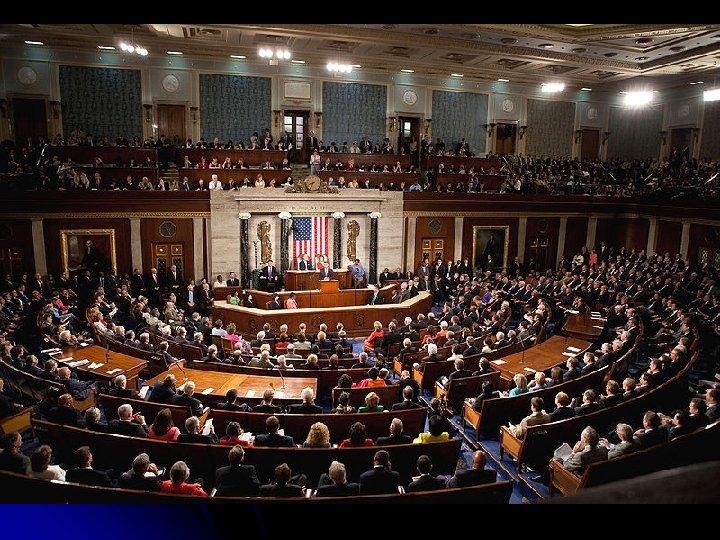
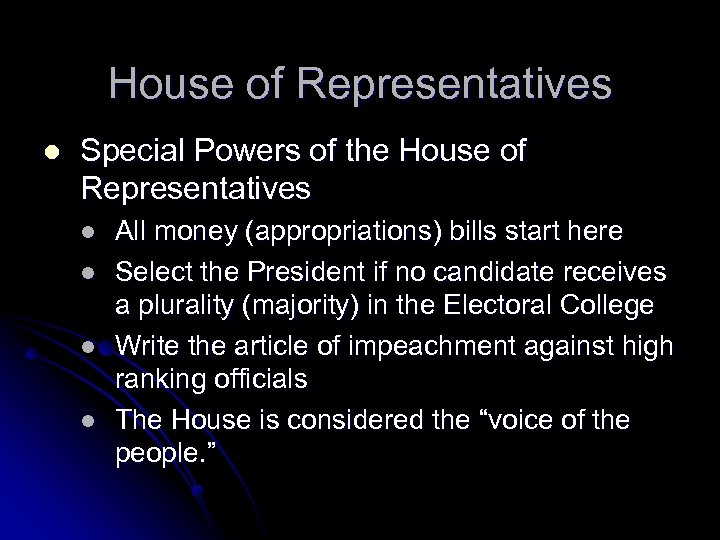
House of Representatives l Special Powers of the House of Representatives l l All money (appropriations) bills start here Select the President if no candidate receives a plurality (majority) in the Electoral College Write the article of impeachment against high ranking officials The House is considered the “voice of the people. ”
Apportionment l l l The seats in the House are divided amongst the population. Population is determined by a census, or official population count taken every 10 years. After each census, congress uses the new information to apportion, or distribute the seats. This is called redistricting.
Apportionment l l l Each congressman is to represent a roughly equal number of people. This is the idea of “one person, one vote. ” Sometimes state politicians draw district lines for political reasons. Gerrymandering is the practice of establishing district lines that favor one political party over the other. Named for Massachusetts governor Elbridge Gerry in 1811. Severs cases are unconstitutional.
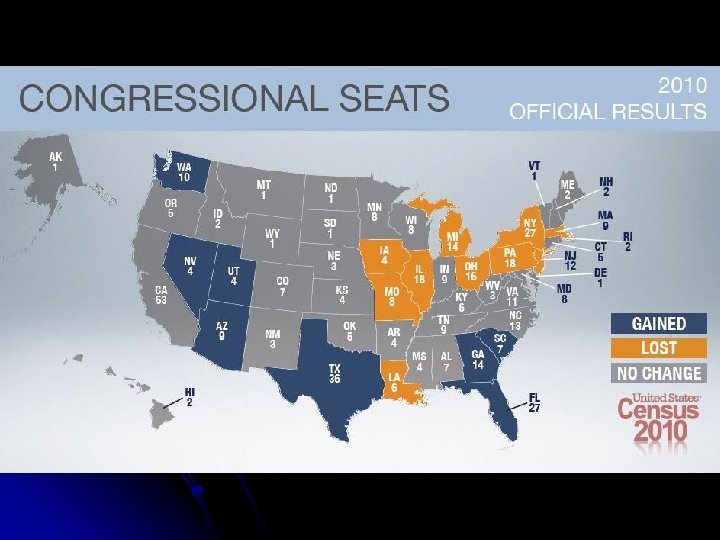
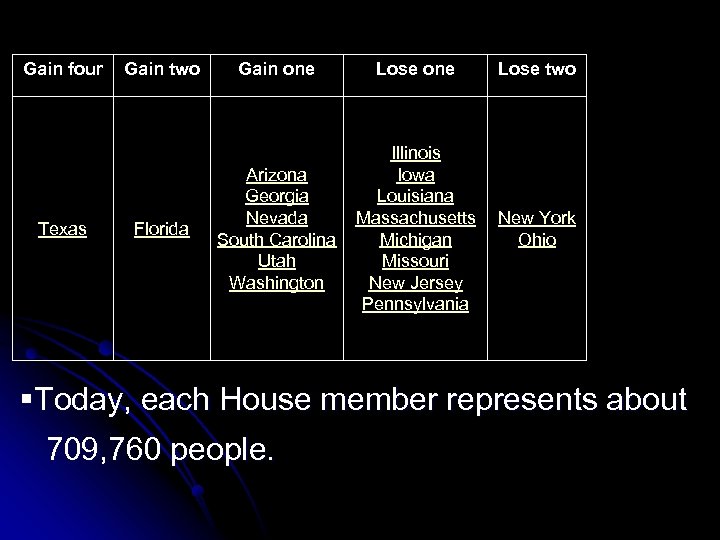
Gain four Texas Gain two Florida Gain one Lose two Arizona Georgia Nevada South Carolina Utah Washington Illinois Iowa Louisiana Massachusetts Michigan Missouri New Jersey Pennsylvania New York Ohio §Today, each House member represents about 709, 760 people.
Discussion Question § When the population increases, should Congress add more members to the House? Why or why not? § The size of the House is limited for more efficient government.
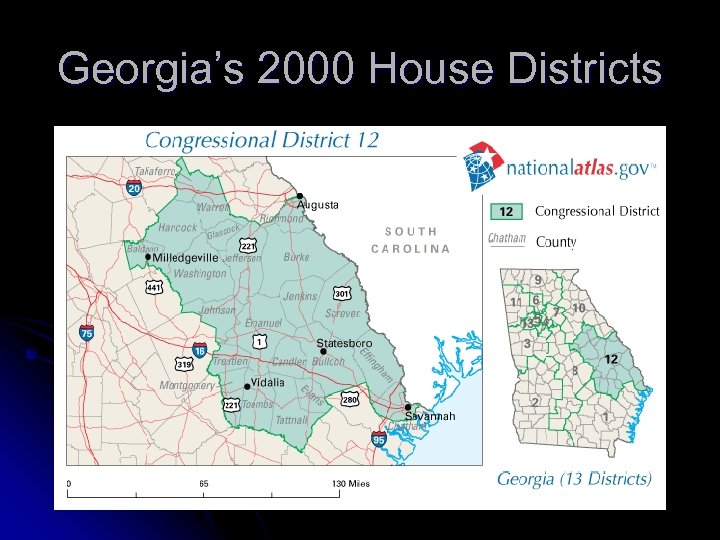
Georgia’s 2000 House Districts
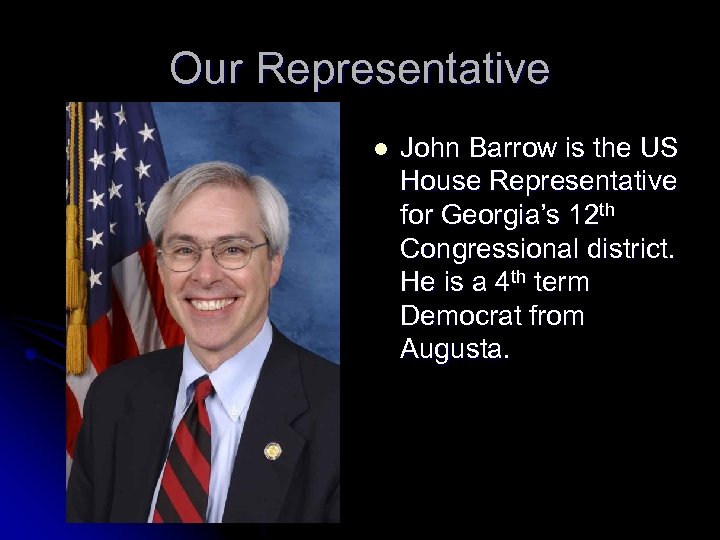
Our Representative l John Barrow is the US House Representative for Georgia’s 12 th Congressional district. He is a 4 th term Democrat from Augusta.
Membership in the Senators must be at least 30 years old, citizens for at least 9 years, and residents of the states they represent. l Senators serve for 6 -year terms; one-third are elected every two years. l Each state elects two senators. l
Senate l Special Powers l l Approves all treaties Approves all appointments Chooses the Vice President if no one receives a plurality in the Electoral College Acts as the jury in all trials of impeachment
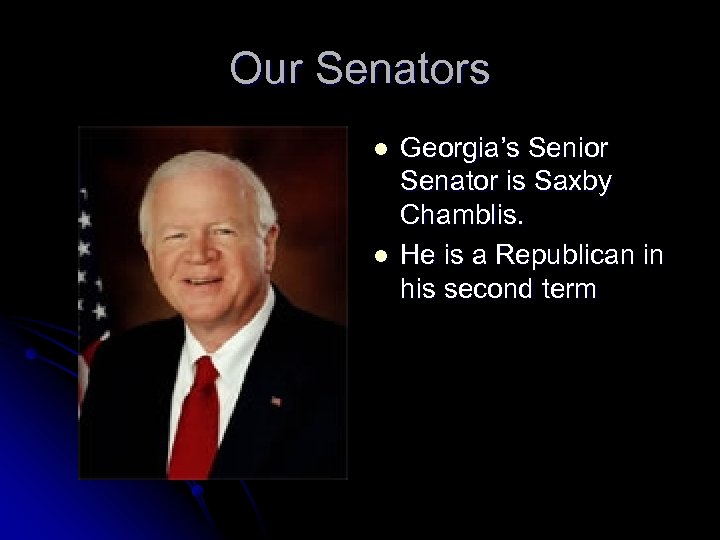
Our Senators l l Georgia’s Senior Senator is Saxby Chamblis. He is a Republican in his second term
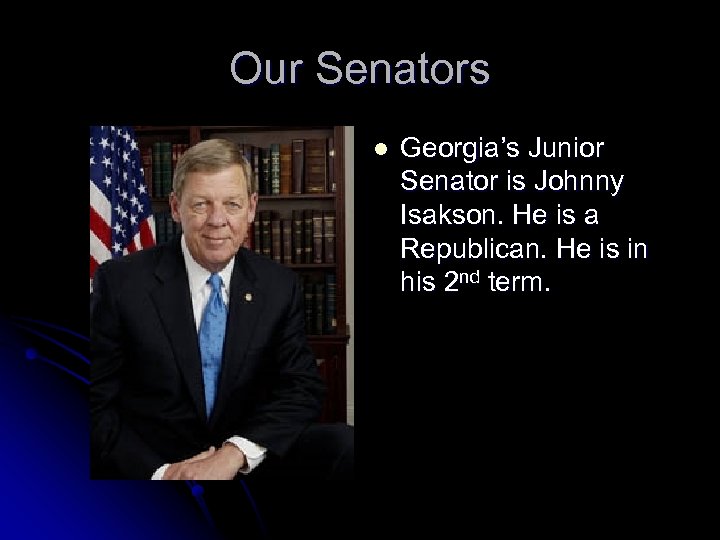
Our Senators l Georgia’s Junior Senator is Johnny Isakson. He is a Republican. He is in his 2 nd term.
Congress l l l Both houses: Must keep a Journal called The Congressional Record Must hold sessions at the same time: l l l Sessions begin January 3 rd each year. There are two sessions per term. Must have a quorum to do business: l 51% of members present on the floor
Duties of Congress l The roles of Congress are: 1. 2. 3. 4. 5. Uphold the Constitution Serve as committee members Represent and serve their constituents Serve as politicians Most importantly – Legislators (Make Laws)
Congressional Privileges l l l l Franking Privilege: postage for official mail Medical clinic and gymnasium Allowances to pay for office staff and assistants Income deductions to help maintain two residences Parking at Capital Retirement pensions available after 5 years of service Salary $174, 000 per year for non-leadership positions 27 th Amendment prohibits a sitting Congress from giving itself a pay raise
Protections and Immunities l Free from arrest in all cases except: 1. 2. 3. l treason felony breach of peace when they are attending Congress or on their way to or from Congress. Cannot be sued for anything they say on the House or Senate floor.
Punishments Congress punishes its own members l Censure is a vote of formal reprimand l Expulsion, or removal from office, is for serious crimes and requires 2/3 vote l
Congressional Vocabulary l l l Incumbent – candidate who already holds the office. Constituents – people who live in a congressman’s district that they represent. Quorum – minimal number who must be present for official business to take place. Filibuster – to stall the legislative process and prevent a vote. Cloture – process that allows each senator to speak only for one hour on a bill under debate.
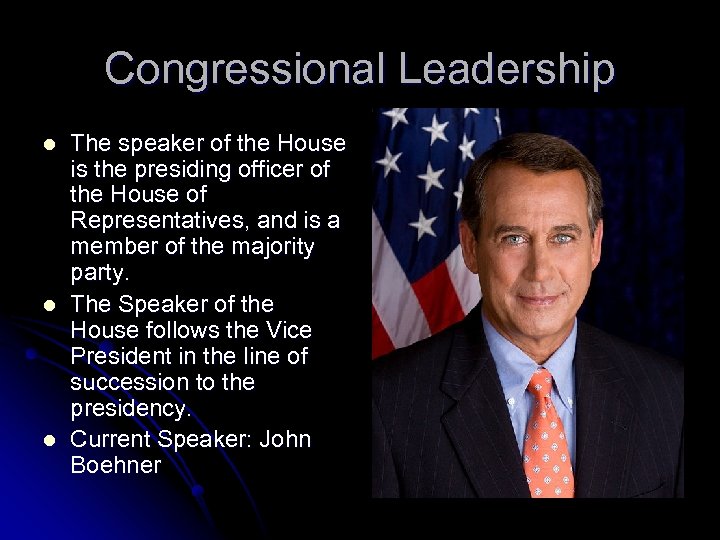
Congressional Leadership l l l The speaker of the House is the presiding officer of the House of Representatives, and is a member of the majority party. The Speaker of the House follows the Vice President in the line of succession to the presidency. Current Speaker: John Boehner
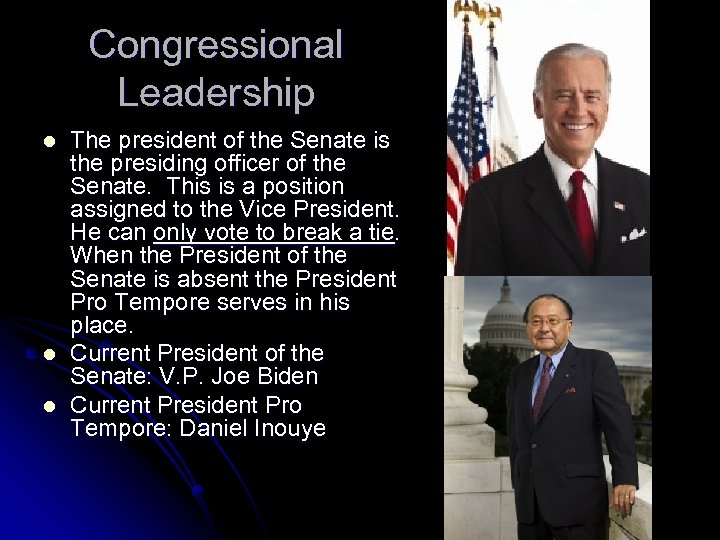
Congressional Leadership l l l The president of the Senate is the presiding officer of the Senate. This is a position assigned to the Vice President. He can only vote to break a tie. When the President of the Senate is absent the President Pro Tempore serves in his place. Current President of the Senate: V. P. Joe Biden Current President Pro Tempore: Daniel Inouye
Congressional Leadership l l Floor Leaders are picked to carry out party decisions and steer legislation to meet party goals. There are two floor leaders: l l House Majority Leader, Eric Cantor House Minority Leader, Nancy Pelosi
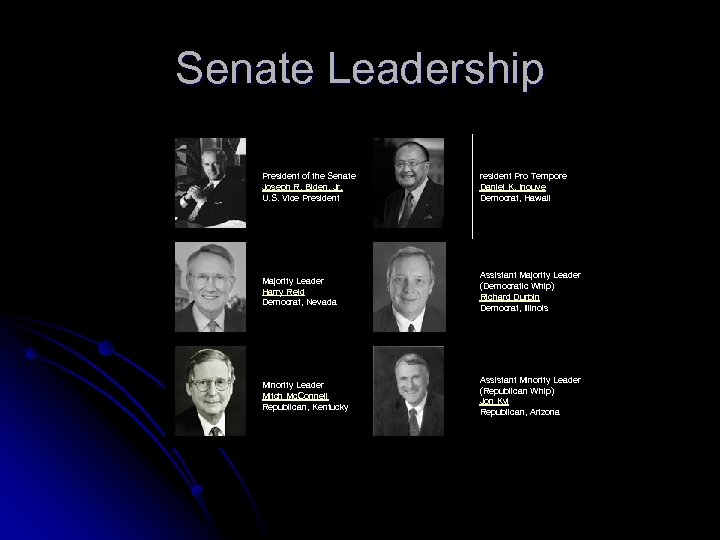
Senate Leadership President of the Senate Joseph R. Biden, Jr. U. S. Vice President Majority Leader Harry Reid Democrat, Nevada Minority Leader Mitch Mc. Connell Republican, Kentucky resident Pro Tempore Daniel K. Inouye Democrat, Hawaii Assistant Majority Leader (Democratic Whip) Richard Durbin Democrat, Illinois Assistant Minority Leader (Republican Whip) Jon Kyl Republican, Arizona
Congressional Leadership A whip is the assistant to the floor leader. They are responsible for monitoring and marshalling votes. l The party caucus is a meeting of party leaders and/or members who conduct party business. It deals with matters of party organization, selection of party leaders, and questions of committee membership. l
Committees A standing committee is a permanent committee. Standing committees deal with bills with a particular policy matter such as federal funding (appropriations) or foreign relations. l A select committee is a special group set up for a specific purpose and most often temporary. l
Committees l l l A conference committee is a temporary, joint body (made of both houses) created to iron out the differences in a bill. Committee chairmen are chosen by the majority party. He gets to direct the work of the committee. Seniority rule is an unwritten custom, which provides that the most important posts, in both formal and the party organization in each chamber will be held by its ranking members
Legislative Powers of Congress l l The Constitution gives Congress its expressed powers. The “necessary and proper clause” gives Congress implied powers. Known as the elastic clause it stretches the power of Congress There are different interpretation as to what “necessary and proper” means. Strict Constructionists believe that the government should not do any more than the Constitution specifically says it can do. Loose Constructionists believe that the federal government has the power to expand its authority for the good of the nation as a whole.
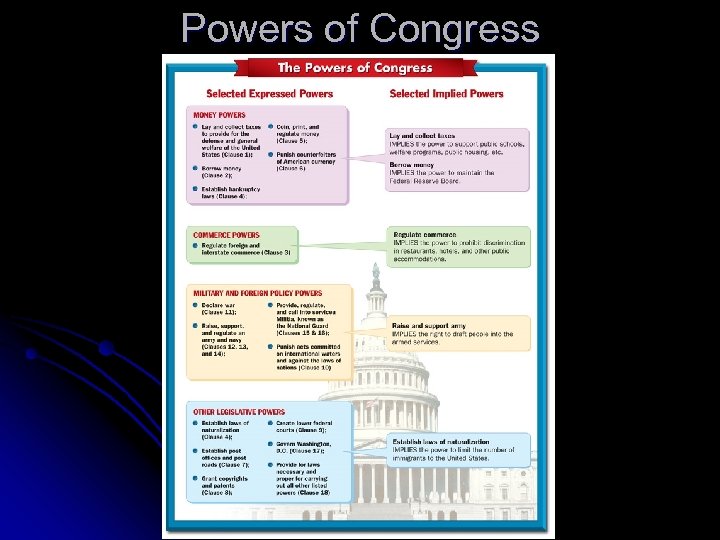
Powers of Congress
Powers of Congress l l l l l Raise and collect taxes Borrow money Regulate commerce Set laws for Naturalization and Bankruptcy Coin Money Punish counterfeiting Post office Copyrights and patents Set up courts l l l Declare war Establish the military and National guard Make rules and allot funds for the military and National guard Punish pirates Run Washington D. C. and all federal property Elastic clause- implied power
Powers denied Congress l l l Congress could not make laws concerning slave trade until 1808 Cannot suspend the writ of Habeas Corpus- must show cause for holding a suspect except in wartime No ex post facto law- cannot punish a person for an act committed before there was a law against it.
Powers denied Congress l l l No direct tax was originally allowed in the Constitution- the 16 th amendment allows income tax No tax on exports All states must be treated the same Congress must approve all expenditures of the President through laws No titles of nobility
Powers denied the States l l l l Cannot coin money Cannot have a state militia, troops, or navy Cannot make treaties No ex post facto law Cannot suspend the Writ of Habeas Corpus No import or export tax No titles of nobility Cannot pass any law that the Federal government is not allowed to pass
Powers of Congress 1. Taxing and spending l ALL revenue bills must start in the H. O. R Appropriations bills- laws to authorize spending money. 2. Other Money Powers l Borrow money l Sell government bonds and securities l Coin money and regulate its value l Bankruptcy laws
Powers of Congress (cont. ) 3. Commerce Powers: l Regulate foreign trade and interstate commerce l The case of Gibbons v. Ogden decided that the federal government, not the states, can regulate interstate commerce. l Commerce powers also give congress the power to regulate banking, broadcasting, finance, air and water pollution.
Powers of Congress (cont. ) 4. Foreign Policy Powers l Approve treaties l Declare war l Create and maintain an army and navy 5. National Growth l Naturalization laws l Admit new states l Govern territories l Govern federal property
Powers of Congress (cont. ) 6. Other Legislative Powers l Grant copyrights l Issue patents l Establish post offices l Establish federal courts
Nonlegislative Powers of Congress Power to choose a President: No electoral college majority 2. 25 th Amendment – allows President to choose a new vice president with approval of Congress. 3. Confirmation Powers: Senate has power to approve officials appointed by the president. 4. Ratification Powers: Senate ratifies treaties. 1.
Nonlegislative Powers of Congress (cont. ) 5. Amendment Power: Congress shares with state legislatures the power to propose and ratify constitutional amendments. l Proposed by 2/3 vote of Congress l ¾ of states must ratify
Nonlegislative Powers of Congress (cont. ) l Impeachment: a formal accusation of misconduct in office l Majority of H. O. R. Must vote to impeach l Senate conducts the trial l 2/3 votes is required to conviction and removal from office l Chief Justice presides over the Senate if President is being tried.
Power to Investigate Investigative powers: 1. Issue a subpoena: a legal order to a person appear or produce documents 2. Require witnesses to testify under oath: can arrest someone if he refuses (Contempt) 3. Grant immunity: freedom from prosecution in exchange for testimony. l Congress uses the power of legislative oversight to weigh how well the executive branch carries out its laws. l
General Accounting Office A major legislative oversight tool is the General Accounting Office (GAO) l Routine financial audits l Investigates agencies and policies l Makes recommendations on all aspects of government l
Congressional Budget Office l l l Congressional Budget office (CBO) Created in 1974 Advises Congress on the possible economic effects of spending programs Provides information on the cost of proposed legislation Prepares analysis of President’s budget and economic projections Aids Congress in budget debates
Cooperation and Conflict l l l The members of Congress represent local, more narrow interests than the president. Congressmen have to keep a smaller number of constituents happy. Partisan differences often cause conflict.
The Struggle for Power l l l The balance of power has shifted back and forth between Congress and the president. Congress can limit or end the emergency powers it has granted the president. Congress has reduced the president’s power in planning the budget and spending appropriated money.
Types of Bills and Resolutions l l l Public bills involve national issues Private bills deal with individual people or places. Resolutions may be passed by either house or by both houses jointly. Both houses pass concurrent resolutions, which do not have the force of law and do not need President’s signature. A rider is a provision attached to a bill on an unrelated subject.
Types of Bills and Resolutions Only a few bills become laws because: 1. the process is long and complex; 2. measures must have broad support; 3. supporters must be willing to compromise; 4. many bills are introduced that have no chance of passing. l
How a Bill Becomes Law 1. 2. 3. 4. 5. The bill is introduced by a member of Congress. The bill is referred to the appropriate committee. The committee holds hearings on the bill. The bill is amended. The bill is reported for floor consideration.
How a Bill Becomes Law 5. 6. 7. 8. 9. 10. The bill is debated and amended. The bill is passed by a majority of the house. The bill is sent to the other house. Steps 2 – 7 are repeated in the other house. The bill is sent to a conference committee. A compromise bill is sent to each house for final action.
How a Bill Becomes Law 11. 12. 13. 14. 15. The compromise bill is passed in each house. The bill is sent to the president. It becomes a law if the president signs it or keeps it for 10 days without signing it. The president may kill it with a veto or a pocket veto. Congress may override the president’s veto with 2/3 approval of both houses.
Did You Know? l Members of Congress often promote spending bills that benefit their district or state. For example, in 1997 Senator Richard Shelby of Alabama added a measure to the House appropriations bill to spend $3 million for fertilizer research in Alabama. Senator Kay Bailey Hutchison of Texas added a bill to build a new commuter lane on a bridge in El Paso. Both senators were important members of the Senate Appropriations Committee, and their efforts were successful.
Appropriating Money l l Congress uses a two-step procedure in appropriating money: 1. an authorization bill, setting up a federal program and specifying how much money may be spent on it; 2. an appropriations bill, providing the money needed to carry out the program or law. Each house of Congress has an appropriations committee.
Uncontrollable Expenditures are money has been previously committed by past Congresses l Called uncontrollable because government is legally committed to spend the money l EX: Social Security, National debt, federal contracts… l
Influences on Lawmakers’ views on decisions are seldom based on individual conscience. l Voters back home, lawmakers’ staff members, lawmakers’ own political parties, the president, and special-interest groups all influence lawmakers’ views. l
Influences on Congress Interest groups and their lobbyists represent various interests, including labor and business groups, education and environmental organizations, and minority groups. l Political action committees (PACs) are political fund-raising organizations that give their funds to support lawmakers who favor the PAC’s position. l
Handling Problems Caseworkers on lawmakers’ staffs help them deal with voters’ requests for help. l Lawmakers spend a great deal of time on casework because responding to voters helps them get reelected, casework brings problems with federal programs to lawmakers’ attention, and caseworkers help citizens cope with the huge national government. l
Helping the District or State Lawmakers bring federal projects and money to their districts and states through pork-barrel legislation, federal grants and contracts, and keeping federal projects. l Congress appropriates billions of dollars for local projects that can bring funds and jobs to districts and states l
Did You Know? l Critics say that the “pork” in “pork-barrel legislation” is used to “grease” the wheels of government. By that, they mean that when Congress appropriates millions of dollars for local projects, such as hydroelectric dams, environmental cleanup programs, and mass transit projects, it does so for two reasons: to help districts and states provide services and, just as important, to improve their own chances of being reelected.
Скачать презентацию Legislative Branch Ch 5 6 7 GPS
4576e3157972540d2e3db989eee2588b.ppt