


 Скачать презентацию Legislative and Regulatory Update US Federal and State
1ba72755795b73dfde461dc69d191a25.ppt
- Количество слайдов: 31
 Legislative and Regulatory Update: US Federal and State Initiatives IERI Electronics Recycling Education Program Jason Linnell Executive Director National Center for Electronics Recycling
 Overview • NCER Background • State Implementation Status • State Activity 2006 • Federal Activity 2006 • Trends/Outlook
 National Center for Electronics Recycling • Mission: dedicated to the development and enhancement • • of a national infrastructure for the recycling of used electronics in the U. S. through 1) the coordination of initiatives targeting the recycling of used electronics in the United States, 2) participation in pilot projects to advance and encourage electronics recycling, and 3) the development of programs that reduce the burden of government through private management of electronics recycling systems. Non-profit 501 c 3 Located in Parkersburg, WV area (Davisville) – Polymer Tech Park
 State-Level Policy Activities
 How are states handling the challenge? • Four programs with mandatory financing – CA, ME, MD, and WA • Others with active study commissions – MO, IL, RI, LA • Upcoming or recent disposal bans – MN, NH, RI, AR (others MA, CA) • Coordinated regional policy strategy – Northeast States: CT, DE, MA, NH, NJ, NY, PA, RI, VT – Midwest States: MN, MI, IL, WI, IA
 California • Two bills vetoed in 2002 – ARF of $15 • SB 20 adopted 2003/Amended 2004 by SB 50 • Point of sale fee on certain video display devices with screens > 4” diagonal – $6, $8, or $10 depending on screen size – All “consumers” covered • Effective January 1, 2005 on covered electronic devices (CEDs) designated by DTSC – CRT devices (TVs & monitors) – LCD devices (laptops and monitors) – LCD and Plasma TVs added July 1, 2005
 CA Law – Recycling System • Collection and Recycling Payments from State – Authorized collector - $0. 20/lb – Authorized recycler - $0. 28/lb • Payments only authorized for covered devices • collected on or after 1/1/05 from CA sources (defined as users of the device in CA) “Cancellation” activities (crushing, shredding, dismantling) must occur within CA
 CA Law – Operations to Date • Approved Collectors: 441 • Approved Recyclers: 48 (some dual collectors) • In 2005: BOE collected million $73 million • Claims approved for payment: $31 million or 65 m lbs – 1. 79 lbs/capita in 2005 • Fees collected through 6/30/06 (estimate): – $33. 3 million As of July 2006
 Implementation in California • 20, 000 retailers; 28, 500 locations registered to • • collect fee 90% of fees from 300 large retailers filing monthly; 8 -9, 000 active quarterly filers 2006: 1 st quarter pounds claimed 3 X’s 1 st quarter 2005 – 97 -98% claims for CRTs, rest “Other CEWs” • Total govt admin costs through 6/30/06: $11. 6 million – 10. 9% of fees collected – Retailers kept $3. 3 million
 Maine • Passed in 2004: covers TVs and computer monitors (includes laptops) from Maine households – Desktops only covered by brand labeling requirement • Municipalities collect from household, send/contract to consolidators (facility or pickup) – Collection from household not funded by system • Consolidators count brands, follow ESM guidelines, bill manufacturers for actual count + orphan share • Manufacturers submit compliance plans, file reports, pay invoices from all (5) consolidators for “allowable costs”
 Maine Law: Orphans • Orphans: “Covered electronic device, the • manufacturers of which cannot be identified or is no longer in business and has no successor in interest” DEP has to identify manufacturer “pro rata share” of orphans, provide to consolidators – So far, 157 brands “orphan” by DEP – Only for OEMs over 1% total return share by product • Example: OEM A has 20% pro rata monitor share; consolidator collects 1000 OEM A claimed brand monitors and 100 total orphan monitors – OEM A billed for 1020 monitors at “reasonable cost” rate
 Maine: Implementation • Manufacturer plans required by 3/1/05 • • • – Collection plan, claim brands, still coming in As of September 26 – 347 brands claimed from – 149 manufacturers 21 manufacturers with 28 brands on “DO NOT SELL” list (9/26/06) Quirks, mis-identified, still researching
 Maine • Began 1/18/06 • 5 consolidators approved, 2 up and running • Manufacturers receiving bills based on actual count + orphan share (29 manufacturers with share) • 2 staff managing program, plus staff at consolidator – tracking brands, invoicing OEMs • No recycling data until after October, when consolidator reports due
 Maryland Computer Recycling Law • HB 575 passed in 2005 • Creates a statewide computer recycling pilot program for 5 years – Effective January 1, 2006, Ends 12/31/10 • Registration and fee required for manufacturers of more than 1, 000 computers per year – 1000 can be sold anywhere, not just in MD • Computers defined as: “desktop personal computer or laptop computer, including the computer monitor“ – Like CA/ME, covered products must be brand labeled
 Maryland Recycling Law cont’d • Initial Registration fee for all OEMs $5000, then: – $5, 000 if manufacturer does NOT implement a computer take-back program – $500 if manufacturer DOES implement a program • Takeback program guidelines flexible • Registration money into state recycling trust fund – Used to provide collection/recycling grants to local governments • First year for education campaign, not recycling grants • Registered Manufacturers as of 6/30/06: – 37 Companies, or $185, 000
 Washington • Signed by governor on 3/24/06 – 4 th major state electronics recycling program – Different than other 3 in significant ways • Producer Responsibility with default – Manufacturer responsible for “equivalent share” either on own or pay into State TPO – No collection goal, but must meet your % at year’s end or pay penalty (refund if collecting more than %) • Orphans must be calculated by DOE – Covers CA/ME products + Desktops – Ban on exports to developing countries according to Basel Convention [VETOED] – Programs must be effective Jan 2009
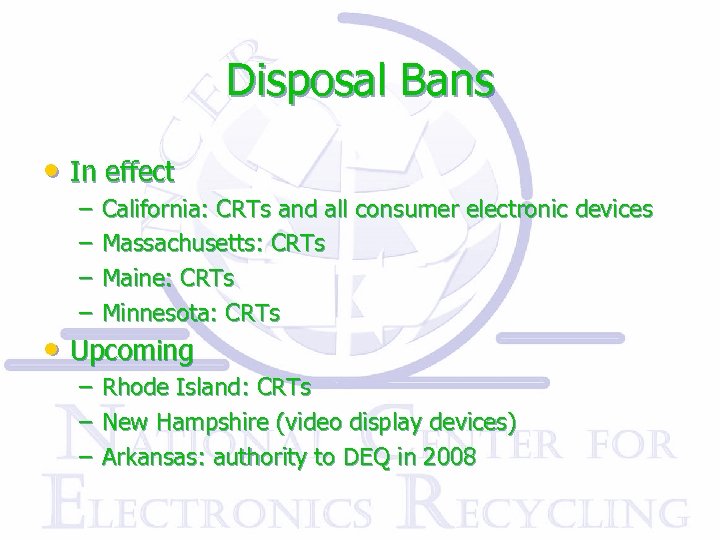 Disposal Bans • In effect – – California: CRTs and all consumer electronic devices Massachusetts: CRTs Maine: CRTs Minnesota: CRTs – – – Rhode Island: CRTs New Hampshire (video display devices) Arkansas: authority to DEQ in 2008 • Upcoming
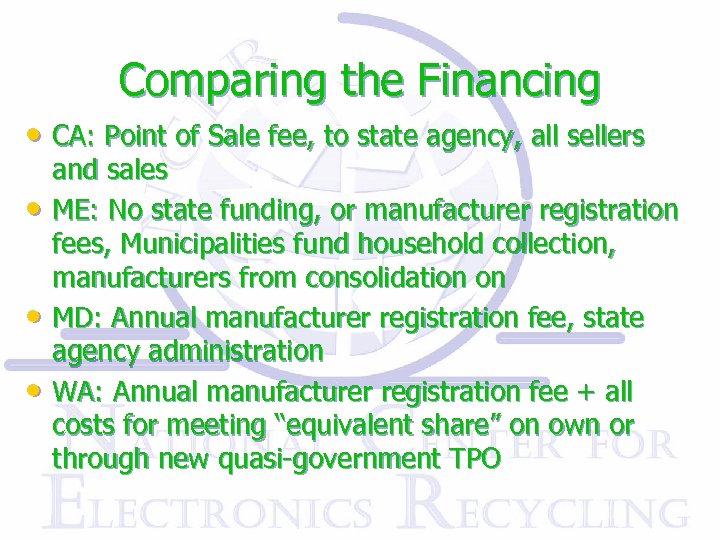 Comparing the Financing • CA: Point of Sale fee, to state agency, all sellers • • • and sales ME: No state funding, or manufacturer registration fees, Municipalities fund household collection, manufacturers from consolidation on MD: Annual manufacturer registration fee, state agency administration WA: Annual manufacturer registration fee + all costs for meeting “equivalent share” on own or through new quasi-government TPO
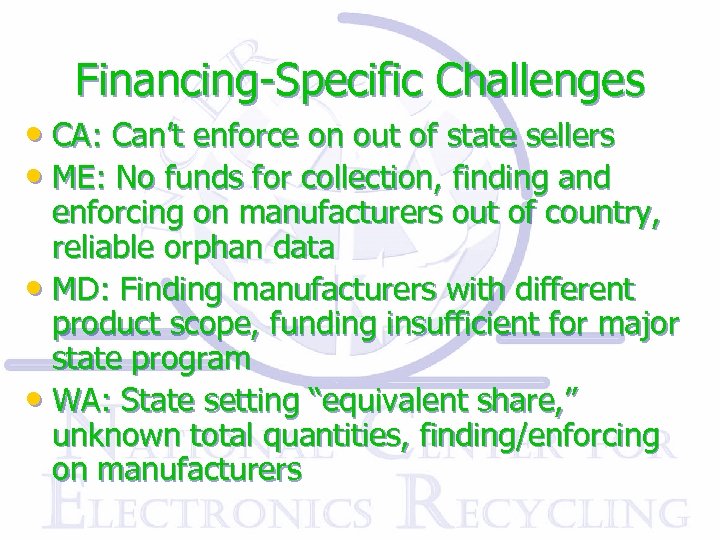 Financing-Specific Challenges • CA: Can’t enforce on out of state sellers • ME: No funds for collection, finding and enforcing on manufacturers out of country, reliable orphan data • MD: Finding manufacturers with different product scope, funding insufficient for major state program • WA: State setting “equivalent share, ” unknown total quantities, finding/enforcing on manufacturers
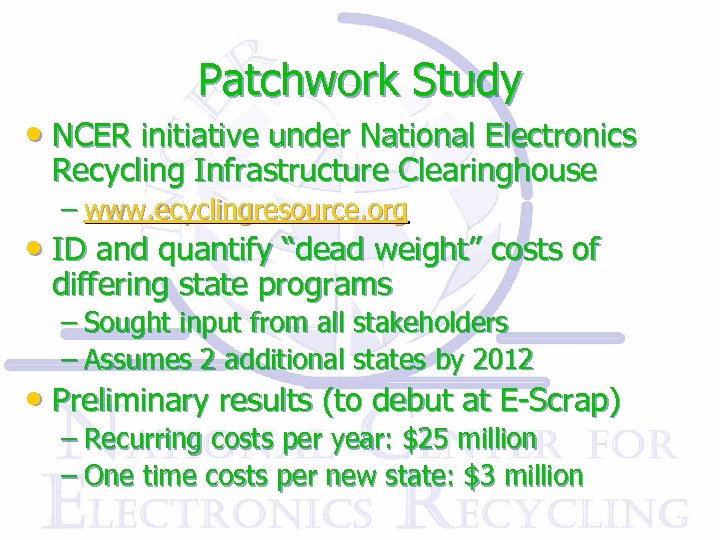 Patchwork Study • NCER initiative under National Electronics Recycling Infrastructure Clearinghouse – www. ecyclingresource. org • ID and quantify “dead weight” costs of differing state programs – Sought input from all stakeholders – Assumes 2 additional states by 2012 • Preliminary results (to debut at E-Scrap) – Recurring costs per year: $25 million – One time costs per new state: $3 million
 Proposed Legislation 2006
 Legislation in 2006 • Over 25 states have introduced – Not including carryover bills from 2005 • Types of Bills – Advanced recovery fees – at POS and Manufacturer/first point of possession • With and without TPO – Producer responsibility, many variations – Studies, commissions & task forces – Landfill &/or incineration bans – California amendments (product scope, material restrictions)/Maine amendments
 Regional Model Legislation and Study Committees
 NERC/Council of State Governments • Northeast Recycling Council/Council of State Governments Initiative • 10 states coordinated to develop on regional electronics recycling model legislation • New England (including Maine), New York, New Jersey, Pennsylvania, Delaware
 NERC/Council of State Governments • Status – Introduced in Delaware, NY • Basic elements – Same scope as WA bill- desktop, monitors, TVs • Financing model: – Manufacturer pays $5 k registration to State, AND – Fee for its “obligation” OR collect/recycle equivalent amount; formula for obligation based on recycling rate – TPO optional for state, can coordinate with multi-state entity
 Midwest Regional Electronic Waste Recycling Policy Initiative • State agencies, not legislators worked on regional model similar to NERC/ERC: Minnesota, Michigan, Illinois, Wisconsin, Ohio, and Iowa • Drafted legislation, but released “policy statement” • Elements of policy statement: – Same product scope as NERC/ERC and WA – Manufacturer pays registration fee and must collect/recycle their obligation; own program or fee to state – Obligation based on previous year’s sales – States may choose to authorize TPO and/or multi-state entity
 Federal Legislative Activity
 Congressional Hearings! • 2005: E-Waste Working Group formed – four House Representatives – 2 Hearings in House, one in Senate • Bills in House and Senate, not moving – 1 ARF, two based on tax credits for manufacturers and/or consumers • Meeting held September 13 – Another scheduled for mid-November – Goal of WG is legislation introduced next session
 Other Federal Activity • EPA Baseline Data Report • Department of Commerce Report • Government Accountability Office 2005 Report
 Conclusions/Outlook • More to learn in 2007 – CA implementation compared to MD/ME – Maine/Maryland begin implementation – Movement towards WA implementation • More state programs? – MA, MN, WI, MI, OR – Pressure on RI, NH from 2006 bills – Will NERC/ERC model move in Northeast? • Will Congress move on legislation? – Funding hard to come by in current climate – Will increasing state differences lead to more national action?
 Thank You! Jason Linnell NCER Phone: (304) 699 -1008 jlinnell@electronicsrecycling. org