 Скачать презентацию Legislative and Advocacy Activities Lisa Robin Certified Medical
00b62671287acc6f19321d94ff676112.ppt
- Количество слайдов: 21



Legislative and Advocacy Activities Lisa Robin Certified Medical Board Executive Institute October 27, 2016
Establishing an FSMB DC Office • Despite legislative successes, FSMB recognized opportunities being missed and visibility being limited by maintaining the status quo • Seeking to raise FSMB’s profile as a health policy leader while protecting the principles of SMBs, the Board of Directors, in 2009, approved a pilot D. C. office project with the following objectives: — Establish FSMB’s presence as a national stakeholder — Develop a comparable operation to other major health orgs. — Meet regularly with Congressional and Administration officials, and participate in coalitions/task forces — Increase exposure and provide for rapid response — Build and expand FSMB’s network, partnerships, and grassroots
FSMB’s D. C. Office PURPOSE: • To maintain an ongoing presence in Washington with legislators, policymakers, media, & key stakeholders LOCATION: • Formally opened January 2010 with offices at 1110 Vermont Avenue within Prime Policy, the FSMB’s government relations firm • Relocated to 1300 Connecticut Avenue in March 2013 with convenient proximity to Capitol Hill
FSMB’s D. C. Office Staff: • • Humayun Chaudhry, DO, MACP, President (Texas and DC) Lisa Robin, Chief Advocacy Officer Jonathan Jagoda, Director, Federal Government Relations Shiri Hickman, Director, State Policy and Legal Services Natalie Weiner, Legislative Associate Eric Fish, Sr. Vice President, Legal Services John Bremer, State Legislative and Policy Coordinator Joe Knickrehm, Communications and Public Affairs Manager
A Player on the National Stage • Meetings with the Administration and Congressional Offices • Department of Health and Human Services —Health Resources and Services Administration National Practitioner Data Bank v Office for Rural Health Policy v —Centers for Disease Control and Prevention (CDC) —Centers for Medicare and Medicaid Services (CMS) —U. S. Surgeon General —Office of the National Coordinator of Health IT (ONC) —Office of the Inspector General (OIG) —National Institutes of Health (NIH) —Substance Abuse and Mental Health Services (SAMHSA) • Government Accounting Office (GAO)
Outreach § D. C. is a “networking town” that requires developing and maintaining relationships with health organizations § FSMB has established relationships with associations including: Assoc. Of American Medical Colleges AOA (D. C. Office) American Academy of Dermatology AMA (D. C. Office) American Society of Anesthesiologists American Telemedicine
2016 Federal Legislative Priorities • Seeking introduction and enactment of State Licensing Board Antitrust Act of 2016 • FSMB retained top antitrust lobbyists to establish the Professional Licensing Coalition (PLC) • Legislation seeks to shield state professional and occupational licensing boards and their staff members from damage awards (trebled under the antitrust laws) • Effort is in response to lack of clarity from U. S. Supreme Court’s February 2015 decision in North Carolina State Board of Dental Examiners v. FTC
Professional Licensing Coalition • Professional Licensing Coalition (PLC) Membership • • • American Association of Veterinary State Boards (AAVSB) Association of Social Work Boards (ASWB) Association of State & Provincial Psychology Boards (ASPPB) Board of Certification for the Athletic Trainer (BOC) Council of Landscape Architectural Registration Boards (CLARB) Federation of Associations of Regulatory Boards (FARB) Federation of State Boards of Physical Therapy (FSBPT) Federation of State Medical Boards (FSMB) National Association of State Boards of Accountancy (NASBA) National Board for Certification in Occupational Therapy (NBCOT) National Council of Architectural Registration Boards (NCARB)
NDAA • National Defense Authorization Act (NDAA) • FSMB working with AMA, AOA, and other stakeholders to oppose Sec 705. Enhancement of Use of Telehealth Services in Military Health Sys Location of Care • This section would, for the purposes of reimbursement, licensure, and professional liability, redefine the practice of medicine as occurring at the location of the provider, rather than the patient • Provision further applies this expansion of state licensure exceptions to the TRI-CARE program, affecting 9. 4 million TRICARE beneficiaries around the world.
NDAA (cont. ) § FSMB co-wrote letter of opposition with AMA and AOA, delivered to the House and Senate Armed Services Committees and NDAA conferees § Alerted all state medical boards of the provision, and requested that boards submit a model letter opposing the provision § Co-signed a letter with nearly 20 organizations, including state licensing board associations, provider associations, specialty associations, hospitals, and telehealth providers § Working closely with the National Council of State Boards of Nursing (NCSBN), American Academy of Family Physicians (AAFP), American College of Radiology (ACR), and the American Academy of Dermatology Association (AAD) to raise awareness on Capitol Hill
Additional Federal Legislative Activity • The. Comprehensive Addiction and Recovery Act • FSMB successfully lobbied for provisions to be written and then inserted within CARA: • Inclusion of SMBs in Pain Management Best Practices Inter-Agency Task Force • Improved information sharing between state medical boards and the Department of Veterans Affairs • Ongoing monitoring and advocacy against legislation that compromises the ability of state medical boards to protect the public • The TELE-MED Act • The VETS Act
State Government Relations • Monitors, tracks and analyzes relevant legislation and regulations • Responds to legislative and research inquiries from state boards and other stakeholders • Supports boards in enhancing and/or creating policies • Oral and written testimony • Policy and legal analysis • Draft language, FSMB model policies, and other resources
State Government Relations • Since January, the FSMB has tracked nearly 4, 000 bills of interest to state medical boards • 30% relate to pain management, opioid abuse and prevention • 28% relate to state health professional licensing/disciplinary boards (i. e. board investigations, board composition and oversight, reporting requirements, and funding) • 25% relate to physician scope of practice • 6% relate to telemedicine • 6% relate to medical malpractice and tort reform • 4% relate to prescription drug monitoring programs
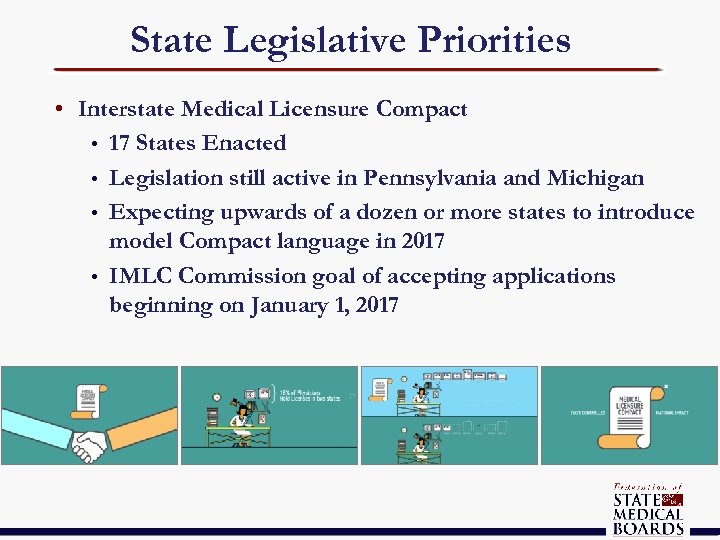
State Legislative Priorities • Interstate Medical Licensure Compact • 17 States Enacted • Legislation still active in Pennsylvania and Michigan • Expecting upwards of a dozen or more states to introduce model Compact language in 2017 • IMLC Commission goal of accepting applications beginning on January 1, 2017
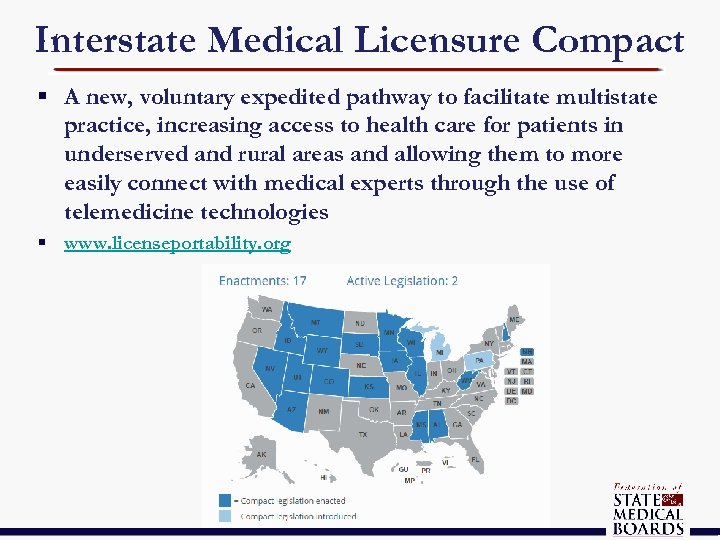
Interstate Medical Licensure Compact § A new, voluntary expedited pathway to facilitate multistate practice, increasing access to health care for patients in underserved and rural areas and allowing them to more easily connect with medical experts through the use of telemedicine technologies § www. licenseportability. org
State Legislative Priorities • Telemedicine • 245 bills in 2016 Legislative session • 49 signed into law • Wide range of issues: • Definition of telehealth/telemedicine • Establishment of standards • Reimbursement & Insurance Parity • Prescriptive authority/e-prescribing
State Legislative Priorities • Marijuana • 463 bills introduced in 2016 legislative session • 76 bills enacted into law • Main focus of legislation: • Establishing Medical Marijuana Acts • Dispensaries • Registration & Regulation • Cultivation • Debilitating Medical Conditions/PTSD
State Legislative Priorities • Pain Management/Opioid Use • 1, 330 bills in 2016 legislative session related to opioids, pain management, and controlled substances. • 300+ address opioid abuse, overdose, and prevention; • 67 signed into law • Various strategies to address prescription drug abuse: • Mandating query to the state PDMP • Implementing Patient Review and Restriction programs (“lock-in” programs) • Requiring registration, certification and inspection of pain clinics (“Pill Mill” legislation) • Increasing access to opioid antagonists (Naloxone) and providing immunity to those that administer • Mandating CME
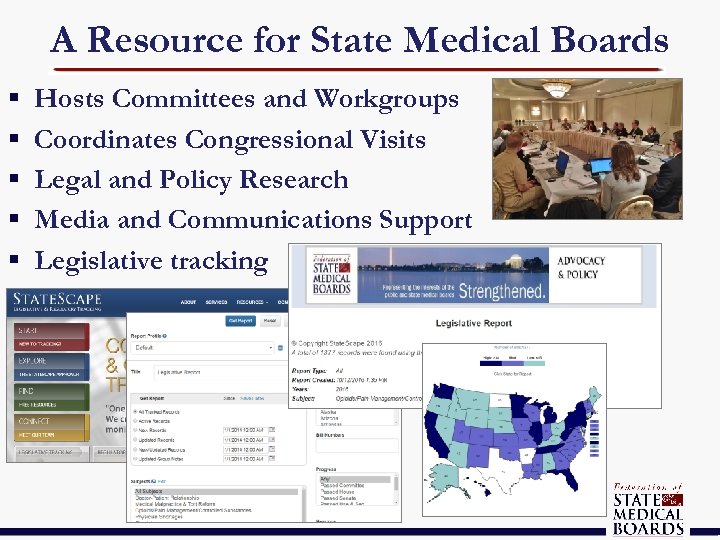
A Resource for State Medical Boards § § § Hosts Committees and Workgroups Coordinates Congressional Visits Legal and Policy Research Media and Communications Support Legislative tracking
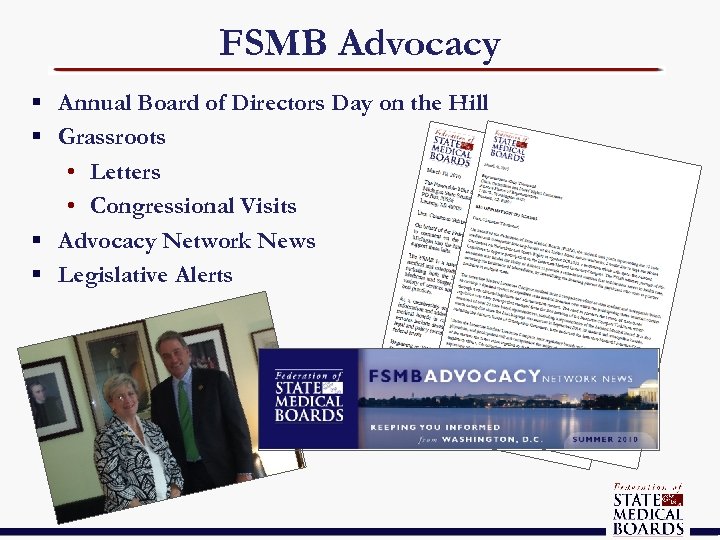
FSMB Advocacy § Annual Board of Directors Day on the Hill § Grassroots • Letters • Congressional Visits § Advocacy Network News § Legislative Alerts
Lisa Robin 202 -263 -4006 lrobin@fsmb. org THANK YOU!
Скачать презентацию Legislative and Advocacy Activities Lisa Robin Certified Medical
00b62671287acc6f19321d94ff676112.ppt