


 Скачать презентацию LEGAL WRITING The Legal Memorandum The Legal
Moscow_State_Legal_Memorandum_Presentation.pptx
- Количество слайдов: 25
 LEGAL WRITING The Legal Memorandum
 The Legal Memorandum
 FUNCTION Problem-solving document Predictive, not persuasive Result-oriented Predict a likely outcome to a legal problem What do we know and what don’t we know Identify our assumptions Not entirely an objective document REMEMBER, SOMEONE IS RELYING ON YOUR ADVICE!!!
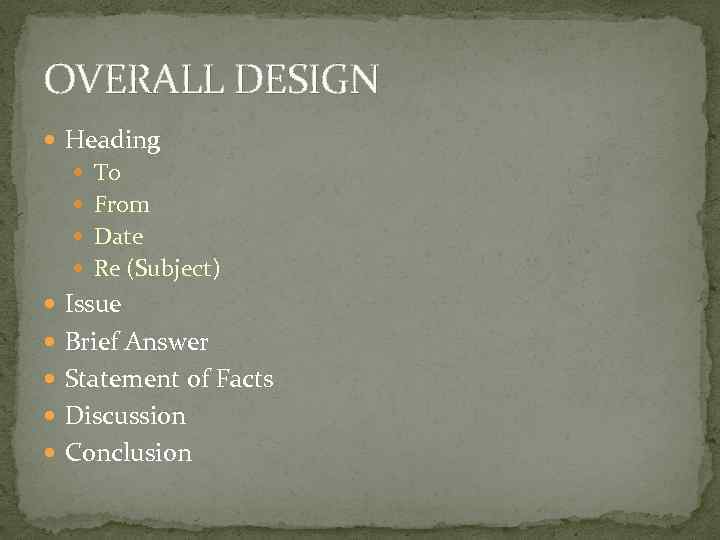 OVERALL DESIGN Heading To From Date Re (Subject) Issue Brief Answer Statement of Facts Discussion Conclusion
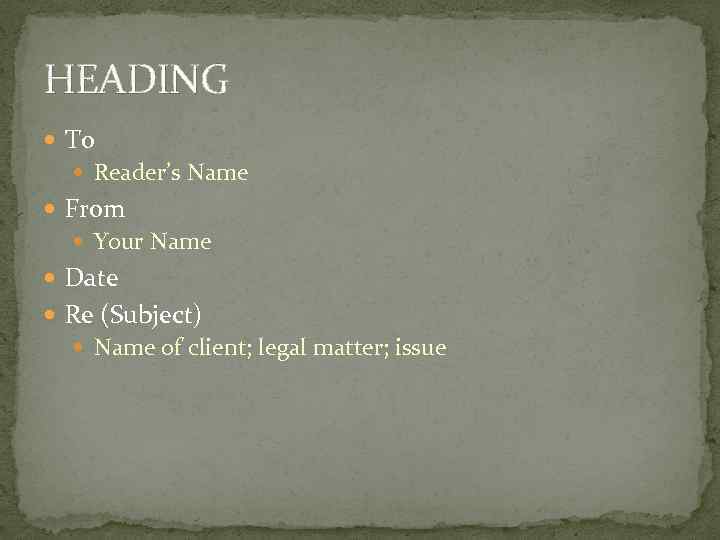 HEADING To Reader’s Name From Your Name Date Re (Subject) Name of client; legal matter; issue
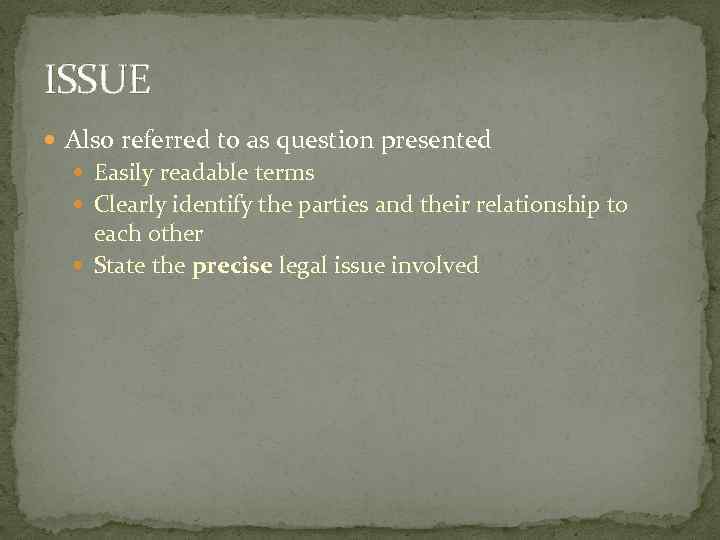 ISSUE Also referred to as question presented Easily readable terms Clearly identify the parties and their relationship to each other State the precise legal issue involved
 FACTS Should be easy-to-follow Self-contained story of relevant facts
 DISCUSSION Identify and discuss the arguments for both sides Predict an outcome on every argument Explain the law in detail Use headings and sub-headings Helps to clarify the discussion and make the document easier to read
 CONCLUSION Answer the question presented and predict the likely outcome. Short and sweet
 PRELIMINARY STEPS IN WRITING THE MEMO Determine: Purpose How will it be used? What issue(s) will be addressed? When is it due? How much time should you spend researching and writing? Intended Reader Level of expertise Format Does the reader have a preference? Tone Level of formality Scope How comprehensive should it be?
 ISSUE State in easily readable form What legal issue have you been asked to address? One sentence long Keep party names short Legal Questions Examines the scope or interpretation of a law or legal principal irrespective of the facts of the case Often identifies the jurisdiction where the case occurs Key words ‘whether’ (n 0 ‘? ’), ‘does’, ‘did’, ‘should’, ‘may’ Not too much detail Do not assume a legal conclusion Do not include facts
 BRIEF ANSWER One or two word answer followed by a concise prediction Include both the Rule and a brief summary of your reasoning KISS How confident are you in your prediction? Definitely? Probably? Possibly? Use appropriate language Don’t be afraid to hedge Always review for consistency with final conclusions
 STATEMENT OF FACTS Purpose Narrative of relevant, decisive facts Necessary background information Any further research? Overview What’s the story? No bias Repeat facts even if the reader already knows them
 STATEMENT OF FACTS Level of Detail Decisive facts Anything that could change the outcome of an issue May be helpful, harmful or neutral What about emotional facts? What about ‘unknown’ facts? Are there any potential land mines?
 STATEMENT OF FACTS When do you write the facts? Write them first Revise after you write the discussion section Have you been complete? Have you been over-inclusive?
 STATEMENT OF FACTS Organizational Methods Time Line Approach Order in which events occurred Thematic Approach Grouping and discussing by common theme How complex are the facts? BE CONSISTENT!!!!! DON’T FORGET TO USE TRANSITIONS AND SIGNPOSTING!!!!!
 THE DISCUSSION Purpose Overall analysis Applying law to facts Explaining conclusions Governing rule for each issue Content Don’t ignore weaknesses Be brutally honest Any gaps in knowledge of law or fact?
 THE DISCUSSION Organization Think critically-what point(s) need to be addressed? Do we have to solve a problem? If yes, what is theory of the case? Create an outline Set forth each step in your reasoning Demonstrate relevance of authorities This creates cohesion
 Organization Issues/Sub-Issues Raw materials Evaluate Draw a conclusion
 THE DISCUSSION Outline steps: Think of possible theories and arguments Review the facts What do we know? What do we still need to learn? Which cases must the court (or Panel) follow? Add ‘legal’ and ‘common sense’ arguments supporting your position (with citations to the relevant rules and facts) Fill in the outline with notes from cases and authorities your research has uncovered WHY IS THE OUTLINE IMPORTANT? BECAUSE IT ORGANIZES YOUR ARGUMENT
 THE DISCUSSION Design: Global introduction in paragraph form Introduce each issue and its relation to the entire case Road map of the entire discussion Use headings and subheadings Restate and focus the issues State overall conclusion State and focus applicable general rules Briefly explain why the application of rule to facts leads to the result Briefly (re)state overall conclusion
 THE DISCUSSION Organizing multiple issues Point-by-point Discuss dispositive issues first The issue which would resolve the case (if your prediction is correct) The other issues are still relevant Threshold issues What you have to resolve before you can continue your analysis
 THE DISCUSSION Writing the Discussion Goal Educate the reader by explaining the law (even if you think the reader already knows it) One possible method of organization Restate the issue and provide an overall conclusion State the general legal rule (e. g. , statute, case law) Focus on part of rule or case relevant to the case (refine the issue) Explain the specific legal rule or ruling Follow with the point of the case or rule, facts, issue, holding, rule and reasoning
 THE CONCLUSION Answer the question presented Predict the likely outcome Perhaps suggest what the client should do Your conclusion can be conditional
 AUTHORITIES CITED Allows the reader to see, at a glance, all citations to authorities cited in the Discussion section Last page of memo Can be divided into categories (e. g. , statutes, regulations and case law) List cases in alphabetical, not chronological, order