 Скачать презентацию LEGAL TOOLS FOR ACCESS AND CONTROL OF BROWNFIELDS
e11d8685019ecc746520fadb2ec8a89a.ppt
- Количество слайдов: 44



LEGAL TOOLS FOR ACCESS AND CONTROL OF BROWNFIELDS PROPERTIES Presented by: Robert M. Frye, Shareholder Stewart & Irwin, P. C. 251 East Ohio Street, Suite 1100 Indianapolis, IN 46204 (317) 639 -5454 rfrye@silegal. com www. silegal. com
BROWNFIELDS Problem of Access and Control n n Problem: How does local government gain access to or control over Brownfields in order to assess the hazards, secure the property and delineate the extent of environmental contamination? No direct legal authority for access to conduct environmental investigations
BROWNFIELDS Problem of Access and Control n Potential Legal Tools: n General authority to enforce ordinances: municipality may enter property to cause it to come into compliance with an ordinance & lien the property for costs n Unsafe Building Law: limited options for actual access, but offers some tools n Property Tax Laws: offer options for gaining access and control
UNSAFE BUILDING LAW Background n n Unsafe Building Law (UBL) codified at I. C. 36 -7 -9 Applicable to: n a consolidated city -- by statute n any other municipality or county that adopts an ordinance adopting the statute
UNSAFE BUILDING LAW Background n Ordinance must: n adopt UBL provisions as a local ordinance n establish uniform standards for securing, repairing and maintaining unsafe properties n specify or establish the executive department responsible for administering the law n in a municipality with a building commissioner, the commissioner administers the UBL
UNSAFE BUILDING LAW Background n Limitation: UBL focuses on structures; “Unsafe Building” defined as a building or structure, or any part thereof, that is: n in an impaired condition making it unsafe to person or property n a fire hazard n a public nuisance n dangerous to person or property due to a violation of statute/ ordinance concerning building condition or maintenance, or n vacant and not maintained in a manner allowing for human habitation, occupancy, or use under a statute/ordinance
UNSAFE BUILDING LAW Background n n Moreover, the legislative purpose of the UBL is stated in terms of the problems posed by vacant structures and remedies to ensure property maintenance and repair of vacant structures UBL is, therefore, best-suited for and most often used in urban areas to secure and facilitate rehabilitation of vacant, abandoned structures
UNSAFE BUILDING LAW Background n n Brownfields often include problem buildings/structures, so the UBL can be used to address threats posed by buildings and structures on located on Brownfields properties And, the UBL covers more than just buildings: “Unsafe Premises” is defined to include: n the unsafe building and the real property on which it is located, and n a non-agricultural tract of real property if it is a fire hazard, a hazard to public health, a public nuisance, or dangerous to a person or property due to violation of statute or ordinance
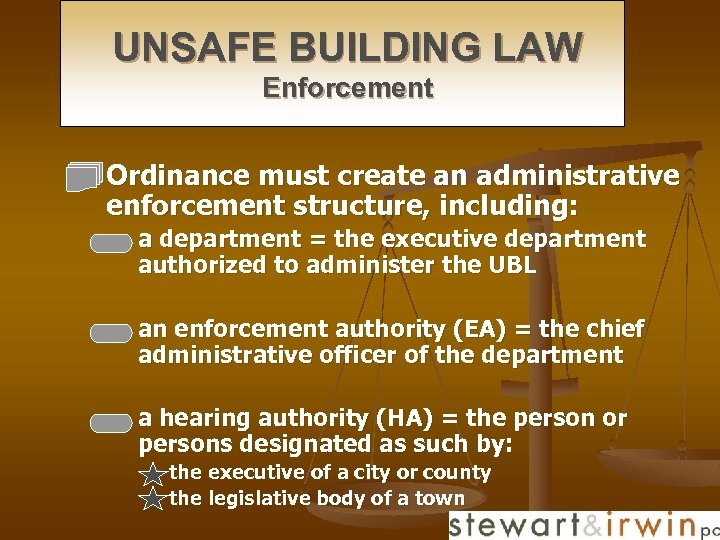
UNSAFE BUILDING LAW Enforcement n Ordinance must create an administrative enforcement structure, including: n n n a department = the executive department authorized to administer the UBL an enforcement authority (EA) = the chief administrative officer of the department a hearing authority (HA) = the person or persons designated as such by: n n the executive of a city or county the legislative body of a town
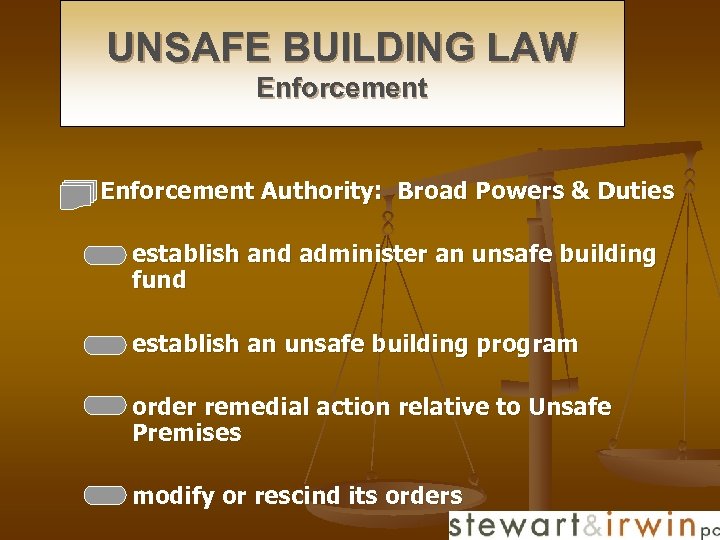
UNSAFE BUILDING LAW Enforcement n Enforcement Authority: Broad Powers & Duties n n establish and administer an unsafe building fund establish an unsafe building program order remedial action relative to Unsafe Premises modify or rescind its orders
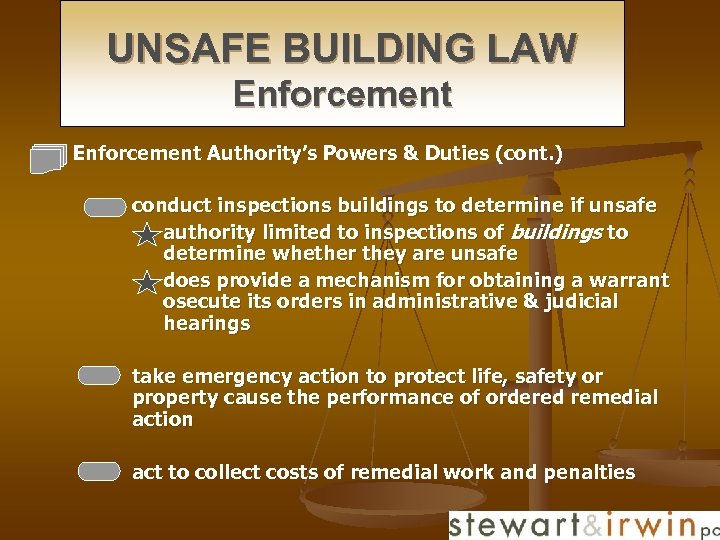
UNSAFE BUILDING LAW Enforcement Authority’s Powers & Duties (cont. ) n n n conduct inspections buildings to determine if unsafe n authority limited to inspections of buildings to determine whether they are unsafe n does provide a mechanism for obtaining a warrant osecute its orders in administrative & judicial hearings take emergency action to protect life, safety or property cause the performance of ordered remedial action act to collect costs of remedial work and penalties
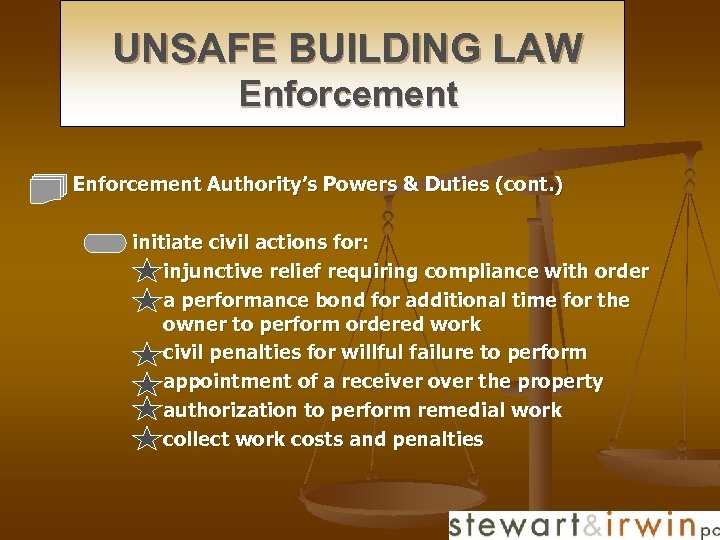
UNSAFE BUILDING LAW Enforcement Authority’s Powers & Duties (cont. ) n initiate civil actions for: n injunctive relief requiring compliance with order n a performance bond for additional time for the owner to perform ordered work n civil penalties for willful failure to perform n appointment of a receiver over the property n authorization to perform remedial work n collect work costs and penalties
UNSAFE BUILDING LAW Enforcement Authority’s Powers & Duties (cont. ) n n take actions to collect work costs and penalties cause remedial costs and penalties to be certified by county as a real property special assessment
UNSAFE BUILDING LAW Enforcement n Hearing Authority’s Powers and Duties: n preside over hearings to review EA’s orders n affirm, rescind or modify EA’s orders n impose a civil penalty up to $5, 000 for willful failure to comply with an order n reduce or strike imposed penalties if satisfied that all necessary work has been done
UNSAFE BUILDING LAW Enforcement Hearing Authority’s Powers & Duties (cont. ) n n n impose additional penalties up to $5, 000 each if work not progressing and premises has a negative effect on property values or quality of life of surrounding area require performance bond for owner promised work make a record of its findings
UNSAFE BUILDING LAW Enforcement n Court Involvement: the circuit or superior courts in the county where the property is located have jurisdiction to: n hear and decide appeals of the HA’s actions n affirm, modify or rescind remedial orders n impose civil penalties n hear and decide civil actions initiated by the EA n issue (or deny) inspection warrants • Note: Civil actions instituted by the EA under the UBL have priority and must be tried and determined by the court as early as possible
UNSAFE BUILDING LAW Enforcement n Enforcement Authority’s Orders: With regard to an Unsafe Premises, the EA may order: n vacation of an Unsafe Building (HA Review) n sealing an Unsafe Building n extermination of vermin in or about the Unsafe Premises n removal of trash, debris, fire hazardous material, or a public health hazard in or about the Unsafe Premises
UNSAFE BUILDING LAW Enforcement Authority’s Orders (cont. ) n n n repair or rehabilitation of building to bring it into compliance with legal standards required for human habitation, occupancy or use removal of part or all of an Unsafe Building (HA Review) require certain exterior improvements for buildings to be sealed for more than 90 days (HA Review)
UNSAFE BUILDING LAW Enforcement Authority’s Orders (cont. ) n n Hearing Authority is required to review orders of EA for vacation of premises, removal of all or part of a building, and exterior improvements required for long-term sealing of a building Hearing Authority may review orders of EA for sealing a building, extermination of vermin, removal of hazards, and repair of a building only if requested within 10 days after notice of the order is given Note: Orders are recorded, so they run with the property
UNSAFE BUILDING LAW Pros and Cons for Brownfields n Con: Limits purposes for site access n UBL allows access to real property only to: n inspect a building to determine if it is unsafe, or n cause ordered remedial actions to be performed n emergency environmental hazards could be an exception (under either the UBL or general police power), but only to abate the immediate threat to persons or property n more extensive remedial action for contamination probably preempted by state/federal law n typical Brownfield not an imminent threat
UNSAFE BUILDING LAW Pros and Cons for Brownfields Con: Limitations regarding access (cont. ) n Example of Distinction: n n Property A contains leaking chemical containers; the EA may use UBL’s emergency provisions to enter the property and remove threat Property B is environmentally impaired, but does not pose imminent danger to persons or property; the UBL not a good tool to gain entry for environmental investigation
UNSAFE BUILDING LAW Pros and Cons for Brownfields Con: Limitations regarding access (cont. ) n With regard to Property B, the EA could conceivably initiate a civil action asking the court to authorize it to conduct environmental investigations as part of a larger plan to assess the threat and carry out a remedial order, but: n court actions cost money n court actions take time (statutory priority helps) n the UBL is not designed to carry out environmental remedial plans; may be preempted by state/federal
UNSAFE BUILDING LAW Pros and Cons for Brownfields n Con: Administratively burdensomewhat complex administrative process n stringent notice requirements to protect due process rights of those with interests in Unsafe Premises, including mortgagees n
UNSAFE BUILDING LAW Pros and Cons for Brownfields n Con: Costs n funding needed for personnel and administrative costs of enforcing the UBL n funding needed for performing ordered work n Unsafe Building Fund (UBF) established, with funding sources, but: n up-front funding needed to establish and operate program n could be a challenge for the UBL program to ever be self-funded
UNSAFE BUILDING LAW Pros and Cons for Brownfields n n n Pro: Use of existing executive organizations to administer the UBL is allowed Pro: The UBL applies to a broad array of properties Pro: Emergency authority available
UNSAFE BUILDING LAW Pros and Cons for Brownfields n Pro: UBF is a dedicated, non-reverting fund with funding sources, including: n all recovered work costs and penalties must be deposited in the UBF n allows general appropriations to the UBF n allows for grants and donations to the UBF n certain property taxes (discussed later)
UNSAFE BUILDING LAW Pros and Cons for Brownfields n n Pro: Costs and penalties may be entered as a personal judgment against those with an interest in the property (except mortgagees) Pro: Costs and penalties may be certified as a special assessment and added to the property tax bill n special assessments are priority liens like property taxes n special assessments are collected like property taxes n county executive to obtain title through tax sale process n probably the most advantageous aspect of the UBL with regard to Brownfields
Property Tax Collection An Option for Control of Brownfields n n Ultimately, the best way for local government to control the fate of a Brownfield is to own or control the property Tools for obtaining ownership of property: n n Donation Purchase Eminent Domain Tax Sale
Property Tax Collection An Option for Control of Brownfields n Purchasing property takes time and requires money: cost of appraisals n negotiation n public notice n administrative and transaction costs n purchase money n
Property Tax Collection An Option for Control of Brownfields n Eminent domain: takes time n imposes administrative and legal costs n property must still be purchased n public scrutiny n
Property Tax Collection An Option for Control of Brownfields n Environmental Liability: Taking ownership through donation, purchase or eminent domain could impose environmental liability under Indiana and Federal law n CERCLA, 42 U. S. C. 9607, excludes from definition of “owner” or “operator” of a facility from which a release of hazardous substances occurs “a unit of state or local government which acquires ownership or control involuntarily through bankruptcy, tax delinquency, abandonment, or other circumstances in which the government involuntarily acquires title by virtue of its function as sovereign. ” n Indiana has a similar provision
Property Tax Collection An Option for Control of Brownfields Environmental Liability (cont. ) n federal courts have held that outright purchase or condemnation by governments are not “involuntary” n thus, as an “owner” or “operator” the local government is liable and can seek only contribution from other potentially responsible parties (PRPs) n contribution = pro rata contribution among PRPs n recovery = PRPs reimburse remedial costs • • de minimis exception could apply Innocent landowner defense could apply
Property Tax Collection An Option for Control of Brownfields n n n The Best Option: The Tax Sale Changes in the tax sale process effective January 1, 2007 make it easier for local government to gain control of abandoned properties with tax delinquencies n most Brownfields are abandoned and tax delinquent Remember the UBL? Costs & penalties imposed under the UBL may be certified as special assessments against the property and collected through tax sale if not paid n special assessments have the same lien priority as taxes n property can be sold for delinquent special assessments
Property Tax Collection An Option for Control of Brownfields n Limitation: Authority in the County Executive n only the county executive (i. e. , board of commissioners) may obtain title to properties through the tax sale process n but, the law allows a number of options for the executive to dispose of the property for reuse, including transfer to government entities n and, the definition of “county executive” includes “the executive’s designee” n allows cities & towns to work collaboratively with the county executive to redevelop the properties
Property Tax Collection An Option for Control of Brownfields n Advantage: Minimal Cost n administrative and personnel cost of a program to identify properties for expedited tax sale n can likely be done by existing personnel n no payment required to obtain title n county treasurer administers the sale process
Property Tax Collection An Option for Control of Brownfields n Bonus: Avoiding Environmental Liability n obtaining title to and control of a property through the tax sale process is “involuntary” under both Indiana and Federal environmental law n allows the government to seek recovery of remedial costs from PRPs n don’t forget the insurance policies!
Property Tax Collection An Option for Control of Brownfields n Double Bonus: Access Without Ownership n if a property does not sell at tax sale, the county auditor is not required to deed it to the county executive if the county executive determines that the property involved contains hazardous waste or another environmental hazard for which the cost of abatement or alleviation will exceed the fair market value of the property n in this instance, the statute provides that: “the county executive may enter the property to conduct environmental investigations” n direct legal authority to access property to conduct environmental investigations in the tax sale statute!
Property Tax Collection An Option for Control of Brownfields n Expedited Tax Sale Process: n county treasurer certifies a list of properties to be sold n county executive certifies a list of vacant or abandoned properties with as little as one tax payment delinquency to be included in the tax sale n expedites getting a property to sale n certified properties must be offered for sale separately from other properties n be mindful of certification deadline (at least 61 days prior to date on which court judgment for tax liens can be had)
Property Tax Collection An Option for Control of Brownfields n County Executive’s Lien: n county executive acquires a lien, by law, on any unsold property immediately at the end of the sale n lien is exercised by the executive requesting a tax sale certificate from the county auditor n county executive may then: n sell the certificates, as can any sale purchaser, in the manner prescribed by the statute, or n after a 120 -day redemption period, obtain an auditor’s deed (reduced from the 360 -day redemption period applicable to sold properties, further expediting the process)
Property Tax Collection An Option for Control of Brownfields n Auditor’s Deed: n extinguishes the taxes and special assessments for which the real property was offered for sale; all subsequent taxes, special assessments, interest, penalties; and costs of the tax sale n vests in the county executive a fee simple absolute title, free and clear of all liens and encumbrances created or suffered before or after the tax sale n exception for federal priority liens and tax liens accruing subsequent to the sale n extinguishes mortgages and mechanic’s liens n easements, restrictive covenants and land use commitments unaffected
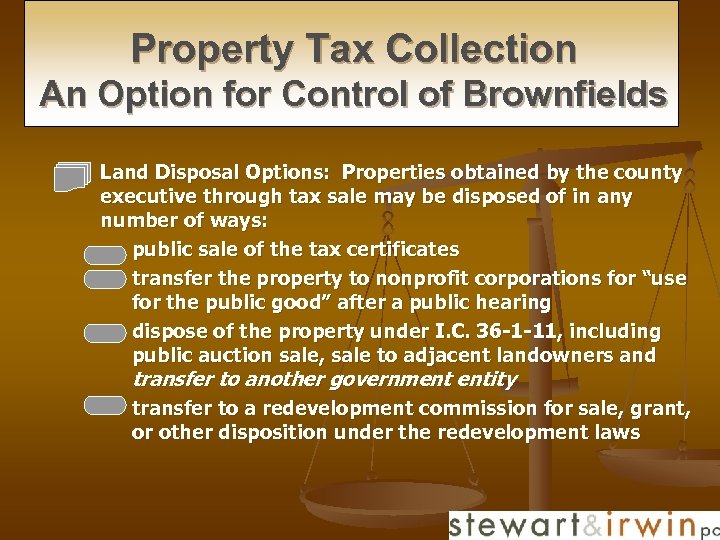
Property Tax Collection An Option for Control of Brownfields n Land Disposal Options: Properties obtained by the county executive through tax sale may be disposed of in any number of ways: n public sale of the tax certificates n transfer the property to nonprofit corporations for “use for the public good” after a public hearing n dispose of the property under I. C. 36 -1 -11, including public auction sale, sale to adjacent landowners and transfer to another government entity n transfer to a redevelopment commission for sale, grant, or other disposition under the redevelopment laws
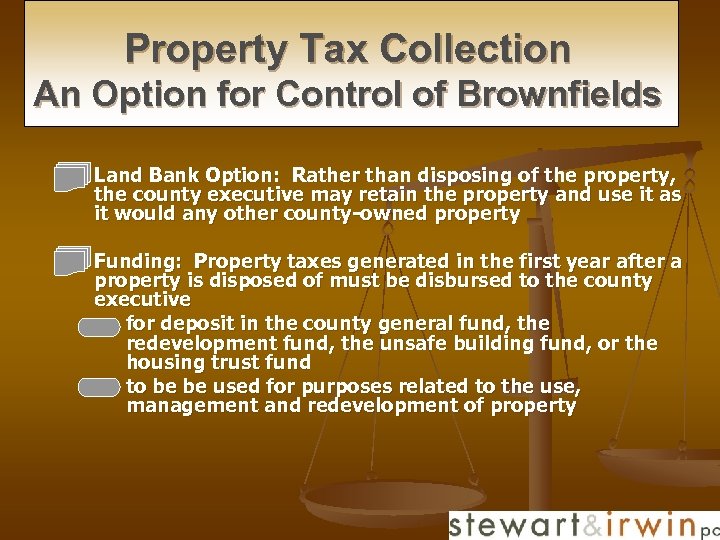
Property Tax Collection An Option for Control of Brownfields n n Land Bank Option: Rather than disposing of the property, the county executive may retain the property and use it as it would any other county-owned property Funding: Property taxes generated in the first year after a property is disposed of must be disbursed to the county executive n for deposit in the county general fund, the redevelopment fund, the unsafe building fund, or the housing trust fund n to be be used for purposes related to the use, management and redevelopment of property
Robert M. Frye, Shareholder Attorney at Law Robert M. Frye is a 1994 graduate of Indiana University School of Law – Indianapolis and a 1989 graduate of the Indiana University School of Public and Environmental Affairs. Prior to and while attending law school, Bob worked in environmental management for the City of Indianapolis, holding a variety of positions with responsibilities ranging from the enforcement of local codes, permitting and inspection, pollutant sampling, performance of Phase I assessments, and oversight and coordination of contractors performing environmental services. From 1995 to 1997, he served as in-house corporate counsel for the City of Indianapolis, counseling local boards and agencies with regard to public works, environmental, municipal and contractual matters. From 1997 to 2000, Bob was an associate with Foley & Pool, LLP, where he practiced civil litigation, real estate, land use and zoning, construction law and environmental law. Bob jointed the City of Indianapolis again in 2000, serving for two years as administrator of the City’s economic development, real estate redevelopment and property management programs. Bob returned to private practice in 2002, and since 2006 has been a shareholder with Stewart & Irwin, P. C. , where he engages in civil and administrative litigation, real estate, land use and zoning, municipal law, construction law and environmental law. Bob continues to advise the City of Indianapolis as outside counsel with regard to redevelopment issues. Bob is admitted to practice law in all state courts in Indiana, the U. S. District Courts for the Northern and Southern Districts of Indiana, and the U. S. Court of Appeals for the Seventh Circuit. Stewart & Irwin, p. c. 251 East Ohio Street, Suite 1100, Indianapolis, IN 46204 317 -639 -5454 www. silegal. com
Скачать презентацию LEGAL TOOLS FOR ACCESS AND CONTROL OF BROWNFIELDS
e11d8685019ecc746520fadb2ec8a89a.ppt