


 Скачать презентацию Legal Regulatory Considerations for Waste Heat Development
49e76d17ec8479a38a4bae6d382a2b0e.ppt
- Количество слайдов: 15
 Legal & Regulatory Considerations for Waste Heat Development Current landscape & future prospects Presented by John Nimmons, J. D. Waste Heat-to-Power Workshop University of California Irvine March 2, 2005 John Nimmons & Associates Mill Valley, California 415. 381. 7310
 Topics w Why legal / regulatory issues matter w Characterizing waste heat & its functions w Selling waste-heat-generated power to utilities w Federal & state support for waste heat development w Conclusions w Useful next steps 2
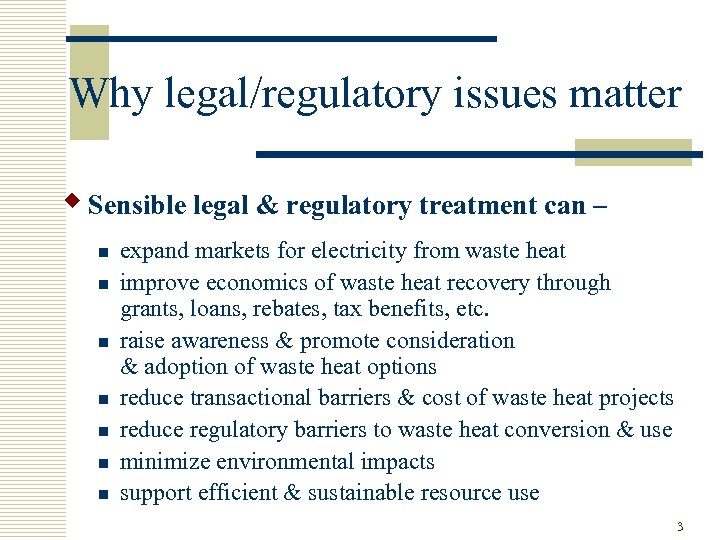 Why legal/regulatory issues matter w Sensible legal & regulatory treatment can – n n n n expand markets for electricity from waste heat improve economics of waste heat recovery through grants, loans, rebates, tax benefits, etc. raise awareness & promote consideration & adoption of waste heat options reduce transactional barriers & cost of waste heat projects reduce regulatory barriers to waste heat conversion & use minimize environmental impacts support efficient & sustainable resource use 3
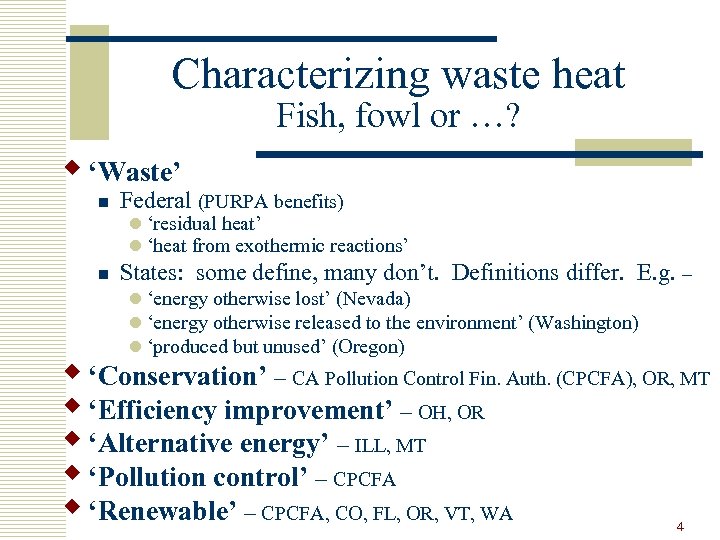 Characterizing waste heat Fish, fowl or …? w ‘Waste’ n Federal (PURPA benefits) l ‘residual heat’ l ‘heat from exothermic reactions’ n States: some define, many don’t. Definitions differ. E. g. – l ‘energy otherwise lost’ (Nevada) l ‘energy otherwise released to the environment’ (Washington) l ‘produced but unused’ (Oregon) w ‘Conservation’ – CA Pollution Control Fin. Auth. (CPCFA), OR, MT w ‘Efficiency improvement’ – OH, OR w ‘Alternative energy’ – ILL, MT w ‘Pollution control’ – CPCFA w ‘Renewable’ – CPCFA, CO, FL, OR, VT, WA 4
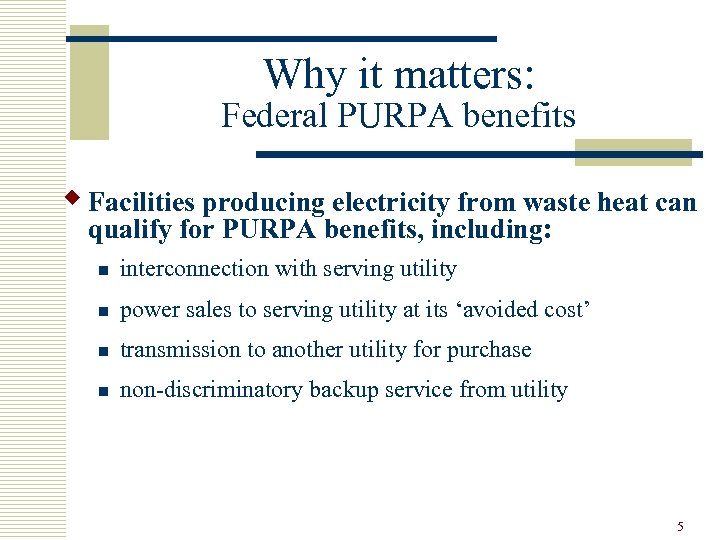 Why it matters: Federal PURPA benefits w Facilities producing electricity from waste heat can qualify for PURPA benefits, including: n interconnection with serving utility n power sales to serving utility at its ‘avoided cost’ n transmission to another utility for purchase n non-discriminatory backup service from utility 5
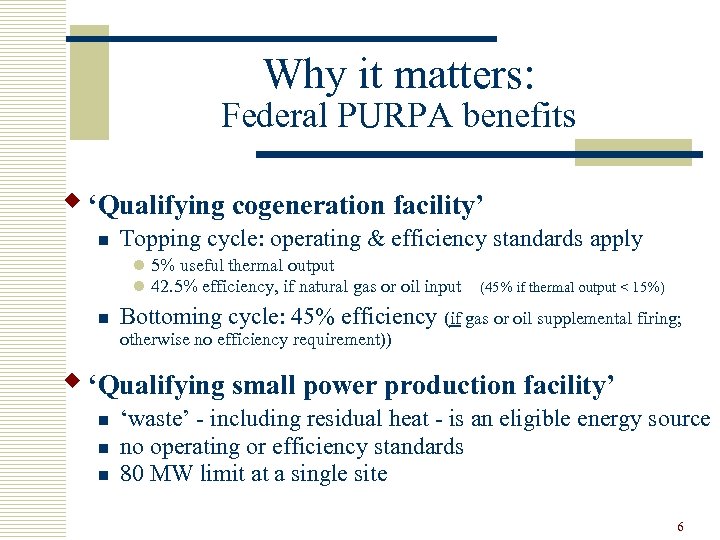 Why it matters: Federal PURPA benefits w ‘Qualifying cogeneration facility’ n Topping cycle: operating & efficiency standards apply l 5% useful thermal output l 42. 5% efficiency, if natural gas or oil input n (45% if thermal output < 15%) Bottoming cycle: 45% efficiency (if gas or oil supplemental firing; otherwise no efficiency requirement)) w ‘Qualifying small power production facility’ n n n ‘waste’ - including residual heat - is an eligible energy source no operating or efficiency standards 80 MW limit at a single site 6
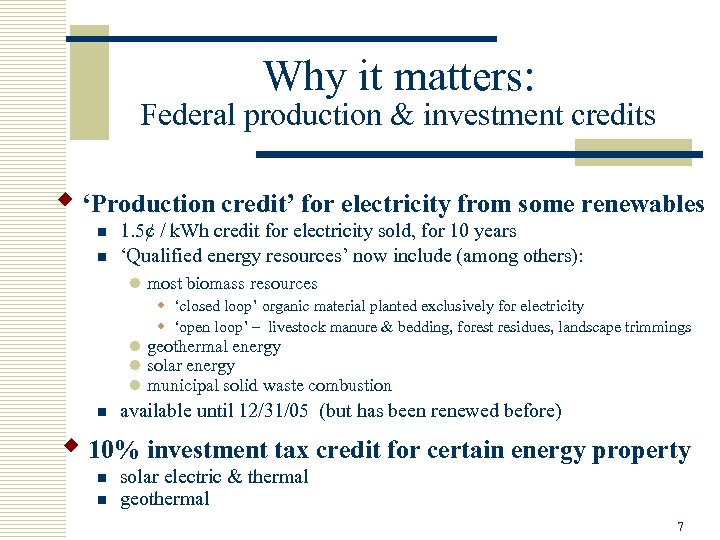 Why it matters: Federal production & investment credits w ‘Production credit’ for electricity from some renewables n n 1. 5¢ / k. Wh credit for electricity sold, for 10 years ‘Qualified energy resources’ now include (among others): l most biomass resources w ‘closed loop’ organic material planted exclusively for electricity w ‘open loop’ – livestock manure & bedding, forest residues, landscape trimmings l geothermal energy l solar energy l municipal solid waste combustion n available until 12/31/05 (but has been renewed before) w 10% investment tax credit for certain energy property n n solar electric & thermal geothermal 7
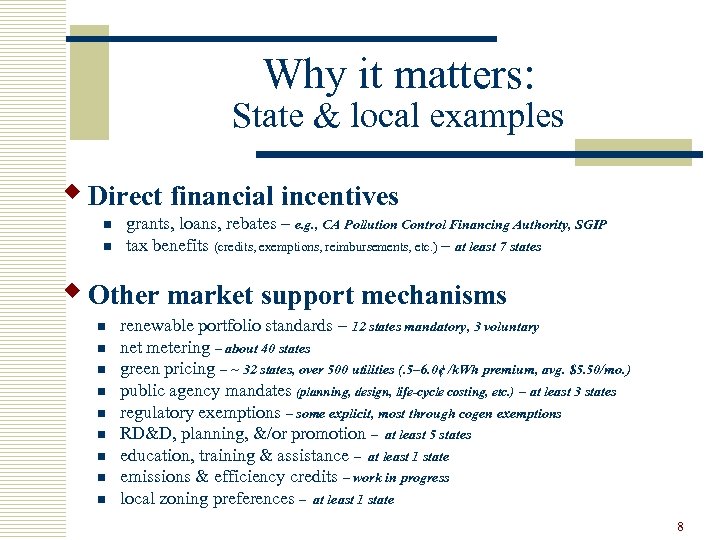 Why it matters: State & local examples w Direct financial incentives n n grants, loans, rebates – e. g. , CA Pollution Control Financing Authority, SGIP tax benefits (credits, exemptions, reimbursements, etc. ) – at least 7 states w Other market support mechanisms n n n n n renewable portfolio standards – 12 states mandatory, 3 voluntary net metering – about 40 states green pricing – ~ 32 states, over 500 utilities (. 5– 6. 0¢ /k. Wh premium, avg. $5. 50/mo. ) public agency mandates (planning, design, life-cycle costing, etc. ) – at least 3 states regulatory exemptions – some explicit, most through cogen exemptions RD&D, planning, &/or promotion – at least 5 states education, training & assistance – at least 1 state emissions & efficiency credits – work in progress local zoning preferences – at least 1 state 8
 State Portfolio Standards w Many states have adopted ‘portfolio standards’ n n Purpose: to stimulate markets for clean, efficient resources Mechanism: utilities & other electricity providers must generate or acquire an increasing annual percentage of electricity from favored resources until target is reached w Standards generally focus on renewables, but states define eligible resources differently 9
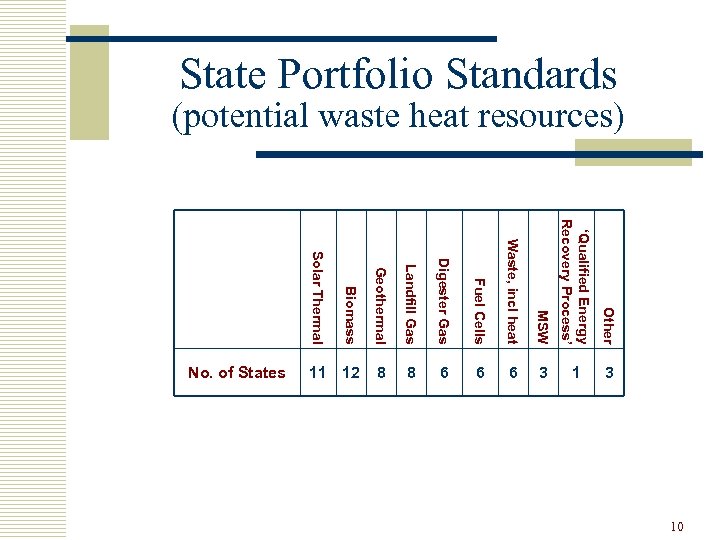 State Portfolio Standards (potential waste heat resources) Biomass Geothermal Landfill Gas Digester Gas Fuel Cells Waste, incl heat MSW ‘Qualified Energy Recovery Process’ Other 8 8 6 6 6 3 1 3 Solar Thermal 11 12 No. of States 10
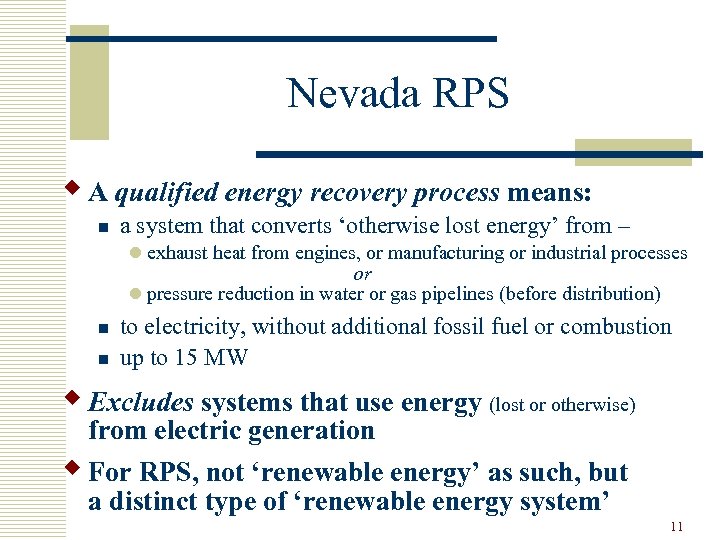 Nevada RPS w A qualified energy recovery process means: n a system that converts ‘otherwise lost energy’ from – l exhaust heat from engines, or manufacturing or industrial processes or l pressure reduction in water or gas pipelines (before distribution) n n to electricity, without additional fossil fuel or combustion up to 15 MW w Excludes systems that use energy (lost or otherwise) from electric generation w For RPS, not ‘renewable energy’ as such, but a distinct type of ‘renewable energy system’ 11
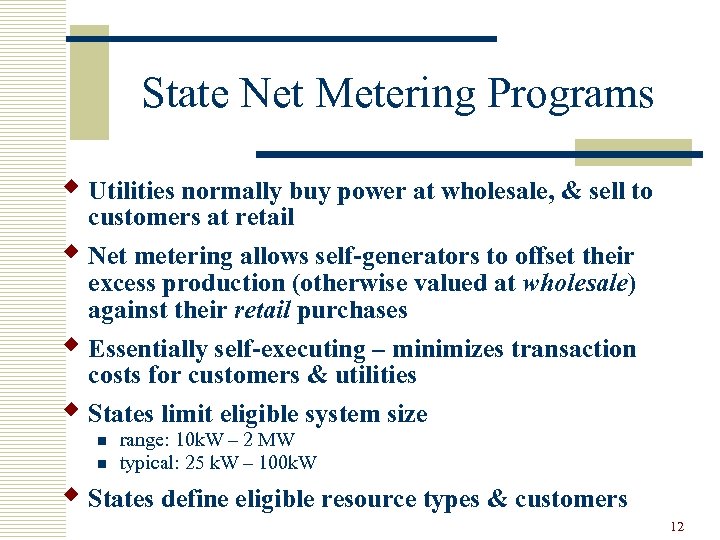 State Net Metering Programs w Utilities normally buy power at wholesale, & sell to customers at retail w Net metering allows self-generators to offset their excess production (otherwise valued at wholesale) against their retail purchases w Essentially self-executing – minimizes transaction costs for customers & utilities w States limit eligible system size n n range: 10 k. W – 2 MW typical: 25 k. W – 100 k. W w States define eligible resource types & customers 12
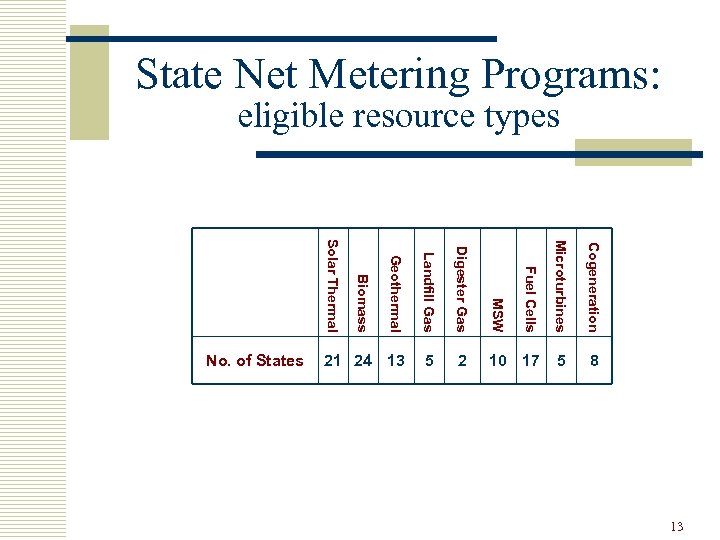 State Net Metering Programs: eligible resource types Geothermal Landfill Gas Digester Gas MSW Fuel Cells Microturbines Cogeneration 5 2 10 17 5 8 Solar Thermal Biomass 21 24 13 No. of States 13
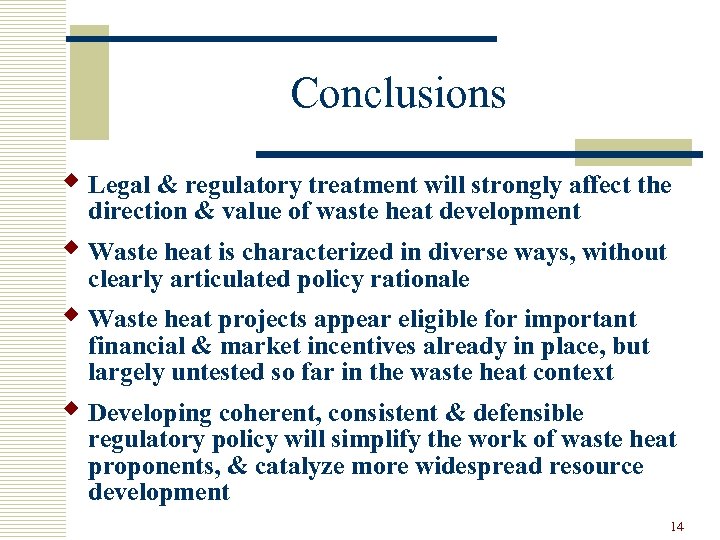 Conclusions w Legal & regulatory treatment will strongly affect the direction & value of waste heat development w Waste heat is characterized in diverse ways, without clearly articulated policy rationale w Waste heat projects appear eligible for important financial & market incentives already in place, but largely untested so far in the waste heat context w Developing coherent, consistent & defensible regulatory policy will simplify the work of waste heat proponents, & catalyze more widespread resource development 14
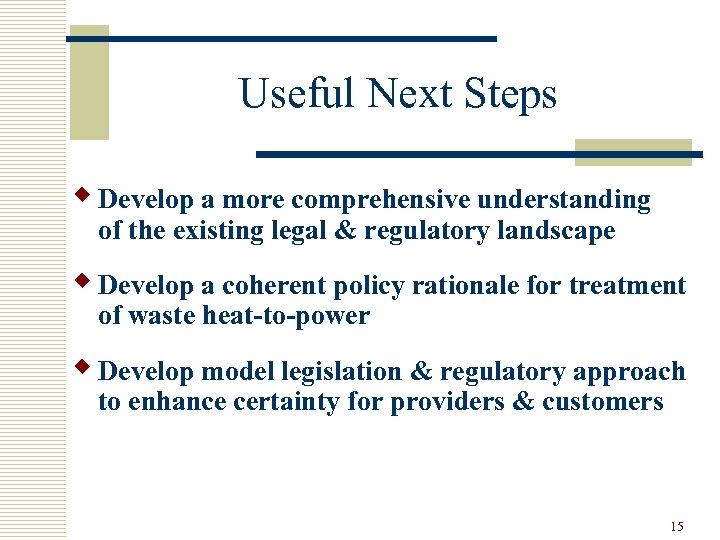 Useful Next Steps w Develop a more comprehensive understanding of the existing legal & regulatory landscape w Develop a coherent policy rationale for treatment of waste heat-to-power w Develop model legislation & regulatory approach to enhance certainty for providers & customers 15