


 Скачать презентацию Legal Framework for European Research Infrastructures ERI Original
00745ae5c0a5bac2f45e25c53e20fa51.ppt
- Количество слайдов: 34
 Legal Framework for European Research Infrastructures (ERI) Original slides from Research Group Brussels 25 July 2008 Modified by Frank Lehner, DESY ILC Hi. Grade Kick-off 29 August 2008
 Towards a Community legal framework Facts and Challenges: • October 2006 Publication of ESFRI Roadmap • 2007 European Councils invited MS to participate actively in the implementation of ESFRI roadmap • Two stakeholders workshops on the most appropriate legal instruments identified the lack of an adequate legal framework allowing the creation of appropriate partnerships with partners from different countries • Report of a Working group on Feasibility study on the creation of a European legal instrument for European Research Infrastructures (July 2007)
 Working Group Report July 2007 ftp: //ftp. cordis. europa. eu/pub/esfri/docs/recommendation-specific-expert-group-2006_en. pdf WG-Chairs: B. Vierkorn-Rudolph, R. -J. Smits Contributions by: Ramon Garcia-Gallardo, Hans Jahreiss, Anne Tutt and Linda Bains
 Findings of Working Group • “regarding the legal form to be used for the establishment of Pan. European research infrastructures in most of the cases purely national legal bases as well as case by case international agreements have proven inadequate to comply with the needs of these new Pan. European research infrastructures. ”
 Existing legal forms I • Legal forms under national law – Company models • French ‘Societé civile’ for the European Synchroton Radiation Facility (ESRF) • German ‚Gesellschaft mit beschränkter Haftung (Gmb. H)’ for XFEL • UK ‚Limited liability Company (Ltd)’ for the Delivery of Advanced Network Technology in Europe (DANTE) and for Diamond Light Source DLS – Foundation models • Dutch ‘Stichting’ (foundation) for the German-Dutch Wind Tunnels
 Limitations of existing legal forms under national law • Flexible, easy to set up - national law is applicable • There is similarity but no identity of legal instruments of EU member states – details matter – all partners must have the same knowledge • Risk of less equitable geographical distribution of new infrastructures in view of legal differences • The psychology factor – the transnational character is not visible Christian Fischer-Dieskau, Honorary Director of EC Talk at ECRI Conference, Hamburg June 2007
 Existing legal forms II international or EU law • International/intergovernmental organizations under international law – the ‘Big Four’ CERN, EMBL, ESO, ESA • EU Community law – Joint Undertaking under the Euratom Treaty for the Joint European Torus (JET), a research tool in the field of thermonuclear fusion – Joint Undertaking under the EC Treaty – Galileo, for a worldwide satellite radio navigation and positioning infrastructure – ‘European Economic Interest Grouping’ (EEIG) under the corresponding EC regulation for the EDCTP, a structure for the coordination and funding of national clinical trial activities in and in favour of developing countries
 Limitations of existing forms under international law • Long and complicated negotiations and ratification procedures • Absence of a national legal reference system • Only subjects of international public law (e. g. countries, the EU) negotiate and conclude such agreements • Contracting parties are in practice obliged to cover all debts of the infrastructure • Politically not favored anymore
 Limitations of existing forms under EU/Community law • Joint undertakings such as Galileo, JET – Ad-hoc case by case creations – Similar to international organisations as no full EU legal system exists – Unlimited liability for debts, joint liability of members – Difficulty for non-European countries to join • The European Economic Interest Grouping (EEIG): – Unlimited liability for debts, joint liability of members – Legal personality not granted by all EU member countries – Economic orientation of the EEIG -not fully appropriate in the research field – Difficulty for non-European countries to join
 A legal framework: ERI • Purpose: to facilitate the constitution of legal entities for the construction and operation of research infrastructures of Pan-European interest necessary for the conduct of Community research programs • Proposal: EC regulation providing a common legal frame, leaving flexibility to the individual consortia to set up the adequate rules for the specific infrastructure
 Proposed regulation for ERI Objectives To provide an easy-to-use legal instrument adapted to European infrastructures, an ERI should: • …have a legal personality recognized in all MS • …have a spirit of a truly European venture • …be flexible enough to adapt to the requirements of specific infrastructures • …provide some of those privileges and exemptions allowed at a national level for intergovernmental organizations (e. g. VAT exemption). The regulation should provide a faster and more cost efficient process according to existing legal forms
 State of Play • The EC planned the proposal in the Commission Legislative Work Programme 2008 • The EC has prepared a draft Council Regulation • Some choices, with obvious limitations, were made: • Focus on basic research -> mainly public actors -> public-public partnership • Avoid VAT-discussion between MS -> VAT-exemption -> aim for status of international organization -> membership limited to States and Intergovernmental Organizations • Community body status to be avoided
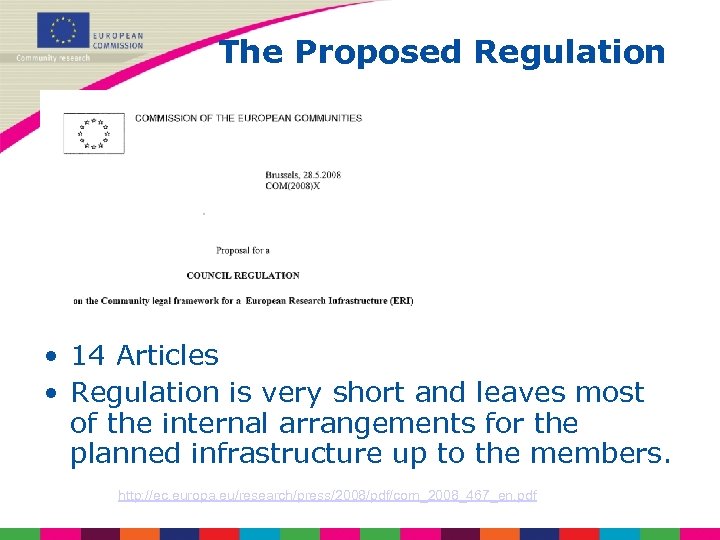 The Proposed Regulation • 14 Articles • Regulation is very short and leaves most of the internal arrangements for the planned infrastructure up to the members. http: //ec. europa. eu/research/press/2008/pdf/com_2008_467_en. pdf
 Framework regulation for ERI • Article 171 of EC treaty forms the legal basis of setting up an ERI The Community may set up joint undertakings or any other structure necessary for the efficient execution of Community research, technological development and demonstration programmes. The decision to set up a joint undertaking is made by the Council based on a proposal from the Commission. This structure ensures the single effective management of programmes combining various funding sources. • The proposed ERI regulation follows the subsidiarity principle.
 Framework regulation Nature of an ERI • • • Primary task: establish and operate a Research Infrastructure Tasks to be pursued on a non economic basis – However, it may carry out economic activity closely related to its primary task Four conditions fulfilled by the Research Infrastructure: – necessary for European research activities, including Community programmes – open to the European research community – added value in the development of ERA and significant improvement in relevant S&T fields at international level – contribute to the dissemination and optimization of the results of the activities
 Framework regulation Nature of an ERI • • • ERI is a legal entity and shall have in each MS the most extensive legal capacity accorded to legal entities under that MS law ERI may acquire, own and dispose of movable, immovable and intellectual property, conclude contracts and be a party of legal proceedings ERI shall have a statutory seat ERI shall be considered as international body/organization ERI shall have a name containing the words “European Research Infrastructure” or abbreviation “ERI”.
 Framework regulation for ERI – Legal model for European research infrastructures – rules and procedures governing their establishment: • legal entities interested draw up the statutes for a concrete European research infrastructure and submit the project to the Commission • The legislator confers the status of “European research infrastructure”; empowerment to the Commission is foreseen (commitology procedure) • Legal personality of Community law as from the date the decision setting up the ERI takes effect
 Framework regulation ERI Membership following entities may become members of an ERI: • EU Member States • Third States • Intergovernmental organisations An ERI must at all times have at least three members Further members may join at any time as specified in statutes. Member States shall jointly hold the majority of the voting rights in the assembly of members. A State may be represented by one or more public entities or private entities with a public-service mission
 Application for the setting-up of an ERI • Content of the application: – Official request to set up the ERI – proposed Statutes of the ERI (with extract) – technical and scientific description of the research infrastructure to be established and operated by the ERI • The Commission, assisted by an advisory Committee, assesses the application; may obtain the views of independent experts • The result is communicated to the applicants (i. e. Member States), if necessary, invited to complete or amend the application within a reasonable time.
 Framework regulation Internal Structure • Statutory seat of ERI in Member State or Associated Country; locations anywhere • Two distinct organs as mandatory bodies (members’ assembly, director/board of directors) • members’ liability üERI shall be liable for its debts – The Community shall not be liable for any debts ülimited to committed contribution, no capital requirement. ümay specify in the Statutes a fixed liability above their respective contributions or unlimited liability.
 Content of Statutes (1) – list of members and entities representing them, their rights and obligations – conditions and procedure for membership changes – tasks and activities – statutory seat – name – bodies: competencies, decisions – duration – procedure/rules for the winding-up – identification of the working language(s) – references to rules implementing the Statutes.
 Content of Statutes (2) – basic principles covering: • access policy for users • data policy • scientific evaluation policy • intellectual property rights policy • dissemination policy • employment policy • procurement policy • decommissioning, if relevant The Statutes shall be publicly available on the website of the ERI and at its statutory seat.
 Statutes (3) • Statutes is the basic legal document of an ERI binding upon its members • Statutes may be amended – if amendment concerns a matter relevant to former ERI decision -> must be ratified by Commission – otherwise through simple notification of the Commission (veto right)
 Hierarchy of applicable law • • Community law, in particular this Regulation the law of the State, where the ERI has its statutory seat the law of the States in which the ERI operates as regards public and occupational health and safety, environmental protection, treatment of hazardous substances and delivery of permits required for such operation Statutes, adopted in conformity with sources of law referred to above, and by its implementing rules complying with its Statutes
 Budgetary principles • • Sound financial management Principle of transparency Yearly financial report Filing, auditing and publication of accounts according to applicable law Staff policy principles • • To be identified in the Statutes Normally following the hierarchy of laws
 VAT, excise duties and public procurement • The ERI is • an international body within the meaning of Article 151(1)(b) of Directive 2006/112/EC, and • an international organisation within the meaning of the second indent of Article 23(1) of Directive 92/12/EEC and of Article 15, point (c), of Directive 2004/18/EC • for the purpose of the application of the Community directives concerning VAT, excise duties and public procurement procedures • Countries that are members of an ERI shall take all possible measures to accord to such ERI the most extensive exemption from other taxes.
 Community funding • Community participation in ERI is not required • ERI not considered as a Community body as the Community is not a member and does not contribute financially to the structure as such • This does not prevent the structure from being the beneficiary of grants according to the procedures established in the legislation in force. • in accordance with Title VI of Financial Regulation applicable to the general budget of the European Communities (grants) • Funding from Structural Funds possible
 Time table Next steps • • • Analysis of possible options (Nov 2007 – Feb 2008) Sounding Board (Jan – May 2008) Consultation of stakeholders (March – July 2008) Elaboration of draft Regulation (May – July 2008) Adoption of proposal by Commission (July 2008) Submission to the Council and the EP (End July 2008) Discussions at the Research Group level (July-Sept-Oct) Continued information of stakeholders (autumn 2008) Foreseen position of the Council by December 2008 Foreseen application of the regulation by mid-2009
 Reporting and control • An ERI shall produce an annual activity report • if indications that an ERI is acting in serious breach of this Regulation or the decisions adopted on its basis or other applicable law: ü ERI provide observations ü Commission may propose remedial action ü If no remedial action is taken, the Commission may repeal the decision establishing the ERI
 ERI – in a nutshell • Regulation is very short and leaves most of the internal arrangements for the planned infrastructure up to the members. • ERI is legal entity, seen as international organisation wrt VAT and excise duties • members: MS, third countries, international organisations; MS must have majority • Statutory seat in MS, location of RI anywhere • Limited liability corresponding to direct contribution (vague? ) of members • Commission grants ERI status and may withdraw it - if primary objectives are not met • The applicable law will be mostly the national law of the country of statutory seat or of operation
 Spare Slides
 Towards a Community legal framework Facts and Challenges: • Some pro & cons of existing legal forms: EEIG: pro: European form contra: unlimited joint and several liability Société civile, Gmb. H, etc. : pro: Flexibility contra: national law applicable Intergovernmental Organization: pro: Flexibility contra: lengthy ratification procedures
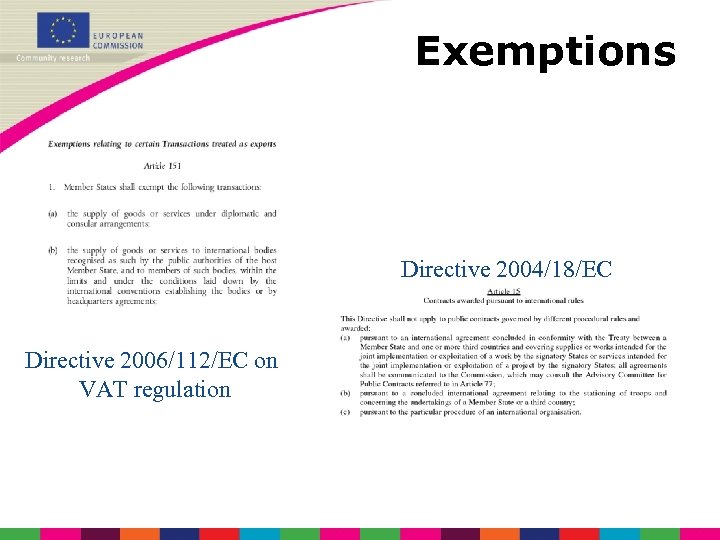 Exemptions Directive 2004/18/EC Directive 2006/112/EC on VAT regulation
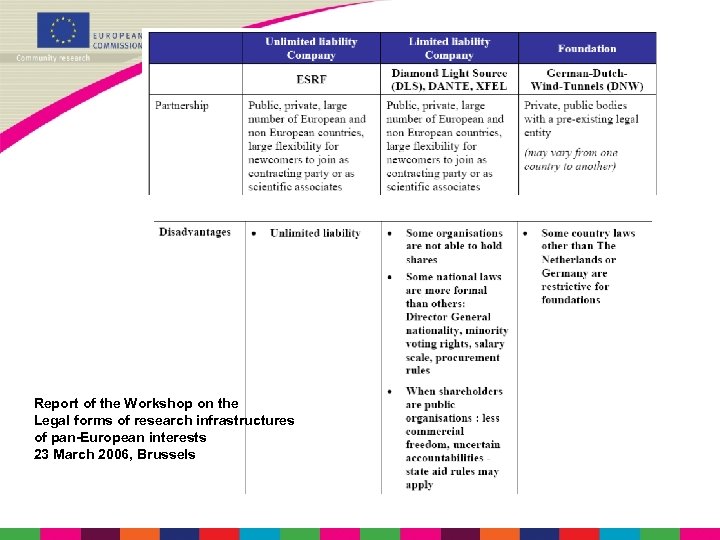 Report of the Workshop on the Legal forms of research infrastructures of pan-European interests 23 March 2006, Brussels