


 Скачать презентацию LEGAL ENVIRONMET FOR GEORGIAN MICROFINANCE ORGANIZATIONS May 26
64ac68c3f4ce321875fbd6bc48e138d9.ppt
- Количество слайдов: 20
 LEGAL ENVIRONMET FOR GEORGIAN MICROFINANCE ORGANIZATIONS May 26, 2006 AGMO Association of Georgian Microfinance Organizations
 what is “microfinance” in Georgia? n n n business credit/leasing consumer credit emergencies, funding social obligations transfer/payment services insurance types: life, health/disability
 Which legal entities are considered “MFIs”? any formal organization that has as a primary purpose to provide financial services to low income people n n n NGOs financial cooperatives (? ? ? ) commercial banks
 Differing types of regulation n “Prudential” regulation and supervision: protects financial solvency of regulated institutions
 Differing types of regulation n Non-prudential regulation: Regulation of financial institutions that has an objective other than preventing insolvency: - Protecting against abusive lending and collection practices - Protecting against fraud and financial crimes - Other “non-prudential” regulatory topics: Tax issues Collateral regulation
 Populist trends may hurt more than help. Every country has relevant regulation, though what another country has, may not be what your country need. Don’t expect too much from selfregulation or self-supervision
 Key principles of MF regulation and supervision: n n n Avoid prudential regulation where there are no retail depositors to protect, or possible systemic risk For depository MF, revisit limits on unsecured lending understand delicate topic of microfinance interest rates and look for policies other than interest caps
 Why is MFI Regulation Necessary? Regulation & Supervision of Microfinance Institutions CGAP - T H E C O N S U LTAT I V E G R O U P T O A S S I S T T H E POO R E S T There is a significant unmet demand for financial services in the microenterprise sector. Serving this market will require access to funding far beyond what donors and governments can provide. Thus, many MFIs want to expand their outreach by raising funds from commercial sources. Most of today’s MFIs are significantly different from banks in institutional structure, and the business of managing a micro-loan portfolio differs in important ways from the business of managing a conventional bank portfolio. MFIs and microloan portfolios cannot be safely funded from commercial sources, unless appropriate regulation and supervision regimes are developed.
 Why is MFI Regulation Necessary? ACCION International The provision of microfinance services has gradually become more formal with the Transformation of NGOs into regulated MFIs. Transformation process allows MFIs to reach a larger number of customers. The transformation usually enables the institutions to attract more commercial funding, either in the form of loans or in the form of equity capital. This provides a greater stability of funding in the long term. Setting up a more formal structure also has a positive impact on governance and on the accountability of the management. The overall profitability of the institution is also improved, which opens the door to innovation, product diversification and more professional services towards clients.
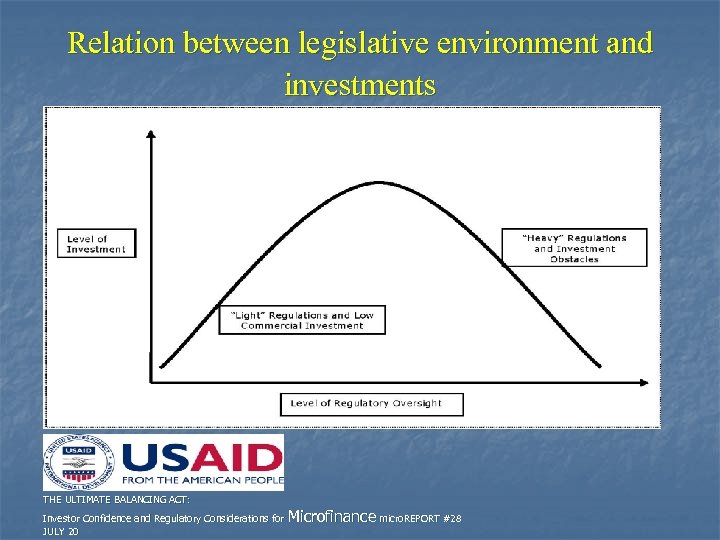 Relation between legislative environment and investments THE ULTIMATE BALANCING ACT: Investor Confidence and Regulatory Considerations for JULY 20 Microfinance micro. REPORT #28
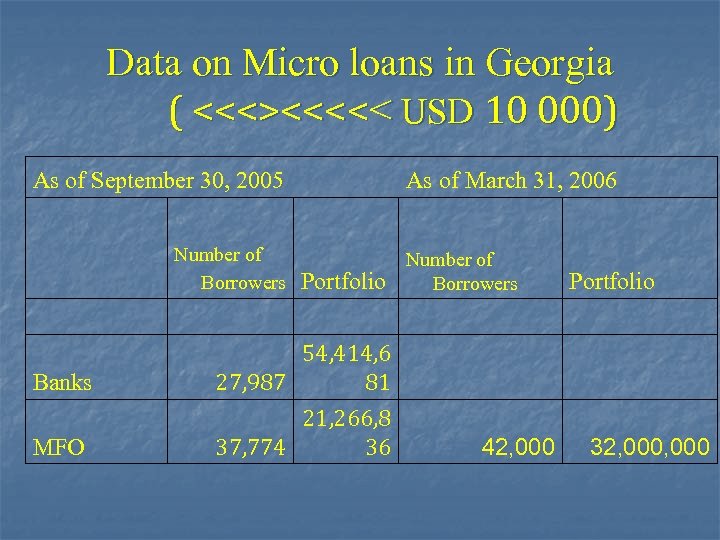 Data on Micro loans in Georgia ( <<<><<<<< USD 10 000) As of September 30, 2005 Number of Borrowers As of March 31, 2006 Number of Borrowers Portfolio Banks 54, 414, 6 27, 987 81 MFO 21, 266, 8 37, 774 36 Portfolio 42, 000 32, 000
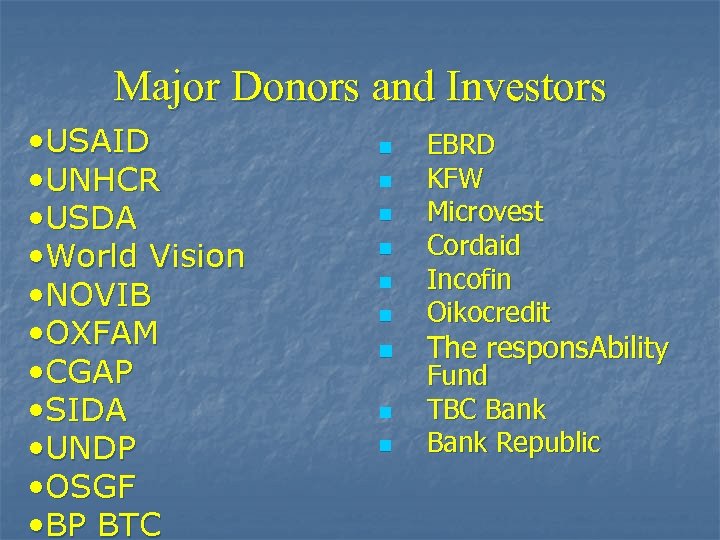 Major Donors and Investors • USAID • UNHCR • USDA • World Vision • NOVIB • OXFAM • CGAP • SIDA • UNDP • OSGF • BP BTC n n n n n EBRD KFW Microvest Cordaid Incofin Oikocredit The respons. Ability Fund TBC Bank Republic
 Major Legislative Problems n n n Non-compliance with MFO‘s legal organizational form and their main activities; Inaccuracy in legislation impeding attraction of private investments; Legislative restrictions that make impossible to offer full microfinance service to consumer.
 Ways to Resolve Legislative Problems n n Definition of microfinance service and microfinance organizations; Definition of such organizational legal form (forms) for MFOs that will give legal basis to those organizations to: provide full microfinance service; attract funds in the form of loans or equity capital.
 Important Questions and Answers Based on the Best Practices n Why is it important for MFO to have a special status? This is a fact, that microfinance sector is quite strong in Georgia. MFOs provide service to major part of low income consumers. MFOs are financial institutions. They should be authorized to provide legal financial service and thus be a part of the financial sector of the country. There is no relevant legal organizational form in the country for financial institutions rather than banks and credit unions. Considering the above said, it is necessary to define legal status of such organizations.
 Important Questions and Answers Based on the Best Practices n How important is well organized legislative environment and regulated MFOs to attract investments? “EBRD became active in lending to non-bank MFIs early this year (2005) when it introduced a USD 10 million framework covering the Early Transition Countries. This has been very successful and is already 90% committed. The Bank plans to introduce a new framework early in 2006, which could accommodate the many successful Georgian organizations, however, the requirement is that the MFIs are regulated and this would require the introduction of the proposed law. ” EBRD letter - December 2005
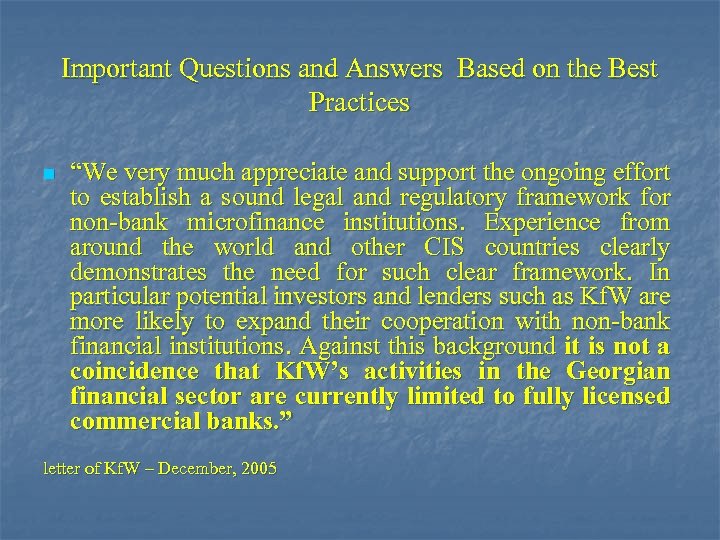 Important Questions and Answers Based on the Best Practices n “We very much appreciate and support the ongoing effort to establish a sound legal and regulatory framework for non-bank microfinance institutions. Experience from around the world and other CIS countries clearly demonstrates the need for such clear framework. In particular potential investors and lenders such as Kf. W are more likely to expand their cooperation with non-bank financial institutions. Against this background it is not a coincidence that Kf. W’s activities in the Georgian financial sector are currently limited to fully licensed commercial banks. ” letter of Kf. W – December, 2005
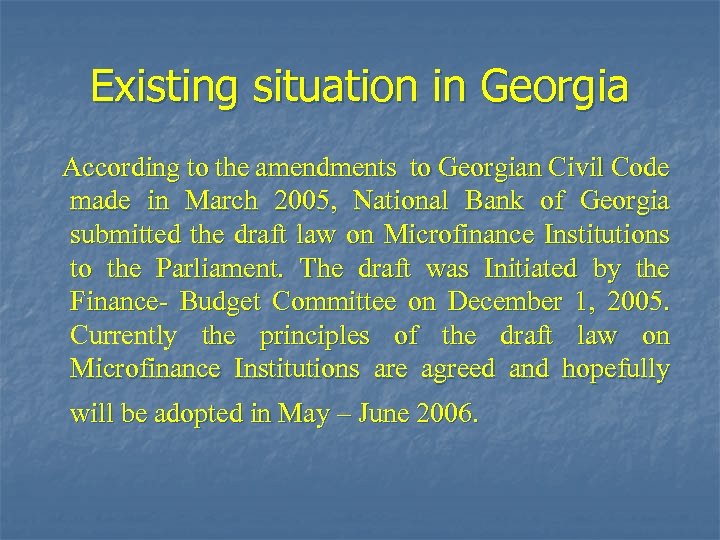 Existing situation in Georgia According to the amendments to Georgian Civil Code made in March 2005, National Bank of Georgia submitted the draft law on Microfinance Institutions to the Parliament. The draft was Initiated by the Finance- Budget Committee on December 1, 2005. Currently the principles of the draft law on Microfinance Institutions are agreed and hopefully will be adopted in May – June 2006.
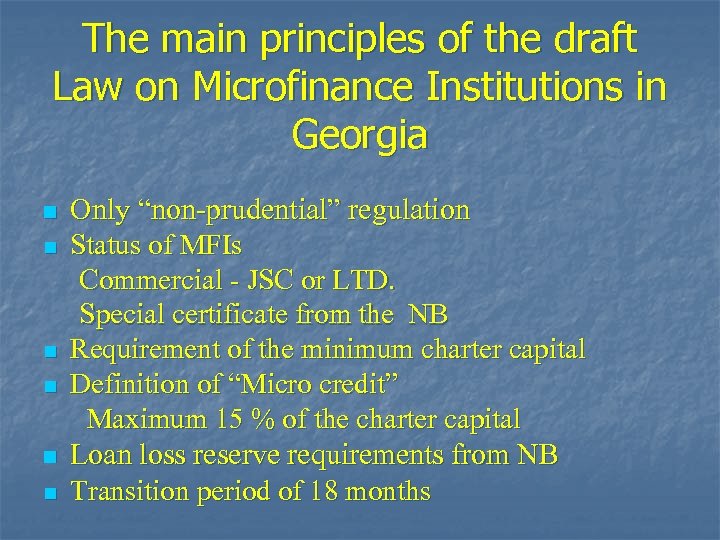 The main principles of the draft Law on Microfinance Institutions in Georgia n n n Only “non-prudential” regulation Status of MFIs Commercial - JSC or LTD. Special certificate from the NB Requirement of the minimum charter capital Definition of “Micro credit” Maximum 15 % of the charter capital Loan loss reserve requirements from NB Transition period of 18 months
 D Thank you