


 Скачать презентацию Legal Environment for Risk and Insurance International We
77ac6a13d2f7b155a439b1d4d59212d5.ppt
- Количество слайдов: 52
 Legal Environment for Risk and Insurance: International We discuss some legal issues in an international environment
 Summary • International diversity in legal systems – Civil and common laws – Islamic Laws – Socialist laws – Others • Tort laws – product liability – workers’ compensation – automobile liability
 Summary • International variations in contract laws • Environmental risks and the law
 What is the problem? • Diversity in legal systems • Legal authority usually comes from cultural and traditional factors • They differ enormously • Some are built on religious authority • National risk management can differ substantially from international ones
 Systems of law • Civil law – Derived from ancient Roman law (Justinian) – Codified (Roman, French and German) – Most ex-colonies have civil law codes – Russia and others in Eastern Europe have adopted civil law codes – Based on abstract principles and the judiciary interprets the code, apply statutary rules to facts and then pass judgement
 • Common Law – derives authority from secular courts recognizing traditional usage and customs – influenced by unwritten law of England – successive courts respect previous court decisions (precedents) – however, it can reject previous decisions if it is deemed outmoded – autonomy of judiciary
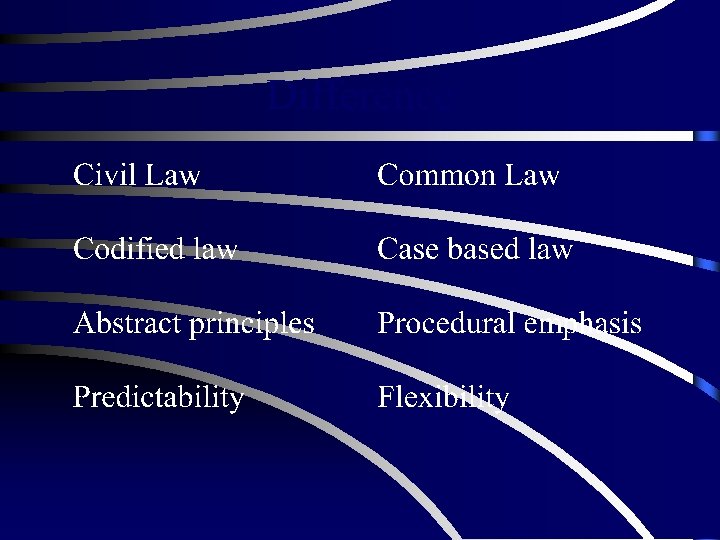 Difference
 Civil versus common laws • Civil law nations expect their legislators to codify laws that anticipate contingencies • Common law nations expect their courts to make case by case decisions that together comprise the law of contracts and torts • However, it is impossible to codify every possible contingency and it is impossible to leave all authority to judges
 Countries • Civil law countries – Argentina, Brazil, Chile, France, Germany, Italy, Japan, Mexico, Poland, Russia, Sweden, Venezuela • Common law countries – Australia, Canada, India, Jamaica, Singapore, UK, US, Zimbabwe
 Islamic Law • One in four in the world is a Muslim • Some very large countries have laws governed by Islam • Many oil rich countries have Islamic laws • The main source of Islamic law is governed by the Qu’raan (Koran) • Koran lays down the rules by which a Muslim should live (Shari’at)
 What are the features? • Contract disputes are resolved in a religious court or through arbitration if commercial in nature and agreed upon by the parties • Injured party seek compensation for damages • Some consequential damages are not recognized • Personal injuries can be settled by diyaah or blood money
 Examples • • • BCCI went bankrupt Many of the directors were Saudis They were tried in Saudi shariat court But profit was not recognized No liability Case of the murder of a nurse was settled by payment of blood money (diyah)
 Relevance • Some Muslim countries are rich • Therefore, many traded items might end up in countries with Islamic laws • Saudi Arabia, Brunei, Iran, Afghanistan are prime examples of strict adherence to Islamic laws • A risk manager from Singapore was found guilty of “murder” and was executed in Saudi Arabia
 Socialist Laws • Exist in China, Cuba, North Korea and Vietnam • Mexico trades quite a bit with Cuba • Typically have very little life insurance • In China, most often private possession of property is not recognized • Typically requires a joint venture role of foreign investor
 Japan’s Legal System • Traditional paternalistic view remains • Government knows best! • Japanese Civil and Commercial codes were modified in 1898 and 1899 after 1896 German Civl Codes • They were considered necessary as Japan started to trade with the rest of the world • Like the Germans, Japanese considered themselves as the “chosen race”
 Japan • 1947 Japanese constitution was modeled after the American one • Even though formal civil codes exist, commercial codes are interpreted and enforced through administrative regulations enacted by highly respected career bureaucrats in different ministries • Ministries provide unwritten laws to business
 Why lawsuits are rare in Japan • Lawsuits are socially considered unusual in Japan • Ethical and religious barriers • Legal Training Research Institute has a monopoly on supplying judges and lawyers in the country • Losing party pays all the legal fees
 Japan • Typically, even with a formal agreement, it is understood that any dispute will be resolved by mutual agreement • Flexible approach but slippery • Spirit of business relationship is important • But not the letter of the law
 Substantive vs Procedural Law • Substantive law defines, creates and regulates rights • Procedural law prescribes methods of enforcement of rights or obtaining redress for their violation • Examples: fraud, offer and acceptance (S) • Framing the method to file lawsuits (P)
 Substantive laws • Tort and contract • Tort is sought to compensate for damage suffered where the liability is based on wrongdoing • Damage for breach of contract is sought when a party fails to perform any promise which is a part of the agreement • (Regulatory process)
 International laws • Substantive laws are covered by UN Convention for the International Sale of Goods (CISG) – The rules of the convention apply to formation of the contract to be bound by the laws of a particular nation – Many goods and services are not covered by the treaty
 ICC • Procedural laws – International contracting parties often insert arbitration clauses which subject the parties to international arbitral tribunals such as the International Chamber of Commerce (ICC) of the UN commission on Intenational Trade Law (UNCITRAL) – UNCITRAL rules are recognized widely
 New York Convention • UN Convention on the Recognition and Enforcement of Foreign Abritral Awards (also called the New York Convention) – provides a procedural mechanism to enforce international contracts that contain arbitration clauses to resolve conflicts. It permits parties holding arbitral awards to seek enforcement of the award in the signatories’ national courts – awards are encforeable inmost countries
 New developments • • Commercial diplomacy WTO is one such forum NAFTA is another Some of these are bilateral, more and more are multilateral • Mercosur • AFTA
 Variations in Tort laws • A tort is a civil wrong resulting in injury to a person or property • Intentional: assault, tresspass • Negligence: unreasonable risk of causing injury (speeding) • Strict liability-liability without fault – product liability of manufacturer or seller – Tort cost is the highest in the US 2. 2% of GDP
 Product liability • US – assigns liability to manufacturer, supplier or their agent for injuries resulting from the use of their products that are defective or use involves unreasonable risk of harm – strict liability has been adopted by most states and plaintiff only has to show that the product caused harm (Mc. Donald example)
 Types of tort damages • Economic: lost wages or medical expenses – typically involves finding the value of a person • Non-economic: pain and suffering – in many countries, they are small awards, but not in the US • Punitive: to punish reckless behavior
 New minefield: mass tort • Started with asbestos • Next came the breast implant – 480, 000 women filed suits against the manufacturer Dow Corning-filed for bankruptcy-plaintiffs went after the parent company-Dow Chemicals! • Now against cigarette companies – It might be settled by a different deal
 How to survive Mass tort • 1. spotting the first attack, • 2. discovering whether a problem exists, • 3. eliminating danger with strategic settlements, • 4. avoiding bad publicity, especially large jury awards, – example: breast implant Pamela Johnson won $25 million in Harris County, Texas, received live coverage on the cable channel Court TV
 Surviving. . . • 5. Fighting all forms of consolidation if more lawsuits arise, • 6. expanding the in-house team if lawsuits threaten to bring the company to a standstill, • 7. going after appellate law, and • 8. knowing the worst-case scenario.
 Breast implant saga • 1943: Dow Chemical and Corning Inc set up Dow Corning, at the request of the US military. • The new company makes materials for military aircraft. • 1964: Dow Corning markets its first silicon filled breast implants.
 Breast implant saga • 1977: A woman sues Dow Corning for disfigurement after her implants rupture. She wins $170, 000 for pain and suffering. • 1982: The allegation that implants cause illness appears in San Francisco. It is filed by Maria Stern. • 1984: Discovery is granted in the Maria Stern case. Stern's Lawyer, Dan Bolton, visits Dow Corning.
 Breast implant saga • 1984: Bolton seizes 20 years-worth of Dow Corning documents. Many are memos about implant safety. • July 1985: Maria Stern wins $1. 7 million. • 1988: Legendary Houston attorney John O'Quinn accepts his first implant client, as a favour to a friend.
 Breast implant saga • 1990: Implant safety becomes a staple of US television magazine shows. • September 1991: Bristol-Myers Squibb, the second biggest implant manufacture, closes its implant business. • December 1991: Mariann Hopkins, another Dan Boton client, wins a $7. 34 million verdict.
 Breast implant saga • 1992: Dow Corning announces yearly sales of $2 billion on its range of 8, 000 silicon products. • January 1992: Bolton sends trial documents to a US government agency, the Food and Drug Administration (FDA). • The move breaches a court order.
 Breast implant saga • January 6 1991: The FDA announces a moratorium on the use of silicon implants. Women with implants head to court in numbers. • January 10 1992: John O'Quinn files 78 implant lawsuits in the state court of Harris County, Texas.
 Breast implant saga • February 1992: Stanley Ches. Ley, of Cincinnati, has implanted women declared a "class". Lawsuits are consolidated before Judge Stanley Pointer in Alabama. Texas cases are not affected. • February 1992: Dow Corning, the Largest manufacturer, officially quits the implant business.
 Breast implant saga • February 1992: Houston Lawyer Michael Gallagher sets up a toll free implant phone Line. • Autumn 1992: Settlement negotiations start in Alabama. Baxter Healthcare, Dow Corning and Bristol-Myers Squibb are involved. Later, 3 M joins.
 Breast implant saga • December 1992: John O'Quinn wins $25 million for his second client, Pamela Johnson. Bristol-Myers Squibb's defeat is watched, live, by viewers across the US, courtesy of cable channel Court TV. • June 1993: Dow Corning wins a case in Colorado. The victory comes after an expert witness for the other side admits having
 Breast implant saga • May 1994: The $425 billion global settlement plan is announced. • Summer 1984: Reaction to the settlement is muted. Texas lawyers see no reason to join. Seven thousand plaintiffs opt-out. Over half are based in Texas.
 Breast implant saga • Autumn 1994: Rumours that Dow Corning faces financial ruin prompt plaintiff lawyers to interview Dow Chemical staff. • Autumn 1994: Dow Chemical becomes codefendant in a Texas lawsuit. • March 1995: Judge Stanley Pointer rules that the proposed $4 -25 billion settlement is insufficient. He says over 480, 000 women have staked claims.
 Breast implant saga • April 15 1995: Judge Pointer adds Dow Chemical to the implant class action. • May to 1995: Dow Corning runs full-page advertisements in 19 US newspapers. Readers are offered copies of recent medical studies. Plaintiff lawyers protest. They say the company is contamination jury pools.
 Breast implant saga • May 15 1995: Dow Corning files for bankruptcy. • June 1995: Lawyers across the US re-file Dow Corning Lawsuits as Dow Chemical Lawsuits. • June 1995: Harvard University publishes a study. It suggests that implanted women are slightly less likely to fall ill than other women.
 Breast implant saga • July 1995: Dow Chemical tries to freeze more than 13, 000 Lawsuits. It argues the trials would interfere with Dow Corning's bankruptcy. • October 2 1995: The Charlotte Mahlum action begins in Washoe, Nevada. Dow Chemical is sole defendant. Frederic Ellis represents Mahlum.
 Breast implant saga • October 31 1995: Charlotte Mahlum wins $14. 1 million. • November 2 1995: The Texas Supreme Court unlocks Texas Law suits involving Dow Chemical. • November 6 1995: Forbes magazine ranks John O'Quinn second richest lawyer in US. It says implant clients have earned O'Quinn $40 million.
 Product liability: EU • Civil and criminal liability for damage caused by defective products to individuals have been enacted in most EU countries in accordance with the Product Liability Directive • UK: Consumer Protection Act similar for Germany • France has no guidelines similar to PLD
 Product liability: Japan • • Very few cases arisen so far Proof required is very stringent Very few lawyers (bengoshi) New law in 1995 – Suppliers are not manufacturers – Product only damage is not covered
 Workers’ compensation • It varies from country to country • US: states have their own laws • Germany has the oldest law 1881 but (like many other countries) it is part of social security. There is no private Workers’ compensation in Germany • UK combined health and safety • Japan: Compulsory scheme
 Auto • US: liability is a state matter • EU: part of the directive • Japan: upper limit on damage
 Internet tort • When the activity complained of takes place over the Internet it will have to be decided where the events constituting the tort actually occurred: • It could be the place where the relevant data was uploaded to make it available to potential readers.
 Internet tort • It could be the place, if any, to which it was specifically directed. • It could be the place where it happened to be accessed, although not deliberately targeted towards the readership of that country.
 Internet issues: English case • *The contract was made in England. • *The contract was made for a foreign principal by or through an agent in England. • *The contract is governed by English law. • *The breach of contract complained of occurred in England. • *An injunction is sought to prevent the defendant taking particular action in England.