


 Скачать презентацию Legal Authorities Statutory Regulatory HUD Notices HUD Notice
bfffc053c6847071f2be7c8db56baf90.ppt
- Количество слайдов: 122
 Legal Authorities Statutory Regulatory HUD Notices HUD Notice of Funding Availability HUD 202 / 811 Handbooks 1
 Legal Issues (cont’d) Where to find all this information ? HUDCLIPS: www. hud. gov click “RESOURCES” click “HUD Handbooks, Forms, Publications” click “Access HUDCILPS” United States Code: http: //www. law. cornell. edu/uscode/ 2
 Legal Issues (cont’d) Who can be a sponsor of a 202 and 811 project ? 5 PRONG TEST 3
 Legal issues (cont’d) 1)202: must have 501(c)(3) or 501(c)(4) 811: must be 501(c)(3) 2) No part of the net earnings of which inures to the benefit of any member, founder, contributor or individual 3) Must not be controlled by, or under the direction of, persons or firms seeking to derive profit or gain therefrom 4) Must have a governing board 5) approved by HUD as to administrative and financial responsibility 4
 Legal Issues (cont’d) 202 Sponsor: cannot be a public body or instrumentality of a public body can be a consumer cooperative 5
 Legal Issues (cont’d) EXHIBIT 2: LEGAL STATUS (a)Articles of Incorporation, Constitution or other organizational documents (b) By-laws (c) IRS tax exemption 6
 Legal Issues (cont’d) EXHIBIT 2: Legal Status Co-sponsors Begin and End dates IRS Tax Exemption Ruling 7
 Legal Issues (cont’d) Exhibit 2: What is Legal Review looking for? Whether sponsor has the legal authority to sponsor the project, to assist the owner and to apply for the capital advance. Whethere are inconsistencies between sponsor’s legal documents and HUD’s statutory, regulatory and NOFA requirements. 8
 Legal Issues (cont’d) EXHIBIT 2: Legal Status There must be language in the legal documents stating no part of the sponsor’s net earnings inures to the benefit of any private party Nothing in the by-laws, sponsor’s organizational or legal documents can conflict with this requirement 9
 Legal Issues (cont’d) EXHIBIT 2: Legal Status “Self-dealing” provisions in by-laws problematic No cure for “self-dealing” 10
 Legal Issues (cont’d) Exhibit 4(d): Site Control There have been no changes to the site control requirements. 202 vs. 811 202: No site control results in rejection 811: No site control placed in Category B 11
 Legal Issues (cont’d) Deed or long-term leasehold Contract of sale Option to purchase or for a long-term leasehold 12
 Legal Issues (cont’d) Site covered by a HUD mortgage Sites acquired from a public body 13
 FY 2009 Section 202 Allocation Formula One-person Very Low-Income Renter Households with one person Very Low. Income Age 62+ With Housing Conditions Incomes at or below the 1 person Section 8 Income Limit (Very Low-Income Limit) 14
 FY 2009 Section 202 Allocation Formula (cont’d) With Housing Conditions: - Living in a unit lacking plumbing or kitchen facilities - Overcrowded - Excess Rent Burden: more than 30% of income for rent Data Source: 2000 Census Special Tabulations of Households 15
 FY 2009 Section 202 Allocation Formula (cont’d) Each HUD Office jurisdiction is allocated funds for a metropolitan share and a nonmetropolitan share. For FY 09, each jurisdiction receives sufficient capital advance funds for a minimum of 20 units in the metro portion and 5 units in the nonmetro portion. 16
 FY 2009 Section 202 Evidence of Need Sponsor’s evidence of need should include: Estimate of demand Market conditions in existing supply (Public Housing, RHS, LIHTC, Sec. 8, & 202) Assisted housing under construction 17
 FY 2009 Section 202 Evidence of Possible Lack of Demand Projected long-term decline in age-cohorts for target population Slow absorption in newer units Persistently high vacancies Widespread use of age-waivers Evidence of new projects filling at the expense of existing ones 18
 FY 2009 Section 202 EMAD Points Awarded for Market Need Only projects in market areas with sufficient demand will be rated Projects will receive 10, 5, or 0 points based upon the unmet need and unmet needs ratio: project units as a percent of the unmet need 19
 FY 2009 Section 202 EMAD Points Awarded for Market Need Unmet need is the number of one-person renters age 75 with very-low incomes and with housing conditions, minus any rental assistance provided since 2000 If the unmet need is positive, rating based on unmet needs ratio: 15 percent or less – 10 points Greater than 15 percent – 5 points If the unmet need is 0 or negative – 0 points 20
 FY 2009 Section 811 EMAD will not conduct market reviews of Section 811 applications and will not assign rating points EMAD will provide assistance to the field Housing staff in cases where there is a concern about market conditions 21
 FY 2009 Section 202 Special Tabulations of Households for 1990 and 2000 http: //www. huduser. org/datasets/ spectabs. html 22
 Questions? Please contact your local field economist with any questions regarding the data, metropolitan definitions, or evidence of need. 23
 Overview Fair Housing/Civil Rights Matters Civil Rights Threshold Review Rating Factor 1. b. (1) Rating Factor 1. b. (2) Rating Factor 3. c. – Section 811 3. b. – Section 202 Rating Factor 3. l. (1) and (2) – Section 811 3. k. (1) and (2) – Section 202 24
 Overview (cont’d) Rating Factor 2. b. Rating Factors: 3. g. – Section 811 3. i. – Section 202 25
 Civil Rights Threshold Review Section III. C. 2. c. of the General Section of the NOFA 26
 Rating Factor 1. b. (1) Scope, extent, and quality of your experience in providing housing or related services to minority persons or minority families Worth a maximum of five (5) points 27
 Significant Previous Experience The percentage of minorities being provided housing or services in the applicant’s current projects are equal to or greater than the percentage of minorities in the housing market area where the housing or services are provided 28
 Rating Factor 1. b. (2) The scope, extent, and quality of relationships overtime with minority communities Worth a maximum of two points 29
 Rating Factor 3. c. – 811 & 3. b. – 202 The suitability of the site in providing greater housing choice to minorities and persons with disabilities and affirmatively furthering fair housing Worth a maximum of 8 points for Section 811 9 points for Section 202 24 CFR 891. 125(b) and (c) 30
 How to meet Rating Factor 3. c. For non-minority neighborhood For minority neighborhood 31
 Rating Factor 3. l. (1) and (2) for Section 811 3. k. (1) and (2) for Section 202 The number of jobs created The type and amount of contracts generated How Section 3 residents and businesses will be targeted for these opportunities 32
 Rating Factor 2. b Connection between the project and the community’s planning document that analyzes fair housing issues 33
 Rating Factors 3. g. – Section 811 3. i. – Section 202 The inclusion of the target population in the development and implementation of the project 34
 Contact Information Gwendolyn. V. Jackson@HUD. gov (202) 402 -7008 35
 SITE SELECTION AND THE ENVIRONMENTAL REVIEW PROCESS 36
 General Timing of environmental review 811 s with site control & 202 s at application processing stage 811 s approved as Category B or changed site for approved grant prior to issuance of FIRM Same environmental requirements as at time of Super. NOFA 37
 General (cont’d) 202/811 Sponsors and HUD are partners And HUD wants Sponsors to: Find a site with no concerns/easily resolvable concerns, especially Toxic Hazards Historic Preservation Floodplain or Wetland 38
 General (cont’d) HUD wants Sponsors to provide certain information to HUD: ◦ Phase I ESA ◦ Comprehensive Asbestos building survey when pre 1978 structures (other than just 1 -4 units; technical correction for 811) ◦ Historic Preservation ◦ Other information as requested 39
 General (cont’d) HUD appraiser will perform environmental review based on Sponsor provided information Research Legwork 40
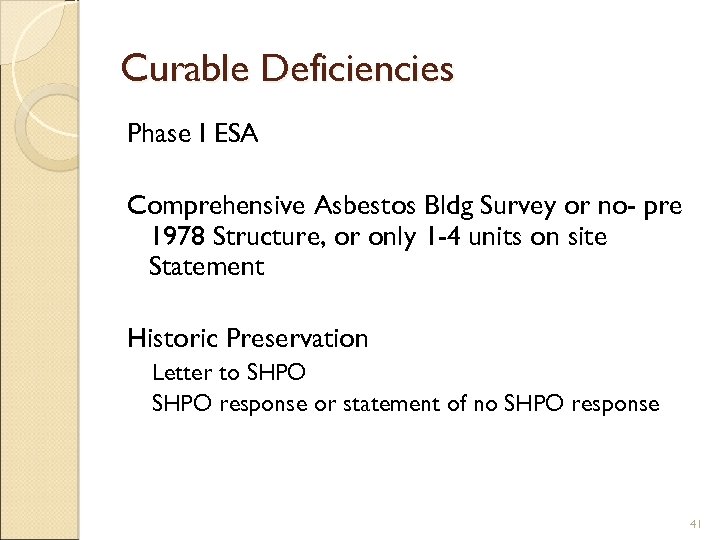 Curable Deficiencies Phase I ESA Comprehensive Asbestos Bldg Survey or no- pre 1978 Structure, or only 1 -4 units on site Statement Historic Preservation Letter to SHPO response or statement of no SHPO response 41
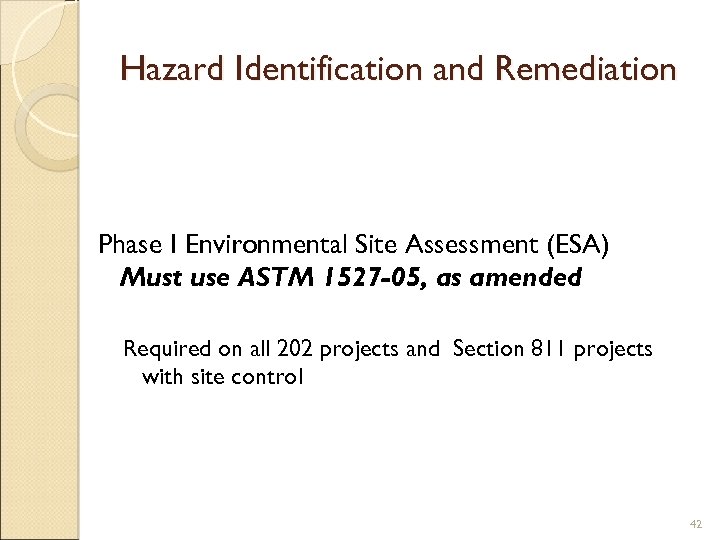 Hazard Identification and Remediation Phase I Environmental Site Assessment (ESA) Must use ASTM 1527 -05, as amended Required on all 202 projects and Section 811 projects with site control 42
 43
43
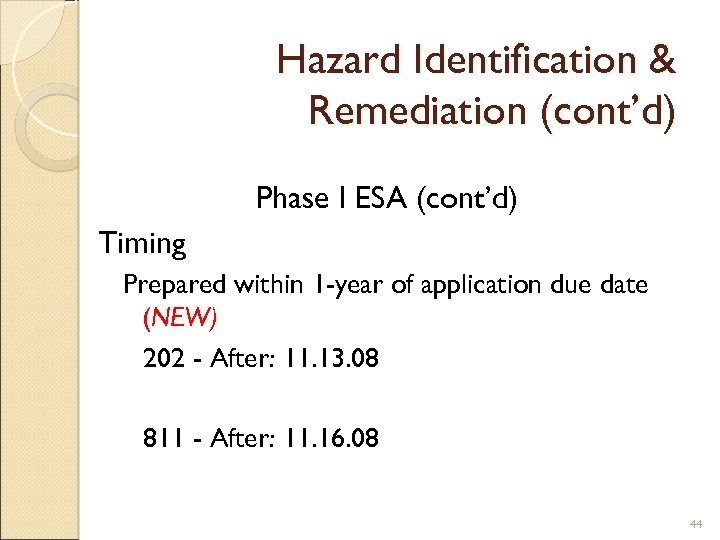 Hazard Identification & Remediation (cont’d) Phase I ESA (cont’d) Timing Prepared within 1 -year of application due date (NEW) 202 - After: 11. 13. 08 811 - After: 11. 16. 08 44
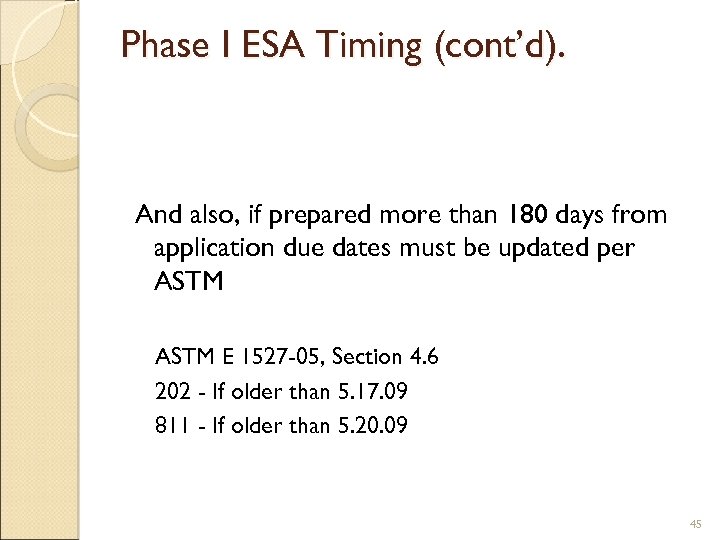 Phase I ESA Timing (cont’d). And also, if prepared more than 180 days from application due dates must be updated per ASTM E 1527 -05, Section 4. 6 202 - If older than 5. 17. 09 811 - If older than 5. 20. 09 45
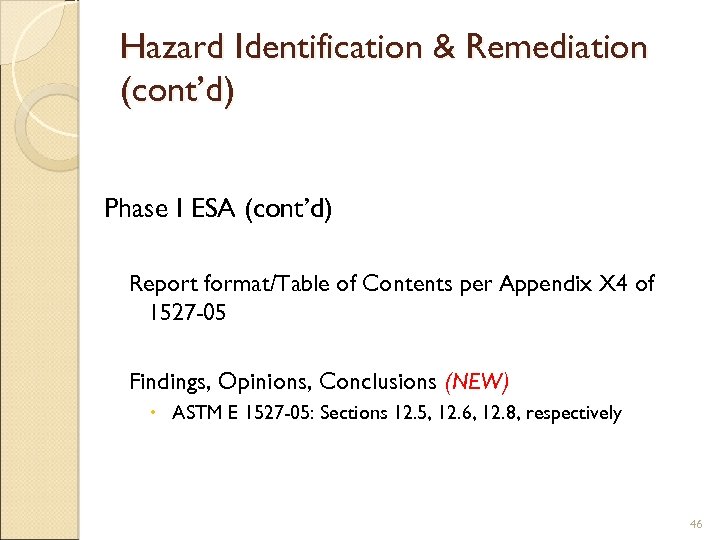 Hazard Identification & Remediation (cont’d) Phase I ESA (cont’d) Report format/Table of Contents per Appendix X 4 of 1527 -05 Findings, Opinions, Conclusions (NEW) ASTM E 1527 -05: Sections 12. 5, 12. 6, 12. 8, respectively 46
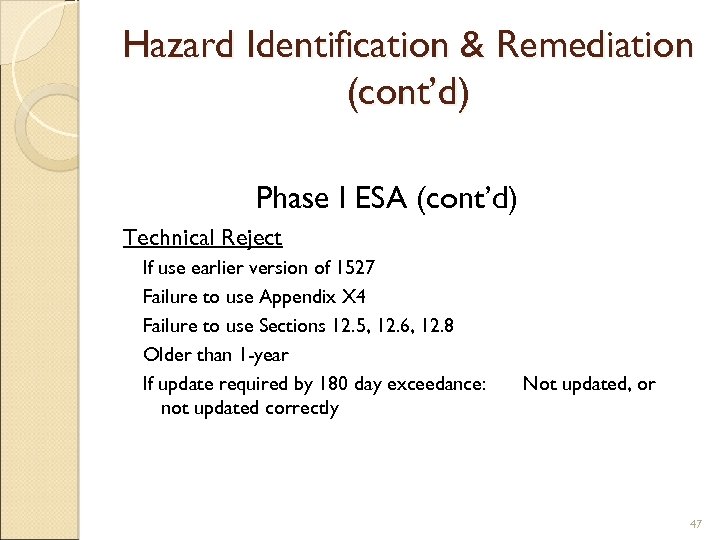 Hazard Identification & Remediation (cont’d) Phase I ESA (cont’d) Technical Reject If use earlier version of 1527 Failure to use Appendix X 4 Failure to use Sections 12. 5, 12. 6, 12. 8 Older than 1 -year If update required by 180 day exceedance: not updated correctly Not updated, or 47
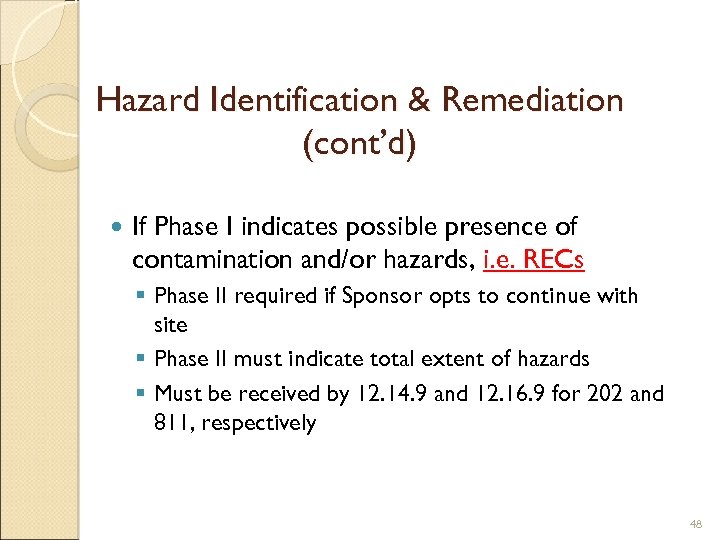 Hazard Identification & Remediation (cont’d) If Phase I indicates possible presence of contamination and/or hazards, i. e. RECs § Phase II required if Sponsor opts to continue with site § Phase II must indicate total extent of hazards § Must be received by 12. 14. 9 and 12. 16. 9 for 202 and 811, respectively 48
 Hazard Identification & Remediation (cont’d) If Phase II indicates hazards, the following must be received by HUD by 12. 14. 9 and 12. 16. 9 for 202 and 811, respectively Contract for Remediation, and Remediation Plan approved by local/State/Federal gov’t Remediation at Sponsor’s expense After remediation, must be clean to non-site specific standards: no capping, monitoring wells, etc. 49
 Hazard Identification & Remediation (cont’d) Groundwater exception to clean site All contamination in Groundwater at least 25 feet below surface No groundwater use in area or active water supply wells on site Remediation able to be completed prior to Initial Closing All passive and active remediation completed Monitoring wells closed out 50
 Comprehensive Building Asbestos Survey Not required if sponsor statement that no Pre-1978 structures or only 1 -4 units residential on site Must be a thorough inspection throughout structures Asbestos screen not acceptable Friable or affected by rehabilitation/demolition – abate Other asbestos: O&M plan Abatement allowable cost to limit of Capital Advance 51
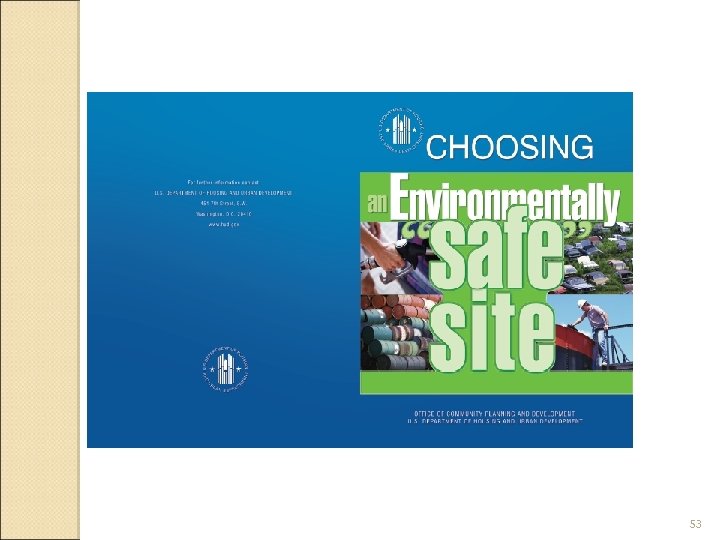
 Choosing an Environmentally “Safe” Site Accessed through WEB page of 202/811 Super. NOFA Discusses Phase I ESAs, especially for 202/811 programs Special discussions on Toxic & hazardous substances USTs Asbestos LBP 52
 53
53
 Choosing an Environmentally “Safe” Site Supplemental Guidance Accessed through WEB page of 202/811 Super. NOFA Discusses manmade hazards as well as items that HUD may look at during environmental review 54
 Choosing an Environmentally “Safe” Site Supplemental Guidance (cont’d) Natural Resources Manmade Hazards 55
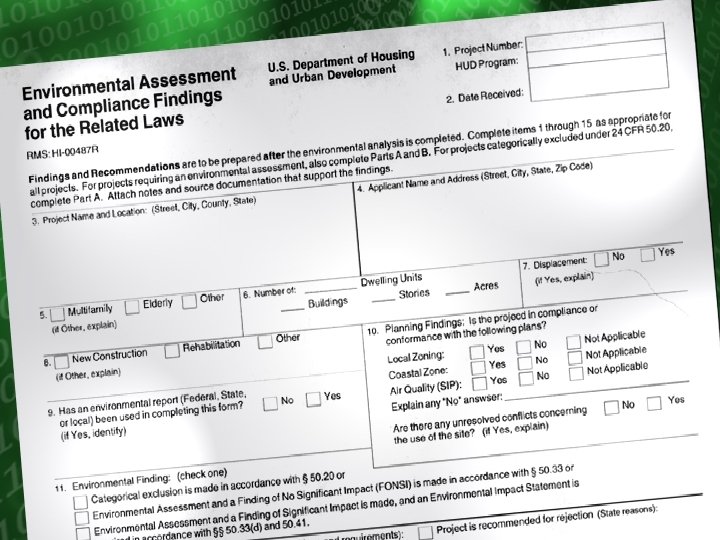
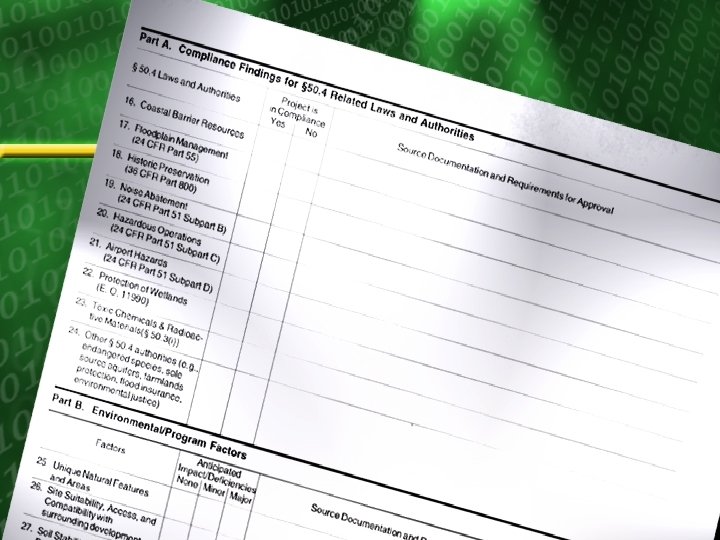
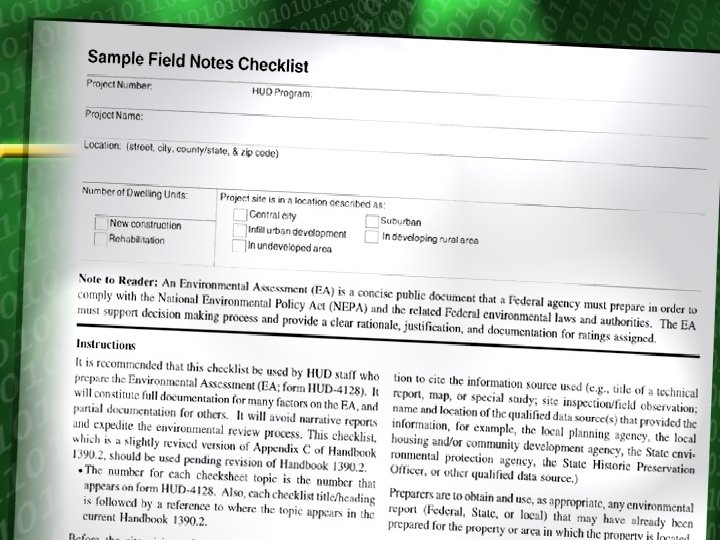
 HUD Form 4128 q. Used to record environmental review q. HUD appraiser performs site visit and records results on the “Sample Field Notes Checklist” 56
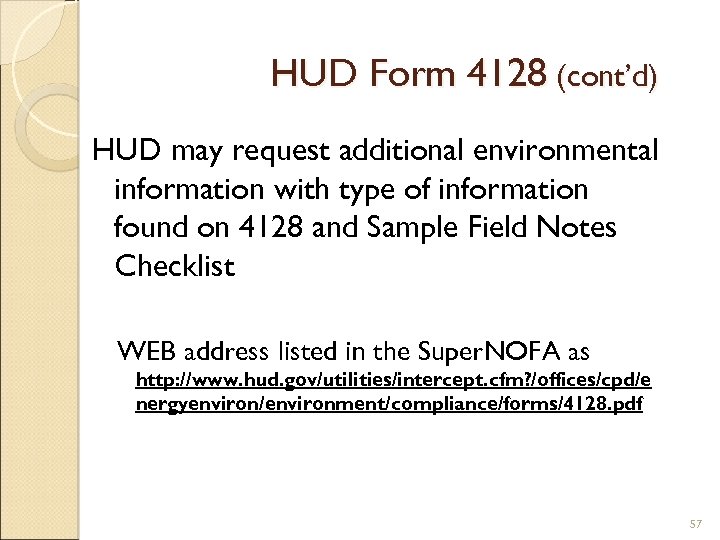 HUD Form 4128 (cont’d) HUD may request additional environmental information with type of information found on 4128 and Sample Field Notes Checklist WEB address listed in the Super. NOFA as http: //www. hud. gov/utilities/intercept. cfm? /offices/cpd/e nergyenviron/environment/compliance/forms/4128. pdf 57
 test Test 58
 test Test ◦ Test test 59
 test 60
 HUD Form 4128, contd. HUD appraiser completes during Technical processing If cannot be completed during technical processing due to complexity 202: Rejected and not rated/ranked 811: Placed in Category B for selection purposes 61
 HUD Form 4128 Conclusions Acceptable as submitted Acceptable with conditions & safeguards placed on approval documents Not acceptable, then 202: Projects rejected and not rated/ranked 811: Placed in Category B for selection purposes 62
 Biological Assessment Requirement ØA biological assessment (BA) will be required for all Western Washington sites Ø Without one, HUD staff will not be able to schedule a consultation with the USMF and USFW Ø If one is not submitted with the application or soon thereafter, there will not be enough time to complete the 4128 process 63
 Historic Preservation SHPO Letter to SHPO/THPO (on tribal land) Response If no response Sponsor statement indicating that it attempted, but SHPO/THPO did not respond 64
 Historic Preservation (cont’d) Sample letter to SHPO/THPO Accessed through HUD WEB page of 202/811 Super. NOFA Developed by HUD HPO Includes all information necessary for SHPO/ THPO to provide comment Allows for dual response to sponsor & HUD Some Field Offices might have other sample letters 65
 Historic Preservation (cont’d) If no or incomplete response HUD will then initiate process 66
 Historic Preservation (cont’d) NRHP or no NRHP properties (National Register of Historic Places) If NRHP - Effect or No Effect If Effect – Not Adverse or Adverse If Adverse –MOA (Memorandum of Agreement) to mitigate adverse effects or Failure to Agree process Can be a long process 67
 Historic Preservation (cont’d) If not sufficient time to complete all above steps of historic preservation process during technical processing 202: Reject 811: Placed in Category B for selection purposes 68
 Historic Preservation (cont’d) If HUD possesses knowledge that a site might have Religious or Cultural Significance to Indian tribe or Native Hawaiian Organization HUD will request their comments 69
 HUD Historic Preservation Archeological Policy HUD rarely requires even if requested by SHPO HUD HP fact sheet 6 REVISED http: //www. hud. gov/offices/cpd/environment/review/hpfactsheet 06. pdf Proposed or adjacent site already determined eligible/listed Preliminary site work (e. g. previous surveys or predictive models) has established eligibility 70
 Floodplains and Wetlands HUD cannot approve sites in FEMA 100 year floodplain in non-participating or suspended jurisdictions 71
 Floodplains and Wetlands (cont’d) Sponsors should try to select sites out of 100 -year floodplain 500 -year floodplain for critical actions: special care; i. e. . . , not independent living projects Wetlands 72
 Floodplains and Wetlands (cont’d) HUD Processing at application stage if known practicable alternatives 202 – Reject 811 - Placed in Category B for selection purposes if not sure that practicable alternatives must complete first 6 steps of 8 -step process 73
 Floodplains and Wetlands (cont’d) If not sufficient time to complete first six steps during technical processing 202: Reject 811: Placed in Category B for selection purposes 74
 Floodplains and Wetlands (cont’d) For new construction projects deemed acceptable based on no practicable alternatives, condition on approval documents CLOMA/CLOMR prior to firm FLOMA/FLOMR prior to final closing Flood insurance during construction 75
 CPD’s Role in 202/811 Application Reviews Three areas of review: 1) Acquisition and Relocation 2) Certification of Consistency with the Consolidated Plan 3) RC/EZ/EC-II Bonus Points 76
 Acquisition and Relocation Applicants must comply with the Uniform Relocation Assistance and Real Property Acquisition Policies Act of 1970 (URA or Uniform Act) 77
 The Uniform Act Covers: The acquisition of real property (with or without existing structures) The permanent and involuntary displacement, or temporary relocation, of both residential and non-residential persons 78
 Acquisition Exception… Sponsors are exempt from complying with Subpart B (sections 24. 102 -24. 108) of the Uniform Act only if an identified site can be acquired “voluntarily” in accordance with Sec. 24. 101 of Subpart B A failure to comply with 24. 101 can trigger the requirements of Subpart B (sections 24. 10224. 108) 79
![The “Voluntary” Process [49 CFR 24. 101] The buyer is required to inform the](https://present5.com/presentation/bfffc053c6847071f2be7c8db56baf90/image-80.jpg "The “Voluntary” Process [49 CFR 24. 101] The buyer is required to inform the") The “Voluntary” Process [49 CFR 24. 101] The buyer is required to inform the Seller, prior to executing an agreement to purchase, That it does not have the power of eminent domain and, it will not be able to buy the property if negotiations fail to result in an amicable agreement Of the Sponsor’s estimate of fair market value of the property to be acquired 80
The “Voluntary” Process [49 CFR 24. 101] The buyer is required to inform the Seller, prior to executing an agreement to purchase, That it does not have the power of eminent domain and, it will not be able to buy the property if negotiations fail to result in an amicable agreement Of the Sponsor’s estimate of fair market value of the property to be acquired 80
 Estimating Fair Market Value (FMV) An appraisal is not required by the URA to establish the FMV of a property, but the acquiring agency’s acquisition file must include an explanation, with reasonable evidence, of the basis for the estimate If the negotiated price is above the estimate of FMV, it’s best that the above-value difference be paid with non-federal funds 81
 Application Instructions – Acquisition (Exhibit 4) Applications must include evidence of compliance with the “voluntary” acquisition requirements of the URA, i. e. , the Seller was advised: That the Sponsor does not have the power of eminent domain and that it will not be able to buy the property if negotiations fail to result in an amicable agreement Of the Sponsor’s estimate of fair market value of the property to be acquired 82
 Exhibit 4 Instructions (cont’d) HUD requires that the Seller must be offered the right to withdraw from any written purchase agreement if, before that agreement was executed, the Seller was not advised that the acquisition is “voluntary” in nature, and informed of the Sponsor’s estimate of FMV of the property to be acquired. 83
 Exhibit 4 Instructions (cont’d) If it was necessary that the Sponsor offer the Seller an opportunity to withdraw (in accordance with HUD’s corrective action instructions), the Sponsor is encouraged to include such document(s) Inclusion of such documents can help affirm to HUD that the Sponsor’s “firm commitment” is valid in respect to the “voluntary” acquisition requirements found at 49 CFR 24. 101 84
 Projects Involving Relocation Owner Occupants – Owner occupants who sell their property voluntarily are not entitled to displacement assistance Residential and Non-residential Tenants – All displaced tenants are entitled to displacement assistance, as required by the URA 85
![Relocation Planning Nonresidential Planning ◦ Personal interview required [§ 24. 205(c)(2)(i)] Site requirements Outside](https://present5.com/presentation/bfffc053c6847071f2be7c8db56baf90/image-86.jpg "Relocation Planning Nonresidential Planning ◦ Personal interview required [§ 24. 205(c)(2)(i)] Site requirements Outside") Relocation Planning Nonresidential Planning ◦ Personal interview required [§ 24. 205(c)(2)(i)] Site requirements Outside specialists Personalty/realty issues Time required to vacate Site availability Advance payment needs 86
Relocation Planning Nonresidential Planning ◦ Personal interview required [§ 24. 205(c)(2)(i)] Site requirements Outside specialists Personalty/realty issues Time required to vacate Site availability Advance payment needs 86
 Relocation Planning Residential Tenant Survey Determine Household Income Estimate Monthly Housing Cost Average Monthly Utilities Monthly Lease or Rent Amount Identify Special Needs Determine Replacement Housing Needs Estimate Cost of Replacement Housing 87
 Relocation Planning Prepare Relocation Budget Estimate Non-residential move/reestablishment cost (personal interview) Residential move cost (FHWA’s Fixed Move Schedule) Residential housing cost increase for 42 -month period Compare: Lesser of household’s ability to pay (if low income) vs. monthly housing cost paid at displacement unit With: Estimated monthly housing cost of a comparable unit that is in decent, safe, and sanitary condition 88
 Required Relocation Notices Issue General Information Notices (GIN) Each GIN must include advisory services such as that outlined in HUD’s brochure “Relocation Assistance to Tenants Displaced From Their Homes” All GINs should be issued at the date the application is submitted A receipt is required to document delivery of a GIN 89
 Relocation Guidance Relocation can be both: Costly Complex Sponsors may wish to call HUD’s Office of CPD for relocation guidance before entering into a purchase agreement URA guidance for HUD’s programs can also be found at www. hud. gov/relocation 90
 Application Instructions – Relocation (Exhibit 7) If applicable, indicate that no relocation will occur and why (e. g. , property is vacant land, or property was unoccupied and no persons were made to move for the project). 91
 Exhibit 7 Instructions (cont’d) Identifies all persons (families) individuals, businesses, and non-profit organizations) by race/minority group, and status as owners or tenants occupying the property on the date of submission of the application for a capital advance. 92
 Exhibit 7 Instructions (cont’d) Indicates the estimated cost of relocation payments and other services and the basis for the estimate 93
 Exhibit 7 Instructions (cont’d) Indicates the source of funds to be used to pay relocation costs. (You must provide evidence of firm commitment if relocation costs will be funded from sources other than 202/811 capital advance. ) 94
 Exhibit 7 Instructions (cont’d) Identifies the staff or organization that will carry out the relocation activities Identifies all persons who were made to move from the site within the past 12 months and explain reason for such moves 95
 Exhibit 7 Instructions (cont’d) Indicates that all persons occupying the site have been issued the appropriate General Information Notice and advisory services information, receipt required, either at the time the option to acquire the property is executed, or at the time the application is submitted. 96
 Exhibit 7 Instructions (cont’d) NOTE: When evaluating applications, HUD will consider the total cost of proposals (i. e. , cost of site acquisition, relocation, construction and other project costs). 97
 Achieving Results and Program Evaluation Certification of Consistency With The Consolidated Plan Exhibit 8 (e) RC/EZ/EC–II Strategic Plan {2 Bonus Points} Exhibit 8 (h) 98
![Exhibit 8(e) [Form HUD– 2991] Form HUD– 2991 is a required form The “Certification](https://present5.com/presentation/bfffc053c6847071f2be7c8db56baf90/image-99.jpg "Exhibit 8(e) [Form HUD– 2991] Form HUD– 2991 is a required form The “Certification") Exhibit 8(e) [Form HUD– 2991] Form HUD– 2991 is a required form The “Certification of Consistency with the Consolidated Plan” must be completed and submitted with your application, in order to comply with the submission instructions This Exhibit requires the name, title, and signature of the authorized certifying official 99
Exhibit 8(e) [Form HUD– 2991] Form HUD– 2991 is a required form The “Certification of Consistency with the Consolidated Plan” must be completed and submitted with your application, in order to comply with the submission instructions This Exhibit requires the name, title, and signature of the authorized certifying official 99
![Exhibit 8(e) [Form HUD– 2991] Who is the “certifying official? ” The certifying official](https://present5.com/presentation/bfffc053c6847071f2be7c8db56baf90/image-100.jpg "Exhibit 8(e) [Form HUD– 2991] Who is the “certifying official? ” The certifying official") Exhibit 8(e) [Form HUD– 2991] Who is the “certifying official? ” The certifying official of the jurisdiction is the person authorized to sign on behalf of the entitlement grantee 100
Exhibit 8(e) [Form HUD– 2991] Who is the “certifying official? ” The certifying official of the jurisdiction is the person authorized to sign on behalf of the entitlement grantee 100
![Exhibit 8(e) [Form HUD– 2991] The local HUD Office of Community Planning and Development](https://present5.com/presentation/bfffc053c6847071f2be7c8db56baf90/image-101.jpg "Exhibit 8(e) [Form HUD– 2991] The local HUD Office of Community Planning and Development") Exhibit 8(e) [Form HUD– 2991] The local HUD Office of Community Planning and Development (CPD) can provide a list of names and phone numbers of the contact persons for the respective Entitlement grantee Sponsors should contact the local State office responsible for HUD program grants and compliance to determine who to contact for those areas not located in Entitlement communities (i. e. , rural areas) 101
Exhibit 8(e) [Form HUD– 2991] The local HUD Office of Community Planning and Development (CPD) can provide a list of names and phone numbers of the contact persons for the respective Entitlement grantee Sponsors should contact the local State office responsible for HUD program grants and compliance to determine who to contact for those areas not located in Entitlement communities (i. e. , rural areas) 101
 2 Bonus Points for Projects Located in a RC/EZ/EC–II 2 bonus points are available for projects that are located in a RC/EZ/EC–II Form HUD– 2990 (Exhibit 8(h)) must be submitted to earn these bonus points 102
![Exhibit 8 (h) [Form HUD– 2990] Form HUD-2990 is NOT a required form Only](https://present5.com/presentation/bfffc053c6847071f2be7c8db56baf90/image-103.jpg "Exhibit 8 (h) [Form HUD– 2990] Form HUD-2990 is NOT a required form Only") Exhibit 8 (h) [Form HUD– 2990] Form HUD-2990 is NOT a required form Only Sponsors who have projects located within a RC/EZ/EC–II area should complete and submit this form Only if the form is properly completed and submitted can the 2 bonus points be earned 103
Exhibit 8 (h) [Form HUD– 2990] Form HUD-2990 is NOT a required form Only Sponsors who have projects located within a RC/EZ/EC–II area should complete and submit this form Only if the form is properly completed and submitted can the 2 bonus points be earned 103
![Exhibit 8 (h) [Form HUD– 2990] For projects in a RC/EZ/EC–II, this form will:](https://present5.com/presentation/bfffc053c6847071f2be7c8db56baf90/image-104.jpg "Exhibit 8 (h) [Form HUD– 2990] For projects in a RC/EZ/EC–II, this form will:") Exhibit 8 (h) [Form HUD– 2990] For projects in a RC/EZ/EC–II, this form will: Certify that the proposed activities are consistent with the strategic plan of a federally designated RC/EZ/EC– II Certify that the proposed activities will be located within the RC/EZ/EC–II 104
Exhibit 8 (h) [Form HUD– 2990] For projects in a RC/EZ/EC–II, this form will: Certify that the proposed activities are consistent with the strategic plan of a federally designated RC/EZ/EC– II Certify that the proposed activities will be located within the RC/EZ/EC–II 104
![Exhibit 8 (h) [Form HUD– 2990] This form requires the name, title, and signature](https://present5.com/presentation/bfffc053c6847071f2be7c8db56baf90/image-105.jpg "Exhibit 8 (h) [Form HUD– 2990] This form requires the name, title, and signature") Exhibit 8 (h) [Form HUD– 2990] This form requires the name, title, and signature of the authorized certifying official Who is the “certifying official? ” The official authorized to certify that the project is in compliance with the RC/EZ/EC–II strategic plan, is located in an RC/EZ/EC–II, and serves the residents located in the RC/EZ/EC–II area 105
Exhibit 8 (h) [Form HUD– 2990] This form requires the name, title, and signature of the authorized certifying official Who is the “certifying official? ” The official authorized to certify that the project is in compliance with the RC/EZ/EC–II strategic plan, is located in an RC/EZ/EC–II, and serves the residents located in the RC/EZ/EC–II area 105
![Exhibit 8 (h) [Form HUD– 2990] Sponsors who wish to determine if their site](https://present5.com/presentation/bfffc053c6847071f2be7c8db56baf90/image-106.jpg "Exhibit 8 (h) [Form HUD– 2990] Sponsors who wish to determine if their site") Exhibit 8 (h) [Form HUD– 2990] Sponsors who wish to determine if their site is located within an RC/EZ/EC–II area, or who need to determine who the contact person is for a specific RC/EZ/EC –II, may go online to HUD’s Address Locator at www. hud. gov/crlocator 106
Exhibit 8 (h) [Form HUD– 2990] Sponsors who wish to determine if their site is located within an RC/EZ/EC–II area, or who need to determine who the contact person is for a specific RC/EZ/EC –II, may go online to HUD’s Address Locator at www. hud. gov/crlocator 106
![Exhibit 8 (h) [Form HUD– 2990] From this web site, a sponsor can “link”](https://present5.com/presentation/bfffc053c6847071f2be7c8db56baf90/image-107.jpg "Exhibit 8 (h) [Form HUD– 2990] From this web site, a sponsor can “link”") Exhibit 8 (h) [Form HUD– 2990] From this web site, a sponsor can “link” to the two following web sites to obtain general information on RC/EZ/EC–II programs: Renewal Communities and Urban EZ/ECs administered by the U. S. Dept. of Housing and Urban Development www. hud. gov/cr Rural EZ/EC–IIs administered by the U. S. Dept. of Agriculture www. ezec. gov 107
Exhibit 8 (h) [Form HUD– 2990] From this web site, a sponsor can “link” to the two following web sites to obtain general information on RC/EZ/EC–II programs: Renewal Communities and Urban EZ/ECs administered by the U. S. Dept. of Housing and Urban Development www. hud. gov/cr Rural EZ/EC–IIs administered by the U. S. Dept. of Agriculture www. ezec. gov 107
![Exhibit 8 (h) [Form HUD– 2990] While this online tool can help verify if](https://present5.com/presentation/bfffc053c6847071f2be7c8db56baf90/image-108.jpg "Exhibit 8 (h) [Form HUD– 2990] While this online tool can help verify if") Exhibit 8 (h) [Form HUD– 2990] While this online tool can help verify if a particular location is eligible for the tax incentives offered in RC/EZ/EC–II areas, it should be noted that this web site lists both the current and past designations in the designation history 108
Exhibit 8 (h) [Form HUD– 2990] While this online tool can help verify if a particular location is eligible for the tax incentives offered in RC/EZ/EC–II areas, it should be noted that this web site lists both the current and past designations in the designation history 108
 Questions Regarding the URA Acquisition and Relocation Guidance Contact the local HUD Office of Community Planning and Development, or a Regional Relocation Specialist (RRS) To find the RRS for your area, visit HUD’s web site at www. hud. gov/relocation 109
 Questions on RC/EZ/EC–II Designations Information on HUD’s RC/EZs Contact the local HUD Office of Community Planning and Development 110
 Common Mistakes Failure to read the General Section and the Program NOFA THOROUGHLY Failure to obtain a DUNS No. & Register early If HUD waiver given to submit paper application submitting less than original + 4 copies 111
 Common Mistakes (cont’d) Submitting an application without having the appropriate IRS tax exemption because the IRS is still processing your request Submitting an application with no organizational experience (eg. , newly formed and no experienced Co-Sponsor) 112
 Common Mistakes (cont’d) Failure to submit the electronic application in accordance with the requirements detailed in the General Section Failure to submit all of the required exhibits 113
 Common Mistakes (cont’d) Failure to properly label faxed and/or scanned exhibits Not using the compatible version of Adobe Reader Not allowing for sufficient time to electronically submit your application 114
 Common Mistakes (cont’d) You have outstanding delinquent Federal debt with no approved workout plan for repayment prior to deadline Failure to submit your appl. to State Point of Contact (SPOC), if required, by deadline date 115
 Common Mistakes (cont’d) Failure to meet application deadline Failure to submit a Phase I (no substitutions) completed within last 12 months for 202 s and 811 s with site control Your application will be rejected if a 202 or downgraded to site identified if an 811 116
 Common Mistakes (cont’d) For previous fund reservations that went to initial closing after 24, 36 or 48 months: Reasons were not provided for delay No indication as to whether amendment $ was needed 117
 Common Mistakes (cont’d) For 202, failure to have site control or submitting control of a poor site For 202 s and 811 s with site control, the site control failed to meet minimum requirements (e. g. , no reverters, etc. , option must extend beyond 6 months from application deadline and be renewable) 118
 Common Mistakes (cont’d) For 202, proposing to develop a licensed assisted living facility Proposing independent living units with shared bathrooms and kitchens – each must have a separate bathroom and kitchen 119
 Common Mistakes (cont’d) Proposing a 202 scattered site project with less than 5 units per site Site not properly zoned and no indication of likelihood that zoning will be changed 120
 Common Mistakes (cont’d) For an 811 proposing a group home exceeding 6 residents Requesting more units than allocated to the applicable HUD Office (For 202, this applies to metro and non-metro categories separately) 121
 Questions? 122