


 Скачать презентацию Legal and Regulatory Status of CO 2 Capture
76d0ae86d336c23fe327c7b58d0dfe8b.ppt
- Количество слайдов: 21
 Legal and Regulatory Status of CO 2 Capture and Storage John Gale IEA Greenhouse Gas R&D Programme www. ieagreen. org. uk
 Introduction • International acceptance under environmental conventions • UNFCCC/Kyoto Protocol • International marine environment • London Convention/Protocol & OSPAR • National legal and regulatory frameworks • Examples www. ieagreen. org. uk
 Environmental Conventions • United Nations Framework Convention on Climate Change (UNFCCC) • Set up after Earth summit in Rio de Janerio, Brazil 1992 • Entered into force in March 1994 • Its objective was to: "to achieve stabilization of greenhouse gas concentrations in the atmosphere at a low enough level to prevent dangerous anthropogenic interference with the climate system. " www. ieagreen. org. uk
 UNFCCC • Treaty had no mandatory limits on GHG emissions for nations or enforcement provisions • It was legally non-binding • Places a requirement for signatories to develop a national greenhouse gas inventory • Account for GHG emissions and removals • Treaty provisions included for updates, or “protocols” • Main update has been the Kyoto Protocol www. ieagreen. org. uk
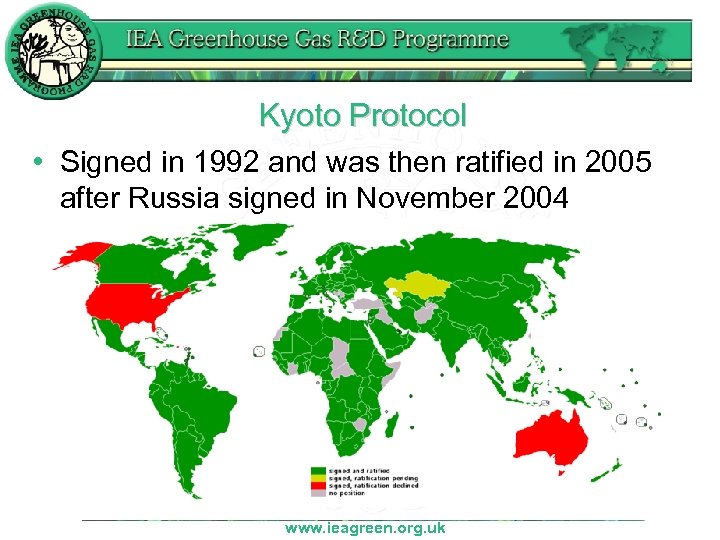 Kyoto Protocol • Signed in 1992 and was then ratified in 2005 after Russia signed in November 2004 www. ieagreen. org. uk
 Kyoto Protocol • Governments are separated into two categories: • Developed countries, referred to as Annex I countries • Who have accepted greenhouse gas emission reduction obligations and must submit an annual GHG inventory • Developing countries, referred to as Non-Annex I countries • Who have no greenhouse gas emission reduction obligations but may participate in the Clean Development Mechanism • By 2008 -2012, Annex I countries have to reduce their greenhouse gas emissions by a collective average of 5% below their 1990 levels • National limitations range from 8% reductions for the European Union to a 10% emissions increase for Iceland • Reduction limitations expire in 2013 • Annex I countries can buy emission credits (CERs) from non Annex 1 countries under the Clean Development Mechanism www. ieagreen. org. uk
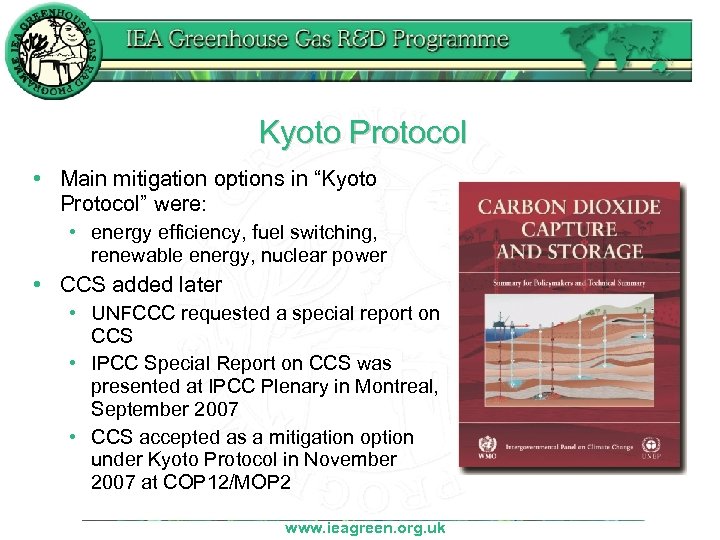 Kyoto Protocol • Main mitigation options in “Kyoto Protocol” were: • energy efficiency, fuel switching, renewable energy, nuclear power • CCS added later • UNFCCC requested a special report on CCS • IPCC Special Report on CCS was presented at IPCC Plenary in Montreal, September 2007 • CCS accepted as a mitigation option under Kyoto Protocol in November 2007 at COP 12/MOP 2 www. ieagreen. org. uk
 After Kyoto • The non-binding “Washington Declaration” agreed on February 16, 2007, • Canada, France, Germany, Italy, Japan, Russia, UK, USA, Brazil, China, India, Mexico and South Africa agreed in principle on a successor to the Kyoto Protocol. • They envisage a global cap-and-trade system that would apply to both industrialized nations and developing countries, • To be in place by 2009 • 33 rd G 8 Summit in 2007 agreed that G 8 nations would 'aim to at least halve global CO 2 emissions by 2050 • Details would be negotiated by environment ministers within the UNFCCC www. ieagreen. org. uk
 International Marine Conventions • International marine environmental convention established in 1972 • London Convention (LC) prevents dumping of wastes at sea • London Convention and extended London Protocol • Below LC there are regional agreements covering specific regions of the ocean • Convention for Protection of the Marine Environment of the North East Atlantic (OSPAR) www. ieagreen. org. uk
 London Convention • London Convention introduced in 1975 • Prevents aims to control all sources of pollution to the marine environment • Contracting parties agree to prevent dumping of of industrial wastes at sea • Those that are liable to cause damage to human health, marine life etc. , • Include precautionary approach to ensure preventative measures are taken in the event that anything introduced can cause harm • Limited to sea not sea bed and subsoil www. ieagreen. org. uk
 London Protocol • More extensive approach to dumping than LC • Prevents dumping of all materials not included in a “reverse list” • CO 2 not in “reverse list” • Includes sea, sea bed and sub soil • But does not include sub sea bed repositories accessed by land • Precautionary principle will apply www. ieagreen. org. uk
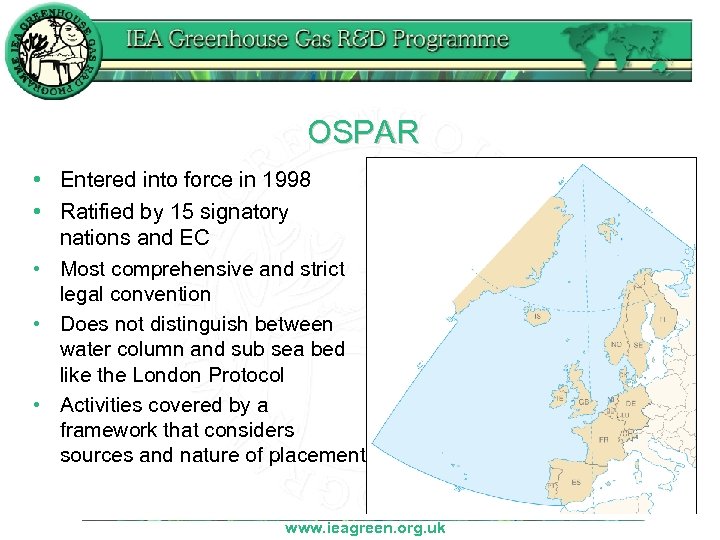 OSPAR • Entered into force in 1998 • Ratified by 15 signatory nations and EC • Most comprehensive and strict legal convention • Does not distinguish between water column and sub sea bed like the London Protocol • Activities covered by a framework that considers sources and nature of placement www. ieagreen. org. uk
 Recent Amendments to Marine Conventions • Amendment to London Protocol accepted in November 2006 • CCS is a waste management option to be considered by Contracting Parties’ in their approaches to mitigating greenhouse gas emissions • CCS in sub sea geological storage structures (CCS_SSGS) now legal under London Protocol • CO 2 to be included under list of wastes that can be disposed of • The waste is overwhelmingly of carbon dioxide, • No wastes or other matter are added. www. ieagreen. org. uk
 Recent Amendments to Marine Conventions • London Protocol • Guidelines adopted in April 2007 for use by national authorities regulating disposal at sea • Guidelines indicate that acceptance of CCS does not remove obligation to reduce need for disposal under the Protocol • Guidelines require: • Waste prevention audit/Waste management option review • Characterisation of waste stream • Site characterisation • Impact assessment • Permit Issue • Compliance monitoring • Performance monitoring • Mitigation plan www. ieagreen. org. uk
 Recent Amendments to Marine Conventions • In Spring 2007 OSPAR adopted amendments to the Annexes to the Convention to allow storage of CO 2 in geological formations under the seabed. • Follows publication of reports on ocean acidification, which indicated early action was needed to prevent damage to the marine environment from natural uptake of CO 2. • CCS seen as one of a portfolio of measures to reduce emissions • OSPAR adopted a Decision to ensure environmentally safe storage of carbon dioxide streams in geological formations • OSPAR adopted guidelines for Risk Assessment and Management of that activity. • A Decision was also adopted to legally rule out placement of CO 2 into the water-column of the sea and on the seabed. • Actions considered complimentary to those of London Protocol www. ieagreen. org. uk
 National Legal and Regulatory Frameworks • Two key goals for Governments; • To promote CCS as a climate change option • To ensure protection of public health and safety • Development of a regulatory regime is a key step in developing industry & public confidence • Several countries regulating CCS under existing laws • For many countries it will be quicker to adapt existing legislation than to develop new legal frameworks • For countries without existing legislation this might be an issue www. ieagreen. org. uk
 Adaptation of Existing Laws • Many countries looking at adaptation of existing laws • UK - Petroleum Act for North Sea operations • Norway – regulated under Petroleum Act and Pollution Control Act • Netherlands - Mining Law adapted for K-12 B • USA – Existing Underground Injection Control programme for ground water protection adapted for Pilot projects • USA/Canada – CO 2 -EOR already permitted under existing laws • Canada – acid gas injection already permitted • Most existing laws cover; permitting, construction, operational and abandonment phases but NOT post closure • European Commission developing a new CCS Directive • Details of which are awaited • Will require member states to have national CCS regulations in place www. ieagreen. org. uk
 Regulatory Components • It is likely than any regulatory regime for CCS will include the following: • Detailed site characterisation for permitting and operational requirements • Monitoring during all phases • Pre-operational, post operational and post abandonment • Abandonment plan • Remediation plan www. ieagreen. org. uk
 Development of Regulations • In Europe • OSPAR and new EU Directive on CCS will require regulations to be in place by 2012 • Planned demonstration projects to go ahead • UK/Norway and Netherlands leading way • USA and Australia working to similar timescales • Future. Gen • Stanwell/Zero. Gen www. ieagreen. org. uk
 Summary • CCS legal under International Marine Environmental Conventions • CCS accepted as a mitigation option under Kyoto Protocol • National regulations being developed • Need to be in place at latest by 2012 www. ieagreen. org. uk
 THANK YOU ANY QUESTIONS? www. ieagreen. org. uk