


 Скачать презентацию Legal and Regulatory Issues Concerning Volunteer Health Professionals
3bb445171bc2367f18136fa207035e0f.ppt
- Количество слайдов: 61
 Legal and Regulatory Issues Concerning Volunteer Health Professionals in Emergencies– An Overview James G. Hodge, Jr. , J. D. , LL. M. Associate Professor, Johns Hopkins Bloomberg School of Public Health Executive Director, Center for Law & the Public’s Health: A Collaborative at Johns Hopkins and Georgetown Universities 1
 Major Resources • HRSA’s ESAR-VHP Legal and Regulatory Issues Report and Checklist – May 2006 (updated version forthcoming) • Center’s Advanced Tool Kit – April 2008 • Hurricanes Katrina and Rita: Legal Issues Concerning VHPs Compendium – October 2005 • Numerous scholarly articles and other memos • HRSA ESAR-VHP Legal Project Advisory Group • http: //www. publichealthlaw. net/Projects/ESAR-VHP. php 2
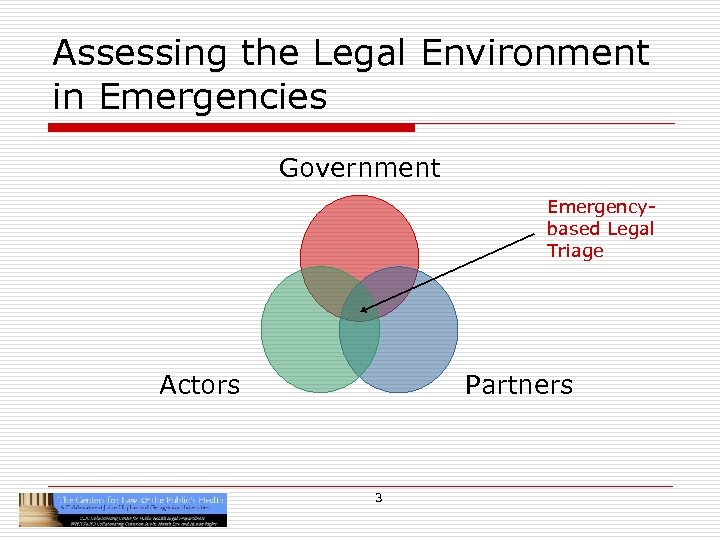 Assessing the Legal Environment in Emergencies Government Emergencybased Legal Triage Actors Partners 3
 Major Topical Areas 1) Declaration of State of Emergency or Public Health Emergency 2) Regulation of Professionals - Licensing, Credentialing, and Privileging 3) Civil Liability, Immunity, and 4) Indemnification 5) 4) Workers’ Compensation 5) Criminal Liability 4
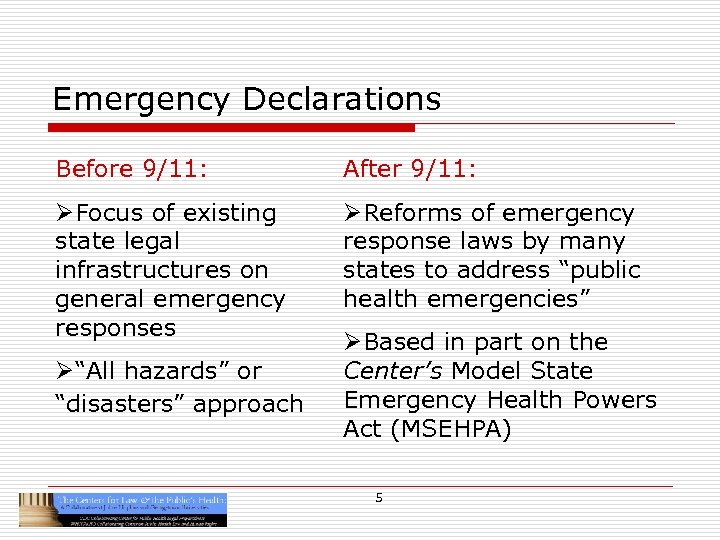 Emergency Declarations Before 9/11: After 9/11: ØFocus of existing state legal infrastructures on general emergency responses ØReforms of emergency response laws by many states to address “public health emergencies” Ø“All hazards” or “disasters” approach ØBased in part on the Center’s Model State Emergency Health Powers Act (MSEHPA) 5
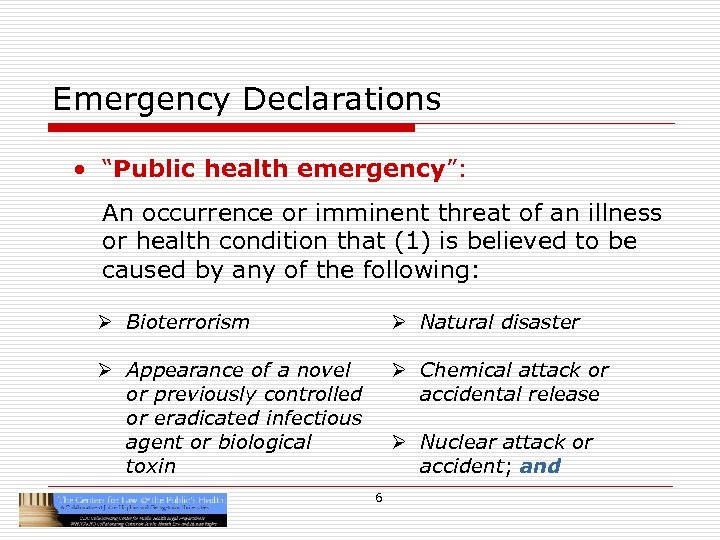 Emergency Declarations • “Public health emergency”: An occurrence or imminent threat of an illness or health condition that (1) is believed to be caused by any of the following: Ø Bioterrorism Ø Natural disaster Ø Appearance of a novel or previously controlled or eradicated infectious agent or biological toxin Ø Chemical attack or accidental release Ø Nuclear attack or accident; and 6
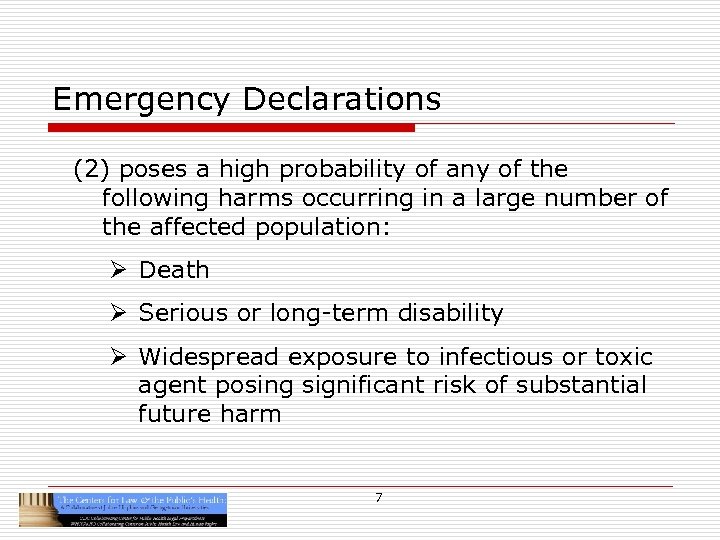 Emergency Declarations (2) poses a high probability of any of the following harms occurring in a large number of the affected population: Ø Death Ø Serious or long-term disability Ø Widespread exposure to infectious or toxic agent posing significant risk of substantial future harm 7
 Emergency Declarations Once an emergency has been declared, the legal landscape changes. 8
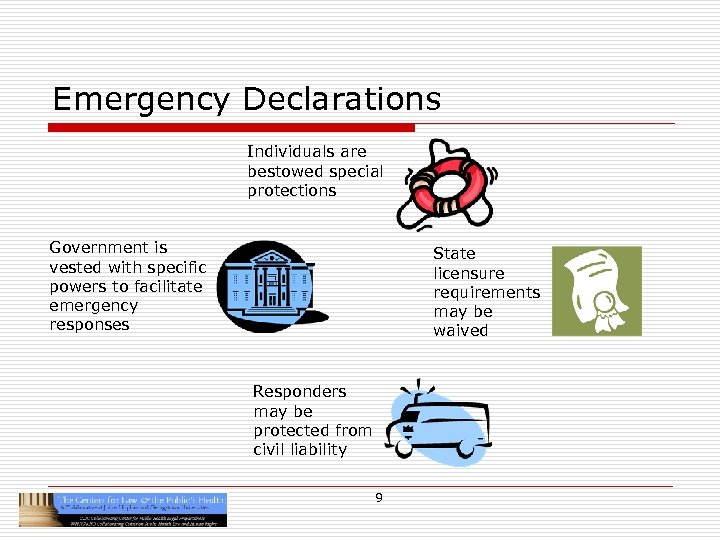 Emergency Declarations Individuals are bestowed special protections Government is vested with specific powers to facilitate emergency responses State licensure requirements may be waived Responders may be protected from civil liability 9
 Emergency Declarations • While every state (and the federal government) can declare a general emergency or disaster, the powers and protections that arise from such declarations vary. • Some states authorize declarations for “public health emergencies” and “general emergencies. ” • Emergency powers, legal protections, and operational definitions may be inconsistent in “dual declaration” states. 10
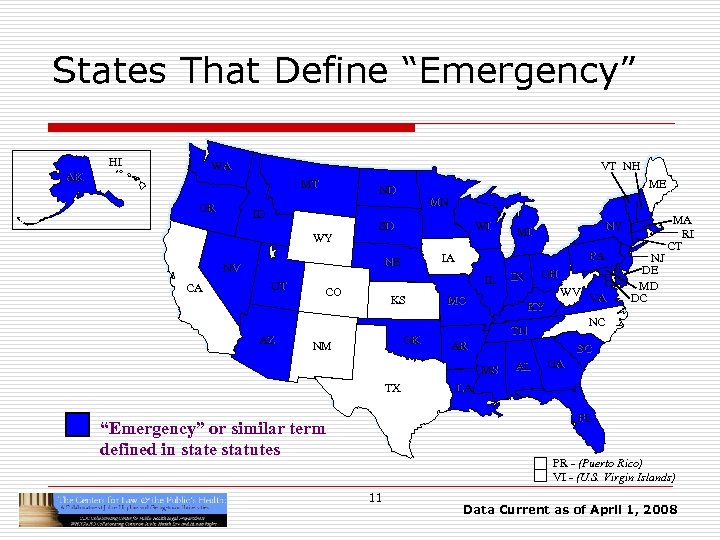 States That Define “Emergency” HI WA AK VT NH MT OR ID WY MN SD WI UT AZ PA IL CO KS OK NM MO OH IN KY WV VA NJ DE MD DC MA RI CT NC TN AR SC MS TX NY MI IA NE NV CA ME ND AL GA LA FL “Emergency” or similar term defined in state statutes PR - (Puerto Rico) VI - (U. S. Virgin Islands) 11 Data Current as of April 1, 2008
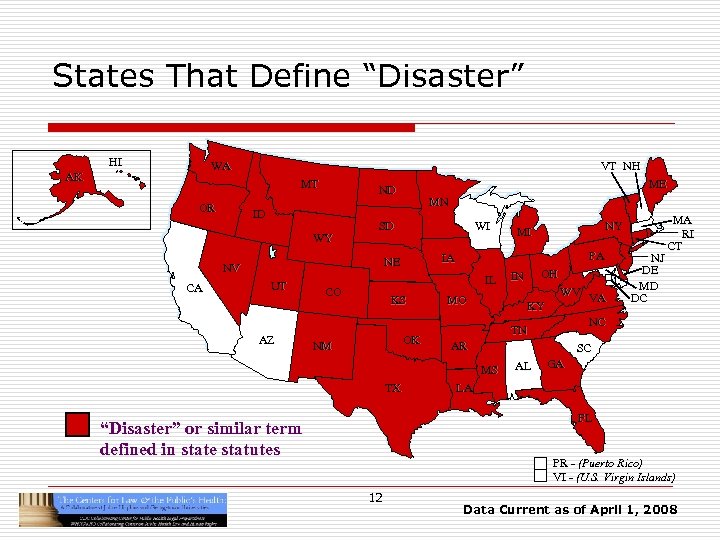 States That Define “Disaster” HI WA AK VT NH MT OR ID WY MN SD WI UT AZ PA IL CO KS OK NM MO OH IN KY WV VA NJ DE MD DC MA RI CT NC TN AR SC MS TX NY MI IA NE NV CA ME ND AL GA LA FL “Disaster” or similar term defined in state statutes PR - (Puerto Rico) VI - (U. S. Virgin Islands) 12 Data Current as of April 1, 2008
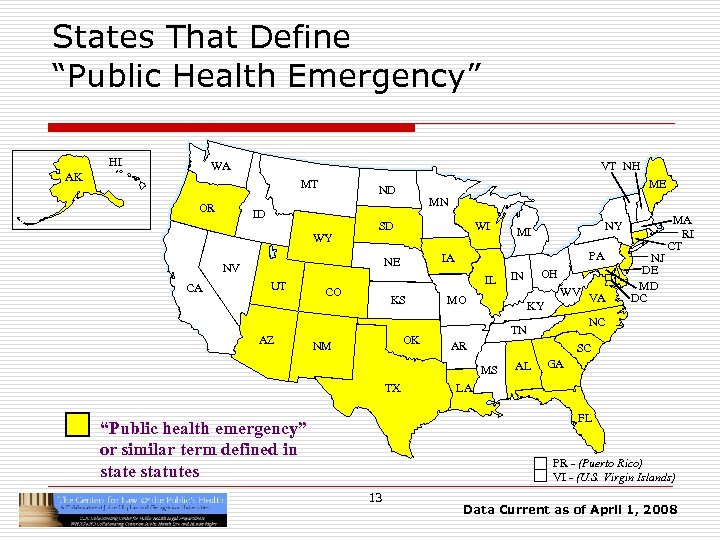 States That Define “Public Health Emergency” HI WA AK VT NH MT OR ID WY MN SD WI UT AZ PA IL CO KS OK NM MO OH IN KY WV VA NJ DE MD DC MA RI CT NC TN AR SC MS TX NY MI IA NE NV CA ME ND AL GA LA FL “Public health emergency” or similar term defined in state statutes PR - (Puerto Rico) VI - (U. S. Virgin Islands) 13 Data Current as of April 1, 2008
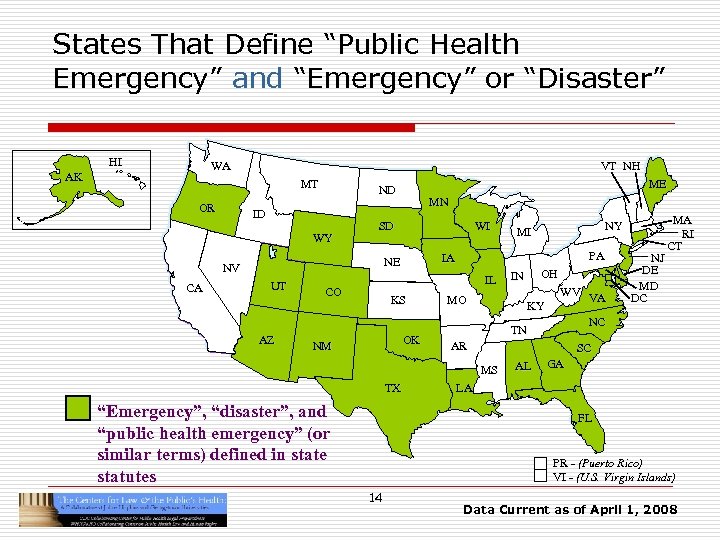 States That Define “Public Health Emergency” and “Emergency” or “Disaster” HI WA AK VT NH MT OR ID WY MN SD WI UT AZ PA IL CO KS OK NM MO “Emergency”, “disaster”, and “public health emergency” (or similar terms) defined in state statutes OH IN KY WV VA NJ DE MD DC MA RI CT NC TN AR SC MS TX NY MI IA NE NV CA ME ND AL GA LA FL PR - (Puerto Rico) VI - (U. S. Virgin Islands) 14 Data Current as of April 1, 2008
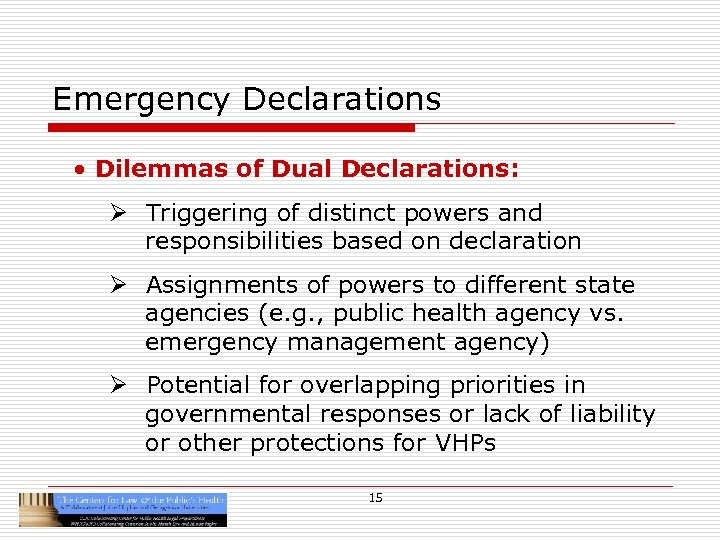 Emergency Declarations • Dilemmas of Dual Declarations: Ø Triggering of distinct powers and responsibilities based on declaration Ø Assignments of powers to different state agencies (e. g. , public health agency vs. emergency management agency) Ø Potential for overlapping priorities in governmental responses or lack of liability or other protections for VHPs 15
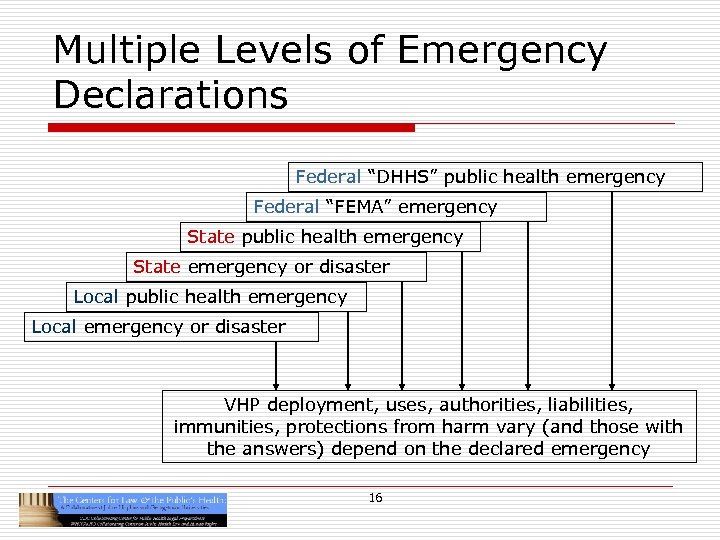 Multiple Levels of Emergency Declarations Federal “DHHS” public health emergency Federal “FEMA” emergency State public health emergency State emergency or disaster Local public health emergency Local emergency or disaster VHP deployment, uses, authorities, liabilities, immunities, protections from harm vary (and those with the answers) depend on the declared emergency 16
 Major Topical Areas 1) Declaration of State of Emergency 2) or Public Health Emergency 2) Regulation of Professionals - Licensing, Credentialing, and Privileging 3) 3) Civil Liability, Immunity, and 4) Indemnification 5) 4) Workers’ Compensation 6) 5) Criminal Liability 17
 Regulation of Professionals Two essential questions of portability 1. When can volunteer health professionals practice across state lines? 2. When can hospitals and other health care entities utilize out-of-state volunteers? 18
 Regulation of Professionals • Licensing, Credentialing, and Privileging: Ø Allow for evaluation and certification of the skills, education, experience, and training of health care professionals. Ø May limit the ability of health care professionals to volunteer in other jurisdictions or health care facilities during an emergency. 19
 Regulation of Professionals • State professional licensing requirements: Ø Establish a set of minimum competencies and prerequisites for entry into each health care profession Ø Create mechanisms to grant licenses to appropriately qualified professionals Ø Establish the scope of practice for the professions Ø Provide disciplinary actions for violations 20
 Regulation of Professionals • When can volunteer health professionals practice across state lines? Ø Emergency Declarations and other laws often provide for portability of licensure, certification, and credentialing for some volunteer responders Ø ESAR-VHP registrants may have increased portability under state-level agreements like EMAC Ø Other non-emergency reciprocity agreements may apply 21
 Regulation of Professionals • Emergency Declarations and other laws allow the state to waive its normal laws for professional licensure, certification, and permitting during a declared emergency and to recognize professionals licensed, certified, or permitted in other states. • Some states have enacted reciprocity agreements for certain professions even when there is not a declared emergency (e. g. Nurse Licensure Compact) 22
 Regulation of Professionals Emergency Management Assistance Compact (EMAC) Ø Mutual Aid Agreement Ø Passed into law by 50 states Ø Formalized emergency request framework Ø Provides broad license reciprocity 23
 Regulation of Professionals EMAC provides: “Whenever any person holds a license, certificate, or other permit issued by any state party…evidencing the meeting of qualifications for professional, mechanical, or other skills… [that person] shall be deemed licensed, certified, or permitted by the state requesting assistance… subject to such limitations and conditions as the governor of the requesting state may prescribe. ” 24
 Major Topical Areas 1) 2) Declaration of State of Emergency or Public Health Emergency 3) 2) Regulation of Professionals. . . 3) Civil Liability, Immunity, and Indemnification 4) Workers’ Compensation 5) Criminal Liability 25
 Civil Liability • Major questions: Ø What is civil liability? Ø Who may face civil liability? Ø What types of actions are subject to civil liability? Ø How does civil liability affect ESAR-VHP? Ø What legal protections from civil liability are in place? 26
 Civil Liability • What is civil liability? Civil liability is the potential responsibility that a person or institution may owe for their actions, or failures to act, that result in injuries or losses to others. 27
 Civil Liability • Who may face civil liability? Ø Volunteers Ø Health care entities that provide volunteers Ø Health care entities that accept volunteers Ø Persons or entities responsible for the registration system 28
 Civil Liability • Legal theories: Ø Negligence Ø Intentional torts Ø Privacy Ø Misrepresentation Ø Discrimination 29
 Civil Liability – Health Care Entities • Theories of Liability: Ø Respondeat Superior Ø Ostensible Agency Ø Corporate Liability 30
 Civil Liability Risks to Volunteers and Hospitals 31
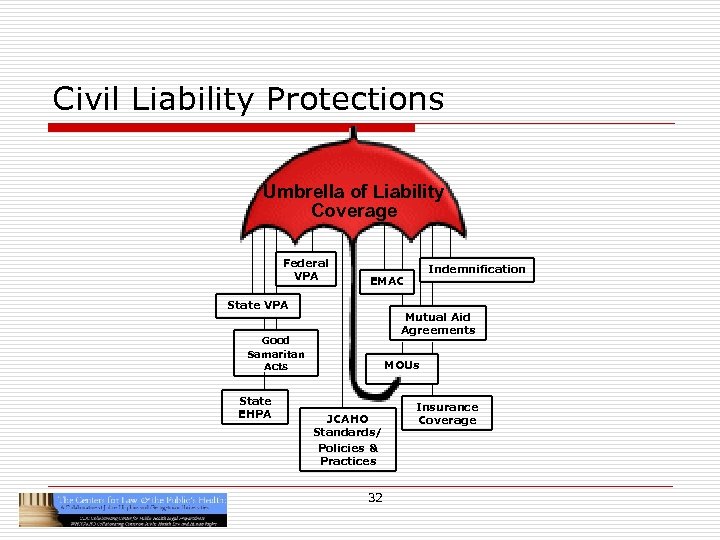 Civil Liability Protections Umbrella of Liability Coverage Federal VPA State VPA Mutual Aid Agreements Good Samaritan Acts State EHPA Indemnification EMAC MOUs JCAHO Standards/ Policies & Practices 32 Insurance Coverage
 Civil Liability • Legal protection from civil liability: Ø Immunity provisions Ø Indemnification provisions Ø Risk management policies and practices 33
 Civil Liability - Volunteers • Legal provisions that may grant immunity to volunteers: Ø Volunteer Protection statutes Ø Governmental (sovereign) immunity Ø Good Samaritan laws Ø Emergency statutes Ø EMAC 34
 Civil Liability – Volunteers • Volunteer Protection statutes: Ø Federal and state Volunteer Protection Acts Ø No emergency required Ø Apply to volunteers for nonprofit and governmental entities only Ø Do not apply to organizations Ø No compensation allowed 35
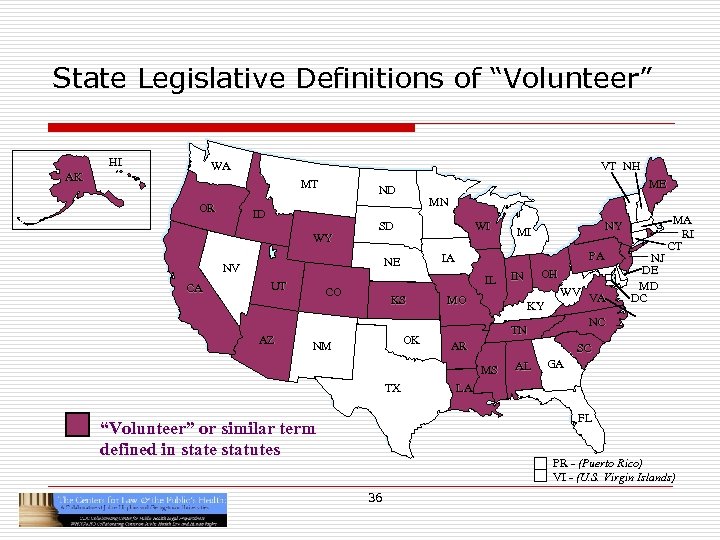 State Legislative Definitions of “Volunteer” HI WA AK VT NH MT OR ID WY MN SD WI UT AZ PA IL CO KS OK NM MO OH IN KY WV VA NJ DE MD DC MA RI CT NC TN AR SC MS TX NY MI IA NE NV CA ME ND AL GA LA FL “Volunteer” or similar term defined in state statutes PR - (Puerto Rico) VI - (U. S. Virgin Islands) 36
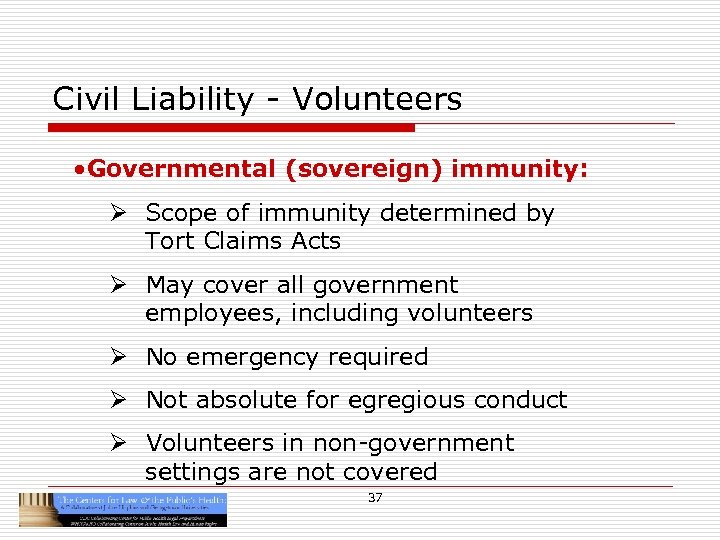 Civil Liability - Volunteers • Governmental (sovereign) immunity: Ø Scope of immunity determined by Tort Claims Acts Ø May cover all government employees, including volunteers Ø No emergency required Ø Not absolute for egregious conduct Ø Volunteers in non-government settings are not covered 37
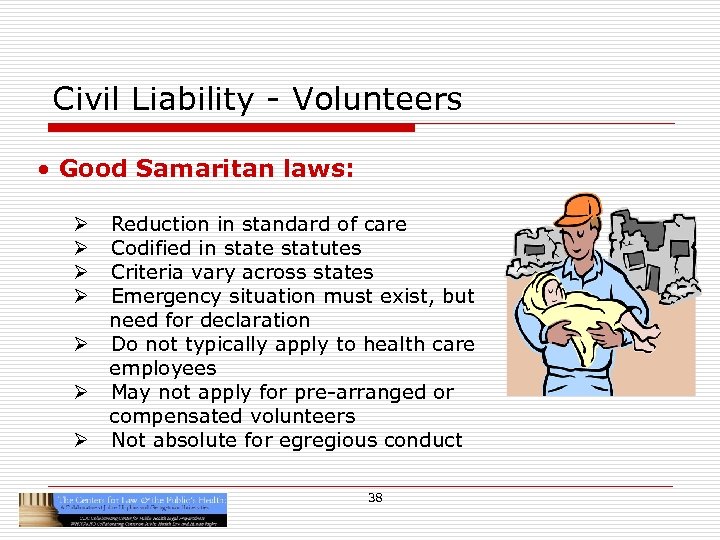 Civil Liability - Volunteers • Good Samaritan laws: Reduction in standard of care Codified in state statutes Criteria vary across states Emergency situation must exist, but need for declaration Ø Do not typically apply to health care employees Ø May not apply for pre-arranged or compensated volunteers Ø Not absolute for egregious conduct Ø Ø 38 no
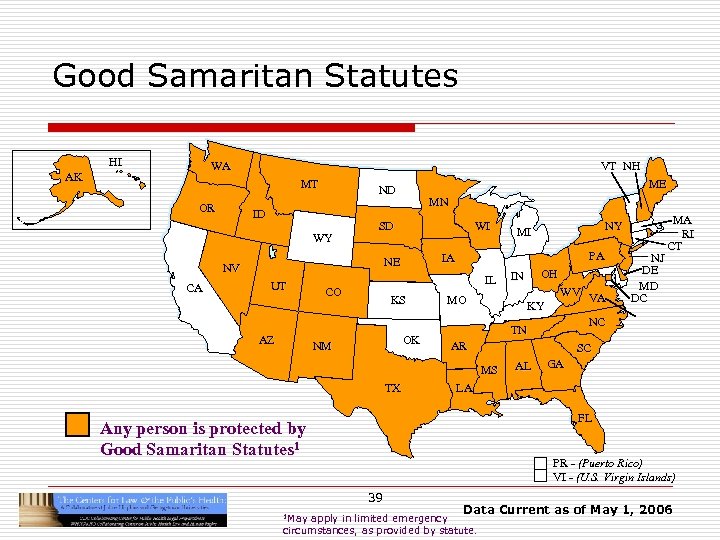 Good Samaritan Statutes HI WA AK VT NH MT OR ID WY MN SD WI UT AZ PA IL CO KS OK NM MO WV VA NJ DE MD DC MA RI CT NC TN AR SC AL GA LA FL Any person is protected by Good Samaritan Statutes 1 PR - (Puerto Rico) VI - (U. S. Virgin Islands) 39 1 May OH IN KY MS TX NY MI IA NE NV CA ME ND Data Current as of May 1, 2006 apply in limited emergency circumstances, as provided by statute.
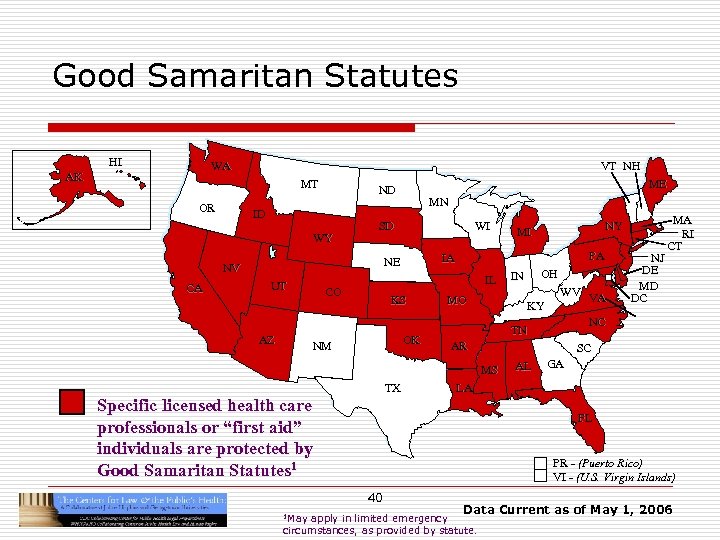 Good Samaritan Statutes HI WA AK VT NH MT OR ID WY MN SD WI UT AZ PA IL CO KS OK NM MO WV VA NJ DE MD DC MA RI CT NC TN AR SC AL GA LA Specific licensed health care professionals or “first aid” individuals are protected by Good Samaritan Statutes 1 FL PR - (Puerto Rico) VI - (U. S. Virgin Islands) 40 1 May OH IN KY MS TX NY MI IA NE NV CA ME ND Data Current as of May 1, 2006 apply in limited emergency circumstances, as provided by statute.
 Civil Liability - Volunteers • Emergency statutes: Ø Provide immunity during declared emergencies explicitly or by converting responders into state employees Ø Provisions can be broad, redundant, or vague Ø Not absolute for egregious conduct 41
 Civil Liability - Volunteers • Emergency statutes: Center’s Model State Emergency Health Powers Act (MSEHPA) Out-of-state emergency health care providers “shall not be held liable for any civil damages as a result of medical care or treatment related to the response to the public health emergency” 42
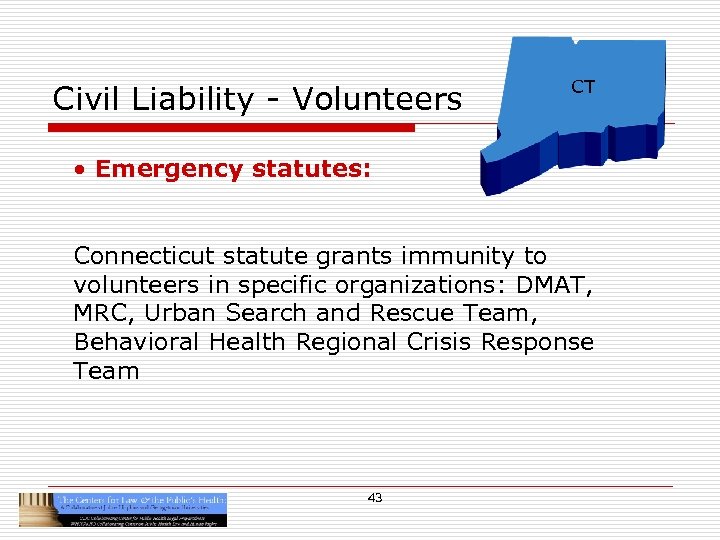 Civil Liability - Volunteers CT • Emergency statutes: Connecticut statute grants immunity to volunteers in specific organizations: DMAT, MRC, Urban Search and Rescue Team, Behavioral Health Regional Crisis Response Team 43
 Civil Liability - Volunteers • EMAC issues: Ø Interpretation of statutory language “officers or employees of the state” may only include certain volunteers Ø Some states were able to expand the EMAC workforce during Hurricane Katrina emergency responses Ø IEMAC features more expansive coverage. Any “person or entity” who is part of a state response will benefit from immunity 44
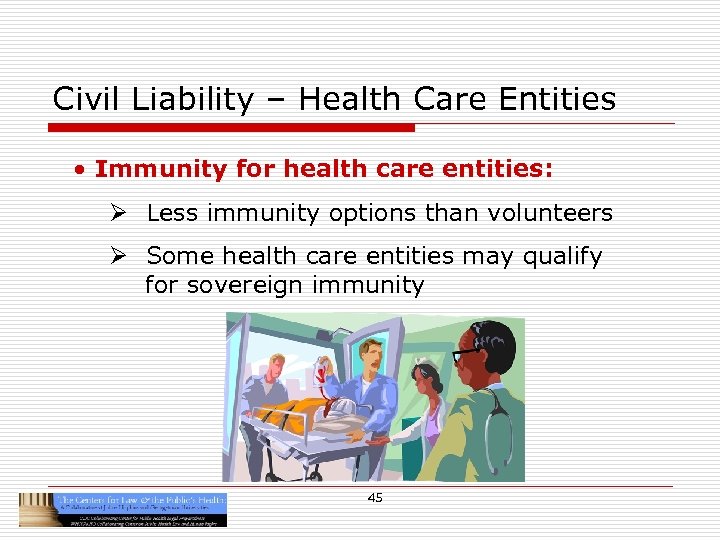 Civil Liability – Health Care Entities • Immunity for health care entities: Ø Less immunity options than volunteers Ø Some health care entities may qualify for sovereign immunity 45
 Civil Liability – Health Care Entities • Health care entities that provide volunteers: Ø Unlikely to be liable for acts by its employees in other facilities or jurisdictions. • Health care entities that accept volunteers: Ø May be liable for actions that take place under their supervision - depends on relationship between volunteer and entity 46
 Civil Liability – ESAR-VHP System • State-operated ESAR-VHP System: Ø Likely to have sovereign immunity • ESAR-VHP System operated by nongovernmental organizations: Ø May have sovereign immunity as a contractor, but assumption is otherwise Ø May have contractual indemnity via government 47
 Major Topical Areas 1) 2) Declaration of State of Emergency or Public Health Emergency 3) 2) Regulation of Professionals. . . 3) 4) Civil Liability, Immunity, and Indemnification 4) Workers’ Compensation 5) Criminal Liability 48
 Workers’ Compensation • Key Questions: Ø Who is an employee for the purposes of workers’ compensation? Ø Who is the employer of volunteers? Ø When is a volunteer acting within the scope of her employment? Ø When is a volunteer “injured” in the course of emergency responses? 49
 Workers’ Compensation • Who is an employee for the purposes of worker’s compensation? Ø Absent a state law extending workers’ compensation to volunteers, unpaid individuals who respond to emergencies are not covered because they are not “employees” Ø Narrowly written laws that appear to cover VHPs may not apply if the (1) employer has option and decides to not cover volunteers or (2) volunteer has not appropriately registered 50
 Workers’ Compensation • Who is the employer of volunteers? Ø The employer from the “home” state is not likely to be responsible for injuries to volunteers because they are acting outside the course of employment (unless the employer offers to provide coverage) Ø Temporary “host” employer may be the state or municipal government. Ø If not, the “host” institution may be responsible. 51
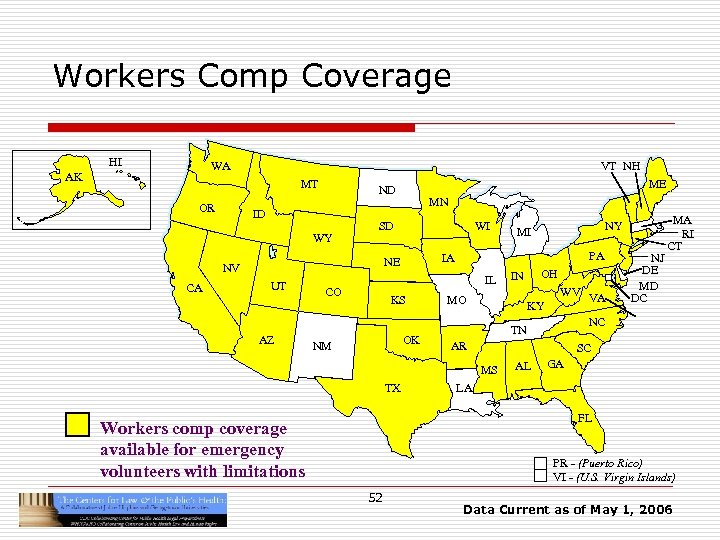 Workers Comp Coverage HI WA AK VT NH MT OR ID WY MN SD WI UT AZ PA IL CO KS OK NM MO OH IN KY WV VA NJ DE MD DC MA RI CT NC TN AR SC MS TX NY MI IA NE NV CA ME ND AL GA LA FL Workers comp coverage available for emergency volunteers with limitations PR - (Puerto Rico) VI - (U. S. Virgin Islands) 52 Data Current as of May 1, 2006
 Workers’ Compensation • Key Questions: Ø When is a volunteer acting within the scope of her employment? – A critical question even if coverage exists b/c such coverage only extends to acts within the scope of employment Ø When is a volunteer “injured” in the course of emergency responses? – Workers compensation only pertains to injuries that occur at work. Questions as to the timing of injuries may arise, especially among states that lack comprehensive occupational health provisions 53
 Major Topical Areas 1) 2) Declaration of State of Emergency or Public Health Emergency 2) Regulation of Professionals. . . 3) Civil Liability, Immunity, and Indemnification 2) 4) 5) Workers’ Compensation Criminal Liability 54
 Criminal Liability • Volunteer criminal responsibility varies under federal or state laws • Statutory provisions that protect individuals from civil liability do not typically protect persons from criminal liability • Employer may face vicarious criminal liability for criminal acts of employees/volunteers, though the risk is minimal 55
 Uniform Emergency Volunteer Health Practitioners Act (UEVHPA) • Developed by the National Conference of Commissioners on Uniform State Laws (NCCUSL) – completed in August, 2007 • Current version is available at www. uevhpa. org • Provides state legislative provisions relating to the deployment and use of VHPS during declared states of emergency 56
 Participants in the Development of the UEVHPA o o o o o American Red Cross American Public Health Association American Medical Assn, American Nurses Assn, American Psychological Assn, Nat’l Assn. of Social Workers, American Counseling Assn, American Assn for Marriage & Family Therapy, American College of Emergency Physicians American Veterinary Medicine Assn. Nat’l Funeral Directors Assn Multiple Nat’l Assn’s of State Licensing Boards National Emergency Management Assn. National Governors Assn. of State and Territorial Health Officials American Trial Lawyers Association 57
 UEVHPA – Major Issues • Trigger – declaration of a state of emergency • Scope – includes virtually all VHPs regardless of compensation • Application – applies only to registered VHPs in ESAR-VHP or other approved registration systems • Licensure – recognizes out-of-state VHPs as having instate license for duration of emergency • Standard of care – limits the scope of practice of VHPs depending on emergency standard of care 58
 UEVHPA – Major Issues • Liability – offers 2 alternatives for protecting VHPs during emergencies • Alternative A – individual and entity liability protection for VHPs • Alternative B – individual liability protection for uncompensated VHPs akin to Federal VPA • Worker’s Compensation – any VHP who is harmed or killed during emergency may elect worker’s comp protections of the host state as a payer of last resort 59
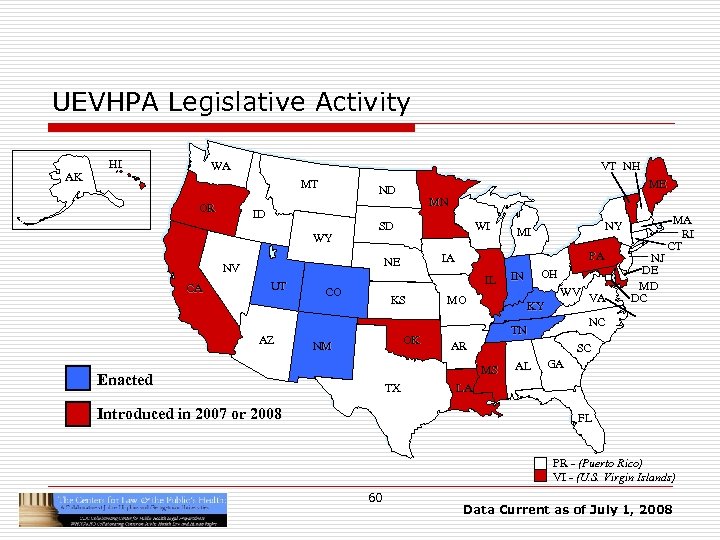 UEVHPA Legislative Activity AK HI WA VT NH MT OR ID WY MN SD WI UT AZ PA IL CO KS OK NM MO TX Introduced in 2007 or 2008 OH IN KY WV VA NJ DE MD DC MA RI CT NC TN AR SC MS Enacted NY MI IA NE NV CA ME ND AL GA LA FL PR - (Puerto Rico) VI - (U. S. Virgin Islands) 60 Data Current as of July 1, 2008
 Conclusions • For more information, please contact us or visit our website: http: //www. publichealthlaw. net/Projects/ESAR-VHP. php • James G. Hodge, Jr. , Executive Director jhodge@jhsph. edu • Thank you! 61