 Скачать презентацию Legacy technologies in corporate environments Alberto R
625d56f77732c2a05bbb422d1abe7e81.ppt
- Количество слайдов: 53



Legacy technologies in corporate environments – Alberto R. Schiesari – jan/2008
My background Experience since 1970 in Information. Technology. Companies where I’ve worked : Private and State companies; Banks; IT Services Providers; Areas and activities in which I’ve been involved : IT Planning; Software Factory; Training; Appl Systems Dev & Maint (systems analysis and programming); Technical Support (system programmer). And, since 1981 I’m also an University Teacher (Computing Sciences courses) Legacy technologies in corporate environments – Alberto R. Schiesari – jan/2008 2
Abstract ABSTRACT Even today, most large corporations (in both developing and developed countries) still rely on 'legacy' technologies such as mainframes for daily operations. In this talk, I will present a review of the characteristics of the mainframes and related technology, the suppliers, the legacy systems user’s profile, and the roles that these technologies play, including software development and maintenance. Finally, I’ll present some trends we can observe in the corporations in the use of legacy systems. Legacy technologies in corporate environments – Alberto R. Schiesari – jan/2008 3
Outline 1. Mainframe concept 1. 1 In the sixties 1. 2 Suppliers 1. 3 Characteristics 2. Mainframe users 3. Mainframe legacy systems 3. 1 Some words about software assets 3. 2 Hardware and Software survival 3. 3 Application Software survival 3. 4 People 3. 5 Trends Legacy technologies in corporate environments – Alberto R. Schiesari – jan/2008 4
1. Mainframe Concept 1. Mainframe concept 1. 1 In the sixties 1. 2 Suppliers 1. 3 Characteristics 2. Mainframe users 3. Mainframe legacy systems 3. 1 Some words about software assets 3. 2 Hardware and Software survival 3. 3 Application Software survival 3. 4 People 3. 5 Trends Legacy technologies in corporate environments – Alberto R. Schiesari – jan/2008 5
1. Mainframe Concept Was once the 60’s… Legacy technologies in corporate environments – Alberto R. Schiesari – jan/2008 6
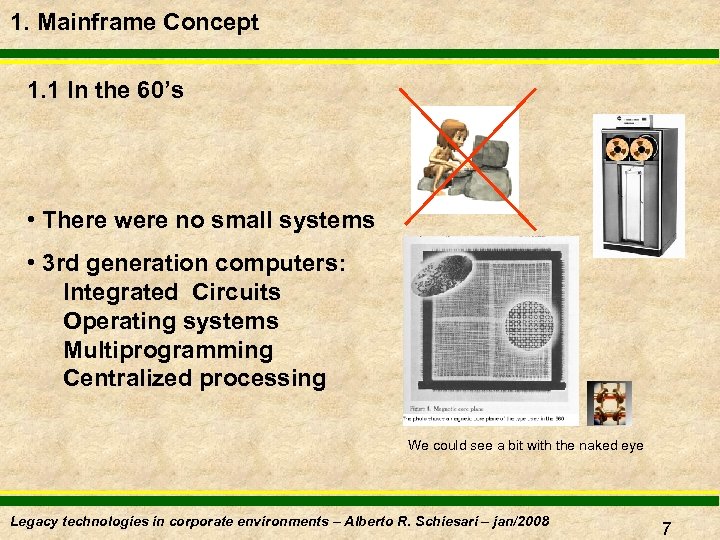
1. Mainframe Concept 1. 1 In the 60’s • There were no small systems • 3 rd generation computers: Integrated Circuits Operating systems Multiprogramming Centralized processing We could see a bit with the naked eye Legacy technologies in corporate environments – Alberto R. Schiesari – jan/2008 7
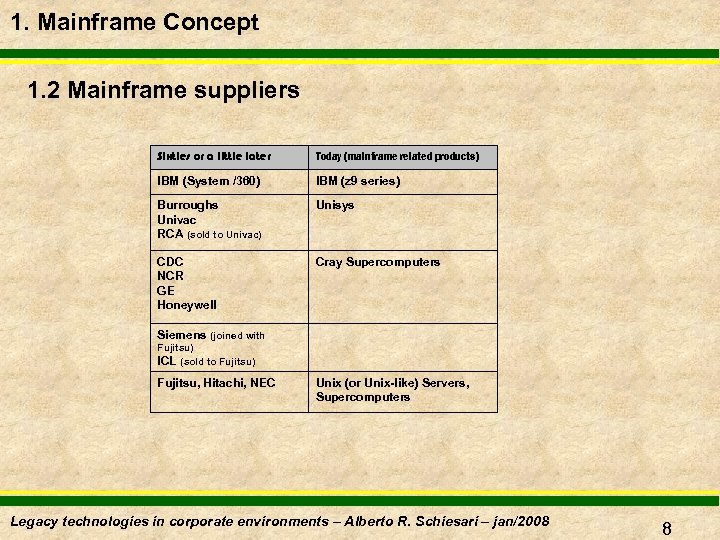
1. Mainframe Concept 1. 2 Mainframe suppliers Sixties or a little later Today (mainframe related products) IBM (System /360) IBM (z 9 series) Burroughs Univac RCA (sold to Univac) Unisys CDC NCR GE Honeywell Cray Supercomputers Siemens (joined with Fujitsu) ICL (sold to Fujitsu) Fujitsu, Hitachi, NEC Unix (or Unix-like) Servers, Supercomputers Legacy technologies in corporate environments – Alberto R. Schiesari – jan/2008 8
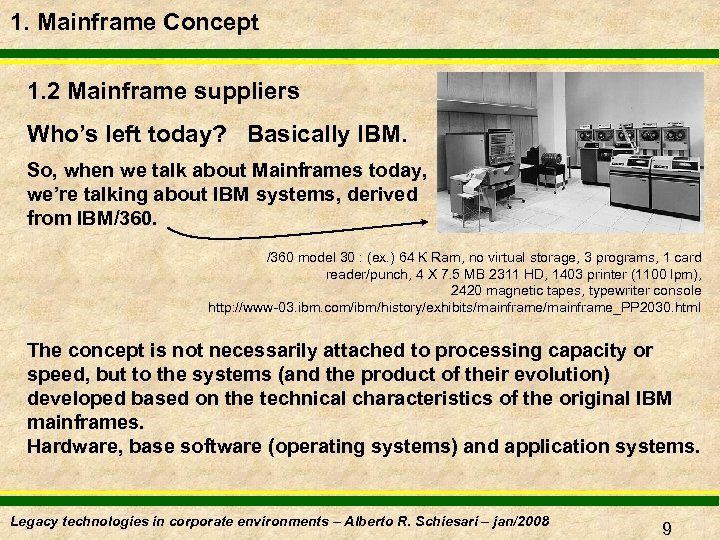
1. Mainframe Concept 1. 2 Mainframe suppliers Who’s left today? Basically IBM. So, when we talk about Mainframes today, we’re talking about IBM systems, derived from IBM/360 model 30 : (ex. ) 64 K Ram, no virtual storage, 3 programs, 1 card reader/punch, 4 X 7. 5 MB 2311 HD, 1403 printer (1100 lpm), 2420 magnetic tapes, typewriter console http: //www-03. ibm. com/ibm/history/exhibits/mainframe_PP 2030. html The concept is not necessarily attached to processing capacity or speed, but to the systems (and the product of their evolution) developed based on the technical characteristics of the original IBM mainframes. Hardware, base software (operating systems) and application systems. Legacy technologies in corporate environments – Alberto R. Schiesari – jan/2008 9
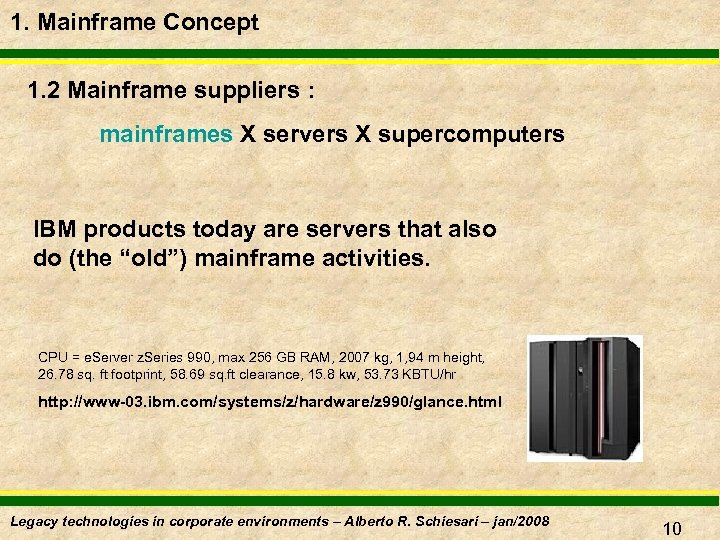
1. Mainframe Concept 1. 2 Mainframe suppliers : mainframes X servers X supercomputers IBM products today are servers that also do (the “old”) mainframe activities. CPU = e. Server z. Series 990, max 256 GB RAM, 2007 kg, 1, 94 m height, 26. 78 sq. ft footprint, 58. 69 sq. ft clearance, 15. 8 kw, 53. 73 KBTU/hr http: //www-03. ibm. com/systems/z/hardware/z 990/glance. html Legacy technologies in corporate environments – Alberto R. Schiesari – jan/2008 10
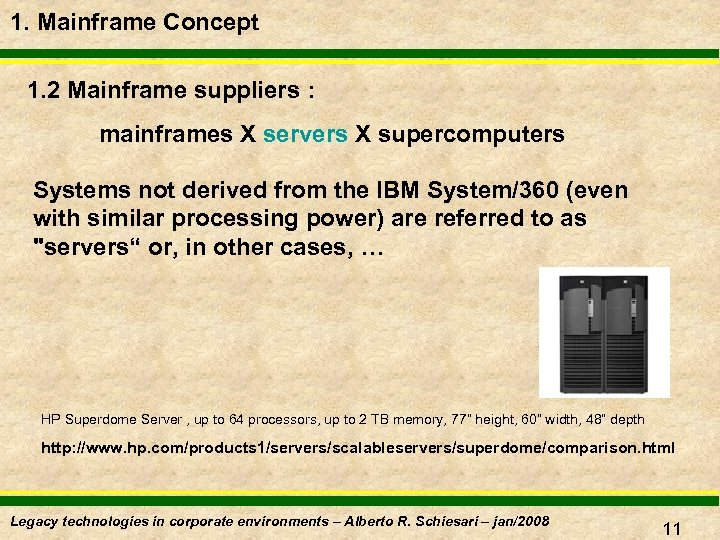
1. Mainframe Concept 1. 2 Mainframe suppliers : mainframes X servers X supercomputers Systems not derived from the IBM System/360 (even with similar processing power) are referred to as "servers“ or, in other cases, … HP Superdome Server , up to 64 processors, up to 2 TB memory, 77” height, 60” width, 48” depth http: //www. hp. com/products 1/servers/scalableservers/superdome/comparison. html Legacy technologies in corporate environments – Alberto R. Schiesari – jan/2008 11
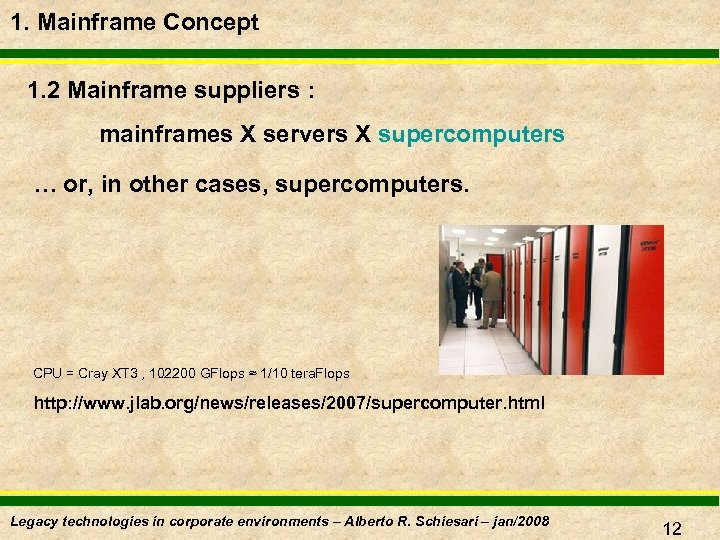
1. Mainframe Concept 1. 2 Mainframe suppliers : mainframes X servers X supercomputers … or, in other cases, supercomputers. CPU = Cray XT 3 , 102200 GFlops ≈ 1/10 tera. Flops http: //www. jlab. org/news/releases/2007/supercomputer. html Legacy technologies in corporate environments – Alberto R. Schiesari – jan/2008 12
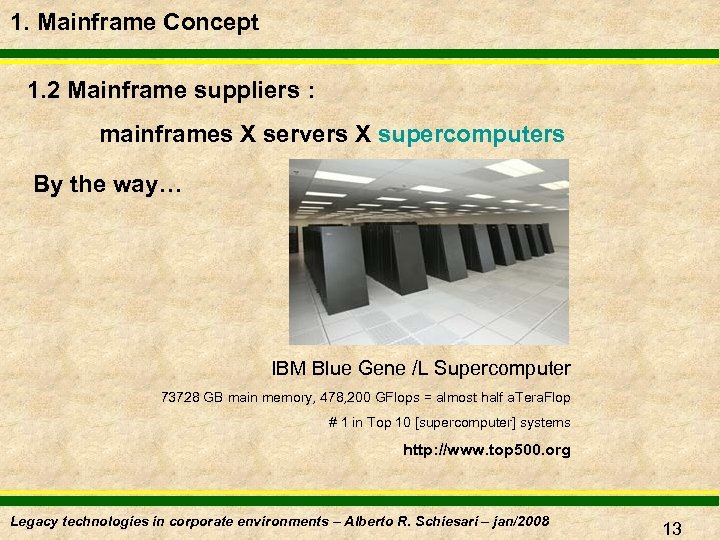
1. Mainframe Concept 1. 2 Mainframe suppliers : mainframes X servers X supercomputers By the way… IBM Blue Gene /L Supercomputer 73728 GB main memory, 478, 200 GFlops = almost half a. Tera. Flop # 1 in Top 10 [supercomputer] systems http: //www. top 500. org Legacy technologies in corporate environments – Alberto R. Schiesari – jan/2008 13
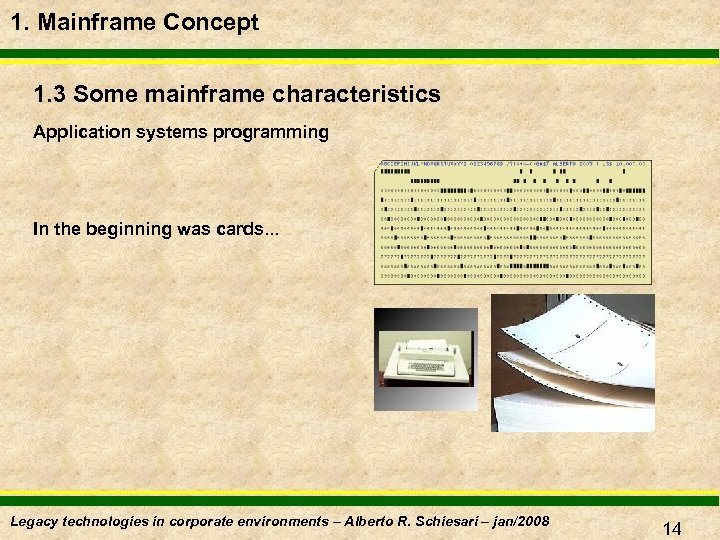
1. Mainframe Concept 1. 3 Some mainframe characteristics Application systems programming In the beginning was cards. . . Legacy technologies in corporate environments – Alberto R. Schiesari – jan/2008 14
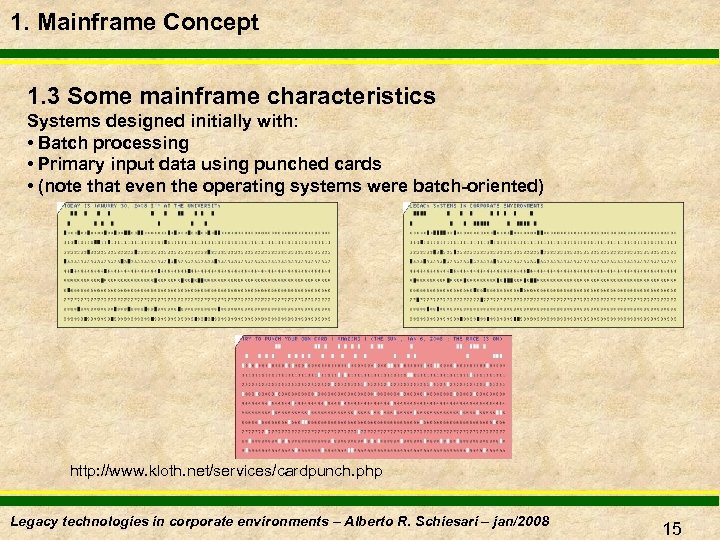
1. Mainframe Concept 1. 3 Some mainframe characteristics Systems designed initially with: • Batch processing • Primary input data using punched cards • (note that even the operating systems were batch-oriented) http: //www. kloth. net/services/cardpunch. php Legacy technologies in corporate environments – Alberto R. Schiesari – jan/2008 15
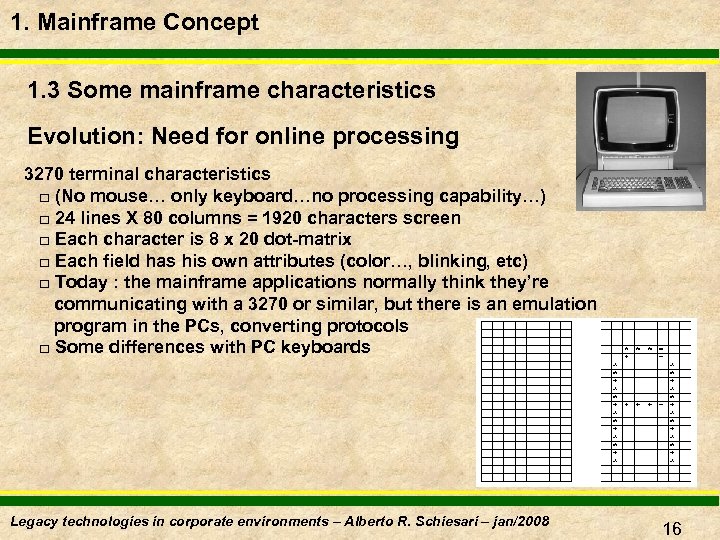
1. Mainframe Concept 1. 3 Some mainframe characteristics Evolution: Need for online processing 3270 terminal characteristics □ (No mouse… only keyboard…no processing capability…) □ 24 lines X 80 columns = 1920 characters screen □ Each character is 8 x 20 dot-matrix □ Each field has his own attributes (color…, blinking, etc) □ Today : the mainframe applications normally think they’re communicating with a 3270 or similar, but there is an emulation program in the PCs, converting protocols □ Some differences with PC keyboards Legacy technologies in corporate environments – Alberto R. Schiesari – jan/2008 16
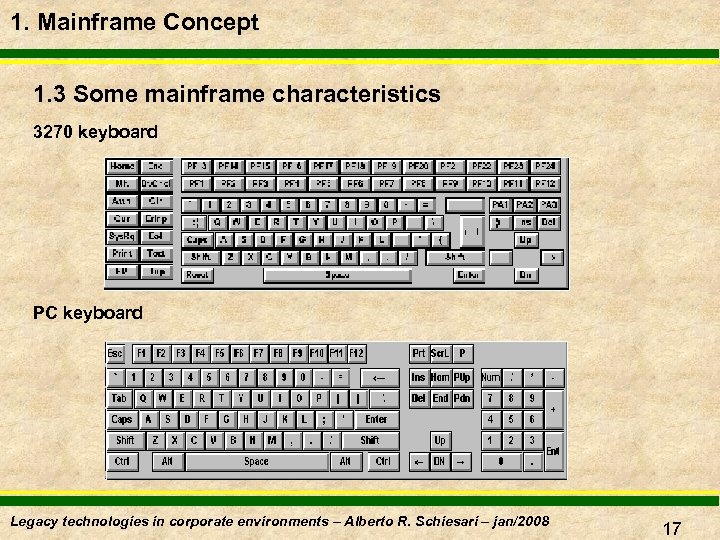
1. Mainframe Concept 1. 3 Some mainframe characteristics 3270 keyboard PC keyboard Legacy technologies in corporate environments – Alberto R. Schiesari – jan/2008 17
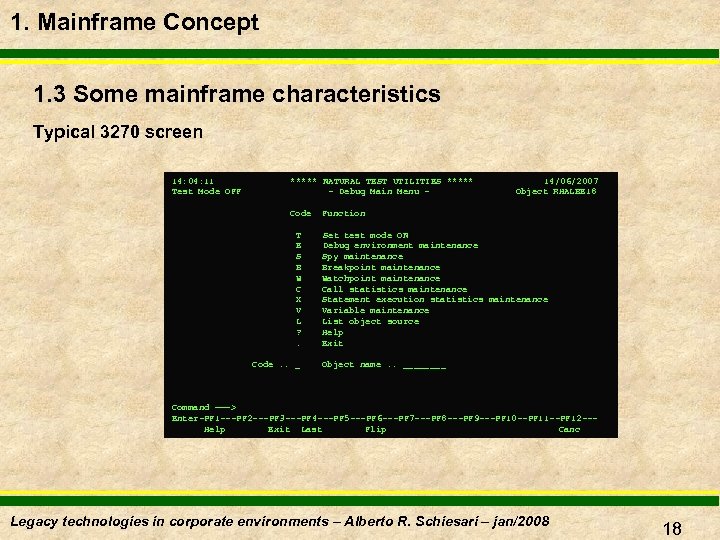
1. Mainframe Concept 1. 3 Some mainframe characteristics Typical 3270 screen 14: 04: 11 Test Mode OFF ***** NATURAL TEST UTILITIES ***** - Debug Main Menu Code T E S B W C X V L ? . Code. . _ 14/06/2007 Object RHALBE 18 Function Set test mode ON Debug environment maintenance Spy maintenance Breakpoint maintenance Watchpoint maintenance Call statistics maintenance Statement execution statistics maintenance Variable maintenance List object source Help Exit Object name. . ____ Command ===> Enter-PF 1 ---PF 2 ---PF 3 ---PF 4 ---PF 5 ---PF 6 ---PF 7 ---PF 8 ---PF 9 ---PF 10 --PF 11 --PF 12 --Help Exit Last Flip Canc Legacy technologies in corporate environments – Alberto R. Schiesari – jan/2008 18
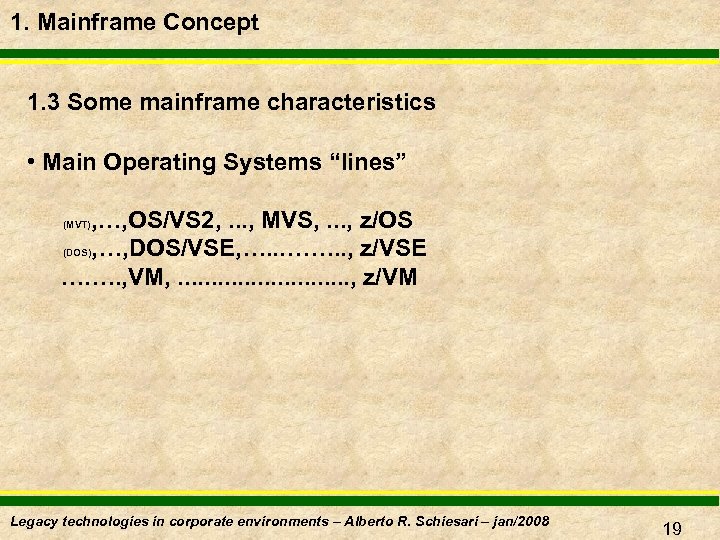
1. Mainframe Concept 1. 3 Some mainframe characteristics • Main Operating Systems “lines” , …, OS/VS 2, . . . , MVS, . . . , z/OS (DOS), …, DOS/VSE, …. . . ……. . , z/VSE …. …. , VM, . . . , z/VM (MVT) Legacy technologies in corporate environments – Alberto R. Schiesari – jan/2008 19
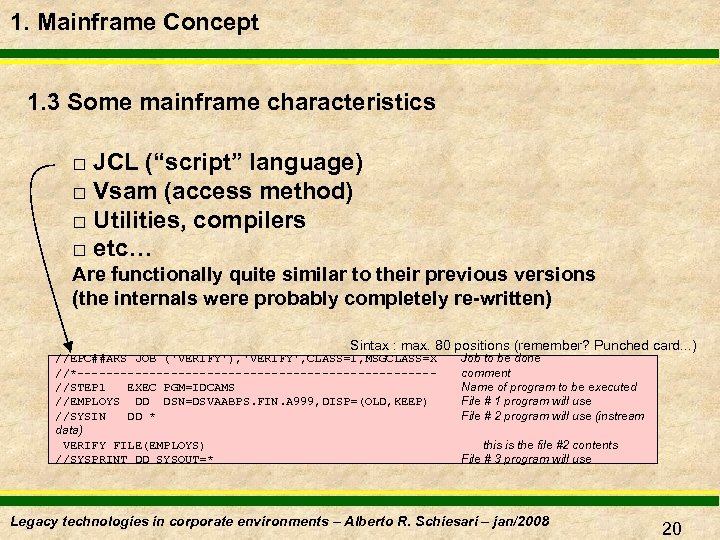
1. Mainframe Concept 1. 3 Some mainframe characteristics □ JCL (“script” language) □ Vsam (access method) □ Utilities, compilers □ etc… Are functionally quite similar to their previous versions (the internals were probably completely re-written) Sintax : max. 80 positions (remember? Punched card. . . ) //EPC##ARS JOB ('VERIFY'), 'VERIFY', CLASS=1, MSGCLASS=X //*-------------------------//STEP 1 EXEC PGM=IDCAMS //EMPLOYS DD DSN=DSVAABPS. FIN. A 999, DISP=(OLD, KEEP) //SYSIN DD * data) VERIFY FILE(EMPLOYS) //SYSPRINT DD SYSOUT=* Job to be done comment Name of program to be executed File # 1 program will use File # 2 program will use (instream this is the file #2 contents File # 3 program will use Legacy technologies in corporate environments – Alberto R. Schiesari – jan/2008 20
1. Mainframe Concept 1. 3 Some mainframe characteristics • Compatibility with previous environments provided, to preserve investments (and therefore, clients): applications developed decades ago can be run, in some cases even without recompiling, in the ultimate versions of hardware and software Legacy technologies in corporate environments – Alberto R. Schiesari – jan/2008 21
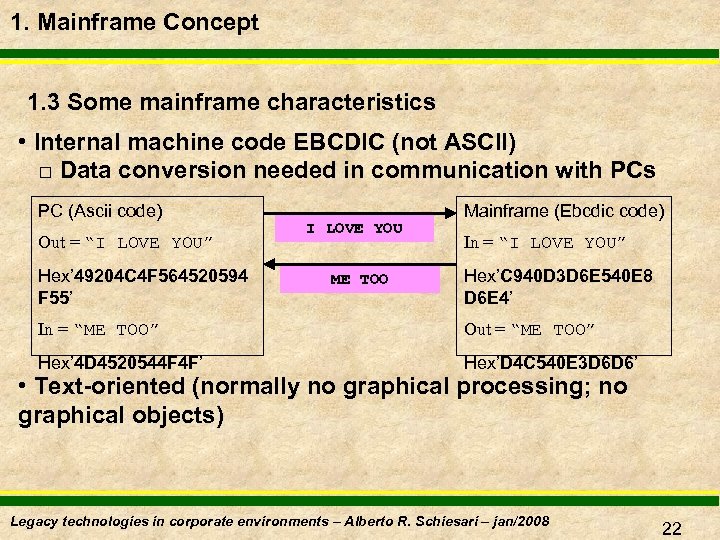
1. Mainframe Concept 1. 3 Some mainframe characteristics • Internal machine code EBCDIC (not ASCII) □ Data conversion needed in communication with PCs PC (Ascii code) Out = “I LOVE YOU” Hex’ 49204 C 4 F 564520594 F 55’ I LOVE YOU ME TOO Mainframe (Ebcdic code) In = “I LOVE YOU” Hex’C 940 D 3 D 6 E 540 E 8 D 6 E 4’ In = “ME TOO” Out = “ME TOO” Hex’ 4 D 4520544 F 4 F’ Hex’D 4 C 540 E 3 D 6 D 6’ • Text-oriented (normally no graphical processing; no graphical objects) Legacy technologies in corporate environments – Alberto R. Schiesari – jan/2008 22
1. Mainframe Concept 1. 3 Some mainframe characteristics Evolution : online processing For the application systems: • IBM solution : a “driver” to manage online applications • CICS = was (and still is. . . ) responsible for managing the resources demanded by most online applications (storage, files, CPU use, locks, . . . ) Legacy technologies in corporate environments – Alberto R. Schiesari – jan/2008 23
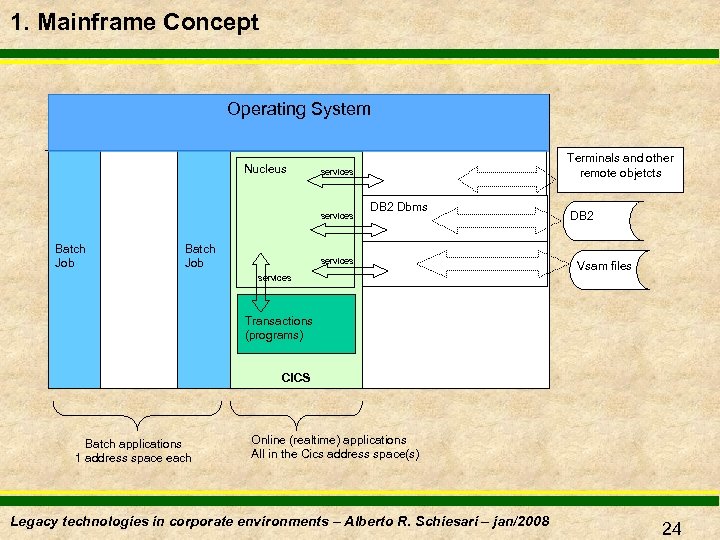
1. Mainframe Concept Operating System Nucleus services Batch Job Terminals and other remote objetcts services DB 2 Dbms services DB 2 Vsam files services Transactions (programs) CICS Batch applications 1 address space each Online (realtime) applications All in the Cics address space(s) Legacy technologies in corporate environments – Alberto R. Schiesari – jan/2008 24
1. Mainframe Concept 1. 3 Some mainframe characteristics CICS is not a programming language; user has a set of commands to demand services to CICS, and a host language is needed (ok, we can use it in another way, without a host language, but just for development / test purposes…). It can be Cobol, PL/I, C, … : CICS commands embedded in the host language commands About CICS use, see http: //websphere. sys-con. com/read/46839. htm Legacy technologies in corporate environments – Alberto R. Schiesari – jan/2008 25
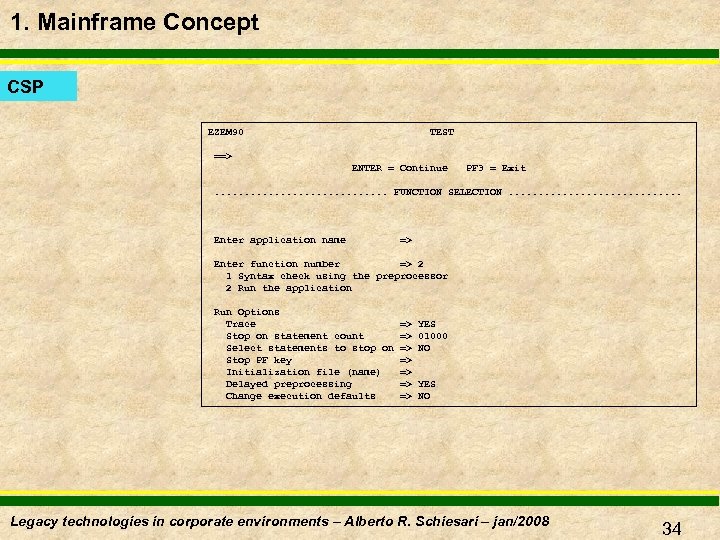
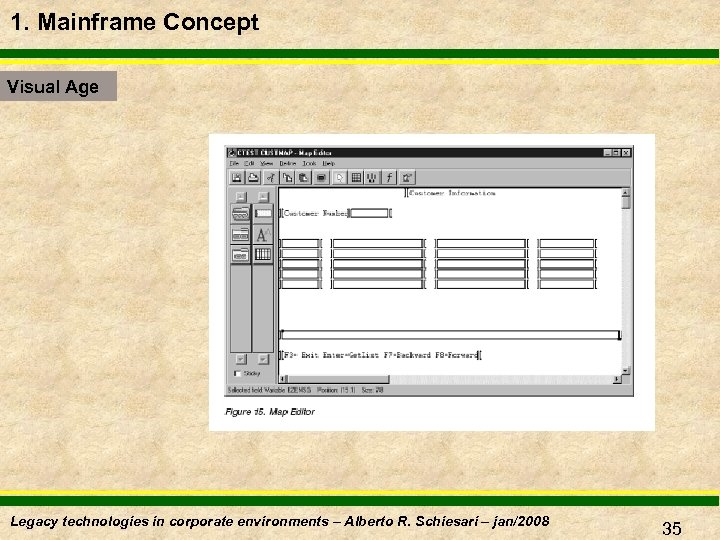
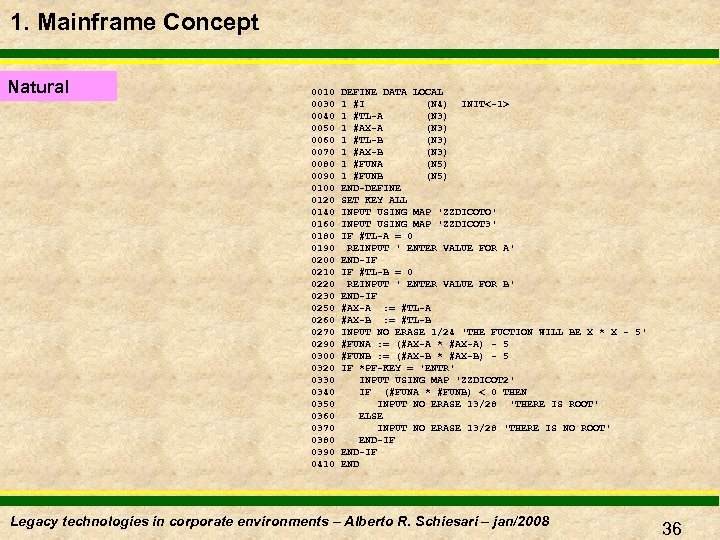
1. Mainframe Concept 1. 3 Some mainframe characteristics Some alternatives to host language with CICS: IBM = CSP (discontinued), Visual AGE. Non-IBM (Software AG) = Natural [+ Adabas] + Cics (Natural = programming language; can also be used to develop batch applications ) (Adabas = DBMS) Most mainframe online applications worldwide are created using these tools. Legacy technologies in corporate environments – Alberto R. Schiesari – jan/2008 26
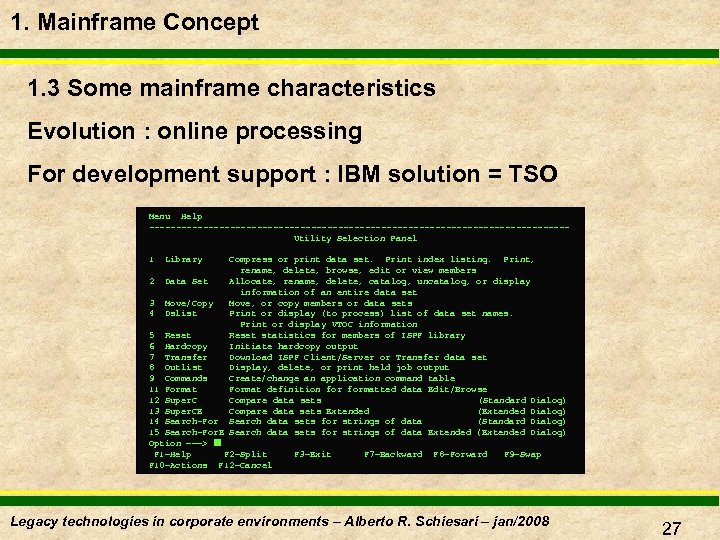
1. Mainframe Concept 1. 3 Some mainframe characteristics Evolution : online processing For development support : IBM solution = TSO Menu Help ---------------------------------------Utility Selection Panel 1 Library Compress or print data set. Print index listing. Print, rename, delete, browse, edit or view members 2 Data Set Allocate, rename, delete, catalog, uncatalog, or display information of an entire data set 3 Move/Copy Move, or copy members or data sets 4 Dslist Print or display (to process) list of data set names. Print or display VTOC information 5 Reset statistics for members of ISPF library 6 Hardcopy Initiate hardcopy output 7 Transfer Download ISPF Client/Server or Transfer data set 8 Outlist Display, delete, or print held job output 9 Commands Create/change an application command table 11 Format definition formatted data Edit/Browse 12 Super. C Compare data sets (Standard Dialog) 13 Super. CE Compare data sets Extended (Extended Dialog) 14 Search-For Search data sets for strings of data (Standard Dialog) 15 Search-For. E Search data sets for strings of data Extended (Extended Dialog) Option ===> F 1=Help F 2=Split F 3=Exit F 7=Backward F 8=Forward F 9=Swap F 10=Actions F 12=Cancel Legacy technologies in corporate environments – Alberto R. Schiesari – jan/2008 27
1. Mainframe Concept 1. 3 Some mainframe characteristics Program Samples Legacy technologies in corporate environments – Alberto R. Schiesari – jan/2008 28
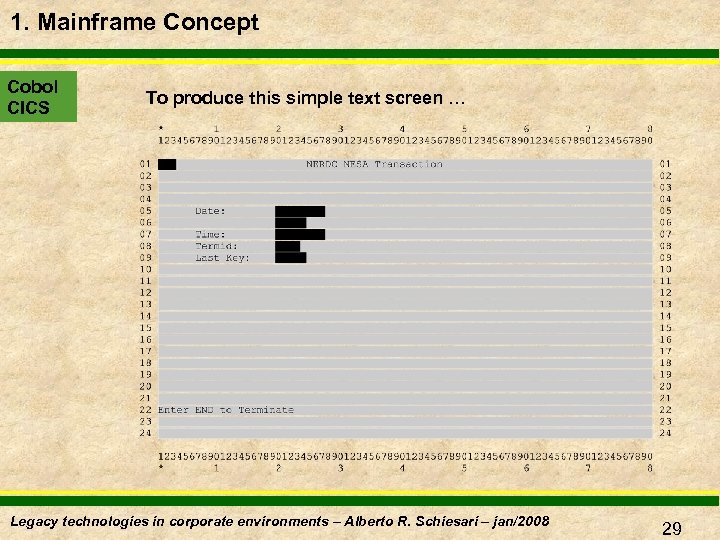
1. Mainframe Concept Cobol CICS To produce this simple text screen … Legacy technologies in corporate environments – Alberto R. Schiesari – jan/2008 29
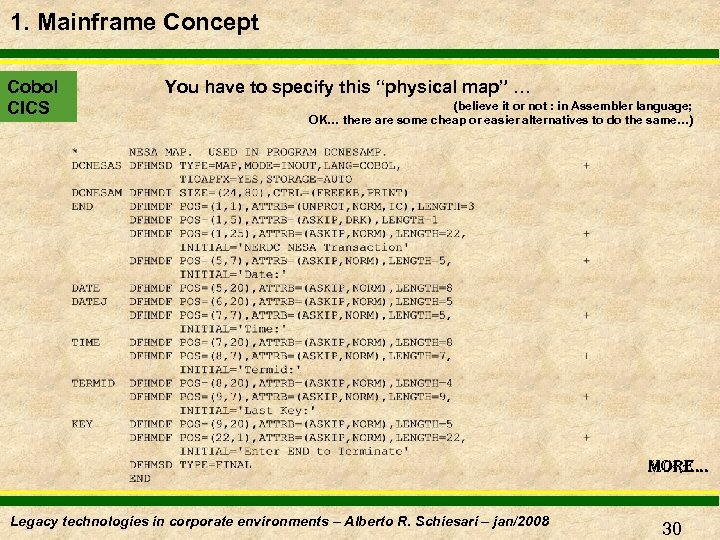
1. Mainframe Concept Cobol CICS You have to specify this “physical map” … (believe it or not : in Assembler language; OK… there are some cheap or easier alternatives to do the same…) More. . . Legacy technologies in corporate environments – Alberto R. Schiesari – jan/2008 30
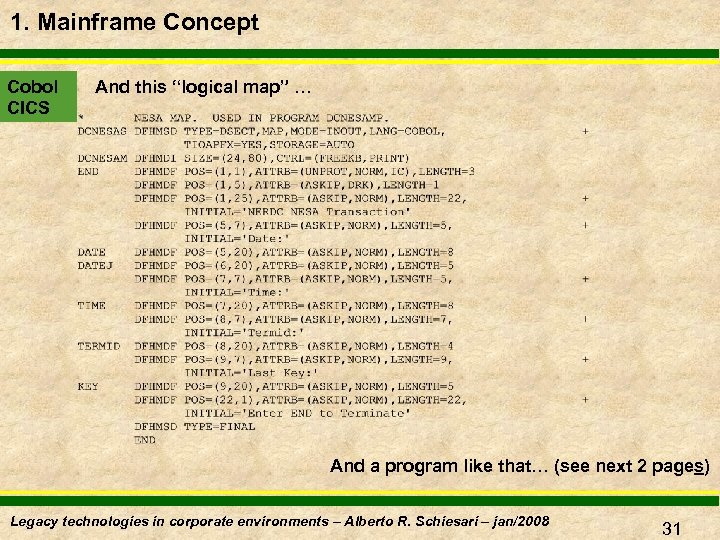
1. Mainframe Concept Cobol CICS And this “logical map” … And a program like that… (see next 2 pages) Legacy technologies in corporate environments – Alberto R. Schiesari – jan/2008 31
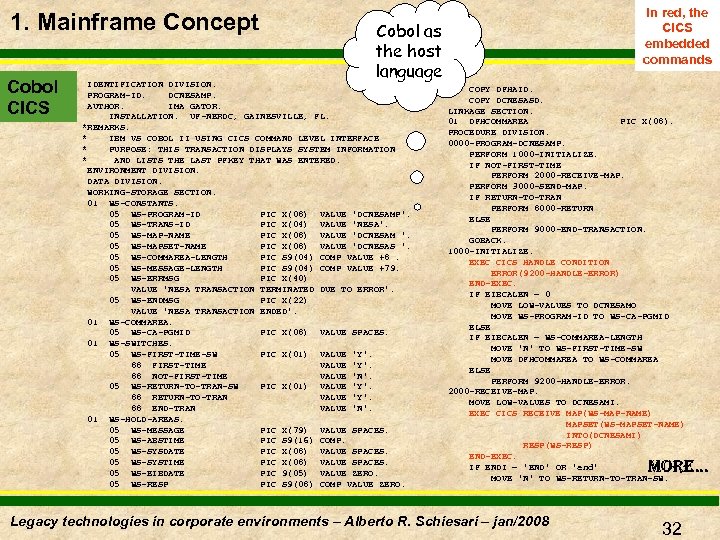
1. Mainframe Concept Cobol CICS In red, the CICS embedded commands Cobol as the host language IDENTIFICATION DIVISION. PROGRAM-ID. DCNESAMP. AUTHOR. IMA GATOR. INSTALLATION. UF-NERDC, GAINESVILLE, FL. *REMARKS. * IBM VS COBOL II USING CICS COMMAND LEVEL INTERFACE * PURPOSE: THIS TRANSACTION DISPLAYS SYSTEM INFORMATION * AND LISTS THE LAST PFKEY THAT WAS ENTERED. ENVIRONMENT DIVISION. DATA DIVISION. WORKING-STORAGE SECTION. 01 WS-CONSTANTS. 05 WS-PROGRAM-ID PIC X(08) VALUE 'DCNESAMP'. 05 WS-TRANS-ID PIC X(04) VALUE 'NESA'. 05 WS-MAP-NAME PIC X(08) VALUE 'DCNESAM '. 05 WS-MAPSET-NAME PIC X(08) VALUE 'DCNESAS '. 05 WS-COMMAREA-LENGTH PIC S 9(04) COMP VALUE +8. 05 WS-MESSAGE-LENGTH PIC S 9(04) COMP VALUE +79. 05 WS-ERRMSG PIC X(40) VALUE 'NESA TRANSACTION TERMINATED DUE TO ERROR'. 05 WS-ENDMSG PIC X(22) VALUE 'NESA TRANSACTION ENDED'. 01 WS-COMMAREA. 05 WS-CA-PGMID PIC X(08) VALUE SPACES. 01 WS-SWITCHES. 05 WS-FIRST-TIME-SW PIC X(01) VALUE 'Y'. 88 FIRST-TIME VALUE 'Y'. 88 NOT-FIRST-TIME VALUE 'N'. 05 WS-RETURN-TO-TRAN-SW PIC X(01) VALUE 'Y'. 88 RETURN-TO-TRAN VALUE 'Y'. 88 END-TRAN VALUE 'N'. 01 WS-HOLD-AREAS. 05 WS-MESSAGE PIC X(79) VALUE SPACES. 05 WS-ABSTIME PIC S 9(16) COMP. 05 WS-SYSDATE PIC X(08) VALUE SPACES. 05 WS-SYSTIME PIC X(08) VALUE SPACES. 05 WS-EIBDATE PIC 9(05) VALUE ZERO. 05 WS-RESP PIC S 9(08) COMP VALUE ZERO. COPY DFHAID. COPY DCNESASD. LINKAGE SECTION. 01 DFHCOMMAREA PIC X(08). PROCEDURE DIVISION. 0000 -PROGRAM-DCNESAMP. PERFORM 1000 -INITIALIZE. IF NOT-FIRST-TIME PERFORM 2000 -RECEIVE-MAP. PERFORM 3000 -SEND-MAP. IF RETURN-TO-TRAN PERFORM 8000 -RETURN ELSE PERFORM 9000 -END-TRANSACTION. GOBACK. 1000 -INITIALIZE. EXEC CICS HANDLE CONDITION ERROR(9200 -HANDLE-ERROR) END-EXEC. IF EIBCALEN = 0 MOVE LOW-VALUES TO DCNESAMO MOVE WS-PROGRAM-ID TO WS-CA-PGMID ELSE IF EIBCALEN = WS-COMMAREA-LENGTH MOVE 'N' TO WS-FIRST-TIME-SW MOVE DFHCOMMAREA TO WS-COMMAREA ELSE PERFORM 9200 -HANDLE-ERROR. 2000 -RECEIVE-MAP. MOVE LOW-VALUES TO DCNESAMI. EXEC CICS RECEIVE MAP(WS-MAP-NAME) MAPSET(WS-MAPSET-NAME) INTO(DCNESAMI) RESP(WS-RESP) END-EXEC. IF ENDI = 'END' OR 'end' MOVE 'N' TO WS-RETURN-TO-TRAN-SW. Legacy technologies in corporate environments – Alberto R. Schiesari – jan/2008 More. . . 32
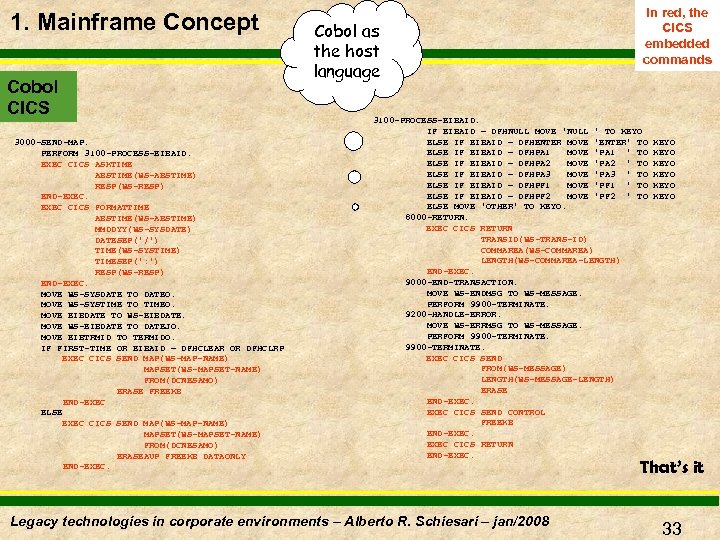
1. Mainframe Concept Cobol CICS 3000 -SEND-MAP. PERFORM 3100 -PROCESS-EIBAID. EXEC CICS ASKTIME ABSTIME(WS-ABSTIME) RESP(WS-RESP) END-EXEC CICS FORMATTIME ABSTIME(WS-ABSTIME) MMDDYY(WS-SYSDATE) DATESEP('/') TIME(WS-SYSTIME) TIMESEP(': ') RESP(WS-RESP) END-EXEC. MOVE WS-SYSDATE TO DATEO. MOVE WS-SYSTIME TO TIMEO. MOVE EIBDATE TO WS-EIBDATE. MOVE WS-EIBDATE TO DATEJO. MOVE EIBTRMID TO TERMIDO. IF FIRST-TIME OR EIBAID = DFHCLEAR OR DFHCLRP EXEC CICS SEND MAP(WS-MAP-NAME) MAPSET(WS-MAPSET-NAME) FROM(DCNESAMO) ERASE FREEKB END-EXEC ELSE EXEC CICS SEND MAP(WS-MAP-NAME) MAPSET(WS-MAPSET-NAME) FROM(DCNESAMO) ERASEAUP FREEKB DATAONLY END-EXEC. Cobol as the host language In red, the CICS embedded commands 3100 -PROCESS-EIBAID. IF EIBAID = DFHNULL MOVE 'NULL ' TO KEYO ELSE IF EIBAID = DFHENTER MOVE 'ENTER' TO ELSE IF EIBAID = DFHPA 1 MOVE 'PA 1 ' TO ELSE IF EIBAID = DFHPA 2 MOVE 'PA 2 ' TO ELSE IF EIBAID = DFHPA 3 MOVE 'PA 3 ' TO ELSE IF EIBAID = DFHPF 1 MOVE 'PF 1 ' TO ELSE IF EIBAID = DFHPF 2 MOVE 'PF 2 ' TO ELSE MOVE 'OTHER' TO KEYO. 8000 -RETURN. EXEC CICS RETURN TRANSID(WS-TRANS-ID) COMMAREA(WS-COMMAREA) LENGTH(WS-COMMAREA-LENGTH) END-EXEC. 9000 -END-TRANSACTION. MOVE WS-ENDMSG TO WS-MESSAGE. PERFORM 9900 -TERMINATE. 9200 -HANDLE-ERROR. MOVE WS-ERRMSG TO WS-MESSAGE. PERFORM 9900 -TERMINATE. EXEC CICS SEND FROM(WS-MESSAGE) LENGTH(WS-MESSAGE-LENGTH) ERASE END-EXEC CICS SEND CONTROL FREEKB END-EXEC CICS RETURN END-EXEC. Legacy technologies in corporate environments – Alberto R. Schiesari – jan/2008 KEYO KEYO That’s it 33
1. Mainframe Concept CSP EZEM 90 TEST ==> ENTER = Continue PF 3 = Exit . . . . FUNCTION SELECTION. . . . Enter application name => Enter function number => 2 1 Syntax check using the preprocessor 2 Run the application Run Options Trace Stop on statement count Select statements to stop on Stop PF key Initialization file (name) Delayed preprocessing Change execution defaults => => YES 01000 NO YES NO Legacy technologies in corporate environments – Alberto R. Schiesari – jan/2008 34
1. Mainframe Concept Visual Age Legacy technologies in corporate environments – Alberto R. Schiesari – jan/2008 35
1. Mainframe Concept Natural 0010 0030 0040 0050 0060 0070 0080 0090 0100 0120 0140 0160 0180 0190 0200 0210 0220 0230 0250 0260 0270 0290 0300 0320 0330 0340 0350 0360 0370 0380 0390 0410 DEFINE DATA LOCAL 1 #I (N 4) INIT<-1> 1 #TL-A (N 3) 1 #AX-A (N 3) 1 #TL-B (N 3) 1 #AX-B (N 3) 1 #FUNA (N 5) 1 #FUNB (N 5) END-DEFINE SET KEY ALL INPUT USING MAP 'ZZDICOTO' INPUT USING MAP 'ZZDICOT 3' IF #TL-A = 0 REINPUT ' ENTER VALUE FOR A' END-IF IF #TL-B = 0 REINPUT ' ENTER VALUE FOR B' END-IF #AX-A : = #TL-A #AX-B : = #TL-B INPUT NO ERASE 1/24 'THE FUCTION WILL BE X * X - 5' #FUNA : = (#AX-A * #AX-A) - 5 #FUNB : = (#AX-B * #AX-B) - 5 IF *PF-KEY = 'ENTR' INPUT USING MAP 'ZZDICOT 2' IF (#FUNA * #FUNB) < 0 THEN INPUT NO ERASE 13/28 'THERE IS ROOT' ELSE INPUT NO ERASE 13/28 'THERE IS NO ROOT' END-IF END Legacy technologies in corporate environments – Alberto R. Schiesari – jan/2008 36
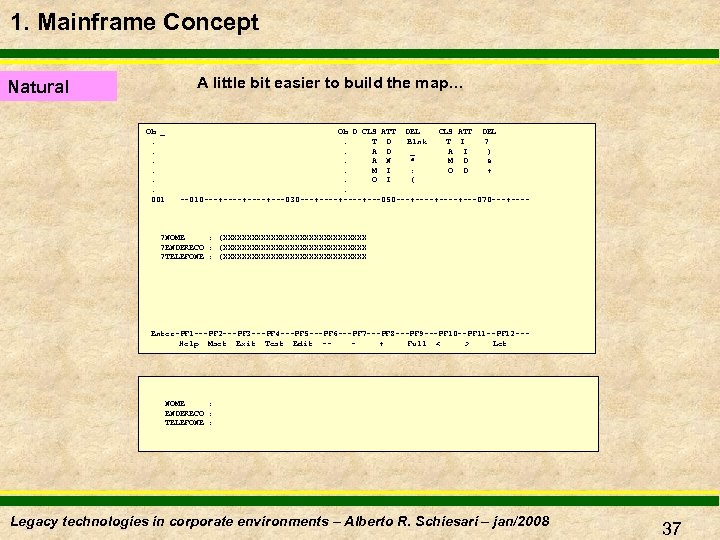
1. Mainframe Concept A little bit easier to build the map… Natural Ob _. . . 001 Ob D CLS ATT DEL. T D Blnk T I ? . A D _ A I ). A N ª M D &. M I : O D +. O I (. --010 ---+----+---030 ---+----+---050 ---+----+---070 ---+---- ? NOME : (XXXXXXXXXXXXXXX ? ENDERECO : (XXXXXXXXXXXXXXX ? TELEFONE : (XXXXXXXXXXXXXXX Enter-PF 1 ---PF 2 ---PF 3 ---PF 4 ---PF 5 ---PF 6 ---PF 7 ---PF 8 ---PF 9 ---PF 10 --PF 11 --PF 12 --Help Mset Exit Test Edit -+ Full < > Let NOME : ENDERECO : TELEFONE : Legacy technologies in corporate environments – Alberto R. Schiesari – jan/2008 37
2. Mainframe Users 1. Mainframe concept 1. 1 In the sixties 1. 2 Suppliers 1. 3 Characteristics 2. Mainframe users 3. Mainframe legacy systems 3. 1 Some words about software assets 3. 2 Hardware and Software survival 3. 3 Application Software survival 3. 4 People 3. 5 Trends Legacy technologies in corporate environments – Alberto R. Schiesari – jan/2008 38
2. Mainframe Users Who, since the 60’s, are the users? Big companies: both government and private Private : banks and most of the Top 500 Industries : (most of them migrated to SAP or other ERP systems) Companies like that normally have a long life; most of them are alive today. Some solutions and processes they use were set long time ago. The IT systems – software - is one of them. Legacy technologies in corporate environments – Alberto R. Schiesari – jan/2008 39
2. Mainframe Users Note that it’s unlike a younger company, born in the 80’s or 90’s: in this case, the IT solutions and processes implemented were based on new designs, new architectures (web, for instance), new development environments. Legacy technologies in corporate environments – Alberto R. Schiesari – jan/2008 40
3. Mainframe Legacy Systems 1. Mainframe concept 1. 1 In the sixties 1. 2 Suppliers 1. 3 Characteristics 2. Mainframe users 3. Mainframe legacy systems 3. 1 Some words about software assets 3. 2 Hardware and Software survival 3. 3 Application Software survival 3. 4 People 3. 5 Trends Legacy technologies in corporate environments – Alberto R. Schiesari – jan/2008 41
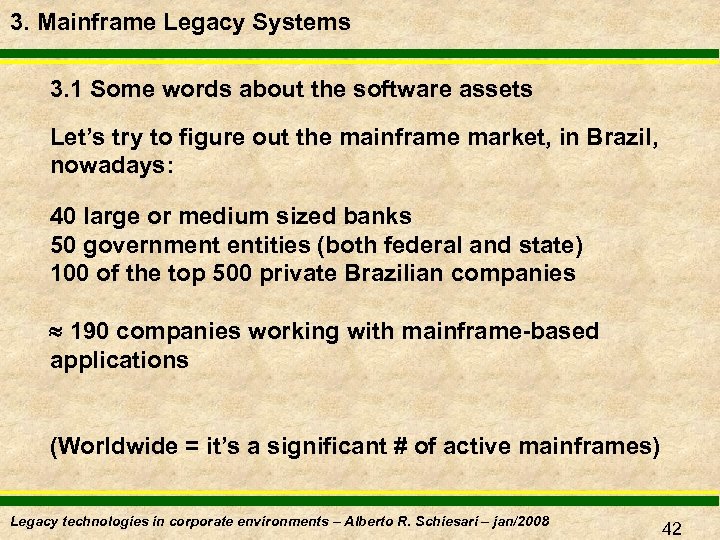
3. Mainframe Legacy Systems 3. 1 Some words about the software assets Let’s try to figure out the mainframe market, in Brazil, nowadays: 40 large or medium sized banks 50 government entities (both federal and state) 100 of the top 500 private Brazilian companies 190 companies working with mainframe-based applications (Worldwide = it’s a significant # of active mainframes) Legacy technologies in corporate environments – Alberto R. Schiesari – jan/2008 42
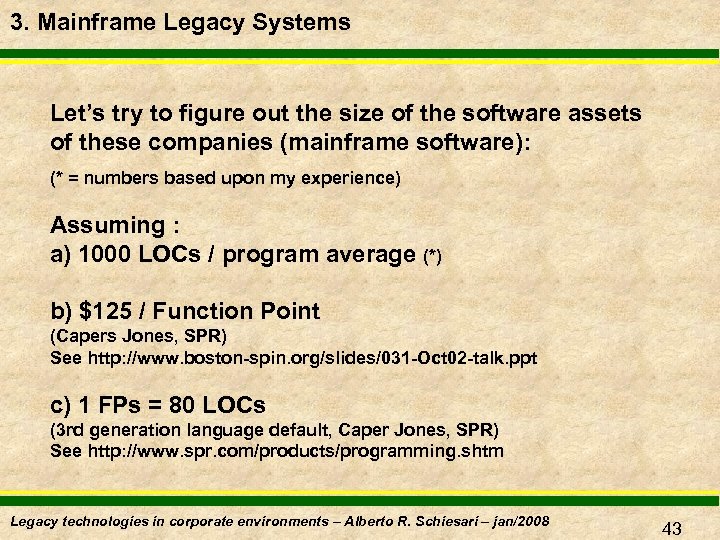
3. Mainframe Legacy Systems Let’s try to figure out the size of the software assets of these companies (mainframe software): (* = numbers based upon my experience) Assuming : a) 1000 LOCs / program average (*) b) $125 / Function Point (Capers Jones, SPR) See http: //www. boston-spin. org/slides/031 -Oct 02 -talk. ppt c) 1 FPs = 80 LOCs (3 rd generation language default, Caper Jones, SPR) See http: //www. spr. com/products/programming. shtm Legacy technologies in corporate environments – Alberto R. Schiesari – jan/2008 43
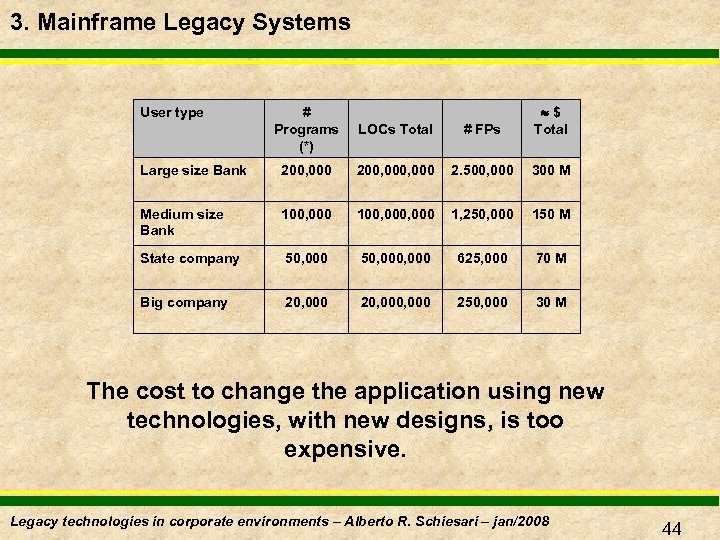
3. Mainframe Legacy Systems # Programs (*) LOCs Total # FPs $ Total Large size Bank 200, 000, 000 2. 500, 000 300 M Medium size Bank 100, 000, 000 1, 250, 000 150 M State company 50, 000, 000 625, 000 70 M Big company 20, 000, 000 250, 000 30 M User type The cost to change the application using new technologies, with new designs, is too expensive. Legacy technologies in corporate environments – Alberto R. Schiesari – jan/2008 44
3. Mainframe Legacy Systems 3. 2 Hardware and Software survival There’s a kind of “supplier commitment” to provide compatibility with previous versions (backward compatibility); there is no reason for great concerns about obsolete environments; programs “always” run on new equipment. Hardware has the ability to run (host) many operating systems / virtual machines. There is also the backward compatibility “commitment” with the base software (operating systems, compilers, dbms, etc. ) Legacy technologies in corporate environments – Alberto R. Schiesari – jan/2008 45
3. Mainframe Legacy Systems 3. 3 Application Software survival - Reliability • It is well known that the more a software is tested, the more it is error-free and, thus, reliable. • Mainframe software technologies do not change substantially. • In the mainframe area, quickly releasing new products and new versions isn’t as fundamental as it is in the other platforms (remember: there is no competition…). • There is enough time to do the necessary tests. • The products are released in very reliable versions. Legacy technologies in corporate environments – Alberto R. Schiesari – jan/2008 46
3. Mainframe Legacy Systems 3. 3 Application Software survival - Reliability • Unavailability in a net PC and in a server supporting thousands of workstations is quite different. • Unscheduled boots rarely occur • There is a small number of interfacing components; to track and correct errors is easier Legacy technologies in corporate environments – Alberto R. Schiesari – jan/2008 47
3. Mainframe Legacy Systems 3. 4 Application Software survival - People • People who designed, developed, worked on the systems leave the company. • There’s a need to replace these technicians. • In Universities, there’s practically no more training on Mainframe technologies: CICS, Cobol, batch programming logic – for example, how to create a report, controlling lines, pages, breaks, etc? Do you know OOP? Forget it! Legacy technologies in corporate environments – Alberto R. Schiesari – jan/2008 48
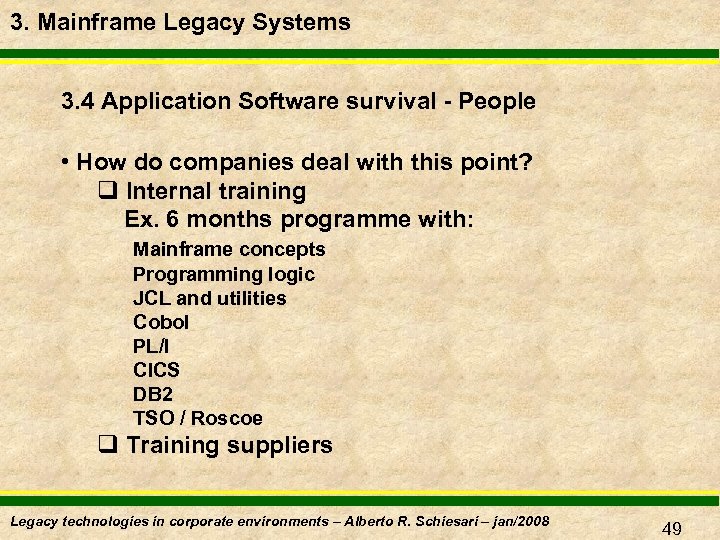
3. Mainframe Legacy Systems 3. 4 Application Software survival - People • How do companies deal with this point? q Internal training Ex. 6 months programme with: Mainframe concepts Programming logic JCL and utilities Cobol PL/I CICS DB 2 TSO / Roscoe q Training suppliers Legacy technologies in corporate environments – Alberto R. Schiesari – jan/2008 49
3. Mainframe Legacy Systems 3. 5 Application Software survival – Trends • Batch applications: Ø They’ll probably continue the same way Ø I bet: 20 years from now you’ll see a batch system running in a quantum computer, “reading” 80 byte records as cards… Legacy technologies in corporate environments – Alberto R. Schiesari – jan/2008 50
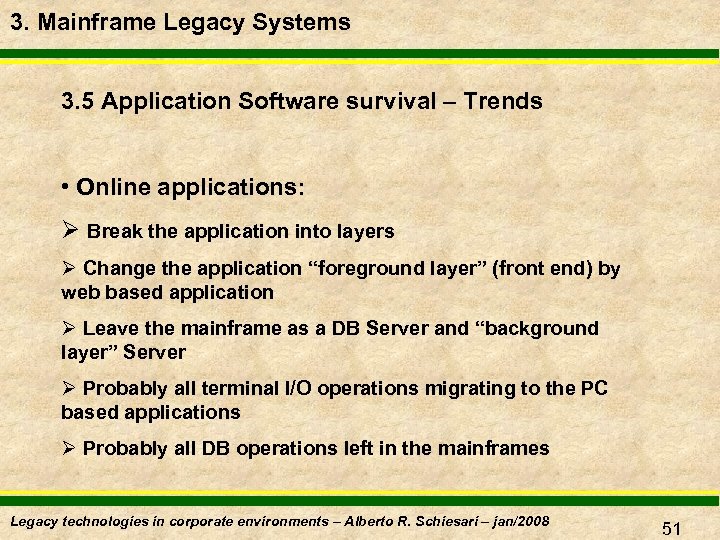
3. Mainframe Legacy Systems 3. 5 Application Software survival – Trends • Online applications: Ø Break the application into layers Ø Change the application “foreground layer” (front end) by web based application Ø Leave the mainframe as a DB Server and “background layer” Server Ø Probably all terminal I/O operations migrating to the PC based applications Ø Probably all DB operations left in the mainframes Legacy technologies in corporate environments – Alberto R. Schiesari – jan/2008 51
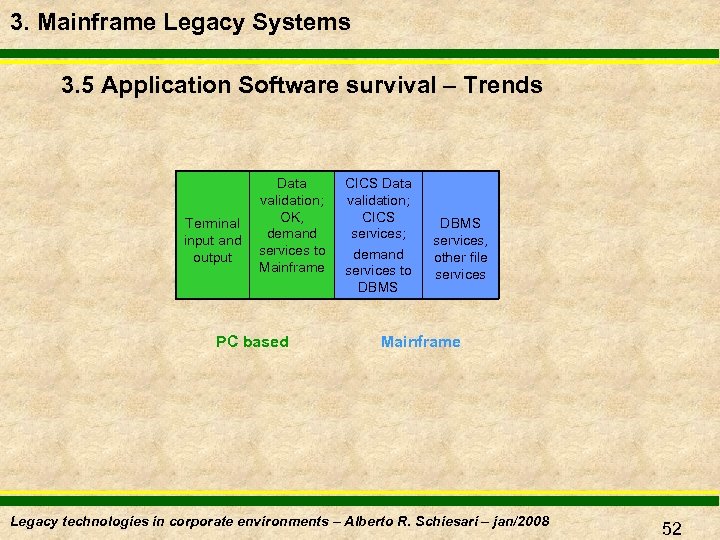
3. Mainframe Legacy Systems 3. 5 Application Software survival – Trends Terminal input and output Data validation; OK, demand services to Mainframe PC based CICS Data validation; CICS services; demand services to DBMS services, other file services Mainframe Legacy technologies in corporate environments – Alberto R. Schiesari – jan/2008 52
Questions ? Legacy technologies in corporate environments – Alberto R. Schiesari – jan/2008 53
Скачать презентацию Legacy technologies in corporate environments Alberto R
625d56f77732c2a05bbb422d1abe7e81.ppt