


 Скачать презентацию Leeds Institute of Health Sciences Academic Unit of
beb55e0275eac8892d5783666236628d.ppt
- Количество слайдов: 19
 Leeds Institute of Health Sciences Academic Unit of Psychiatry and Behavioural Sciences Some material (e. g. images and data) have been removed due to copyright restrictions. Can electronic feedback reduce student alcohol intake? A multi-site investigation of Unitcheck Bridgette M Bewick, Brendan Mulhern and Andrew J Hill INEBRIA October 2009
 Leeds Institute of Health Sciences Academic Unit of Psychiatry and Behavioural Sciences How much do students drink?
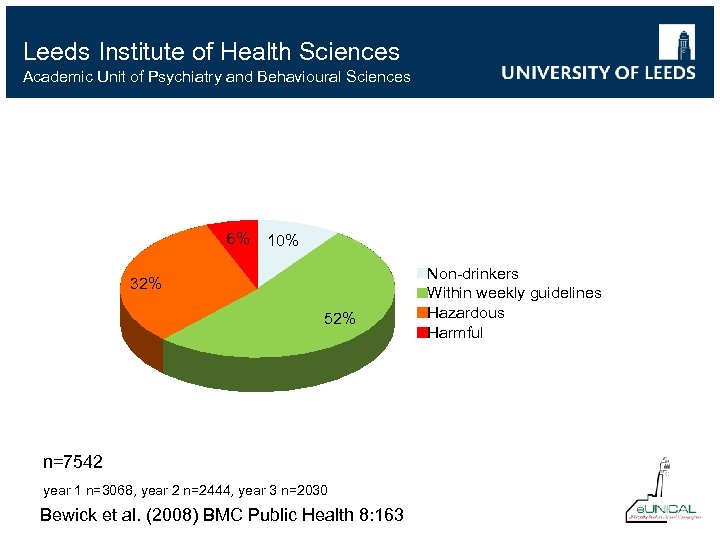 Leeds Institute of Health Sciences Academic Unit of Psychiatry and Behavioural Sciences 6% 10% 32% 52% n=7542 year 1 n=3068, year 2 n=2444, year 3 n=2030 Bewick et al. (2008) BMC Public Health 8: 163 Non-drinkers Within weekly guidelines Hazardous Harmful
 Leeds Institute of Health Sciences Academic Unit of Psychiatry and Behavioural Sciences Could a web-based approach work?
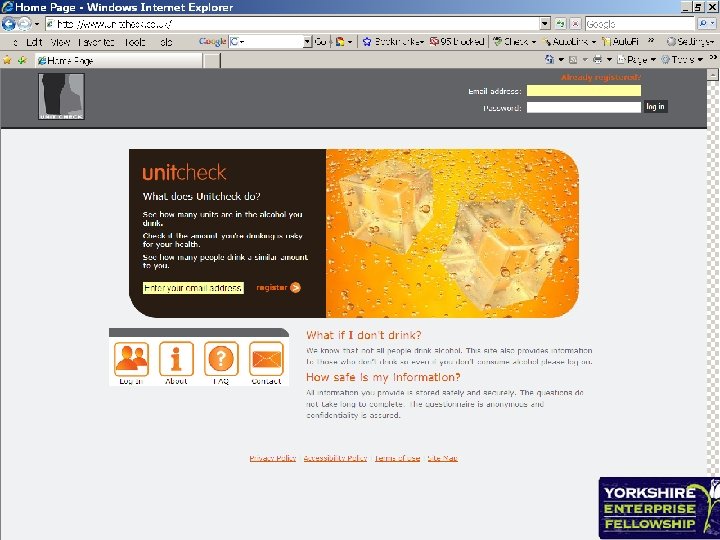
 Leeds Institute of Health Sciences Academic Unit of Psychiatry and Behavioural Sciences Personalised feedback Alcohol consumption • Units consumed per week • Number of alcohol free days • Binge drinking behaviour Social norms • The percentage of students who drink less than them • Perceived negative effects of alcohol perceived by other students who consume a similar amount of alcohol. Information on support services
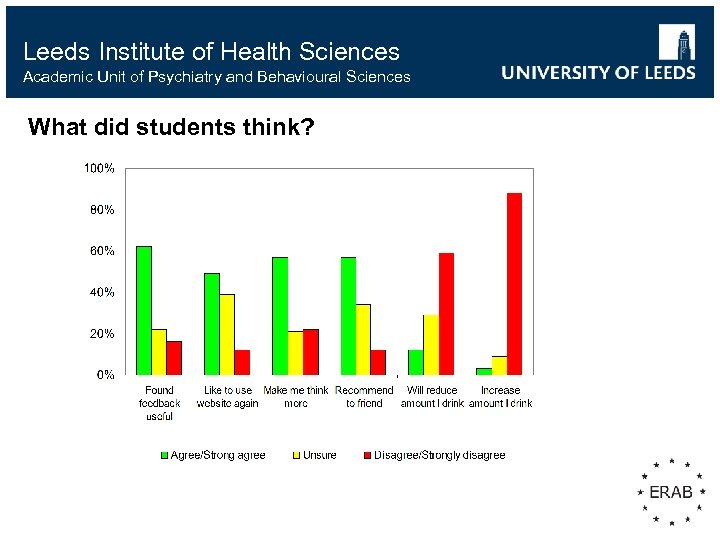 Leeds Institute of Health Sciences Academic Unit of Psychiatry and Behavioural Sciences What did students think?
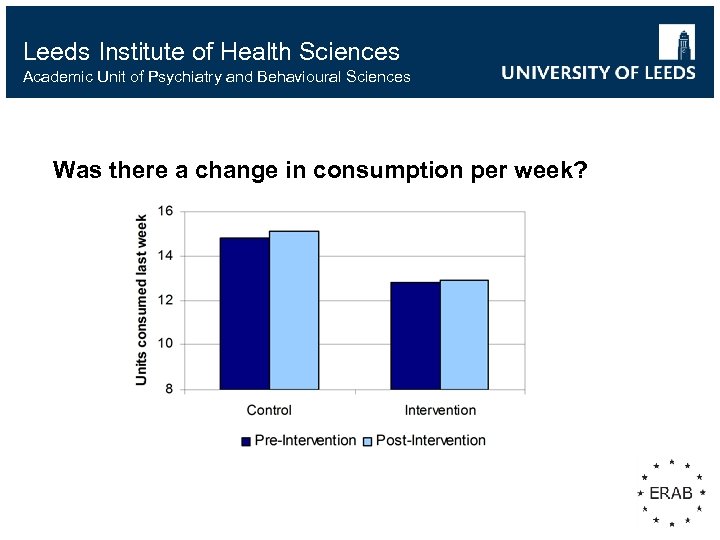 Leeds Institute of Health Sciences Academic Unit of Psychiatry and Behavioural Sciences Was there a change in consumption per week?
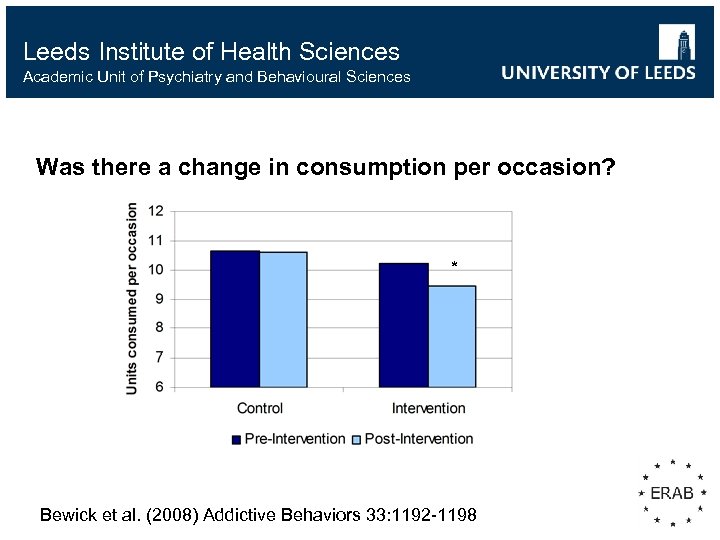 Leeds Institute of Health Sciences Academic Unit of Psychiatry and Behavioural Sciences Was there a change in consumption per occasion? * Bewick et al. (2008) Addictive Behaviors 33: 1192 -1198
 Leeds Institute of Health Sciences Academic Unit of Psychiatry and Behavioural Sciences Could these findings be replicated?
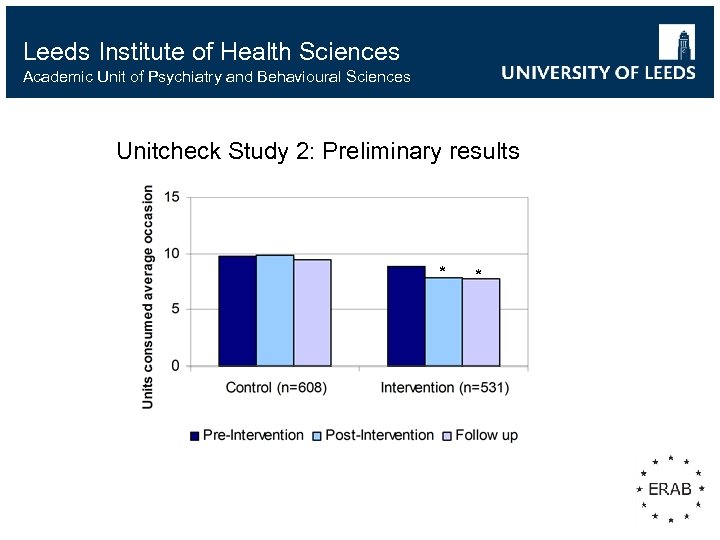 Leeds Institute of Health Sciences Academic Unit of Psychiatry and Behavioural Sciences Unitcheck Study 2: Preliminary results * *
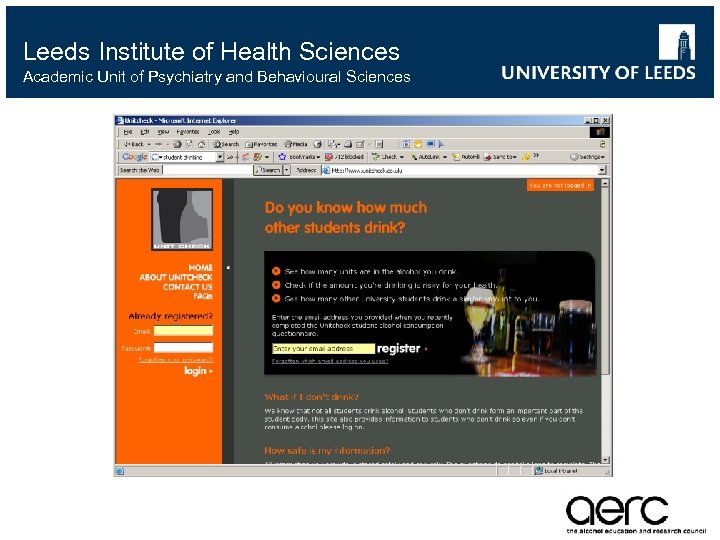
 Leeds Institute of Health Sciences Academic Unit of Psychiatry and Behavioural Sciences What about outside of University of Leeds?
 Leeds Institute of Health Sciences Academic Unit of Psychiatry and Behavioural Sciences
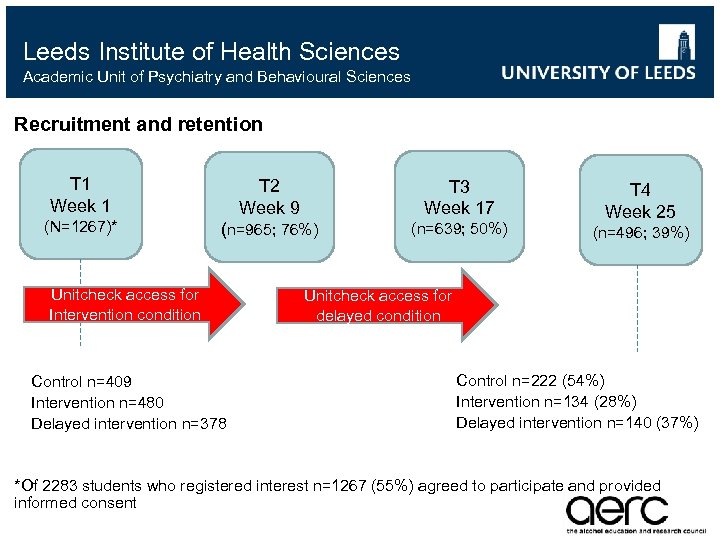 Leeds Institute of Health Sciences Academic Unit of Psychiatry and Behavioural Sciences Recruitment and retention T 1 Week 1 (N=1267)* T 2 Week 9 T 3 Week 17 (n=965; 76%) (n=639; 50%) Unitcheck access for Intervention condition Control n=409 Intervention n=480 Delayed intervention n=378 T 4 Week 25 (n=496; 39%) Unitcheck access for delayed condition Control n=222 (54%) Intervention n=134 (28%) Delayed intervention n=140 (37%) *Of 2283 students who registered interest n=1267 (55%) agreed to participate and provided informed consent
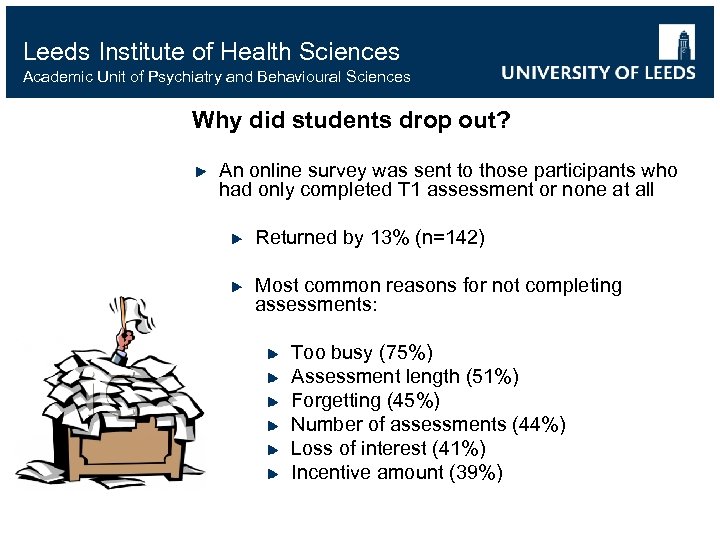 Leeds Institute of Health Sciences Academic Unit of Psychiatry and Behavioural Sciences Why did students drop out? An online survey was sent to those participants who had only completed T 1 assessment or none at all Returned by 13% (n=142) Most common reasons for not completing assessments: Too busy (75%) Assessment length (51%) Forgetting (45%) Number of assessments (44%) Loss of interest (41%) Incentive amount (39%)
 Leeds Institute of Health Sciences Academic Unit of Psychiatry and Behavioural Sciences Neither confidentiality (5%) or computer access (8%) were seen as problems Alcohol consumption data at registration showed those who dropped-out: Drank significantly more per week (21± 23 vs 16± 20 units) Were more likely to drink at levels above recommended weekly guidelines (46% vs 34%)
 Leeds Institute of Health Sciences Academic Unit of Psychiatry and Behavioural Sciences
 Leeds Institute of Health Sciences Academic Unit of Psychiatry and Behavioural Sciences The future How do we measure perceived norms? How do we contextualise ‘norms’? How does ‘local culture’ impact on intervention effectiveness? Which elements of interventions are effective? What is the life-span of delivering web-based interventions? What facilitates/enables engagement with web-based interventions? How can we increase retention amongst participants recruited remotely?
 Leeds Institute of Health Sciences Academic Unit of Psychiatry and Behavioural Sciences Thanks for listening Faculty of Medicine and Health, Charles Thackrah Building 101 Clarendon Road, Leeds, United Kingdom. LS 2 9 LJ b. m. bewick@leeds. ac. uk www. leeds. ac. uk/lihs +44 (0) 113 343 0809
 Leeds Institute of Health Sciences Academic Unit of Psychiatry and Behavioural Sciences References Bewick, B. M. , Trusler, K. , Barkham, M. , Hill, A. J. , Cahill, J. and Mulhern, B. (2008). The effectiveness of web-based interventions designed to decrease alcohol consumption – a systematic review. Preventive Medicine, Doi: 10. 1016/j. ypmed. 2008. 01. 005. Bewick, B. M, Mulhern, B. , Barkham, M. , Trusler, K. , Hill, A. J. and Stiles, W. B. (2008). Changes in undergraduate student alcohol consumption as they progress through university. BMC Public Health, 8, 163, Doi: 10. 1186/1471 -2458 -8 -163. Bewick, B. M. Trusler, K. , Mulhern, B. , Barkham, M. and Hill, A. J. (2008). Feasibility and effectiveness of a web-based personalized feedback and social norms alcohol intervention in UK university students: a randomized control trial. Addictive Behaviors, Doi: 10. 1016/j. addbeh. 2008. 05. 002.