


 Скачать презентацию Lee Chu Keong Intellectual Property What is
d24f6f9c75e1257b95c68c4daa586112.ppt
- Количество слайдов: 174
 Lee Chu Keong Intellectual Property
 What is Intellectual Property? Intellectual Property (IP) is society’s recognition of intellectual efforts. It is a monopoly granted in exchange for the contribution of intellectual creations to the society. It is an intangible property. The use of IP by a third party does not deprive the owner of his right of enjoyment. As such, an IP right is a right to restrain others from using that right. The extent of this right is dependent upon the scope of the ability granted by the law to restrain its use. The wider the scope given, the greater the monopoly an IP owner has. (Hamzah, 2006, p. 19)
 The theoretical justification for IP protection ranges from economic or inventive arguments to those which is based on the belief that IP is an extension of one’s personality – the latter being appropriated to copyright. What is clear is that IP is the fruit of one’s labour and, hence, one ought to own the IP. The difference in price between a piece of wood and a chair is the value added by the carpenter – his skill and labour in transforming the wood into a chair. Similarly, the product of intelligence and creativity which IP protects should be treated likewise. (Hamzah, 2006, p. 19)
 The Genesis of an Idea Hesse (2002) states that the concept of intellectual property the idea that an idea can be owned is a child of the European Enlightenment Ancient Greeks did not think of knowledge as something that could be owned or sold A tour of the other great civilisations of the pre-modern world Chinese, Islamic, Jewish, and Christian reveals a striking absence of any notion of human ownership of ideas or their expressions Confusion thought despised commerce, and thus also writing for profit
 Chinese Ideas Authors practiced their craft for the moral improvement of themselves and others Chinese authors had no property rights to their published words The contents of books could not be owned not even the particular expressions an author might employ could be claimed as his Chinese characters were thought to have come from nature, and no human being could make a claim upon them that would exclude their usage by others
 Islamic Ideas Throughout the Islamic lands, all knowledge was thought to come from God The Koran was a text that embodied the word of Allah, and it belonged to no one The principal means of transmitting Koranic knowledge was oral recitation (the word “Koran” itself meant “recitation”) from teacher to student The book was merely an instrument to facilitate faithful memorisation of the word This also resulted in the slow penetration of the technology of printing in the Islamic lands
 Judeo-Christian Ideas In the Judeo-Christian tradition, Moses received the law from Yahweh and freely transmitted it to the people chosen to hear it In the New Testament, Jesus exhorts his disciples, “Freely ye have received, freely give. ” Medieval theologians incorporated this passage into the canon law doctrine “Scientia Donum Dei Est Unde Verdi Non Potest”, which translates to “Knowledge is a gift from God, consequently it cannot be sold. ” Selling something that belonged to God constituted the sin of simony
 Renaissance Onwards The Renaissance elevated the poet, the inventor, and the artist to unprecedented social heights, but their genius was still understood to be devinely inspired rather than a mere product of their mental skills or worldly labours In the 16 th century, Martin Luther (1483 1546) could thus preach confidently in his Warning to Printers, “Freely I have received, freely I have given, and I want nothing in return. ” Alexander Pope regarded the poet as a reproducer of traditional truths; Goethe regarded the act of creating poetry as something sacred
 Francis Wayland, the president of Brown University in the 1830 s, wrote his The Element of Moral Science that “genius was not given for the benefit of the possessor, but for the benefit of others”
 Types of IP Copyright Patent Trademark Registered Design Geographical Indications Trade Secrets Semiconductor Topographies Plant Breeders’ Rights Database Rights
 References: Intellectual Property Hamzah, Z. (2006). Intellectual property law & strategy. Singapore: Sweet & Maxwell. Hesse, C. (2002). The rise of intellectual property, 700 B. C. A. D. 2000: An idea in the balance. Daedalus, 131(2), 26 45. Posner, R. A. (2002). The law & economics of intellectual property. Daedalus, 131(2), 5 12.
 Copyright
 Invention of Paper Invented in the first century AD, probably in western China by the eunuch official Ts’ai Lun However, recent archeology has uncovered several examples of crude early paper which can be dated earlier to at least the reign of Han Wu-ti (140 87 B. C. ) These early papers, made mostly from hemp fibres, were very coarse and could hardly have served as writing materials, and were probably intended for wrappings Ts’ai Lun’s paper was made from mulberry bark, worn-out fishing nets and a great variety of natural fibres
 The earliest documents written on paper were discovered in the dry sands of Inner Mongolia and Sinkiang date from the second century A. D. , not long after Ts’ai Lun presented his new paper at court in 105 Both the technique of paper-making and its use developed rapidly By the fourth century, it had almost completely replaced writing materials used by the Chinese in antiquity, the strips of wood or of bamboo each bearing a single line of text, and the silk scroll
 By the fourth century, paper had reached as far as Turfan By 500 A. D. , it was used almost everywhere in Central Asia In the eight century, its use was introduced by the Chinese prisoners of war to the Arabs in the region of Samarkand By 800 A. D. , paper was being manufactured in Bagdad From the Arab world, paper was introduced to Europe, probably in the eleventh century In China itself, by the T’ang period (618 907 A. D. ), papermaking had already grown into a fine art and a major industry, and a variety of fine papers were readily available
 Birth of Printing in the West In medieval times, it was extremely difficult to multiply a work Intellectual works were regulated by the laws of property The author of a manuscript or the sculptor of a statue became the owner of a material object and he could sell it to another person A manuscript could only be re-written by hand which severely limited the possible number of copies The origin of copyright has been linked to the Johann Gutenberg’s (1397 1468) invention of the moveable type
 This is because this invention made possible the manufacture of books A manuscript could now be printed and multiplied in a considerable number of copies and distributed to the public The manuscript now became the object of commerce and could bring wealth to their authors Printers were granted the privilege of printing ancient manuscripts (the Gutenberg Bible, completed in 1454 or 1455, was the first book) The Gutenberg Bible at the Ransom Center [link] The Gutenberg Bibles at the British Library [link]
 Birth of Copyright Later, they began printing the works of living authors The first royal grant of a privilege to the book trade was the creation of the title “King’s Printer”, which was given to William Facques in 1504 This position allowed him to print royal proclamations, statues and other official documents By 1557, the English crown reorganised the guild of printers and publishers known as the “Stationers’ Company” and gave them a virtual monopoly over printing and publishing, both in London and in the kingdom as a whole
 Rights to profit from a book derived not from property in ideas, but from a “privilege” granted by royalty By 1570 s, four members of the Stationers’ Company came to have a monopoly control, through “letters patent” over the most lucrative books in print: Christopher Barker, the Queen’s Printer, controlled the Bible, the New Testament, the Book of Common Prayer, and all statutes, proclamations, and other official documents William Serres, private prayer books, primers and schoolbooks Richard Tottel, common law texts John Day, alphabet books, the Cathechism, and the Psalms in meter
 During the 17 th century, the Stationers’ Company pressed for some kind of copyright protection On January 11, 1709, a draft bill was introduced in the House of Commons “for the Encouragement of Learning” This draft became law on April 10, 1710 The Statute of Anne (So. A) is the first copyright law in the modern sense of the term and it recognised for the first time the existence of an individual right to protection of a published work
 The So. A gave the author of already printed books the sole right to reprint them for a period of 21 years For unpublished books, the terms of copyright ran for 14 years with a proviso that after the expiration of that term, the author, if still living, could renew the term for another 14 years The protection granted in the So. A was subjected to some formalities, namely, the registration by authors of their works in their own name and the deposit of nine copies for universities and libraries in Stationers’ Hall
 William Hogarth petitioned Parliament for protection of engraved works (these were not books and therefore not protected by So. A) Parliament passed the Engravers’ Copyright or Hogarth’s Act in 1735 In 1791, Johann Gottlieb Fichte contributed yet another piece of the puzzle he noted that a great many people seemed able to share ideas, and it seemed intuitively just that as many people as possible should be permitted to express freely the same ideas independently of one another
 Fichte argued that for an idea to be regarded as a piece of property, it had to be assigned some distinguishing characteristic that allowed one person, and no other, to claim as his own That quality lay not in the ideas per se, but rather in the unique form in which an author chooses to express these ideas Once published, the ideas in a book belonged to all, but the singular form of their expression remained the sole property
 A New Type of Writer In the late 18 th century, reading became popular and literacy increased Demand for secular literature, in particular, novels, theatrical works, and self-help manuals increased in tandem An increasing number of young men and women aspired to become writers But they were writers of a new sort, writers that were more oriented towards commercial potential rather than towards eternal glory Many tried to begin living from their pens
 Authors began to claim that they deserve a share of the profits and increasingly sought to sell “rights” to a single edition, rather than selling a manuscript The increase in the demand for books led to an expansion in the practice of literary piracy Cheap reprints began to flood urban markets publishers of pirate editions successfully represented themselves as champions of the “public interest” against the monopolistic members of the book guilds
 The question they put forth: Why should any publisher have an exclusive claim on a work whose authors or heirs were no longer living indeed on many works composed before the invention of printing? The reform of the publishing industry in Europe entailed a rethinking of the basis and purpose of knowledge Two influential intellectuals contributed to this rethink John Locke wrote that “every Man has a Property in his own Person. This no Body has any right but to himself. The Labour of his Body, and the Work of his Hands, we may say, are properly his. ”
 To Locke, knowledge was derived from the senses working upon nature In his secular epistemology, inspiration is internalised and redefined as cognition Poet Edward Young asserted that the author contributed more than just his labour to a book he imprinted its contents with his original personality Cognition emanates from the workings of a unique mind These ideas sparked of a secularisation of theory of knowledge
 Locke and Young’s Ideas Spread to France What form of wealth could belong to a man, if not the work of the mind … if not his own thoughts … the most precious part of himself, that will never perish, that will immortalise him? What comparison could there be between a man, the very substance of a man, his soul, and a field, a tree, a vine, that nature has offered in the beginning equally to all, and which the individual has only appropriated through cultivating it? Denis Diderot (1763)
 And to Germany What? The writer is to be blamed for trying to make the offspring of his imagination as profitable as he can? Just because he works with his noblest faculties he isn’t supposed to enjoy the satisfaction that the roughest handyman is able to procure? … Freely has thou received, freely thou must give! Thus thought the noble Luther. … Luther, I answer, is an exception in many things. Gotthold Lessing (1772)
 Copyright: International Protection Copyright law is territorial, and this was a problem when international trade increased after the opening of the Suez Canal on November 17, 1869 International trade resulted in the increase of foreign works Authors began to suffer from piracy abroad For example, Harriet Beecher Stowe’s novel, Uncle Tom’s Cabin sold in great quantities in England Issues that had to be settled included: The translation of works into other languages The protection of foreign authors within national boundaries
 The first development in this direction was the establishment of special clauses in national laws providing for reciprocity For example, if the works of nationals of State A were protected in State B, them the works of the nationals of State B would be protected in State A These bilateral arrangements were messy solutions In 1886, the Berne Convention for the Protection of Literary and Artistic Works was signed This was followed in 1952 with the adoption of the Universal Copyright Convention
 Author’s Viewpoint At a meeting of the International Confederation of Societies of Authors and Composers (CISEC) in 1956, the Charter of Authors’ Rights was adopted It stated that: A work of the mind is at one and the same time a manifestation of the author’s personality and an economic asset. The author’s rights over his work is, therefore … a right akin to that of paternity. On the same principle, the author is entitled to an exclusive, transmittable right in all forms of economic exploitation of his work, whatever their value and purpose.
 Furthermore … The authors of literary, musical, artistic and scientific works play a spiritual and intellectual role in society which is to the profound and lasting benefit of humanity and a decisive factor in shaping the course of civilization. The State, accordingly, should grant to the author the widest possible protection not merely in consideration of his personal achievement, but also in recognition of his contribution to the common good.
 Today: Electronic Documents Easily manipulable. Content can be composed and revised, cut and pasted, shaped and rotated. Features such as dynamic tables of content can be exploited and customised. Internally and externally linkable. Multiple media formats (text, images, audio, video) can be connected and reconnected within and among documents. Readily transformable. Storage formats (disk, tape, print) and displays are changeable and exchangeable, from input through transmission to output. Storage requires disk space, not warehouses.
 Inherently searchable. Logical document structures, natural- language processing, and expert systems facilitate access to and interpretation of content. Instantly transportable. Information can be transmitted instantly (or for purists, in seconds or less) to any geographic location. Distribution requires electronic networks, not trucks. Infinitely replicable. Distribution is really replication; the original remains at the source. Quantities are technically unlimited. Mass production or copying does not degrade the quality of copies (or of originals).
 The Main Problem Electronic documents are infinitely replicable Distribution is really replication; the original remains at the source. Quantities are technically unlimited. Mass production or copying does not degrade the quality of copies (or of originals).
 Rightsholder’s Concerns Over Digital Content Where content is available in a digital format, rightsholders are understandably nervous about the potential for copyright infringement This can be attributed to four factors: Digital materials are often easy to copy. Compare, for example, the time and effort required to stand over a photocopy machine in order to The copies made are of an extremely high quality. A photocopy of a book, even if you guillotine and then bind the copy, is nowhere near as good as the original from which it is copied, whereas a copy of an item in the digital format will be virtually indistinguishable from the original.
 The material can be distributed to many people within a matter of seconds. For example, if a report is published in a format such as Adobe PDF, Rich Text Format, or MS Word, it can easily be sent as an e-mail attachment from the original. Copying can be achieved at low or marginal cost. Making a photocopy, for example, incurs costs for the paper and the toner, as well as the staff time involved, whereas the making of a digital copy incurs few if any costs.
 It’s About Balance Article 27 of the Universal Declaration of Human Rights (adopted on October 10, 1948) states that: Everyone has the right freely to participate in the cultural life of the community, to enjoy the arts and to share in scientific advancement and its benefits Everyone has the right to the protection of the moral and material interests resulting from any scientific literary or artistic production of which he is the author This balance was carefully crafted over many years, but the digital world has created a new imbalance
 New Strategies Adopted by Rightsholders Introduce new legal protections in the UK, the Copyright and Rights in Databases Regulations was introduced to protect databases In order for a database to qualify for copyright protection, the arrangement of the contents of the database must be original In order for a database to qualify for database right, substantial investment must have taken place to obtain, verify and present the contents of the database Some databases will qualify for both copyright protection and database right protection
 Use technology to control access DRM systems can be used to control access to copyright materials Use contract law to govern the use of content Information in electronic formats is often accompanied by a licence or a set of terms and conditions This, in effect, the use of the information product is governed by the law of contract rather than the law of copyright Make it easier to enforce IP rights Taking a case to court can be extremely costly In the ideal IP system, the enforcement of IP should be swift, affordable and judicious
 Berne Copyright Concention Article 5 rights guaranteed (1) Authors shall enjoy, in respect of works for which they are protected under this Convention, in countries of the Union other than the country of origin, the rights which their respective laws do now or may hereafter grant to their nationals, as well as the rights specially granted by the Convention. (2) The enjoyment and the exercise of these rights shall not be subject to any formality. Source
 Interesting Quote The Internet is the world’s biggest copying machine. (Todd, 2008, p. 159)
 Stuff From the Internet The Internet offers material that is freely obtainable: super-sharp, well-taken photographs (e. g. , from Flickr. com) nice-sounding music (e. g. , from Radio. Blog. Club. com) interesting text (e. g. , from Wired. com) hard-to-find videos (e. g. , from You. Tube. com) All of this is easily downloadable, just right-click and leftclick, and it’s stored in your hard drive Big Question: Can I freely use these material at will? Answer: No
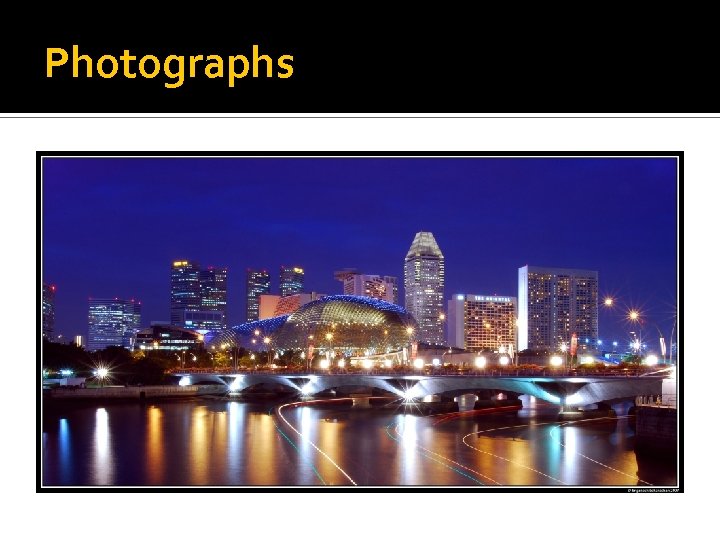 Photographs
 Music Try: http: //www. Radio. Blog. Club. com/ Search for: Air Supply Play: All Out of Love
 Text Try: http: //www. Wired. com/ Search for “Star Wars Costume” Read: the article “Star Wars Costume Copyfight Spreads to England”
 Videos Try: http: //www. You. Tube. com/ Search for: “Paul Potts” Watch: Nessun Dorma
 What is Copyright? Copyright is a form of legal protection for authors of original works, whether they are publish or unpublished The word author refers to any creator of a copyrighted work Why is copyright important? Copyright law exists to ensure that authors get rewarded for their work and can control the conditions over how their work can be used, including copying or altering. It stimulates innovation and encourages the development of new knowledge by providing a financial incentive for those who create and share knowledge.
 What does Copyright Protect? Copyright law protects the expression of an idea but not the underlying ideas or facts themselves, in a rule of law known as the Idea-Expression Dichotomy It separates the subject matter on one side from the manner in which you express it on the other No matter how brilliant your inspiration for a novel, movie, method, or process, you cannot prevent someone from expressing that idea in their own way
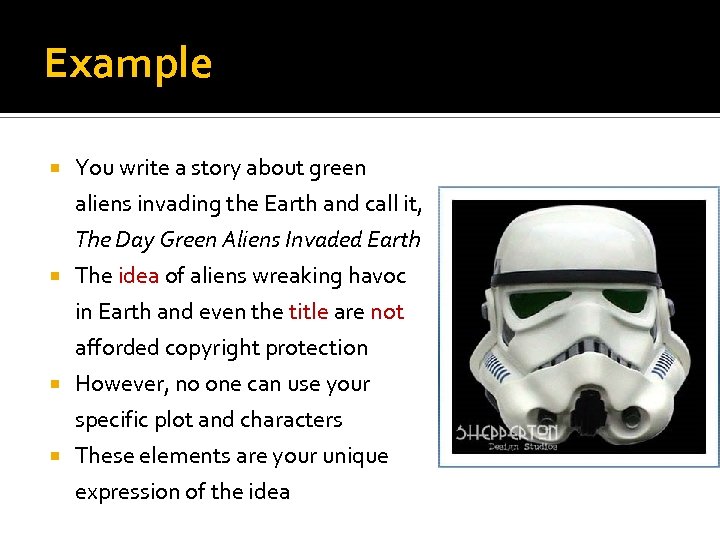 Example You write a story about green aliens invading the Earth and call it, The Day Green Aliens Invaded Earth The idea of aliens wreaking havoc in Earth and even the title are not afforded copyright protection However, no one can use your specific plot and characters These elements are your unique expression of the idea
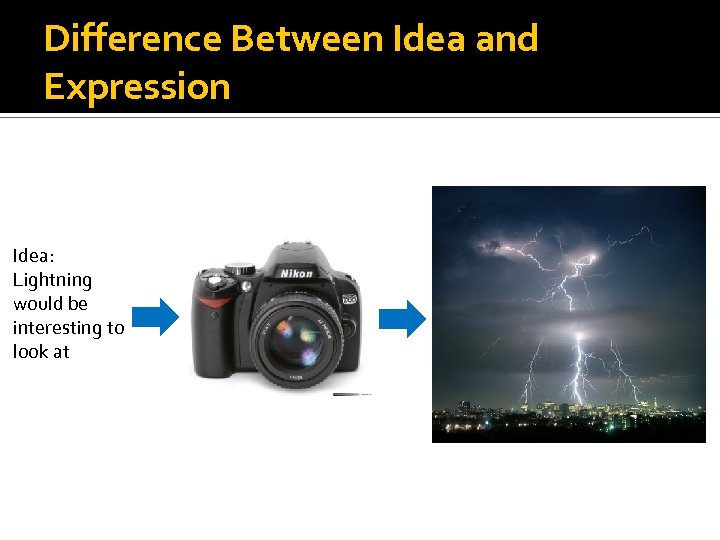 Difference Between Idea and Expression Idea: Lightning would be interesting to look at
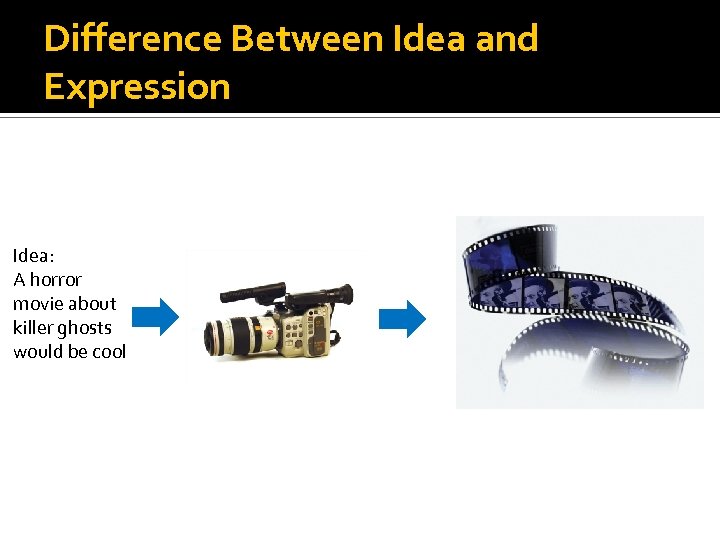 Difference Between Idea and Expression Idea: A horror movie about killer ghosts would be cool
 The Purpose of Copyright law protects the creations of individuals by giving them a monopoly on their works for a set amount of time The law is also intended to dissolve that monopoly by eventually allowing the work to be accessed by the public, which presumably would build upon and improve the work Society should be able to access a work at some point for its betterment and progress An individual can also use a work if he has permission from the author
 Balancing Protection and Innovation Copyright protection serves to balance the interests of creators and society at large Protecting copyright encourages individuals to create and innovate (no one will be motivated to write a novel if he is not be able to derive some monetary reward from his efforts) The access that society has to these creations also stimulates innovation
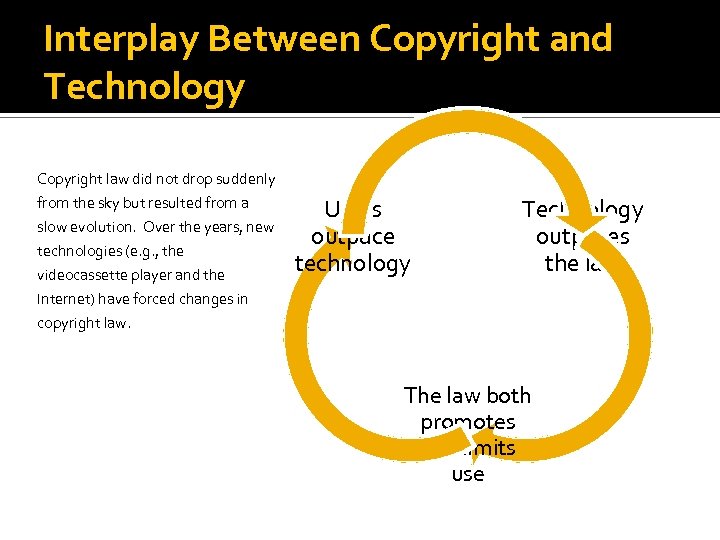 Interplay Between Copyright and Technology Copyright law did not drop suddenly from the sky but resulted from a slow evolution. Over the years, new technologies (e. g. , the videocassette player and the Internet) have forced changes in copyright law. Users outpace technology Technology outpaces the law The law both promotes and limits use
 The Issues Copyright owners are concerned that their right to their work is at risk and that new technologies, such as file-sharing websites, make it increasingly easier to violate copyright by “stealing” intellectual material Users of copyrighted work and the public are concerned that society’s ability to use materials under existing copyright exemptions will be eroded, and that a millennia-old tradition of creating, borrowing, innovating, and improving will be lost
 Copyright Protection: When Does It Begin? Once you create an original work, you don’t have to do anything to obtain copyright protection for it You don’t have to publish your work, and you don’t have to register it Copyright protects your original work of authorship fixed in any tangible medium of expression, as soon as it is captured in a physical form Note: the work must be original, although not necessarily novel or unique the work can be absolutely devoid of ingenuity, quality or artistic value
 Works of Authorship Many forms are possible Literary works, such as books, poetry plays, compilations, and computer programs Musical works, including lyrics or any accompanying words (e. g. , narration) Dramatic works, including any accompanying music Pantomimes and choreographic works Pictorial, graphic, and sculptural works, including architectural plans, two- and three-dimensional art, photographs, maps, charts, diagrams, computer graphics, and models
 Motion pictures and other audiovisual works, including scores, speech, and sound effects Sound recordings, including music, speech, and sound not covered by motion pictures and audiovisual works Architectural works Tattoos
 Tangible Medium of Expression This refers to the form in which a work can be viewed or experienced, for no matter how brief a period of time To be protected, the work must be able to be observed, reproduced, or communicated Examples include paper, recordings, video, digital media, or the random access memory (RAM) in a computer Example: You fix your idea of a song when you (i) record it; (ii) write down the lyrics and music notes on paper; (iii) key in the lyrics and music notes into a notation software (e. g. , Finale)
 Exclusive Rights of the Copyright Holder The author of a protected work has the exclusive rights that control how his work can be used Collectively, these rights are known as a “bundle of rights” and consist of the following Reproduction (e. g. , using a photocopy machine) Creation of derivative works (e. g. , a movie version of a book) Distribution to the public Public performance of literary, musical, dramatic, and choreographic works, pantomimes, and motion pictures and other audiovisual works
 Public display of literary, musical, dramatic, and choreographic works, pantomime, and pictorial, graphic or sculptural works Public performance by digital audio transmission of sound recordings These rights can be broken up at the discretion of the copyright holder if you took a photograph, you can grant Peter the right to publicly display the digital image on his website, Pamela to reproduce the image in a magazine, and Paul to use it in a 70 -ft billboard
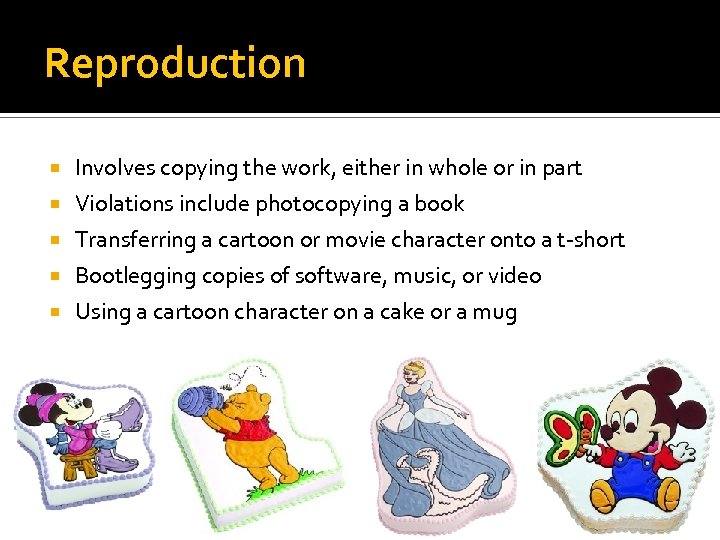 Reproduction Involves copying the work, either in whole or in part Violations include photocopying a book Transferring a cartoon or movie character onto a t-short Bootlegging copies of software, music, or video Using a cartoon character on a cake or a mug
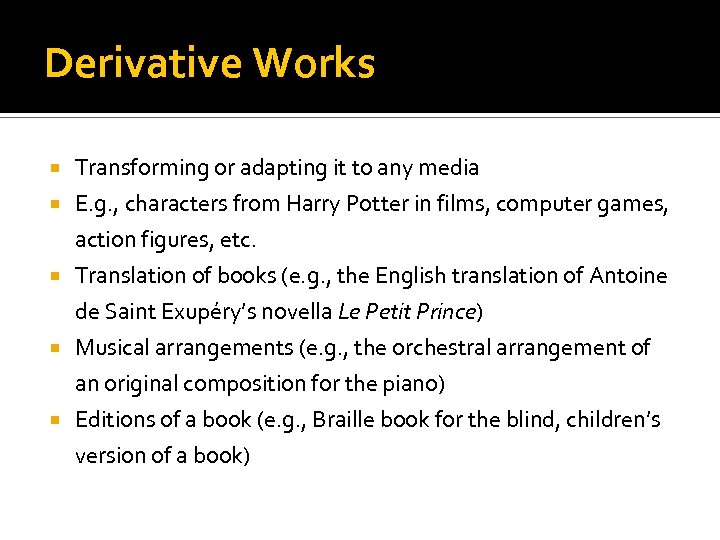 Derivative Works Transforming or adapting it to any media E. g. , characters from Harry Potter in films, computer games, action figures, etc. Translation of books (e. g. , the English translation of Antoine de Saint Exupéry’s novella Le Petit Prince) Musical arrangements (e. g. , the orchestral arrangement of an original composition for the piano) Editions of a book (e. g. , Braille book for the blind, children’s version of a book)
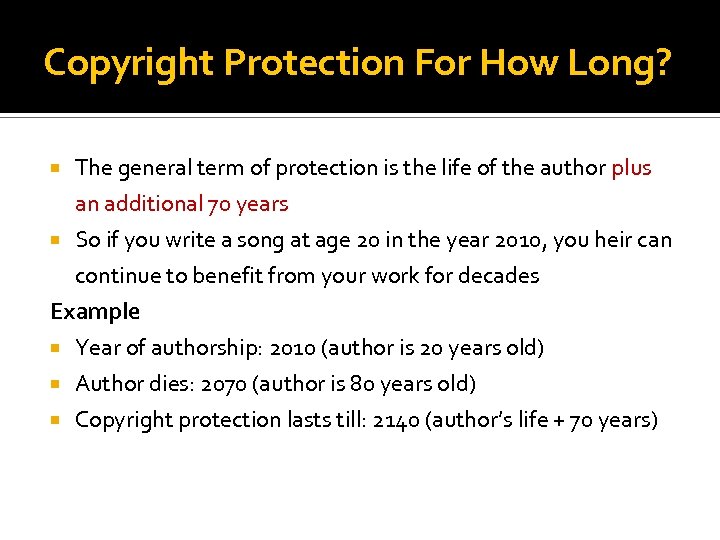 Copyright Protection For How Long? The general term of protection is the life of the author plus an additional 70 years So if you write a song at age 20 in the year 2010, you heir can continue to benefit from your work for decades Example Year of authorship: 2010 (author is 20 years old) Author dies: 2070 (author is 80 years old) Copyright protection lasts till: 2140 (author’s life + 70 years)
 But I Bought The Work A work’s copyright status does not change when you buy a copy of the work When you buy a book, CD, or DVD, you own the physical item, not the copyright interest in that item However, you can resell, lend, give away, or dispose of that single item this legal principle is known as the first sale doctrine You can make a copy of music or video, or tape a television show, but for personal use only
 Unprotected Works Many kinds of works are not protected by copyright Ideas, facts, titles, slogans, discoveries, improvisational works (note: slogans may be eligible for trademark protection) The merger doctrine, which applies when there are only a few ways to describe something or to express an idea E. g. , the rules of a contest or lottery E. g. , there may be only a few ways to write efficient code to produce a desired result
 Stock scenes, characters, and features of a work considered standard or essential to the genre or field (known as scenes à faire) Works can also enter into the public domain for the following reasons: the copyright term expired the owner did not renew the copyright the owner did not properly obtain copyright protection the owner relinquished copyright protection for the work and placed it in the public domain
 The protection of this Convention shall not apply to news of the day or to miscellaneous facts having the character of mere items of press information (Berne, Article 2(8)) It shall be a matter for legislation in the countries of the Union to exclude, wholly or in part, from the protection provided by the preceding Article political speeches and speeches delivered in the course of legal proceedings (Berne, Article 2 bis(1))
 Copyright protection extends to expressions and not to ideas, procedures, methods of operation or mathematical concepts as such (WIPO Copyright Treaty) Works consisting entirely of information that is common property and containing no original authorship (for example: standard calendars, height and weight charts, tape measures and rulers, and lists or tables taken from public documents or other common sources) (U. S. ) Mere listings of ingredients or contents (U. S. )
 Public Domain and Open Access Works The relevant U. S. and state government agencies (e. g. , United States Department of Agriculture’s historical photographic collection (http: //www. usda. gov/oc/photo/histfeat. htm) The Library of Congress (http: //www. loc. gov/) Leading public libraries, e. g. , the New York Public Library (http: //www. nypl. org/) University libraries (e. g. , Harvard University’s Open Collection Programme (http: //ocp. hul. harvard. edu/) Photo-sharing sites (e. g. , Flickr has a Creative Commons section http: //www. flickr. com/creativecommons/)
 Copyright Infringement This refers to the violation of one or more rights granted to a copyright owner by using the work without permission or without paying a royalty Simply, it refers to the unauthorised use of someone’s IP Infringement can take many forms: Making a copy of a work by downloading it to your hard drive Scanning a photograph from a book and using it in your company brochure Distributing copyrighted music or book over the Internet
 Creating a new musical work by sampling an existing work Building a house from a copyrighted design Inline linking (displaying an image from a copyrighted website on your own website) Digitizing a copyrighted movie, and showing it in your website (this constitutes a public performance of the work)
 Types of Infringement Copyright infringement can be either direct or indirect Direct infringement is when you violate one of a copyright owner’s exclusive rights To prove direct infringement, the copyright owner must establish the following elements: The work is protected by copyright The infringer has copied the work, as shown by the following ▪ The infringer’s admission (rare, but it happens!) ▪ The copyright owner offering circumstantial evidence of infringement by demonstrating that the alleged infringer had access to the work and that the infringing work was substantially similar to the copyrighted work The use of the work was improper
 The second type of copyright infringement is indirect infringement In this case, the infringer does not directly infringe a copyright, but aids someone else’s infringing conduct There are two types of indirect infringement contributory infringement and vicarious infringement Contributory infringement is conduct that assist the infringement, such as providing a product whose use central to another person’s ability to infringe (e. g. , the 4 shared. com website allows people to upload copyrighted books, e. g. “ 1907”)
 You can think of contributory infringement as conduct that induces or encourages the infringing behaviour Vicarious infringement occurs when you have the right and ability to supervise the infringing activity and a financial interest in supporting that infringement Even if you are unaware of the infringing activity, you can still be liable for the infringement, e. g. , if you run a flea market, and rent a booth to someone who sells bootleg CDs and DVDs, even if you don’t know they are selling such things
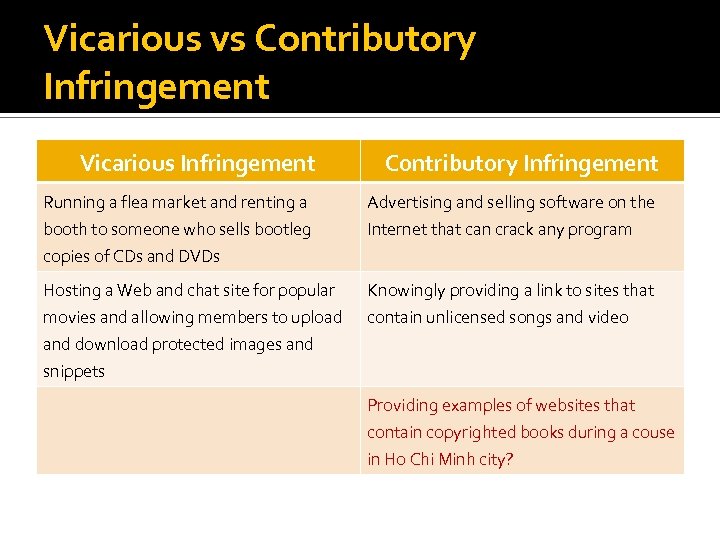 Vicarious vs Contributory Infringement Vicarious Infringement Contributory Infringement Running a flea market and renting a booth to someone who sells bootleg copies of CDs and DVDs Advertising and selling software on the Internet that can crack any program Hosting a Web and chat site for popular movies and allowing members to upload and download protected images and snippets Knowingly providing a link to sites that contain unlicensed songs and video Providing examples of websites that contain copyrighted books during a couse in Ho Chi Minh city?
 The Cease and Desists Letter If you are found using someone’s copyrighted work without permission, you will likely first receive a cease and desist letter This is a formal request for you to stop the infringing action A cease and desist letter serves as official notice that someone believes you have infringed their copyright, and it should be taken seriously This letter states when and how you copied the work without permission, demands that you immediately stop the use and distribution of the work, and demands that you respond that you have performed this action by a certain date
 Fair Use Doctrine Fair use is the foremost limitation upon, or exceotion to, copyright protection. It permits the public to use copyrighted material for certain purposes without obtaining prior consent from the owner. But, there are no hard-and-fast rules on what is considered fair use. The doctrine is always applied on a caseto-case basis, which can make it a difficult concept to grasp. The fair use doctrine identifies four factors that the courts weigh when considering whether a use is fair.
 The Four Factors Factor 1: The purpose and character of use Factor 2: The nature of the copyrighted work Factor 3: The amount and substantiality of the portion used in relation to the copyrighted work as a whole Factor 4: The effect of the use on the market or the potential market for the copyrighted work
 Factor 1 How you intent to use the work guides whether you can Examples of uses include: non-profit educational, news reporting, scholarship, research, transformative Transformative means that the work is altered (reinterpreted or re-analysed) such that the reader receives some new meaning or message Parodies are transformative works (e. g. , a parody of Star Wars) A work that compares the directing styles of Alfred Hitchcock and Martin Scorsese is also transformative
 Factor 2 Looks at whether the work is factual or creative An expression of fact is said to have “thin” copyright unless the expression is extremely creative The facts themselves cannot be copyrighted because they are like ideas discoverable but not protected by copyright Example: A database that
 Factor 3 Pertains to either the amount or portion of the work you intend to copy or use The courts do not care if you only used 12% of a work, or 17 maps out of 100 The amount you didn’t use is not a defence you cannot escape liability by showing how much of a work you did not take The court value the qualitative “heart of a work” over the amount you take from the whole The amount may be small, but if it is key or central to the work, you cannot use it
 Factor 4 Pertains to the market for the copyrighted work The court attempts to assess the impact of the work on the market of the copyrighted work, often weighting it highest among the four factors E. g. , ripping a track from an audio CD and making it available as an MP 3 file on your website will make the work available to the world, and lower the sales of the original item E. g. , selling photocopy editions of an expensive textbook will decrease its sales at the bookstore
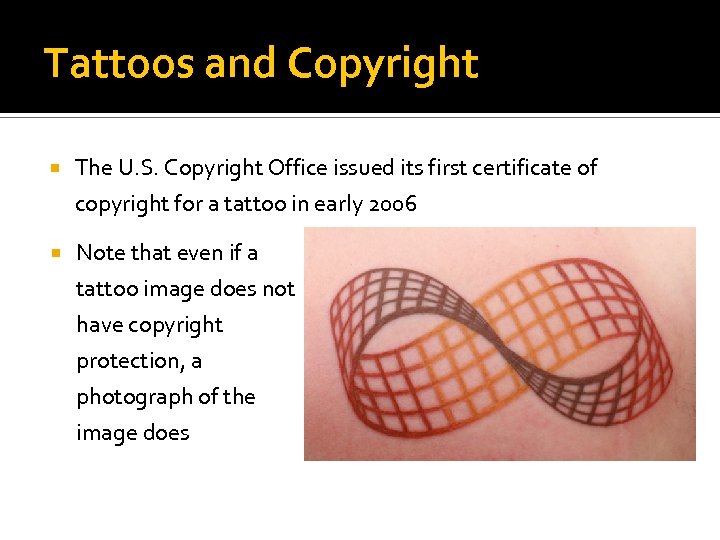 Tattoos and Copyright The U. S. Copyright Office issued its first certificate of copyright for a tattoo in early 2006 Note that even if a tattoo image does not have copyright protection, a photograph of the image does
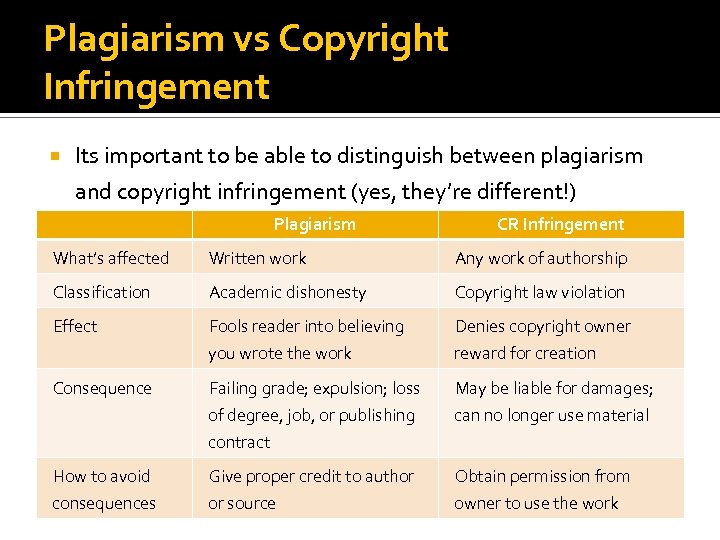 Plagiarism vs Copyright Infringement Its important to be able to distinguish between plagiarism and copyright infringement (yes, they’re different!) Plagiarism CR Infringement What’s affected Written work Any work of authorship Classification Academic dishonesty Copyright law violation Effect Fools reader into believing you wrote the work Denies copyright owner reward for creation Consequence Failing grade; expulsion; loss of degree, job, or publishing contract May be liable for damages; can no longer use material How to avoid consequences Give proper credit to author or source Obtain permission from owner to use the work
 The Invention of Xerography
 Pre-Xerography: The Rectigraph In 1906, George Beidler built the first photographic copying machine Beidler named his machine the Rectigraph The Rectigraph was large and almost needed a room of its own It depended on two things electric power and running water Because of this, it was usually found only in specialty shops Beidler’s major competitor was the Photostat Corporation, which had a licensing and manufacturing relationships with Eastman Kodak
 Chester Carlson Chester’s father, Olof Adolph Carlson He married Ellen Josephine Hawkins Chester Carlson was born on February 8, 1906 Olof was sickly, as he had tuberculosis and suffered from spinal arthritis Olof died in 1932 (Carlson rushed back but was not on time) Chester was fired from Bell Labs in 1933 for participating in an extracurricular “business scheme” with several other Bell Labs employees, who, like him, were interested in finding a “hedge against the depression” (this “business scheme” came to nothing
 He was offered a job at Austin & Dix A year later, having been warned by Mr. Austin that business was deteriorating, he moved to the patent office of P. R. Mallory & Company, a manufacturer of electrical and electronic components In 1934, Chester married Elsa von Mallon, but the marriage was not happy they had very little in common Elsa’s mother also felt that her daughter had made a poor choice of husband, and she did not conceal her opinion In 1936, Chester enrolled in night classes at New York Law School
 He did most of his studying on weekends at the New York Public Library, where he copied by hand long passages from law books that he couldn’t afford to buy His copying gave him writer’s cramp, and sitting for hours at a desk hurt his back When his hand hurt from too much writing, Chester sometimes turned his full attention to the copying problem Inventing an office copier would solve all his difficulties, he believed, since doing so would eliminate the necessity of copying text by hand would also generate the income that his young wife and her mother seemed to require
 One day in 1937, as he was thumbing through an obscure German scientific journal, he found a brief article by a Hungarian physicist who had been experimenting with the transmission and development of photographic images and suddenly he thought of a way in which the thing might be done Chester first called his idea “electron photography”, and then “electrophotography” He applied for his patent in the fall of 1937, and followed it a little later with an improved and expanded version, which was issued in the fall of 1942
 Now that he had patented the idea, he proceeded to prove the practicality of his idea, i. e. , to actually make a copy of something He faced two challenges: (i) his manual ineptitude; (ii) the circumstances under which he was trying to work He could see the process in his mind, and he could understand how its elements fit together, but he couldn’t make it work (manual ineptitude) He was conducting the experiments in the house (he and Elsa had been living with Elsa’s parents in a small house in Jackson Heights)
 The experiments would occasionally make the whole building smell like rotten eggs This annoyed his wife and drew bitter complaints fomr is mother-in-law In the fall of 1938, he rented a room on the second floor of a house own by his in-laws, at 32 -05 Thirty-seventh Street in Astoria, Queens The room had a gas connection, was just a fifteen-minute walk away, and had a low rent ($15 per month payable to his mother-in-law)
 Chester looked for an assistant He found an ad in a magazine called Electronics which looked promising It had been placed by an Austrian physicist, Otto Kornei, who had recently immigrated to the United States and had not luck in finding work His finances at that point was not robust, and Elsa was annoyed by his copying obsession Kornei, who started work on October 6, 1938, turned out to be an ideal assistant
 In just a few days, Otto made more concrete progress than Chester had in managed in over a year of fumbling experience Kornei managed to make the first xerographic print, “ 10. -22. 1938 ASTORIA” Kornei worked for Chester for a period of six months, during which time he made a number of significant advances When his employment contract expired in March 1939, he told Chester that he had accepted a job offer from the Brush Development Company in Cleveland (Kornei simply could not see a future in electrophotography)
 Kornei and Chester remained on cordial terms, and corresponded for a time Shortly before Kornei moved to Cleveland, he and Chester met to dissolve their agreement that would have given him 10% of Chester’s future proceeds from electrophotography Chester wrote letters to more than twenty companies, including, IBM, General Electric, RCA, and A. B. Dick, in the hope that one of them would be interested in commercially developing electrophotography The response was “an enthusiastic lack of interest”, although a few companies did invite him to make a presentation
 Chester used a presentation kit that Kornei had prepared before he left for Cleveland to make his pitches to companies But none of the companies bit because: (i) Carlson was too soft-spoken; and (ii) the demonstration was crude and it did not impress the audience
 Justin Frankel In 1987, the German engineering firm Fraunhofer Schaltungen devised a compression standard known as mpeg-1 Audio Layer 3, better known as MP 3 The Germans were trying to solve a vexing problem: how to broadcast digital audio as CD-quality sound files were just too big and cumbersome Justin Frankel “needed a better player” and started coding 12 hours per day He released Winamp 1. 0 in April 1997
 Within a month of uploading the software for distribution from his website, it was getting 40, 000 visitors a day Within 18 months, Frankel’s free Winamp had been downloaded 15 million times He suggested a registration $10 registration fee, and also earned from advertising fees as well He started a company, Nullsoft, and his father acted as legal counsel Justin later sold Nullsoft to America Online
 References: Copyright Man, J. (2002). Gutenberg: How one man remade the world with words. New York: John Wiley. Owen, D. (2004). Copies in seconds: Chester Carlson and the birth of the Xerox machine. New York: Simon & Schuster. Pedley, P. (2007). Digital copyright (2 nd ed. ). London: Facet Publishing. Schamber, L. (1996). What is a document? Rethinking the concept in uneasy times. Journal of the American Society for Information Science, 47(9), 669 671. Todd, E. (2008). Gringas: The laws of the Internet. London: Tottel Publishing. Twitchett, D. (1983). Printing and publishing in medieval China. New York: Frederic C. Beil. UNESCO. (1982). The ABC of copyright. Paris: UNESCO.
 Waxer, B. M. , & Baum, M. L. (2007). Copyright on the Internet. Boston: Course Technology.
 Patents
 The Patent in the United States The congress shall have the power … to promote the progress of science and useful arts, by securing for limited time to authors and inventors the exclusive right to their respective writings and discoveries. The U. S. Constitution
 Blotting Out Some Words … The congress shall have the power … to promote the progress of science and useful arts, by securing for limited time to authors and inventors the exclusive right to their respective writings and discoveries. The U. S. Constitution
 Why Patents? If nature has made any one thing less susceptible than all others of exclusive property, it is the action of the thinking power called an idea, which an individual may exclusively possess as long as he keeps it to himself. Thomas Jefferson, 3 rd President of the United States Letter to Isaac Mc. Pherson, 13 August 1813 The law of the state of Massachusetts of March 17, 1789 states that there is “no property more peculiarly a man’s own than the labour of his mind”.
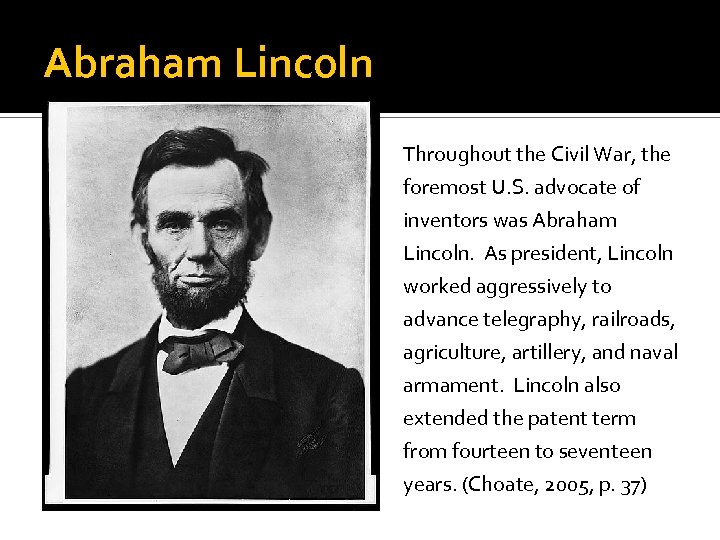 Abraham Lincoln Throughout the Civil War, the foremost U. S. advocate of inventors was Abraham Lincoln. As president, Lincoln worked aggressively to advance telegraphy, railroads, agriculture, artillery, and naval armament. Lincoln also extended the patent term from fourteen to seventeen years. (Choate, 2005, p. 37)
 The patent system … added the fuel of interest to the fire of genius, in the discovery and production of new and useful things. Abraham Lincoln, 16 th President of the United States Second Lecture on Discoveries and Inventions Jacksonville, Illinois, February 11, 1859 Some Trivia Abraham Lincoln is the only president of the United States to hold a patent (Patent No. 6469: Buoying Vessels over Shoals, filed May 10, 1849 and granted May 22, 1849)
 More Trivia: Thomas Alva Edison The record holder for the most number of patents registered at the USPTO is Thomas Alva Edison In his lifetime, he registered a whopping 1, 093 patents (1, 084 utility patents and 9 design patents) remember that Edison has also got foreign patents! Patent No. 223898, Electric-Lamp (the incandescent light bulb), is Edison’s most famous patent It was granted on 27 January, 1880 View the patent at: http: //www. ourdocuments. gov/doc. php? flash=true&doc=46
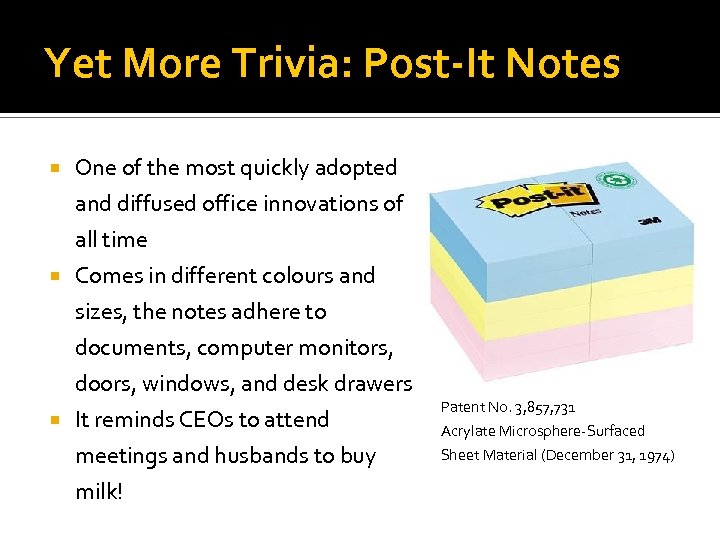 Yet More Trivia: Post-It Notes One of the most quickly adopted and diffused office innovations of all time Comes in different colours and sizes, the notes adhere to documents, computer monitors, doors, windows, and desk drawers It reminds CEOs to attend meetings and husbands to buy milk! Patent No. 3, 857, 731 Acrylate Microsphere-Surfaced Sheet Material (December 31, 1974)
![What is a Patent? [1] A patent is a limited monopoly given to an](https://present5.com/presentation/d24f6f9c75e1257b95c68c4daa586112/image-112.jpg "What is a Patent? [1] A patent is a limited monopoly given to an") What is a Patent? [1] A patent is a limited monopoly given to an inventor in exchange for a complete and “enabling” disclosure of the invention. What is a limited monopoly? What is an invention? What is an “enabling” disclosure?
What is a Patent? [1] A patent is a limited monopoly given to an inventor in exchange for a complete and “enabling” disclosure of the invention. What is a limited monopoly? What is an invention? What is an “enabling” disclosure?
![What is a Patent? [2] … a grant to the patentee … of the](https://present5.com/presentation/d24f6f9c75e1257b95c68c4daa586112/image-113.jpg "What is a Patent? [2] … a grant to the patentee … of the") What is a Patent? [2] … a grant to the patentee … of the right to exclude others from making, using, offering for sale, or selling the invention throughout the United States … for a term beginning on the date on which the patent issues and ending 20 years from the date on which the application was filed … Depending on your perspective, a patent can be seen as: a technical document, or a legal document, or a business asset.
What is a Patent? [2] … a grant to the patentee … of the right to exclude others from making, using, offering for sale, or selling the invention throughout the United States … for a term beginning on the date on which the patent issues and ending 20 years from the date on which the application was filed … Depending on your perspective, a patent can be seen as: a technical document, or a legal document, or a business asset.
 Three Characteristics Contractual: between government and inventor; the right to exclude for limited time in exchange for full disclosure of invention Property: can be sold, rented, licensed, just like any other property Monopolistic: limited in time (20 years); negative in character (exclusionary) – a patent does NOT give the right to practice the invention, only the right to exclude other parties from practicing it Also remember the territorial characteristic of patents
 Patentability Requirements Novelty It must be new (not necessarily totally new, many patents are actually improvements of older ones) Significant improvements allowed Not acceptable: changes in size, shape, materials, substitution/reconfiguration of components Note In his article, Aluminum, the Magic Metal, published in the August 1978 issue of the National Geographic, Canby highlighted a violin made of aluminum (p. 200). The person who made this violin would not have been successful in his patent application (had he applied) as the only difference was in the material of construction (from wood to aluminum).
 Utility Some degree of usefulness (some, any purpose) Usually the easiest requirement to fulfill Nonobvious to all persons “skilled in the art” (a person who is familiar to the subject are of the patent) Usually raises the most questions as it is difficult to apply Utility guidelines have been tightened in January 2001
 Prior Art Any technology which predates the filing of a patent application for an invention that appears to incorporate the same or similar technology (e. g. , knife and pocket knife) It includes: any description or discussion of the primary and defining elements of the invention any description or discussion of the invention in a printed publication any relevant U. S. /foreign patents that has been issued any relevant patent that has already been filed and is pending
 Types of Patents Utility patents may be granted to anyone who invents any new, useful, and nonobvious process, machine, article of manufacture, or composition of matter, or any new and useful improvement thereof. (new zipper/genetically altered corn) Protects the functionality. Most common there are over 7, 000 utility patents). G Design patents may be granted to anyone who invents a new, original, and ornamental design for an article of `manufacture. Protects the appearance. G
 Plant patents may be granted to anyone who invents or discovers AND asexually reproduces any distinct and new variety of plant. (Those that reproduce by means other than seeds such as by layering, budding, grafting, and rooting cuttings. ) G
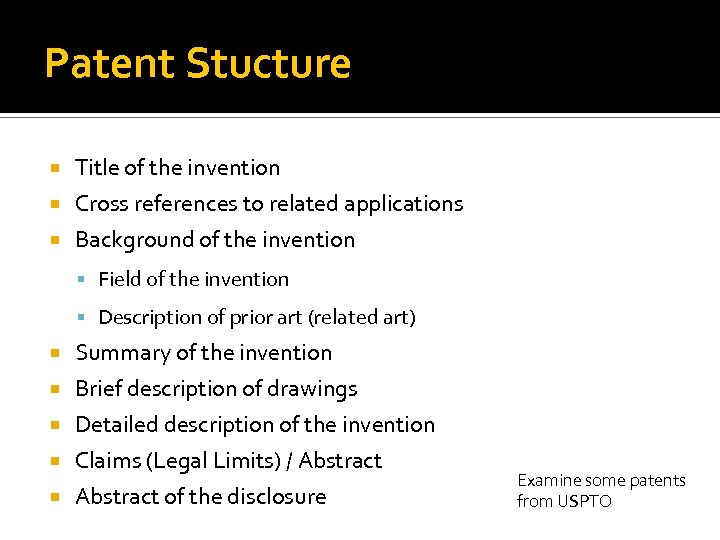 Patent Stucture Title of the invention Cross references to related applications Background of the invention Field of the invention Description of prior art (related art) Summary of the invention Brief description of drawings Detailed description of the invention Claims (Legal Limits) / Abstract of the disclosure Examine some patents from USPTO
 INID Codes Internationally agreed Number for the Identification of Data A standardised system for identifying data Useful for understanding foreign patents See examples Look out for the INID codes on the patents
 U. S. Patent Classification Over 7 million patents have been registered with the USPTO They are classified according to the U. S. Patent Classification (http: //www. uspto. gov/go/classification/) There are ≈400 classes and ≈160, 000 subclasses in the USPC A patent may be cross-referenced into several classes/subclasses The USPC is dynamic and classes are constantly kept relevant with the progress of technology (“buggies” disappeared and “biotechnology” appeared)
 Information about the USPC is located in several PDF files: Overview of the USPC (2007) [link] Handbook of Classification (2005) [link] Class Number List [link] The notation of the USPC is simple: “ 570/206” means class 570, subclass 206 “ 570/206” is called the “classification code” or simply the “classification”
 International Patent Classification (IPC 8: January 1, 2006; IPC 7: January 1, 2000) Can be searched at http: //www. wipo. int/classifications/ipc 8/ Provided for by the Strasbourg Agreement (1971), which entered into force on October 7, 1975 Provides for a common (internationally uniform) classification for patents for invention Hierarchical classification system sections (A H), classes, subclasses and groups (main groups and subgroups). The sixth edition of the IPC consists of 8 sections, 118 classes, 624 subclasses and over 67, 000 groups
 Guide to the International Patent Classification (Eight Edition, 2006) is available online at link 1 or link 2
 IPC: Other Uses Serves as: an instrument for the orderly arrangement of patent documents in order to facilitate access to the technological and legal information contained therein; a basis for selective dissemination of information to all users of patent information; a basis for investigating the state of the art in given fields of technology; a basis for the preparation of industrial property statistics which in turn permit the assessment of technological development in various areas
 Patent Searching Patents are searched in one of five ways Each search method requires the searcher to approach the search in a slightly different way, depending on the objective of the search: Patentability search Infringement search Validity search Assignment search Maintenance fee search
 Patentability Search The objective is to learn what has been patented in the area of the concept A patentability search will not determine prior art The inventor hopes for a negative result (no patent on an identical invention found) It is conducted prior to filing to decide whether or not to file (filing is expensive) Scope is usually general to learn the state of the prior art in the general area of concern
 Infringement Search The objective is to determine if the claims infringe any other unexpired patent The infringement search seek to identify any overlaps in the claims The search is limited only to active patents It is also performed to determine whether some activity will infringe the claims of someone else’s patent
 Validity Search The objective is to determine if claims are valid (do they define a new invention or does the invention lack novelty) Reviews local and foreign patents in the search area and also the literature to determine if the concept has been disclosed before Most time consuming
 Assignment Search The objective is to determine the present owner of a patent (remember that patents can be bought & sold) All ownership transfers of patent rights must be registered with the PTO Beware of time lapse (it takes time for the transfer to be recorded)
 Maintenance Fee Search The objective is to determine if the fees have been paid, and the enforceability of the patent In USPTO, payments are due on the 4 th, 8 th, and 12 th year to keep the patent in force
 USPTO United States Patent and Trademark Office A part of the United States Department of Commerce Presently based in Alexandria, Virginia (near Washington D. C. ) Established by Congress to grant patents and trademarks on behalf of the federal government Examine patent and trademark applications Determine whether applicants are entitled to patents and trademarks Maintain records of issued patents and trademarks
 Creating a working system of patents and copyrights was a top priority for George Washington In his first State of the Union message, delivered on January 8, 1790, he recommended that Congress enact legislation to encourage the introduction of new inventions from abroad and foster their creation domestically Congress acted quickly, and the president signed the first Patent Act into law on April 10, 1790, and the first Copyright Act less than two months later, on May 31, 1790
 The Patent Act made the issuance of a patent a matter of the highest importance a function administered by the president and three senior cabinet officers There was no patent office A petition was submitted directly to Secretary of State Thomas Jefferson Then Secretary of War Henry Knox and Attorney General Edmund Randolph reviewed it These three people constituted a patent board
 They established strict rules for obtaining a patent, and on the last Saturday of every month, they met to review applications If two of the three approved, a patent letter was prepared for the personal signature of President Washington, who then sent it back to Jefferson who, as secretary of state, also signed the letter and then had the Great Seal of the United States affixed The patentee then had a fourteen-year period during which to exclude others from using the creation
 The total cost was approximately $5 Soon, the workload became unmanageable by 1793, only 53 patents had been issued and 114 applications were pending Eventually, Congress enacted the Patent Act of 1793 Congress now allowed inventors to register their inventions with the State Department without examination The whole process became very lenient and between 1793 and 1836, when the patent law were next altered, more than 9, 500 patents were issued
 Anarchy ruled and often the same idea was patented multiple times!
 IPOS Intellectual Property Office of Singapore Department under the Ministry of Law Responsible for the administration of the Trade Marks Act(Cap. 332, 1999 Edn) and the Patents Act (Cap. 221) Receiving office for international applications for patents filed under the Patent Cooperation Treaty Responsible for processing trade mark and patent applications and determining the outcome of such applications. It also deals with post-grant actions such as renewals and restoration Hear and adjudicate on infringement and revocation
 e. Patents http: //www. epatents. gov. sg/ To provide a one-stop information services infrastructure to deliver published patent information to the public via Internet To provide electronic payment facilities over the Internet for the services provided So far, filings and searches allowed Free registration; charges apply for some services Download “The Patents Journal: Singapore” in PDF from this site (January March 2008 only; warning large files)
 INPADOC INternational PAtent DOcumentation Center Contains the bibliographic and family data of patent documents and utility models of 65 patent issuing organizations including the European Patent Office and the World Intellectual Property Organization
 Patent Searching using the Internet U. S. : http: //www. uspto. gov/ Singapore: http: //www. epatents. gov. sg/ Delphion: http: //www. delphion. com/ Canadian: http: //cipo. gc. ca/ UK: http: //www. patent. gov. uk/ Japan: http: //www. jpo. go. jp/ Some useful links: Association of Patent Law Firms: http: //www. aplf. org/
 Recap: Patents Dual Purpose To protect the rights of the inventor Broader societal purpose: to promote the progress of technology (innovation) The patent law is directed to the public purposes of fostering technological progress, investment in research and development, capital formation, entrepreneurship, innovation, natural strength, and international competitiveness. Hilton Davis v. Warner-Jenkinson
 Problems … Numbers Patent 5, 373, 560, which was granted to Roger Schlafly on December 13, 1994 for two large prime numbers Life forms oil-eating bacterium Burkholderia cepacia patent was awarded to Ananda Chakrabarty in 1980 Transgenic animals Harvard [onco]mouse (transgenic mouse) patent was awarded in 1988 (US), 1992 (Europe), 1994 (Japan), 2000 (Canada) Surgical procedures
 Business-Method Patents (705, 707 & 709) #5, 960, 411: Amazon. com’s “ 1 -Click” patent (Amazon. com vs Barnes. And. Noble. com) #5, 794, 207: Priceline. com’s name your price patent (Priceline. com vs Microsoft) Open Market’s “online shopping cart” patents Software Patents (364 & 395 40, 000 patents) #5, 016, 009 & #4, 701, 745 Stac’s data compression patent Stac vs Microsoft Stac’s program was unlawfully included in Microsoft’s MS-DOS 6. 0
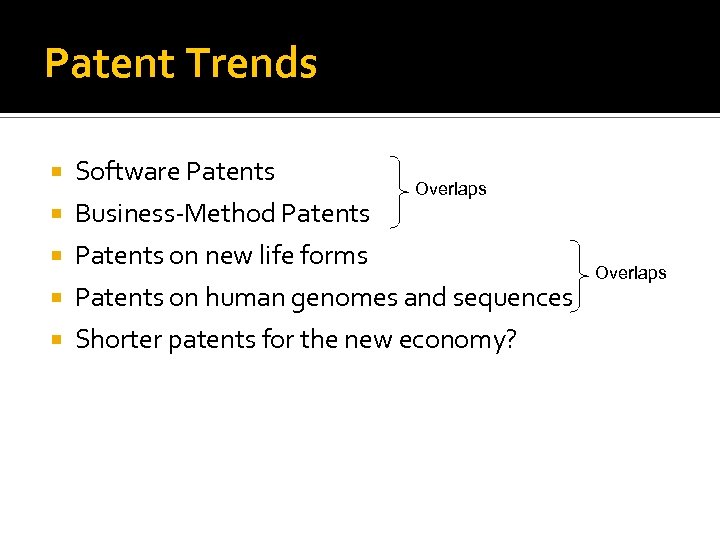 Patent Trends Software Patents Overlaps Business-Method Patents on new life forms Patents on human genomes and sequences Shorter patents for the new economy? Overlaps
 Software Patents cannot be granted to: scientific truths mathematical expressions of scientific truth 1970 s no patent if invention utilized a calculation made by a computer (they were mathematical algorithms, and not processes or machines) In 1996, the USPTO adopted its “Examination Guidelines for Computer-Related Inventions” to assist patent examiners in handling hardware and software related inventions
 Today numerous Most software patents are classified under classes 364 and 395 Amazon: 5960411 (1 -Click) & 6029141 Software patents may: prevent others from utilizing a certain algorithm (such as the GIF image compression algorithm) without permission
 prevent others from creating software programs that perform a function in a certain way (such as Compton’s withdrawn patent that allegedly prevented all others from performing certain types of multimedia database queries) Major Cases: Stac Electronics v. Microsoft Corp. $120 million patent victory over Microsoft in 1996 Amazon v. Barnes & Noble (1 -Click) Priceline. com v. Microsoft (name-your-own-price)
 Software Patents: A Major Problem Finding software prior art is a particularly difficult task For other types of inventions, patent examiners can review previously issued patents BUT most software inventions were unpatented Most software technology has traditionally been held as a trade secret or published in non-patent publications Patent examiners do not have ready access to such technology in trying to evaluate the patentability of a software-related invention disclosed in a patent application
 Patent examiners who rely on previous patents for prior art end up missing most of the preexisting software RESULT: “bad patents” patents that would not have been issued had the examiner been able to find all of the prior art Two developments from this: League for Programming Freedom called for the abolition of patents for software-related technologies their argument is that software is different
 Bernard Galler (University of Michigan) formed the Software Patent Institute (SPI), which attempts to make more software prior art available to patent examiners Created and made available to USPTO and the public courses and its Database of Software Technologies (free), particularly non-patented techniques Database contains “folklore” of the computing industry
 Business Method Patents Business methods, e. g. “frequent-flier miles”, “order upsizing”, were in the past, considered ideas, and therefore, not patentable However, the new economy has technology companies whose primary, or only, assets are their ideas! Protecting these ideas is essential for their survival Patenting intangibles, e. g. , a way of doing things, to prevent competitors from doing business in the same way [and in doing so, erecting a barrier to market entry for potential competitors]
 1980: U. S. Supreme Court stated “anything under the sun that is made by man” can be patented 1998: floodgates were opened when USPTO granted the Signature Financial Group a patent on a method of managing mutual funds Today: this is the fastest growing category of patents
 Patents for New Life Forms Techniques of genetic modification now allows novel characteristics/traits to be introduced into living organisms Harvard Mouse (Oncomouse): a mouse which is genetically predisposed to cancer Microorganism capable of cleaning oil spills Growth hormone gene inserted into pigs to accelerate growth Moral issues? “Man playing God? ” largely unresolved! Ethical issues?
 Patents: International Differences Attempts have been made to harmonize patent law and practice internationally However, major differences exist: disclosure before filing vs. disclosure after filing date of patent application (first to file) vs. date of invention (first to invent) inventions only vs. inventions + discoveries
 Patent Information Users Group (PIUG) An international not-for-profit organization for individuals having a professional, scientific or technical interest in patent information Aims to: encourage the development of patent information research and analysis systems further develop members’ patent research and analysis skills, and provide appropriate recognition for its members excelling in the field promote and improve the retrieval, analysis and dissemination of patent information
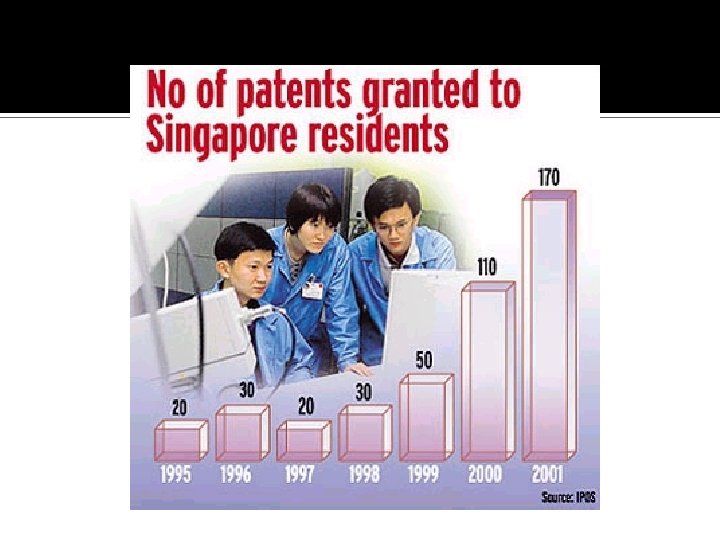
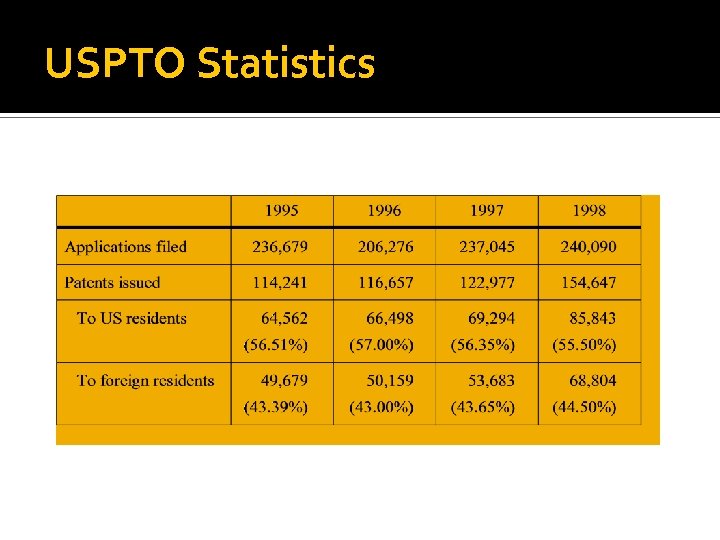 USPTO Statistics
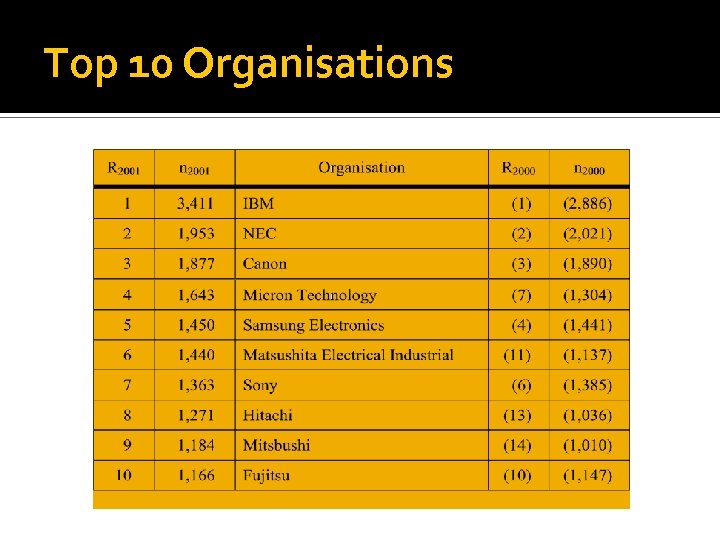 Top 10 Organisations
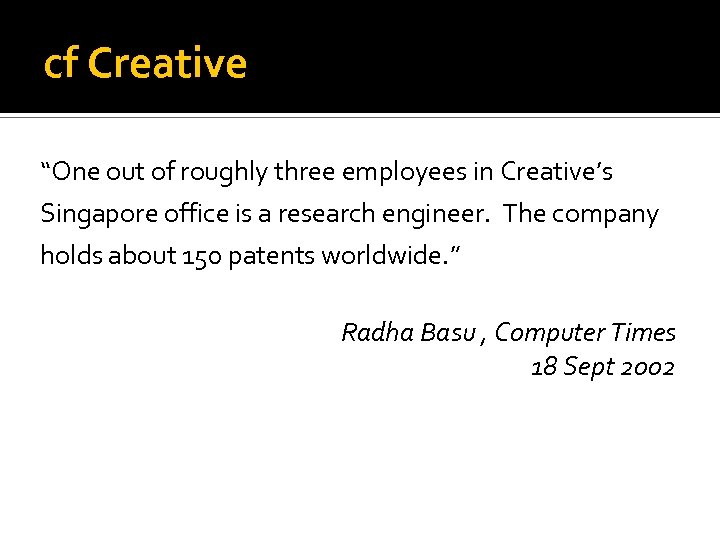 cf Creative “One out of roughly three employees in Creative’s Singapore office is a research engineer. The company holds about 150 patents worldwide. ” Radha Basu , Computer Times 18 Sept 2002
 The Story of the Selden Patent
 George Selden a cunning patent lawyer (he was George Eastman’s first patent lawyer) and an amateur inventor Selden invented a vehicle in May 1878, but could not get it to run for more than 5 minutes He filed his application for a patent in the spring of 1879 At that time, an inventor was allowed two years to complete his application in complete secrecy Selden employed “delay tactics” for 16½ years, by filing a series of amendments and continuations
 His amendments incorporated later advances in automotive technology made by others Selden timed the final acceptance of his patent (No. 549, 160) just as the gasoline car was gaining popularity November 5, 1895 The Electric Vehicle Company (William Whitney and Colonel Albert Pope) bought the patent on November 4, 1899 They used it to demand a royalty on every gasoline car made in America, and Selden stood to gain $15 for every car made
 The outcome was an alliance between ten automobile manufacturers to exploit the patent and control entry into the auto industry (barrier to entry created) for the life of the patent (up to November 1912) They formed the Association of Licensed Automobile Manufacturers (ALAM) in March 1903 This was bad timing for Henry Ford as the Ford Motor Company was incorporated on June 16, 1903 Automobile manufacturers who were granted a license under the patent paid 1. 25% royalty on every car sold
 The intent of the patent was to ruin small automobile manufacturers Ford was defiant and continued to manufacture and cars ALAM installed brass tags in all ALAM cars and engaged spies to inspect parked cars Oral presentations started in the New York District Court on May 28, 1909 A transcontinental race was arranged, but there was a no show from the Selden party
 On September 15, 1909, it was found for the monopoly on the grounds that while Selden did NOT invent the different components that made up his car, he was the inventor of the ensemble William Crapo Durant (of General Motors) gave in and paid back royalties of ~$1 million Unlicensed car manufacturers clamoured to gain membership into ALAM Ford stood his ground, and refused to join ALAM The appeal started on November 22, 1910
 This time, the verdict was in Ford’s favour Judge Noyes wrote that Senden’s patent had contributed nothing of social value and that Selden’s 1879 patent did not cover any novel combination of elements Ford was congratulated for his courage and tenacity in fighting the case, while all the other companies caved in to the demands of ALAM
 Unisys GIF Patent Unisys owns the patent on the compression scheme used in the GIF file format In 1994, Unisys decided to begin charging developers a licensing fee for using the GIF file format This resulted in a backlash of harsh opposition from developers and users who felt Unisys had acted unfairly Later, Unisys tried to charge webmasters $5, 000 if their website used one or more GIF images Users began to use the Portable Network Graphic (PNG) format, created largely in response to the Unisys patent fiasco
 Eolas ‘ 906 Patent In 2003, Microsoft was ordered to pay $520. 6 million for allegedly infringing U. S. patent number 5, 838, 906 issued to the University of California, which formed a company named Eolas to handle the licensing (it rose to $565. 9 million when interest was added) This patent covers the technology used by browsers to automatically launch the appropriate applet or plug-in to display embedded content, such as Flash animations, within a hypermedia document When Eolas won the case, the World Wide Web Consortium (W 3 c) asked for a review of the patent
 The W 3 c provided evidence that the Eolas patent was based on prior art, and therefore should be overturned (Director of the W 3 C, Tim Bernes-Lee personally wrote the letter see) It further highlighted the fact that enforcing this patent could cause “substantial economic and technical damage to the operation of the World Wide Web” On September 27, 2005, the USPTO reviewed and reaffirmed the patent owned by the University of California and licensed exclusively to Eolas Technologies
 Cipro Patent During the anthrax scare (threat of bioterrorism), the Bush administration threatened to revoke patent on ciprofloxacin (Cipro), held by Bayer, unless it cut its price (halved to 95¢) The Canadian government did just that, and ordered a million tablets of a generic version from a Canadian company, Apotex Inc. Days later, the Canadian government made a turnabout It announced that it had rescinded its agreement with Apotex and that it was offering compensation to the company
 References: Patents Burlingame, R. (1955). Henry Ford: A great life in brief. New York: Alfred A. Knopf. Canby, T. Y. (1978). Aluminum, the magic metal. National Geographic, 154(2), 186 211. Choate, P. (2005). Hot property: The stealing of ideas in an age of globalization. New York: Alfred A. Knopf. Evans, H. (2004). They made America. New York: Little, Brown and Company. (p. 40 48) Garfinkel, S. L. , Stallman, R. M. , & Kapor, M. (1991). Why patents are bad for software. Issues in Science and Technology, 50 55. Gandal, N. (2002). A first look at Internet Business Methods patents, Science, Technology and the Economy Program (Working Papers Series STE -WP-12). Technion City, Israel: Samuel Neaman Institute.
![Gleick, J. (2000). Patently Absurd. [link] Gordon, T. T. , & Cookfair, A.](https://present5.com/presentation/d24f6f9c75e1257b95c68c4daa586112/image-174.jpg "Gleick, J. (2000). Patently Absurd. [link] Gordon, T. T. , & Cookfair, A.") Gleick, J. (2000). Patently Absurd. [link] Gordon, T. T. , & Cookfair, A. S. (2000). Patent fundamentals for scientists and engineers (2 nd ed. ). Boca Raton, FL: Lewis Publishers. Ikenson, B. (2004). Patents: Ingenious inventions. New York: Black Dog & Leventhal Publishers. Jefferson, T. (1813). Letter to Isaac Mc. Pherson, 13 August 1813. [link] League for Programming Freedom. (1991). Against Software Patents. [link] Sandonato, M. P. , Valdivia, A. , & Grodin, A. (2002). Software and Business -Method Patents: A decade in review. The Patent Journal.
Gleick, J. (2000). Patently Absurd. [link] Gordon, T. T. , & Cookfair, A. S. (2000). Patent fundamentals for scientists and engineers (2 nd ed. ). Boca Raton, FL: Lewis Publishers. Ikenson, B. (2004). Patents: Ingenious inventions. New York: Black Dog & Leventhal Publishers. Jefferson, T. (1813). Letter to Isaac Mc. Pherson, 13 August 1813. [link] League for Programming Freedom. (1991). Against Software Patents. [link] Sandonato, M. P. , Valdivia, A. , & Grodin, A. (2002). Software and Business -Method Patents: A decade in review. The Patent Journal.