 Скачать презентацию Lecturer: Prof. Alexander Kostyuk, DBA, Ph. D Editor-in-Chief,
Lecture_1.ppt
- Количество слайдов: 20



Lecturer: Prof. Alexander Kostyuk, DBA, Ph. D Editor-in-Chief, Corporate Ownership & Control journal
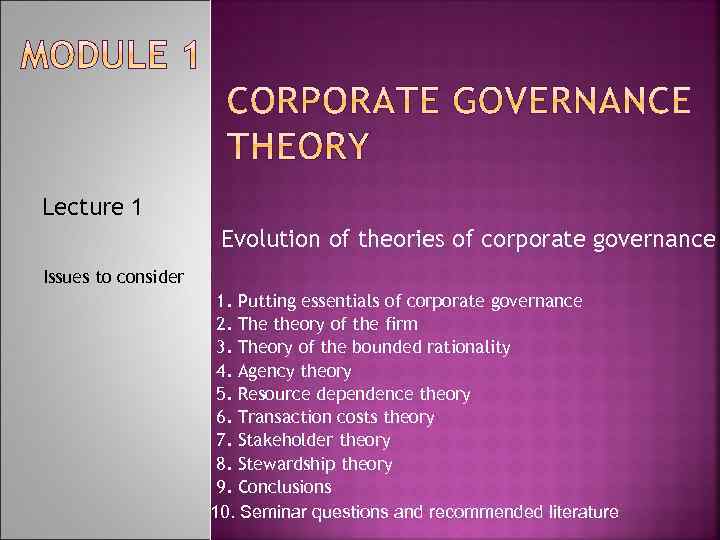
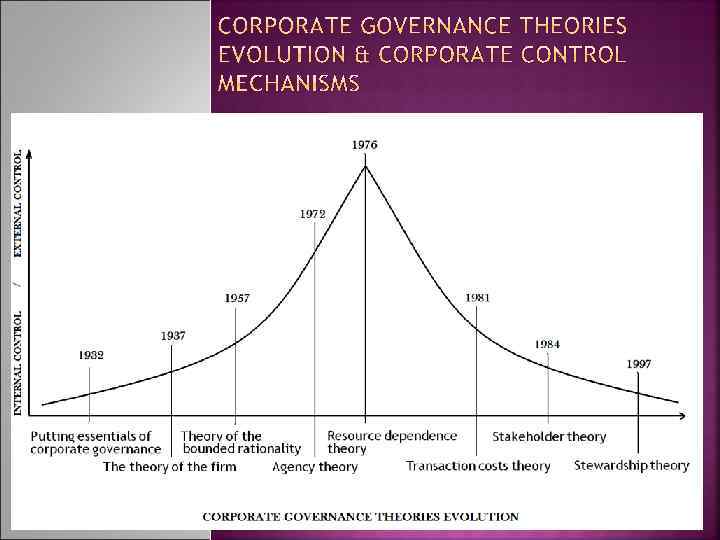
Lecture 1 Evolution of theories of corporate governance Issues to consider 1. Putting essentials of corporate governance 2. The theory of the firm 3. Theory of the bounded rationality 4. Agency theory 5. Resource dependence theory 6. Transaction costs theory 7. Stakeholder theory 8. Stewardship theory 9. Conclusions 10. Seminar questions and recommended literature
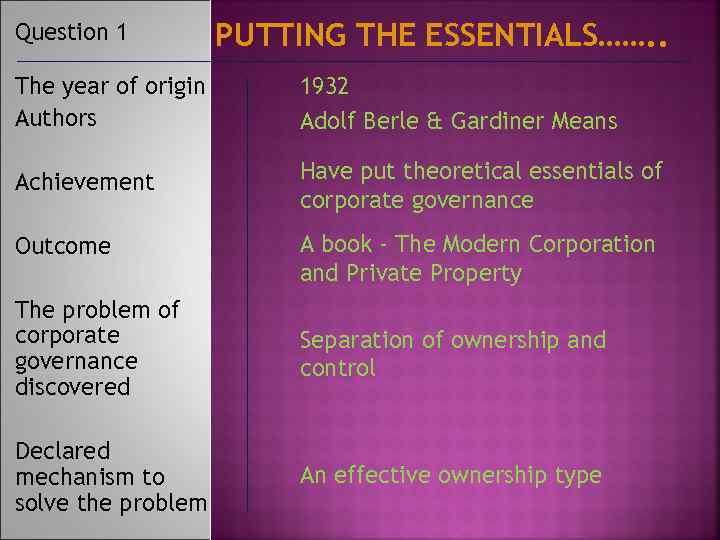
Question 1 PUTTING THE ESSENTIALS……. . The year of origin Authors 1932 Adolf Berle & Gardiner Means Achievement Have put theoretical essentials of corporate governance Outcome A book - The Modern Corporation and Private Property The problem of corporate governance discovered Separation of ownership and control Declared mechanism to solve the problem An effective ownership type
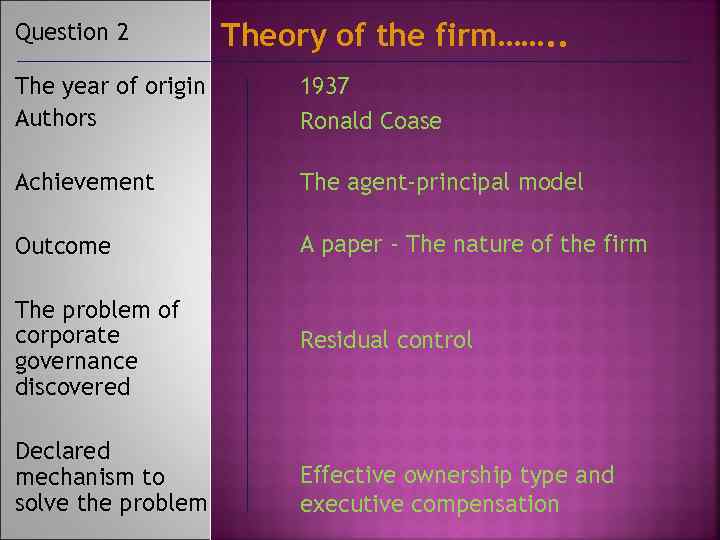
Question 2 Theory of the firm……. . The year of origin Authors 1937 Ronald Coase Achievement The agent-principal model Outcome A paper - The nature of the firm The problem of corporate governance discovered Residual control Declared mechanism to solve the problem Effective ownership type and executive compensation
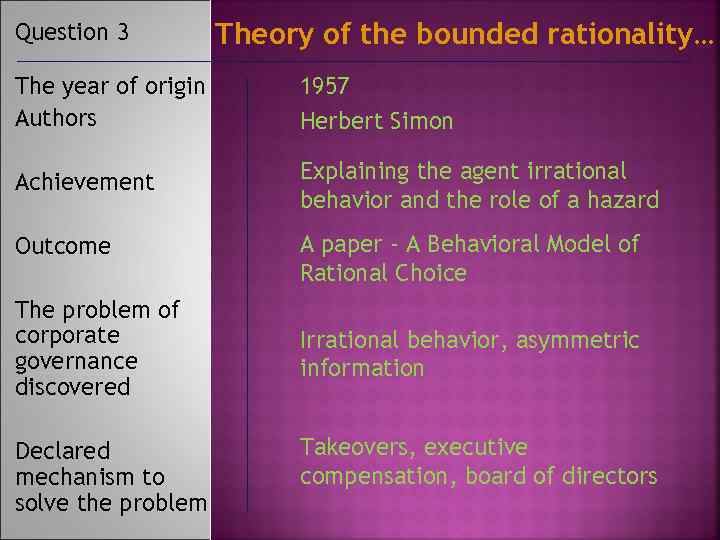
Question 3 Theory of the bounded rationality… The year of origin Authors 1957 Herbert Simon Achievement Explaining the agent irrational behavior and the role of a hazard Outcome A paper - A Behavioral Model of Rational Choice The problem of corporate governance discovered Declared mechanism to solve the problem Irrational behavior, asymmetric information Takeovers, executive compensation, board of directors
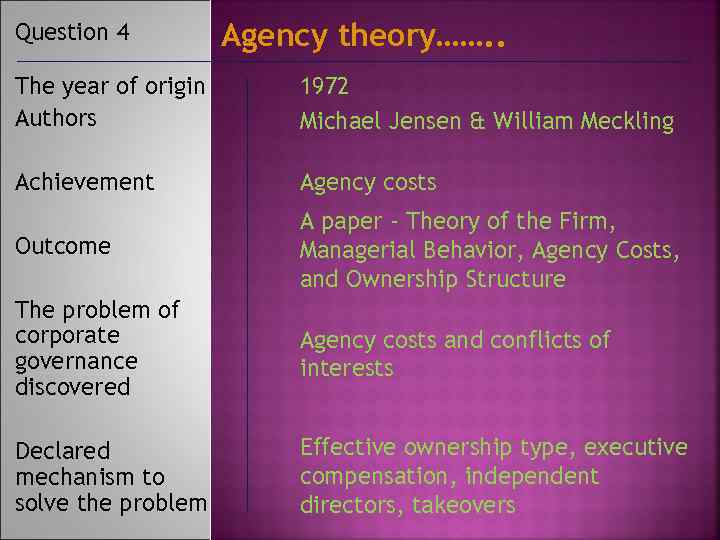
Question 4 Agency theory……. . The year of origin Authors 1972 Michael Jensen & William Meckling Achievement Agency costs Outcome A paper - Theory of the Firm, Managerial Behavior, Agency Costs, and Ownership Structure The problem of corporate governance discovered Agency costs and conflicts of interests Declared mechanism to solve the problem Effective ownership type, executive compensation, independent directors, takeovers
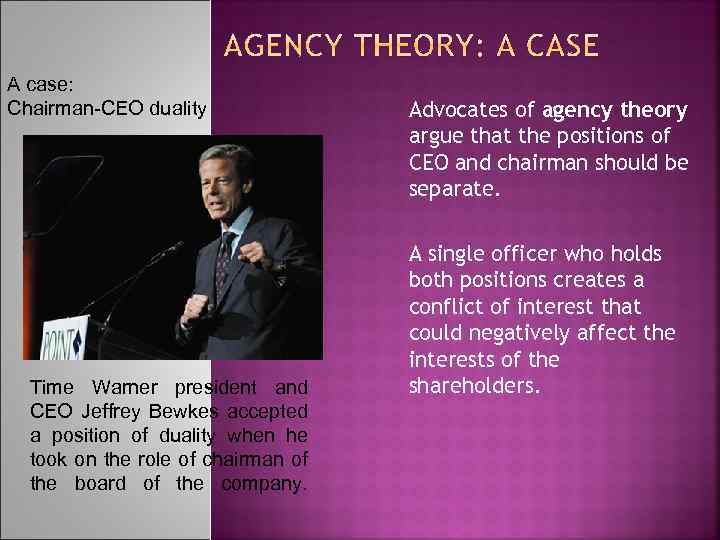
A case: Chairman-CEO duality Time Warner president and CEO Jeffrey Bewkes accepted a position of duality when he took on the role of chairman of the board of the company. Advocates of agency theory argue that the positions of CEO and chairman should be separate. A single officer who holds both positions creates a conflict of interest that could negatively affect the interests of the shareholders.
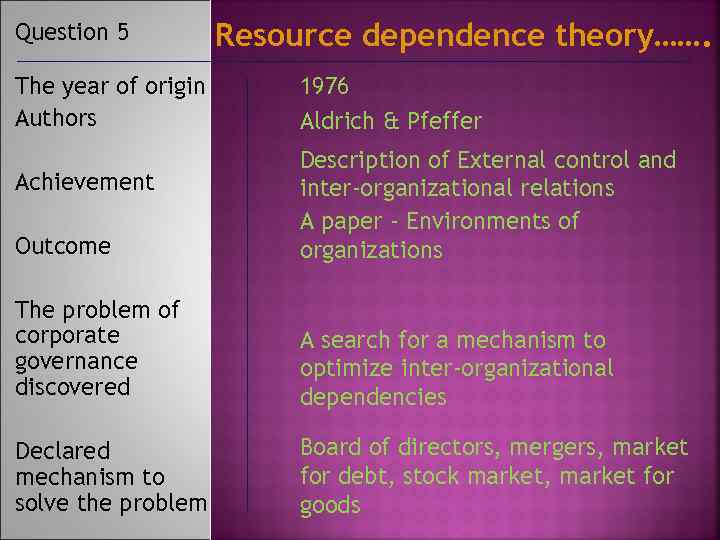
Question 5 The year of origin Authors Resource dependence theory……. 1976 Aldrich & Pfeffer Outcome Description of External control and inter-organizational relations A paper - Environments of organizations The problem of corporate governance discovered A search for a mechanism to optimize inter-organizational dependencies Declared mechanism to solve the problem Board of directors, mergers, market for debt, stock market, market for goods Achievement
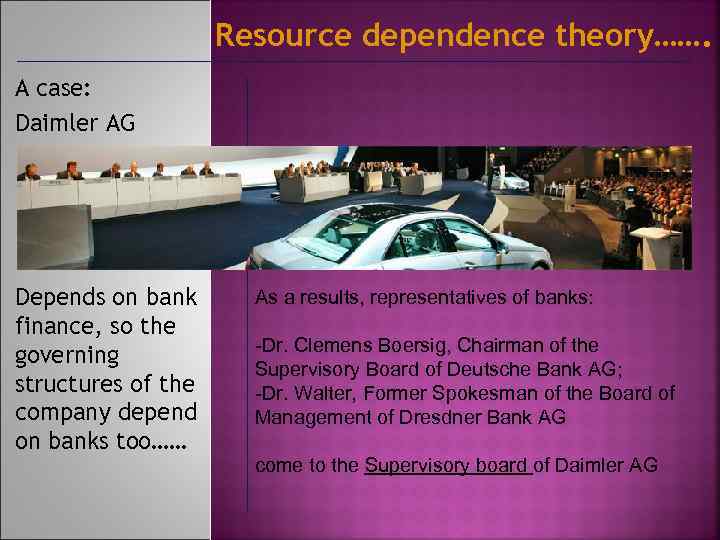
Resource dependence theory……. A case: Daimler AG Depends on bank finance, so the governing structures of the company depend on banks too…… As a results, representatives of banks: -Dr. Clemens Boersig, Chairman of the Supervisory Board of Deutsche Bank AG; -Dr. Walter, Former Spokesman of the Board of Management of Dresdner Bank AG come to the Supervisory board of Daimler AG
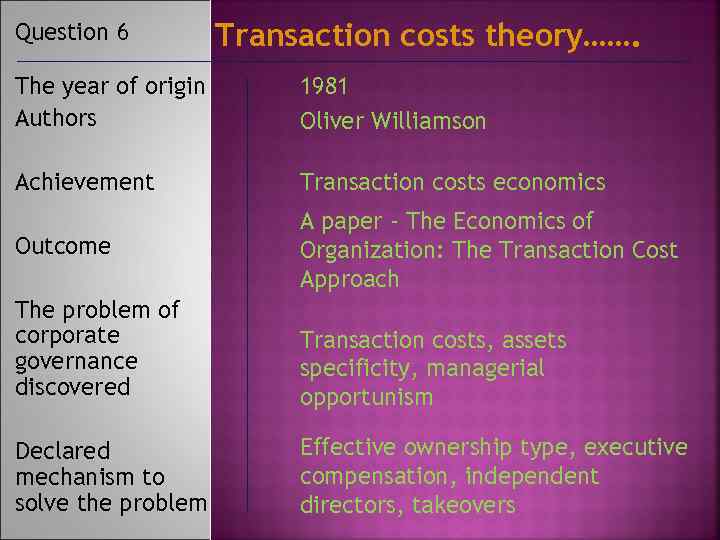
Question 6 Transaction costs theory……. The year of origin Authors 1981 Oliver Williamson Achievement Transaction costs economics Outcome A paper - The Economics of Organization: The Transaction Cost Approach The problem of corporate governance discovered Transaction costs, assets specificity, managerial opportunism Declared mechanism to solve the problem Effective ownership type, executive compensation, independent directors, takeovers
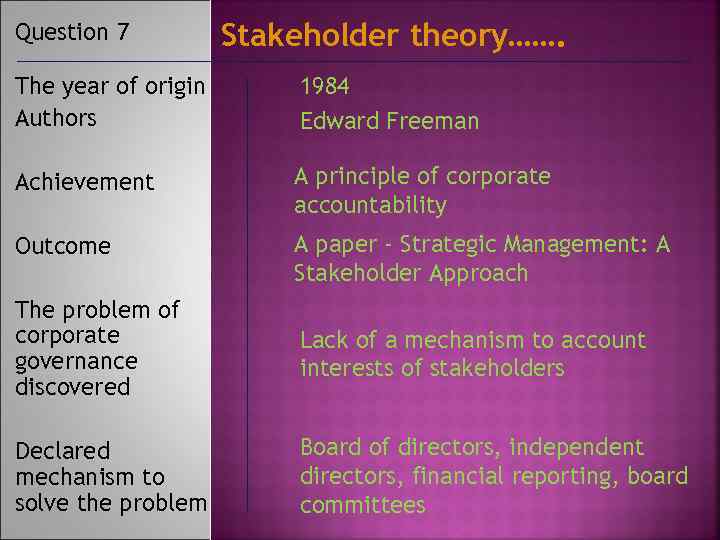
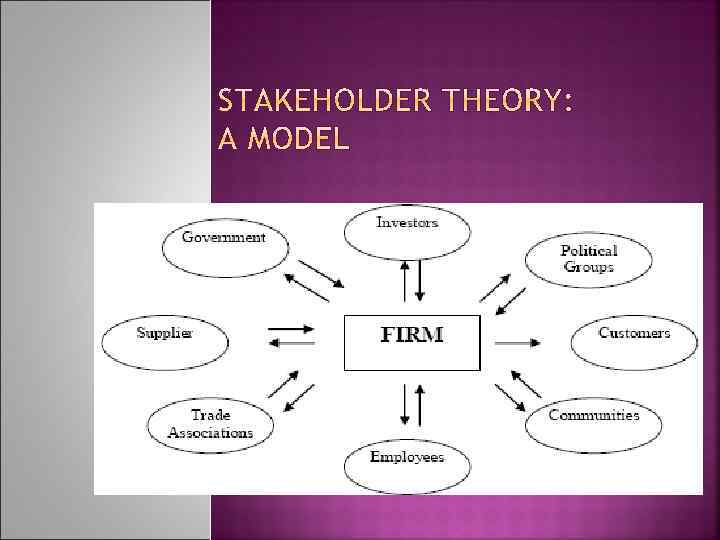
Question 7 Stakeholder theory……. The year of origin Authors 1984 Edward Freeman Achievement A principle of corporate accountability Outcome A paper - Strategic Management: A Stakeholder Approach The problem of corporate governance discovered Lack of a mechanism to account interests of stakeholders Declared mechanism to solve the problem Board of directors, independent directors, financial reporting, board committees
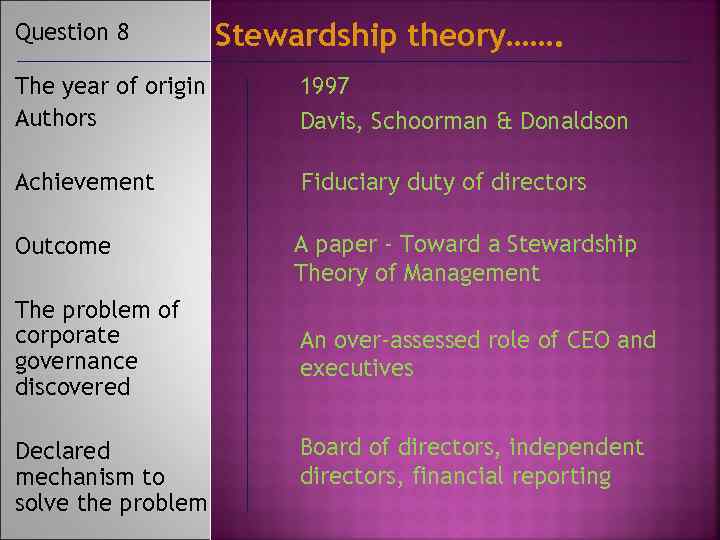
Question 8 Stewardship theory……. The year of origin Authors 1997 Davis, Schoorman & Donaldson Achievement Fiduciary duty of directors Outcome The problem of corporate governance discovered Declared mechanism to solve the problem A paper - Toward a Stewardship Theory of Management An over-assessed role of CEO and executives Board of directors, independent directors, financial reporting
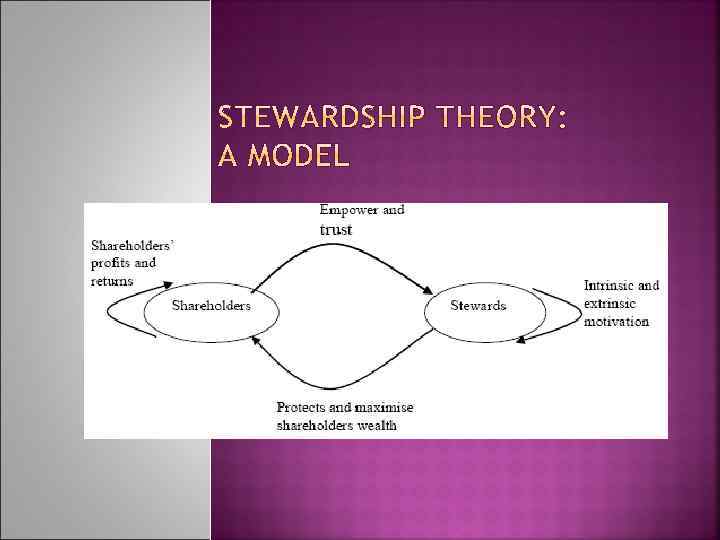

Stewardship theory……. A case: Enron bankruptcy Enron is blamed in financial fraud and auditing crimes (2001 -2002) A reason: lack of independent directors on the board Fiduciary duty of directors are failed by CEO and executive directors So, the best stewards for the company are independent directors

VIDEO INTERVIEW

So, we have come to the roots. Essentials by Berle & Means are supported nowdays and embodied in the internal control mechanisms like board of directors, board committees, independent directors, executive directors and…. CEOs who are under academic and society critics now.
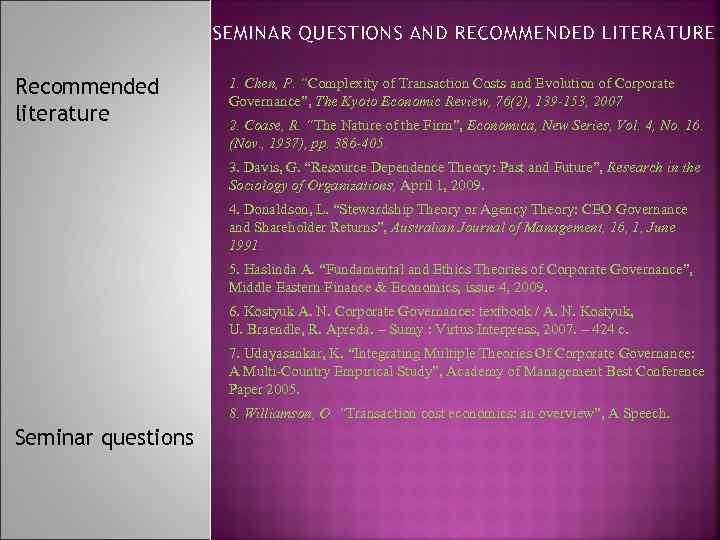
SEMINAR QUESTIONS AND RECOMMENDED LITERATURE Recommended literature 1. Chen, P. “Complexity of Transaction Costs and Evolution of Corporate Governance”, The Kyoto Economic Review, 76(2), 139 -153, 2007 2. Coase, R. “The Nature of the Firm”, Economica, New Series, Vol. 4, No. 16. (Nov. , 1937), pp. 386 -405. 3. Davis, G. “Resource Dependence Theory: Past and Future”, Research in the Sociology of Organizations, April 1, 2009. 4. Donaldson, L. “Stewardship Theory or Agency Theory: CEO Governance and Shareholder Returns”, Australian Journal of Management, 16, 1, June 1991. 5. Haslinda A. “Fundamental and Ethics Theories of Corporate Governance”, Middle Eastern Finance & Economics, issue 4, 2009. 6. Kostyuk A. N. Corporate Governance: textbook / A. N. Kostyuk, U. Braendle, R. Apreda. – Sumy : Virtus Interpress, 2007. – 424 c. 7. Udayasankar, K. “Integrating Multiple Theories Of Corporate Governance: A Multi-Country Empirical Study”, Academy of Management Best Conference Paper 2005. 8. Williamson, O. “Transaction cost economics: an overview”, A Speech. Seminar questions
Скачать презентацию Lecturer: Prof. Alexander Kostyuk, DBA, Ph. D Editor-in-Chief,
Lecture_1.ppt