


 Скачать презентацию LECTURE Theme Using internet — resources in teaching
lecture.pptx
- Количество слайдов: 14
 LECTURE Theme: Using internet - resources in teaching foreign language
 Plan 1. 2. 3. 4. 5. 6. Technology and Foreign Language Education What is the Internet? The Internet and Electronic Mail The Internet as a Teaching and Learning Tool Didactic meaning of the Internet Implications and Conclusion
 Technology and Foreign Language Education The Internet is the latest in a series of technological innovations for second language education. In order to understand the role of the Internet, it would be useful to provide a brief history of technology and language teaching, present a survey of the technological resources available to second language learners, and, finally consider the role of the Internet and its possibilities.
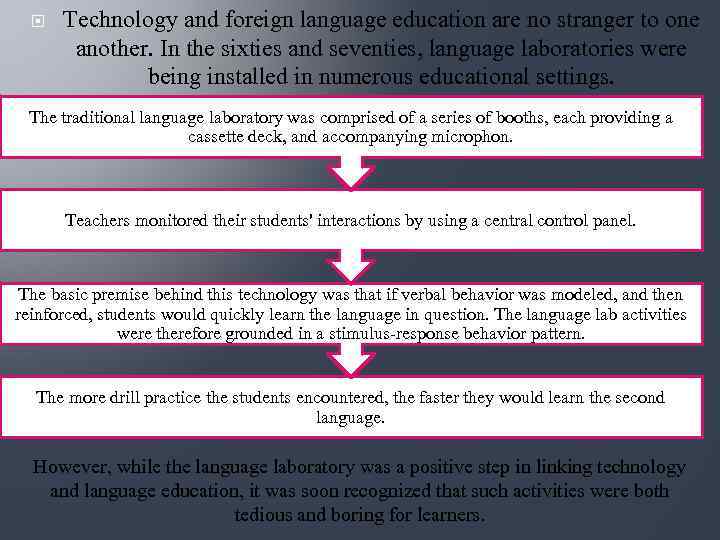 Technology and foreign language education are no stranger to one another. In the sixties and seventies, language laboratories were being installed in numerous educational settings. The traditional language laboratory was comprised of a series of booths, each providing a cassette deck, and accompanying microphon. Teachers monitored their students' interactions by using a central control panel. The basic premise behind this technology was that if verbal behavior was modeled, and then reinforced, students would quickly learn the language in question. The language lab activities were therefore grounded in a stimulus-response behavior pattern. The more drill practice the students encountered, the faster they would learn the second language. However, while the language laboratory was a positive step in linking technology and language education, it was soon recognized that such activities were both tedious and boring for learners.
 What is the Internet? While the computer is now used in some form or another in most language classrooms, and is considered standard equipment, the Internet is also gradually being introduced in the second language classroom as teachers become more familiar with it. The Internet is a confederation of thousands of computers from various sectors of society such as education, business, government and the military. It is a network of thousands of computer networks (Lewis, 1994). For example, the Internet can be accessed from an IBM computer in a student's home in Australia, or from a Macintosh computer at a school in Canada. It can therefore be conceived of as the equivalent of a telephone system for computers. It can be used to both exchange information through electronic mail, newsgroups, list serves, professional on-line discussion groups, and so forth, as well as to retrieve information on a variety of topics through the World Wide Web.
 The Internet and Electronic Mail The Internet has been used by some language instructors in creative ways - one of these innovations being use of electronic mail (e-mail), a specific feature of the Internet. Overall, e-mail can encourage students to use computers in realistic, authentic situations in order to develop communicative, and thinking skills. E-mail is easy to use and even teachers intimidated by computers can quickly become adept at using e-mail with their students. Furthermore, even timid or inhibited students can benefit from the meaningful interaction and communication e-mail makes possible.
 Chat rooms can also be carried out through e-mail. In this situation, two or more individuals can "talk" on-line about various topics or issues. For instance, language learners can be paired up and can be given a debatable topic to discuss. Such experiences, once again stimulate authentic communication and assist students in developing specific communication skills such as arguing, persuading, or defending a particular point. List serves from around the world can offer news and discussion groups in the target language providing another source of authentic input and interaction.
 E-mail can also be used to communicate long-distance with language learners in other schools, or other countries for that matter. A study exploring the potential of long-distance communication involving second language learners was carried out by Chang (1993). The goals of the study were to provide students with a real context for improving their writing, help them to expand their ideas of "content-area" reading and functional writing across cultural boundaries, make students familiar with international telecommunications, and investigate with students, the potential effects of telecommunications on literacy acquisition (Davis & Chang, 1994).
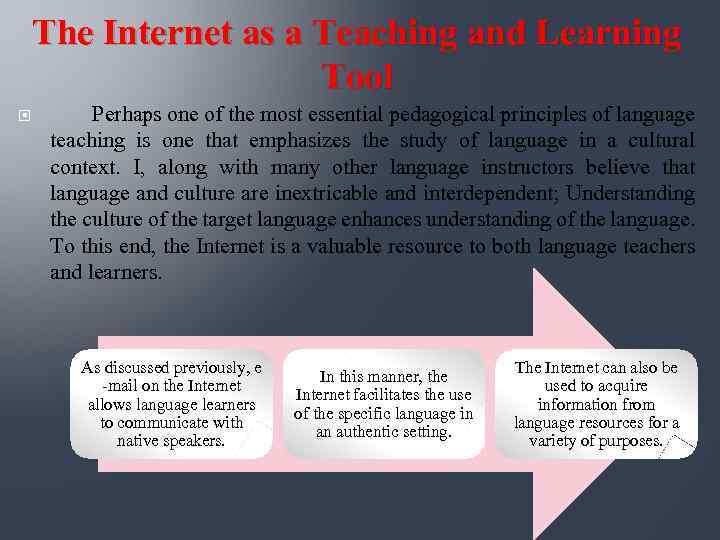 The Internet as a Teaching and Learning Tool Perhaps one of the most essential pedagogical principles of language teaching is one that emphasizes the study of language in a cultural context. I, along with many other language instructors believe that language and culture are inextricable and interdependent; Understanding the culture of the target language enhances understanding of the language. To this end, the Internet is a valuable resource to both language teachers and learners. As discussed previously, e -mail on the Internet allows language learners to communicate with native speakers. In this manner, the Internet facilitates the use of the specific language in an authentic setting. The Internet can also be used to acquire information from language resources for a variety of purposes.
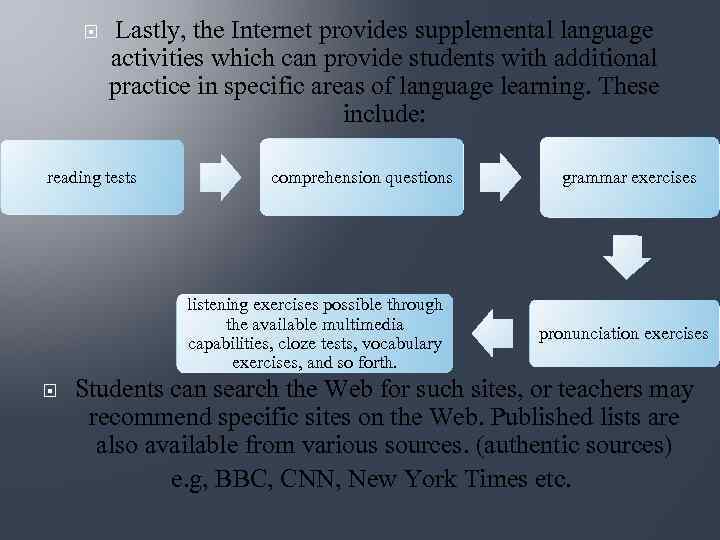 Lastly, the Internet provides supplemental language activities which can provide students with additional practice in specific areas of language learning. These include: reading tests comprehension questions listening exercises possible through the available multimedia capabilities, cloze tests, vocabulary exercises, and so forth. grammar exercises pronunciation exercises Students can search the Web for such sites, or teachers may recommend specific sites on the Web. Published lists are also available from various sources. (authentic sources) e. g, BBC, CNN, New York Times etc.
 Didactic meaning of the Internet In didactic meaning of the internet includes at least two major components: the forms of telecommunication and information resources. The most common forms of telecommunications (i. e communication via Internet technologies) include e-mail, chat, forum, ICQ, video, web conferencing, etc. They were originally created for real communication between people located in the distance from each other and only after that began to be used for educational purposes in learning a foreign language. Most students and teachers have intimate knowledge about many of these forms of Internet communication. In the scientific literature there a big number of researches on the use of various forms of telecommunications in learning a foreign language.
 Conclusion The more enthusiastic and more knowledgeable language teachers are, the more successfully they can implement Internet in the language classroom. For the language learner, the Internet offers a world of information available to students at the touch of a button. While it must be recognized that the Internet cannot replace the language classroom or the interaction between the language teacher and student, if offers a vast amount of information and lends itself to communication possibilities that can greatly enhance the language learning experience.
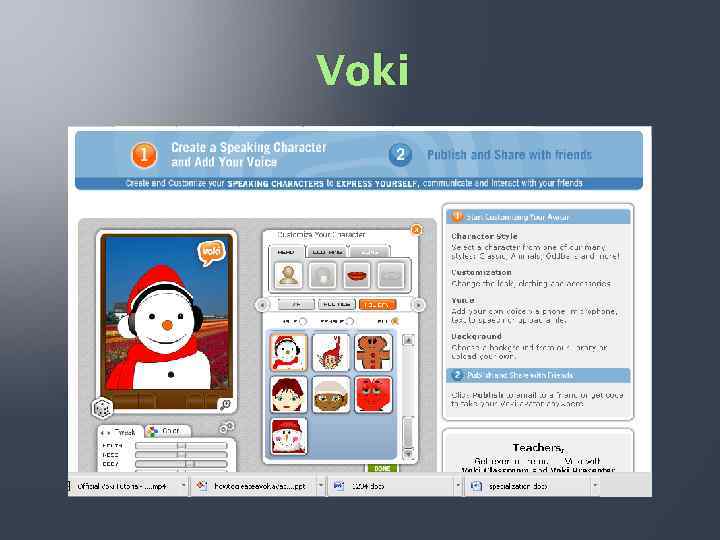
 Voki is an educational tool that allows users to create their very own talking character.
 Voki
Voki