


 Скачать презентацию Lecture slides from Ohio State Prof Anish Arora
84faf30d4d9a688d5f579ed672827189.ppt
- Количество слайдов: 12
 Lecture slides from Ohio State (Prof. Anish Arora) Wireless Sensor Networks for Habitat Monitoring Intel Research Lab EECS UC at Berkeley College of the Atlantic
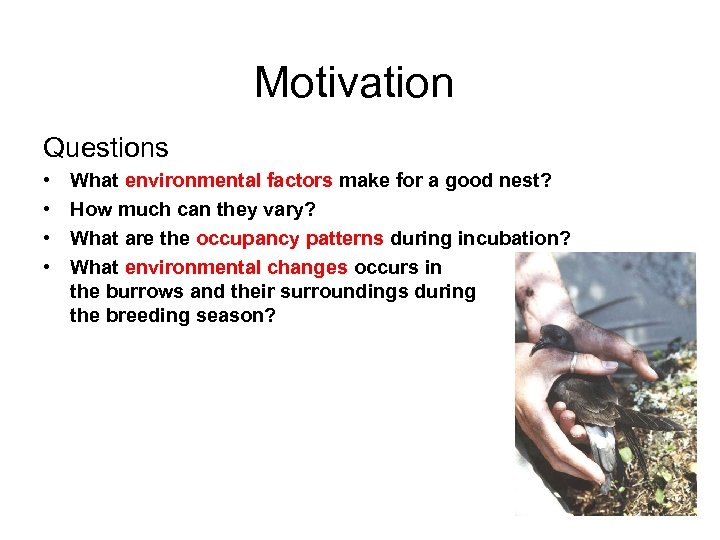 Motivation Questions • • What environmental factors make for a good nest? How much can they vary? What are the occupancy patterns during incubation? What environmental changes occurs in the burrows and their surroundings during the breeding season?
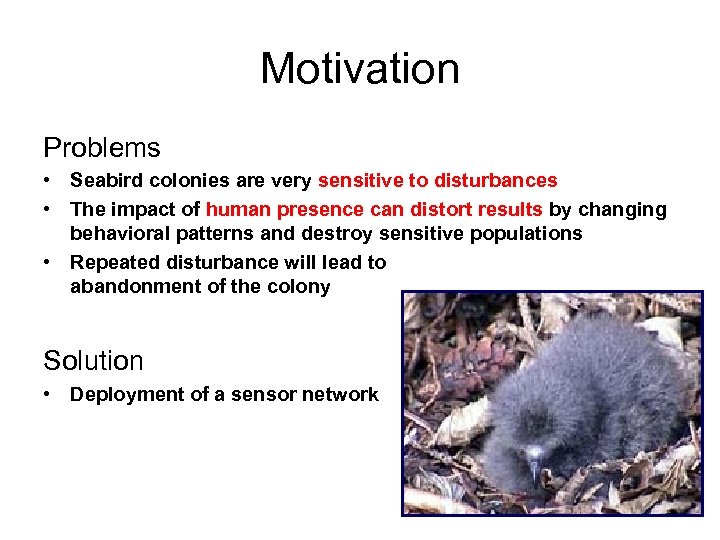 Motivation Problems • Seabird colonies are very sensitive to disturbances • The impact of human presence can distort results by changing behavioral patterns and destroy sensitive populations • Repeated disturbance will lead to abandonment of the colony Solution • Deployment of a sensor network
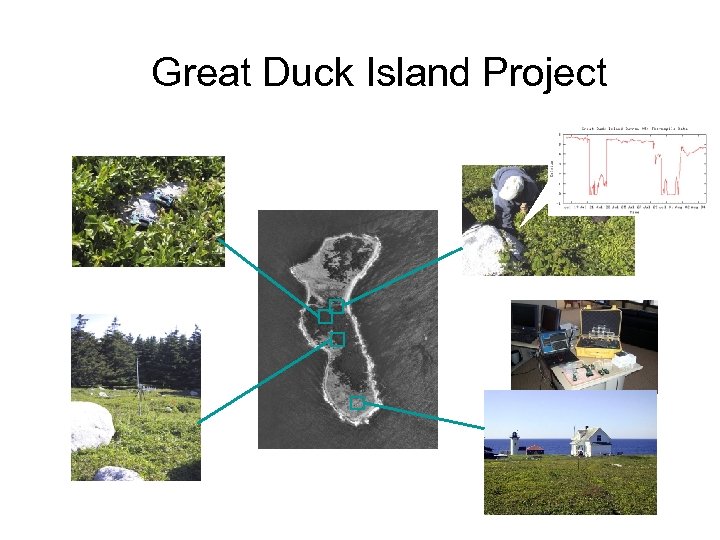 Great Duck Island Project
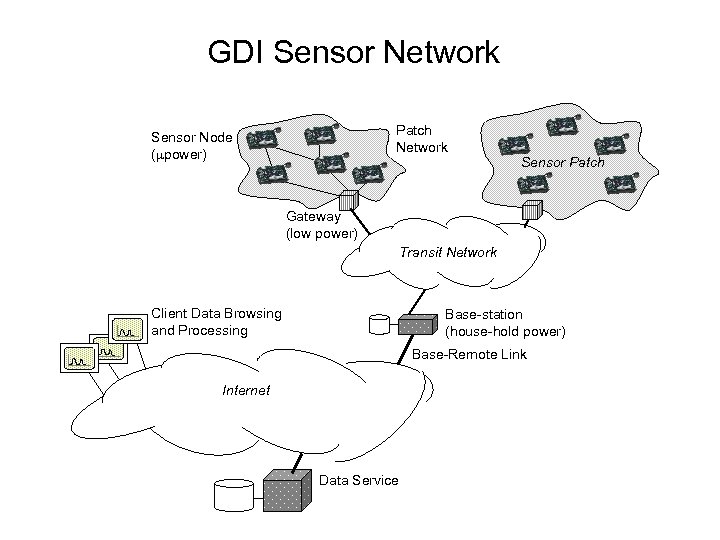 GDI Sensor Network Patch Network Sensor Node ( power) Sensor Patch Gateway (low power) Transit Network Client Data Browsing and Processing Base-station (house-hold power) Base-Remote Link Internet Data Service
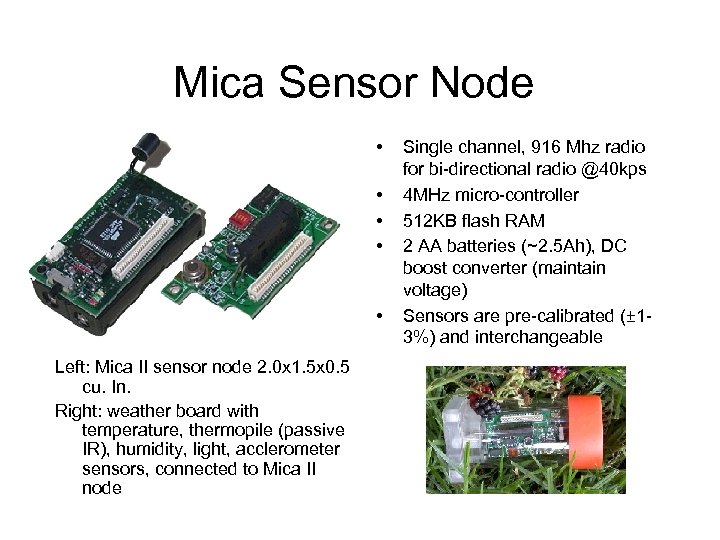 Mica Sensor Node • • • Left: Mica II sensor node 2. 0 x 1. 5 x 0. 5 cu. In. Right: weather board with temperature, thermopile (passive IR), humidity, light, acclerometer sensors, connected to Mica II node Single channel, 916 Mhz radio for bi-directional radio @40 kps 4 MHz micro-controller 512 KB flash RAM 2 AA batteries (~2. 5 Ah), DC boost converter (maintain voltage) Sensors are pre-calibrated (± 13%) and interchangeable
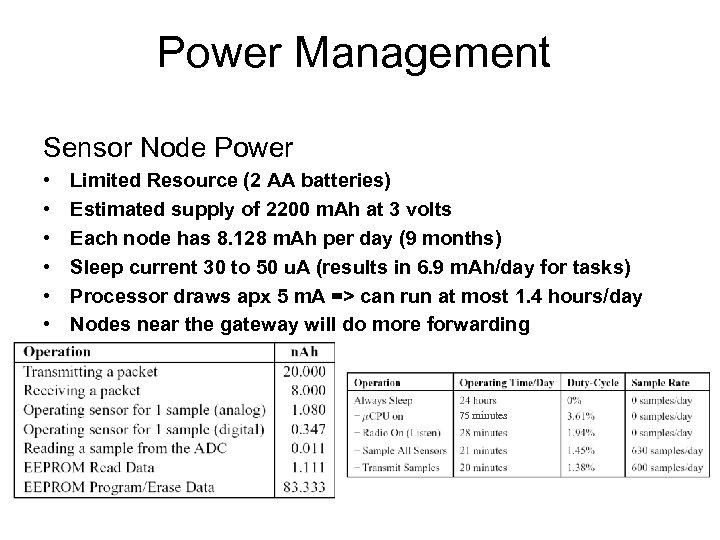 Power Management Sensor Node Power • • • Limited Resource (2 AA batteries) Estimated supply of 2200 m. Ah at 3 volts Each node has 8. 128 m. Ah per day (9 months) Sleep current 30 to 50 u. A (results in 6. 9 m. Ah/day for tasks) Processor draws apx 5 m. A => can run at most 1. 4 hours/day Nodes near the gateway will do more forwarding 75 minutes
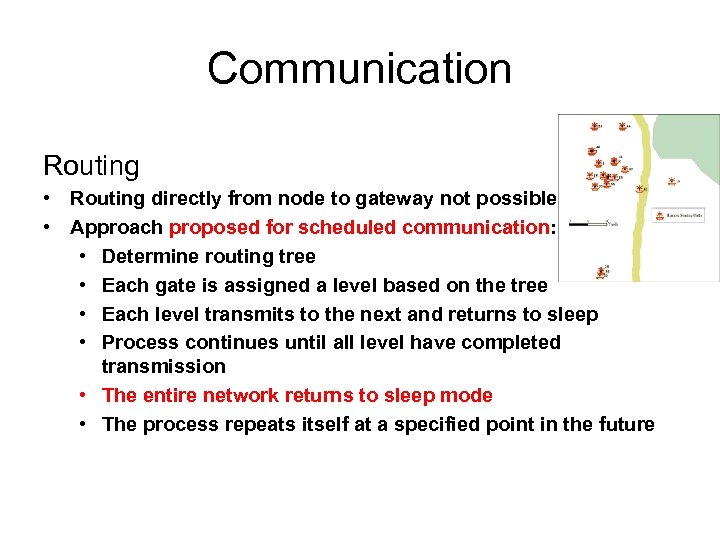 Communication Routing • Routing directly from node to gateway not possible • Approach proposed for scheduled communication: • Determine routing tree • Each gate is assigned a level based on the tree • Each level transmits to the next and returns to sleep • Process continues until all level have completed transmission • The entire network returns to sleep mode • The process repeats itself at a specified point in the future
 Network Re-tasking Initially collect absolute temperature readings • After initial interpretation, could be realized that information of interest is contained in significant temperature changes • Full reprogramming process is costly: • Transmission of 10 kbit of data • Reprogramming application: 2 minutes @ 10 m. A • Equals one complete days energy • Virtual Machine based retasking: • Only small parts of the code needs to be changed
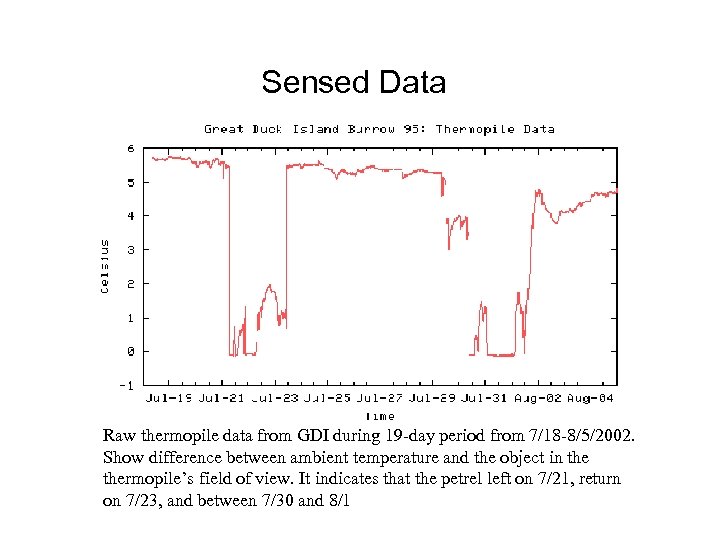 Sensed Data Raw thermopile data from GDI during 19 -day period from 7/18 -8/5/2002. Show difference between ambient temperature and the object in thermopile’s field of view. It indicates that the petrel left on 7/21, return on 7/23, and between 7/30 and 8/1
 Health and Status Monitoring • Monitor the mote’s health and the health of neighboring motes • Duty cycle can be dynamically adjusted to alter lifetime • Periodically include battery voltage level with sensor readings (0~3. 3 volts) • Can be used to infer the validity of the mote’s sensor readings
 Conclusion Paper conclusion • Applied wireless sensor networks to real-world habitat monitoring • Two small scale sensor networks deployed at Great Duck Island James Reserve (one patch each) • Results not evaluated Future • Develop a habitat monitoring kit