


 Скачать презентацию Lecture slides for Automated Planning Theory and Practice
dcc7fd58dd77dbe23aa8e52abdb9605d.ppt
- Количество слайдов: 25
 Lecture slides for Automated Planning: Theory and Practice Chapter 10 Control Rules in Planning Dana S. Nau University of Maryland 3: 42 AM 16 March 2018 Dana Nau: Lecture slides for Automated Planning Licensed under the Creative Commons Attribution-Non. Commercial-Share. Alike License: http: //creativecommons. org/licenses/by-nc-sa/2. 0/ 1
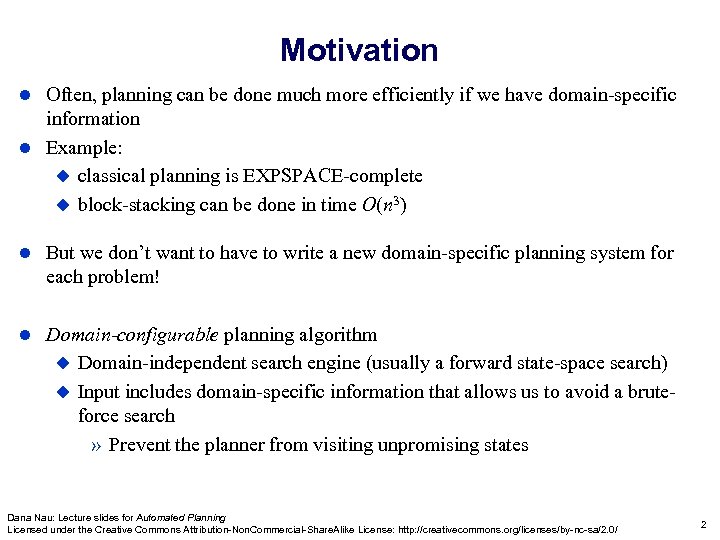 Motivation Often, planning can be done much more efficiently if we have domain-specific information Example: classical planning is EXPSPACE-complete block-stacking can be done in time O(n 3) But we don’t want to have to write a new domain-specific planning system for each problem! Domain-configurable planning algorithm Domain-independent search engine (usually a forward state-space search) Input includes domain-specific information that allows us to avoid a bruteforce search » Prevent the planner from visiting unpromising states Dana Nau: Lecture slides for Automated Planning Licensed under the Creative Commons Attribution-Non. Commercial-Share. Alike License: http: //creativecommons. org/licenses/by-nc-sa/2. 0/ 2
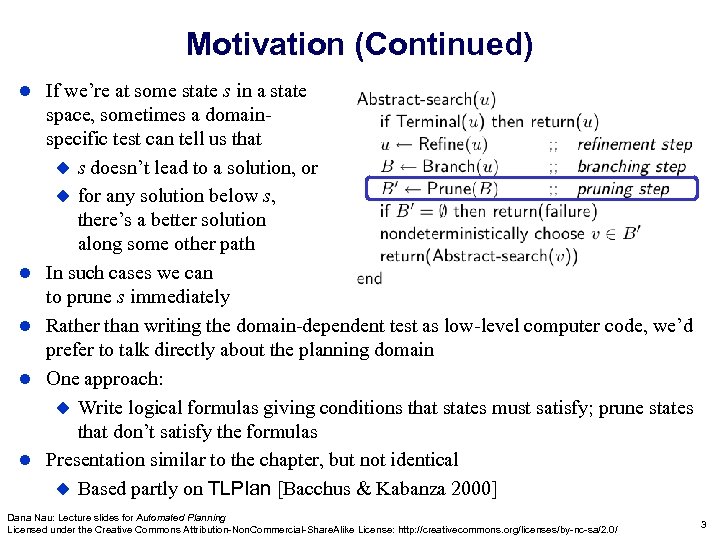 Motivation (Continued) If we’re at some state s in a state space, sometimes a domainspecific test can tell us that s doesn’t lead to a solution, or for any solution below s, there’s a better solution along some other path In such cases we can to prune s immediately Rather than writing the domain-dependent test as low-level computer code, we’d prefer to talk directly about the planning domain One approach: Write logical formulas giving conditions that states must satisfy; prune states that don’t satisfy the formulas Presentation similar to the chapter, but not identical Based partly on TLPlan [Bacchus & Kabanza 2000] Dana Nau: Lecture slides for Automated Planning Licensed under the Creative Commons Attribution-Non. Commercial-Share. Alike License: http: //creativecommons. org/licenses/by-nc-sa/2. 0/ 3
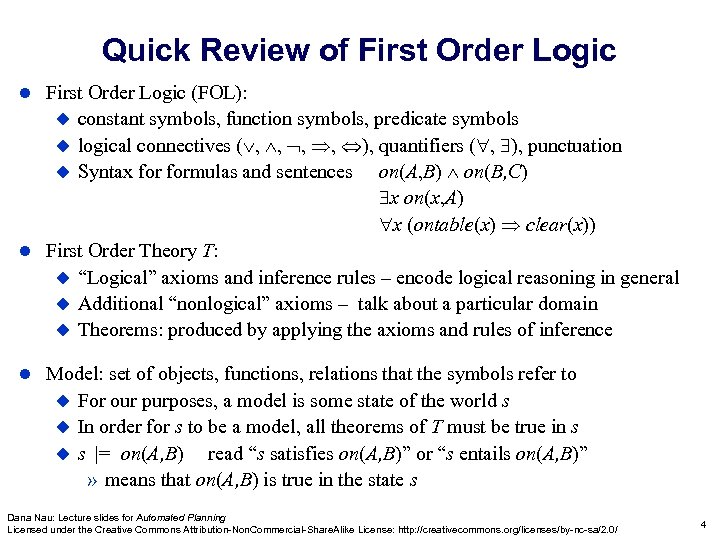 Quick Review of First Order Logic (FOL): constant symbols, function symbols, predicate symbols logical connectives ( , , ), quantifiers ( , ), punctuation Syntax formulas and sentences on(A, B) on(B, C) x on(x, A) x (ontable(x) clear(x)) First Order Theory T: “Logical” axioms and inference rules – encode logical reasoning in general Additional “nonlogical” axioms – talk about a particular domain Theorems: produced by applying the axioms and rules of inference Model: set of objects, functions, relations that the symbols refer to For our purposes, a model is some state of the world s In order for s to be a model, all theorems of T must be true in s s |= on(A, B) read “s satisfies on(A, B)” or “s entails on(A, B)” » means that on(A, B) is true in the state s Dana Nau: Lecture slides for Automated Planning Licensed under the Creative Commons Attribution-Non. Commercial-Share. Alike License: http: //creativecommons. org/licenses/by-nc-sa/2. 0/ 4
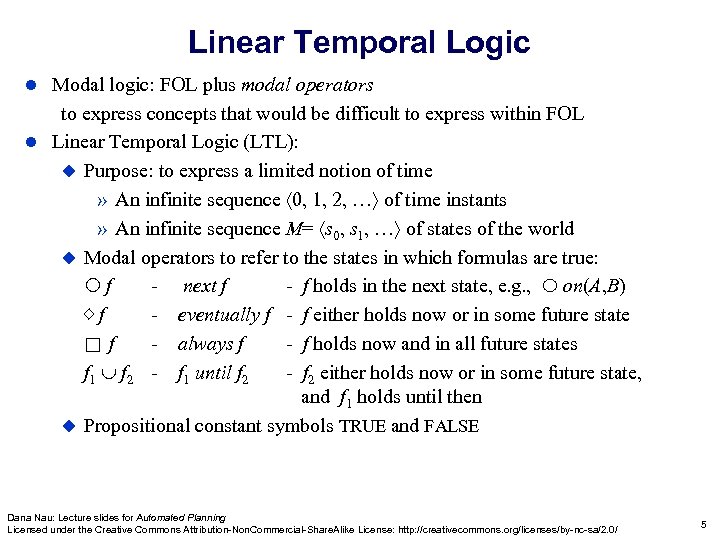 Linear Temporal Logic Modal logic: FOL plus modal operators to express concepts that would be difficult to express within FOL Linear Temporal Logic (LTL): Purpose: to express a limited notion of time » An infinite sequence 0, 1, 2, … of time instants » An infinite sequence M= s 0, s 1, … of states of the world Modal operators to refer to the states in which formulas are true: f - next f - f holds in the next state, e. g. , on(A, B) ♢ f - eventually f - f either holds now or in some future state f - always f - f holds now and in all future states f 1 f 2 - f 1 until f 2 - f 2 either holds now or in some future state, and f 1 holds until then Propositional constant symbols TRUE and FALSE Dana Nau: Lecture slides for Automated Planning Licensed under the Creative Commons Attribution-Non. Commercial-Share. Alike License: http: //creativecommons. org/licenses/by-nc-sa/2. 0/ 5
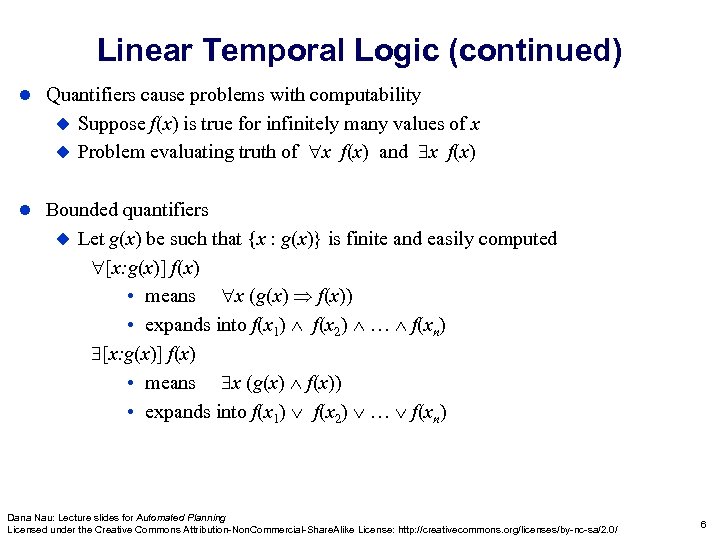 Linear Temporal Logic (continued) Quantifiers cause problems with computability Suppose f(x) is true for infinitely many values of x Problem evaluating truth of x f(x) and x f(x) Bounded quantifiers Let g(x) be such that {x : g(x)} is finite and easily computed [x: g(x)] f(x) • means x (g(x) f(x)) • expands into f(x 1) f(x 2) … f(xn) [x: g(x)] f(x) • means x (g(x) f(x)) • expands into f(x 1) f(x 2) … f(xn) Dana Nau: Lecture slides for Automated Planning Licensed under the Creative Commons Attribution-Non. Commercial-Share. Alike License: http: //creativecommons. org/licenses/by-nc-sa/2. 0/ 6
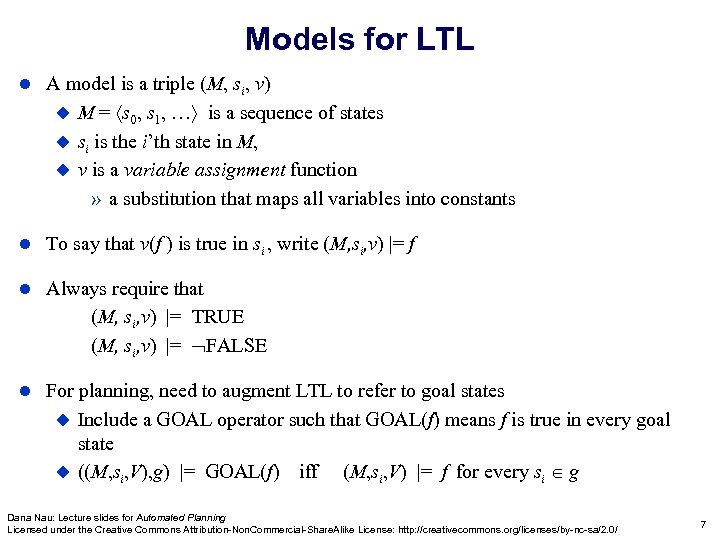 Models for LTL A model is a triple (M, si, v) M = s 0, s 1, … is a sequence of states si is the i’th state in M, v is a variable assignment function » a substitution that maps all variables into constants To say that v(f ) is true in si , write (M, si, v) |= f Always require that (M, si, v) |= TRUE (M, si, v) |= FALSE For planning, need to augment LTL to refer to goal states Include a GOAL operator such that GOAL(f) means f is true in every goal state ((M, si, V), g) |= GOAL(f) iff (M, si, V) |= f for every si g Dana Nau: Lecture slides for Automated Planning Licensed under the Creative Commons Attribution-Non. Commercial-Share. Alike License: http: //creativecommons. org/licenses/by-nc-sa/2. 0/ 7
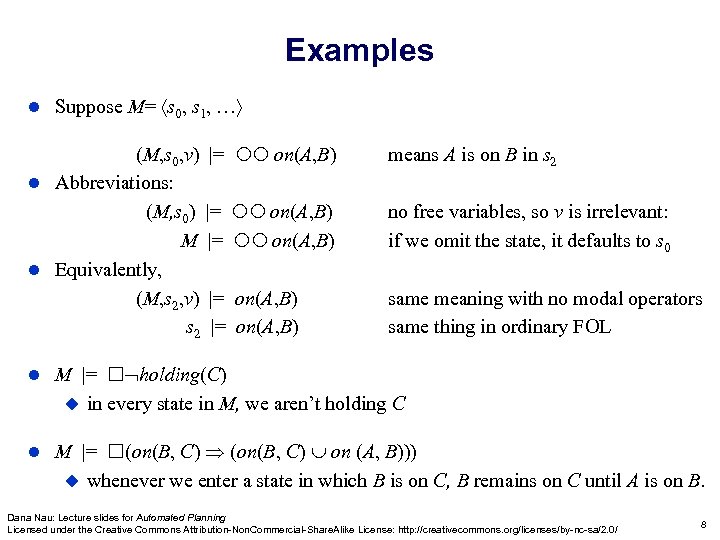 Examples Suppose M= s 0, s 1, … (M, s 0, v) |= on(A, B) Abbreviations: (M, s 0) |= on(A, B) M |= on(A, B) Equivalently, (M, s 2, v) |= on(A, B) s 2 |= on(A, B) means A is on B in s 2 no free variables, so v is irrelevant: if we omit the state, it defaults to s 0 same meaning with no modal operators same thing in ordinary FOL M |= holding(C) in every state in M, we aren’t holding C M |= (on(B, C) on (A, B))) whenever we enter a state in which B is on C, B remains on C until A is on B. Dana Nau: Lecture slides for Automated Planning Licensed under the Creative Commons Attribution-Non. Commercial-Share. Alike License: http: //creativecommons. org/licenses/by-nc-sa/2. 0/ 8
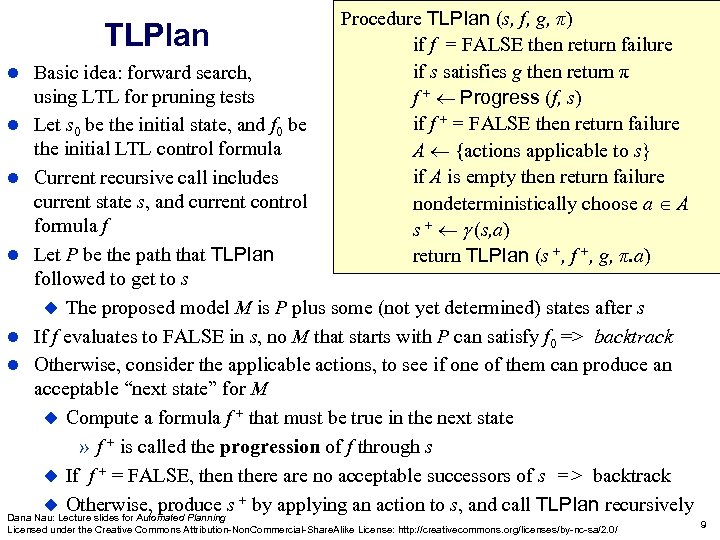 TLPlan Procedure TLPlan (s, f, g, π) if f = FALSE then return failure if s satisfies g then return π f + Progress (f, s) if f + = FALSE then return failure A {actions applicable to s} if A is empty then return failure nondeterministically choose a A s + (s, a) return TLPlan (s +, f +, g, π. a) Basic idea: forward search, using LTL for pruning tests Let s 0 be the initial state, and f 0 be the initial LTL control formula Current recursive call includes current state s, and current control formula f Let P be the path that TLPlan followed to get to s The proposed model M is P plus some (not yet determined) states after s If f evaluates to FALSE in s, no M that starts with P can satisfy f 0 => backtrack Otherwise, consider the applicable actions, to see if one of them can produce an acceptable “next state” for M Compute a formula f + that must be true in the next state » f + is called the progression of f through s If f + = FALSE, then there are no acceptable successors of s => backtrack Otherwise, produce s + by applying an action to s, and call TLPlan recursively Dana Nau: Lecture slides for Automated Planning Licensed under the Creative Commons Attribution-Non. Commercial-Share. Alike License: http: //creativecommons. org/licenses/by-nc-sa/2. 0/ 9
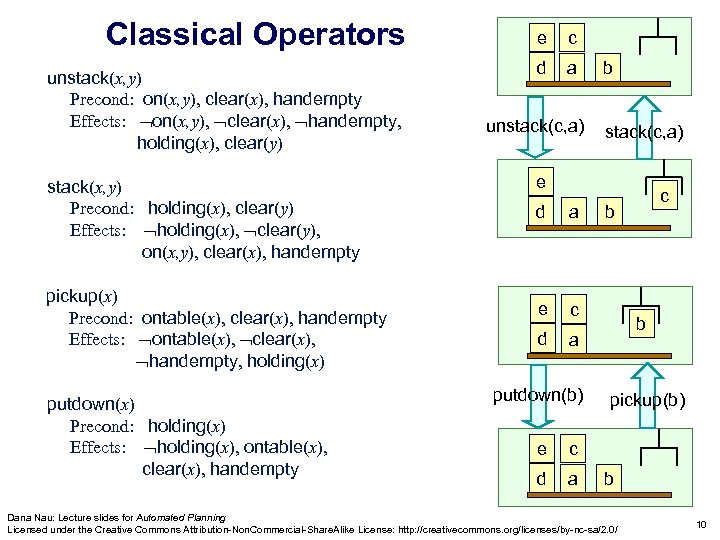 Classical Operators unstack(x, y) Precond: on(x, y), clear(x), handempty Effects: on(x, y), clear(x), handempty, holding(x), clear(y) stack(x, y) Precond: holding(x), clear(y) Effects: holding(x), clear(y), on(x, y), clear(x), handempty pickup(x) Precond: ontable(x), clear(x), handempty Effects: ontable(x), clear(x), handempty, holding(x) putdown(x) Precond: holding(x) Effects: holding(x), ontable(x), clear(x), handempty e c d a unstack(c, a) b stack(c, a) e d a e c d a putdown(b) e a b b pickup(b) c d c b Dana Nau: Lecture slides for Automated Planning Licensed under the Creative Commons Attribution-Non. Commercial-Share. Alike License: http: //creativecommons. org/licenses/by-nc-sa/2. 0/ 10
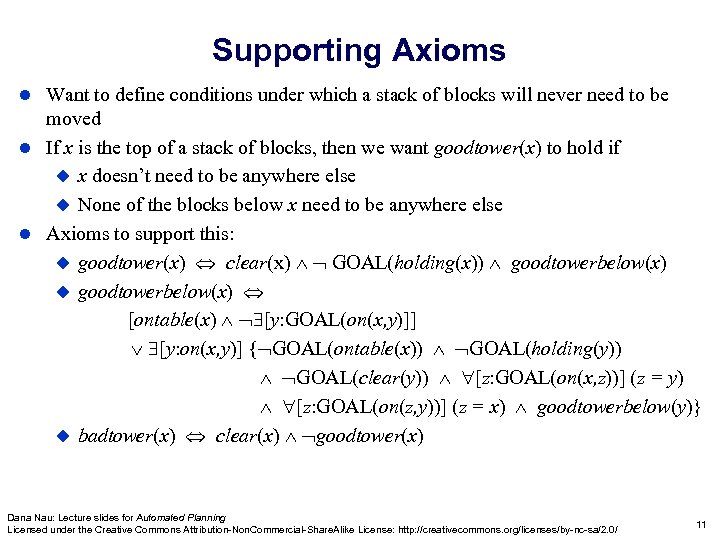 Supporting Axioms Want to define conditions under which a stack of blocks will never need to be moved If x is the top of a stack of blocks, then we want goodtower(x) to hold if x doesn’t need to be anywhere else None of the blocks below x need to be anywhere else Axioms to support this: goodtower(x) clear(x) GOAL(holding(x)) goodtowerbelow(x) [ontable(x) [y: GOAL(on(x, y)]] [y: on(x, y)] { GOAL(ontable(x)) GOAL(holding(y)) GOAL(clear(y)) [z: GOAL(on(x, z))] (z = y) [z: GOAL(on(z, y))] (z = x) goodtowerbelow(y)} badtower(x) clear(x) goodtower(x) Dana Nau: Lecture slides for Automated Planning Licensed under the Creative Commons Attribution-Non. Commercial-Share. Alike License: http: //creativecommons. org/licenses/by-nc-sa/2. 0/ 11
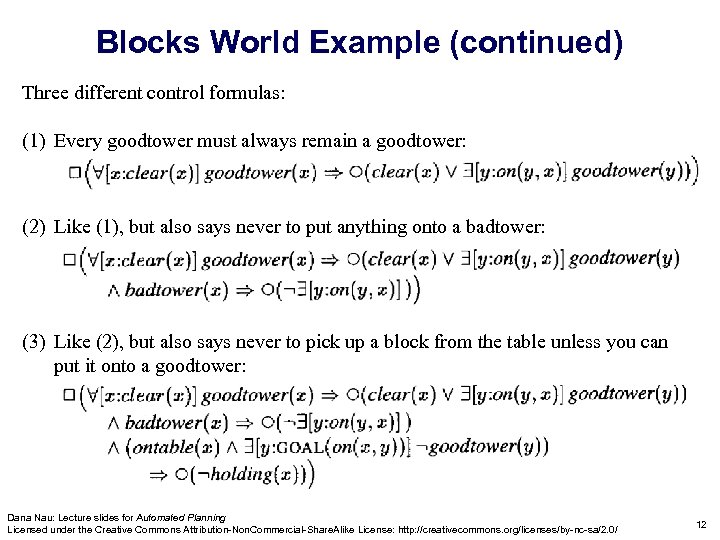 Blocks World Example (continued) Three different control formulas: (1) Every goodtower must always remain a goodtower: (2) Like (1), but also says never to put anything onto a badtower: (3) Like (2), but also says never to pick up a block from the table unless you can put it onto a goodtower: Dana Nau: Lecture slides for Automated Planning Licensed under the Creative Commons Attribution-Non. Commercial-Share. Alike License: http: //creativecommons. org/licenses/by-nc-sa/2. 0/ 12
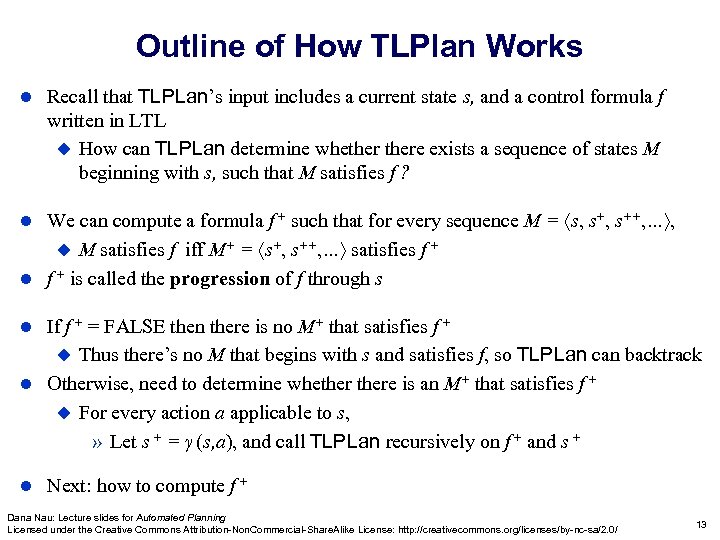 Outline of How TLPlan Works Recall that TLPLan’s input includes a current state s, and a control formula f written in LTL How can TLPLan determine whethere exists a sequence of states M beginning with s, such that M satisfies f ? We can compute a formula f + such that for every sequence M = s, s++, … , M satisfies f iff M+ = s+, s++, … satisfies f + is called the progression of f through s If f + = FALSE then there is no M+ that satisfies f + Thus there’s no M that begins with s and satisfies f, so TLPLan can backtrack Otherwise, need to determine whethere is an M+ that satisfies f + For every action a applicable to s, » Let s + = γ (s, a), and call TLPLan recursively on f + and s + Next: how to compute f + Dana Nau: Lecture slides for Automated Planning Licensed under the Creative Commons Attribution-Non. Commercial-Share. Alike License: http: //creativecommons. org/licenses/by-nc-sa/2. 0/ 13
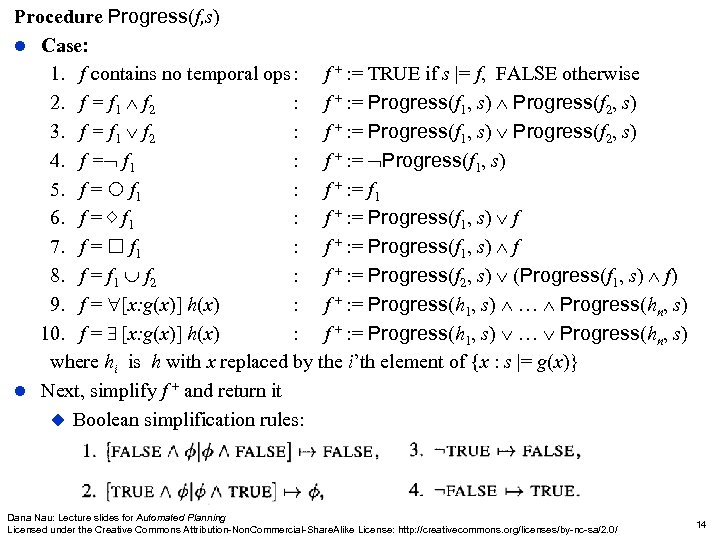 Procedure Progress(f, s) Case: 1. f contains no temporal ops : f + : = TRUE if s |= f, FALSE otherwise 2. f = f 1 f 2 : f + : = Progress(f 1, s) Progress(f 2, s) 3. f = f 1 f 2 : f + : = Progress(f 1, s) Progress(f 2, s) 4. f = f 1 : f + : = Progress(f 1, s) 5. f = f 1 : f + : = f 1 6. f = ♢ f 1 : f + : = Progress(f 1, s) f 7. f = f 1 : f + : = Progress(f 1, s) f 8. f = f 1 f 2 : f + : = Progress(f 2, s) (Progress(f 1, s) f) 9. f = [x: g(x)] h(x) : f + : = Progress(h 1, s) … Progress(hn, s) 10. f = [x: g(x)] h(x) : f + : = Progress(h 1, s) … Progress(hn, s) where hi is h with x replaced by the i’th element of {x : s |= g(x)} Next, simplify f + and return it Boolean simplification rules: Dana Nau: Lecture slides for Automated Planning Licensed under the Creative Commons Attribution-Non. Commercial-Share. Alike License: http: //creativecommons. org/licenses/by-nc-sa/2. 0/ 14
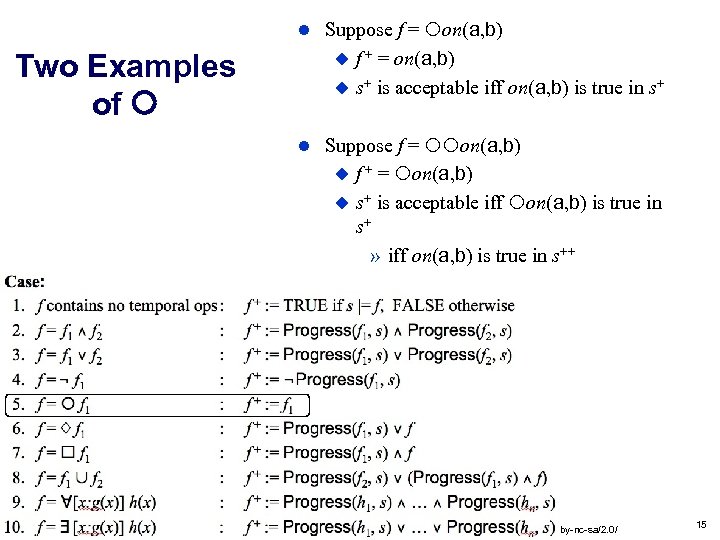 Suppose f = on(a, b) f + = on(a, b) s+ is acceptable iff on(a, b) is true in s+ Suppose f = on(a, b) f + = on(a, b) s+ is acceptable iff on(a, b) is true in s+ » iff on(a, b) is true in s++ Two Examples of Dana Nau: Lecture slides for Automated Planning Licensed under the Creative Commons Attribution-Non. Commercial-Share. Alike License: http: //creativecommons. org/licenses/by-nc-sa/2. 0/ 15
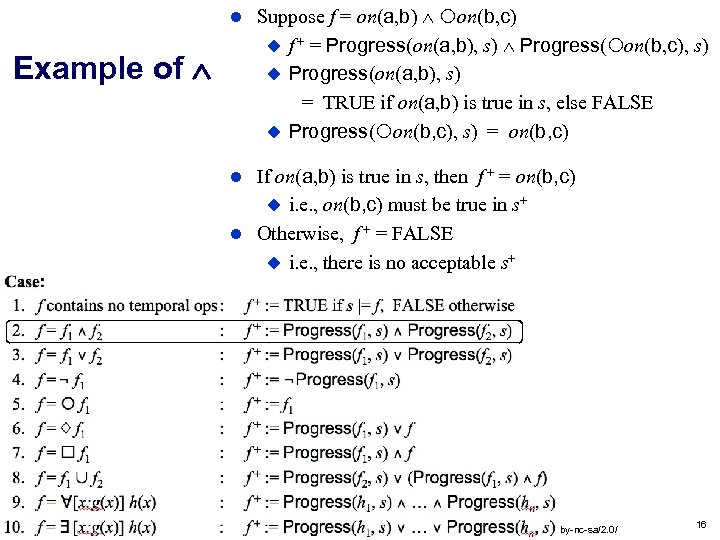 Example of Suppose f = on(a, b) on(b, c) f + = Progress(on(a, b), s) Progress( on(b, c), s) Progress(on(a, b), s) = TRUE if on(a, b) is true in s, else FALSE Progress( on(b, c), s) = on(b, c) If on(a, b) is true in s, then f + = on(b, c) i. e. , on(b, c) must be true in s+ Otherwise, f + = FALSE i. e. , there is no acceptable s+ Dana Nau: Lecture slides for Automated Planning Licensed under the Creative Commons Attribution-Non. Commercial-Share. Alike License: http: //creativecommons. org/licenses/by-nc-sa/2. 0/ 16
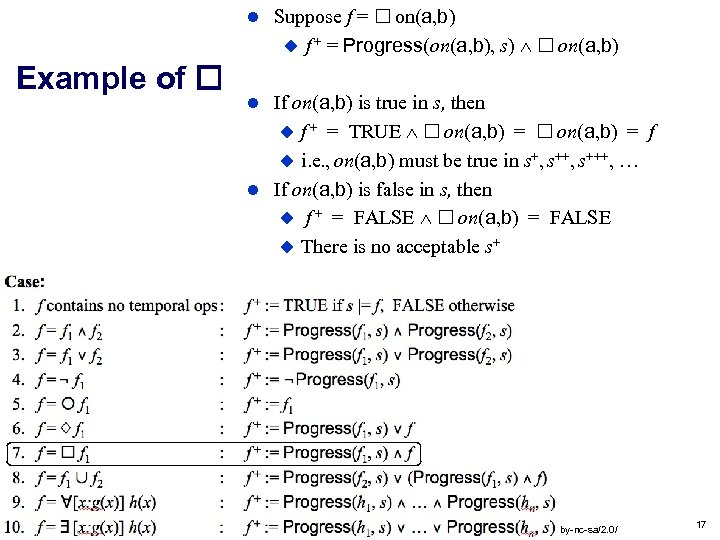 Example of Suppose f = on(a, b) f + = Progress(on(a, b), s) on(a, b) If on(a, b) is true in s, then f + = TRUE on(a, b) = f i. e. , on(a, b) must be true in s+, s+++, … If on(a, b) is false in s, then f + = FALSE on(a, b) = FALSE There is no acceptable s+ Dana Nau: Lecture slides for Automated Planning Licensed under the Creative Commons Attribution-Non. Commercial-Share. Alike License: http: //creativecommons. org/licenses/by-nc-sa/2. 0/ 17
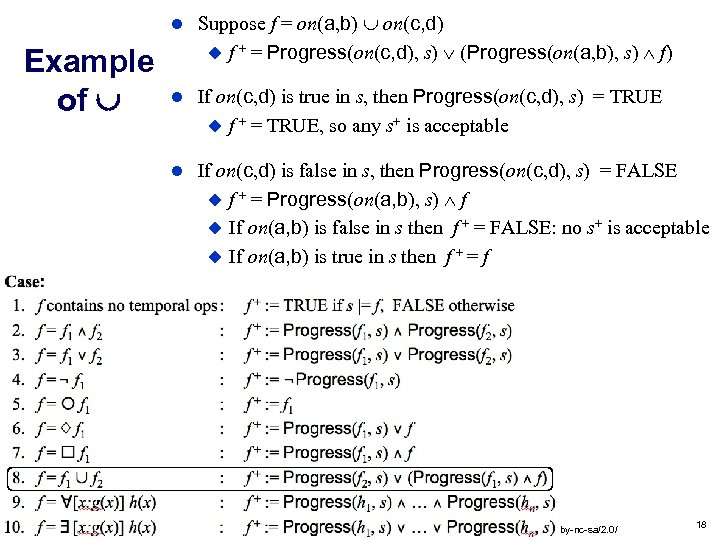 If on(c, d) is true in s, then Progress(on(c, d), s) = TRUE f + = TRUE, so any s+ is acceptable Example of Suppose f = on(a, b) on(c, d) f + = Progress(on(c, d), s) (Progress(on(a, b), s) f) If on(c, d) is false in s, then Progress(on(c, d), s) = FALSE f + = Progress(on(a, b), s) f If on(a, b) is false in s then f + = FALSE: no s+ is acceptable If on(a, b) is true in s then f + = f Dana Nau: Lecture slides for Automated Planning Licensed under the Creative Commons Attribution-Non. Commercial-Share. Alike License: http: //creativecommons. org/licenses/by-nc-sa/2. 0/ 18
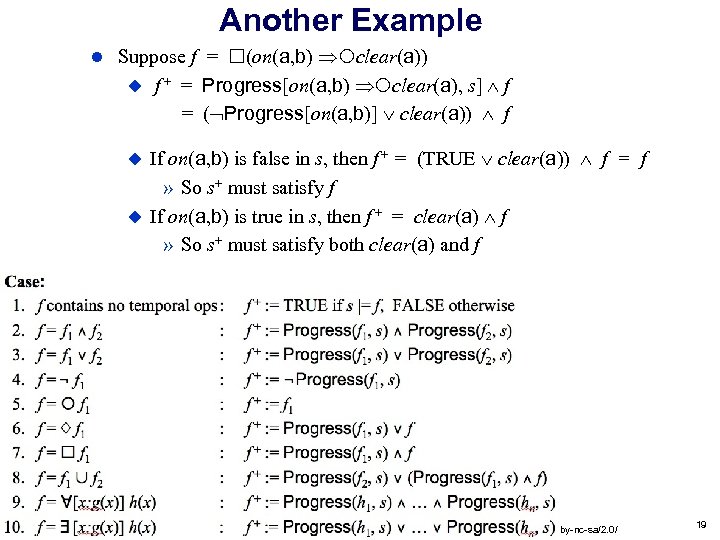 Another Example Suppose f = (on(a, b) clear(a)) f + = Progress[on(a, b) clear(a), s] f = ( Progress[on(a, b)] clear(a)) f If on(a, b) is false in s, then f + = (TRUE clear(a)) f = f » So s+ must satisfy f If on(a, b) is true in s, then f + = clear(a) f » So s+ must satisfy both clear(a) and f Dana Nau: Lecture slides for Automated Planning Licensed under the Creative Commons Attribution-Non. Commercial-Share. Alike License: http: //creativecommons. org/licenses/by-nc-sa/2. 0/ 19
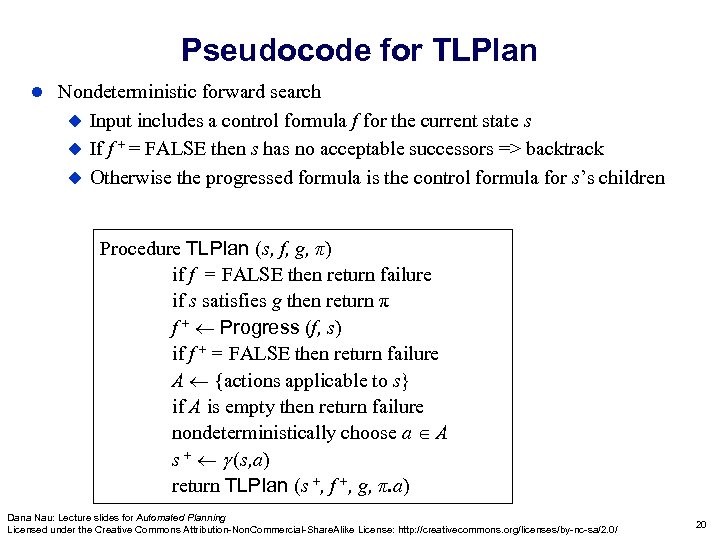 Pseudocode for TLPlan Nondeterministic forward search Input includes a control formula f for the current state s If f + = FALSE then s has no acceptable successors => backtrack Otherwise the progressed formula is the control formula for s’s children Procedure TLPlan (s, f, g, π) if f = FALSE then return failure if s satisfies g then return π f + Progress (f, s) if f + = FALSE then return failure A {actions applicable to s} if A is empty then return failure nondeterministically choose a A s + (s, a) return TLPlan (s +, f +, g, π. a) Dana Nau: Lecture slides for Automated Planning Licensed under the Creative Commons Attribution-Non. Commercial-Share. Alike License: http: //creativecommons. org/licenses/by-nc-sa/2. 0/ 20
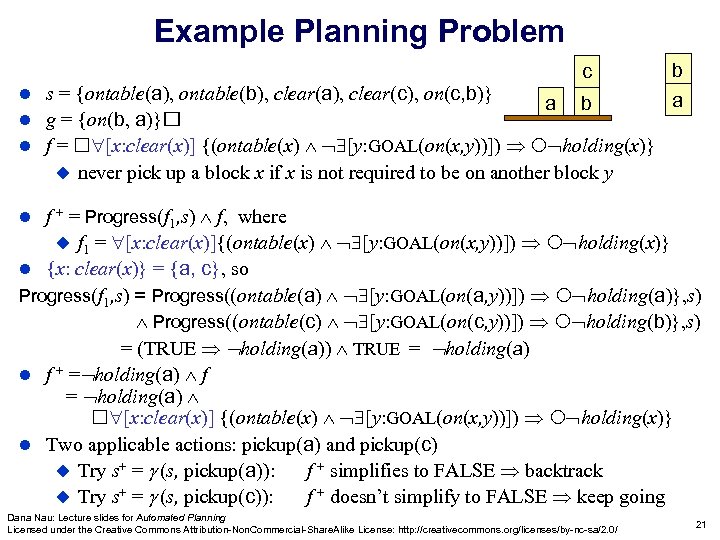 Example Planning Problem c s = {ontable(a), ontable(b), clear(a), clear(c), on(c, b)} a b g = {on(b, a)} f = [x: clear(x)] {(ontable(x) [y: GOAL(on(x, y))]) holding(x)} never pick up a block x if x is not required to be on another block y b a f + = Progress(f 1, s) f, where f 1 = [x: clear(x)]{(ontable(x) [y: GOAL(on(x, y))]) holding(x)} {x: clear(x)} = {a, c}, so Progress(f 1, s) = Progress((ontable(a) [y: GOAL(on(a, y))]) holding(a)}, s) Progress((ontable(c) [y: GOAL(on(c, y))]) holding(b)}, s) = (TRUE holding(a)) TRUE = holding(a) f + = holding(a) f = holding(a) [x: clear(x)] {(ontable(x) [y: GOAL(on(x, y))]) holding(x)} Two applicable actions: pickup(a) and pickup(c) Try s+ = (s, pickup(a)): f + simplifies to FALSE backtrack Try s+ = (s, pickup(c)): f + doesn’t simplify to FALSE keep going Dana Nau: Lecture slides for Automated Planning Licensed under the Creative Commons Attribution-Non. Commercial-Share. Alike License: http: //creativecommons. org/licenses/by-nc-sa/2. 0/ 21
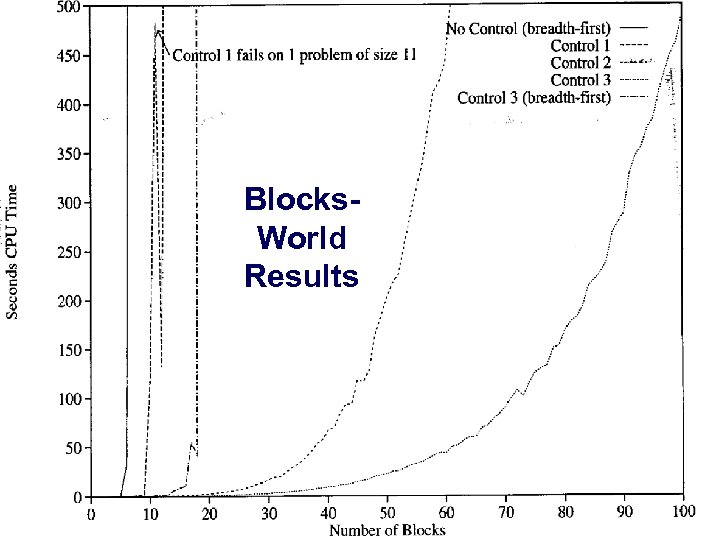 Blocks. World Results Dana Nau: Lecture slides for Automated Planning Licensed under the Creative Commons Attribution-Non. Commercial-Share. Alike License: http: //creativecommons. org/licenses/by-nc-sa/2. 0/ 22
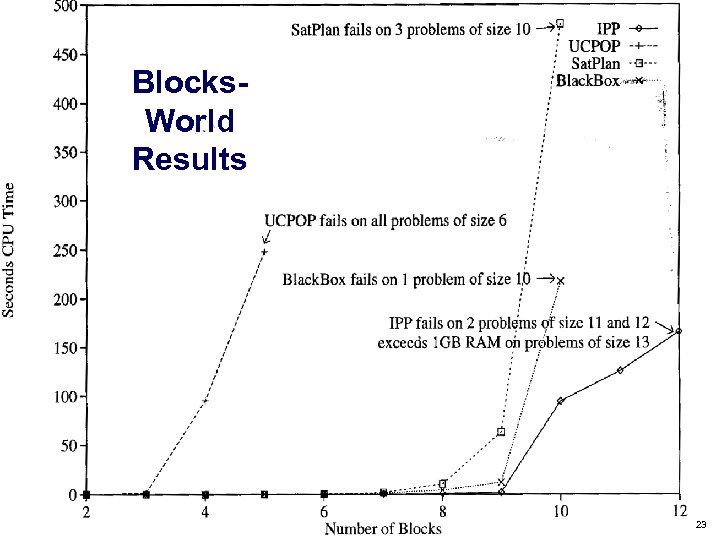 Blocks. World Results Dana Nau: Lecture slides for Automated Planning Licensed under the Creative Commons Attribution-Non. Commercial-Share. Alike License: http: //creativecommons. org/licenses/by-nc-sa/2. 0/ 23
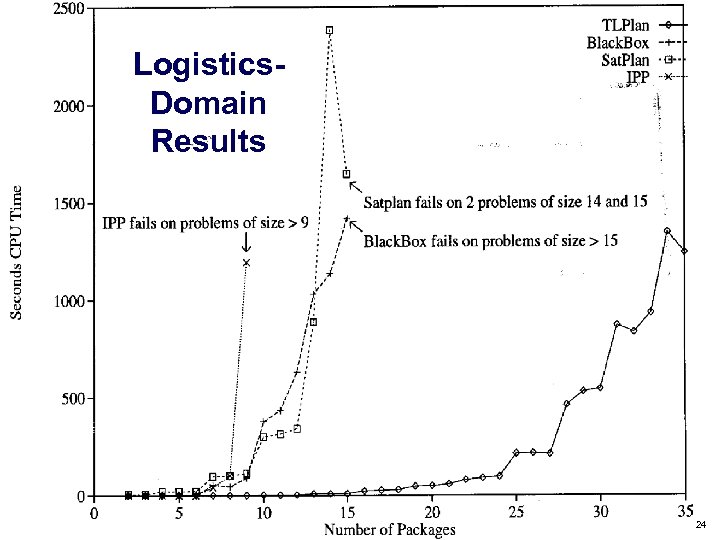 Logistics. Domain Results Dana Nau: Lecture slides for Automated Planning Licensed under the Creative Commons Attribution-Non. Commercial-Share. Alike License: http: //creativecommons. org/licenses/by-nc-sa/2. 0/ 24
 Discussion 2000 International Planning Competition TALplanner: similar algorithm, different temporal logic » received the top award for a “hand-tailored” (i. e. , domain-configurable) planner TLPlan won the same award in the 2002 International Planning Competition Both of them: Ran several orders of magnitude faster than the “fully automated” (i. e. , domain-independent) planners » especially on large problems Solved problems on which the domain-independent planners ran out of time or memory Dana Nau: Lecture slides for Automated Planning Licensed under the Creative Commons Attribution-Non. Commercial-Share. Alike License: http: //creativecommons. org/licenses/by-nc-sa/2. 0/ 25