


 Скачать презентацию Lecture Series 3 Financial Risk Management Chris Droussiotis
b2a6b9f383694c44494ef2afe1954290.ppt
- Количество слайдов: 28
 Lecture Series #3 Financial Risk Management Chris Droussiotis October 2011
 Table of Contents l l l 2 Managerial Strategies Return, Risk, Asset Allocation and Time Fundamental Analysis Technical Analysis Behavioral Analysis
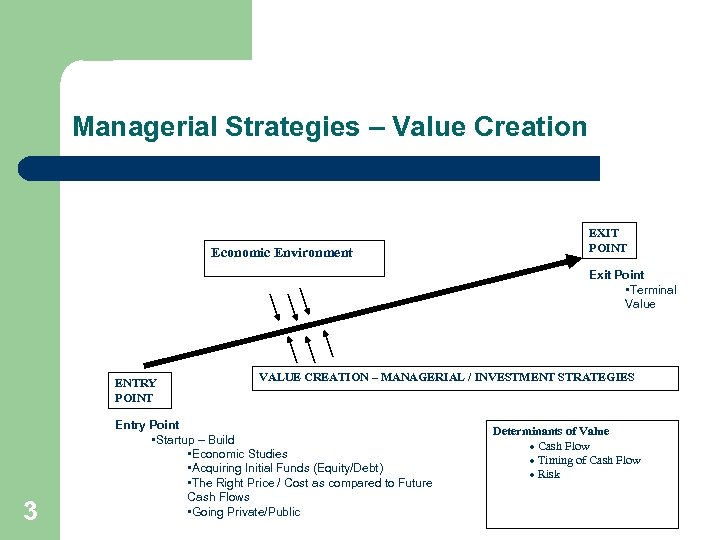 Managerial Strategies – Value Creation Economic Environment EXIT POINT Exit Point • Terminal Value ENTRY POINT 3 VALUE CREATION – MANAGERIAL / INVESTMENT STRATEGIES Entry Point • Startup – Build • Economic Studies • Acquiring Initial Funds (Equity/Debt) • The Right Price / Cost as compared to Future Cash Flows • Going Private/Public Determinants of Value · Cash Flow · Timing of Cash Flow · Risk
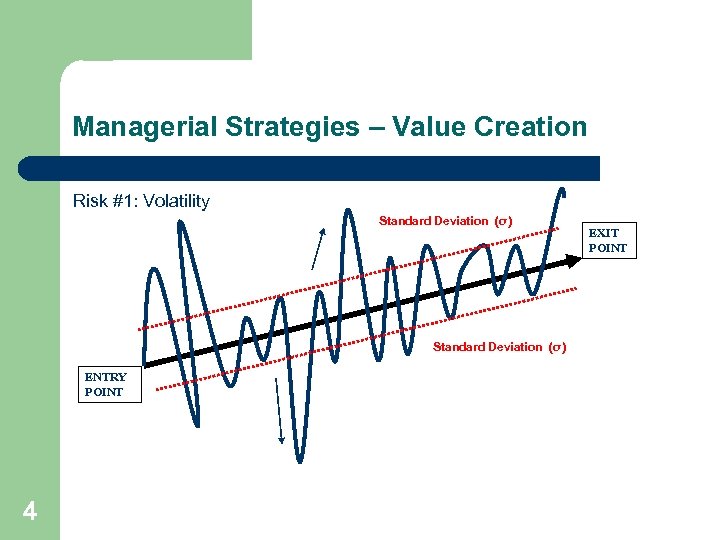 Managerial Strategies – Value Creation Risk #1: Volatility Standard Deviation (σ) ENTRY POINT 4 EXIT POINT
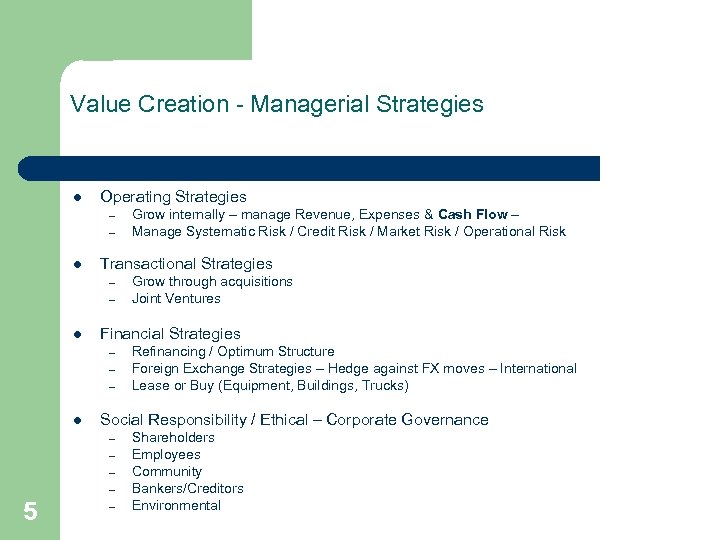 Value Creation - Managerial Strategies l Operating Strategies – – l Transactional Strategies – – l – – Refinancing / Optimum Structure Foreign Exchange Strategies – Hedge against FX moves – International Lease or Buy (Equipment, Buildings, Trucks) Social Responsibility / Ethical – Corporate Governance – – 5 Grow through acquisitions Joint Ventures Financial Strategies – l Grow internally – manage Revenue, Expenses & Cash Flow – Manage Systematic Risk / Credit Risk / Market Risk / Operational Risk – Shareholders Employees Community Bankers/Creditors Environmental
 Financial Risk Management l l Identifying Risk l Achieving Diversification via Asset Allocation l 6 Seeking Return Time is important
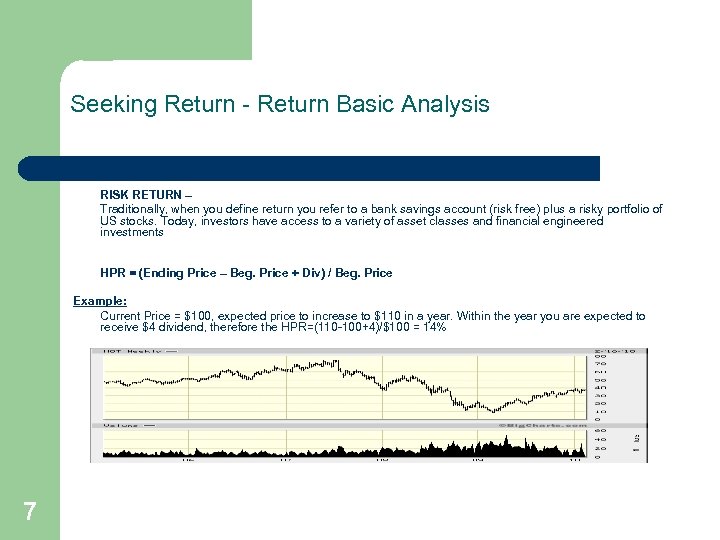 Seeking Return - Return Basic Analysis RISK RETURN – Traditionally, when you define return you refer to a bank savings account (risk free) plus a risky portfolio of US stocks. Today, investors have access to a variety of asset classes and financial engineered investments HPR = (Ending Price – Beg. Price + Div) / Beg. Price Example: Current Price = $100, expected price to increase to $110 in a year. Within the year you are expected to receive $4 dividend, therefore the HPR=(110 -100+4)/$100 = 14% 7
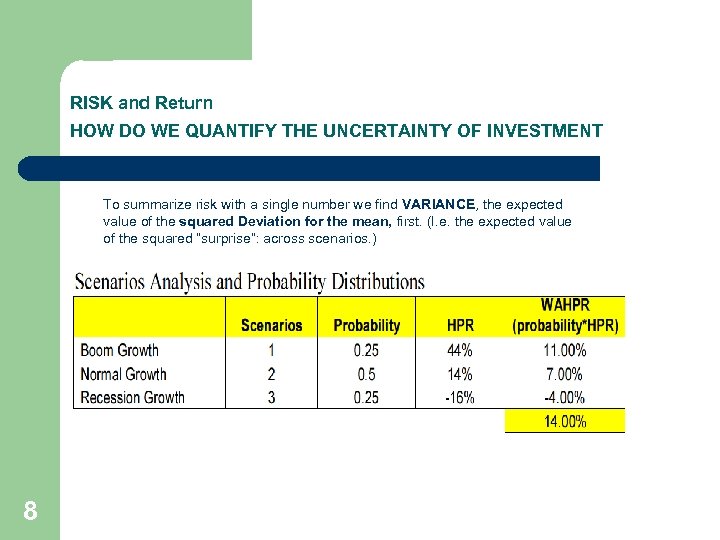 RISK and Return HOW DO WE QUANTIFY THE UNCERTAINTY OF INVESTMENT To summarize risk with a single number we find VARIANCE, the expected value of the squared Deviation for the mean, first. (I. e. the expected value of the squared “surprise”: across scenarios. ) 8
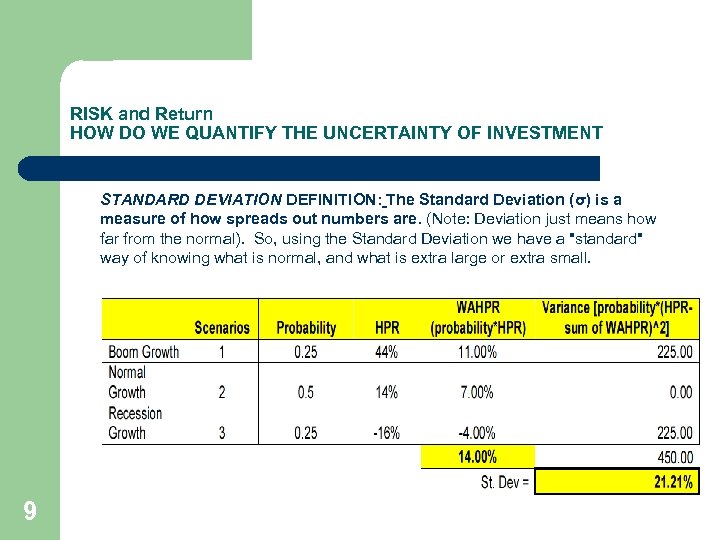 RISK and Return HOW DO WE QUANTIFY THE UNCERTAINTY OF INVESTMENT STANDARD DEVIATION DEFINITION: The Standard Deviation (σ) is a measure of how spreads out numbers are. (Note: Deviation just means how far from the normal). So, using the Standard Deviation we have a "standard" way of knowing what is normal, and what is extra large or extra small. 9
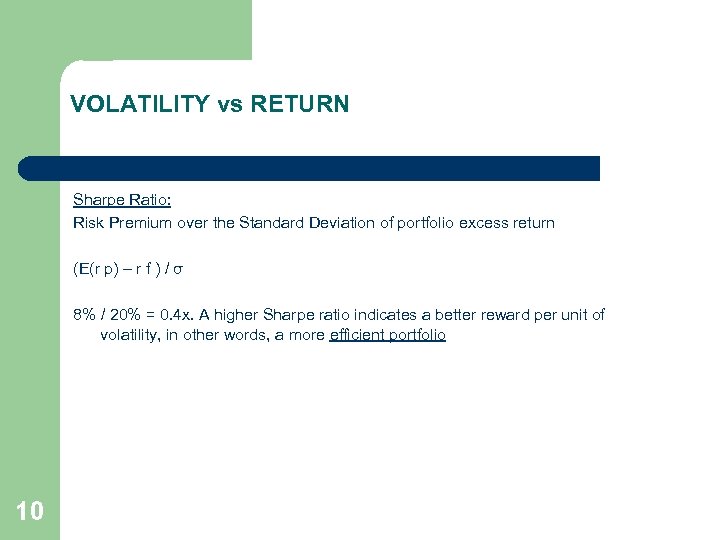 VOLATILITY vs RETURN Sharpe Ratio: Risk Premium over the Standard Deviation of portfolio excess return (E(r p) – r f ) / σ 8% / 20% = 0. 4 x. A higher Sharpe ratio indicates a better reward per unit of volatility, in other words, a more efficient portfolio 10
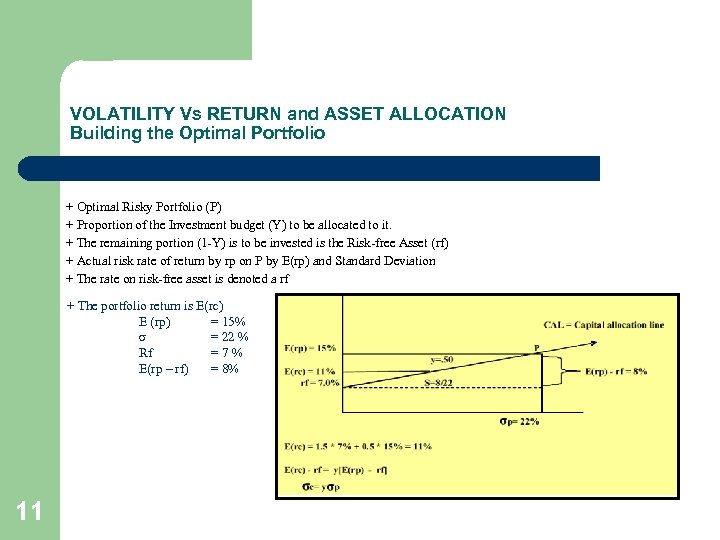 VOLATILITY Vs RETURN and ASSET ALLOCATION Building the Optimal Portfolio + Optimal Risky Portfolio (P) + Proportion of the Investment budget (Y) to be allocated to it. + The remaining portion (1 -Y) is to be invested is the Risk-free Asset (rf) + Actual risk rate of return by rp on P by E(rp) and Standard Deviation + The rate on risk-free asset is denoted a rf + The portfolio return is E(rc) E (rp) = 15% σ = 22 % Rf =7% E(rp – rf) = 8% 11
 RISK, RETURN, ASSET ALLOCATION AND DIVERSIFICATION l l From one stock to two stocks to three stocks…. . sensitivity to external factors (i. e. oil, non-oil stocks) – But even extensive diversification cannot eliminate risk – MARKET RISK l Other Names for Market risk: Systematic risk, non-diversifiable risk l 12 DIVERSIFICATION AND PORTFOLIO RISK The Risk that can be eliminated by diversification is called: – Unique Risk – Firm-specific risk – Non-systematic risk – Diversifiable risk
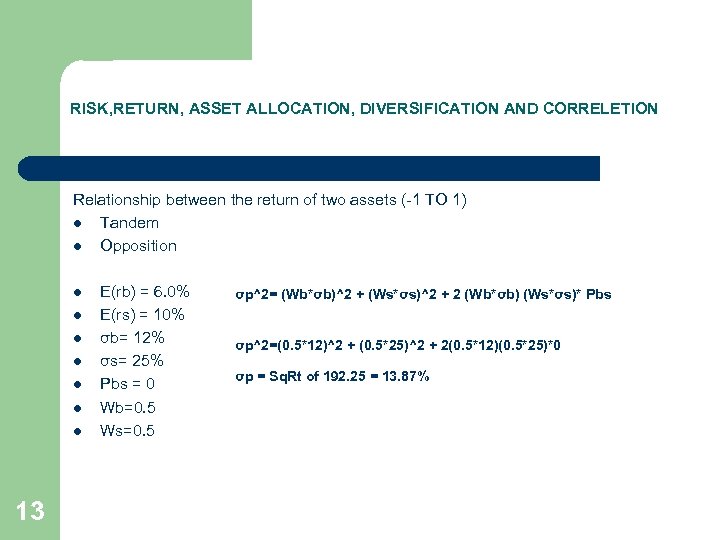 RISK, RETURN, ASSET ALLOCATION, DIVERSIFICATION AND CORRELETION Relationship between the return of two assets (-1 TO 1) l Tandem l Opposition l l l l 13 E(rb) = 6. 0% E(rs) = 10% σb= 12% σs= 25% Pbs = 0 Wb=0. 5 Ws=0. 5 σp^2= (Wb*σb)^2 + (Ws*σs)^2 + 2 (Wb*σb) (Ws*σs)* Pbs σp^2=(0. 5*12)^2 + (0. 5*25)^2 + 2(0. 5*12)(0. 5*25)*0 σp = Sq. Rt of 192. 25 = 13. 87%
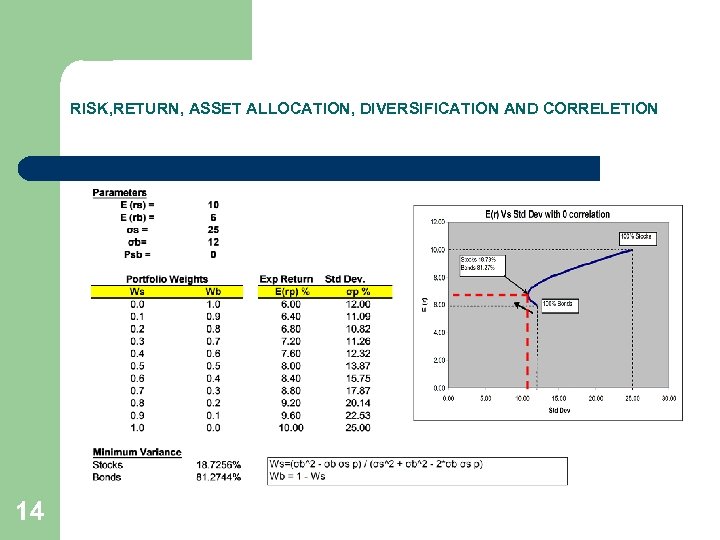 RISK, RETURN, ASSET ALLOCATION, DIVERSIFICATION AND CORRELETION 14
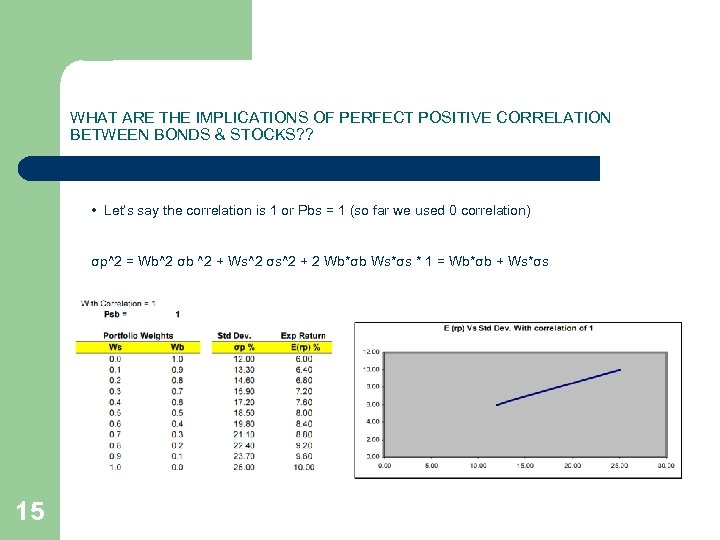 WHAT ARE THE IMPLICATIONS OF PERFECT POSITIVE CORRELATION BETWEEN BONDS & STOCKS? ? • Let’s say the correlation is 1 or Pbs = 1 (so far we used 0 correlation) σp^2 = Wb^2 σb ^2 + Ws^2 σs^2 + 2 Wb*σb Ws*σs * 1 = Wb*σb + Ws*σs 15
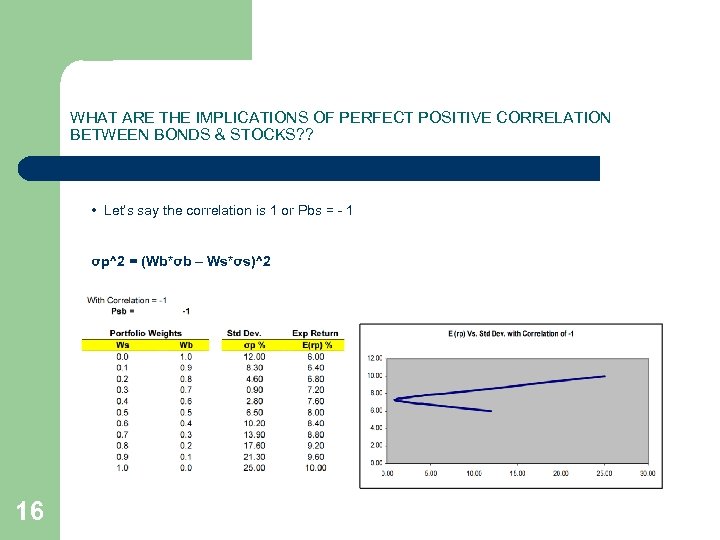 WHAT ARE THE IMPLICATIONS OF PERFECT POSITIVE CORRELATION BETWEEN BONDS & STOCKS? ? • Let’s say the correlation is 1 or Pbs = - 1 σp^2 = (Wb*σb – Ws*σs)^2 16
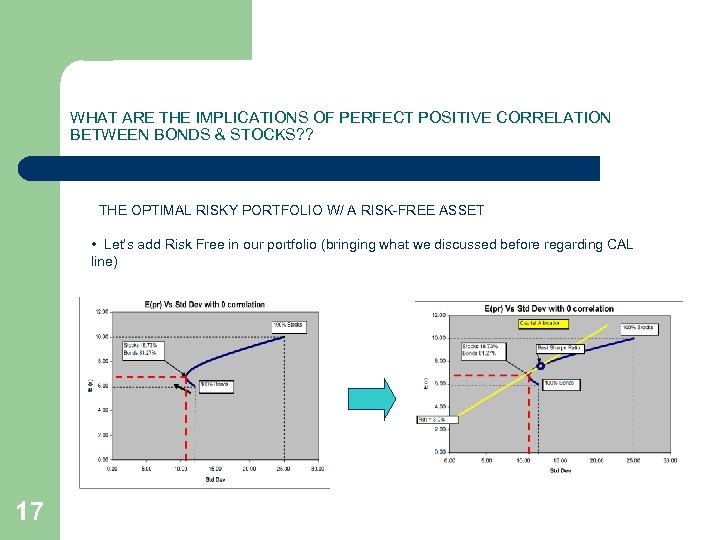 WHAT ARE THE IMPLICATIONS OF PERFECT POSITIVE CORRELATION BETWEEN BONDS & STOCKS? ? THE OPTIMAL RISKY PORTFOLIO W/ A RISK-FREE ASSET • Let’s add Risk Free in our portfolio (bringing what we discussed before regarding CAL line) 17
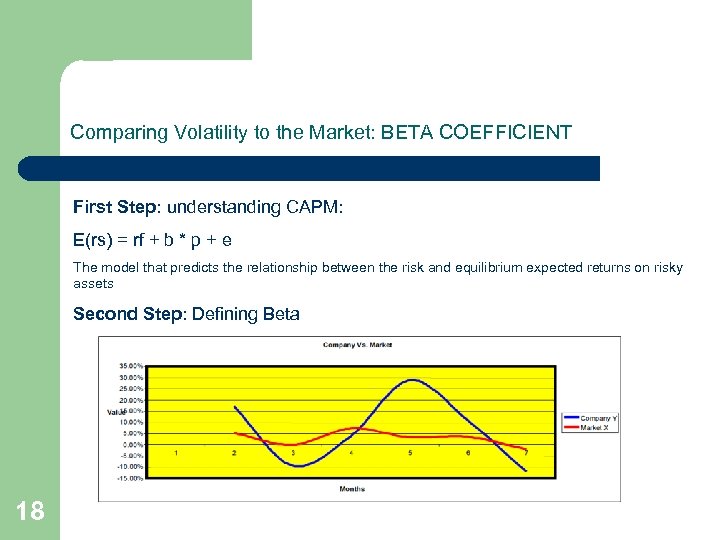 Comparing Volatility to the Market: BETA COEFFICIENT First Step: understanding CAPM: E(rs) = rf + b * p + e The model that predicts the relationship between the risk and equilibrium expected returns on risky assets Second Step: Defining Beta 18
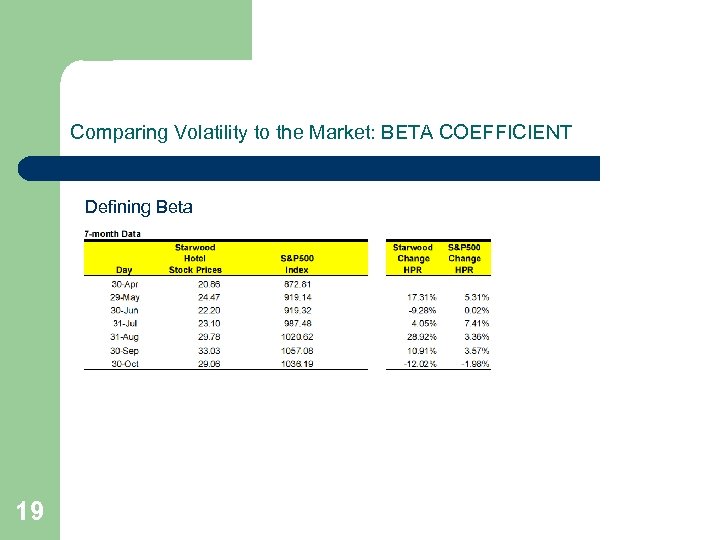 Comparing Volatility to the Market: BETA COEFFICIENT Defining Beta 19
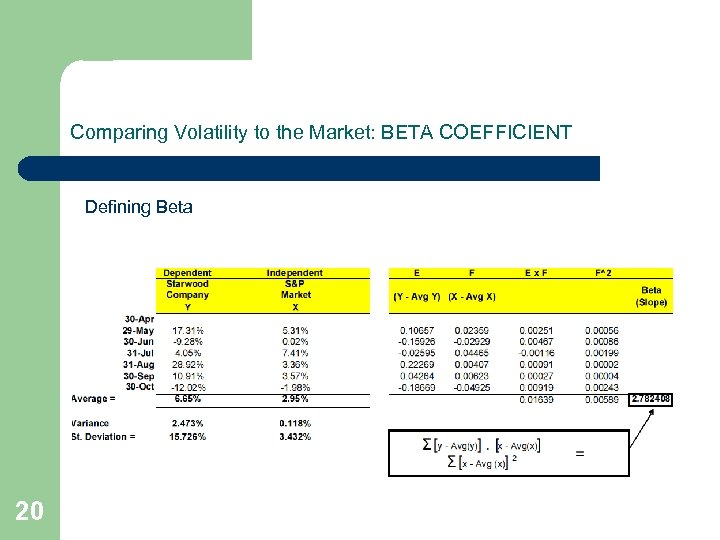 Comparing Volatility to the Market: BETA COEFFICIENT Defining Beta 20
 Valuation Methods – Private Company l DCF Analysis – Transaction Sources & Uses l Capital markets – Debt (Loans. Mezzanine and Corporate Bonds) – Equity (Private & Public) l l – Initial Valuation – purchase price / Cost of investment WACC / CAPM concepts Debt Schedule Payments l Principal & Interest – Floating Rate – Fixed Rate 21
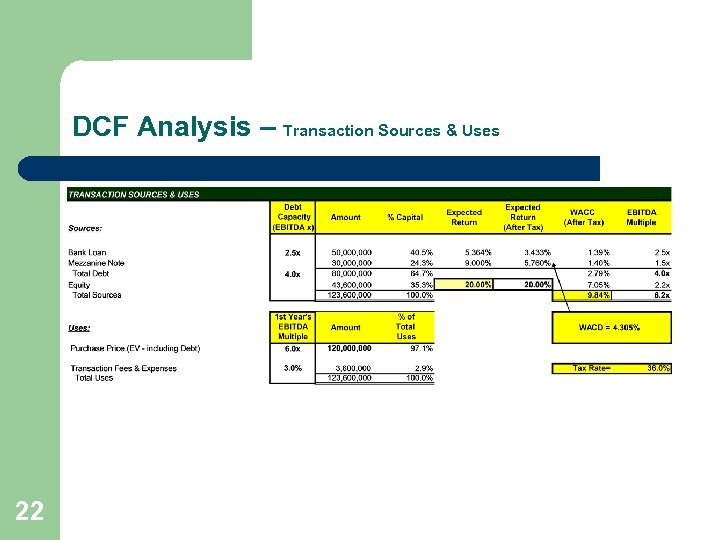 DCF Analysis – Transaction Sources & Uses 22
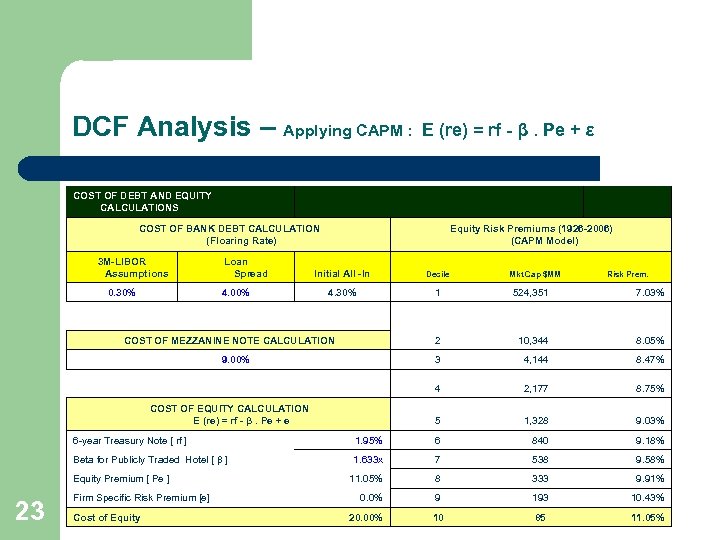 DCF Analysis – Applying CAPM : E (re) = rf - β. Pe + ε COST OF DEBT AND EQUITY CALCULATIONS COST OF BANK DEBT CALCULATION (Floaring Rate) 3 M-LIBOR Assumptions Loan Spread 0. 30% Equity Risk Premiums (1926 -2006) (CAPM Model) Initial All -In Decile 4. 30% 4. 00% 1 Mkt Cap $MM 524, 351 COST OF MEZZANINE NOTE CALCULATION Risk Prem. 7. 03% 9. 00% 4, 144 8. 47% 2, 177 8. 75% 5 COST OF EQUITY CALCULATION E (re) = rf - β. Pe + e 8. 05% 3 10, 344 4 2 1, 328 9. 03% 6 -year Treasury Note [ rf ] 1. 95% 6 840 9. 18% Beta for Publicly Traded Hotel [ β ] 1. 633 x 7 538 9. 58% 11. 05% 8 333 9. 91% 0. 0% 9 193 10. 43% 20. 00% 10 85 11. 05% Equity Premium [ Pe ] 23 Firm Specific Risk Premium [e] Cost of Equity
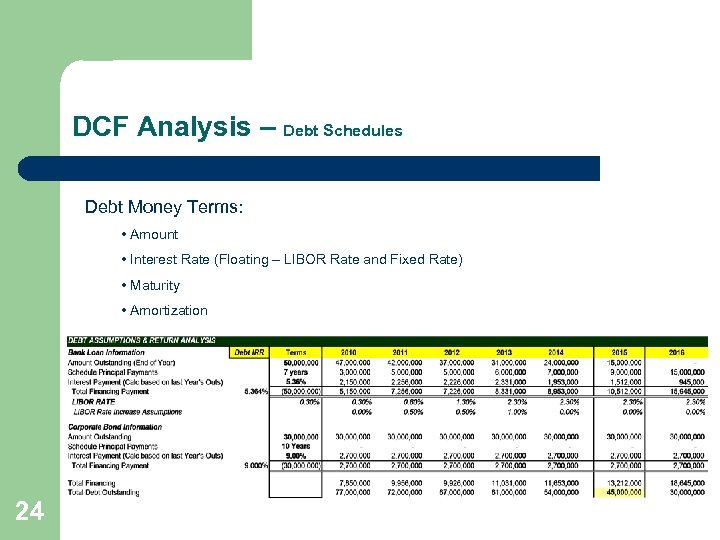 DCF Analysis – Debt Schedules Debt Money Terms: • Amount • Interest Rate (Floating – LIBOR Rate and Fixed Rate) • Maturity • Amortization 24
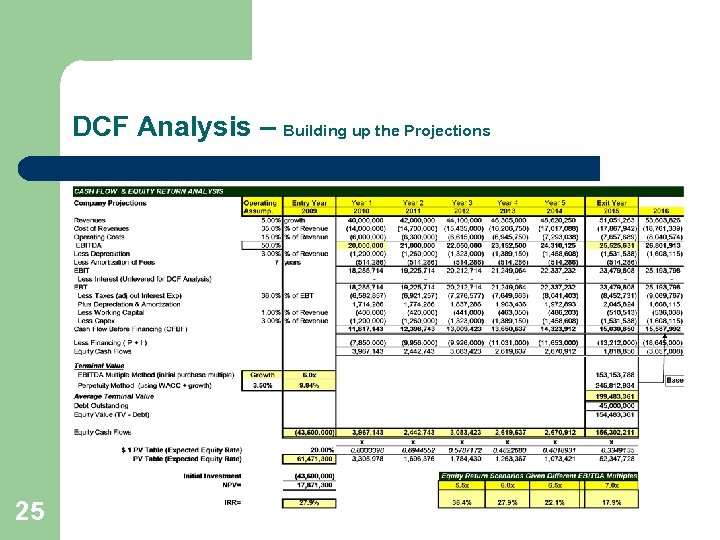 DCF Analysis – Building up the Projections 25
 Reviewing Financial Risk Management l Fundamental Analysis – – l Financial Ratio Analysis DCF Valuation Analysis Technical Analysis – Portfolio Analysis Approach l l 26 Historical Returns / Standard Deviation / Correlations Behavioral Analysis
 Behavioral Analysis Concepts ARE MARKETS EFFICIENT? EMH Concept Looking for behavioral motivations for buying/selling: • High Exposure • Risk Appetite • Tax motivation • Resource allocation Behavioral Finance - People are people and they make decisions differently “Irrational Exuberance” – Greenspan 12/2006 – affected the stock markets around the world after he mention that word (Tokyo was down 3. 0%, Hong Kong was down 2. 0%, UK down 3. 0%, U. S. down 2. 0%) 27
 Behavioral Analysis Concepts ARE MARKETS EFFICIENT? EMH Concept INFORMATION PROCESSING • Forecasting Errors – High multiples • Overconfidence – “Irrational Exuberance” • Conservatism – the article of banks – in Leverage Cycle BEHAVIORAL BIASES • Bluffing – Game theory – “All-in” has nothing, betting slow could have a good hand. • Mental Accounting – managing other people’s money versus your own • Regret Avoidance – unconventional choices Vs. acceptable choices when wrong • Prospect theory - as wealth increases more risk averse. 28