


 Скачать презентацию LECTURE II Translation Theory and Sociolinguistics I Pragmatic
8838f9e11f7d6c063715126f9e8c1929.ppt
- Количество слайдов: 29
 LECTURE II Translation Theory and Sociolinguistics I Pragmatic adaptation: the adjustment of the translated work to the needs of the target language reader (Voltaire’s Zadig, ou La Destinée, ‘Zadig, or The Book of Fate’ 1747 → András Dugonics: Cserei, egy honvári herceg) Sociolinguistic research in TT studies the relationship between translation and society against the more general background of the relationship between language and society. II/1 Translating the idiolect, i. e. how to translate individual language features Aristophanes’ Lysistrate: the ‘boorish’ Doric dialect of Spartans vs the urbane Attic speech of Athenians. Lysistrata is one of the few surviving plays written by Aristophanes. It is a comic account of one woman's extraordinary mission to end the Peloponnesian War. Lysistrata persuades the women of Greece to withhold sexual priviliges from their husbands and lovers as a means of forcing the men to negotiate peace — a strategy, however, that inflames the battle between the sexes.
 LECTURE II Translation Theory and Sociolinguistics II II/2 Translating dialectal features Mikhail Sholokhov’s novel And Quiet Flows the Don → Csendes Don, by Imre Makai (from Russian); the problem of translating the Cossack dialect into that of the Hajdúság area. II/3 Rendering social relations of superiority/inferiority Can the Russian –s marker be translated? The T/V problem II/4 Translating words without equivalents Culture-bound terms, „realia”: studied in the framework of language contact as a process of recognizing and naming the emblematic objects of the other. Adstratum influence: two-way, contact between linguistic communities at the same social/economic level; Substratum/superstratum influence: unidirectional, contact between unequal communities
 LECTURE II Translation Theory and Sociolinguistics III II/5 Translatability – intranslatability relationship between language and reality: rich wordstock describing - snow in Eskimo languages, - camel-breeding in Arabic, - fish in Russian, - shipping in English, - various kinds of pasta in Italian, etc
 LECTURE II Translation Theory and Sociolinguistics IV II/6 Culture-bound terms and intranslatability - simple transliteration: will remain incomprehensible without a footnote, - use of some equivalent culture-bound term: role of translator as transmitter between cultures will be lost. - the role of language contact: a community accumulates some knowledge of what the culture-bound terms of the other actually mean (the growing prestige of Russian culture-bound terms in the 50 s, the soaring prestige of anything American today). A sociolinguistic approach: translators should rely on what the TL community actually knows about them and how they evaluate them. II/7 What has TT to offer to sociolinguistics? - new research topics, e. g. forms of address and their historical aspects
 LECTURE II Translation Theory and Sociolinguistics V 1/ The you-problem in literary translation • Reagan to Gorbachev: Call me Ron! • The thou/you morphological contrast in ME and EMod. E: see the tables in the following slides
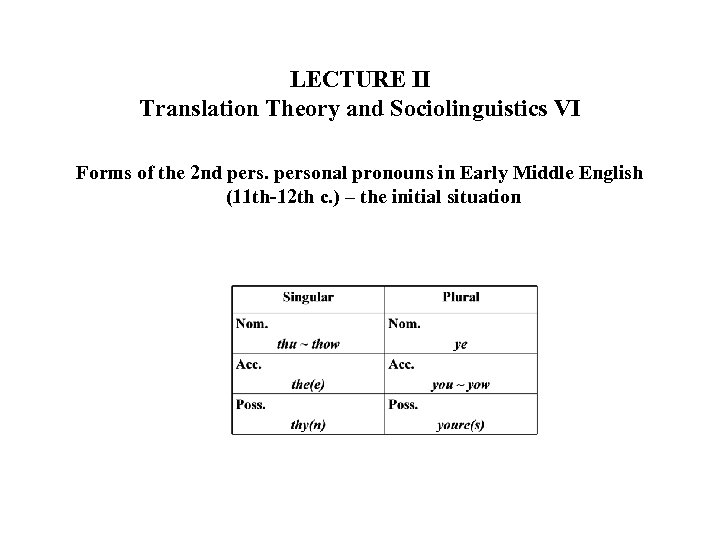 LECTURE II Translation Theory and Sociolinguistics VI Forms of the 2 nd personal pronouns in Early Middle English (11 th-12 th c. ) – the initial situation
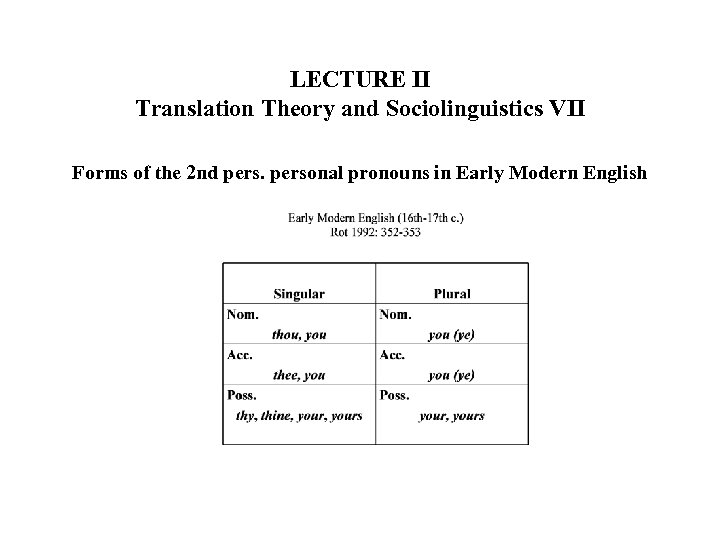 LECTURE II Translation Theory and Sociolinguistics VII Forms of the 2 nd personal pronouns in Early Modern English (16 th-17 th c. )
 LECTURE II Translation Theory and Sociolinguistics VIII • Totally fallacious conclusion: it is easier to translate Shakespeare and his contemporaries or Middle English-speaking predecessors like Chaucer, for the thou/you distinction will automatically generate the Hungarian informal or formal address. • Despite overlaps, however, the situation is not at all unambiguous: • 1/ In Shakespeare’s time you had already firmly established itself as the general form, therefore the use of thou always conveyed some special meaning or was of particular, mostly emotional, significance. 2/ There is a seemingly illogical flight between two characters from one form to the other even within one and the same scene, which hardly corresponds to the social conventions governing their use in Hungarian.
 LECTURE II Translation Theory and Sociolinguistics IX Views concerning the thou/you contrast and its functions in Renaissance English: The you of respect and politeness began to spread from about the 14 th century, under French influence. In Chaucer’s works the new role of you is well detectable (Burnley 1989: 17 -22). You was used by inferiors to address their superiors in rank or age: servants addressing masters, children addressing parents, city-dwelling (lower) middle class addressing nobles, nobles addressing the sovereign, whereas thou worked in the opposite direction of social relationships (Barber 1997: 152).
 LECTURE II Translation Theory and Sociolinguistics X Views concerning the thou/you contrast and its functions in Renaissance (Early Modern) English(from early/mid 16 th century) • • • 1/ you increasingly becoming general and neutral, reflecting human relationships exempt from any extremity, especially in the upper middle class and nobility. Unexpected thou in a situation: some emotional surplus the deviation from the common you: expression of tenderness and intimacy OR outbursts of anger, dislike or contempt (Quirk’s famous unmarked/marked contrast: 1971: 70 -73). 2/ In Renaissance dramas and, naturally, in Shakespeare, the choice between you and thou often serves as a device to characterise dramatis personae (Mc. Intosh 1963).
 LECTURE II Translation Theory and Sociolinguistics XI Views concerning the thou/you contrast and its functions in Renaissance (Early Modern) English (from early/mid 16 th century) 3/ Brown and Gilman (1960): the „power and solidarity” principle nobleman to servant: thou of condescension servant to nobleman: you of respect nobleman to nobleman: mutual you of solidarity lower classes: reciprocal thou of solidarity stranger to stranger: reciprocal you of non-solidarity 4/ Sociolinguistic and text linguistic aspects in the historical study of language thou/you contrast: temporary (and often tacitly negotiated) social status of the characters in contact (Calvo 1992); transition from you to thou or vice versa: discourse marker indicating a change in the mood and/or in the topic of the conversation.
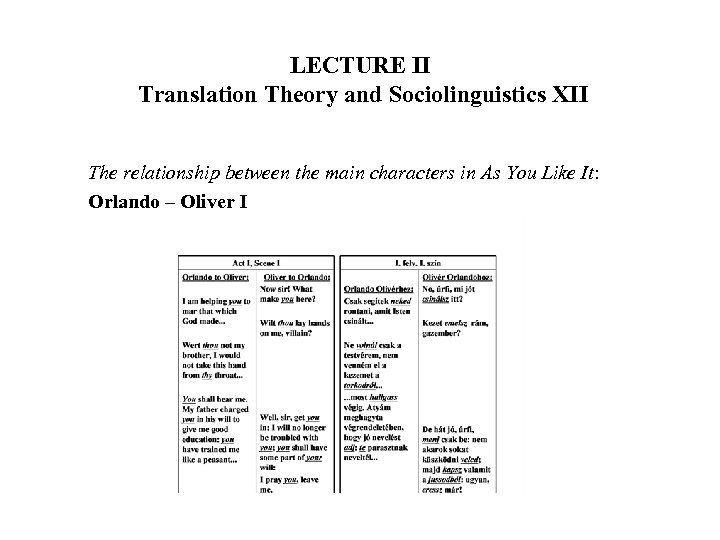 LECTURE II Translation Theory and Sociolinguistics XII The relationship between the main characters in As You Like It: Orlando – Oliver I
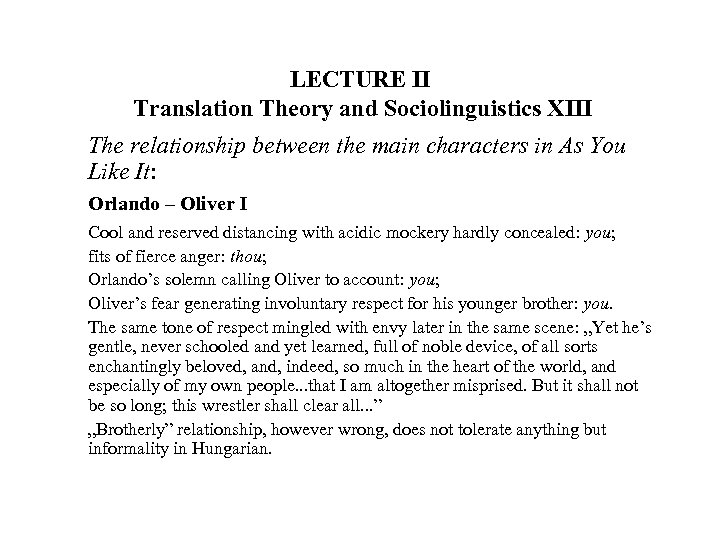 LECTURE II Translation Theory and Sociolinguistics XIII The relationship between the main characters in As You Like It: Orlando – Oliver I Cool and reserved distancing with acidic mockery hardly concealed: you; fits of fierce anger: thou; Orlando’s solemn calling Oliver to account: you; Oliver’s fear generating involuntary respect for his younger brother: you. The same tone of respect mingled with envy later in the same scene: „Yet he’s gentle, never schooled and yet learned, full of noble device, of all sorts enchantingly beloved, and, indeed, so much in the heart of the world, and especially of my own people. . . that I am altogether misprised. But it shall not be so long; this wrestler shall clear all. . . ” „Brotherly” relationship, however wrong, does not tolerate anything but informality in Hungarian.
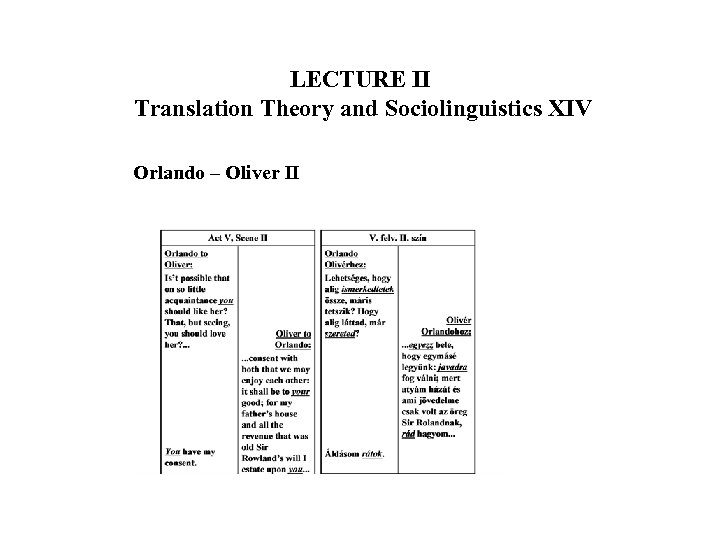 LECTURE II Translation Theory and Sociolinguistics XIV Orlando – Oliver II
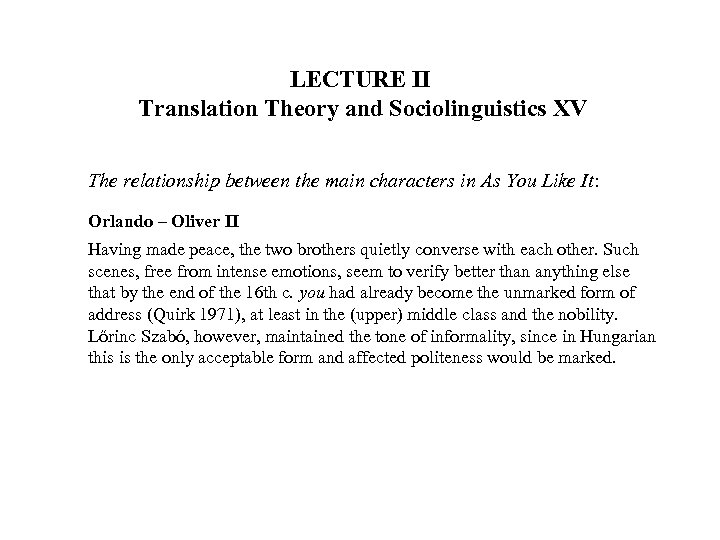 LECTURE II Translation Theory and Sociolinguistics XV The relationship between the main characters in As You Like It: Orlando – Oliver II Having made peace, the two brothers quietly converse with each other. Such scenes, free from intense emotions, seem to verify better than anything else that by the end of the 16 th c. you had already become the unmarked form of address (Quirk 1971), at least in the (upper) middle class and the nobility. Lőrinc Szabó, however, maintained the tone of informality, since in Hungarian this is the only acceptable form and affected politeness would be marked.
 LECTURE II Translation Theory and Sociolinguistics XVI
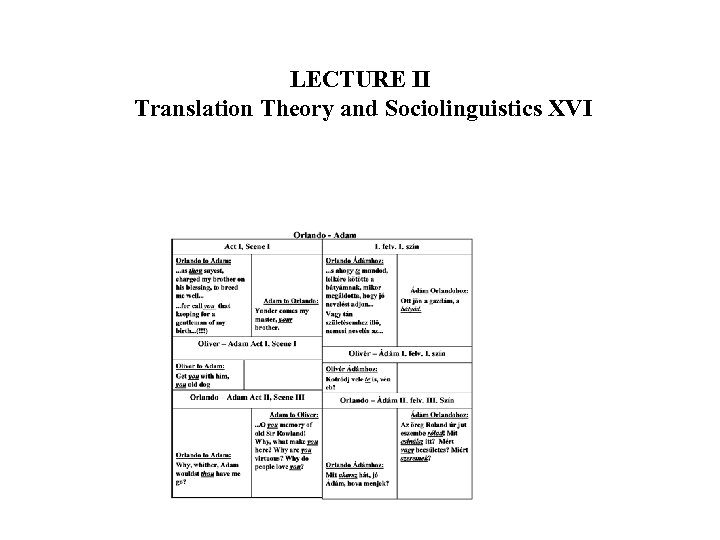
 LECTURE II Translation Theory and Sociolinguistics XVII The relationship between the main characters in As You Like It: Orlando - Adam In the English text, everyone knows their place: the lord uses thou, which the servant returns with you, even if the relationship between them can be compared to one between son and father. That is why Oliver’s you is striking: it sounds either as if the momentum of you to Orlando is maintained or active contrast (Quirk 1971) is at work: if thou is expected in a situation, you can produce an even more dramatic effect. Here Lőrinc Szabó makes no distinction whatsoever: everyone adresses everyone else informally (though Adam does not enter into a conversation with Oliver). It would really sound farcical to pair off the rude phrase vén eb (’old dog’) and a Hungarian verb form of formality. Besides, Oliver may be unwilling to undertake any solidarity with the love between Orlando and Adam (Brown and Gilman 1960). The !!! means that in that utterance the you is not directed toward Adam but is a general subject rendered by Lőrinc Szabó in the appropriate way. • What is much less noticeable for the Hungarian reader is the „Hungarian” Adam’s using the informal address with regard to Orlando. We may instinctively attribute it to the considerable age gap between them (Adam might be father or even grandfather to Orlando) as well as to their patriarchal relationship
 LECTURE II Translation Theory and Sociolinguistics XVIII Orlando-Rosalind I
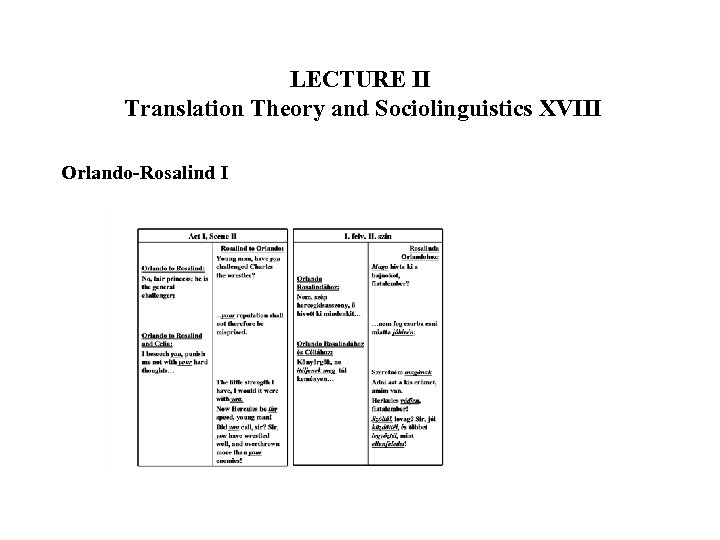
 LECTURE II Translation Theory and Sociolinguistics XIX The relationship between the main characters in As You Like It: Orlando – Rosalind I A young nobleman, well-mannered by birth, not by education, politely converses with two princesses: you (Its having been translated into Hungarian maga evokes the middle-class milieu of early last century and sounds anachronistic, although ön would be no less anachronistic, see below). But it is also in this scene that love kindles in their breasts, to which a mythological reference is also added: thy. In the renewed dialogue, Shakespeare returns to the more neutral and polite you. It is all the more interesting that Lőrinc Szabó, replacing formality with informality at the same point as Shakespeare, maintains the latter tone throughout the whole scene and applies it even to Celia. This is one of the few loci (for others, see below) where Lőrinc Szabó makes any use of this capacity of Hungarian, otherwise he does not overcomplicate his own work with the you-thou contrast.
 LECTURE II Translation Theory and Sociolinguistics XX Orlando – Rosalind II
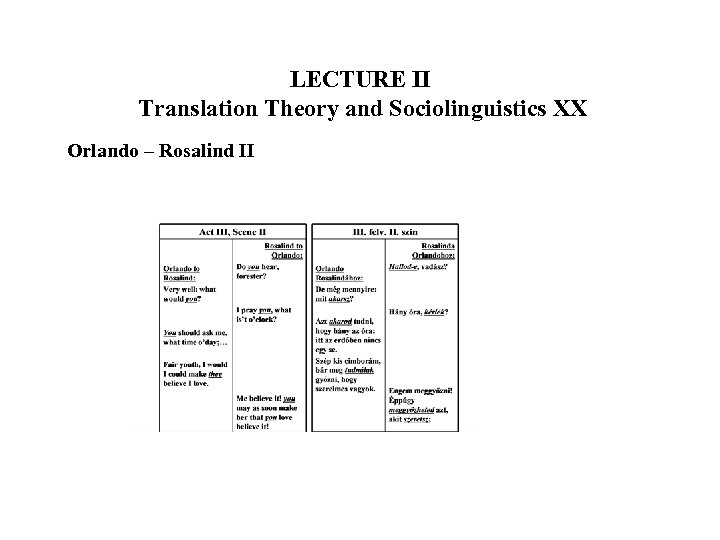
 LECTURE II Translation Theory and Sociolinguistics XXI The relationship between the main characters in As You Like It: Orlando – Rosalind II Orlando does not recognize Rosalind when they meet again in the forest. The dialogue hits the tone of two educated young men of equal social status talking to each other and begins with Rosalind’s hackneyed trick of a kerbcrawler. Mutual you is maintained until Rosalind describes what a really „love-shaked” (sic!) youth should look like. This may arouse Orlando’s passion, who switches over to thou, whereas Rosalind continues the cool and distancing you. This little play has not any reflection in the Hungarian translation – and the remark should not be taken as one of criticism.
 LECTURE II Translation Theory and Sociolinguistics XXII Orlando – Rosalind III
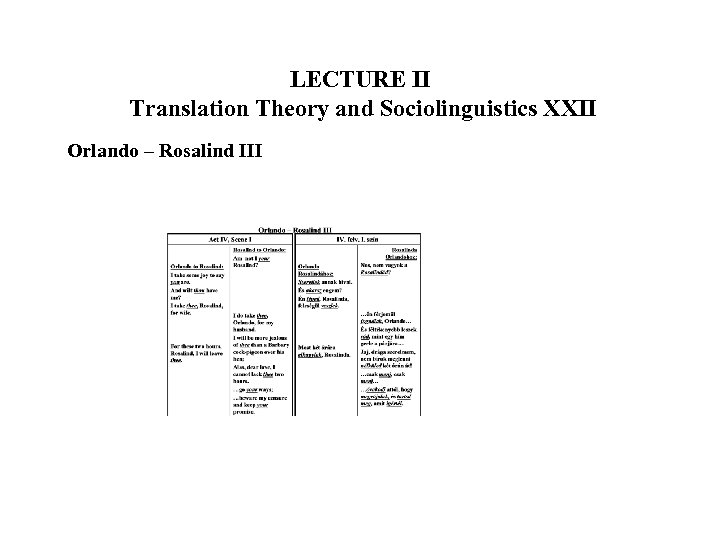
 LECTURE II Translation Theory and Sociolinguistics XXIII The relationship between the main characters in As You Like It: Orlando – Rosalind III It is in this scene that the banter of feigned courtship begins, with mutual you. Then they come to be increasingly pervaded by the spirit of the love game, especially Rosalind, as Orlando cannot have an idea who she actually is. This is reasserted by the religious elevatedness of the text of the wedding ritual, resulting in reciprocal thou. It is maintained by Orlando throughout the scene, while Rosalind sinks back into grief paired with reprimand warning, which makes her return to you.
 LECTURE II Translation Theory and Sociolinguistics XXIV Rosalind – Celia I
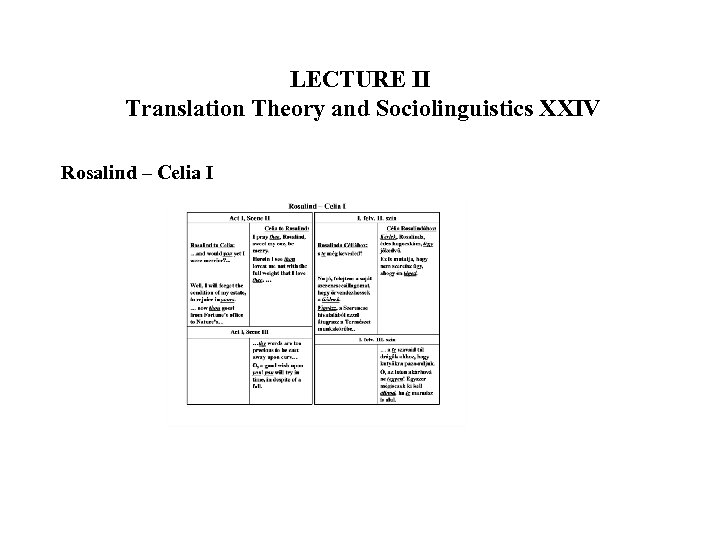
 LECTURE II Translation Theory and Sociolinguistics XXV The relationship between the main characters in As You Like It: Rosalind – Celia I Theirs is the most problematic relationship from the point of view of linguistic expression, and the flight from you to thou and back the most conspicuous. There have been several suggestions as to how this should be interpreted. Mc. Intosh (1963) holds that thou would be the expectable form of address between them, therefore the devation from it must convey some hidden content (see active contrast later in Quirk 1971). That is to say that Celia’s affection, not burdened with any complications, is perfectly represented by the prevalence of thou, whereas Rosalind, with her father being banished and her presence being hardly tolerated at the court, is much more reserved. When Celia succeeds in making her forget about her misfortune, Rosalind also switches over to thou, and in Scene III it is Celia who takes up you in a sudden fit of intense emotion. All this said, there may be an element of thruth in the statement that in the usurper duke’s court the use of you is typical of Rosalind, who seems to be a little over-idealised anyway, while Celia, somewhat rash and impetuous by nature, is aptly characterised by the proliferation of the instances of thou, which can be taken as the linguistic evidence supporting the image having generally been formed of them. To reflect this in Hungarian by means of contrasting informality with formality would be absurd, considering the relationship between two teenage female friends.
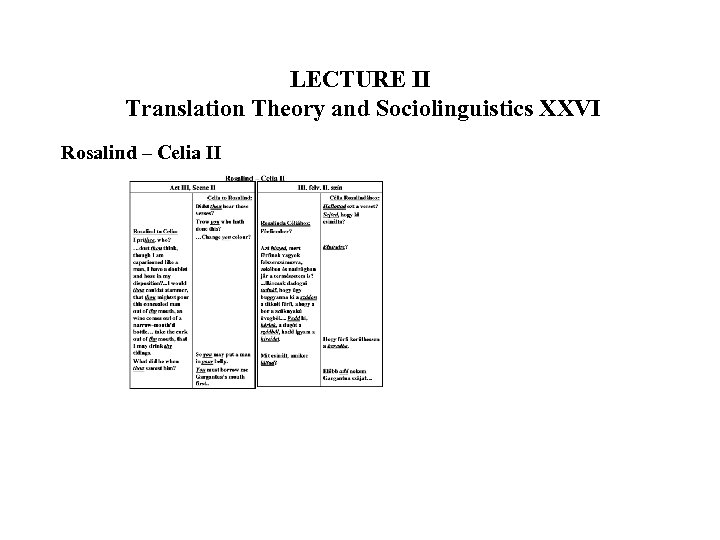 LECTURE II Translation Theory and Sociolinguistics XXVI Rosalind – Celia II
 LECTURE II Translation Theory and Sociolinguistics XXVII The relationship between the main characters in As You Like It: Rosalind – Celia II The reverse of the one above: Rosalind using much more instances of thou and Celia adhering to you. Possible explanations: a/ in the forest of Arden Rosalind is in power, she is the „man”, even if disguised, her father is the ruler in the forest and her lover is nearby: too many reasons for her to feel too self-confident over Celia, who has lost her dominant position. Mc. Intosh (1963: 75 -77): Rosalind’s suddenly changing the forms can be attributed to her being distracted by Orlando’s presence; Celia’s overuse of you: her impatient character and worry, tinted with a shade of jealousy, about Orlando and Rosalind’s relationship. Mc. Intosh: the main function of the contrast is the expression of the difference in the two girls’ characters. b/ Calvo (1992: 14): active contrast (reference to Quirk 1971); opposed to the general and neutral you, reflecting a cool and reserved attitude tinged with irony, with which the characters demarcate themselves from the situation their partner is in, is thou, emotionally (over)loaded even between Rosalind and Celia. All this is supported by forms of address other than thou and its grammatical accompaniments: „O coz, my pretty little coz” (Ó húgom, szépséges kis húgocskám, Act IV, Scene I), „sweet my coz” (édes húgocskám, Act I, Scene II), „my sweet Rose, my dear Rose” (édes Rózsikám, drága Rosalindám, Act I, Scene II). c/ Calvo (1992: 16 -19) : one of the reasons why Celia uses thou in Act I is that she does everything she can to involve Rosalind in the group she belongs to and the more expressive the form, the more suitable for the purpose. Rosalind, on the other hand, stays aloof from that group with what can be called negative politeness and sticks to the unmarked you. In the forest is just the opposite: Rosalind chooses thou to get Celia involved in the game. Celia, however, puts on the affected airs of a witty courtier and remains outside Orlando and Rosalind’s relationship. Consequently, both in Act I and III the message the two characters send to each other during these ingenious exchanges of ideas, which sometimes have the sharpness of a sabre blade edge, is that I do not want to interfere with your affairs, this your business alone and I cannot identify myself with it. d/ The sudden pronoun switches can function as discourse markers: in the above example, when they start the conversation by chatting about the poems only, Celia also uses thou. When, however, she touches upon their author, she comes up with you, which is immediately sensed by Rosalind, who takes the lead in the argument, by putting questions herself rather than just answering Celia’s e/ All this is totally lost in the translation and, of course, it is not Lőrinc Szabó who is at fault: the Hungarian forms are incapable of expressing these subtleties. Being on formal or informal terms means that one cannot change positions in a situation at will.
 LECTURE II Translation Theory and Sociolinguistics XXVIII Conclusions • • 1/ The possible interpretations and theories of Early Modern English and, of course, Shakespearean thou/you contrast, from the traditional description (e. g. Barber 1997: 152 -156) to Calvo’s discourse analysis, do not contradict but complement each other with either the one or the other(s) being more applicable to the evaluation of a particular situation. What seems to be the most probable, however, is that a combination of all these approaches holds in most cases. 2/ The analysis of the Hungarian translation from this point of view does not require too much effort, since Lőrinc Szabó has hardly translated anything of the subtleties detectable in the English text of As You Like It. 3/ Neither he, nor any other Hungarian translator of Shakespeare can be blamed for this, because – as mentioned above – a/ in (modern) Hungarian society the social rules governing the use of the forms of informal and polite address are completely different; b/ Shakespeare is a 16 th century Renaissance author, in whose language the distinction was still alive, although on the verge of becoming extinct, whereas in contemporary Hungarian the pronouns of polite address like (te) kegyelmed, (te) nagyságod, accompanied by 2 nd or 3 rd person verbs existed only in their germs. The first sporadic occurrences of maga are dated with the mid-17 th century only (see Kertész 1931: 102 -125 for details). 4/ Consequently, all Hungarian translators commit the act of anachronism if they apply (present-day) polite forms. It cannot be by chance that the most thorough analysis of Lőrinc Szabó’s (and others’) translation(s) of As You Like It (Vargha 1991: 25 -82) does not give a single word of consideration the reflection of the thou/you contrast as a problem of either translator or translation. Translating habits vary from play to play and translator from translator. Those interested in how all this stock of problems is being fought with in the translator’s study room are referred to the noted Shakespeare-translator and expert Ádám Nádasdy’s essay, attached to his translation of A Midsummer Night’s Dream, published in 1995.
 LECTURE II Translation Theory and Sociolinguistics XXIX What has sociolinguistics to offer to TT? • adequate and well grounded description of : • the relation of the SL and SL society to the TL and TL society; • Helping to solve problems of translation/interpreting deriving from cultural/social differences (case studies of court trials in Sweden and Israel