


 Скачать презентацию Lecture four The Greek-Turkish Exchange of populations
lecture 4 .ppt
- Количество слайдов: 29
 Lecture four The Greek-Turkish Exchange of populations
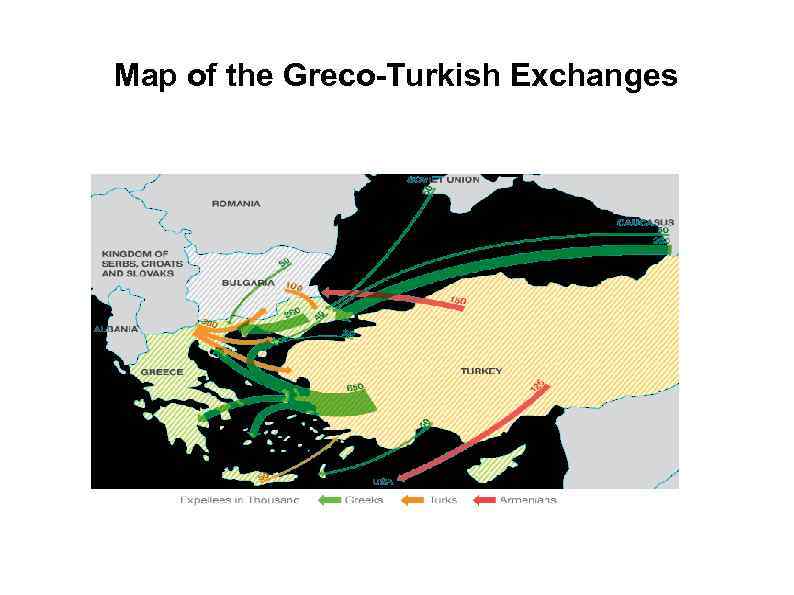 Map of the Greco-Turkish Exchanges
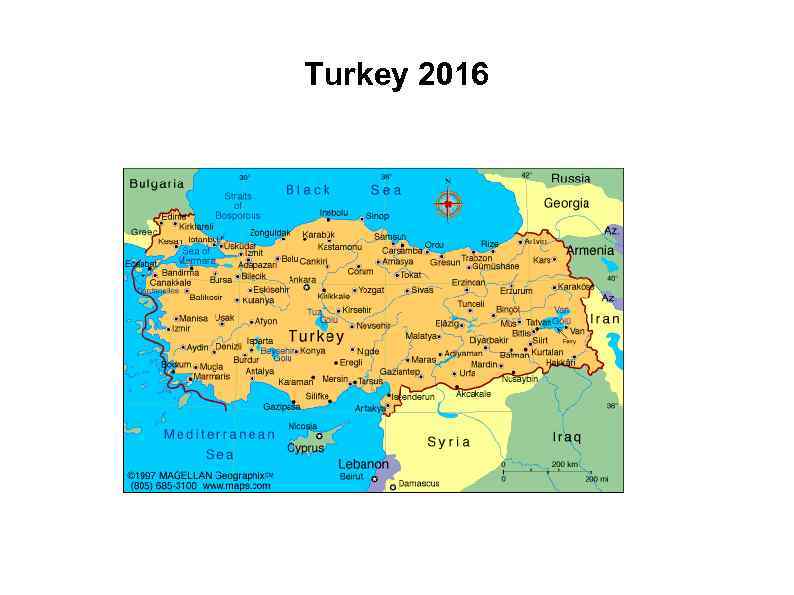 Turkey 2016
 Two very different narratives a) For Greeks – greatest tragedy in modern Greek history – loss of Asia Minor b) For Turks- successful war of independence in the face of adversity - Culturally and historically important for both countries – but from very different perspectives - On both sides considerable social, economic and political consequences of the exchanges - Crucial impact on international law – one of the most important reasons for studying this topic
 Things to think about during the lecture 1) Were the exchanges worth it? 2) What kind of a precedent did the exchanges set for the international community? 3) What does displacement tell us about the development of national identities and national narratives? 4) How were the displaced treated during and after the time of movement?
 Lecture run-down 1) Population exchanges in the Twentieth century. 'Legalised ethnic cleansing'? History and approaches 2) Nationalism in the Ottoman Empire – revision 3) The position of Greeks within the Empire 4) The First World War to the Evacuation of Smyrna/Izmir 5) The Treaty of Lausanne and the exchanges 6) The consequences of Lausanne – Overview 7) Situation of the displaced after the exchanges 8) Conclusions
 1) Population exchanges in the Twentieth century. 'Legalised ethnic cleansing'? History and approaches 'Legalised ethnic cleansing'? The internationally recognised face of ethnic cleansing a) History of population exchanges i) Beginnings around the time of the First World War – in the Balkans – principle of selfdetermination ii) Massive population exchanges during the Second World War – Nazi movements Iii) Immediate post Second World War era saw a host of population exchanges – Poles, Germans, partition of India iv) Dayton Accords 1995 - Yugoslavia But Treaty of Lausanne – paradigmatic population exchange – referred to as a successful operation post WWII
 1) Population exchanges in the Twentieth century. 'Legalised ethnic cleansing'? History and approaches - continued b) The effectiveness of the exchanges: i) International relations approach – most important concern is national security – Michael Barutciski – prevention of massaces all important ii) Social sciences/humanities approach – ethical and moral aspects of exchanges and the danger of creating nationalist myths c) Legal issues: i) Compulsary/Voluntary exchanges – Lausanne compulsary, others not ii) Right to return/compensation – normally one or the other – Palestinian case – theoretically have the right to return but not able to, neither
 Citations from Hirschon 'Indeed, the Treaty of Lausanne is held by many in these disciplines as one of the most durable of the twentieth century since it ended the political and territorial fragmentation in that part of the region (in contrast with the situation in the former Yugoslavia in the 1990 s and ongoing instability in the present) ' International relations' approach 'Through time, the process of separation rather than symbiosis inevitably entails diminished contact. The loss of shared experience is accompanied by growing ignorance of the ways of others; thus, separation entails the loss of ground for communication. What is lost is familiarity which carries with it the possibility for understanding and respect, and this is all too often replaced by suspicion, hostility and the inability to cooperate ' 'We should therefore consider the feasibility, viability and indeed, the desirability of the long-term separation or 'unmixing' of peoples, as a way to go forward in the modern world. ' Social sciences' approach 'For many observers, this feature makes it an unacceptable model for the international community's attempts to deal with threatened minorities' Compulsary exchanges
 2) Nationalism in the Ottoman Empire – revision a) Millet system b) Urge to reform, rise of nationalism c) Radicalisation of war (Balkan Wars and First World War) d) Genocide of the Armenians e) Turkification of the Empire
 3) The position of Greeks within the Empire a) Similar to Armenians in that: i) Many wealthy merchants and members of the bourgeoisie ii) Had inhabited Western Anatolia long before the Turks had b) But different as: i) Greece had been an independent state since 1830 – Ottomans have to respect rights of their Greek subjects more ii) Despite this – Greece fought against the Ottomans in the Balkan wars in 1912 -3 – something that led to Ottoman discussions in 1913 about population transfers c) Greeks dominant in big cities of Smyrna/Izmir, Samsun – culturally and economically powerful there
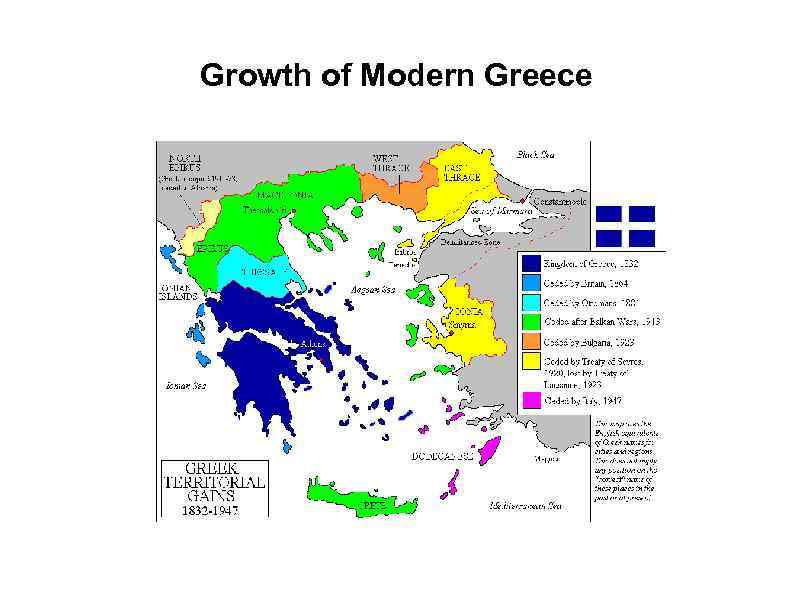 Growth of Modern Greece
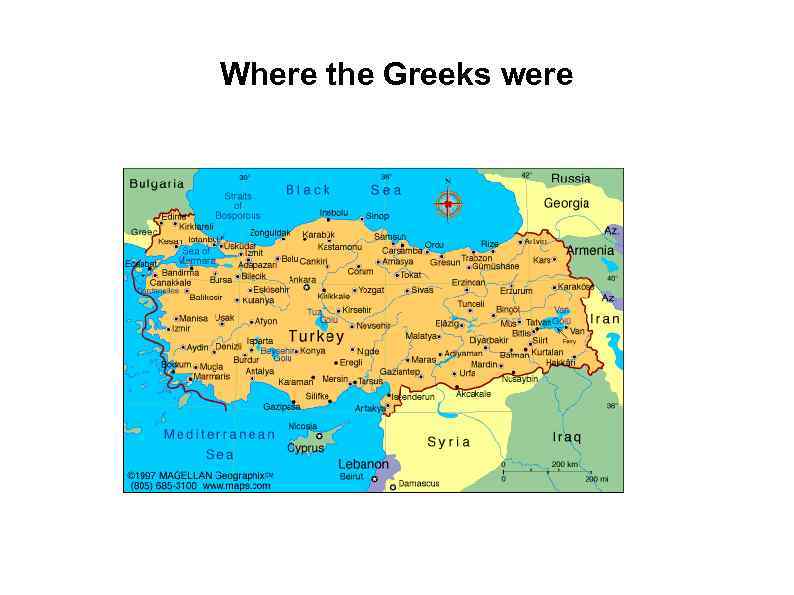
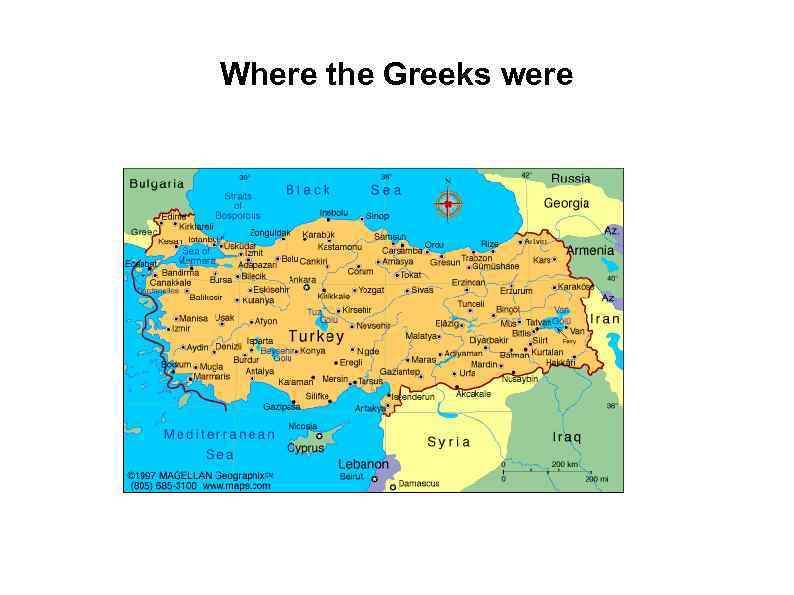 Where the Greeks were
 4) World War I and the moves towards the transfers a) Greek state initially neutral in the war b) Deportation of Greeks to the Anatolian interior and many work in labour battalions c) Greeks enter war on side of allies 1917 – promised gains – The 'Megali idea. ' d) 1918 -9 – Greek army occupies Smyrna/Izmir and environs e) Treaty of Sevres 1920 – Greece gets lands near Izmir f) Greeks however get overconfident - invade the Anatolian interior in July 1921 - get to Ankara g) Turks reorganise around Attaturk – from his base in Eastern Anatolia – September 1919 – national pact h) Turkish counter-attack August/September 1921 - drives Greeks back to Smyrna – ethnic cleansing by Turkish army i) The Great fire of Smyrna/Izmir – September 1922 – Mass evacuation of Greeks
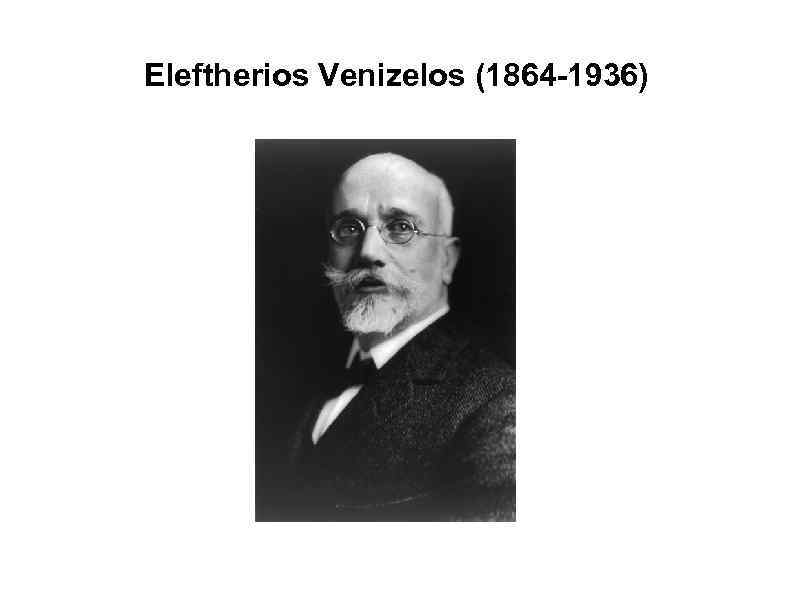 Eleftherios Venizelos (1864 -1936)
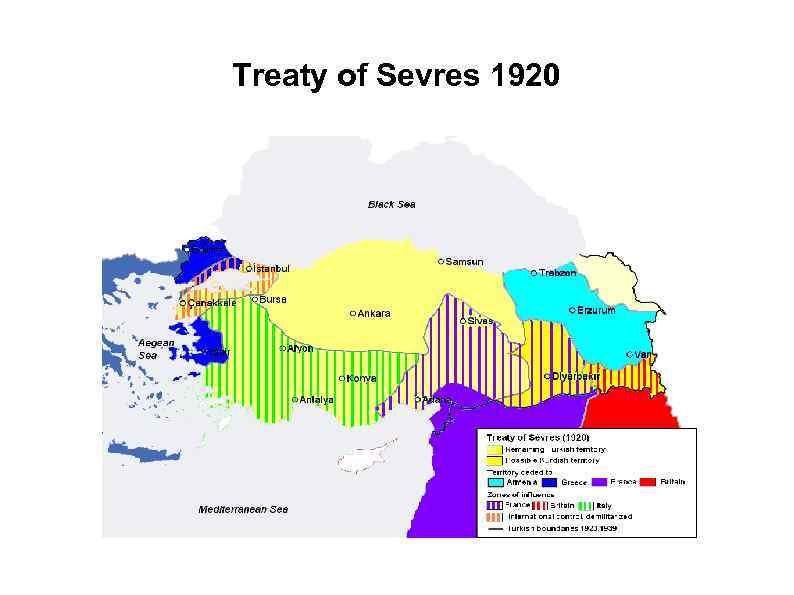 Treaty of Sevres 1920
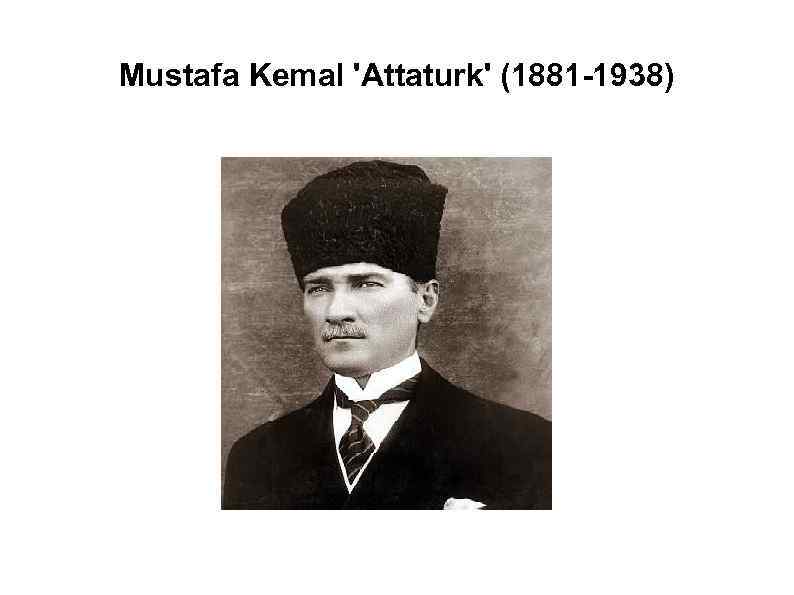 Mustafa Kemal 'Attaturk' (1881 -1938)
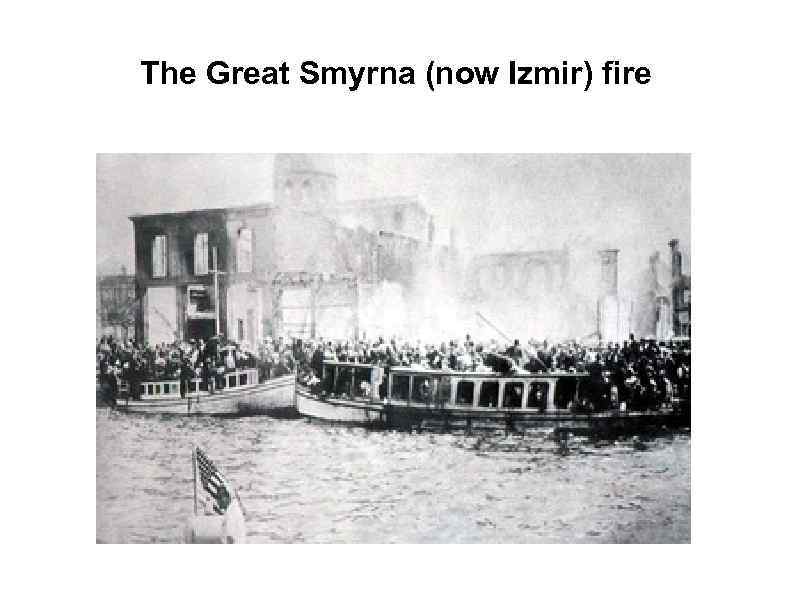 The Great Smyrna (now Izmir) fire
 5)Treaty of Lausanne and the exchanges a) Attaturk in a strong position after the victory over the Greeks b) Many Greeks moved out of Anatolia before a peace treaty signed c) Ataturk puts pressure on for compulsary exchanges – creation of an ethnically pure Anatolian Turkish homeland d) Discussions regarding amending the treaty of Sevres – movement of Greeks and Turks across national boundaries e) Treaty of Lausanne – June 1923 – mixed property commissions set up f) Important to remember that most Greeks (app. 1 million) already evacuated prior to the Treaty g) 200, 000 Greeks and 350, 000 Turks move due to the treaty h) Ethnic purging of both states
 Naimark on the exchanges 'It was absolute, precluding any choice: those who had fled with only their clothes were not allowed to return, and the expulsion was to include others defined by the criteria of religion and nationality laid down by the Convention. Significantly, this reveals a feature common to many examples of expulsions in conflict situations - the legal framework is placed upon and institutionalises an already existing de facto population displacement ' 'The Treaty of Lausanne can hardly be considered a creative international solution to minority problems; instead it finished the job of ethnic cleansing and legitimised the Turkish nationalists' desires to homogenise their Anatolian homeland'
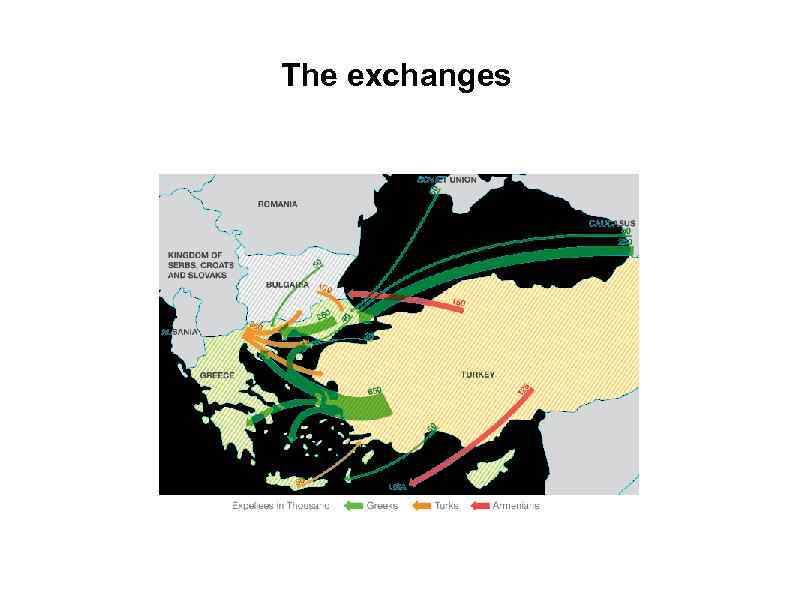 The exchanges
 6) The consequences of Lausanne – Overview Wide ranging effects, political, economic, cultural, social a) Assymetry of the exchanges – very different perspectives on both sides i) Greeks – tragedy, Turks – founding myth of the state ii) Scale and character of the populations involved b) Demographic effects i) Greek territories packed due to the influx of refugees – Turkish territory emptied ii) Both states become much more ethnically homogenous as a result of the transfers c) Economic effects i) Turkey – loses large parts of its bourgeoisie and trading classes ii) Greece – gains productive classes, but has to deal financially with refugees
 6) The consequences of Lausanne – Overview d) Political effects i) Greece - many refugees not integrated properly – they often turn to support the left ii) Turkey – loss of business elites strenghens the state, nationalism increases due to homogenity e) Cultural effects i) Asia Minor Greeks – culturally rich – artistically – music/literature created based on the loss of the old homeland ii) Turkey – little cultural impact of the new arrivals – absence of narrative regarding those who left f) Social effects i) Greece – often new arrivals poorly treated by locals– leads to discontent eventually ii) Turkey – new arrivals also often treated poorly – seen as 'half-infidels. ' The exchanges had major effects across the board – many of them not very positive.
 7) Situation of the refugees after the exchanges a) Greek refugees i) Greek refugees gradually displaced between 1921 to 1923 – main route – Black sea >>>Istanbul >>> evacuation to the Greek mainland ii) They experience very poor conditions during evacuation, poor conditions on ships etc iii) By middle of 1923 Athens had become a 'refugee city' iv) Integration problems for the Greek government – lack of hospital beds, medical supplies v) Relief efforts – large international relief effort between 1921 -3 vi) Clashes between locals and new arrivals vii) Two narratives regarding the integration of Greek refugees: a) Success narrative – Support of refugees by the Refugee Settlement Commission b) Negative long-term effects – due to the poor treatment of refugees, lack of integration
 7) Situation of the refugees after the exchanges b) Turkish refugees i) Almost all wait until after the treaty to move ii) Move in better conditions than the Greeks – but relief not really availble for the refugees Iii) Turkish government doesn't plan resettlement effectively – no distinction between urban/rural settlers iv) Bad relationship locals/new arrivals – Samsun – tensions continue until the 1930 s v) No organisation to complain to
 Where the Greeks were
 Problems for the displaced 'Upon the departure of Muslims from the region, local powerful notables and other members of local communities, rich and poor alike, seized their fields and buildings. These properties could only be expropriated by the government in the late 1920 s with a view to being distributed to the refugees' Karakasidou, Fields of wheat. 'In Izmir many houses and business premises abandoned by Greeks and Armenians and earmarked for the refugees had been occupied by a diverse group of people prior to the arrival of the newcomers' Yildirim, Diplomacy and Displacement
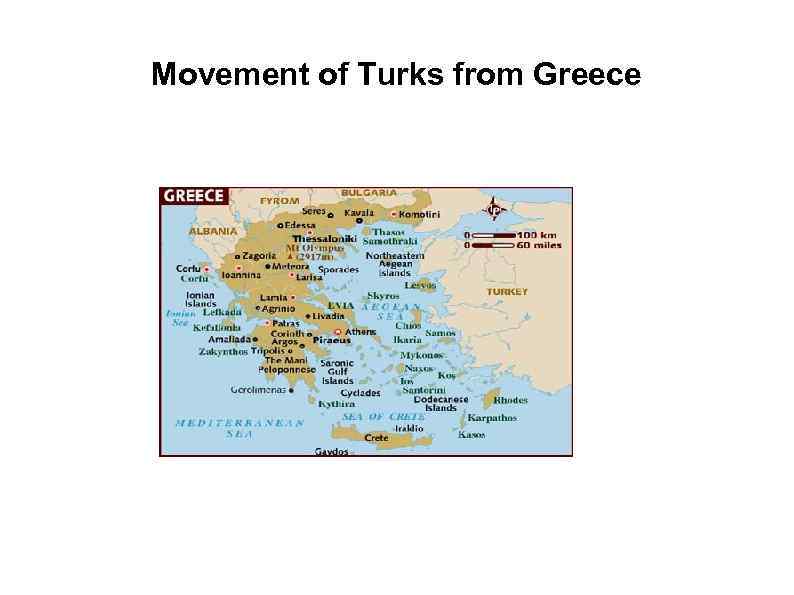 Movement of Turks from Greece
 Conclusions 1) Were they worth it? Helps regional security, prevents death but awful human and societal cost - 2) Precedent of the exchanges? Bad precedent - State rights more important than individual rights - Good precedent - at least it gives states a last resort in times of acute crisis 3) National identities? Exchanges mean the strengthening of Turkish nationalist narratives, Greek – dominant narrative that of loss 4) Treatment of refugees? A close analysis shows in both cases bad treatment and clashes between local populations -in Greek situation – at least there was a higher body to which they could complain