


 Скачать презентацию Lecture DRAM Main Memory Topics virtual memory
155fca152d96ac0d7de828eebf4ebf8a.ppt
- Количество слайдов: 24
 Lecture: DRAM Main Memory • Topics: virtual memory wrap-up, DRAM intro and basics (Section 2. 3) 1
 TLB and Cache 2
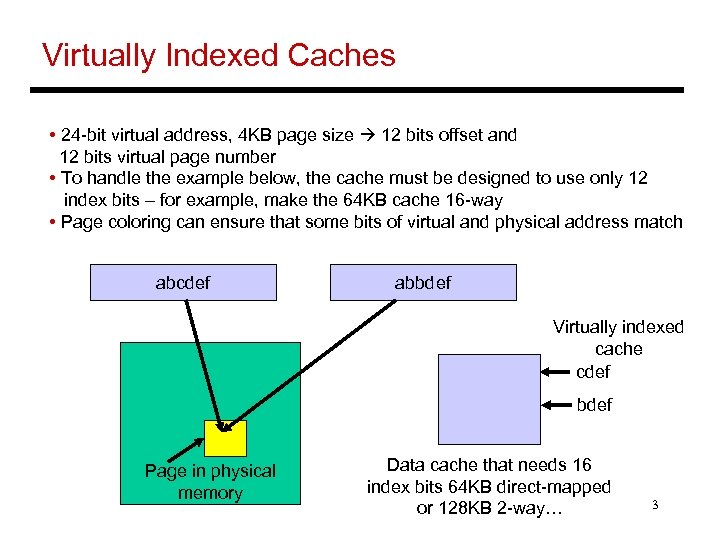 Virtually Indexed Caches • 24 -bit virtual address, 4 KB page size 12 bits offset and 12 bits virtual page number • To handle the example below, the cache must be designed to use only 12 index bits – for example, make the 64 KB cache 16 -way • Page coloring can ensure that some bits of virtual and physical address match abcdef abbdef Virtually indexed cache cdef bdef Page in physical memory Data cache that needs 16 index bits 64 KB direct-mapped or 128 KB 2 -way… 3
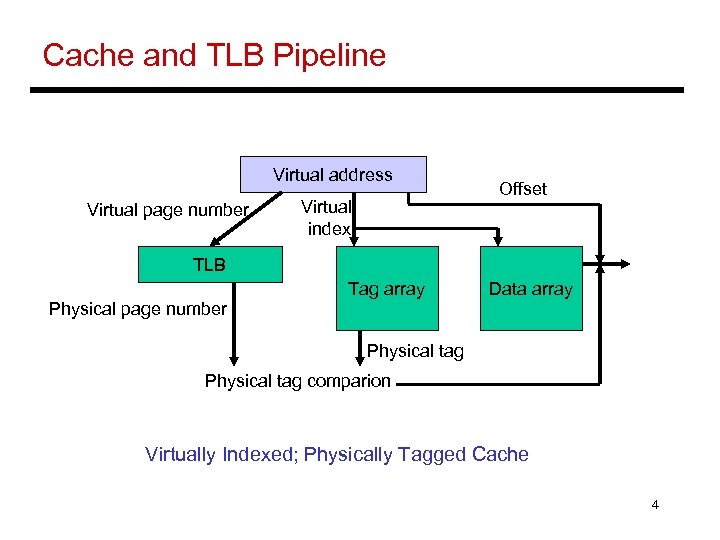 Cache and TLB Pipeline Virtual address Virtual page number Virtual index Offset TLB Tag array Data array Physical page number Physical tag comparion Virtually Indexed; Physically Tagged Cache 4
 Problem 3 • Assume that page size is 16 KB and cache block size is 32 B. If I want to implement a virtually indexed physically tagged L 1 cache, what is the largest direct-mapped L 1 that I can implement? What is the largest 2 -way cache that I can implement? 5
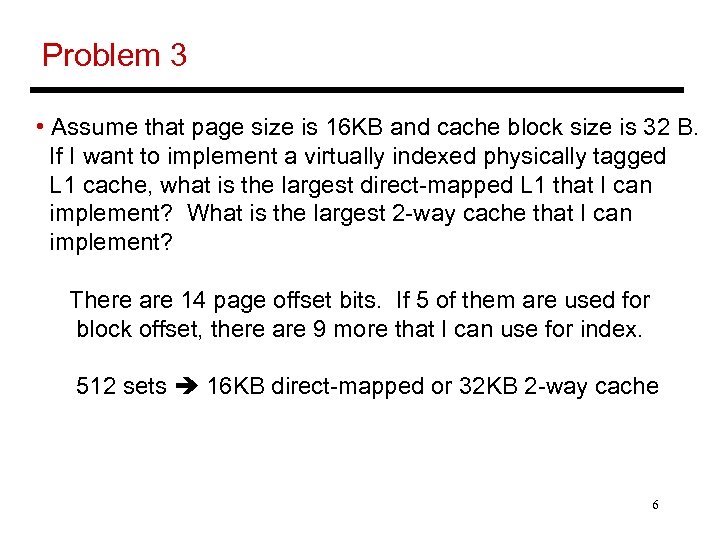 Problem 3 • Assume that page size is 16 KB and cache block size is 32 B. If I want to implement a virtually indexed physically tagged L 1 cache, what is the largest direct-mapped L 1 that I can implement? What is the largest 2 -way cache that I can implement? There are 14 page offset bits. If 5 of them are used for block offset, there are 9 more that I can use for index. 512 sets 16 KB direct-mapped or 32 KB 2 -way cache 6
 Protection • The hardware and operating system must co-operate to ensure that different processes do not modify each other’s memory • The hardware provides special registers that can be read in user mode, but only modified by instrs in supervisor mode • A simple solution: the physical memory is divided between processes in contiguous chunks by the OS and the bounds are stored in special registers – the hardware checks every program access to ensure it is within bounds • Protection bits are tracked in the TLB on a per-page basis 7
 Superpages • If a program’s working set size is 16 MB and page size is 8 KB, there are 2 K frequently accessed pages – a 128 -entry TLB will not suffice • By increasing page size to 128 KB, TLB misses will be eliminated – disadvantage: memory waste, increase in page fault penalty • Can we change page size at run-time? • Note that a single page has to be contiguous in physical memory 8
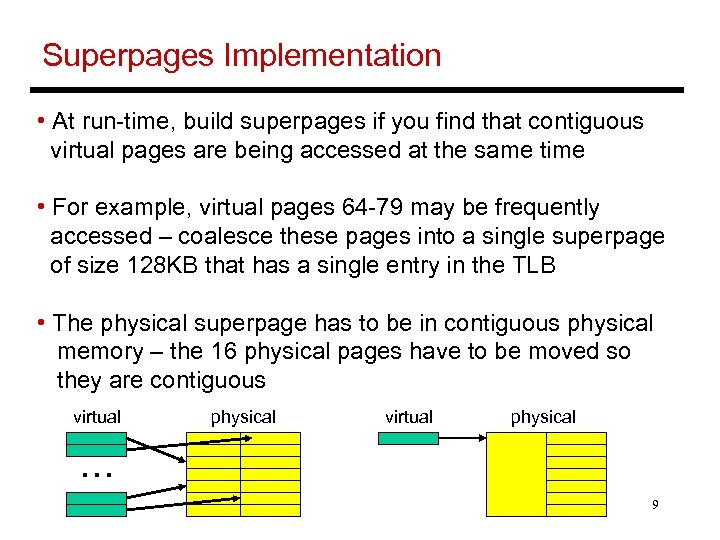 Superpages Implementation • At run-time, build superpages if you find that contiguous virtual pages are being accessed at the same time • For example, virtual pages 64 -79 may be frequently accessed – coalesce these pages into a single superpage of size 128 KB that has a single entry in the TLB • The physical superpage has to be in contiguous physical memory – the 16 physical pages have to be moved so they are contiguous virtual physical … 9
 Ski Rental Problem • Promoting a series of contiguous virtual pages into a superpage reduces TLB misses, but has a cost: copying physical memory into contiguous locations • Page usage statistics can determine if pages are good candidates for superpage promotion, but if cost of a TLB miss is x and cost of copying pages is Nx, when do you decide to form a superpage? • If ski rentals cost $50 and new skis cost $500, when do I decide to buy new skis? Ø If I rent 10 times and then buy skis, I’m guaranteed to not spend more than twice the optimal amount 10
 DRAM Main Memory • Main memory is stored in DRAM cells that have much higher storage density • DRAM cells lose their state over time – must be refreshed periodically, hence the name Dynamic • DRAM access suffers from long access time and high energy overhead 11
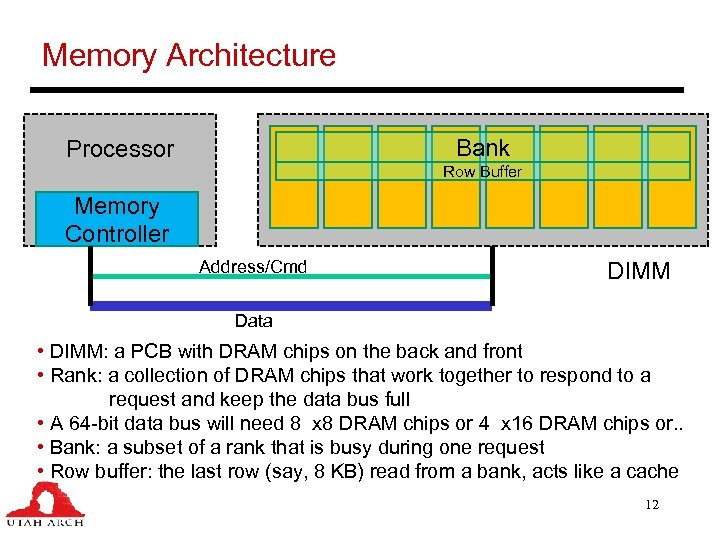 Memory Architecture Bank Processor Row Buffer Memory Controller Address/Cmd DIMM Data • DIMM: a PCB with DRAM chips on the back and front • Rank: a collection of DRAM chips that work together to respond to a request and keep the data bus full • A 64 -bit data bus will need 8 x 8 DRAM chips or 4 x 16 DRAM chips or. . • Bank: a subset of a rank that is busy during one request • Row buffer: the last row (say, 8 KB) read from a bank, acts like a cache 12
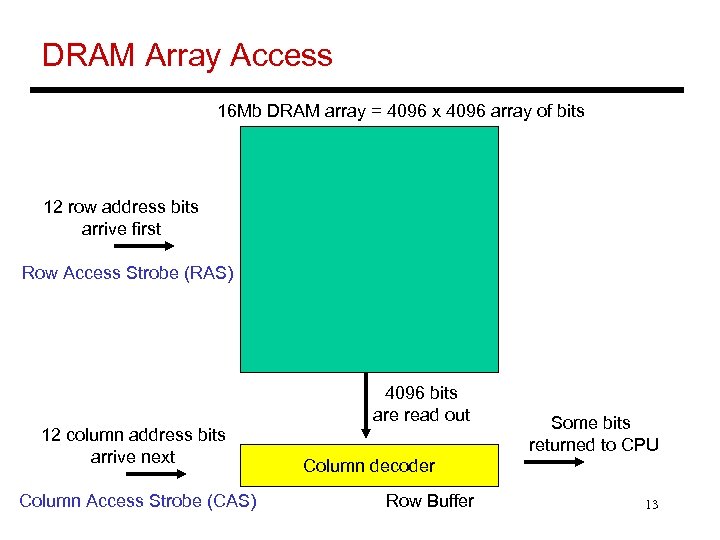 DRAM Array Access 16 Mb DRAM array = 4096 x 4096 array of bits 12 row address bits arrive first Row Access Strobe (RAS) 4096 bits are read out 12 column address bits arrive next Column Access Strobe (CAS) Some bits returned to CPU Column decoder Row Buffer 13
 Organizing a Rank • DIMM, rank, bank, array form a hierarchy in the storage organization • Because of electrical constraints, only a few DIMMs can be attached to a bus • One DIMM can have 1 -4 ranks • For energy efficiency, use wide-output DRAM chips – better to activate only 4 x 16 chips per request than 16 x 4 chips • For high capacity, use narrow-output DRAM chips – since the ranks on a channel are limited, capacity per rank is boosted by having 16 x 4 2 Gb chips than 4 x 16 2 Gb chips 14
 Organizing Banks and Arrays • A rank is split into many banks (4 -16) to boost parallelism within a rank • Ranks and banks offer memory-level parallelism • A bank is made up of multiple arrays (subarrays, tiles, mats) • To maximize density, arrays within a bank are made large rows are wide row buffers are wide (8 KB read for a 64 B request, called overfetch) • Each array provides a single bit to the output pin in a cycle (for high density) 15
 Problem 1 • What is the maximum memory capacity supported by the following server: 2 processor sockets, each socket has 4 memory channels, each channel supports 2 dual-ranked DIMMs, and x 4 4 Gb DRAM chips? 16
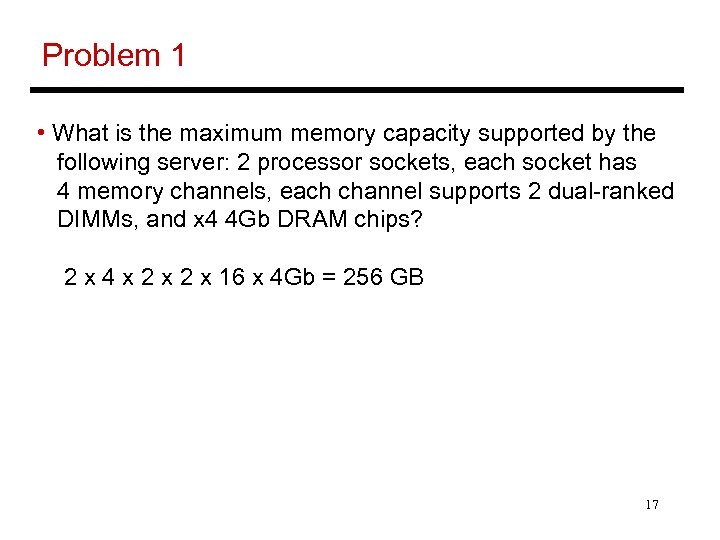 Problem 1 • What is the maximum memory capacity supported by the following server: 2 processor sockets, each socket has 4 memory channels, each channel supports 2 dual-ranked DIMMs, and x 4 4 Gb DRAM chips? 2 x 4 x 2 x 16 x 4 Gb = 256 GB 17
 Problem 2 • A basic memory mat has 512 rows and 512 columns. What is the memory chip capacity if there are 512 mats in a bank, and 8 banks in a chip? 18
 Problem 2 • A basic memory mat has 512 rows and 512 columns. What is the memory chip capacity if there are 512 mats in a bank, and 8 banks in a chip? Memory chip capacity = 512 x 8 = 1 Gb 19
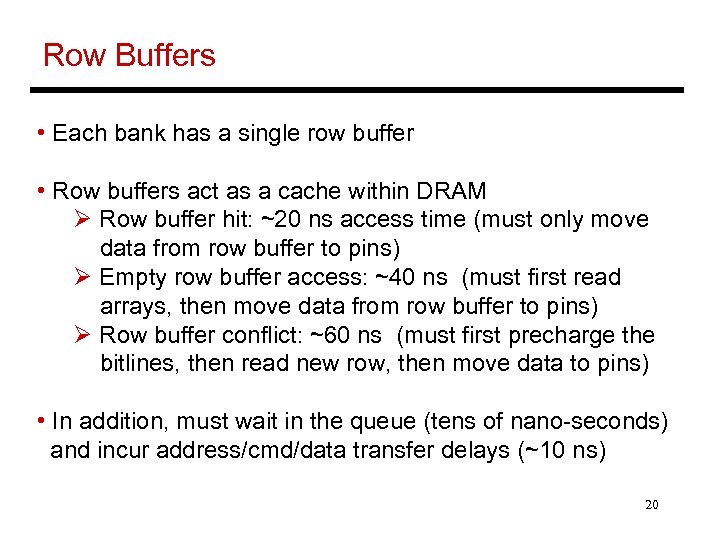 Row Buffers • Each bank has a single row buffer • Row buffers act as a cache within DRAM Ø Row buffer hit: ~20 ns access time (must only move data from row buffer to pins) Ø Empty row buffer access: ~40 ns (must first read arrays, then move data from row buffer to pins) Ø Row buffer conflict: ~60 ns (must first precharge the bitlines, then read new row, then move data to pins) • In addition, must wait in the queue (tens of nano-seconds) and incur address/cmd/data transfer delays (~10 ns) 20
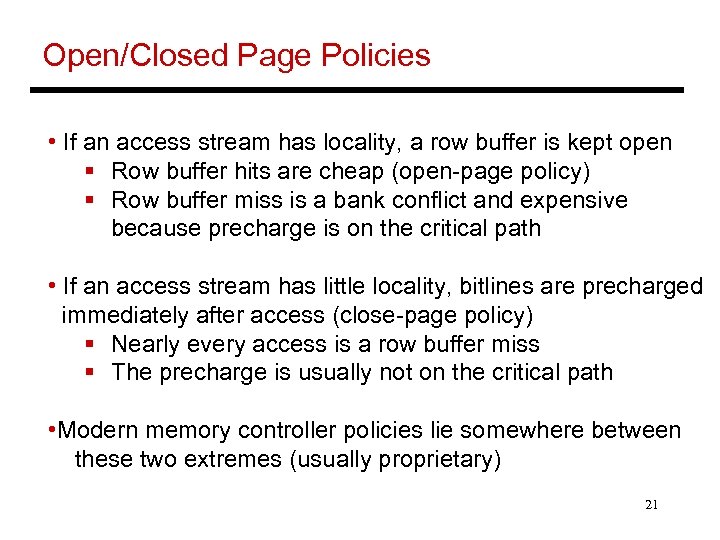 Open/Closed Page Policies • If an access stream has locality, a row buffer is kept open § Row buffer hits are cheap (open-page policy) § Row buffer miss is a bank conflict and expensive because precharge is on the critical path • If an access stream has little locality, bitlines are precharged immediately after access (close-page policy) § Nearly every access is a row buffer miss § The precharge is usually not on the critical path • Modern memory controller policies lie somewhere between these two extremes (usually proprietary) 21
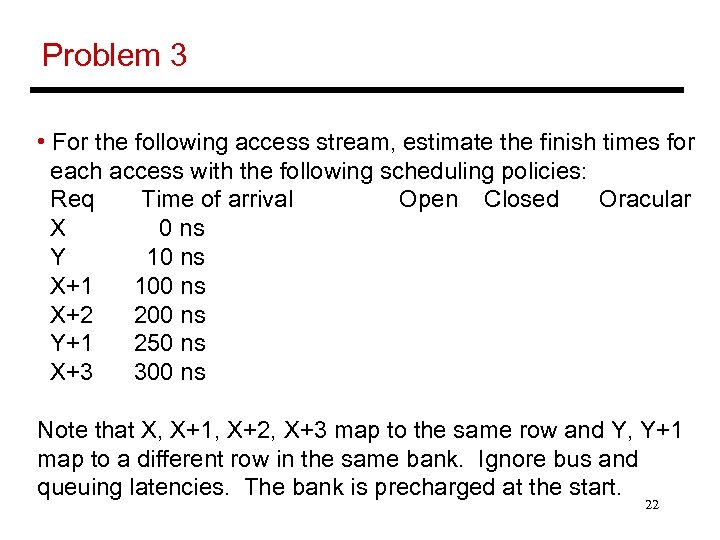 Problem 3 • For the following access stream, estimate the finish times for each access with the following scheduling policies: Req Time of arrival Open Closed Oracular X 0 ns Y 10 ns X+1 100 ns X+2 200 ns Y+1 250 ns X+3 300 ns Note that X, X+1, X+2, X+3 map to the same row and Y, Y+1 map to a different row in the same bank. Ignore bus and queuing latencies. The bank is precharged at the start. 22
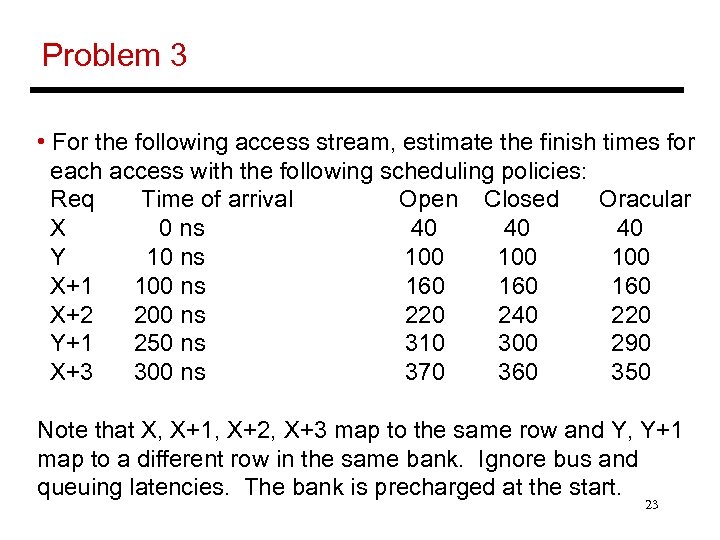 Problem 3 • For the following access stream, estimate the finish times for each access with the following scheduling policies: Req Time of arrival Open Closed Oracular X 0 ns 40 40 40 Y 10 ns 100 100 X+1 100 ns 160 160 X+2 200 ns 220 240 220 Y+1 250 ns 310 300 290 X+3 300 ns 370 360 350 Note that X, X+1, X+2, X+3 map to the same row and Y, Y+1 map to a different row in the same bank. Ignore bus and queuing latencies. The bank is precharged at the start. 23
 Title • Bullet 24