


 Скачать презентацию Lecture 9_Pricing CHAPTER PRICING PRODUCTS AND SERVICES Associate
Questuins 31,32,34 - Lecture09.ppt
- Количество слайдов: 48
 Lecture 9_Pricing CHAPTER PRICING PRODUCTS AND SERVICES Associate professor of Plekhanov REA marketing department Irina I. Skorobogatykh (Ph. D) Marketing, lecture 10 ass. prof. Skorobogatykh (Ph. D) 1 Slide 12 -2
 LECTURE QUESTIONS: • Elements of price. • Demand-oriented, cost-oriented, profitoriented, and competition-oriented approaches to pricing Marketing, lecture 10 ass. prof. Skorobogatykh (Ph. D) 2 Slide 12 -5
 LECTURE QUESTIONS: • Explain what a demand curve is and what price elasticity of demand means. • Explain the role of revenues (sales) and costs in pricing decisions. • Understand the value of break-even analysis. Marketing, lecture 10 ass. prof. Skorobogatykh (Ph. D) 3 Slide 12 -6
 LECTURE QUESTIONS: • The objectives a firm has in setting prices and the constraints on the range of prices a firm can charge. • Describe the special adjustments made to the approximate price level on the basis of geography, discounts, and allowances. Marketing, lecture 10 ass. prof. Skorobogatykh (Ph. D) 4 Slide 12 -7
 NATURE AND IMPORTANCE OF PRICE • What is a Price? § Price § Barter Marketing, lecture 10 ass. prof. Skorobogatykh (Ph. D) 5 Slide 12 -11
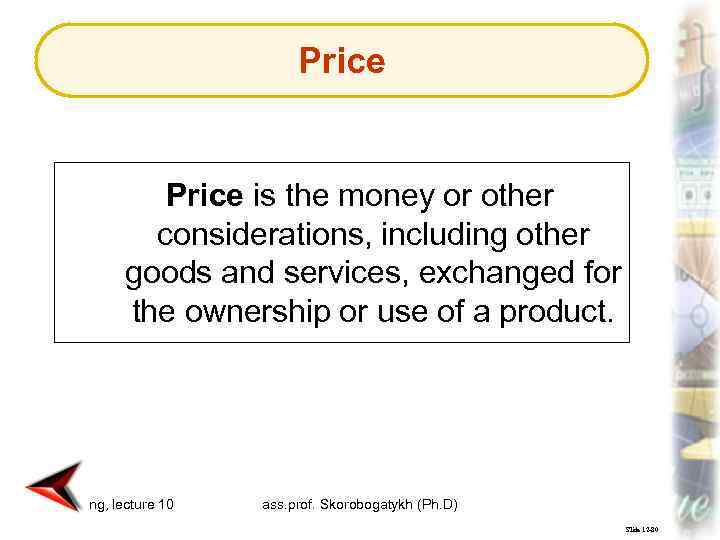 Price is the money or other considerations, including other goods and services, exchanged for the ownership or use of a product. Marketing, lecture 10 ass. prof. Skorobogatykh (Ph. D) 6 Slide 12 -80
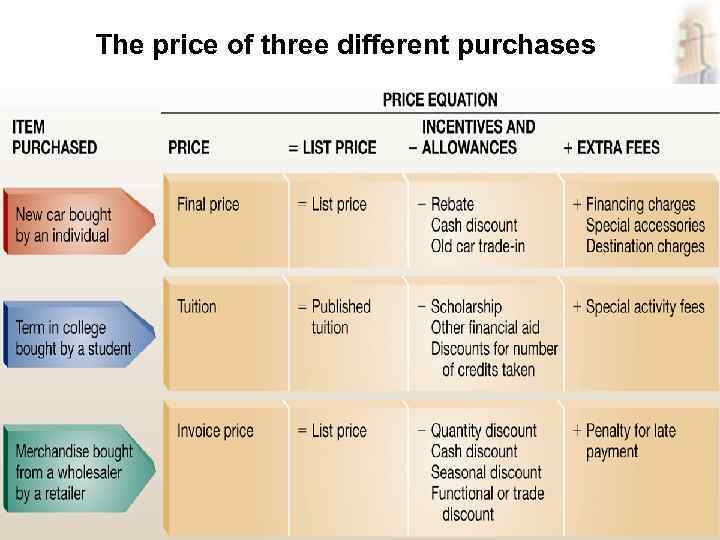 The price of three different purchases Marketing, lecture 10 ass. prof. Skorobogatykh (Ph. D) 7 Slide 12 -12
 NATURE AND IMPORTANCE OF PRICE • Price as an Indicator of Value § Value Pricing • Price in the Marketing Mix § Profit Equation Marketing, lecture 10 ass. prof. Skorobogatykh (Ph. D) 8 Slide 12 -16
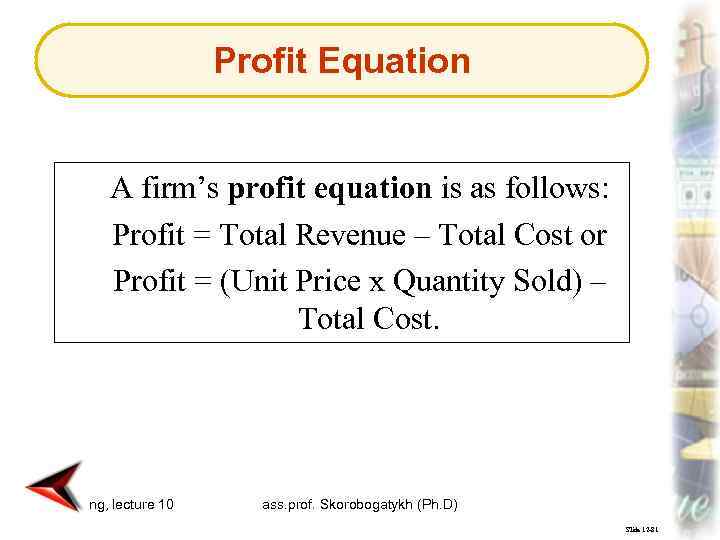 Profit Equation A firm’s profit equation is as follows: Profit = Total Revenue – Total Cost or Profit = (Unit Price x Quantity Sold) – Total Cost. Marketing, lecture 10 ass. prof. Skorobogatykh (Ph. D) 9 Slide 12 -81
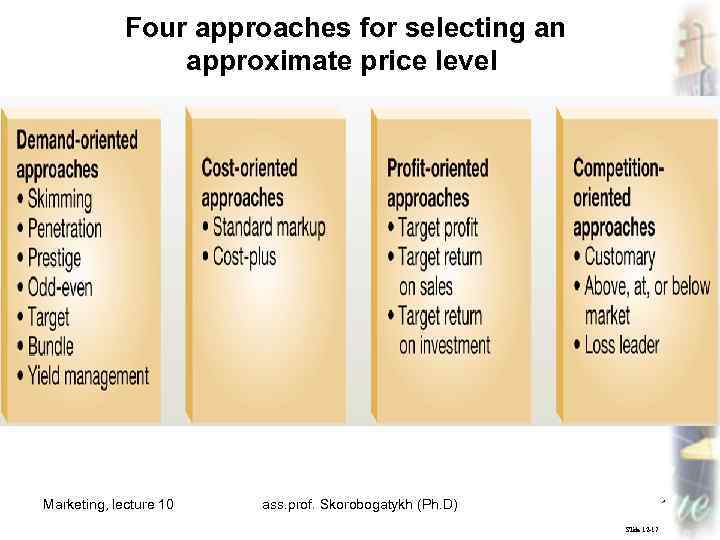 Four approaches for selecting an approximate price level Marketing, lecture 10 ass. prof. Skorobogatykh (Ph. D) 10 Slide 12 -17
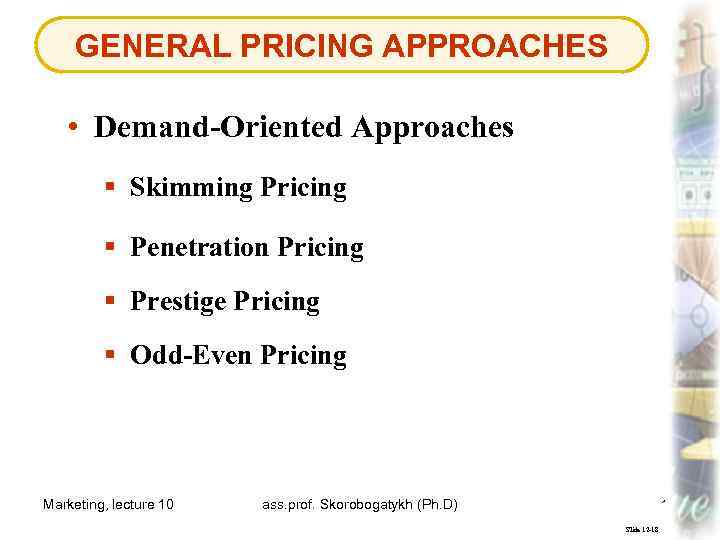 GENERAL PRICING APPROACHES • Demand-Oriented Approaches § Skimming Pricing § Penetration Pricing § Prestige Pricing § Odd-Even Pricing Marketing, lecture 10 ass. prof. Skorobogatykh (Ph. D) 11 Slide 12 -18
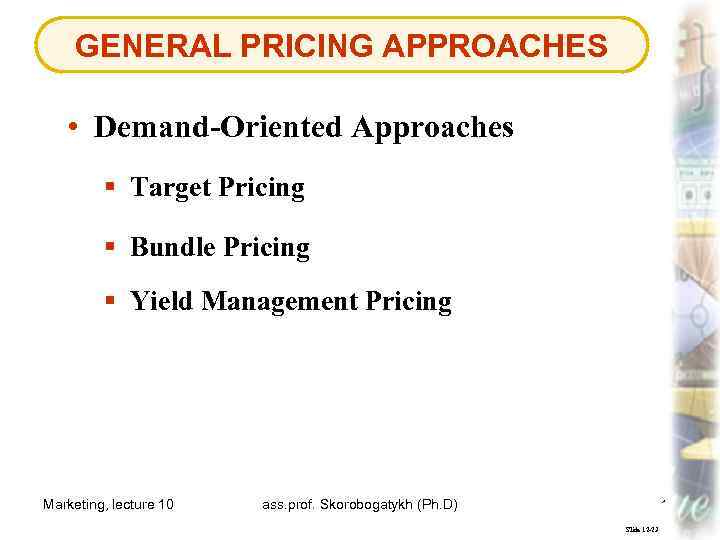 GENERAL PRICING APPROACHES • Demand-Oriented Approaches § Target Pricing § Bundle Pricing § Yield Management Pricing Marketing, lecture 10 ass. prof. Skorobogatykh (Ph. D) 12 Slide 12 -23
 Concept Check 1. What is the profit equation? A: The profit equation is: Profit = Total Revenue - Total Cost = (Unit Price x Quantity Sold) - Total Cost Marketing, lecture 10 ass. prof. Skorobogatykh (Ph. D) 13 Slide 12 -24
 Concept Check 2. What is the difference between skimming and penetration pricing? A: A firm introducing a new product can use either skimming pricing to set the highest initial price that customers desiring the product are willing to pay or penetration pricing to set a low initial price to appeal immediately to the mass market. Marketing, lecture 10 ass. prof. Skorobogatykh (Ph. D) 14 Slide 12 -25
 Concept Check 3. What is odd-even pricing? A: Odd-even pricing involves setting prices a few dollars or cents under an even number ($599. 99 vs. $600. 00). Psychologically, the $599. 99 price feels lower than $600. 00, even though the difference is 1 cent. Marketing, lecture 10 ass. prof. Skorobogatykh (Ph. D) 15 Slide 12 -26
 GENERAL PRICING APPROACHES • Cost-Oriented Approaches § Standard Markup Pricing § Cost-Plus Pricing • Profit-Oriented Approaches § Target Profit Pricing § Target Return-on-Sales Pricing § Target Return-on-Investment Pricing Marketing, lecture 10 ass. prof. Skorobogatykh (Ph. D) 16 Slide 12 -27
 GENERAL PRICING APPROACHES • Competition-Oriented Approaches § Customary Pricing § Above-, At-, or Below-Market Pricing § Loss-Leader Pricing Marketing, lecture 10 ass. prof. Skorobogatykh (Ph. D) 17 Slide 12 -29
 ESTIMATING DEMAND REVENUE • Fundamentals of Estimating Demand § Demand Curve • Consumer Tastes • Price & Availability of Similar Products • Consumer Income Marketing, lecture 10 ass. prof. Skorobogatykh (Ph. D) 18 Slide 12 -30
 Demand Curve A demand curve shows the number of products that will be sold at a given price. Marketing, lecture 10 ass. prof. Skorobogatykh (Ph. D) 19 Slide 12 -82
 ESTIMATING DEMAND REVENUE • Fundamentals of Estimating Demand § Movement Along vs. Shift of a Demand Curve § Price Elasticity of Demand • Elastic Demand • Inelastic Demand Marketing, lecture 10 ass. prof. Skorobogatykh (Ph. D) 20 Slide 12 -32
 Concept Check 1. What is loss-leader pricing? A: For a special promotion, retail stores deliberately sell a product below its customary price to attract customers in hopes they will buy other products as well, particularly the discretionary items with large markups. Marketing, lecture 10 ass. prof. Skorobogatykh (Ph. D) 21 Slide 12 -36
 Concept Check 2. What are the four demand factors that determine consumers’ willingness and ability to pay for goods and services? A: They are price, consumer tastes, price and availability of similar products, and consumer income. Marketing, lecture 10 ass. prof. Skorobogatykh (Ph. D) 22 Slide 12 -37
 Concept Check 3. What is the difference between movement along a demand curve and a shift in a demand curve? A: A movement along a demand curve occurs when the price is lowered and the quantity demanded increases (and vice versa), assuming that other factors remain unchanged. However, if these factors change, then the demand curve will shift. Marketing, lecture 10 ass. prof. Skorobogatykh (Ph. D) 23 Slide 12 -38
 ESTIMATING DEMAND REVENUE • Fundamentals of Estimating Revenue § Total Revenue Marketing, lecture 10 ass. prof. Skorobogatykh (Ph. D) 24 Slide 12 -39
 Total Revenue Total revenue is the total money received from the sale of a product. Total revenue (TR) equals the unit price (P) times the quantity sold (Q) or TR = P x Q. Marketing, lecture 10 ass. prof. Skorobogatykh (Ph. D) 25 Slide 12 -83
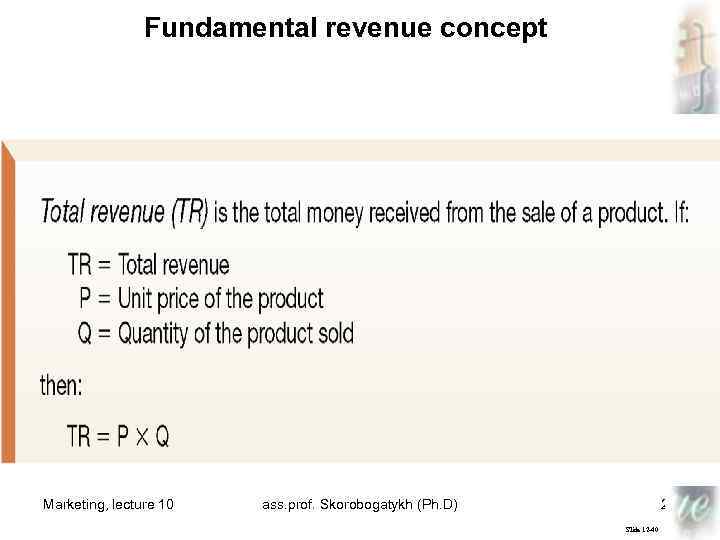 Fundamental revenue concept Marketing, lecture 10 ass. prof. Skorobogatykh (Ph. D) 26 Slide 12 -40
 DETERMINING COST, VOLUME, AND PROFIT RELATIONSHIPS • The Importance of Controlling Costs § Total Cost § Fixed Cost § Variable Cost Marketing, lecture 10 ass. prof. Skorobogatykh (Ph. D) 27 Slide 12 -41
 Total Cost Total cost is the total expense incurred by a firm in producing and marketing the product. Total cost (TC) equals the sum of fixed cost (FC) and variable cost (VC) or TC = FC + VC. Marketing, lecture 10 ass. prof. Skorobogatykh (Ph. D) 28 Slide 12 -84
 Fixed Cost Fixed cost (FC) is the sum of the expenses of the firm that are stable and do not change with the quantity of the product that is produced and sold. Examples include rent, executive salaries, and insurance. Marketing, lecture 10 ass. prof. Skorobogatykh (Ph. D) 29 Slide 12 -85
 Variable Cost Variable cost (VC) is the sum of the expenses of the firm that vary directly with the quantity of the product that is produced and sold. Examples include direct labor and direct materials used to produce the product and the sales commissions tied to the quantity sold. Marketing, lecture 10 ass. prof. Skorobogatykh (Ph. D) 30 Slide 12 -86
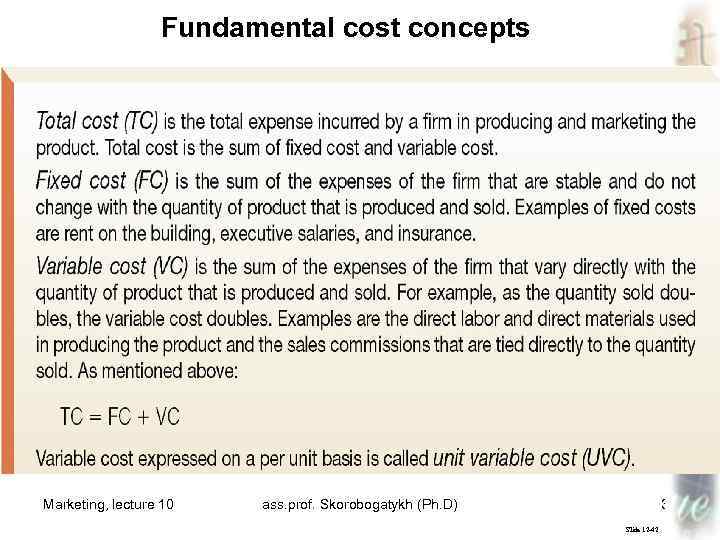 Fundamental cost concepts Marketing, lecture 10 ass. prof. Skorobogatykh (Ph. D) 31 Slide 12 -42
 DETERMINING COST, VOLUME, AND PROFIT RELATIONSHIPS • Break-Even Analysis § Break-Even Point (BEP) § Calculating a Break-Even Point • Break-Even Chart § Applications of Break-Even Analysis Marketing, lecture 10 ass. prof. Skorobogatykh (Ph. D) 32 Slide 12 -43
 Break-Even Analysis Break-even analysis is a technique that analyzes the relationship between total revenue and total cost to determine profitability at various levels of output. Marketing, lecture 10 ass. prof. Skorobogatykh (Ph. D) 33 Slide 12 -87
 Concept Check 1. What is the difference between fixed costs and variable costs? A: Fixed cost is the sum of the expenses of the firm that are stable and do not change with the quantity of the product that is produced and sold. Variable cost is the sum of the expenses of the firm that vary directly with the quantity of the product that is produced and sold. (Ph. D) Marketing, lecture 10 ass. prof. Skorobogatykh 34 Slide 12 -46
 Concept Check 2. What is a break-even point? A: A break-even point (BEP) is the quantity at which total revenue and total cost are equal. Marketing, lecture 10 ass. prof. Skorobogatykh (Ph. D) 35 Slide 12 -47
 PRICING OBJECTIVES AND CONSTRAINTS • Identifying Pricing Objectives § Profit • Managing for Long-Run Profits • Maximizing Current Profits • Target Return Marketing, lecture 10 ass. prof. Skorobogatykh (Ph. D) 36 Slide 12 -48
 Pricing Objectives Pricing objectives specify the role of price in an organization’s marketing and strategic plans. Marketing, lecture 10 ass. prof. Skorobogatykh (Ph. D) 37 Slide 12 -88
 PRICING OBJECTIVES AND CONSTRAINTS • Identifying Pricing Objectives § Sales § Market Share § Unit Volume § Survival § Social Responsibility Marketing, lecture 10 ass. prof. Skorobogatykh (Ph. D) 38 Slide 12 -50
 PRICING OBJECTIVES AND CONSTRAINTS • Identifying Pricing Constraints § Demand for the Product Class, Product, and Brand § Newness of the Product: Stage in the Product Life Cycle Marketing, lecture 10 ass. prof. Skorobogatykh (Ph. D) 39 Slide 12 -51
 Pricing Constraints Pricing constraints are factors that limit the range of price a firm may set. Marketing, lecture 10 ass. prof. Skorobogatykh (Ph. D) 40 Slide 12 -89
 PRICING OBJECTIVES AND CONSTRAINTS • Identifying Pricing Constraints § Cost of Producing and Marketing the Product § Competitors’ Prices § Legal and Ethical Considerations • Price Fixing • Deceptive Pricing • Price Discrimination • Predatory Pricing Marketing, lecture 10 ass. prof. Skorobogatykh (Ph. D) 41 Slide 12 -53
 Concept Check 1. What is the difference between pricing objectives and pricing constraints? A: Pricing objectives specify the role of price in an organization’s marketing and strategic plans. Pricing constraints are factors that limit the range of price a firm may set. Marketing, lecture 10 ass. prof. Skorobogatykh (Ph. D) 42 Slide 12 -54
 Concept Check 2. Explain what bait and switch is and why it is an example of deceptive pricing. A: This occurs when a firm offers a very low price on a product (the bait) to attract customers to a store, who then are persuaded to purchase a higher-priced item (the switch). Misleading consumers is both illegal and unethical. Marketing, lecture 10 ass. prof. Skorobogatykh (Ph. D) 43 Slide 12 -55
 SETTING A FINAL PRICE • Step 1: Set an Approximate Price Level • Step 2: Set the List or Quoted Price § One-Price Policy § Flexible-Price Policy Marketing, lecture 10 ass. prof. Skorobogatykh (Ph. D) 44 Slide 12 -56
 SETTING A FINAL PRICE • Step 3: Make Special Adjustments to the List or Quoted Price § Discounts • Quantity Discounts • Seasonal Discounts • Trade (Functional) Discounts • Cash Discounts Marketing, lecture 10 ass. prof. Skorobogatykh (Ph. D) 45 Slide 12 -59
 SETTING A FINAL PRICE • Step 3: Make Special Adjustments to the List or Quoted Price § Allowances • Trade-in Allowances • Promotional Allowances § Geographical Adjustments • FOB Origin Pricing • Uniform Delivered Pricing Marketing, lecture 10 ass. prof. Skorobogatykh (Ph. D) 46 Slide 12 -61
 Concept Check 1. Why would a seller choose a flexibleprice policy over a one-price policy? A: A flexible-price policy involves setting different prices for products and services depending on individual buyers and purchasing situations in light of demand, cost, and competitive factors instead of setting one price for all buyers. Marketing, lecture 10 ass. prof. Skorobogatykh (Ph. D) 47 Slide 12 -62
 Concept Check 2. What is the purpose of (a) quantity discounts and (b) promotional allowances? A: (a) Quantity discounts encourage customers to buy larger quantities of a product. (b) Promotional allowances are used to encourage sellers to undertake certain advertising or selling activities to promote a product. Marketing, lecture 10 ass. prof. Skorobogatykh (Ph. D) 48 Slide 12 -63