


 Скачать презентацию Lecture 9 Data Integration May 30 th 2002
bcc7186b1efc5844f2d27f146407c205.ppt
- Количество слайдов: 56
 Lecture #9 Data Integration May 30 th, 2002
 Agenda/Administration • Project demo scheduling. • Reading pointers for exam.
 What is Data Integration • Providing – Uniform (same query interface to all sources) – Access to (queries; eventually updates too) – Multiple (we want many, but 2 is hard too) – Autonomous (DBA doesn’t report to you) – Heterogeneous (data models are different) – Structured (or at least semi-structured) – Data Sources (not only databases).
 The Problem: Data Integration Uniform query capability across autonomous, heterogeneous data sources on LAN, WAN, or Internet
 Motivation(s) • Enterprise data integration; web-site construction. • WWW: – Comparison shopping – Portals integrating data from multiple sources – B 2 B, electronic marketplaces • Science and culture: – – Medical genetics: integrating genomic data Astrophysics: monitoring events in the sky. Environment: Puget Sound Regional Synthesis Model Culture: uniform access to all cultural databases produced by countries in Europe.
 Discussion • Why is it hard? • How will we solve it?
 Current Solutions • Mostly ad-hoc programming: create a special solution for every case; pay consultants a lot of money. • Data warehousing: load all the data periodically into a warehouse. – 6 -18 months lead time – Separates operational DBMS from decision support DBMS. (not only a solution to data integration). – Performance is good; data may not be fresh. – Need to clean, scrub you data.
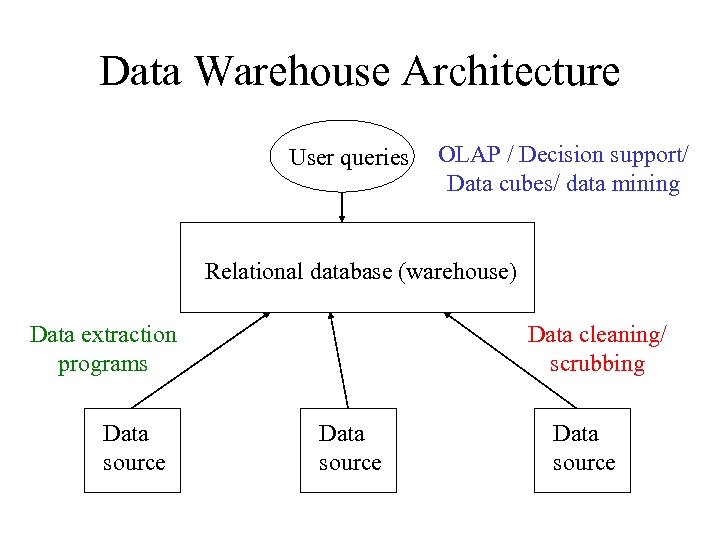 Data Warehouse Architecture User queries OLAP / Decision support/ Data cubes/ data mining Relational database (warehouse) Data extraction programs Data source Data cleaning/ scrubbing Data source
 The Virtual Integration Architecture • Leave the data in the sources. • When a query comes in: – Determine the relevant sources to the query – Break down the query into sub-queries for the sources. – Get the answers from the sources, and combine them appropriately. • Data is fresh. • Challenge: performance.
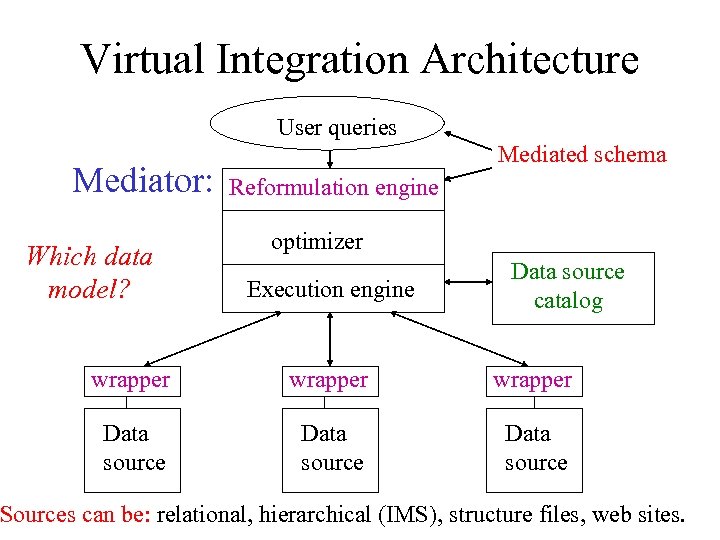 Virtual Integration Architecture User queries Mediator: Which data model? Mediated schema Reformulation engine optimizer Execution engine Data source catalog wrapper Data source Sources can be: relational, hierarchical (IMS), structure files, web sites.
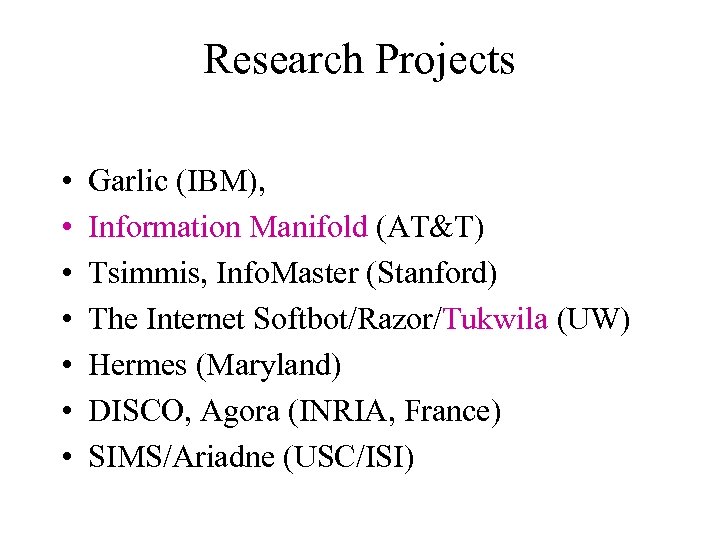 Research Projects • • Garlic (IBM), Information Manifold (AT&T) Tsimmis, Info. Master (Stanford) The Internet Softbot/Razor/Tukwila (UW) Hermes (Maryland) DISCO, Agora (INRIA, France) SIMS/Ariadne (USC/ISI)
 Industry • • Nimble Technology Enosys Markets IBM starting to announce stuff BEA marketing announcing stuff too.
 Dimensions to Consider • • • How many sources are we accessing? How autonomous are they? Meta-data about sources? Is the data structured? Queries or also updates? Requirements: accuracy, completeness, performance, handling inconsistencies. • Closed world assumption vs. open world?
 Outline • Wrappers • Semantic integration and source descriptions: – Modeling source completeness – Modeling source capabilities • • Query optimization Query execution Peer-data management systems Creating schema mappings
 Wrapper Programs • Task: to communicate with the data sources and do format translations. • They are built w. r. t. a specific source. • They can sit either at the source or at the mediator. • Often hard to build (very little science). • Can be “intelligent”: perform sourcespecific optimizations.
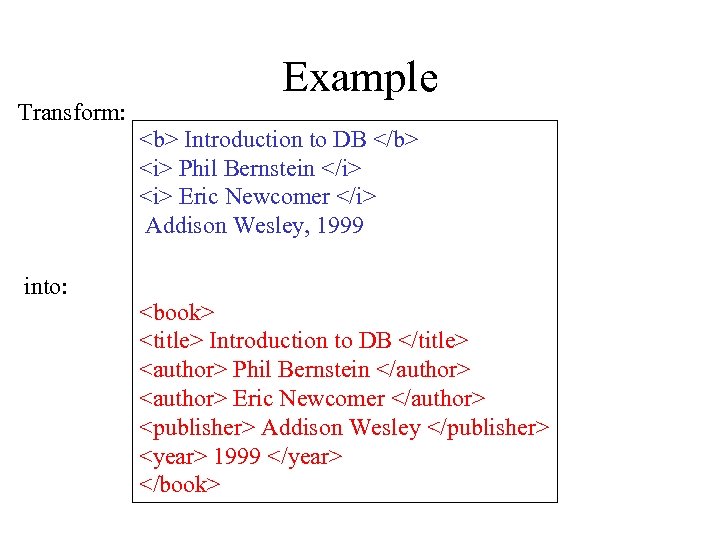 Transform: Example Introduction to DB Phil Bernstein Eric Newcomer Addison Wesley, 1999 into:
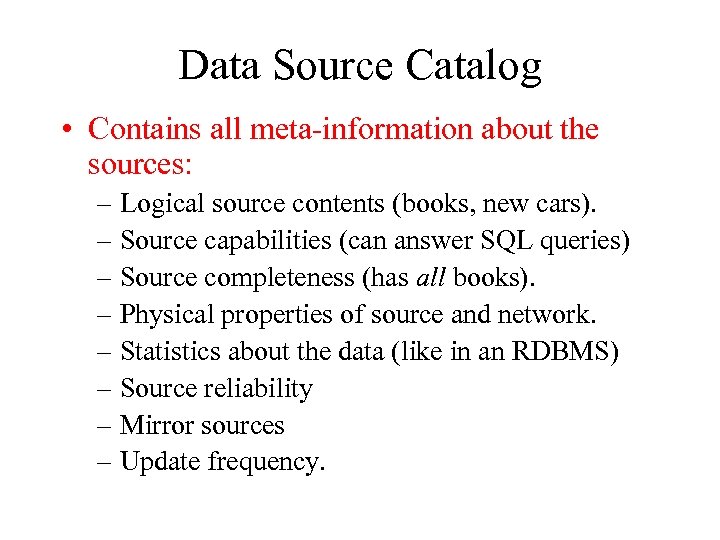 Data Source Catalog • Contains all meta-information about the sources: – Logical source contents (books, new cars). – Source capabilities (can answer SQL queries) – Source completeness (has all books). – Physical properties of source and network. – Statistics about the data (like in an RDBMS) – Source reliability – Mirror sources – Update frequency.
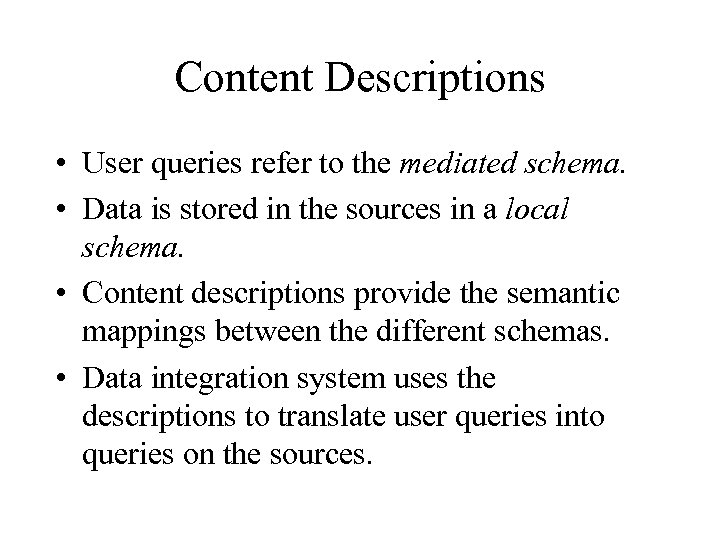 Content Descriptions • User queries refer to the mediated schema. • Data is stored in the sources in a local schema. • Content descriptions provide the semantic mappings between the different schemas. • Data integration system uses the descriptions to translate user queries into queries on the sources.
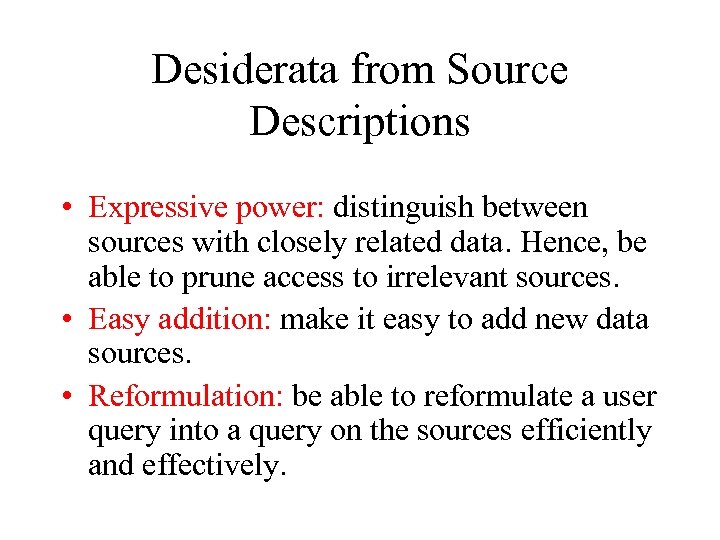 Desiderata from Source Descriptions • Expressive power: distinguish between sources with closely related data. Hence, be able to prune access to irrelevant sources. • Easy addition: make it easy to add new data sources. • Reformulation: be able to reformulate a user query into a query on the sources efficiently and effectively.
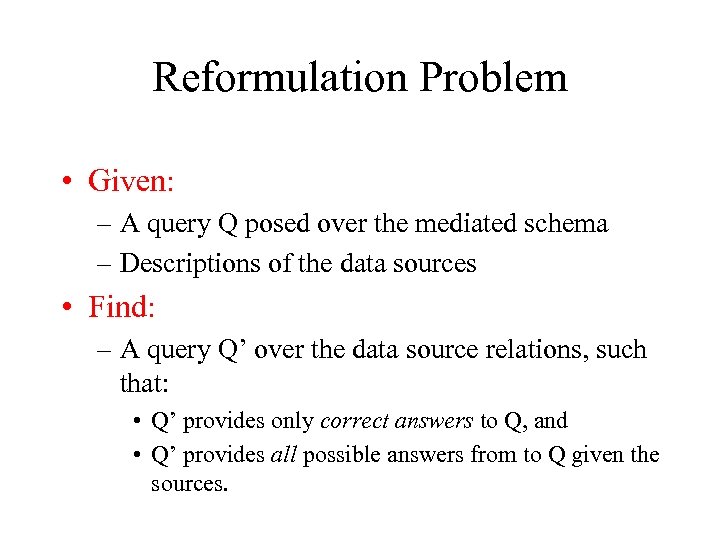 Reformulation Problem • Given: – A query Q posed over the mediated schema – Descriptions of the data sources • Find: – A query Q’ over the data source relations, such that: • Q’ provides only correct answers to Q, and • Q’ provides all possible answers from to Q given the sources.
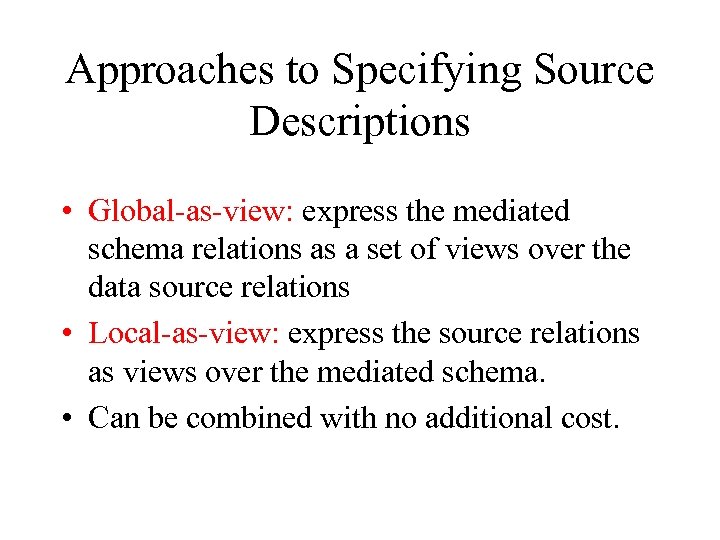 Approaches to Specifying Source Descriptions • Global-as-view: express the mediated schema relations as a set of views over the data source relations • Local-as-view: express the source relations as views over the mediated schema. • Can be combined with no additional cost.
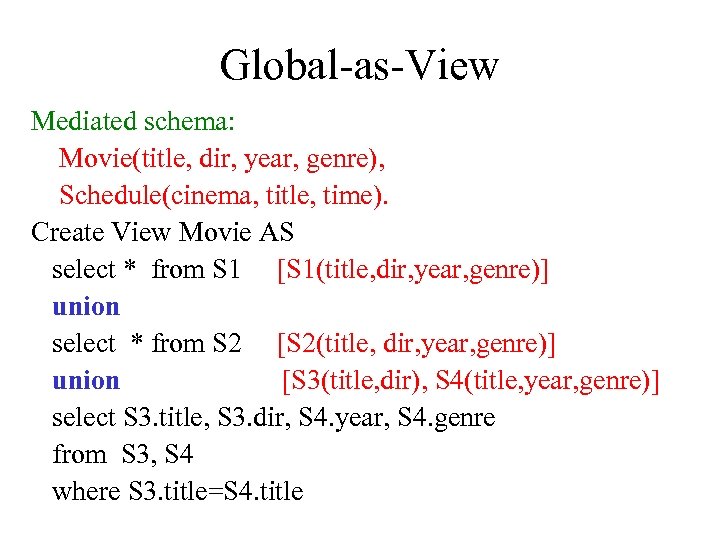 Global-as-View Mediated schema: Movie(title, dir, year, genre), Schedule(cinema, title, time). Create View Movie AS select * from S 1 [S 1(title, dir, year, genre)] union select * from S 2 [S 2(title, dir, year, genre)] union [S 3(title, dir), S 4(title, year, genre)] select S 3. title, S 3. dir, S 4. year, S 4. genre from S 3, S 4 where S 3. title=S 4. title
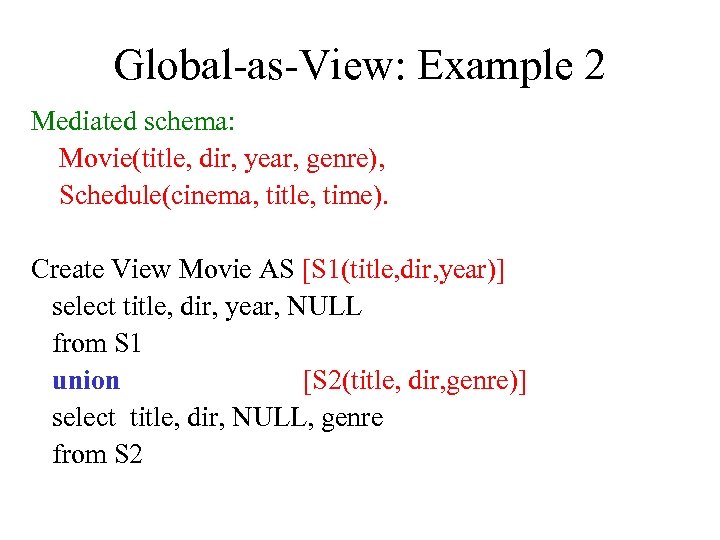 Global-as-View: Example 2 Mediated schema: Movie(title, dir, year, genre), Schedule(cinema, title, time). Create View Movie AS [S 1(title, dir, year)] select title, dir, year, NULL from S 1 union [S 2(title, dir, genre)] select title, dir, NULL, genre from S 2
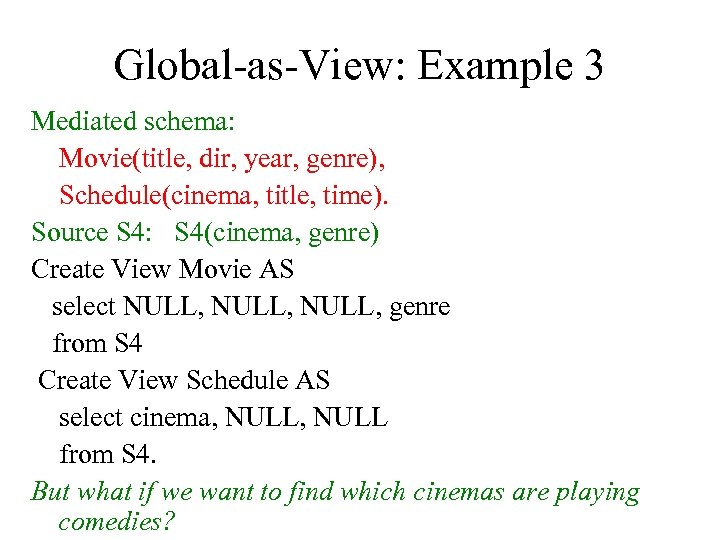 Global-as-View: Example 3 Mediated schema: Movie(title, dir, year, genre), Schedule(cinema, title, time). Source S 4: S 4(cinema, genre) Create View Movie AS select NULL, genre from S 4 Create View Schedule AS select cinema, NULL from S 4. But what if we want to find which cinemas are playing comedies?
 Global-as-View Summary • Query reformulation boils down to view unfolding. • Very easy conceptually. • Can build hierarchies of mediated schemas. • You sometimes loose information. Not always natural. • Adding sources is hard. Need to consider all other sources that are available.
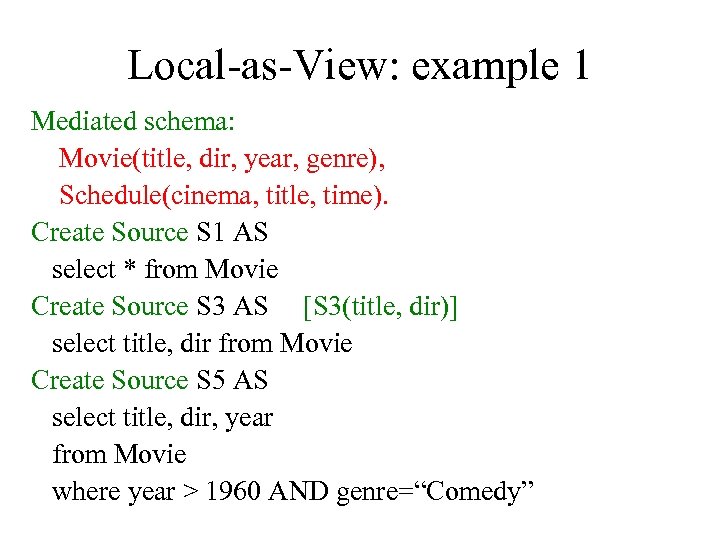 Local-as-View: example 1 Mediated schema: Movie(title, dir, year, genre), Schedule(cinema, title, time). Create Source S 1 AS select * from Movie Create Source S 3 AS [S 3(title, dir)] select title, dir from Movie Create Source S 5 AS select title, dir, year from Movie where year > 1960 AND genre=“Comedy”
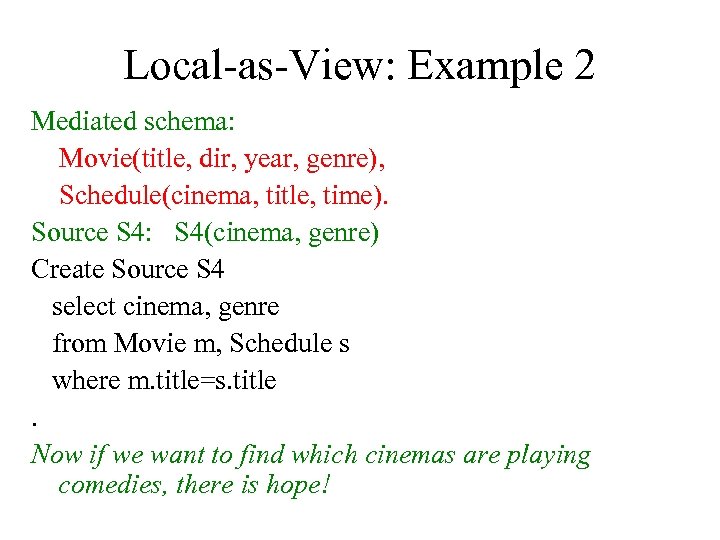 Local-as-View: Example 2 Mediated schema: Movie(title, dir, year, genre), Schedule(cinema, title, time). Source S 4: S 4(cinema, genre) Create Source S 4 select cinema, genre from Movie m, Schedule s where m. title=s. title. Now if we want to find which cinemas are playing comedies, there is hope!
 Local-as-View Summary • Very flexible. You have the power of the entire query language to define the contents of the source. • Hence, can easily distinguish between contents of closely related sources. • Adding sources is easy: they’re independent of each other. • Query reformulation: answering queries using views!
 The General Problem • Given a set of views V 1, …, Vn, and a query Q, can we answer Q using only the answers to V 1, …, Vn? • Many, many papers on this problem. • The best performing algorithm: The Mini. Con Algorithm, (Pottinger & Levy, 2000). • Great survey on the topic: (Halevy, 2001).
 Local Completeness Information • If sources are incomplete, we need to look at each one of them. • Often, sources are locally complete. • Movie(title, director, year) complete for years after 1960, or for American directors. • Question: given a set of local completeness statements, is a query Q’ a complete answer to Q?
 Example • Movie(title, director, year) (complete after 1960). • Show(title, theater, city, hour) • Query: find movies (and directors) playing in Seattle: Select m. title, m. director From Movie m, Show s Where m. title=s. title AND city=“Seattle” • Complete or not?
 Example #2 • Movie(title, director, year), Oscar(title, year) • Query: find directors whose movies won Oscars after 1965: select m. director from Movie m, Oscar o where m. title=o. title AND m. year=o. year AND o. year > 1965. • Complete or not?
 Query Optimization • Very related to query reformulation! • Goal of the optimizer: find a physical plan with minimal cost. • Key components in optimization: – Search space of plans – Search strategy – Cost model
 Optimization in Distributed DBMS • A distributed database (2 -minute tutorial): – Data is distributed over multiple nodes, but is uniform. – Query execution can be distributed to sites. – Communication costs are significant. • Consequences for optimization: – Optimizer needs to decide locality – Need to exploit independent parallelism. – Need operators that reduce communication costs (semi-joins).
 DDBMS vs. Data Integration • In a DDBMS, data is distributed over a set of uniform sites with precise rules. • In a data integration context: – Data sources may provide only limited access patterns to the data. – Data sources may have additional query capabilities. – Cost of answering queries at sources unknown. – Statistics about data unknown. – Transfer rates unpredictable.
 Modeling Source Capabilities • Negative capabilities: – A web site may require certain inputs (in an HTML form). – Need to consider only valid query execution plans. • Positive capabilities: – A source may be an ODBC compliant system. – Need to decide placement of operations according to capabilities. • Problem: how to describe and exploit source capabilities.
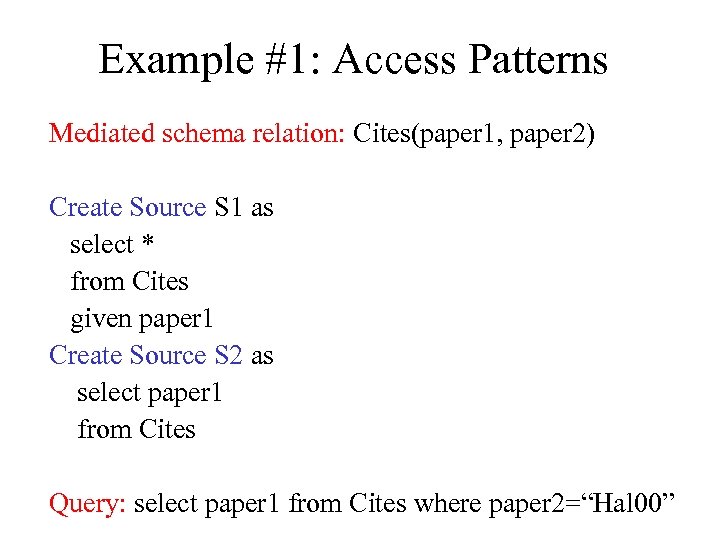 Example #1: Access Patterns Mediated schema relation: Cites(paper 1, paper 2) Create Source S 1 as select * from Cites given paper 1 Create Source S 2 as select paper 1 from Cites Query: select paper 1 from Cites where paper 2=“Hal 00”
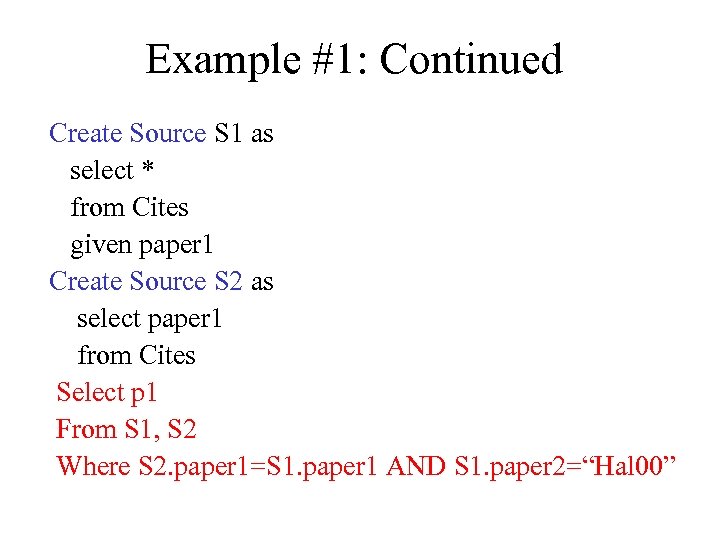 Example #1: Continued Create Source S 1 as select * from Cites given paper 1 Create Source S 2 as select paper 1 from Cites Select p 1 From S 1, S 2 Where S 2. paper 1=S 1. paper 1 AND S 1. paper 2=“Hal 00”
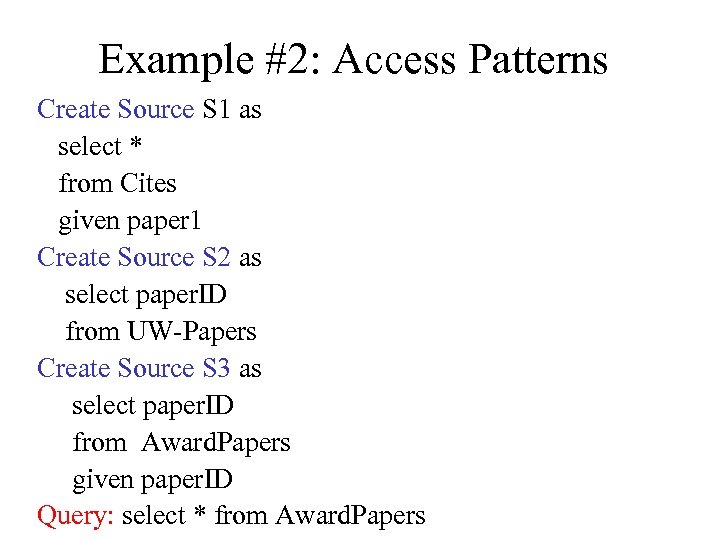 Example #2: Access Patterns Create Source S 1 as select * from Cites given paper 1 Create Source S 2 as select paper. ID from UW-Papers Create Source S 3 as select paper. ID from Award. Papers given paper. ID Query: select * from Award. Papers
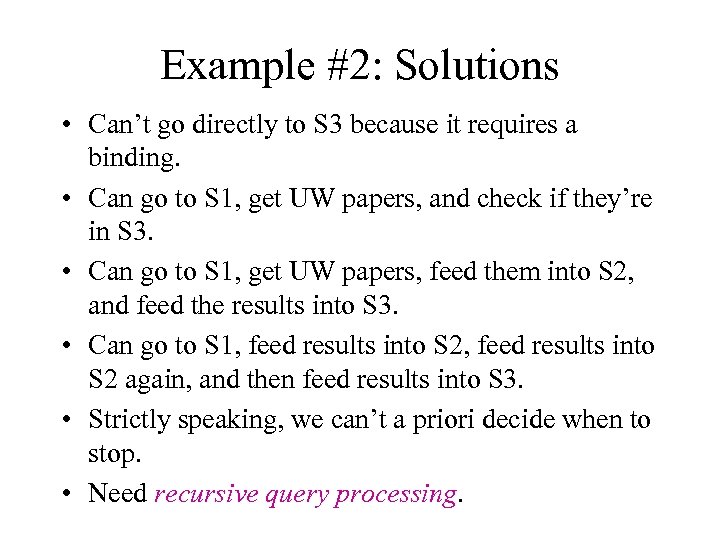 Example #2: Solutions • Can’t go directly to S 3 because it requires a binding. • Can go to S 1, get UW papers, and check if they’re in S 3. • Can go to S 1, get UW papers, feed them into S 2, and feed the results into S 3. • Can go to S 1, feed results into S 2 again, and then feed results into S 3. • Strictly speaking, we can’t a priori decide when to stop. • Need recursive query processing.
 Handling Positive Capabilities • Characterizing positive capabilities: – Schema independent (e. g. , can always perform joins, selections). – Schema dependent: can join R and S, but not T. – Given a query, tells you whether it can be handled. • Key issue: how do you search for plans? • Garlic approach (IBM): Given a query, STAR rules determine which subqueries are executable by the sources. Then proceed bottom-up as in System-R.
 Matching Objects Across Sources • How do I know that A. Halevy in source 1 is the same as Alon Halevy in source 2? • If there are uniform keys across sources, no problem. • If not: – Domain specific solutions (e. g. , maybe look at the address, ssn). – Use Information retrieval techniques (Cohen, 98). Judge similarity as you would between documents. – Use concordance tables. These are time-consuming to build, but you can then sell them for lots of money.
 Optimization and Execution • Problem: – Few and unreliable statistics about the data. – Unexpected (possibly bursty) network transfer rates. – Generally, unpredictable environment. • General solution: (research area) – Adaptive query processing. – Interleave optimization and execution. As you get to know more about your data, you can improve your plan.
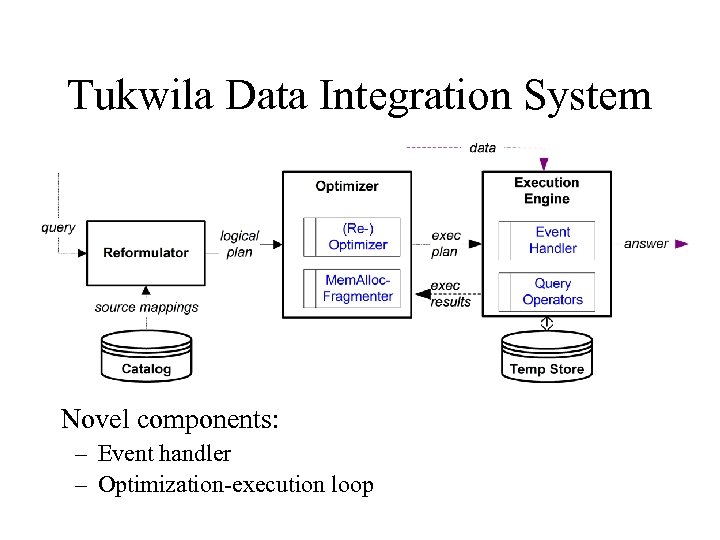 Tukwila Data Integration System Novel components: – Event handler – Optimization-execution loop
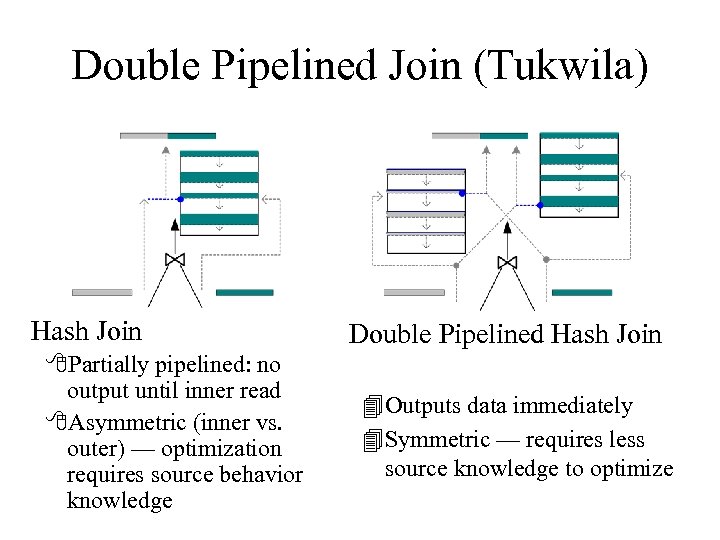 Double Pipelined Join (Tukwila) Hash Join 8 Partially pipelined: no output until inner read 8 Asymmetric (inner vs. outer) — optimization requires source behavior knowledge Double Pipelined Hash Join 4 Outputs data immediately 4 Symmetric — requires less source knowledge to optimize
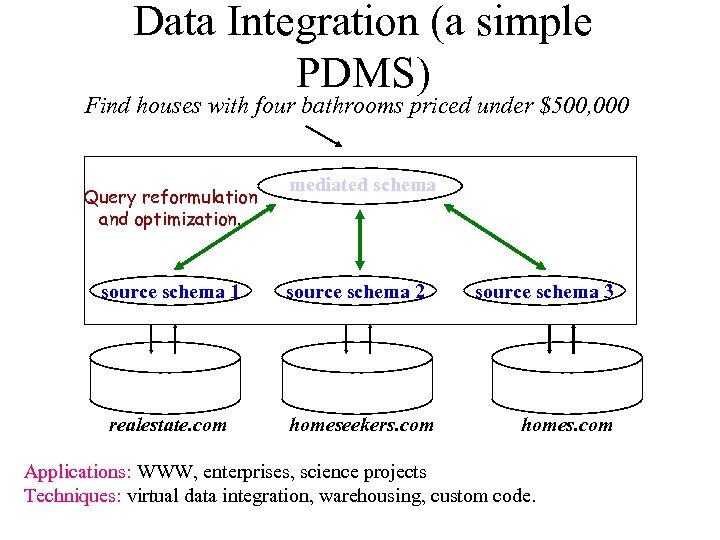
 Piazza: A Peer-Data Management System Goal: To enable users to share data across local or wide area networks in an ad-hoc, highly dynamic distributed architecture. § Peers share data, mediated views. § Peers act as both clients and servers § Rich semantic relationships between peers. § Ad-hoc collaborations (peers join and leave at will).
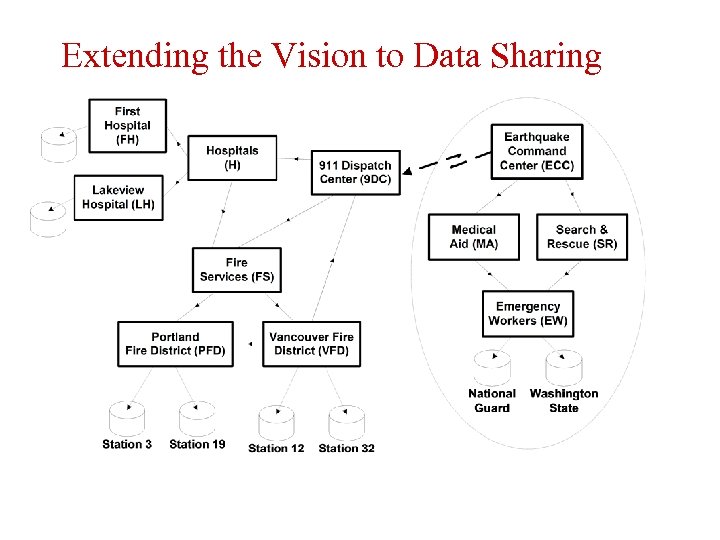 Extending the Vision to Data Sharing
 The Structure Mapping Problem • Types of structures: – Database schemas, XML DTDs, ontologies, …, • Input: – Two (or more) structures, S 1 and S 2 – (perhaps) Data instances for S 1 and S 2 – Background knowledge • Output: – A mapping between S 1 and S 2 • Should enable translating between data instances.
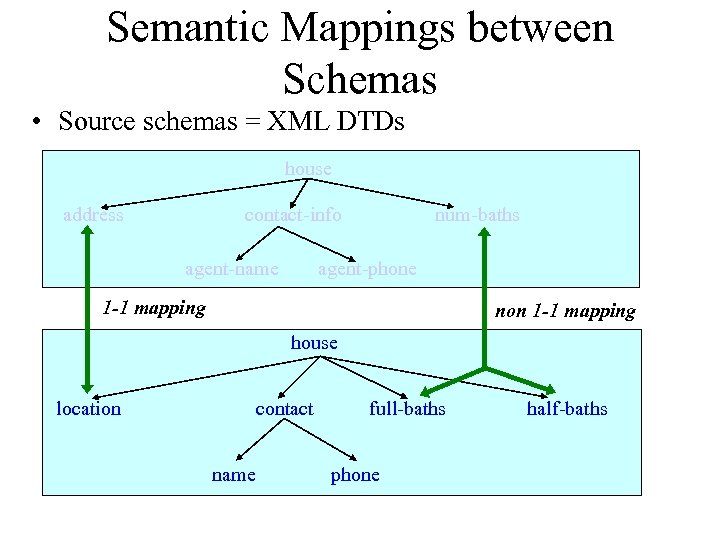 Semantic Mappings between Schemas • Source schemas = XML DTDs house address contact-info agent-name num-baths agent-phone 1 -1 mapping non 1 -1 mapping house location contact name full-baths phone half-baths
 Why Matching is Difficult • Structures represent same entity differently – different names => same entity: • area & address => location – same names => different entities: • area => location or square-feet • Intended semantics is typically subjective! – IBM Almaden Lab = IBM? • Schema, data and rules never fully capture semantics! – not adequately documented, certainly not for machine consumption. • Often hard for humans (committees are formed!)
 Desiderata from Proposed Solutions • Accuracy, efficiency, ease of use. • Realistic expectations: – Unlikely to be fully automated. Need user in the loop. • Some notion of semantics for mappings. • Extensibility: – Solution should exploit additional background knowledge. • “Memory”, knowledge reuse: – System should exploit previous manual or automatically generated matchings. – Key idea behind LSD.
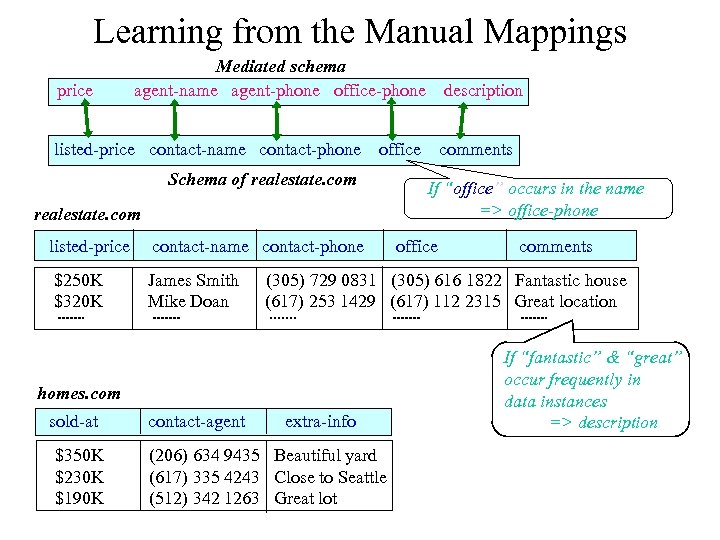
 Learning for Mapping • Context: generating semantic mappings between a mediated schema and a large set of data source schemas. • Key idea: generate the first mappings manually, and learn from them to generate the rest. • Technique: multi-strategy learning (extensible!) • L(earning) S(ource) D(escriptions) [SIGMOD 2001].
 Data Integration (a simple PDMS) Find houses with four bathrooms priced under $500, 000 Query reformulation and optimization. source schema 1 realestate. com mediated schema source schema 2 homeseekers. com source schema 3 homes. com Applications: WWW, enterprises, science projects Techniques: virtual data integration, warehousing, custom code.
 Learning from the Manual Mappings price Mediated schema agent-name agent-phone office-phone listed-price contact-name contact-phone office Schema of realestate. com listed-price contact-name contact-phone $250 K $320 K James Smith Mike Doan $350 K $230 K $190 K contact-agent comments If “office” occurs in the name => office-phone office comments (305) 729 0831 (305) 616 1822 Fantastic house (617) 253 1429 (617) 112 2315 Great location homes. com sold-at description extra-info (206) 634 9435 Beautiful yard (617) 335 4243 Close to Seattle (512) 342 1263 Great lot If “fantastic” & “great” occur frequently in data instances => description
 Multi-Strategy Learning • Use a set of base learners: – Name learner, Naïve Bayes, Whirl, XML learner • And a set of recognizers: – County name, zip code, phone numbers. • Each base learner produces a prediction weighted by confidence score. • Combine base learners with a meta-learner, using stacking.
 The Semantic Web • How does it relate to data integration? • How are we going to do it? • Why should we do it? Do we need a killer app or is the semantic web a killer app?