


 Скачать презентацию Lecture 8 Fundamentals of English Lexicography Plan
Lecture 8.ppt
- Количество слайдов: 89
 Lecture 8 Fundamentals of English Lexicography
 Plan: 1. Encyclopedic and linguistic dictionaries. Classification of linguistic dictionaries. 2. Basic problems of dictionary compiling. 3. Learner's dictionaries and some problems of their compilation.
 • Dictionaries are like watches: the worst is better than none and the best cannot be expected to be quite true. Samuel L. Johnson
 1. Encyclopedic and linguistic dictionaries. Classification of linguistic dictionaries
 Lexicography: the science of dictionary compiling
 Lexicography is closely connected with Lexicology The object of lexicography and lexicology: vocabulary of a language • The material collected in dictionaries is widely used by linguists in their research. • The principles of dictionary making are always based on linguistic fundamentals.
 Dictionary: a word book with lists of vocabulary units and their specific semantic, structural and functional characteristics
 There about 250 different kinds of dictionaries and their typology is not easy.
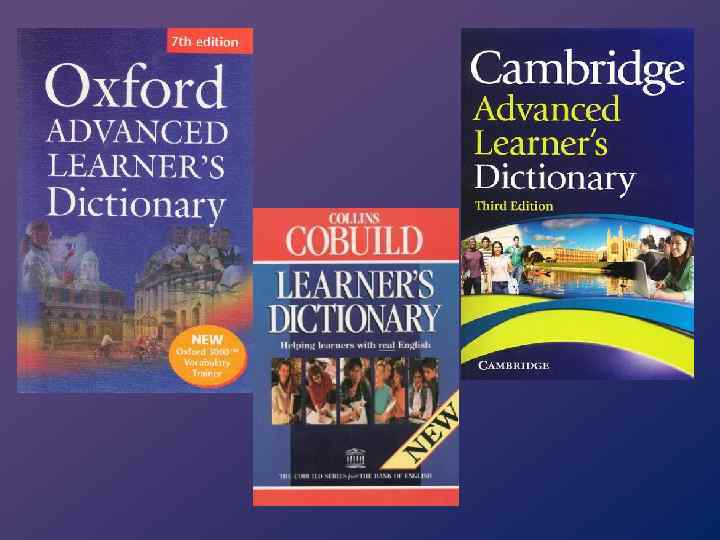
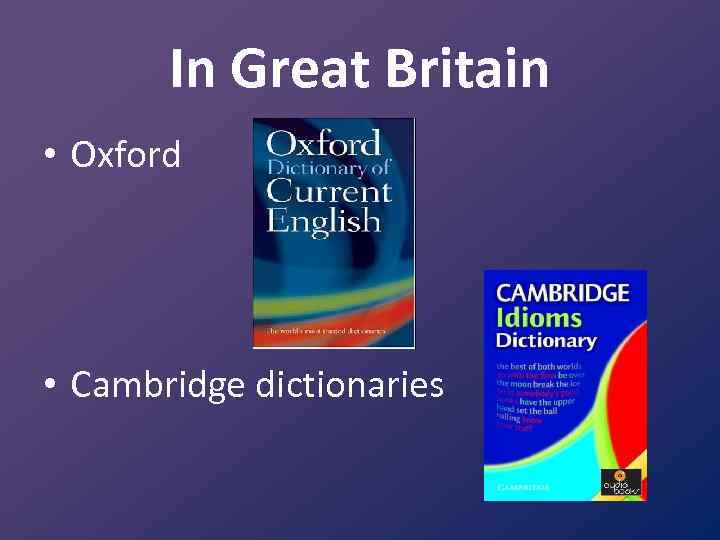 In Great Britain • Oxford • Cambridge dictionaries
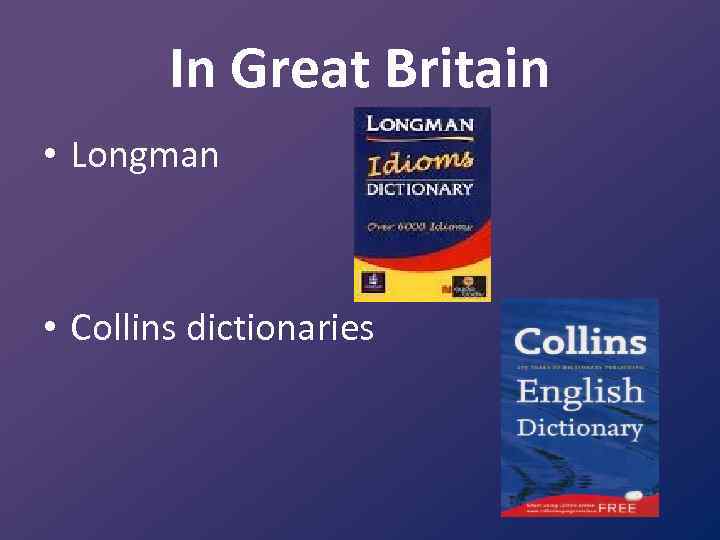 In Great Britain • Longman • Collins dictionaries
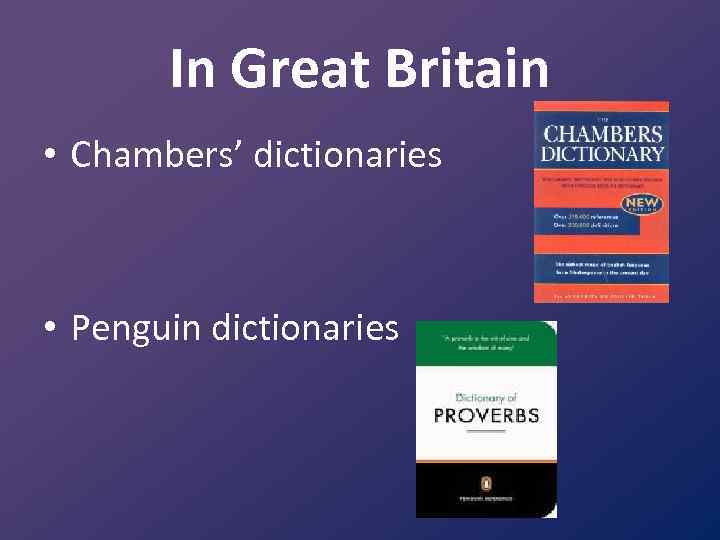 In Great Britain • Chambers’ dictionaries • Penguin dictionaries
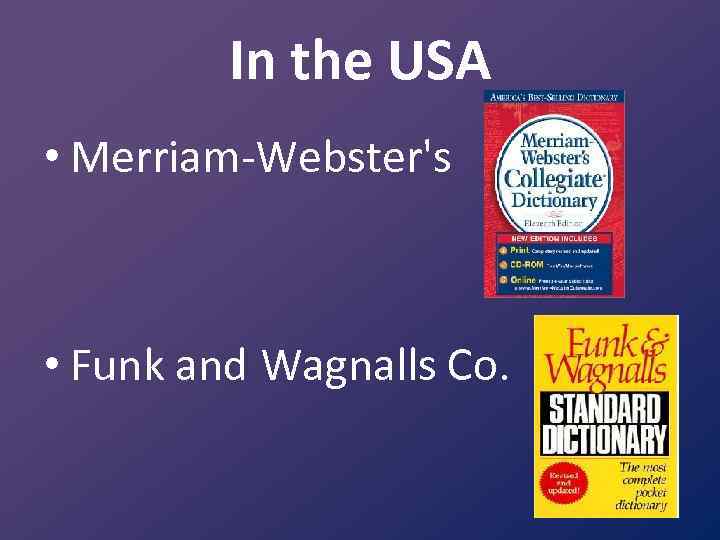 In the USA • Merriam Webster's • Funk and Wagnalls Co.
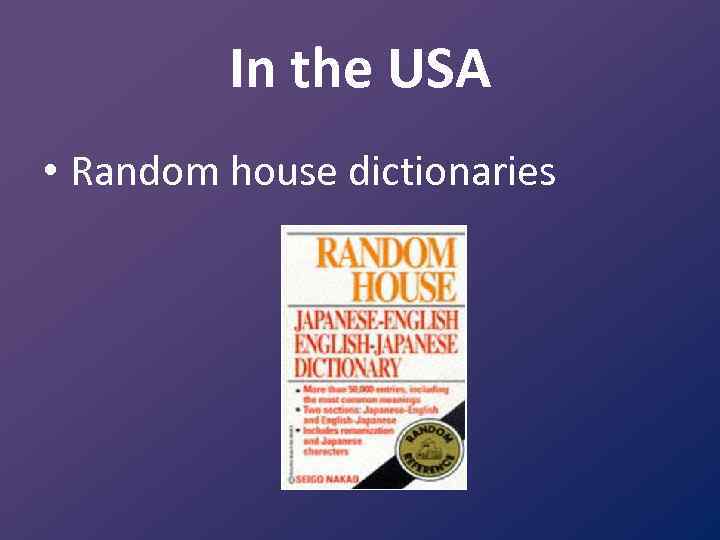 In the USA • Random house dictionaries
 According to the choice of items included and the sort of information given about them: • Encyclopedic dictionaries • Linguistic dictionaries
 • Linguistic dictionaries are word books. Subject matter: lexical units and their linguistic properties (pronunciation, meaning, peculiarities of use, etc)
 • Encyclopedic dictionaries are thing books that give information about the extra linguistic world. Subject matter: concepts, their relations to other objects and phenomena, etc.
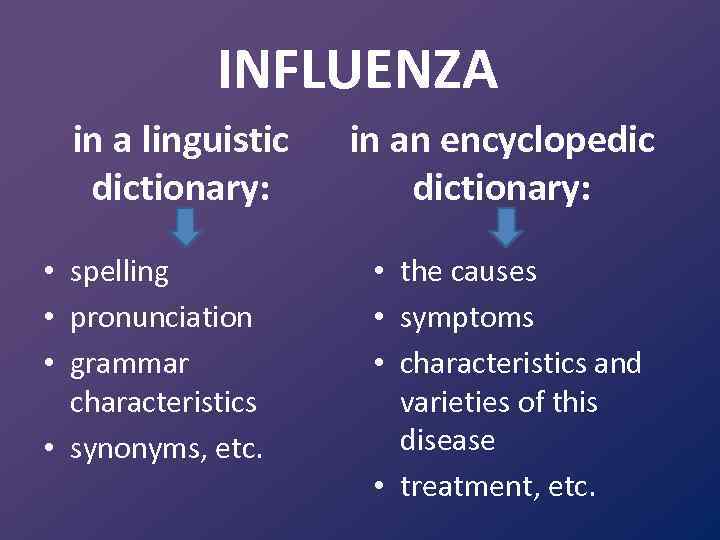 INFLUENZA in a linguistic dictionary: • spelling • pronunciation • grammar characteristics • synonyms, etc. in an encyclopedic dictionary: • the causes • symptoms • characteristics and varieties of this disease • treatment, etc.
 The Encyclopedia Britannica (24 volumes)
 The Encyclopedia Americana (30 volumes)
 Collier’s Encyclopedia (24 volumes)
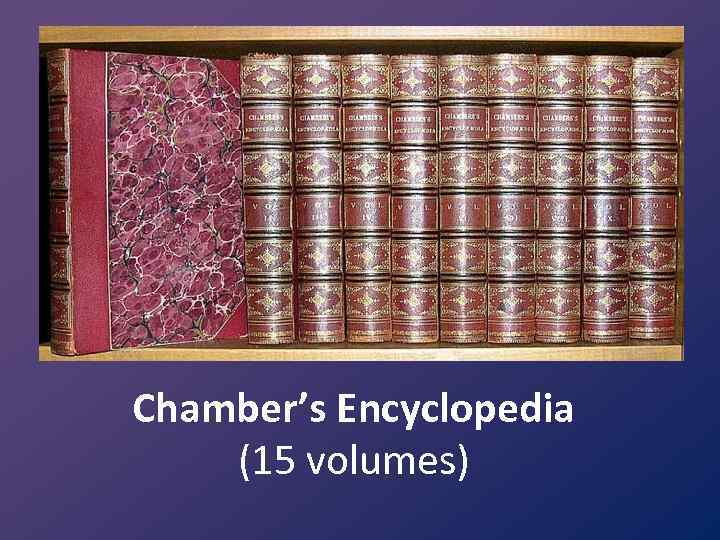 Chamber’s Encyclopedia (15 volumes)
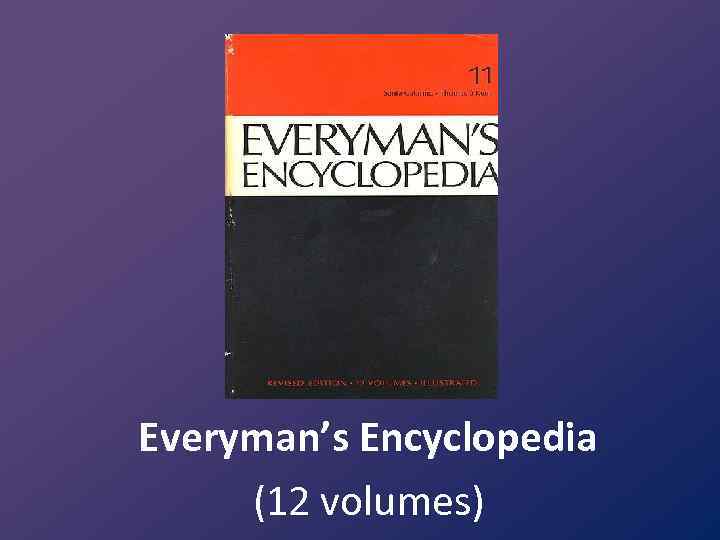 Everyman’s Encyclopedia (12 volumes)
 Reference books: • books confined for definite fields of knowledge
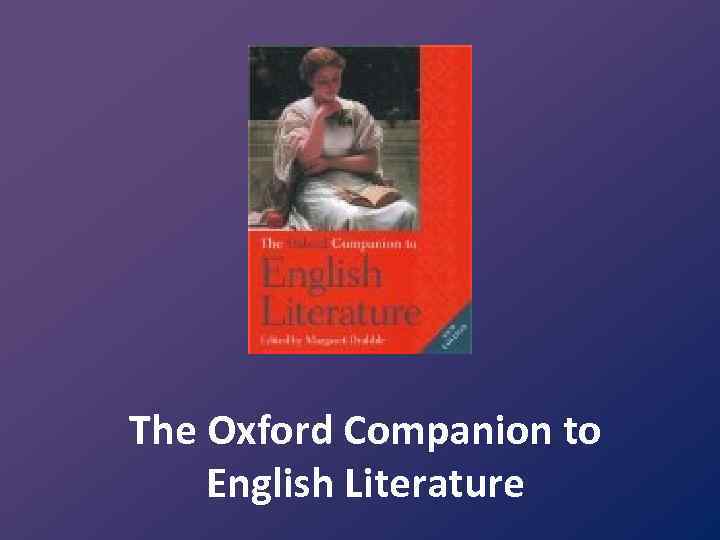 The Oxford Companion to English Literature
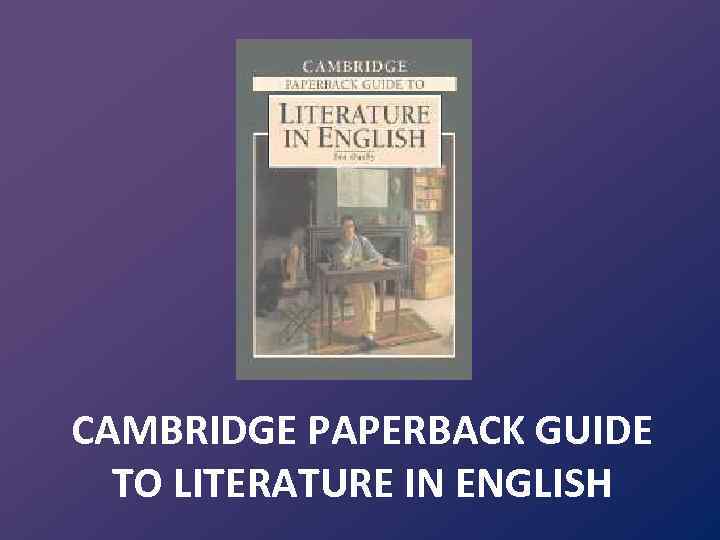 CAMBRIDGE PAPERBACK GUIDE TO LITERATURE IN ENGLISH
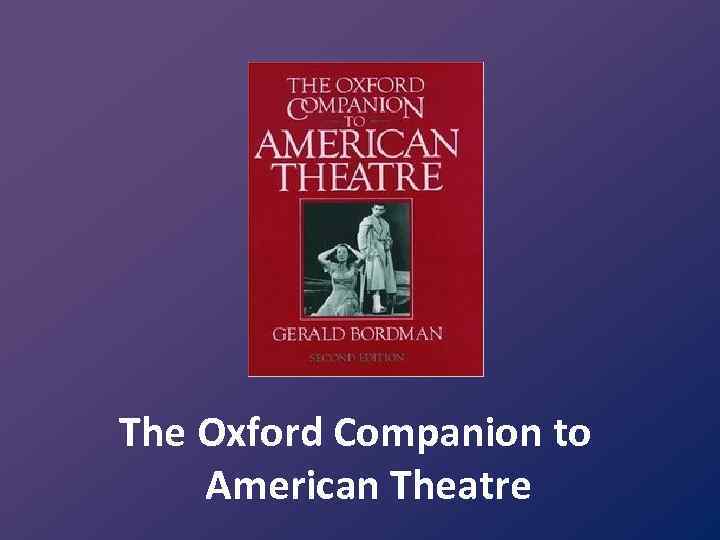 The Oxford Companion to American Theatre
 Encyclopedic and linguistic dictionaries often overlap.
 Linguistic Dictionaries: 1. nature of the word-list: • general – contain lexical units in ordinary use with this or that proportion of items from various spheres of life; • restricted – contain lexical units from a certain part of the word stock (terminological, phraseological, dialectal, etc. ).
 2. the information provided: • explanatory – present a wide range of data, especially with regard to the semantic aspect of the vocabulary items entered; • specialized – deal with lexical units only in relation to their etymology or frequency or pronunciation.
 3. the language: • monolingual (information is given in the same language); • bilingual.
 No dictionary can be a general purpose word book. Each is designed for a certain set of users.
 Characterization of a Dictionary: 1. the nature of the word list; 2. the information supplied; 3. the language of the explanations; 4. the prospective user.
 Main types of linguistic dictionaries
 Explanatory Dictionaries: provide information on all aspects of the lexical units entered: graphical, phonetical, grammatical, semantic, stylistic, etymological, etc.
 Synchronic: deal with the form, usage and meaning of lexical units in modern English, taking no account of its past development. • Concise Oxford Dictionary of Current English; • Universal Dictionary of the English Language.
 Diachronic: concerned with the development of words occurring within the written history of the language. • New English Dictionary on Historical Principles; • The Shorter Oxford Dictionary on Historical Principles.
 Translation Dictionaries: word books containing vocabulary items in one language and their equivalents in another language. • New E. -R. Dictionary by Prof. I. R. Galperin; • The E. -R. Dictionary by Prof. V. K. Muller; • The E. -R. Dictionary under Prof. A. I. Smirnitsky.
 Phraseological Dictionaries: have vast collections of idiomatic or colloquial phrases, proverbs. • An E. -R. Phraseological Dictionary by A. V. Kunin
 New Words Dictionaries: reflect the growth of neologisms in the English language.
 Dictionaries of Neologisms: • A Dictionary of new English. A Barnhart Dictionary (1973) (covers the period of time from 1963 – 1972); • The Longman Register of New Words (1990); • Bloomsbury Dictionary of New Words (1996); • Beyond the Dictionary by Brian Locket (1998).
 Dictionaries of Slang: contain elements from areas of substandard speech (vulgarisms, jargonisms, taboo words, curse words, colloquialisms, etc. ) • Dictionary of Slang and Unconventional English by E. Partridge; • The Dictionary of American Slang by H. Wentworth and S. B. Flexner.
 Usage Dictionaries: investigate usage problems of all kinds: • the difference in meaning between words – e. g. formality and formalism; • give the proper pronunciation of words; • give the plural forms. • Dictionary of Modern English Usage by N. W. Fowler.
 Dictionaries of Word-frequency: inform the user about the frequency of occurrence of lexical units in speech.
 Reverse Dictionary: a list of words in which the words are arranged in alphabetical order starting with their final letters. • Rhyming Dictionary of the English Language by John Walker.
 Pronouncing Dictionaries: record contemporary pronunciation, indicate various pronunciations. • English Pronouncing dictionary by Daniel Jones.
 Etymological Dictionaries: trace present day words to the oldest forms available, establish their original meaning, point out the source of borrowing. • Oxford Dictionary of English Etymology by C. T. Onions
 Ideographic Dictionaries: contain words grouped by the concepts. • Thesaurus of English Words and Phrases by P. M. Roget.
 Dictionaries of Synonyms: • A Dictionary of English Synonyms and Synonymous Expressions by R. Soule; • Webster’s Dictionary of Synonyms; • The best known bilingual dictionary of synonyms is English Synonyms compiled by Y. Apresyan.
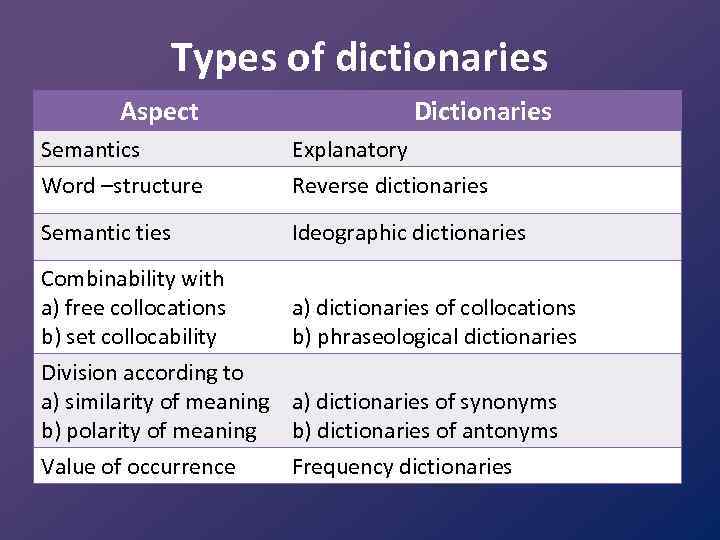 Types of dictionaries Aspect Dictionaries Semantics Word –structure Explanatory Reverse dictionaries Semantic ties Ideographic dictionaries Combinability with a) free collocations b) set collocability a) dictionaries of collocations b) phraseological dictionaries Division according to a) similarity of meaning a) dictionaries of synonyms b) polarity of meaning b) dictionaries of antonyms Value of occurrence Frequency dictionaries
 2. Basic problems of dictionary-compiling
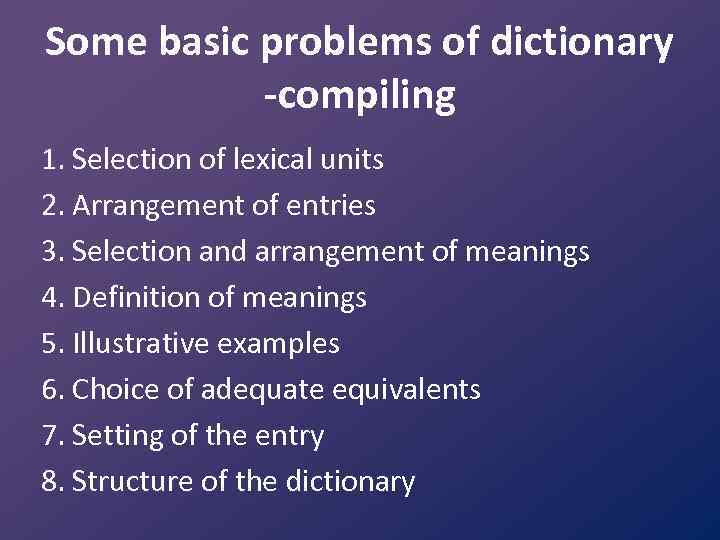 Some basic problems of dictionary -compiling 1. Selection of lexical units 2. Arrangement of entries 3. Selection and arrangement of meanings 4. Definition of meanings 5. Illustrative examples 6. Choice of adequate equivalents 7. Setting of the entry 8. Structure of the dictionary
 1. Selection of Lexical Units
 No dictionary of any size can register all lexical units.
 The Choice of Lexical Units Depends upon: • the type of the dictionary; • the aim of the compiler; • the user of the dictionary.
 A Dictionary Compiler Chooses: • the type of lexical units; • the number of items; • what to select and what to leave out in the dictionary.
 2. Arrangement of Entries
 Types of Arrangement: 1) alphabetical: the basic units are given as main entries that appear in alphabetical order while the derivatives are given as subentries or in the same entry (run outs).
 Run-outs – in the same entry • despicable, adj. Vile, contemptible Hence – LY adv. Subentry – includes definitions • despicable adj. that is or should be despised; contemptible. despicably, adv. in a despicable manner.
 Advantage: easy finding of any word and establishing its meaning, frequency value, etc.
 Types of Arrangement: 2) cluster type: words are arranged in nests, based on this or that principle Advantage: it requires less space and presents a clear picture of the relations of this unit with other words.
 3. Selection and Arrangement of Meanings
 The number of meanings and their choice depend on: • the aim of compilers; • their decisions about archaic, dialectical words, etc.
 Diachronic dictionaries list more meanings than synchronic dictionaries.
 3 ways of meaning arrangement: • in the sequence of historical development (historical order); • frequency of use (empirical or actual order); • logical connection (logical order).
 4. Definition of Meanings
 Types of definitions: 1. encyclopedic definition – determine not only the word meaning, but also the underlying concepts; 2. descriptive definitions or paraphrases – determine only the word meaning;
 Types of definitions: 3. synonymous words and expressions – consist of words or word groups with nearly equivalent meaning; 4. by means of cross-references. – decrescendo = diminuendo – waggle = wiggle
 5. Illustrative Examples
 • Diachronic dictionaries: quotations are drawn from literary sources. • Synchronic: from classical or contemporary sources.
 6. Choice of Adequate Equivalents
 It is one of the major problems in compiling translation dictionaries.
 The dictionary maker is to give the most exact equivalent in the target language. When there is no equivalent by means of a descriptive explanation or transliteration.
 7. Setting of the Entry
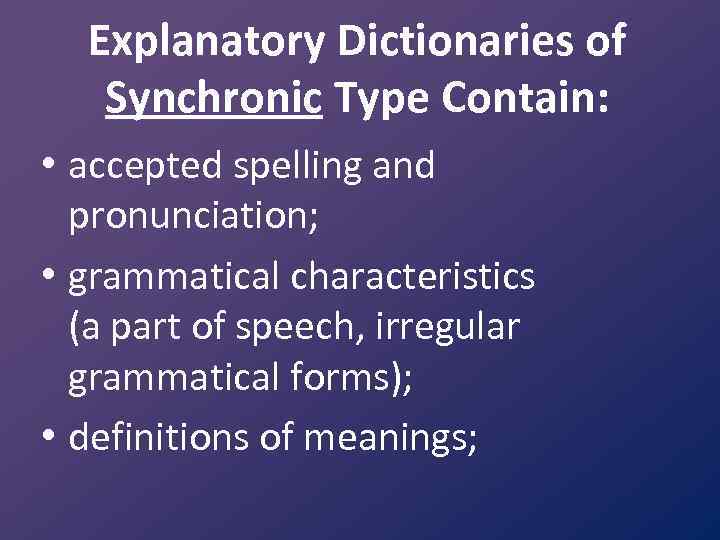 Explanatory Dictionaries of Synchronic Type Contain: • accepted spelling and pronunciation; • grammatical characteristics (a part of speech, irregular grammatical forms); • definitions of meanings;
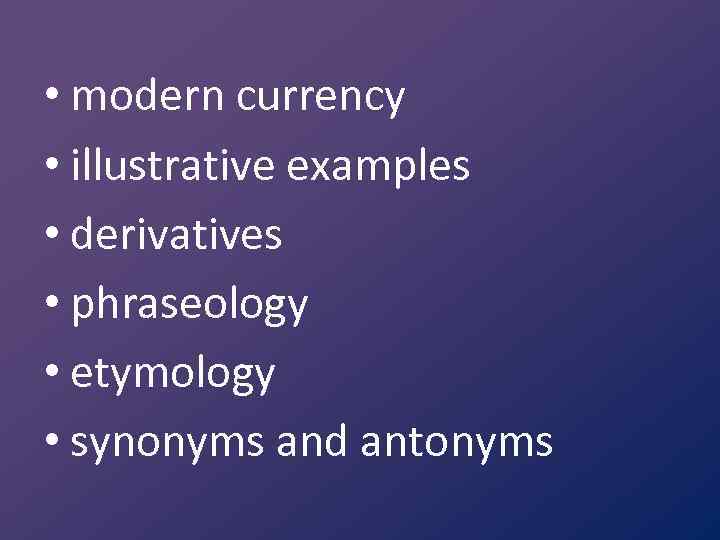 • modern currency • illustrative examples • derivatives • phraseology • etymology • synonyms and antonyms
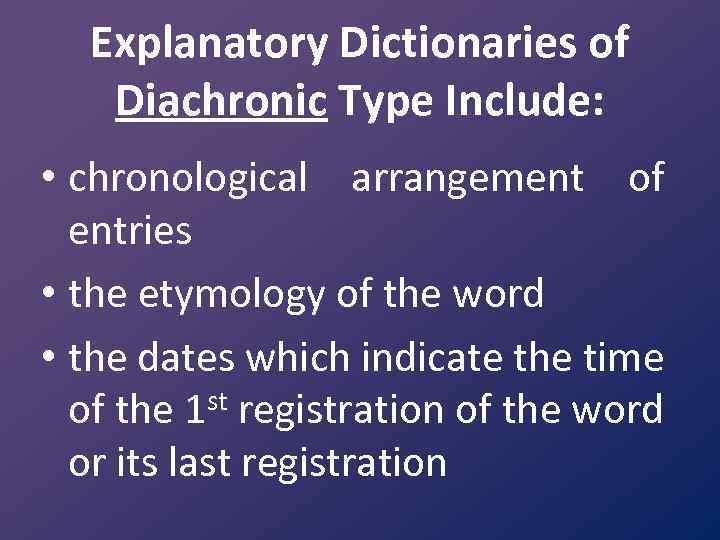 Explanatory Dictionaries of Diachronic Type Include: • chronological arrangement of entries • the etymology of the word • the dates which indicate the time of the 1 st registration of the word or its last registration
 8. Structure of the Dictionary
 Parts of a dictionary: 1. introduction or preface (some separate sections designed to help the user in handling the dictionary);
 2. dictionary itself; 3. addendum (usually contains a key to pronunciation, the list of abbreviations, geographical and personal names, etc. )
 3. Learner’s dictionaries and some problems of their compilation
 Learner’s Dictionaries: • specially compiled dictionaries to meet the demands of the learners for whom English is not their mother tongue
 Features: • a strictly limited word list; • a great attention to the functioning of lexical units in speech; • a strong normative character of the lexical units included; • their compilation is focused on the native linguistic background of the user.
 Problems of The Compilation 1. the selection of entry words • information of currently accepted usage; • no archaic, dialectal words; • only the most accepted pronunciation forms; • words are chosen on the frequency principle.
 2. the arrangement of meanings • the actual order (the main meanings before minor ones), • literal uses before special, • easily understandable uses before difficult.
 3. the definition of meanings • descriptive definitions are mostly used; • encyclopedic definitions and cross references are rare; • definitions are in simple terms.
 4. setting of the entry The attention is to the ways words are used in speech.
 5. the supplementary lists of irregular verbs, common abbreviations, geographical names, etc. • common forenames, • numerical expressions, • the works of William Shakespeare, etc.
 List of Literature: 1. 2. 3. 4. Воробей, А. Н. Глоссарий лингвистических терминов / А. Н. Воробей, Е. Г. Карапетова. – Барановичи : УО "Бар. ГУ", 2004. – 108 с. Дубенец, Э. М. Современный английский язык. Лексикология : пособие для студ. гуманит. вузов / Э. М. Дубенец. – М. / СПб. : ГЛОССА / КАРО, 2004. – C. 179– 184. Лексикология английского языка : учебник для ин тов и фак тов иностр. яз. / Р. З. Гинзбург [и др. ] ; под общ. ред. Р. З. Гинзбург. – 2 е изд. , испр. и доп. – М. : Высш. школа, 1979. – C. 210– 233. Лещева, Л. М. Слова в английском языке. Курс лексикологии современного английского языка : учебник для студ. фак в и отдел. английского языка (на англ. яз. ) / Л. М. Лещева. – Минск : Академия управления при Президенте Республики Беларусь, 2001. – C. 136– 153.