


 Скачать презентацию Lecture 8 Artificial Intelligence Intelligent agents Mc Graw-Hill Irwin
ad837366f6e46640e2abca98dbb70edc.ppt
- Количество слайдов: 55
 Lecture 8 Artificial Intelligence Intelligent agents Mc. Graw-Hill/Irwin Copyright © 2008, The Mc. Graw-Hill Companies, Inc. All rights reserved. 2008 The Mc. Graw-Hill Companies, Inc. All rights reserved.
 Learning Objectives • Identify how • neural networks • fuzzy logic • genetic algorithms • virtual reality, and • intelligent agents can be used in business and understand the concepts related to each of these technologies • Give examples of several ways expert systems can be used in business decision-making situations 2
 Case 2: Automated Decision Making • AI is best suited for • Decisions that must be made quickly and frequently, using electronic data • Highly structured decision criteria • High-quality data • Common users of AI • Transportation industry • Hotels • Investment firms and lenders 3
 Artificial Intelligence (AI) • AI is a field of science and technology based on • • • Computer science Biology Psychology Linguistics Mathematics Engineering • The goal of AI is to develop computers than can simulate the ability to think • And see, hear, walk, talk, and feel as well 4
 Attributes of Intelligent Behavior • A major goal of AI is to create computer functions with features normally associate with intelligent behavior of human beings • • • Think and reason Use reason to solve problems Learn or understand from experience Acquire and apply knowledge Exhibit creativity and imagination Deal with complex or perplexing situations 5
 Attributes of Intelligent Behavior • Features of intelligent behavior (continued) • Respond quickly and successfully to new situations • Recognize the relative importance of elements in a situation • Handle ambiguous, incomplete, or erroneous information 6
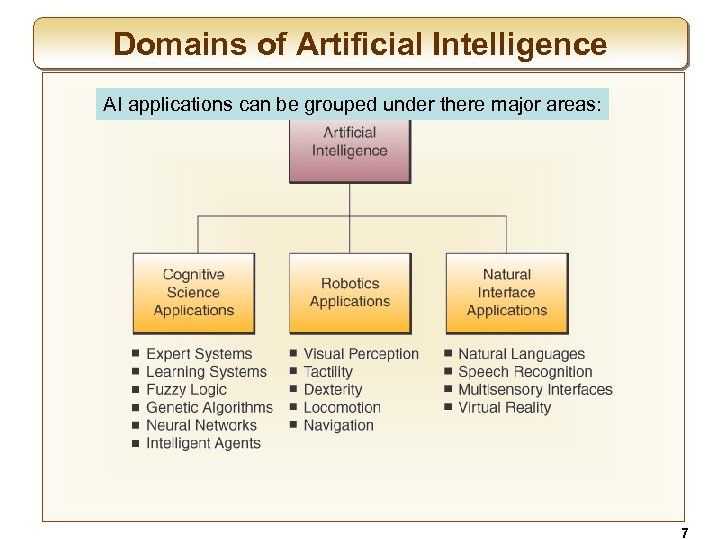 Domains of Artificial Intelligence AI applications can be grouped under there major areas: 7
 Cognitive Science • It focuses on how the human brain works and how humans think and learn. • AI in this area is based on research in biology, neurology, physiology, mathematics and other disciplines. • Applications in the cognitive science of AI • • Expert systems Knowledge-based systems Adaptive learning systems Fuzzy logic systems Neural networks Genetic algorithm software Intelligent agents 8
 Robotics • AI, engineering, and physiology are the basic disciplines of robotics • Produces robot machines with computer intelligence and humanlike physical capabilities • This area include applications designed to give robots the powers of • • • Sight or visual perception Touch or tactile capabilities Dexterity, or skill in handling and manipulation Locomotion, or the physical ability to move Navigation, or the intelligence to properly find one’s way to a destination 9
 Natural Interfaces • Major parts in the area of AI and the development of natural interfaces • Natural languages • Speech recognition • Virtual reality – using multisensory human-computer interfaces that enable human users to experience computer -simulated objects, spaces, activities, and “worlds” as if they actually exists. • Involves research and development in • • Linguistics Psychology Computer science Other disciplines 10
 Latest Commercial Applications of AI • Decision Support • Rule based AI technologies for automatic approval of bank loans • Information Retrieval • Database mining for marketing trend analysis and financial forecasting • Virtual Reality • X-ray-like vision enabled by enhanced-reality visualization helps surgeons • Automated animation and sensory interfaces allow users to interact with virtual objects 11
 Expert Systems • An Expert System (ES) is • A knowledge-based information system • Contain knowledge about a specific, complex application area • Acts as an expert consultant to end users • Expert system provide answers to questions in a very specific problem area by making humanlike inferences about knowledge contained in a specialized knowledge base and explain the reasoning process and conclusions to the user. 12
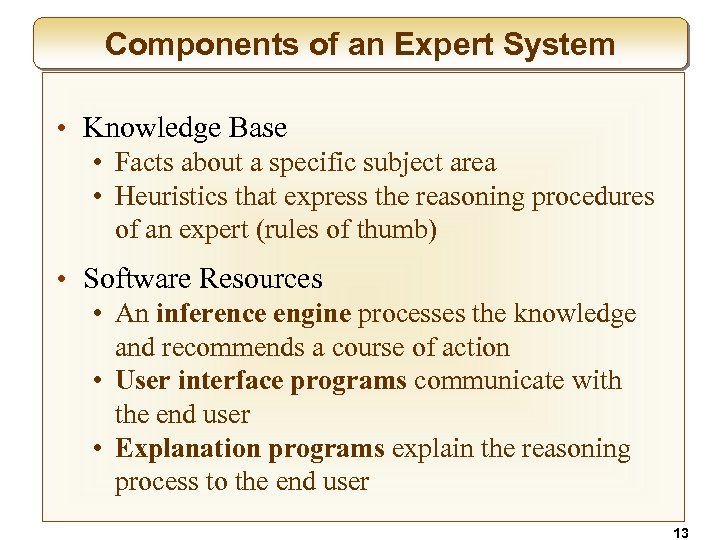 Components of an Expert System • Knowledge Base • Facts about a specific subject area • Heuristics that express the reasoning procedures of an expert (rules of thumb) • Software Resources • An inference engine processes the knowledge and recommends a course of action • User interface programs communicate with the end user • Explanation programs explain the reasoning process to the end user 13
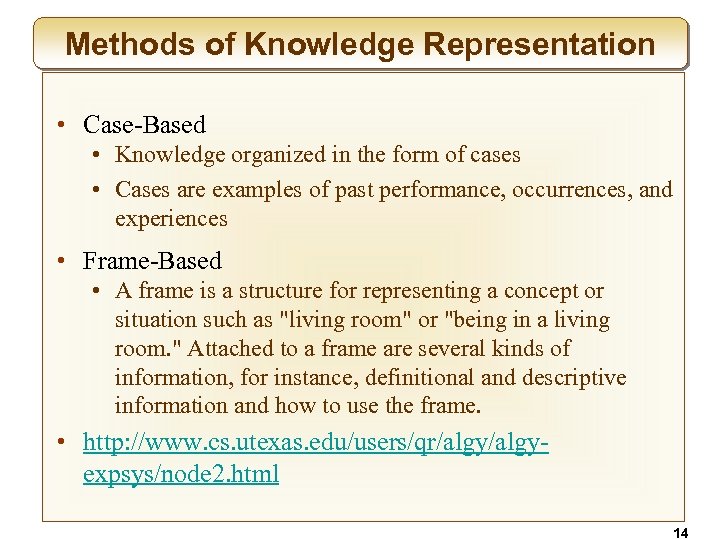 Methods of Knowledge Representation • Case-Based • Knowledge organized in the form of cases • Cases are examples of past performance, occurrences, and experiences • Frame-Based • A frame is a structure for representing a concept or situation such as "living room" or "being in a living room. " Attached to a frame are several kinds of information, for instance, definitional and descriptive information and how to use the frame. • http: //www. cs. utexas. edu/users/qr/algyexpsys/node 2. html 14
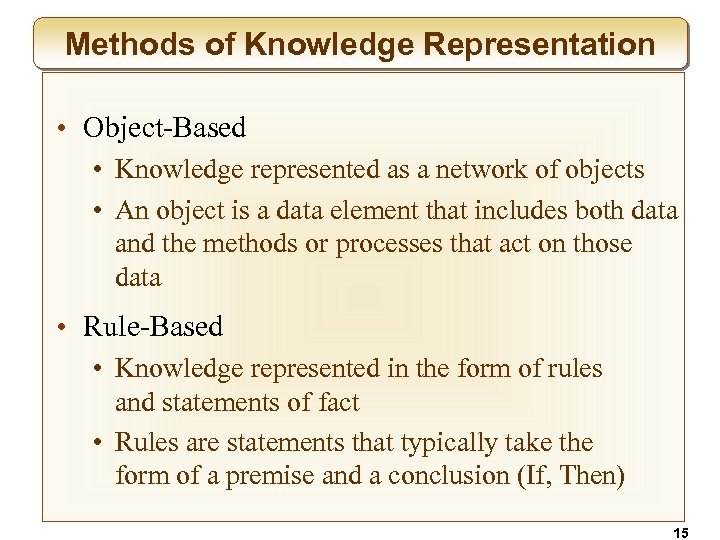 Methods of Knowledge Representation • Object-Based • Knowledge represented as a network of objects • An object is a data element that includes both data and the methods or processes that act on those data • Rule-Based • Knowledge represented in the form of rules and statements of fact • Rules are statements that typically take the form of a premise and a conclusion (If, Then) 15
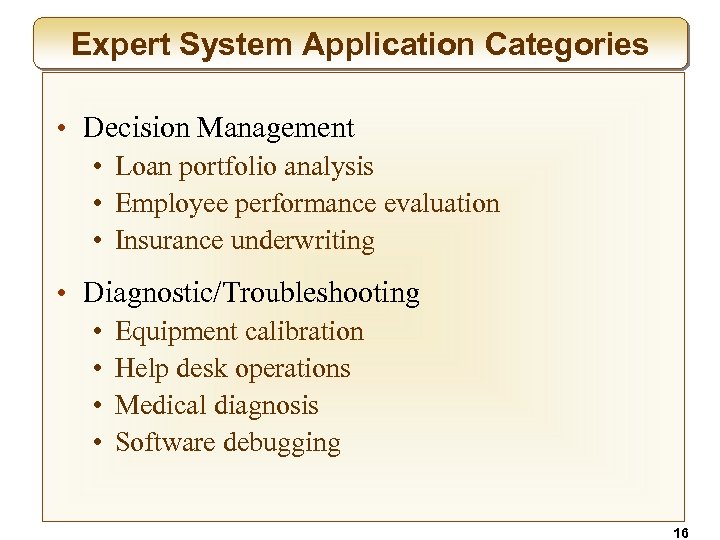 Expert System Application Categories • Decision Management • Loan portfolio analysis • Employee performance evaluation • Insurance underwriting • Diagnostic/Troubleshooting • • Equipment calibration Help desk operations Medical diagnosis Software debugging 16
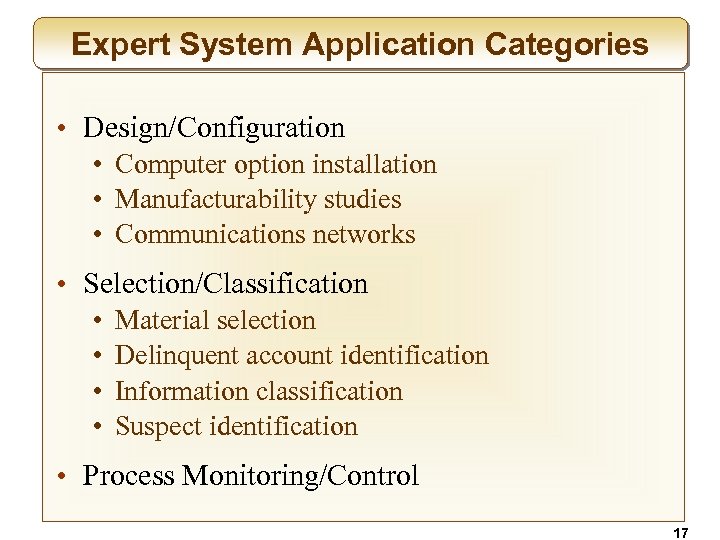 Expert System Application Categories • Design/Configuration • Computer option installation • Manufacturability studies • Communications networks • Selection/Classification • • Material selection Delinquent account identification Information classification Suspect identification • Process Monitoring/Control 17
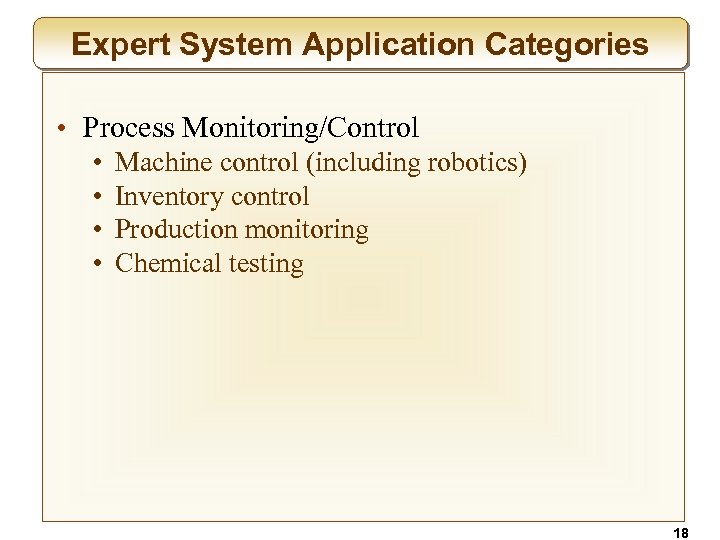 Expert System Application Categories • Process Monitoring/Control • • Machine control (including robotics) Inventory control Production monitoring Chemical testing 18
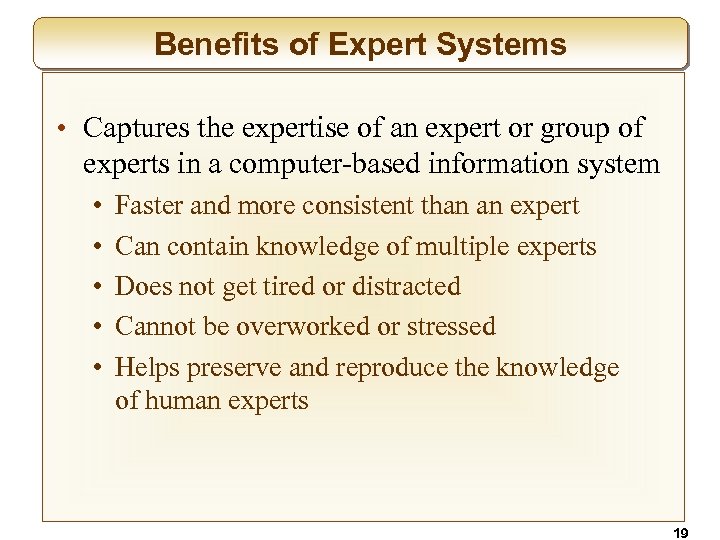 Benefits of Expert Systems • Captures the expertise of an expert or group of experts in a computer-based information system • • • Faster and more consistent than an expert Can contain knowledge of multiple experts Does not get tired or distracted Cannot be overworked or stressed Helps preserve and reproduce the knowledge of human experts 19
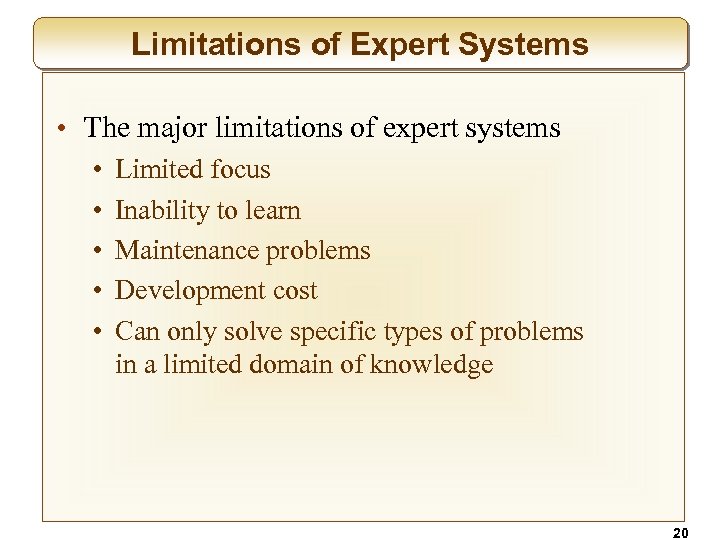 Limitations of Expert Systems • The major limitations of expert systems • • • Limited focus Inability to learn Maintenance problems Development cost Can only solve specific types of problems in a limited domain of knowledge 20
 Developing Expert Systems • Suitability Criteria for Expert Systems • Domain: the domain or subject area of the problem is small and well-defined • Expertise: a body of knowledge, techniques, and intuition is needed that only a few people possess • Complexity: solving the problem is a complex task that requires logical inference processing 21
 Developing Expert Systems • Suitability Criteria for Expert Systems • Structure: the solution process must be able to cope with ill-structured, uncertain, missing, and conflicting data and a changing problem situation • Availability: an expert exists who is articulate, cooperative, and supported by the management and end users involved in the development process 22
 Development Tool • Expert System Shell • The easiest way to develop an expert system • A software package consisting of an expert system without its knowledge base • Has an inference engine and user interface programs • Example: http: //www. lpa. co. uk/pws_exec/pws/proweb. exe ? eg=Expert+System+Shell 23
 Knowledge Engineering • A knowledge engineer • Works with experts to capture the knowledge (facts and rules of thumb) they possess • Builds the knowledge base, and if necessary, the rest of the expert system • Performs a role similar to that of systems analysts in conventional information systems development 24
 Neural Networks • Computing systems modeled after the brain’s mesh-like network of interconnected processing elements (neurons) • Interconnected processors operate in parallel and interact with each other • Allows the network to learn from the data it processes • A neural network is a powerful data modelling tool that is able to capture and represent complex input/output relationships. • The motivation for the development of neural network technology came from the desire to develop an artificial system that could perform "intelligent" tasks similar to those performed by the human brain. 25
 How does Neural network resemble the human brain? • Neural networks resemble the human brain in the following two ways: • A neural network acquires knowledge through learning. • A neural network's knowledge is stored within inter-neuron connection strengths known as synaptic weights. 26
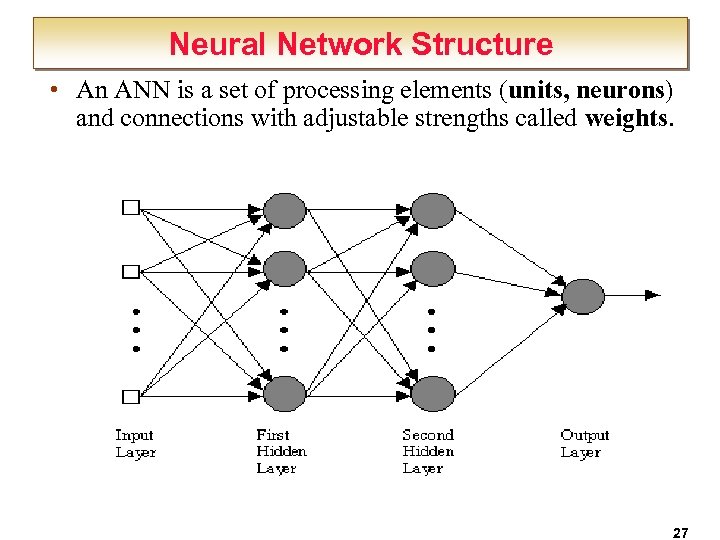 Neural Network Structure • An ANN is a set of processing elements (units, neurons) and connections with adjustable strengths called weights. 27
 How do ANNs work? • • Train the network • Present data to the network • Calculate the network output • Compare the network output with the desired output • Modify the weights to reduce the error using a training algorithm Use the network • Present new data to the network • Compute the output using the weights set during the training 28
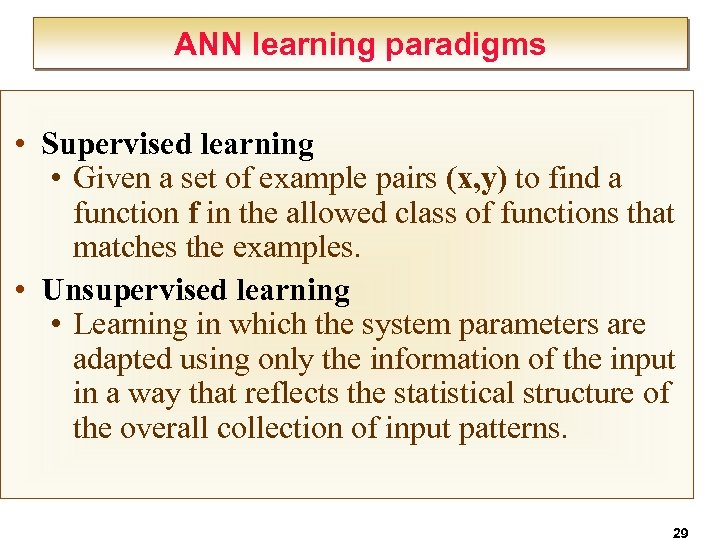 ANN learning paradigms • Supervised learning • Given a set of example pairs (x, y) to find a function f in the allowed class of functions that matches the examples. • Unsupervised learning • Learning in which the system parameters are adapted using only the information of the input in a way that reflects the statistical structure of the overall collection of input patterns. 29
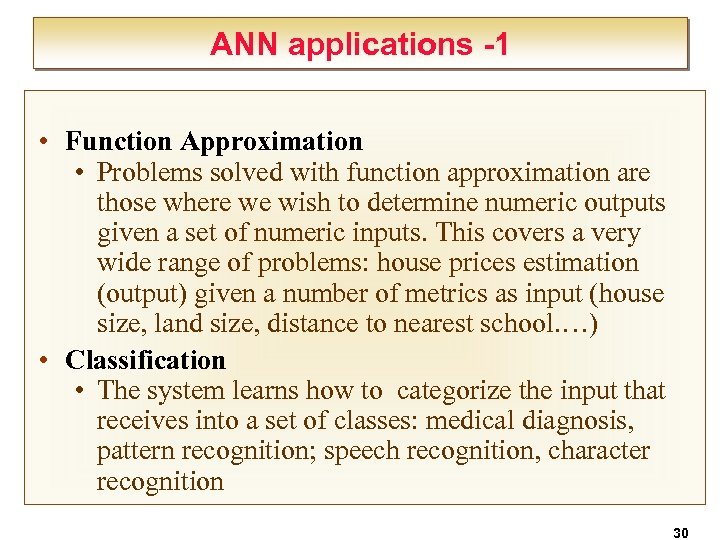 ANN applications -1 • Function Approximation • Problems solved with function approximation are those where we wish to determine numeric outputs given a set of numeric inputs. This covers a very wide range of problems: house prices estimation (output) given a number of metrics as input (house size, land size, distance to nearest school. …) • Classification • The system learns how to categorize the input that receives into a set of classes: medical diagnosis, pattern recognition; speech recognition, character recognition 30
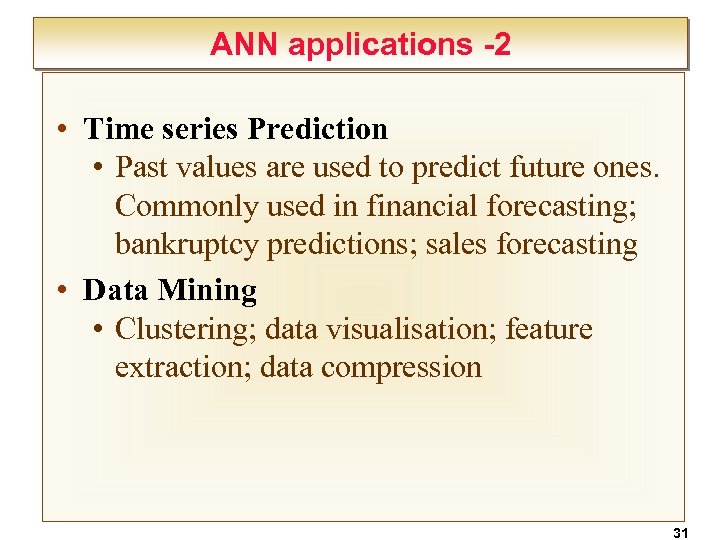 ANN applications -2 • Time series Prediction • Past values are used to predict future ones. Commonly used in financial forecasting; bankruptcy predictions; sales forecasting • Data Mining • Clustering; data visualisation; feature extraction; data compression 31
 Function Approximation – Age estimation Problem: To design neural network based models that accept low dimensional representation of unseen image and produce an estimate of the age of the person in the corresponding face image. Applications • Age specific human computer interaction • Age-based indexing of face images • Development of automatic age progression systems • Understanding the process of age perception by humans Face Image Face Parameters Age Estimate PCA 22 Model Face Parameters 32
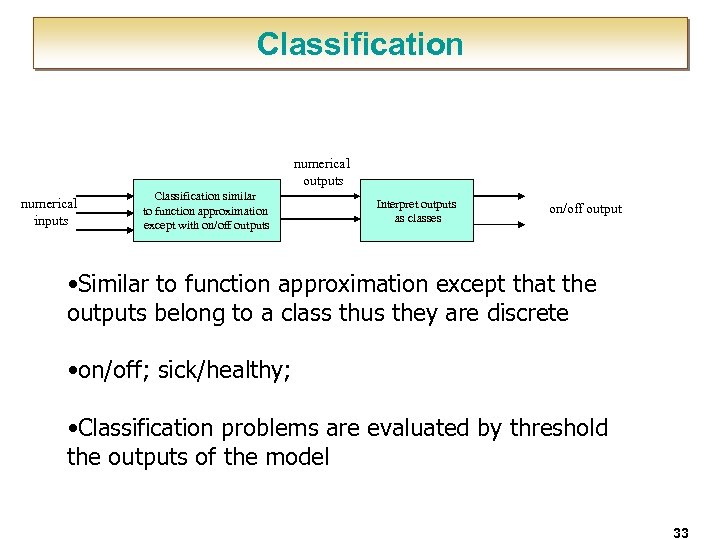 Classification numerical outputs numerical inputs Classification similar to function approximation except with on/off outputs Interpret outputs as classes on/off output • Similar to function approximation except that the outputs belong to a class thus they are discrete • on/off; sick/healthy; • Classification problems are evaluated by threshold the outputs of the model 33
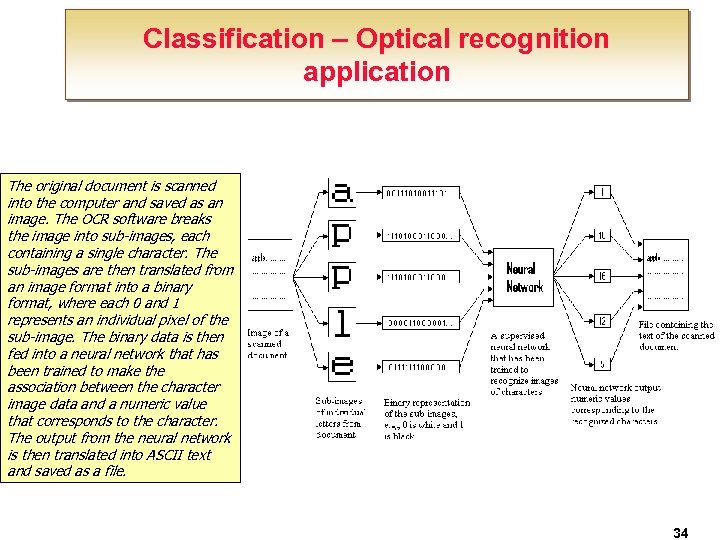 Classification – Optical recognition application The original document is scanned into the computer and saved as an image. The OCR software breaks the image into sub-images, each containing a single character. The sub-images are then translated from an image format into a binary format, where each 0 and 1 represents an individual pixel of the sub-image. The binary data is then fed into a neural network that has been trained to make the association between the character image data and a numeric value that corresponds to the character. The output from the neural network is then translated into ASCII text and saved as a file. 34
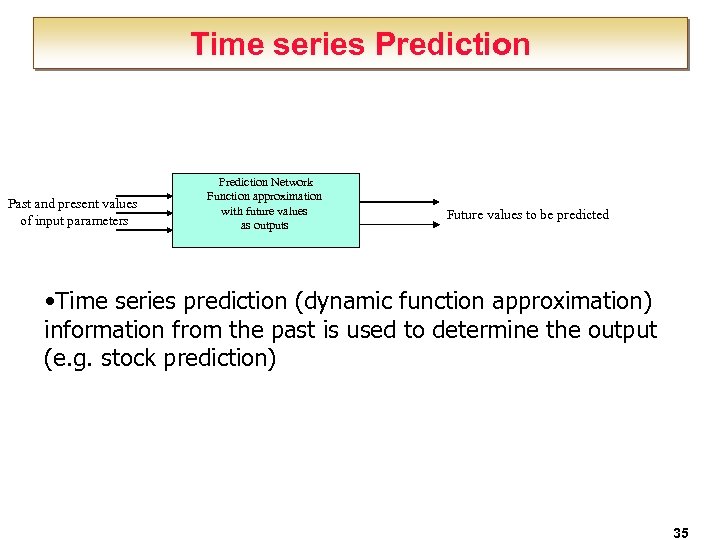 Time series Prediction Past and present values of input parameters Prediction Network Function approximation with future values as outputs Future values to be predicted • Time series prediction (dynamic function approximation) information from the past is used to determine the output (e. g. stock prediction) 35
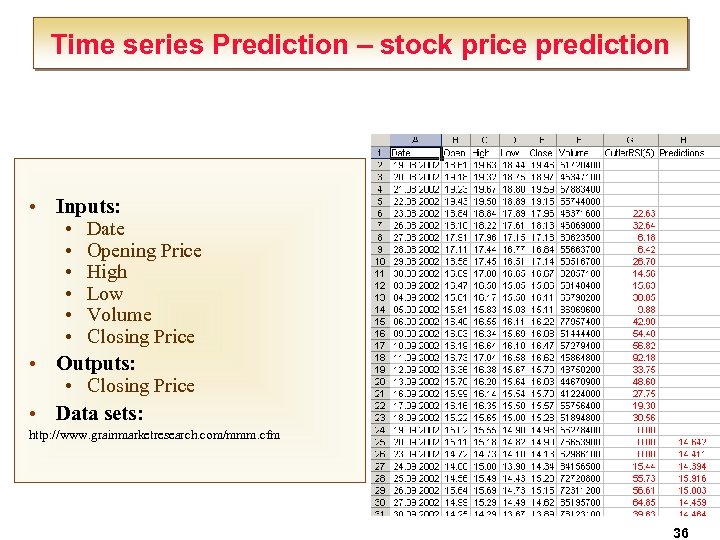 Time series Prediction – stock price prediction • Inputs: • Date • Opening Price • High • Low • Volume • Closing Price • Outputs: • Closing Price • Data sets: http: //www. grainmarketresearch. com/mmm. cfm 36
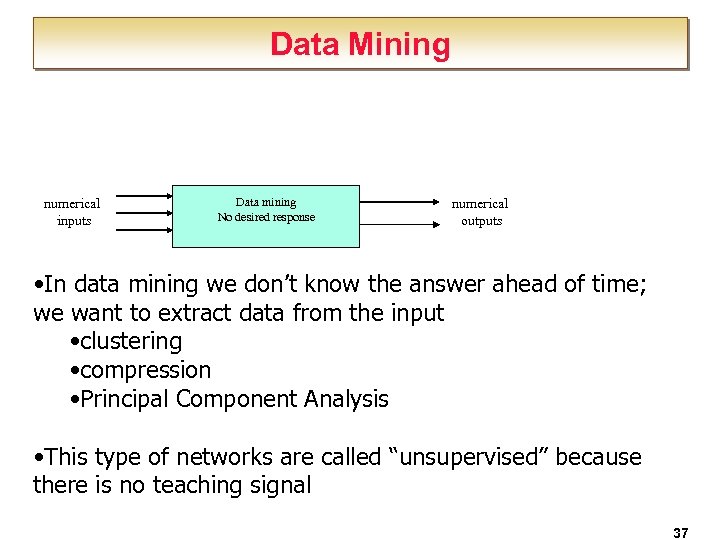 Data Mining numerical inputs Data mining No desired response numerical outputs • In data mining we don’t know the answer ahead of time; we want to extract data from the input • clustering • compression • Principal Component Analysis • This type of networks are called “unsupervised” because there is no teaching signal 37
 Data Mining - World Poverty Map • http: //www. cis. hut. fi/research/som-research/worldmap. html • The Self-Organizing Map algorithm (Kohonen: Self. Organizing Maps, Springer, 1997) is used to visualize and interpret large high-dimensional data sets • The data consisted of World Bank statistics of countries in 1992. 39 indicators describing various quality-of-life factors, such as state of health, nutrition, educational services, etc, were used. The complex joint effect of these factors can be visualized by organizing the countries using the selforganizing map • Countries that had similar values of the indicators found a place near each other on the map. The different clusters on the map were automatically encoded with different bright colors. 38
 More applications • Machine Diagnostics - Detect when a machine has failed so that the system can automatically shut down the machine when this occurs. • Portfolio Management - Allocate the assets in a portfolio in a way that maximizes return and minimizes risk. • Target Recognition - Military application which uses video and/or infrared image data to determine if an enemy target is present. • Medical Diagnosis - Assisting doctors with their diagnosis by analyzing the reported symptoms and/or image data such as MRIs or X-rays. 39
 More applications • Credit Rating - Automatically assigning a company's or individuals credit rating based on their financial condition. • Targeted Marketing - Finding the set of demographics which have the highest response rate for a particular marketing campaign. • Voice Recognition - Transcribing spoken words into ASCII text. • Quality Control - Attaching a camera or sensor to the end of a production process to automatically inspect for defects. • Intelligent Searching - An internet search engine that provides the most relevant content and banner ads based on the users' past behavior. • Fraud Detection - Detect fraudulent credit card transactions and automatically decline the charge. 40
 NN resources • Neural Nets: Dr K Gurney http: //www. shef. ac. uk/psychology/gurney/notes/contents. html • An Introduction to Neural Networks http: //www. cs. stir. ac. uk/~lss/NNIntro/Inv. Slides. html • http: //ieeexplore. ieee. org/xpl/Recent. Issue. jsp? punumber= 72 • Elsevier – Neural networks http: //www. sciencedirect. com/science/journal/08936080 41
 Intelligent Agents • A software surrogate for an end user or a process that fulfills a stated need or activity • Uses built-in and learned knowledge base to make decisions and accomplish tasks in a way that fulfills the intentions of a user • Also called software robots or bots • “An agent is anything that can be viewed as perceiving its environment through sensors and acting upon that environment through effectors, ” (from Russell and Norvig, Artificial Intelligence: a Modern Approach) 42
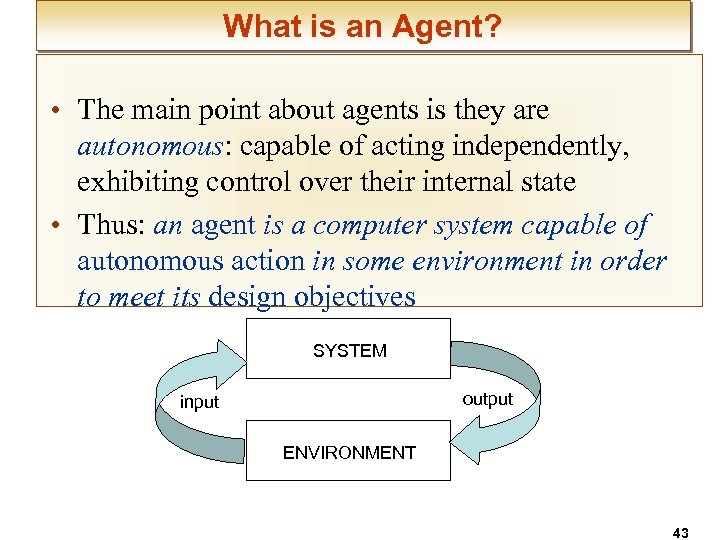 What is an Agent? • The main point about agents is they are autonomous: capable of acting independently, exhibiting control over their internal state • Thus: an agent is a computer system capable of autonomous action in some environment in order to meet its design objectives SYSTEM output input ENVIRONMENT 43
 Intelligent Agent • (from Woodridge and Jennings): • autonomy: agents operate without direct intervention of humans, and have control over their actions and internal state; • social ability: agents interact with other agents (and possibly humans) through negotiation and/or cooperation, to satisfy their deign objectives; • reactivity: agents perceive their environment and respond in a timely and rational fashion to changes that occur in it; In a changed environment, intelligent agents have to recognise opportunities and take the initiative if they are to produce meaningful results. • pro-activeness: agents do not simply act in response to their environment, they are capable of taking the initiative (generate their own goals and act to achieve them). 44
 Other Features of Intelligent Agents • An intelligent agent has mental properties, such as knowledge, belief, intention, obligation. In addition, and agent has other properties such as: • mobility: agents can move around from one machine to another and across different system architectures and platforms; • veracity: agents do not knowingly communicate false information; • benevolence: agents always try to do what they are asked of; • rationality: agents will try to achieve their goals and not act in such a way to prevent their goals from being achieved. • learning/adaptation: agent improve performance over time 45
 Application of Agent-based computing - I It can solve new problems. • Openness. When components of the system are not known in advance, change over time, and are highly heterogeneous (e. g. programming the Internet) an agentbased approach allows to create systems that are flexible, robust, and can adapt to the environment by using their social skills, ability to negotiate with other agents, and ability to take advantage of opportunities. • Complexity. With large and complex problems, agents offer a natural way to partition the problem into smaller and simpler components, that are easier to develop and maintain, and are specialized. 46
 Application of Agent-based computing - II • Natural Metaphor. Agents provide an easy way to conceptualize metaphors. For instance, an e-mail filtering program can be presented using the metaphor of a personal digital assistant. This could also cause problems if the reasoning done by the agent is a black box to the user. • Legacy systems. Modifying existing software to keep pace with changing needs is often impossible. Legacy software can be incorporated into agentbased software by building an “agent wrapper” around it, to allow it to cooperate and communicate with other agent-based software. • http: //agents. umbc. edu/introduction/jennings 98. p df 47
 User Interface Agents • Interface Tutors – observe user computer operations, correct user mistakes, provide hints/advice on efficient software use • Presentation Agents – show information in a variety of forms/media based on user preferences • Network Navigation Agents – discover paths to information, provide ways to view it based on user preferences • Role-Playing – play what-if games and other roles to help users understand information and make better decisions 48
 Information Management Agents • Search Agents – help users find files and databases, search for information, and suggest and find new types of information products, media, resources • Information Brokers – provide commercial services to discover and develop information resources that fit business or personal needs • Information Filters – Receive, find, filter, discard, save, forward, and notify users about products received or desired, including e-mail, voice mail, and other information media 49
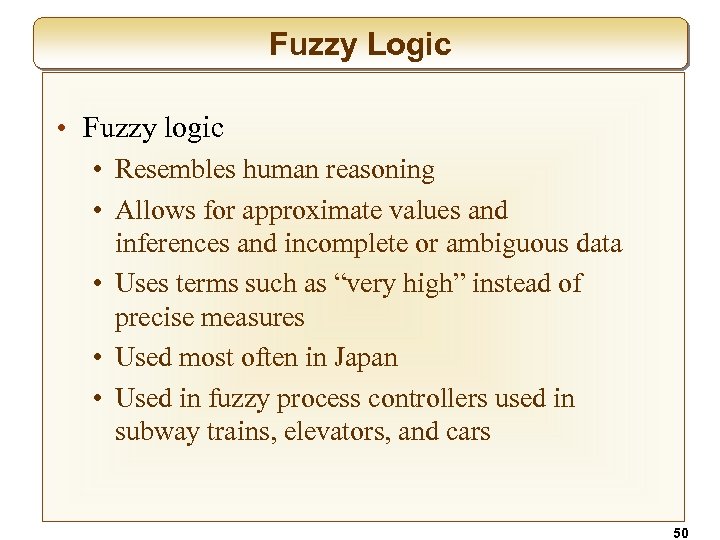 Fuzzy Logic • Fuzzy logic • Resembles human reasoning • Allows for approximate values and inferences and incomplete or ambiguous data • Uses terms such as “very high” instead of precise measures • Used most often in Japan • Used in fuzzy process controllers used in subway trains, elevators, and cars 50
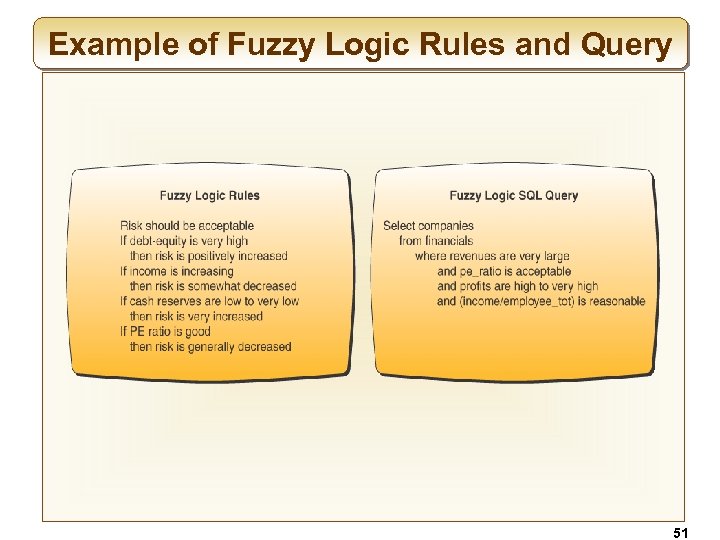 Example of Fuzzy Logic Rules and Query 51
 Genetic Algorithms • Genetic algorithm software • Uses Darwinian (survival of the fittest), randomizing, and other mathematical functions to simulate an evolutionary process, yielding increasingly better solutions to a problem • Being uses to model a variety of scientific, technical, and business processes • Especially useful for situations in which thousands of solutions are possible and must be evaluated to produce an optimal solution. • GA Tutorial: http: //cs. felk. cvut. cz/~xobitko/ga/ 52
 Virtual Reality (VR) • Virtual reality is a computer-simulated reality • Fast-growing area of artificial intelligence • Originated from efforts to build natural, realistic, multi-sensory human-computer interfaces • Relies on multi-sensory input/output devices • Creates a three-dimensional world through sight, sound, and touch • Also called telepresence 53
 Typical VR Applications • Current applications of virtual reality • Computer-aided design • Medical diagnostics and treatment • Scientific experimentation • Flight simulation • Product demonstrations • Employee training • Entertainment Science News http: //www. sciencedaily. com/releases/2008/03/080 330225933. htm 54
 Summary • Neural networks • Fuzzy logic • Genetic algorithms • Virtual reality • Intelligent agents 55